Our readers keep the lights on and my smoothie glass nicely filled. As an Amazon Associate, I earn from qualifying purchases.
A flooded basement from a failed sump pump during a storm is a nightmare that every homeowner dreads. The line of defense between dry storage and thousands in water damage rests on one component: the battery that powers your backup system when the grid goes dark. Choosing the wrong chemistry or capacity can leave you stranded with a useless pile of plastic just when you need it most.
I’m Mohammad Maruf — the founder and writer behind WellFizz. Over years of analyzing battery technology for backup power systems, I’ve compared the cycle life, discharge rates, and real-world compatibility of dozens of sealed lead-acid and lithium iron phosphate models designed for sump pump applications.
This guide cuts through the marketing noise to deliver a focused, spec-driven analysis of the top contenders, helping you secure the best battery for sump pump backup that matches your pump system, budget, and peace of mind.
How To Choose The Best Battery For Sump Pump Backup
Selecting a standby battery for your sump pump isn’t like picking a car battery. Your choice directly dictates how many hours of pumping you get during a blackout. Focus on three pillars: chemistry, capacity, and compatibility with your inverter or backup controller.
Battery Chemistry: AGM vs. LiFePO4
Sealed AGM (Absorbent Glass Mat) lead-acid batteries are the traditional standby choice. They are maintenance-free, spill-proof, and cost-effective upfront. Most dedicated sump pump backup systems from Wayne and Basement Watchdog are designed around 12V AGM deep-cycle batteries. LiFePO4 (lithium iron phosphate) units are significantly lighter (one-third the weight of an equivalent AGM), offer 5000+ deep discharge cycles, and hold voltage higher under load, which is critical for running pumps longer. However, not all backup controllers have the correct charge profile for lithium chemistry, so confirm compatibility before switching.
Amp-Hour Capacity: Matching Reserve Power to Pump Load
The runtime of a battery backup is directly proportional to its amp-hour (Ah) rating. A 35Ah AGM battery will run a 1/2 HP sump pump for a fraction of the time a 100Ah LiFePO4 unit can. As a rule of thumb, expect roughly 30-60 minutes of runtime per 10Ah of capacity on a standard 1/3 HP pump under moderate load. For real security, many homeowners target at least 75Ah to cover intermittent storm cycles. Lithium batteries, because they maintain higher voltage until nearly empty, often deliver more usable energy from the same Ah rating compared to lead-acid.
Quick Comparison
On smaller screens, swipe sideways to see the full table.
| Model | Category | Best For | Key Spec | Amazon |
|---|---|---|---|---|
| DJLBERMPW 100Ah LiFePO4 | LiFePO4 | Long runtime & lightweight | 100Ah, 10-Year Lifespan | Amazon |
| Basement Watchdog BW-27AGM | AGM | Recommended for Basement Watchdog systems | 40+ Hour Backup (10% Duty) | Amazon |
| PumpSpy 2000W System | Inverter System | Universal backup with inverter | 2000W Pure Sine Wave | Amazon |
| Wayne WSB1275 75Ah | AGM | Direct fit for Wayne systems | 75Ah, Sealed Lead Acid | Amazon |
| Mighty Max ML75-12 | AGM | Budget-friendly 75Ah replacement | 75Ah, 50 lbs | Amazon |
| Newport 12V50Ah | AGM | Entry-level mid-range backup | 50Ah, 32 lbs | Amazon |
| Goldenmate 20Ah LiFePO4 (2-Pack) | LiFePO4 | Compact parallel setup | 20Ah each, 5000+ Cycles | Amazon |
| Interstate Batteries 35Ah | AGM | Budget entry point | 35Ah, 22.1 lbs | Amazon |
In‑Depth Reviews
1. DJLBERMPW 12V 100Ah LiFePO4 Battery

This 100Ah lithium iron phosphate unit redefines what a backup battery can do for a sump pump. Weighing just 23 pounds, it is two-thirds lighter than a comparable AGM battery, making it manageable to move in an emergency. The built-in 100A BMS manages low-temperature cutoff, overcharge, and short-circuit protection, which is crucial for a device that sits on standby in a potentially damp basement.
Users report running a trolling motor for five hours and still seeing a full charge, which translates to significant pump runtime during a storm. The ability to connect up to four of these batteries in series or parallel allows for capacity expansion from 100Ah up to 400Ah, providing multi-day coverage for high-water scenarios. The unit’s 10-year lifespan and 15,000-cycle rating at 60% depth of discharge mean you can install it and forget about replacements for a decade.
The primary consideration here is compatibility: you must have a backup controller that supports LiFePO4 charging profiles. Pairing this with a standard lead-acid charger will not work. If your system is compatible, the combination of lightweight design, massive capacity, and long cycle life makes this the gold standard for serious home protection.
Why it’s great
- Exceptional 100Ah capacity for extended pump runtime during outages.
- Weighs only 23 lbs — easy to handle and install.
- Supports up to 15,000 deep discharge cycles for long-term value.
Good to know
- Requires a compatible LiFePO4 inverter or charger to function properly.
- Higher initial investment than lead-acid alternatives.
2. Basement Watchdog BW-27AGM Standby Battery

If you own a Basement Watchdog backup sump pump system, this AGM battery is the recommended drop-in match. The BW-27AGM is a maintenance-free sealed lead-acid battery specifically designed to work with controllers like the Big Dog (BWD12-120C+) and the Special Plus (BWSP+). There is no need to add water or check acid levels, which simplifies installation in tight sump pits.
Basement Watchdog rates this unit for up to 40 hours of intermittent protection on the Big Dog system and up to 80 hours on the Emergency model, assuming a 10% duty cycle. Real-world feedback confirms it keeps basements dry through extended storms, with multiple users reporting five-plus years of service. The battery’s AGM construction means it is spill-proof and can be mounted in any orientation, a key feature for confined spaces.
Before purchasing, ensure your controller is compatible with AGM batteries. Older systems manufactured before 2014 may trigger false alarms. The weight is a consideration at nearly 50 pounds, but the performance and straightforward integration with the Basement Watchdog ecosystem make it a top pick for owners of that brand.
Why it’s great
- Designed specifically for Basement Watchdog backup systems.
- Maintenance-free AGM construction eliminates fluid checks.
- Provides up to 80 hours of backup on compatible Emergency models.
Good to know
- Not suitable for older pre-2014 Basement Watchdog controllers without checking compatibility.
- Heavier than equivalent LiFePO4 options.
3. PumpSpy 2000W Sump Pump Battery Backup System

The PumpSpy 2000W is not just a battery but a complete inverter-based backup system. It converts 12V DC power from a deep-cycle battery (sold separately) into a pure sine wave 120V AC output, which is essential for sensitive pump electronics. The unit generates a stable waveform and can power two primary sump pumps simultaneously, provided the combined draw stays under 16.6 amps.
One standout feature is the intelligent cooling system that extends the inverter’s life during prolonged use. Users appreciate the digital display that shows battery charge status and the two grounded outlets plus a USB port for charging devices. The system automatically switches to battery power when AC fails and trickle-charges the battery when grid power returns, maintaining readiness without user intervention.
Installation requires a separate 12V deep-cycle battery and some wiring. Some users noted the included battery cables are short, requiring careful placement or longer cables for large setups. If you require a universal backup solution that works with any 12V battery and can double as a portable power inverter, this system delivers reliable performance.
Why it’s great
- Generates clean pure sine wave power, safe for pump electronics.
- Can power two sump pumps simultaneously during an outage.
- Automatic transfer switch and intelligent cooling for extended use.
Good to know
- Requires purchasing a separate 12V deep-cycle battery.
- Included battery cables may be too short for some configurations.
4. Wayne WSB1275 75Ah Maintenance-Free Battery
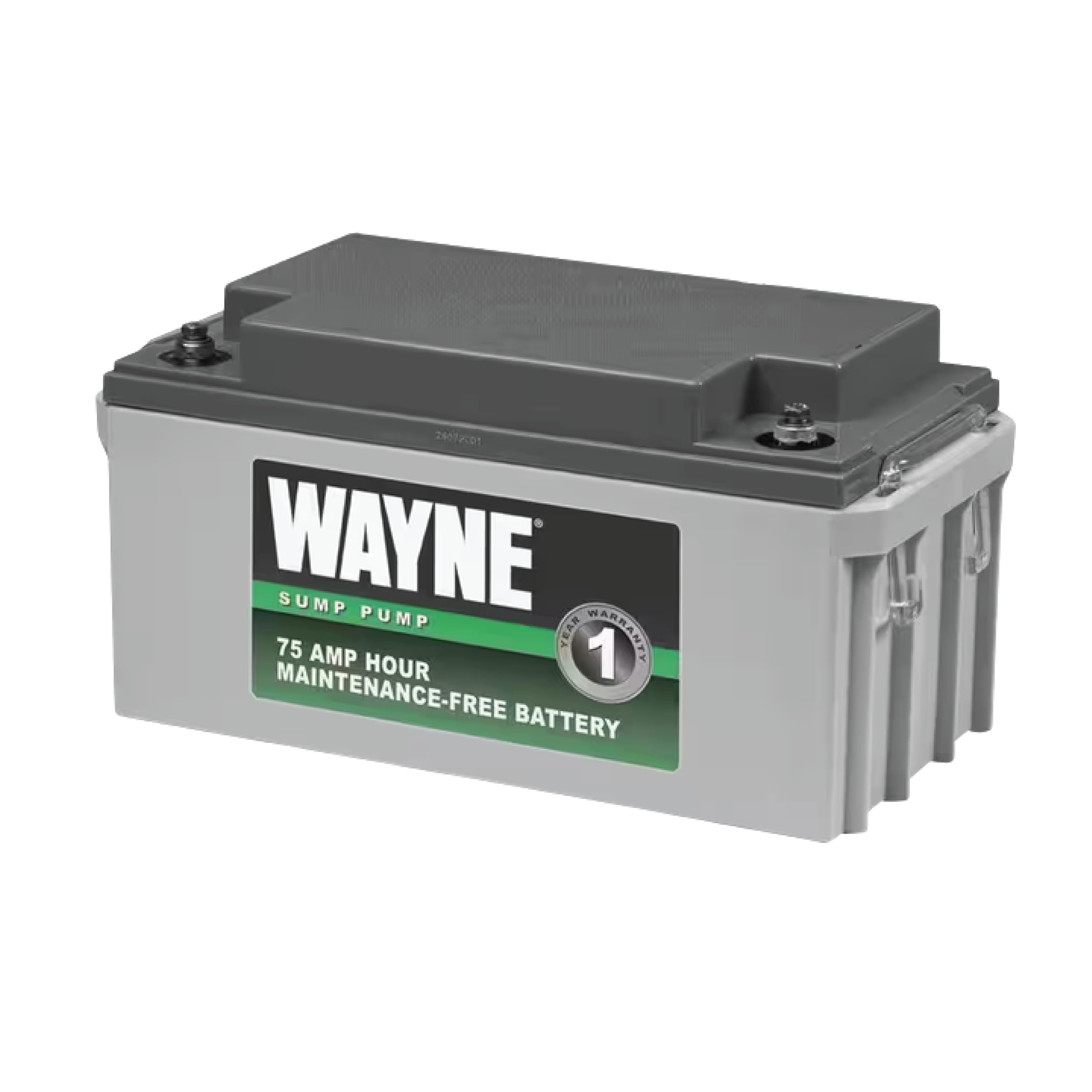
Wayne’s WSB1275 is the factory-recommended battery for the popular ESP25 and WSS30V backup systems, and it fits all Wayne Basement Guardian units. It arrives fully charged from the factory, with convenient carry handles that make installation straightforward. Users consistently report five-year lifespans, with one reviewer noting the battery powered their WSS30Vn backup through several pump cycles out of the box.
The 75Ah capacity provides a solid balance of runtime and physical size. The sealed lead-acid construction means no acid mixing or water top-ups are required, just periodic charging. The AGM technology ensures it can handle the deep discharge cycles typical of sump pump use without damage. For Wayne pump owners, this is essentially a turnkey solution that eliminates compatibility worries.
Some users consider the price high relative to generic alternatives of similar capacity. However, the consistent five-year service life reported by multiple owners suggests the longevity justifies the cost. If you need a direct replacement for a Wayne system and prefer a brand-matching battery, this is a reliable choice.
Why it’s great
- Perfect drop-in fit for Wayne ESP25 and WSS30V backup systems.
- Arrives fully charged and ready to install.
- Reported five-year lifespan by multiple long-term users.
Good to know
- Premium pricing compared to generic 75Ah AGM batteries.
- One review noted failure after 1.5 years, though rare.
5. Mighty Max Battery 12V 75Ah for Wayne ESP25

The Mighty Max ML75-12 is an alternative to the Wayne-branded battery, offering the same 75Ah SLA/AGM chemistry at a more accessible price point. It is UL certified and designed as a direct replacement for the Wayne ESP25 and similar systems. Users report a straightforward installation process, with one reviewer stating the battery dropped into their Wayne battery box perfectly and worked on the first test.
One user shared that their previous Mighty Max battery lasted a full five years, which matches the longevity of the premium options. The AGM, VRLA design means it is maintenance-free and spill-proof. At 50 pounds, it is heavy, but this is typical for a 75Ah lead-acid battery. The included terminal screws make connections simple, though no wire harness is provided.
This battery strikes a strong balance between capacity, price, and reliability. If you are on a budget but still want a 75Ah battery that works with standard sump pump backup controllers, the Mighty Max delivers without the brand premium. Just ensure your system can accommodate the group 24 size dimensions.
Why it’s great
- Same 75Ah capacity as premium alternatives at a lower cost.
- UL certified and compatible with Wayne ESP25 systems.
- Reported five-year lifespan from a long-term user.
Good to know
- Heavy at 50 lbs; may be difficult to maneuver into place.
- Does not include wire harness or mounting accessories.
6. Newport 12V50Ah Deep Cycle AGM Marine Battery
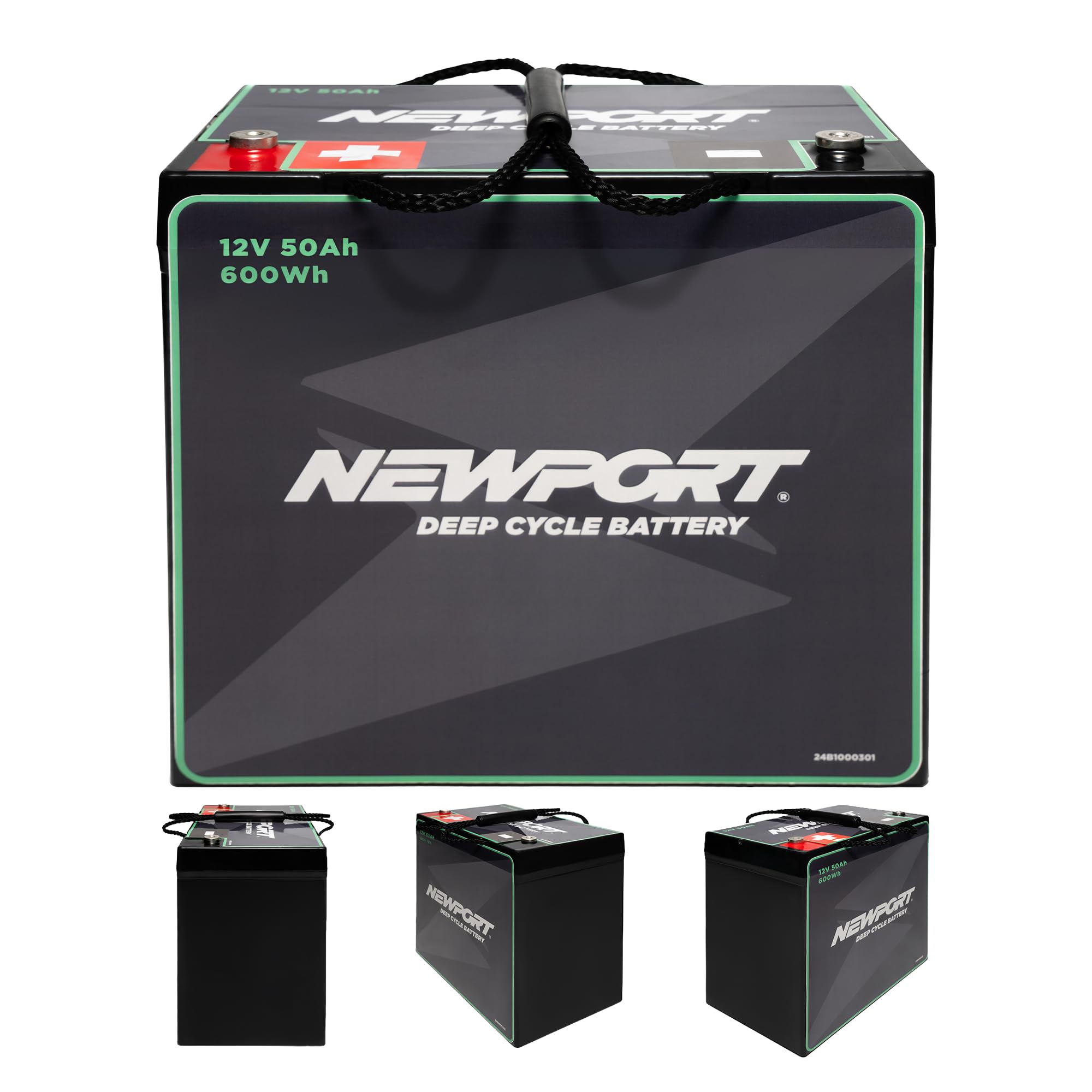
Newport’s 50Ah AGM battery is a versatile option that works for sump pump backup despite being marketed as a marine battery. At 32 pounds, it is significantly lighter than 75Ah units, making it easier to carry down basement steps. One reviewer explicitly states they use it as a backup for their sump pump after a previous battery failure flooded their basement.
The AGM construction is completely sealed and leak-proof, which is essential for indoor installation. The battery provides 50Ah of deep-cycle capacity, enough for several hours of intermittent pump operation. The marine terminal design allows for secure cable connections, and the battery holds steady voltage under load, as confirmed by users running 55lb trolling motors for more than four hours.
The main limitation is the 50Ah capacity, which provides less runtime than larger options. If your sump pump draws significant current or you face extended outages, you may need more capacity. However, for moderate storms or as a secondary backup, this battery offers a good balance of weight, price, and performance.
Why it’s great
- Lightweight design at 32 lbs for easier handling.
- Sealed and leak-proof AGM construction for indoor safety.
- Solid 50Ah capacity for mid-range backup needs.
Good to know
- Does not include a built-in charge indicator.
- 50Ah capacity may be insufficient for extended outages.
7. Goldenmate 12V 20Ah LiFePO4 Battery (2-Pack)

Goldenmate’s two-pack of 20Ah LiFePO4 batteries is a compact solution for sump pump backup when space is tight. Each battery weighs only 5.3 pounds, allowing for easy placement on shelves or in small cabinets. The 20Ah capacity per unit is modest, but you can wire them in parallel to achieve a combined 40Ah, which is enough for a backup pump running intermittently for several hours.
The built-in BMS provides protection against overcharging, over-discharging, and overheating, which is critical for a battery that may sit unused for months. The LiFePO4 chemistry delivers 5000+ cycles at 100% depth of discharge, vastly outlasting SLA batteries. One reviewer used a single 10Ah LiFePO4 to replace a 9Ah SLA in a UPS and saw runtime increase from 396 to 420 minutes due to the stable voltage profile of lithium.
This pack is best suited for low-power sump pumps or as an additional capacity boost for an existing backup system. It is not a substitute for a large 75Ah or 100Ah battery if you have a powerful pump. Ensure your inverter or charger supports the LiFePO4 charge profile before purchasing.
Why it’s great
- Ultra-lightweight at 5.3 lbs each for easy transport.
- 5000+ cycles offer exceptional longevity over lead-acid.
- Compact size fits in tight basement spaces.
Good to know
- 20Ah per battery provides limited runtime for larger pumps.
- Requires a compatible LiFePO4 charger or inverter.
8. Interstate Batteries 12V 35Ah SLA AGM Battery

Interstate Batteries brings its trusted brand name to the 35Ah SLA AGM segment. This battery is often used in UPS systems and emergency lighting, but its 12V output and AGM construction make it viable for smaller sump pump backup applications. The flag terminal design is common and compatible with many backup controllers. At 22.1 pounds, it is the lightest lead-acid option on this list.
The battery is maintenance-free and spill-proof, thanks to AGM and VRLA technology. Interstate backs it with a 12-month warranty and promotes its battery recycling program. Some users report success using it in their lawn mowers and mobility scooters, confirming its deep-cycle capabilities. One reviewer used it as a replacement for their Wayne backup sump pump battery.
The 35Ah capacity is the main limitation. It will provide the shortest runtime of any battery on this list, likely under an hour of continuous pump operation. It is best suited for infrequent, short-duration outages or as a budget-friendly starter battery. If you have a high-capacity sump pump or live in a flood-prone area, consider a larger unit.
Why it’s great
- Trusted Interstate brand with 12-month warranty.
- Lightweight at 22.1 lbs for easy handling.
- Maintenance-free AGM construction.
Good to know
- 35Ah capacity offers limited backup runtime.
- One review reported failure within six months.
FAQ
Can I use a car battery for my sump pump backup?
How do I know what amp-hour capacity I need?
Will a LiFePO4 battery work with my existing backup controller?
How often should I test my sump pump backup battery?
Final Thoughts: The Verdict
For most users, the best battery for sump pump backup winner is the DJLBERMPW 100Ah LiFePO4 because it provides massive 100Ah capacity in a lightweight package with a 10-year lifespan. If you need a direct replacement for Wayne pump systems, grab the Wayne WSB1275 for worry-free compatibility. And for a complete inverter-based solution that works with any 12V battery, nothing beats the PumpSpy 2000W System.

Mo Maruf
I created WellFizz to bridge the gap between vague wellness advice and actionable solutions. My mission is simple: to decode the research and give you practical tools you can actually use.
Beyond the data, I am a passionate traveler. I believe that stepping away from the screen to explore new environments is essential for mental clarity and physical vitality.