Our readers keep the lights on and my smoothie glass nicely filled. As an Amazon Associate, I earn from qualifying purchases.
Matching a battery to a small solar system is less about picking the biggest number and more about understanding how your panels, inverter, and daily loads actually interact. A mismatch in chemistry, cycle life, or usable capacity can turn a well-planned setup into a frustrating string of blackouts and early replacements.
I’m Mohammad Maruf — the founder and writer behind WellFizz. I’ve spent years analyzing battery chemistries, BMS designs, and real-world user reports to separate marketing claims from genuine performance in the residential and portable solar space.
Whether you are wiring a cabin, a van, or an emergency backup station, finding the right battery for small solar system means weighing chemistry, cycle count, depth of discharge, and built-in safety features against your actual energy budget.
How To Choose The Best Battery For Small Solar System
A small solar system battery must balance three competing priorities: enough usable capacity to cover your nightly loads, a chemistry that can handle frequent cycling without degrading quickly, and a physical form factor that fits your space constraints. Beginners often focus on the biggest amp-hour number they can afford, but usable energy, cycle life, and discharge safety matter more than raw capacity.
Chemistry: LiFePO4 vs. Lead-Acid vs. AGM
Lithium iron phosphate (LiFePO4) dominates modern small solar systems because it delivers 80% to 100% depth of discharge without damage, offers 3,000 to 15,000 cycles, and is roughly half the weight of an equivalent lead-acid battery. AGM and flooded lead-acid batteries are cheaper upfront but degrade below 50% DoD, require maintenance (flooded), and typically last only 300 to 700 cycles. For any system you plan to use weekly, the longer lifespan of LiFePO4 makes it the more economical choice over a few years.
Capacity Matching: Amp-Hours and Watt-Hours
Calculate your daily load in watt-hours, then multiply by 1.3 to account for inverter losses and reserve energy. A 12V battery rated at 100Ah holds 1,280Wh of usable energy (with LiFePO4); a 300W load would drain that in about four hours. For small solar systems, 100Ah to 200Ah is a common sweet spot for running a laptop, lights, a CPAP machine, and a mini fridge overnight. Oversizing by 20% gives you buffer during cloudy days.
BMS: The Untold Safety Layer
A quality Battery Management System monitors cell voltage, temperature, and current — cutting power automatically during over-discharge, over-charge, short circuit, or extreme cold. Low-temperature protection is critical if your battery lives in an unheated garage or vehicle during winter. Batteries without a proper BMS risk cell damage or even thermal runaway, especially when connected in series or parallel.
Cycle Life and Depth of Discharge
Manufacturers list cycle life at a specific DoD — often 80% or 100%. A battery rated for 4,000 cycles at 80% DoD will degrade to 80% of its original capacity after 4,000 deep cycles. If you cycle it only 50% per day, it can last significantly longer. For a small system used daily, aim for at least 3,000 cycles at 80% DoD to get 8 to 10 years of service.
Quick Comparison
On smaller screens, swipe sideways to see the full table.
| Model | Category | Best For | Key Spec | Amazon |
|---|---|---|---|---|
| LiTime 12V 100Ah Group 24 | LiFePO4 | Smart monitoring & all-weather use | 4000+ cycles, Bluetooth, IP65 | Amazon |
| ECO-WORTHY 12V 280Ah Metal Case | LiFePO4 | Vibration resistance & fire safety | 280Ah, metal enclosure, 200A BMS | Amazon |
| HumsiENK 12V 320Ah | LiFePO4 | High capacity & fast recharge | 320Ah, 250A BMS, 1C charge rate | Amazon |
| OKMO 12V 400Ah | LiFePO4 | Maximum energy storage in one unit | 400Ah, 5120Wh, 150A BMS | Amazon |
| FLLYROWER 12V 100Ah | LiFePO4 | Budget-friendly expandable starter | 100Ah, 16500 cycles max, BMS | Amazon |
| Dumfume 12V 150Ah | LiFePO4 | Mid-capacity value with expansion | 150Ah, 1920Wh, 100A BMS | Amazon |
| Arkpax Core 300W Power Station | Portable LiFePO4 | All-in-one portable emergency power | 192Wh, 300W AC, 10ms UPS | Amazon |
| DaranEner NEOZ 192Wh | Portable LiFePO4 | Ultra-light portable backup | 192Wh, 5.73 lbs, 60W USB-C | Amazon |
| WEIZE 12V 100Ah Deep Cycle | AGM Lead-Acid | Entry-level fixed installation backup | 100Ah, 1150A max discharge | Amazon |
In‑Depth Reviews
1. LiTime 12V 100Ah Group 24 LiFePO4 Battery
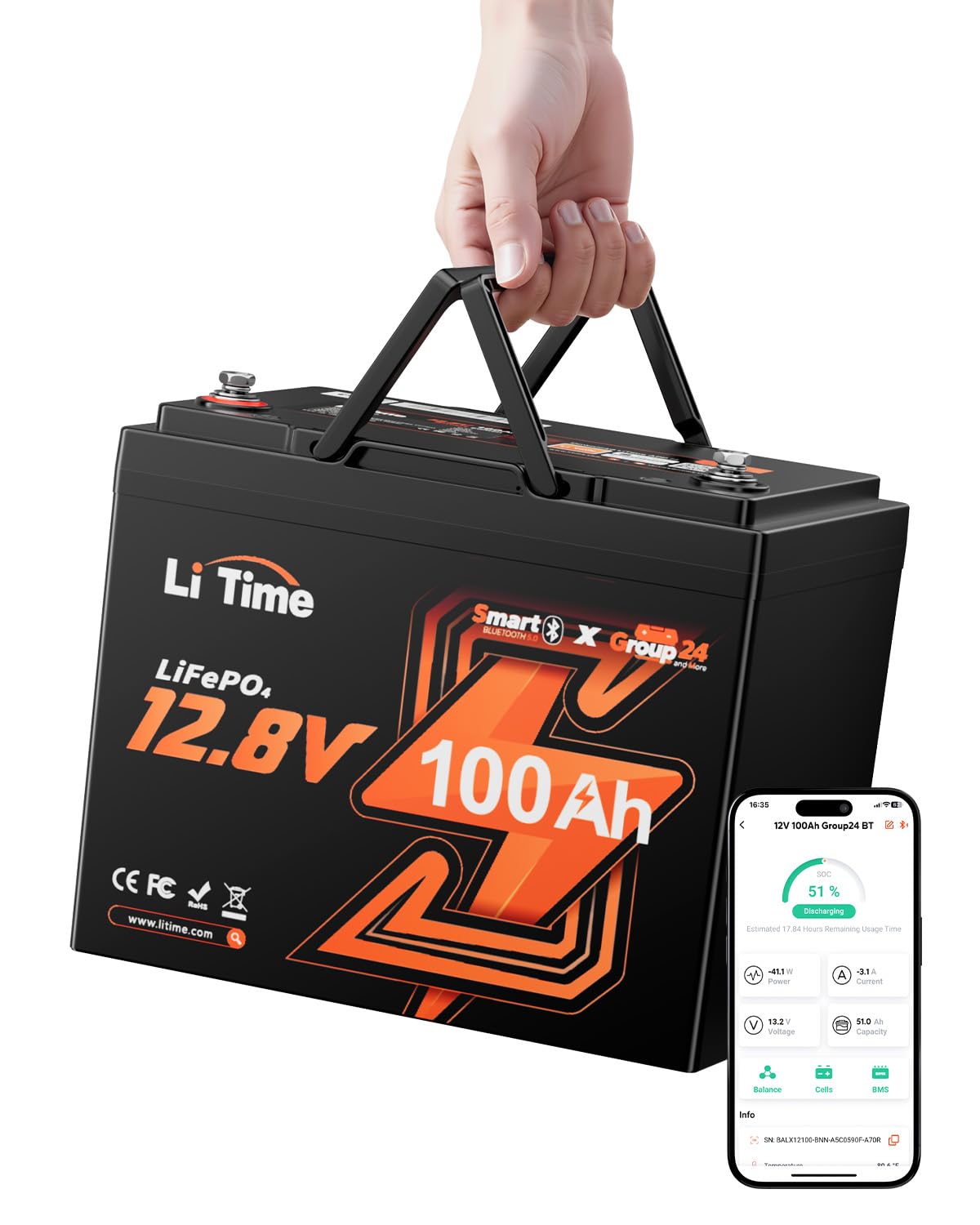
The LiTime Group 24 delivers a rare combination of smart features and rugged build quality for its class. The built-in Bluetooth 5.0 lets you monitor state of charge, voltage, and remaining capacity directly from the LiTime App — a feature usually reserved for much pricier units. At 1280Wh and 21.9 pounds, it sheds nearly two-thirds of the weight of a comparable lead-acid battery while offering double the usable energy thanks to full depth of discharge capability.
Automotive-grade LiFePO4 cells support over 4,000 deep cycles at 100% DoD, backed by a self-developed BMS with 20+ safety protections. The all-weather cold protection kicks in below 0°F for charging and -4°F for discharging, preserving cell health during winter camping or unheated storage. Its UL 1973 compliance and IP65 rating mean it can handle dust and water splashes in a boat hatch or camper compartment.
For a small solar system where you want remote visibility, reliable cold-weather performance, and the ability to expand up to 48V 400Ah in a 4P4S configuration, the LiTime Group 24 is the most balanced option available. The only real trade-off is the Group 24 form factor may not drop into every battery tray without a spacer.
Why it’s great
- Real-time Bluetooth monitoring with SOC and voltage data
- Ultra-light at 21.9 lbs with full 1280Wh usable energy
- IP65 rating and low-temperature charge cutoff for cold climates
- Expandable to 48V 400Ah for larger systems later
Good to know
- Group 24 footprint might not match larger Group 27/31 trays without adapters
- Bluetooth app is functional but basic compared to Victron ecosystem
2. ECO-WORTHY 12V 280Ah Metal Case LiFePO4 Battery
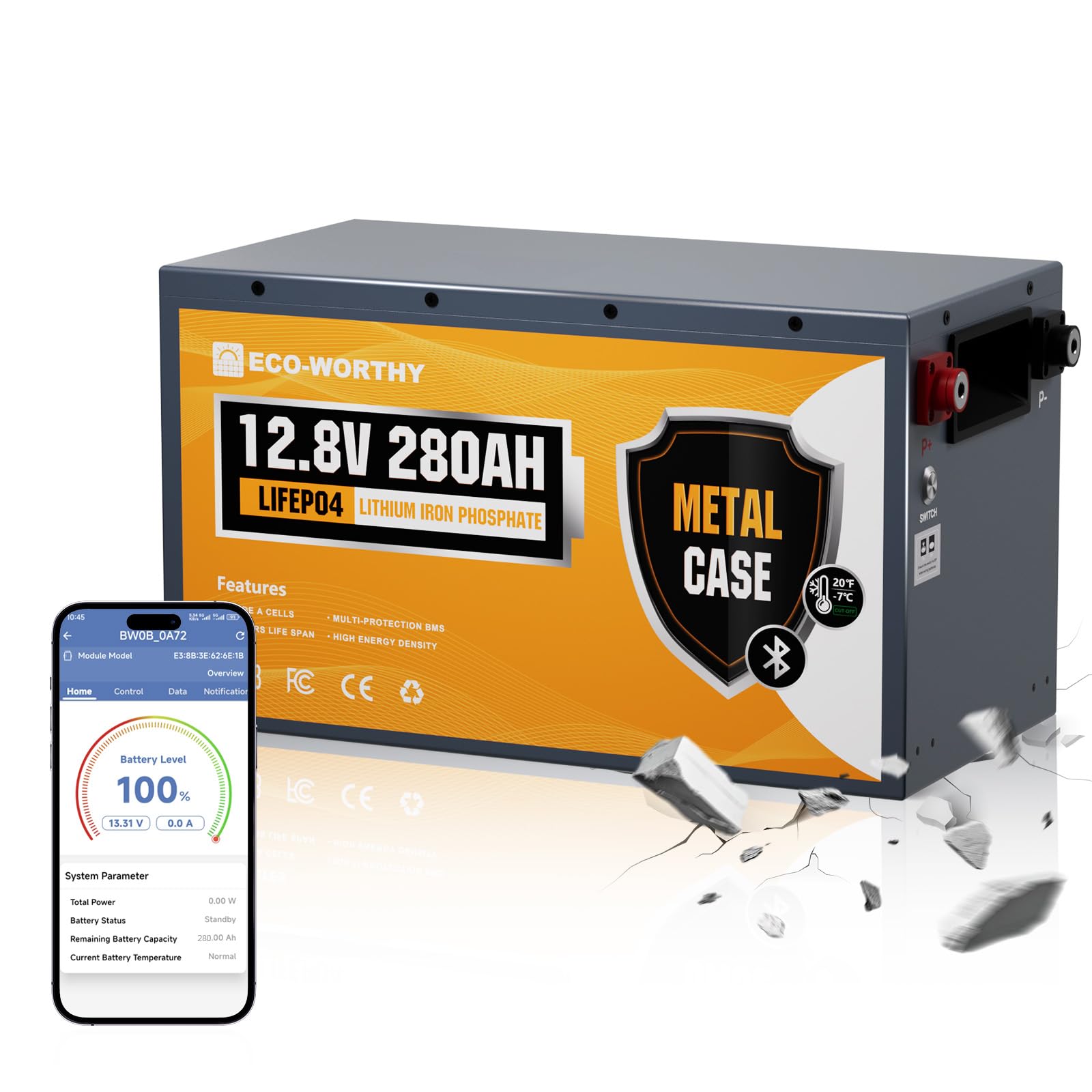
ECO-WORTHY’s 280Ah unit solves two problems simultaneously: mechanical durability and fire safety. The heavy-duty metal case provides superior heat resistance compared to plastic-clad batteries, and it includes four mounting feet that let you bolt the battery directly to the floor of your RV or camper without needing an external battery box. Internal cell holders keep the prismatic cells snug against road vibration, making this one of the best choices for mobile solar installations.
The built-in Bluetooth app gives real-time visibility into voltage, capacity, and charge/discharge status. Low-temperature protection automatically halts charging below freezing to protect the Grade A LiFePO4 cells. The 200A BMS handles overcharge, over-discharge, over-current, short-circuit, and temperature protection. A weak-current power switch lets you cut battery output for safer maintenance — a small touch that simplifies wiring work considerably.
At 68.5 pounds for 280Ah, it is heavier than a comparable plastic-cased lithium battery, but the metal shell adds genuine protection in high-vibration environments. If your small solar system lives in a van, trailer, or off-road vehicle, this is the most road-ready option.
Why it’s great
- Metal case with mounting feet for secure, no-box installation
- 200A BMS with low-temperature charge cutoff and Bluetooth monitoring
- Reinforced internal cell holders reduce vibration damage during travel
- Grade A cells tested above rated capacity by multiple reviewers
Good to know
- Heavier than plastic-cased lithium batteries of similar capacity at 68.5 lbs
- App works well but is not as polished as dedicated BMS apps like Overkill Solar
3. HumsiENK 12V 320Ah LiFePO4 Battery
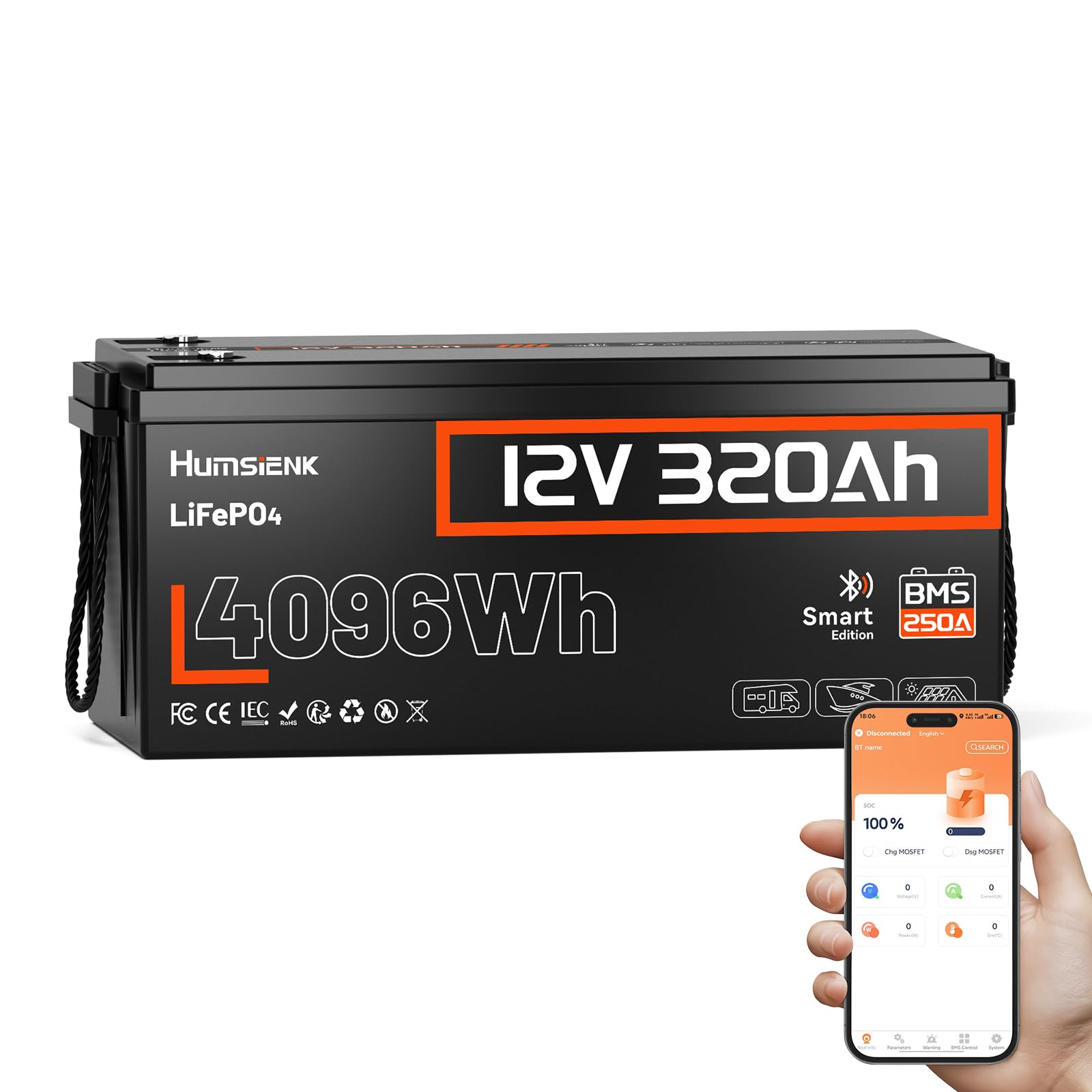
The HumsiENK 320Ah packs 4096Wh into a single 59-pound package, making it a compelling single-battery solution for small solar systems that run a fridge, lights, and laptops overnight. Its 250A BMS handles a 600A peak surge for one second, enough to start small induction loads or power a 2000W inverter during brief spikes. The 1C charge rate means you can refill the entire 320Ah from a robust solar array or generator in just over an hour.
Bluetooth 5.0 provides reliable monitoring up to 26 feet, showing voltage, current, capacity, and cell temperature on the HumsiENK App. The IP65 rating protects against dust and water ingress, and low-temperature cutoff prevents charging below 32°F. The 4S4P expansion design allows building a 51.2V 1280Ah system with 65.5kWh of storage — overkill for small solar but nice to have for future growth.
Some users report up to 10% SOC variance between units in series, so an external balancer is recommended for multi-battery banks. For a standalone 12V system, however, the HumsiENK delivers top-tier capacity per dollar and genuinely fast recharge speeds.
Why it’s great
- 4096Wh capacity in a single unit — no parallel wiring needed for medium loads
- 1C fast charge refills the battery in 1-2 hours with adequate charging power
- 250A BMS with 600A peak surge and IP65 protection
- Bluetooth app offers cell-level voltage visibility
Good to know
- SOC variance between units in series may require external balancing
- Heavier than some 300Ah class batteries at 59 lbs
4. OKMO 12V 400Ah LiFePO4 Battery
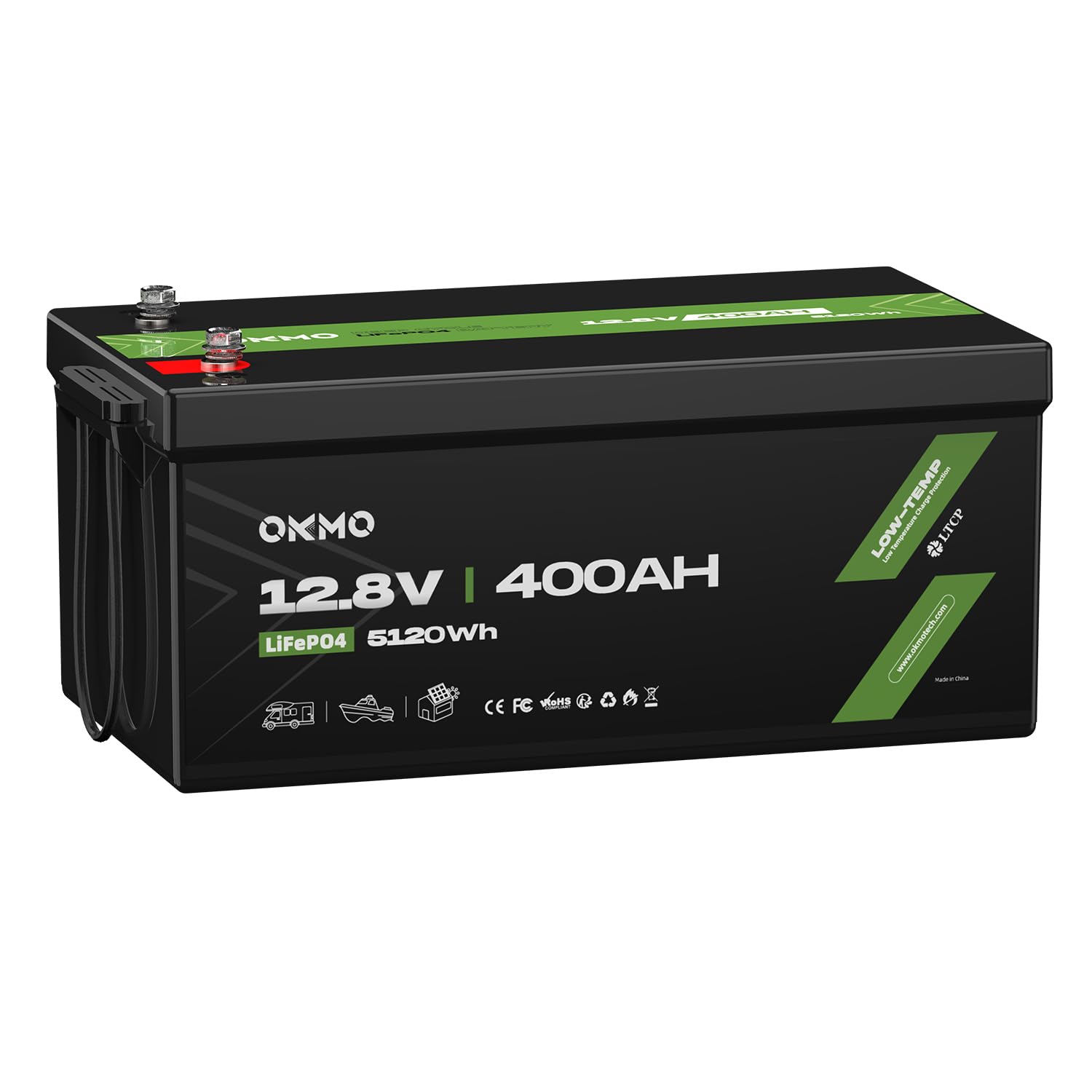
When a single battery needs to power an entire weekend off-grid, the OKMO 400Ah steps up with 5120Wh of stored energy. That is enough to run a CPAP machine all night, keep a 12V fridge cycling for 48 hours, charge phones and laptops, and still have reserve for morning lights. The 150A BMS is conservative but sufficient for a 12V system where peak loads from a 2000W inverter stay around 167A.
At 85.9 pounds, this is the heaviest unit on this list, but it is still one-third the weight of an equivalent lead-acid bank that would need four 100Ah batteries wired in parallel. The compact footprint (20.59 x 10.59 x 8.58 inches) simplifies installation in tight compartments. OKMO backs it with a 5-year warranty and responsive email support — a meaningful safety net given the investment.
The biggest downside is the 150A BMS limits how much surge current you can draw from a large inverter. For a system running a 2000W inverter, you will be near the continuous limit. For pure 12V loads and moderate inverter use, however, the OKMO provides the most single-unit capacity available in a plug-and-play package.
Why it’s great
- 5120Wh of usable energy in one battery — eliminates parallel complexity
- Lighter and smaller than 4x100Ah lead-acid bank for the same energy
- 5-year warranty with responsive customer support
- Shipped at 50% SOC for safe storage and transport
Good to know
- 150A BMS limits surge for large inverter loads above 1800W continuous
- Heaviest unit on the list at 85.9 lbs — needs two people for installation
5. FLLYROWER 12V 100Ah LiFePO4 Battery

FLLYROWER’s 100Ah LiFePO4 battery targets the entry-level solar builder who wants lithium performance without paying for Bluetooth or app connectivity. The Grade A cells are rated for an extraordinary 16,500 cycles under ideal conditions, though real-world cycle life depends heavily on DoD and temperature. Multiple user capacity tests confirmed the unit delivers at or slightly above the rated 100Ah, indicating solid cell matching.
The built-in BMS covers low-temperature protection (auto cutoff for charging below freezing), overcharge, over-discharge, short circuit, and overcurrent. A welcome inclusion is the 7A AC charger, which lets you top off the battery from a wall outlet — useful for initial setup or cloudy periods when solar input is low. The battery supports up to 5S series connections and unlimited parallel configurations, allowing voltage or capacity scaling.
For less than many budget lead-acid setups, you get a lightweight 22-pound battery that fits in a boat console, RV battery tray, or solar cabinet. The lack of a state-of-charge display or Bluetooth means you will need an external shunt or battery monitor to track usage accurately.
Why it’s great
- Grade A LiFePO4 cells tested above rated 100Ah capacity by users
- Includes 7A AC charger — ready to use out of the box
- Ultra-light at 22 lbs with built-in carry handle
- Supports 5S series and unlimited parallel expansion
Good to know
- No Bluetooth or SOC display — requires external monitor for accurate tracking
- 7A charger is slow for a full recharge after deep discharge (about 14 hours)
6. Dumfume 12V 150Ah LiFePO4 Battery
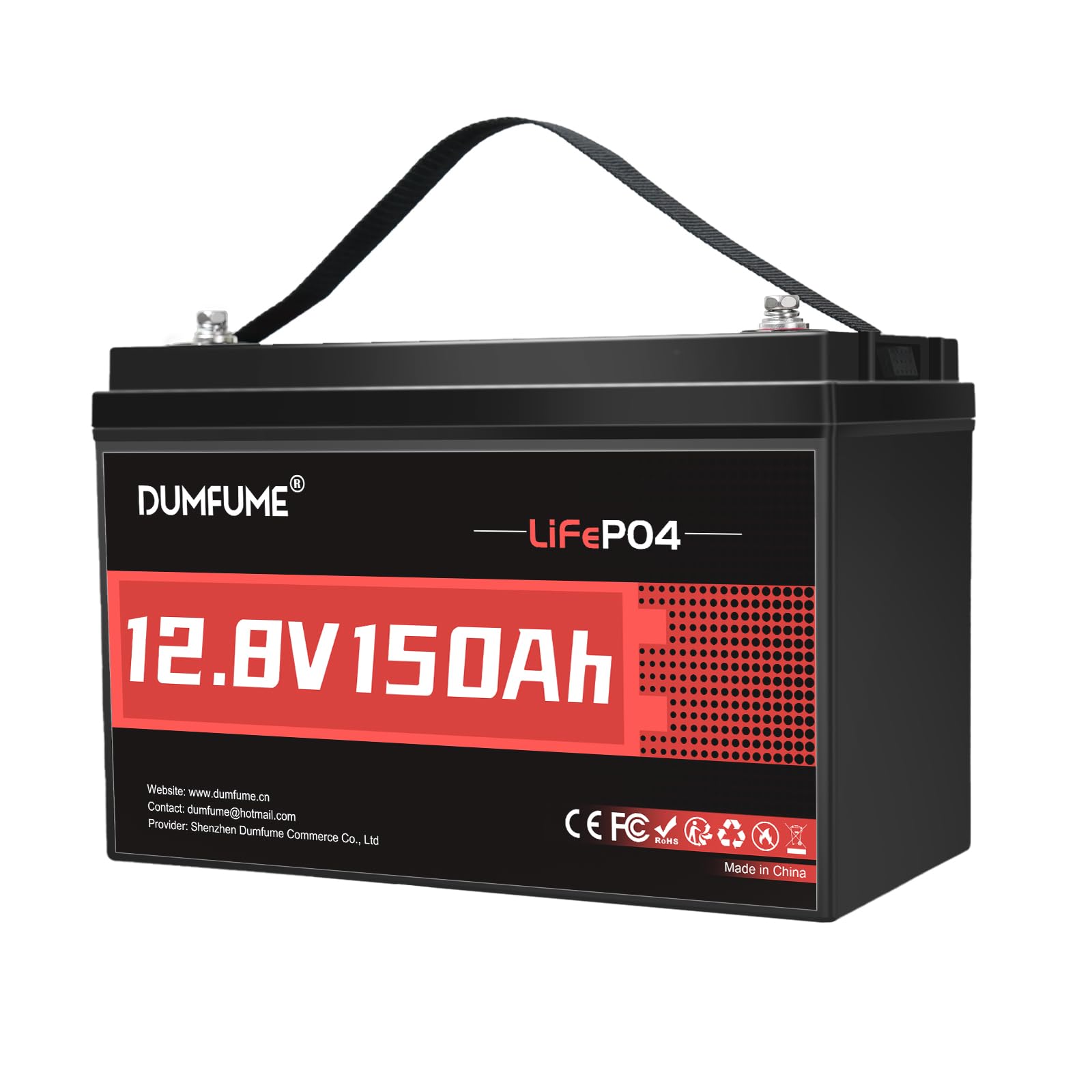
The Dumfume 150Ah sits in a sweet spot for small solar systems that need a bit more runtime than a 100Ah can provide but don’t yet need a massive 280Ah brick. Its 1920Wh capacity comfortably powers a 12V fridge (about 3-4 days), CPAP machine (multiple nights), and basic lighting and phone charging simultaneously. The 100A BMS is sufficient for a 1000W inverter and offers all standard protections including low-temperature cutoff.
At 22.05 pounds, this battery is impressively light for its capacity — the same weight as many 100Ah LiFePO4 units. The compact dimensions fit most Group 31 battery trays, making it a direct drop-in upgrade for older lead-acid installations. Dumfume backs the battery with a 5-year warranty, and multiple user reviews report the actual capacity testing above the 150Ah rating by about 7Ah.
Some buyers received units that arrived below 12.5V and needed a parallel jump charge to wake the BMS. This is common with LiFePO4 batteries in cold storage, but it is worth noting if you are not comfortable with basic troubleshooting. For the price per watt-hour, the Dumfume 150Ah delivers strong value with a reliable warranty.
Why it’s great
- 1920Wh at only 22 lbs — excellent power-to-weight ratio
- 100A BMS with low-temp protection and 5-year warranty
- Direct drop-in replacement for Group 31 lead-acid trays
- Supports 4S4P expansion for up to 48V 600Ah systems
Good to know
- Some units ship below 12.5V and may require a wake charge in parallel
- No Bluetooth or app for remote SOC monitoring
7. Arkpax Core 300W Portable Power Station
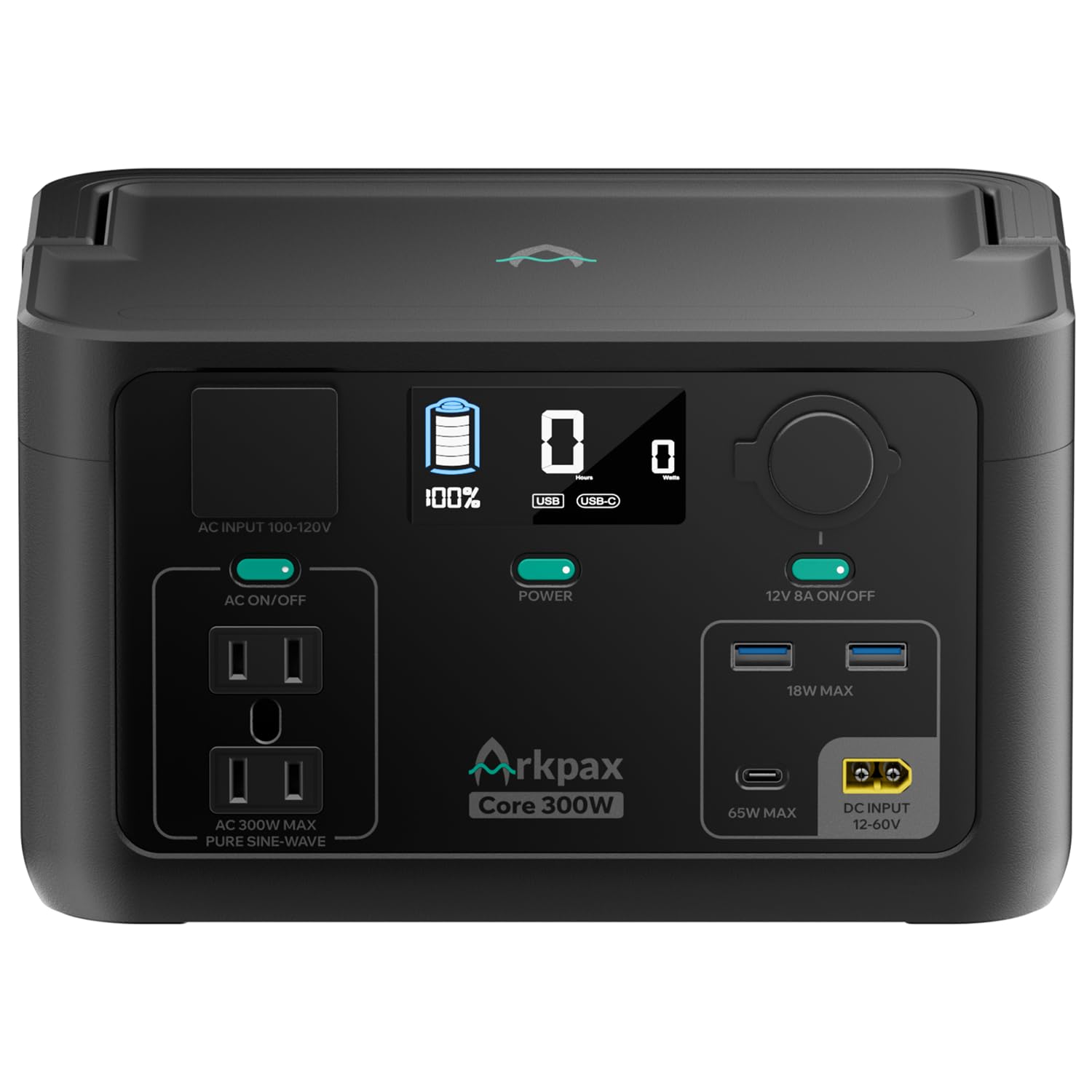
The Arkpax Core 300W is not a standalone battery you wire into a solar system — it is an all-in-one power station with a built-in inverter, MPPT solar controller, and UPS function. With 192Wh of LiFePO4 storage and a 300W pure sine wave inverter (600W surge), it is designed for small electronics: phones, laptops, CPAP machines, routers, and LED lights. The 10ms UPS switchover keeps sensitive devices running through brief power blips.
Recharge options are flexible: the included 180W AC adapter fills the battery in 1.5 hours, or you can add a solar panel (not included) for off-grid top-ups. The built-in LED light offers two brightness levels plus strobe and SOS modes — genuinely useful for emergency kits. At 8.8 pounds, it is easy to grab during a blackout or toss into a car for weekend camping.
This unit is not designed for refrigerator or microwave loads. For a small solar system that already has panels and an inverter, adding a power station like this as a portable UPS for critical electronics makes sense. Just note that the 192Wh capacity is modest — about one CPAP machine for a single night.
Why it’s great
- Built-in 300W pure sine wave inverter and MPPT solar controller
- 10ms UPS function for seamless power transition during outages
- Fast recharge in 1.5 hours via included 180W AC adapter
- Lightweight and portable at 8.8 lbs with emergency LED light
Good to know
- 192Wh is low capacity — only enough for small electronics for a few hours
- Solar panel not included; must be purchased separately
8. DaranEner NEOZ 192Wh Portable Power Station
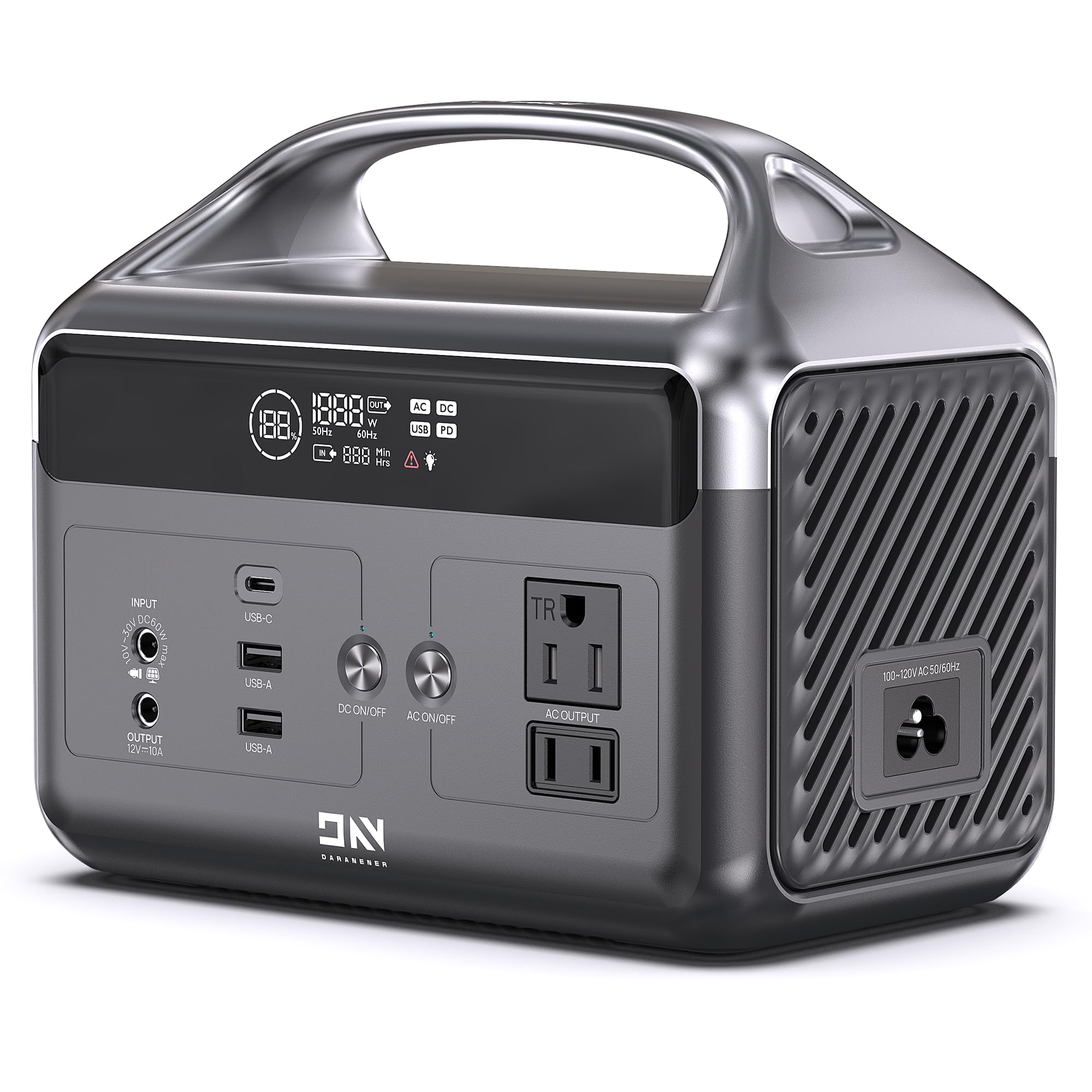
The DaranEner NEOZ is the lightest portable power station in this roundup at just 5.73 pounds, making it the go-to option for backpack solar or minimalist travel setups. The 300W pure sine wave inverter handles sensitive electronics without introducing noise or distortion.
Charging versatility is a strong point: AC wall charging at 100W, car charging, or up to 60W solar input via the built-in MPPT controller. The USB-C PD port delivers 60W, enough to fast-charge most modern laptops. The two USB-A ports support QC 3.0 at 18W each. An integrated LED flashlight offers four brightness modes including SOS, adding practical value for emergencies.
The DC side can be finicky — some users reported early failures on the USB outputs, though the manufacturer replaced units quickly under warranty. For a backup battery for phones, laptops, and small camping gear, the NEOZ delivers maximum portability. But for anything needing sustained AC power through the night, its 192Wh ceiling is a hard limit.
Why it’s great
- Extremely portable at 5.73 lbs — fits in a daypack
- 60W USB-C PD for fast laptop charging on the go
- Multiple charging inputs (AC, car, solar) with MPPT optimization
- Quiet operation and four-mode LED light for emergencies
Good to know
- 192Wh capacity is low for sustained AC loads like CPAP all night
- Some users experienced early USB output failures; warranty service was responsive
9. WEIZE 12V 100Ah Deep Cycle AGM Battery

The WEIZE 100Ah AGM represents the traditional lead-acid approach to small solar storage. Sealed and maintenance-free, this battery delivers reliable 12V power without the need for watering or venting. Its 1150A maximum discharge current makes it suitable for high-crank applications like trolling motors or winches, though solar users will primarily value its steady discharge curve and 3% self-discharge rate, which allows months of storage between uses.
At 63 pounds, this battery is nearly three times heavier than a comparable 100Ah LiFePO4 unit, and its usable capacity is effectively 50Ah since discharging below 50% depth of discharge rapidly shortens its life. For a weekend cabin or seasonal solar setup that sees light use, the lower upfront cost of the WEIZE AGM can make sense. It pairs well with a basic PWM solar controller and a small inverter for lights and phone charging.
The AGM chemistry means you cannot drain it deeply without permanent damage. If you plan to cycle a battery daily, the upfront savings of this WEIZE battery will be erased within two years when you need a replacement. For occasional backup or very small loads, it remains a budget-friendly entry point into solar storage.
Why it’s great
- Sealed, maintenance-free AGM — no watering or venting required
- High surge current (1150A) supports trolling motors and winch loads
- Extremely low self-discharge (3% per month) for seasonal storage
- Budget-friendly upfront cost for entry-level solar setups
Good to know
- Only 50Ah usable capacity — discharging below 50% DoD damages the battery
- Very heavy at 63 lbs; no built-in handle for easy carrying
- Cycle life of 300-700 cycles is far shorter than LiFePO4 alternatives
FAQ
How many amp-hours do I need for a small solar system?
Can I mix old and new LiFePO4 batteries in the same solar system?
Do I need a special solar charge controller for LiFePO4 batteries?
Final Thoughts: The Verdict
For most users, the battery for small solar system winner is the LiTime 12V 100Ah Group 24 because it combines Bluetooth monitoring, IP65 weather resistance, low-temperature protection, and a proven 4000-cycle lifespan in a lightweight 21.9-pound package — at a price that undercuts many competitors with fewer features. If you need a rugged mobile battery that handles vibration and road salt, grab the ECO-WORTHY 280Ah Metal Case. And for a single-battery solution that powers a whole cabin or RV weekend without parallel wiring, nothing beats the OKMO 400Ah.

Mo Maruf
I created WellFizz to bridge the gap between vague wellness advice and actionable solutions. My mission is simple: to decode the research and give you practical tools you can actually use.
Beyond the data, I am a passionate traveler. I believe that stepping away from the screen to explore new environments is essential for mental clarity and physical vitality.