Our readers keep the lights on and my smoothie glass nicely filled. As an Amazon Associate, I earn from qualifying purchases.
Reaching for a dead remote or a silent toy is a friction point that costs both time and money. The right charger eliminates that cycle, turning drained cells into ready power on your schedule.
I’m Mohammad Maruf — the founder and writer behind WellFizz. I break down charger specs like independent bay charging, output voltage, and charge time curves so you can pick the unit that actually fits your household’s battery diet.
Whether you need speed for camera flashes or bulk capacity for game controllers, this guide to the best battery charger for rechargeable batteries covers five distinct solutions that each solve a real-world power problem.
How To Choose The Best Battery Charger For Rechargeable Batteries
Selecting a charger is more than matching the right battery chemistry. You need to balance bay count, charge current, and individual slot control to match how you actually use batteries day to day.
Independent Bay Charging
Cheaper chargers often charge batteries in pairs or as a group, meaning you cannot charge a single AAA without a matching cell in the adjacent slot. Independent bays let you charge one, three, or a full set of mixed AA and AAA cells without waiting for pairs — a must if you use batteries in different devices at different times.
Charge Current and Speed
Charge current, measured in Amps or milliamps (mA), directly determines how fast a battery fills. A 0.5A (500mA) charge rate is gentle and suitable for overnight charging of standard NiMH cells, while 1.8A to 2A rates will fill a depleted AA in under two hours. Higher current is fine for frequent rechargers, but slower rates preserve long-term cell health for occasional users.
Safety and Detection Features
Look for chargers that detect full charge and automatically switch to trickle or cut off. Delta-V detection (a voltage drop that signals a full NiMH cell) prevents overcharging. A good charger also flags defective or non-rechargeable (alkaline) batteries with a blinking LED instead of attempting to charge them, which prevents leakage or rupture.
Quick Comparison
On smaller screens, swipe sideways to see the full table.
| Model | Category | Best For | Key Spec | Amazon |
|---|---|---|---|---|
| Bonai 16-Bay Charger | Premium Bulk | Heavy multi-device households | 16 independent bays, 5-hour full charge | Amazon |
| Panasonic BQ-CC65 | Advanced | Data-driven monitoring and LCD readout | LCD shows voltage, mAh, charge time per slot | Amazon |
| Amazon Basics 8-Bay | Mid-Range | Complete starter bundle with cells | 8 bays, USB-C input, 10-hour AA charge | Amazon |
| POWEROWL 4-Bay | Versatile | Charging C/D cells plus standard AA/AAA | Fast/overnight modes, micro USB input | Amazon |
| Tenergy RC Pack | Specialized | 7.2V RC car battery packs | 1.8A charge, Tamiya connector, 3000mAh cell | Amazon |
In‑Depth Reviews
1. Bonai Rechargeable AA Batteries with Charger (16-Bay)
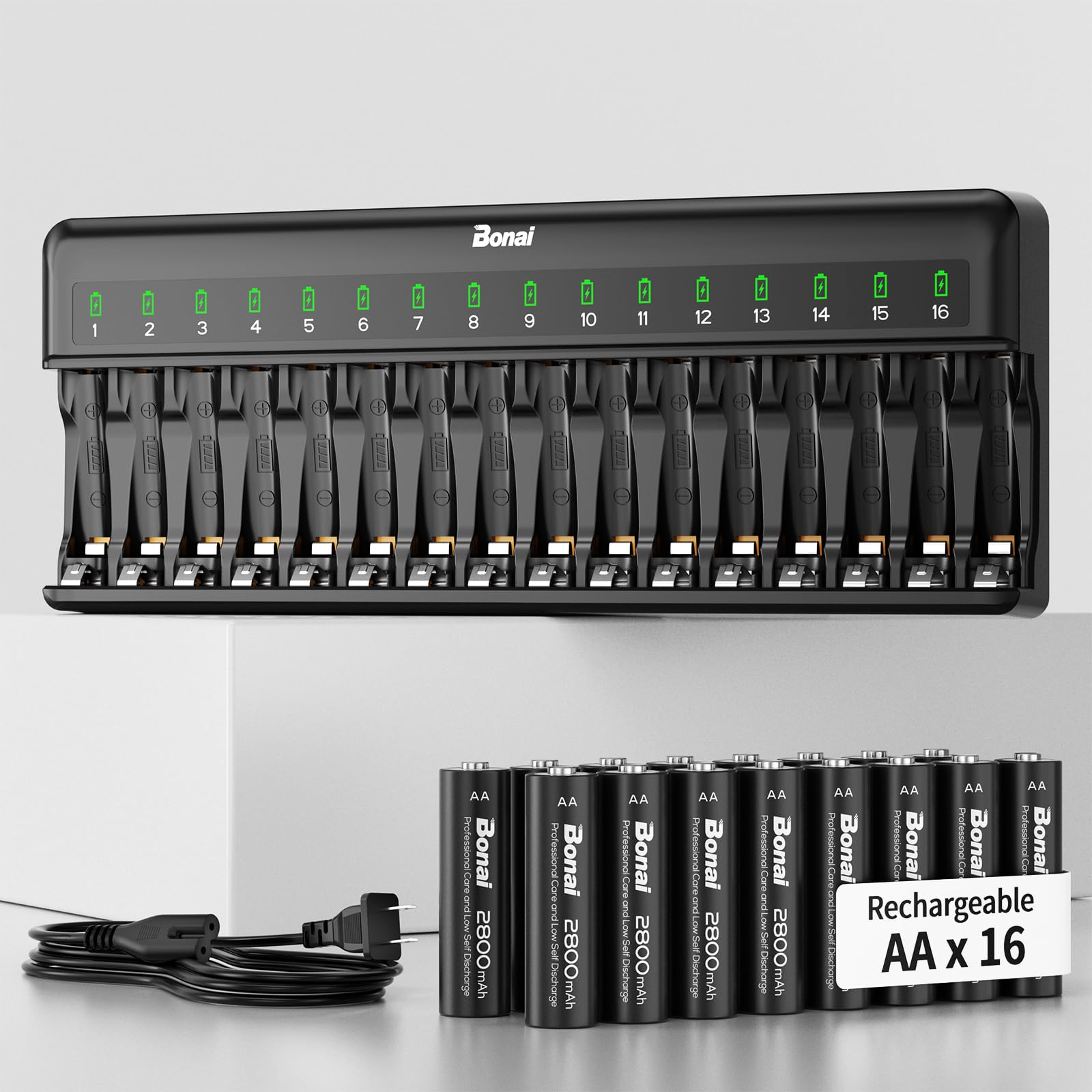
The Bonai 16-bay charger solves the biggest household pain point: waiting for a slot. With sixteen independent channels, you can drop in a single depleted AAA or a full set of 16 AAs and the charger treats each cell individually. The 2800mAh capacity per AA battery is substantial — noticeably higher than the 2000mAh standard found in many bundles — so each charge cycle powers devices longer between swaps.
The included AC plug (Type A) eliminates the need for an external USB adapter, and the LED indicator system clearly shows red for charging, green for full, and flashing red for defective or alkaline cells. Users report a full charge in roughly 2 to 3 hours for a set of AAs, putting this in the fast-charge category. The low self-discharge chemistry holds 80% capacity for up to a year, which makes these batteries ready even after months in a drawer.
At this capacity and bay count, the Bonai system is the smartest choice for families or anyone running multiple controllers, flashlights, or smart home sensors. The 1200 recharge cycles per cell means you will replace alkaline waste with reusable power for years.
Why it’s great
- 16 independent bays accept single or mixed AA/AAA cells without pairing
- 2800mAh AA capacity delivers longer runtime than typical 2000mAh bundles
- Built-in AC plug means no separate adapter needed
Good to know
- 1.2V NiMH output may run slightly dimmer in devices designed for 1.5V alkaline
- Large footprint on the counter — plan shelf space
2. Panasonic BQ-CC65 Super Advanced eneloop Charger

The Panasonic BQ-CC65 is the most technically advanced charger in this lineup. Each of the four charging slots operates independently and reports real-time data on a backlit LCD panel — you can read individual cell voltage, charge time, and mAh discharged during a refresh cycle. This level of visibility helps you spot a weakening battery before it fails mid-use, a feature no other charger here offers.
Charge speed is exceptional: two depleted eneloop Pro AAs reach full in roughly 2 hours, and the full set of four finishes in about 4 hours. The USB output port (5V/1A) lets the charger double as a backup power source for a phone or earbuds, adding versatility beyond battery charging. The Refresh function cycles old NiMH cells to recover lost capacity, extending the usable life of batteries you already own.
This charger is optimized for eneloop and eneloop Pro cells but works with any standard NiMH AA or AAA. The trade-off is bay count — four slots limit bulk charging — and the price reflects the premium LCD and detection hardware.
Why it’s great
- LCD shows voltage, charge time, and mAh per slot for battery health tracking
- Refresh mode restores old or underperforming NiMH cells
- USB output port charges phones or other small devices
Good to know
- Only 4 bays make it less suited for high-volume households
- Designed exclusively for NiMH chemistry — do not charge Li-ion or alkaline
3. Amazon Basics 8-Bay NiMH Charger with Batteries
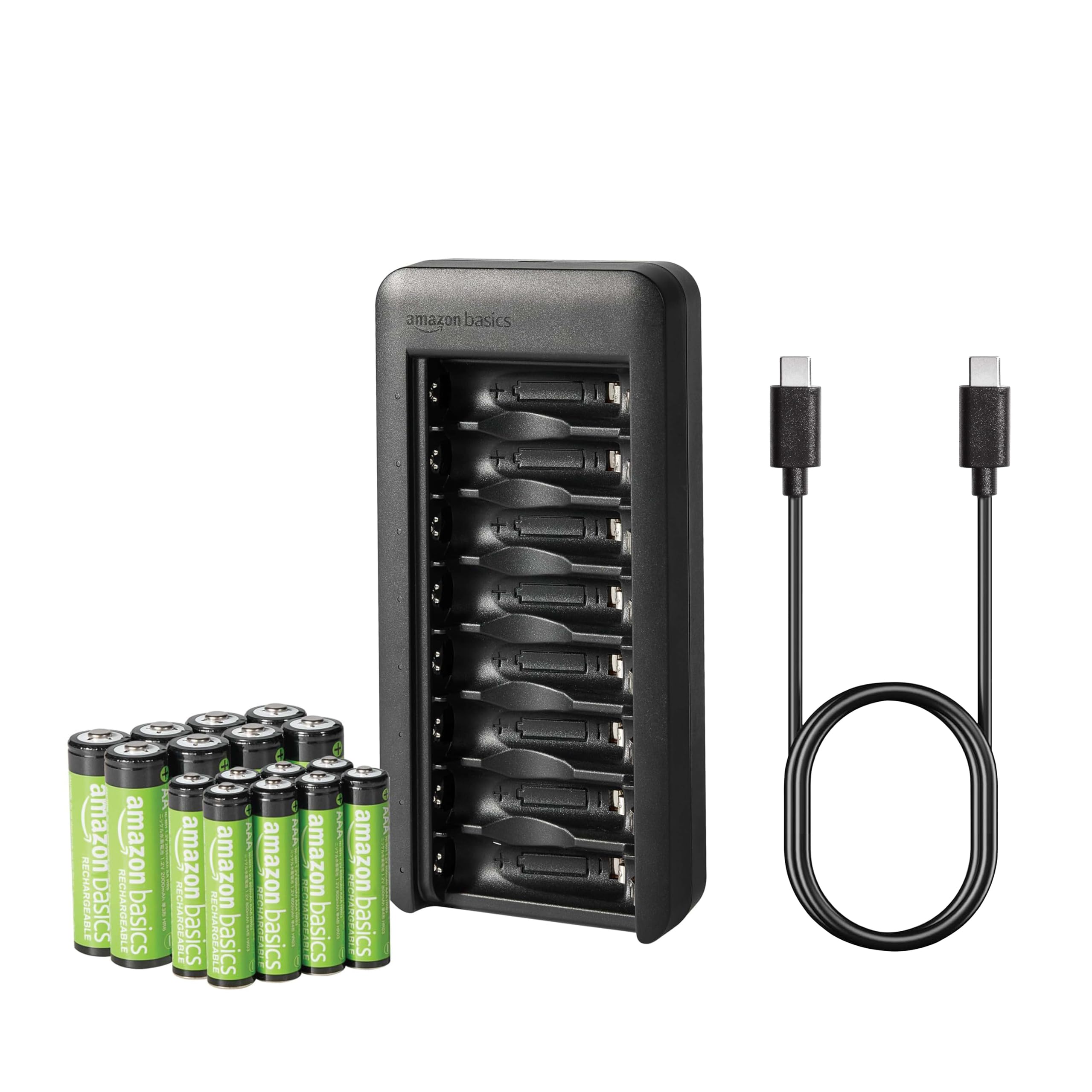
The Amazon Basics 8-bay bundle is the turnkey entry point: you get the charger plus eight AA (2000mAh) and eight AAA (800mAh) cells right out of the box. The charger uses a USB-C input (cable included, wall adapter not included), which is convenient for travelers who already carry a USB-C phone brick. The eight independent bays handle mixed sizes without needing to pair cells.
Charge time is moderate — a full set of eight AAs takes about 10 hours at the standard rate. That is an overnight charge, not an emergency top-up, so plan accordingly. The LED indicators use a four-state system: slow blink for charging, solid white for full, fast blink for an error (defective or alkaline battery detected), and a power-on sequence. Users report that the charger runs cool during operation, which is a good sign for long-term electronics safety.
The batteries themselves are rated for up to 1000 recharges with low self-discharge that holds 80% capacity for 12 months. This is the most practical pick for someone transitioning from disposable batteries who wants a single-box solution.
Why it’s great
- Complete starter kit with 8 AA and 8 AAA batteries included
- USB-C input uses common charging cables and bricks
- Independent bays charge any mix of AA and AAA without pairing
Good to know
- 10-hour charge time on eight AAs is slower than premium chargers
- Some users report LED confusion between charging and error indicators
4. POWEROWL 4-Bay Charger with C Batteries

The POWEROWL charger distinguishes itself by accepting C and D rechargeable cells in addition to standard AA and AAA sizes. That is a rare feature — most chargers in this class cap out at AA/AAA. If you have a boombox, lantern, or toy that runs on C cells, this is one of the few compact options that handles them without a separate adapter tray.
It offers two charging modes selectable through the micro USB input: a fast mode that charges AA batteries in roughly 20 minutes when running only two cells, and an overnight mode that is gentler on battery health. The smart chip prevents overcharging by cutting off power when the cell reaches full capacity, with an LED indicator to confirm status. The included C batteries are rated 1600mAh (NiMH), which is appropriate for medium-drain devices like radios and portable fans.
The charger itself is compact — barely larger than a deck of cards — and runs from a standard 5V micro USB cable (adapter not included). Some users note that the C cells lose charge faster than expected in high-drain devices, but for moderate-drain gadgets the system is reliable.
Why it’s great
- Charges C, D, AA, and AAA cells — unmatched size versatility
- Fast mode fills two AA batteries in about 20 minutes
- Automatic overcharge cutoff and LED status per slot
Good to know
- Batteries included (C cells) may have shorter service life than premium brands
- Micro USB input requires a separate 5V adapter
5. Tenergy 7.2V RC Battery Pack and Universal Charger

The Tenergy system is built for a different world: RC cars, boats, and airsoft guns that run on 7.2V NiMH battery packs. This is not an AA/AAA charger — it is a complete pack-and-charger kit for one specific application. The 3000mAh 6-cell NiMH flat pack uses a standard Tamiya connector and fits popular RC models from Traxxas, Tamiya, Kyosho, and others.
The universal charger supports two selectable charge currents: 0.9 Amp for smaller packs (900-1800mAh) and 1.8 Amps for larger packs (1800-5000mAh). This flexibility lets you charge the included 3000mAh pack in under two hours on the higher setting, or safely trickle-charge a lower-capacity pack. The charger comes with standard Tamiya, mini Tamiya, and alligator clip adapters, covering most RC battery terminals.
Users confirm that the pack fits tight compartments well and delivers about 15-20 minutes of run time on a full charge in a standard RC car at medium throttle. The charger itself handles 7.2V to 12V NiMH/NiCd packs (6S to 10S) but explicitly does not support LiPo chemistries, so check your battery type before plugging in.
Why it’s great
- Complete RC solution: 3000mAh pack plus adjustable current charger
- Two charge rates (0.9A and 1.8A) suit different pack sizes
- Three adapter types (Tamiya, mini Tamiya, alligator clips) for broad compatibility
Good to know
- Only one battery pack included — additional packs cost extra
- Not compatible with LiPo batteries despite similar connectors
FAQ
Can I charge alkaline batteries in a NiMH charger?
What does low self-discharge mean for battery storage?
Final Thoughts: The Verdict
For most users, the battery charger for rechargeable batteries winner is the Bonai 16-Bay Charger because it pairs a huge bay count with high 2800mAh capacity cells and independent slot charging — the one-box solution for heavy households. If you want real-time battery data and LCD diagnostics, grab the Panasonic BQ-CC65. And for charging C or D cells alongside standard AA/AAA, nothing beats the POWEROWL 4-Bay.

Mo Maruf
I created WellFizz to bridge the gap between vague wellness advice and actionable solutions. My mission is simple: to decode the research and give you practical tools you can actually use.
Beyond the data, I am a passionate traveler. I believe that stepping away from the screen to explore new environments is essential for mental clarity and physical vitality.