Our readers keep the lights on and my smoothie glass nicely filled. As an Amazon Associate, I earn from qualifying purchases.
Every dead phone at the worst moment—missed call, lost map, stranded without a ride—traces back to the same problem: a power bank that lived in your drawer instead of your pocket. The real test of a battery bank isn’t the milliamp-hour number on the box; it’s whether you can stand carrying it every single day. Too heavy, too thick, too slow, or too finicky about cables, and it becomes dead weight in your bag. The best designs solve this tension between raw capacity and daily carry-ability with specific cell chemistry, charge-circuit engineering, and port configuration that actually matches how you use your devices.
I’m Mohammad Maruf — the founder and writer behind WellFizz. I analyze the actual power-delivery curves, cell-density specs, and thermal-management systems that separate a reliable daily companion from an emergency-only brick.
After evaluating dozens of models on capacity-to-weight ratio, real-world fast-charge performance, and build integrity, this guide breaks down the five options that earn a spot in your bag — helping you find the truly best battery bank for your specific charging habits and travel routine.
How To Choose The Best Battery Bank
A battery bank is a simple device with a deceptively wide gap between cheap and well-engineered. Most buyers fixate on milliamp-hours, but real-world satisfaction depends on three interconnected specs that determine whether you’ll actually reach for it every day or leave it buried in a backpack pocket.
Capacity Density: The Grams-per-1000mAh Ratio
A 20,000mAh bank can weigh anywhere from 270 grams to over 400 grams depending on the quality of its lithium-polymer cells. Cheaper units use lower-density cells that pack more air and physical volume per milliamp-hour. The densest cells let a 20,000mAh bank slip into a jacket pocket without pulling your collar down. Check the weight specification: anything under 340 grams for a 20K is using high-density cells. The trade-off is cycle life—ultra-dense cells may degrade faster after 300 full cycles than slightly heavier, more conventional cells rated for 500-plus.
Real Fast-Charge Wattage vs. Advertised Peak
Many battery banks advertise a peak wattage (say 30W or 100W) but only sustain that rate for the first few minutes before thermal throttling drops it to 15-18W. The determining factor is the bank’s thermal management: passive heat sinks, active temperature sensing, and the cell’s internal resistance. A bank that holds 20W throughout an iPhone charge from 20% to 80% is more useful than one that spikes to 30W for five minutes then crawls. Look for detailed reviews or teardowns that show sustained power output, not just the peak number on the spec sheet.
Cable Integration: Convenience vs. Failure Point
Built-in cables eliminate the single most common reason a battery bank becomes useless: you forgot the cable at home. But a poorly anchored cable with thin strain relief will fail after a few hundred bends. The best implementations use braided nylon jackets and reinforced connection points rated for 10,000 bends or more. Detachable cable-lanyard designs offer the best of both worlds—you can replace the cable without replacing the entire battery bank. If you use both Lightning and USB-C devices, a bank with both cables built in saves more daily frustration than any capacity number.
Quick Comparison
On smaller screens, swipe sideways to see the full table.
| Model | Category | Best For | Key Spec | Amazon |
|---|---|---|---|---|
| Anker Zolo Power Bank | Mid-Range | Reliable daily carry with premium build | 270g weight / 30W output | Amazon |
| Baseus Blade 100W | Premium | Laptop + phone multi-device charging | 0.78″ thick / 100W PD | Amazon |
| INIU Smallest 20000mAh | Mid-Range | Ultra-portable 20K with detachable cable | 4.1 x 2.8 x 1.2 inches | Amazon |
| Orfeika 20000mAh | Mid-Range | Multi-device families with mixed cables | 4 built-in cables / 6 outputs | Amazon |
| RIDGE Magnetic Power Bank | Premium | MagSafe wireless + Apple Watch charging | 10,000mAh / 15W wireless | Amazon |
In‑Depth Reviews
1. Anker Zolo Power Bank (2025 Upgraded Version)

The Anker Zolo hits the exact intersection of weight, capacity, and durability that defines a daily-carry battery bank done right. At 270 grams and just 4.72 x 2.89 x 1.24 inches, this 20,000mAh unit packs some of the densest lithium-polymer cells in its price tier. The built-in USB-C cable measures 5.98 inches and is rated for over 10,000 bends using a braided nylon jacket with reinforced strain relief — a meaningful improvement over the rigid plastic cables that crack at the connector within months on cheaper banks.
Its 30W output delivers real sustained power: an iPhone 15 charges from 0% to 57% in 30 minutes, and the 20W input recharges the bank itself in about five hours. ActiveShield 2.0 monitors internal temperature three million times per day and throttles output before cells degrade — a feature that extends total cycle life well past the 500-cycle mark. The battery percentage display is precise to 1% increments and remains readable in direct sunlight thanks to its high-contrast white-on-black layout.
Where the Zolo really distinguishes itself from the crowd is its build quality consistency. The matte polycarbonate shell resists scratches after months of sliding around in bags alongside keys and coins. The dual extra USB-C ports (one input/output, one output-only) maintain full 30W throughput even when all three ports are active, thanks to intelligent power distribution that doesn’t just split the wattage equally but prioritizes the device drawing the most power. For most users who want one battery bank that just works without fuss for years, this is the pick.
Why it’s great
- Class-leading 270g weight for a true 20,000mAh capacity
- ActiveShield 2.0 thermal monitoring prevents throttling and extends cell life
- Built-in USB-C cable with 10,000-bend rating removes the “forgot the cord” failure mode
Good to know
- No Lightning cable built in — iPhone users need an adapter or separate cable
- Heavier than some expect despite the 270g spec; the dense cells feel solid in hand
2. Baseus Blade 100W 20000mAh
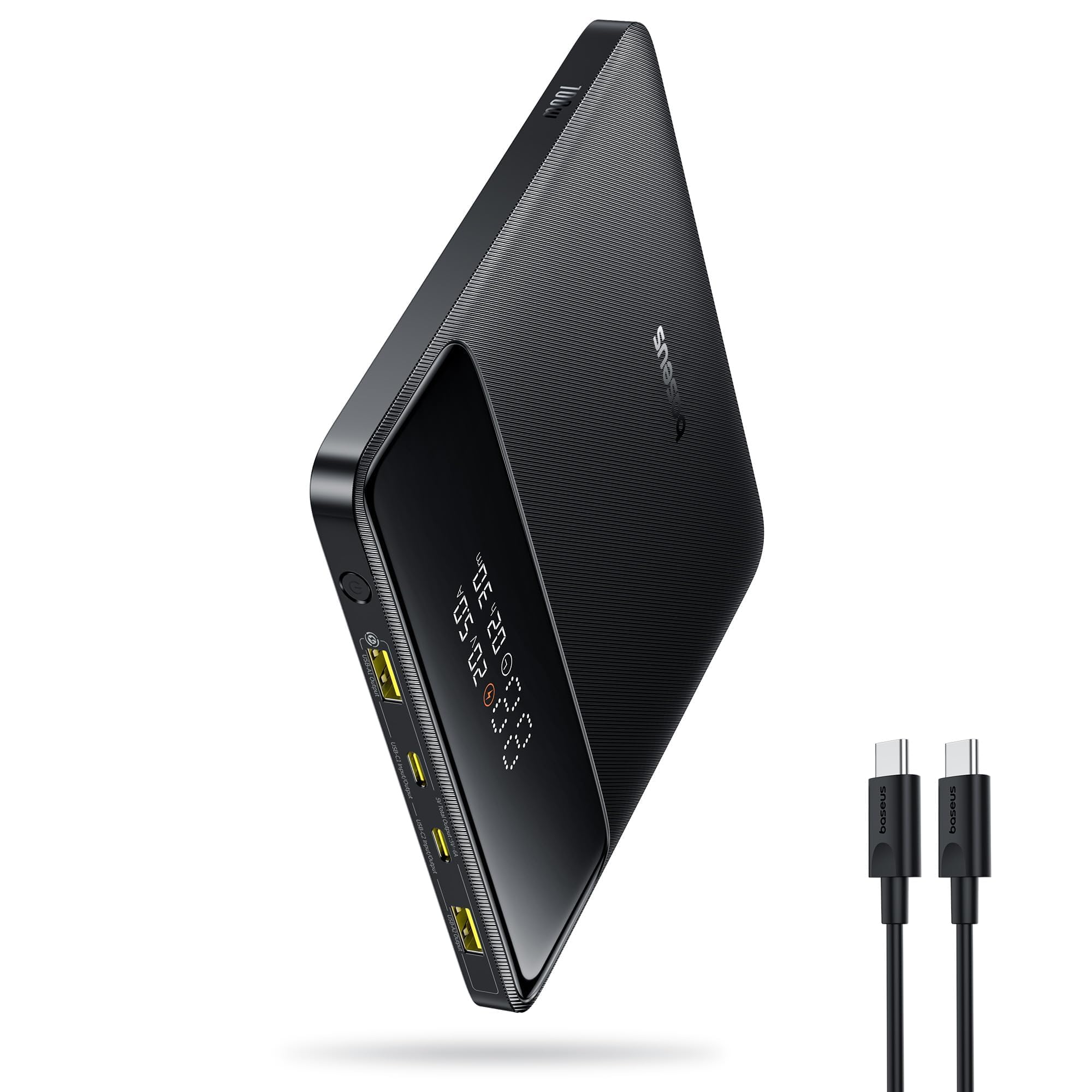
The Baseus Blade solves a specific problem that most battery banks ignore: charging a laptop at full speed without the bulk of a traditional brick. At just 0.78 inches thick with a 5.27 x 5.27 inch footprint, this 20,000mAh bank slides into a laptop sleeve alongside a MacBook Air without creating a visible bulge. The 100W USB-C PD output is genuine — it charges a 13-inch MacBook Pro to 50% in 30 minutes while maintaining the full 100W draw without thermal shutdown, thanks to its aluminum-alloy chassis acting as a heat sink.
The port configuration is what makes this bank versatile for mixed-device households: two USB-C ports and two USB-A ports, all active simultaneously. The secondary USB-C port delivers 30W — enough to fast-charge an iPad Pro or Samsung Galaxy S24 while the primary port handles the laptop. The LED display shows remaining capacity in hours at current draw rather than just a percentage, giving you a more useful estimate of whether you have enough juice for a two-hour meeting or a four-hour flight. UL and IEC safety certifications cover overcharge, overheat, and short-circuit protection.
Real-world efficiency testing shows this bank delivers 85-90% of its rated capacity to devices — slightly better than the industry average of 80-85% due to its low internal resistance cells. That means you get roughly 17,000-18,000mAh of usable power to your devices rather than the typical 16,000mAh from less efficient competitors. The included 100W USB-C cable is a full 3.3 feet, long enough to keep the bank on the floor while your laptop stays on a café table — a small detail that matters more in daily use than most buyers anticipate.
Why it’s great
- True 100W sustained output without thermal shutdown, enabled by aluminum heat-sink chassis
- Slim enough to fit in a laptop sleeve — genuinely different from boxy alternatives
- Four active ports (2 USB-C, 2 USB-A) with intelligent power distribution
Good to know
- Square footprint takes up more bag surface area than rectangular designs
- No built-in cables — you must carry your own USB-C cord
3. INIU Smallest 20000mAh Power Bank
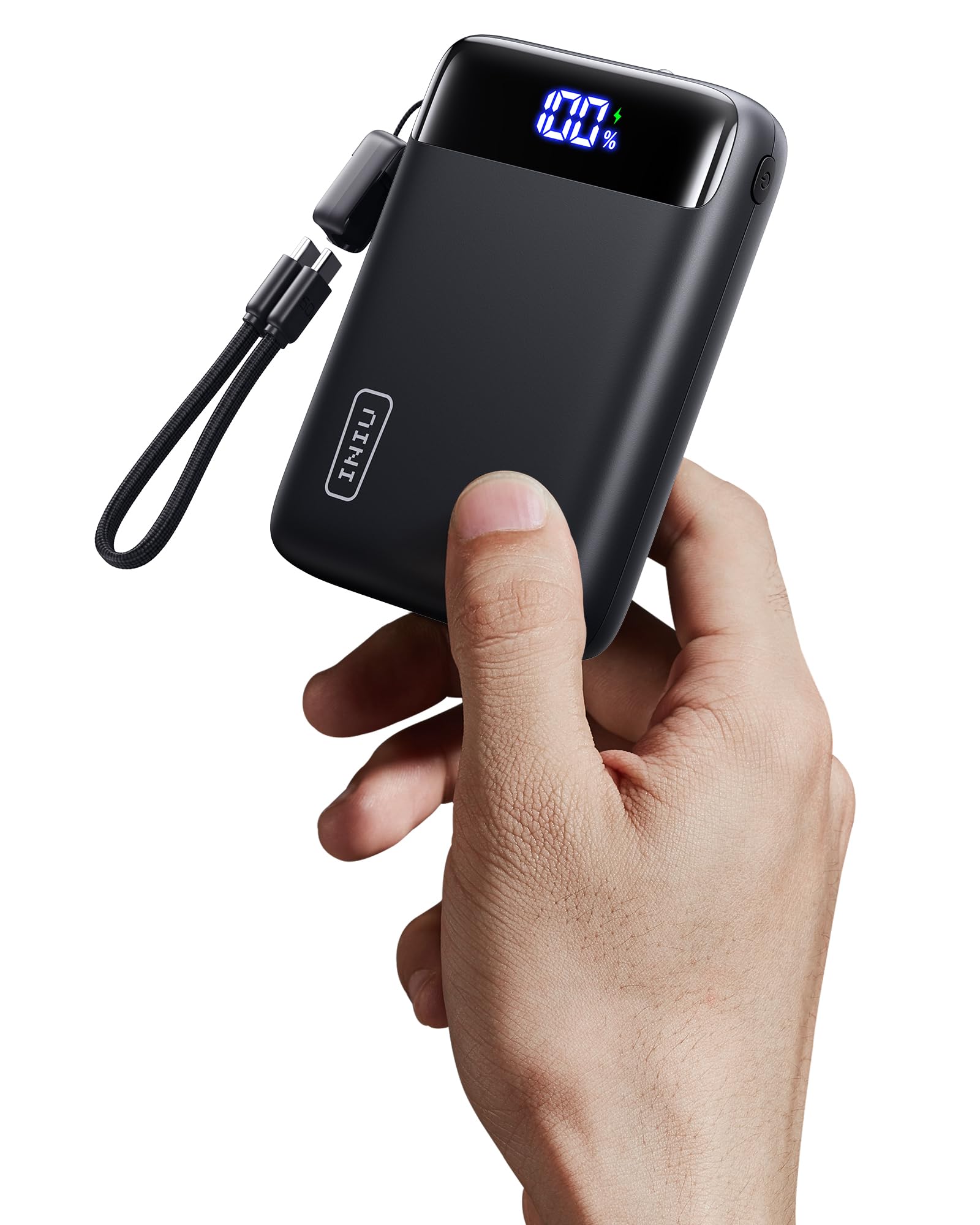
The INIU 20000mAh bank earns its “Smallest” moniker with dimensions of 4.1 x 2.8 x 1.2 inches — roughly the footprint of a passport holder with slightly more thickness. At 320 grams, it’s 50 grams heavier than the Anker Zolo, but that weight includes a unique detachable nylon-braided cable that doubles as a lanyard strap. This design solves the most common cable failure mode: when the cable eventually frays or the connector loosens after a year, you replace just the cable rather than throwing away the entire battery bank.
The 22.5W PD output is slightly lower than the Anker’s 30W, but the real charging speed delta is smaller than the numbers suggest. The INIU reaches 60% on an iPhone 16 in 30 minutes versus the Zolo’s 57% on an iPhone 15 in the same window — both are in the same real-world tier for phone fast charging. Where the INIU pulls ahead is its flashlight feature, which uses a dedicated high-CRI LED capable of illuminating a dark room or tent for up to 40 hours on a full charge. The LED display shows battery percentage with 1% precision and remains visible even through polarized sunglasses.
Flight safety is fully addressed: the 77Wh rating sits comfortably under the 100Wh airline limit, and INIU includes a printed TSA compliance card in the packaging to avoid questions at security. The SafeCharge thermal monitoring system checks temperature at five internal points and reduces output if any zone exceeds safe thresholds — a more granular approach than single-sensor designs. With over 38 million units sold across INIU’s lineup, the 3-year replacement warranty is backed by a logistics operation that typically ships a replacement within 48 hours of a claim.
Why it’s great
- Detachable cable-lanyard replaces the entire failure-prone component independently
- Compact footprint at 4.1 x 2.8 inches rivals many 10,000mAh banks
- Five-point thermal monitoring is more robust than single-sensor competitors
Good to know
- 22.5W output is mid-range; won’t fast-charge a laptop
- Heavier than premium 20K options at 320 grams due to cable-lanyard mechanism
4. Orfeika 20000mAh Power Bank
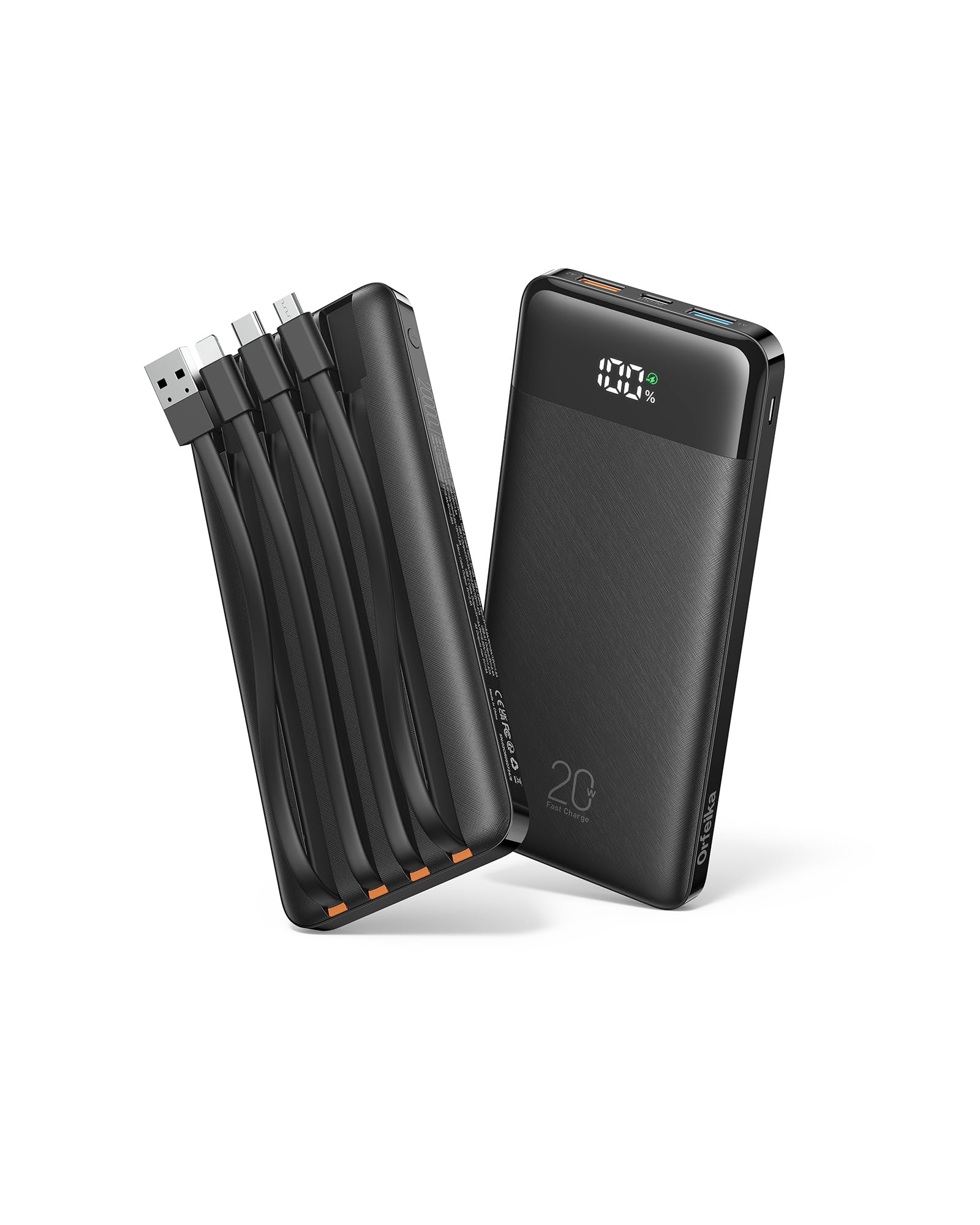
The Orfeika 20000mAh bank answers a question most power banks ignore: what if you need to charge an iPhone, a Galaxy, an iPad, and a pair of wireless earbuds simultaneously, and nobody brought a cable? Its four built-in cables cover USB-C (input and output), Lightning, and Micro-USB, making it the only bank on this list that accommodates older devices and newer ones without adapters. The three external ports bring total simultaneous-device capacity to six — enough for a family of four to charge everything in a hotel room from a single unit.
The cable arrangement is engineered for durability: each cable stows into a recessed channel on the bank’s edge, protected by a scratch-resistant polycarbonate shell. The Lightning cable supports 20W output, meaning an iPhone 16 charges to 50% in 45 minutes through the built-in cord — not quite as fast as a dedicated 30W PD cable, but fast enough for overnight top-ups. The 18W input recharges the bank itself in just over five hours when using the built-in USB-C input cable, eliminating the need to carry a separate charging cord for the bank itself.
The LED display is a full numeric percentage rather than a vague four-bar system, and a separate low-power mode button engages safe charging for earbuds and smartwatches that might be damaged by standard 2.1A output. UL 2056 and UN38.3 certifications are clearly printed on the device itself — no hunting through the manual to confirm flight safety. The included travel pouch keeps the four cables organized in transit, though the bank itself at 0.73 pounds and 6.3 x 2.85 x 0.74 inches is heavier and longer than single-cable alternatives. This is a trade-off that makes sense for households with mixed devices but less so for minimalists carrying only a single USB-C phone.
Why it’s great
- Four built-in cables (USB-C, Lightning, Micro-USB) eliminate adapter hunting
- Six simultaneous outputs charge a whole family’s devices at once
- Low-power mode is genuinely safe for earbuds and watches, not just a marketing checkbox
Good to know
- Heavier and longer than single-cable alternatives at 0.73 pounds
- Built-in Lightning cable is 20W max, not full PD fast-charge speed
5. RIDGE Magnetic Power Bank 10,000mAh
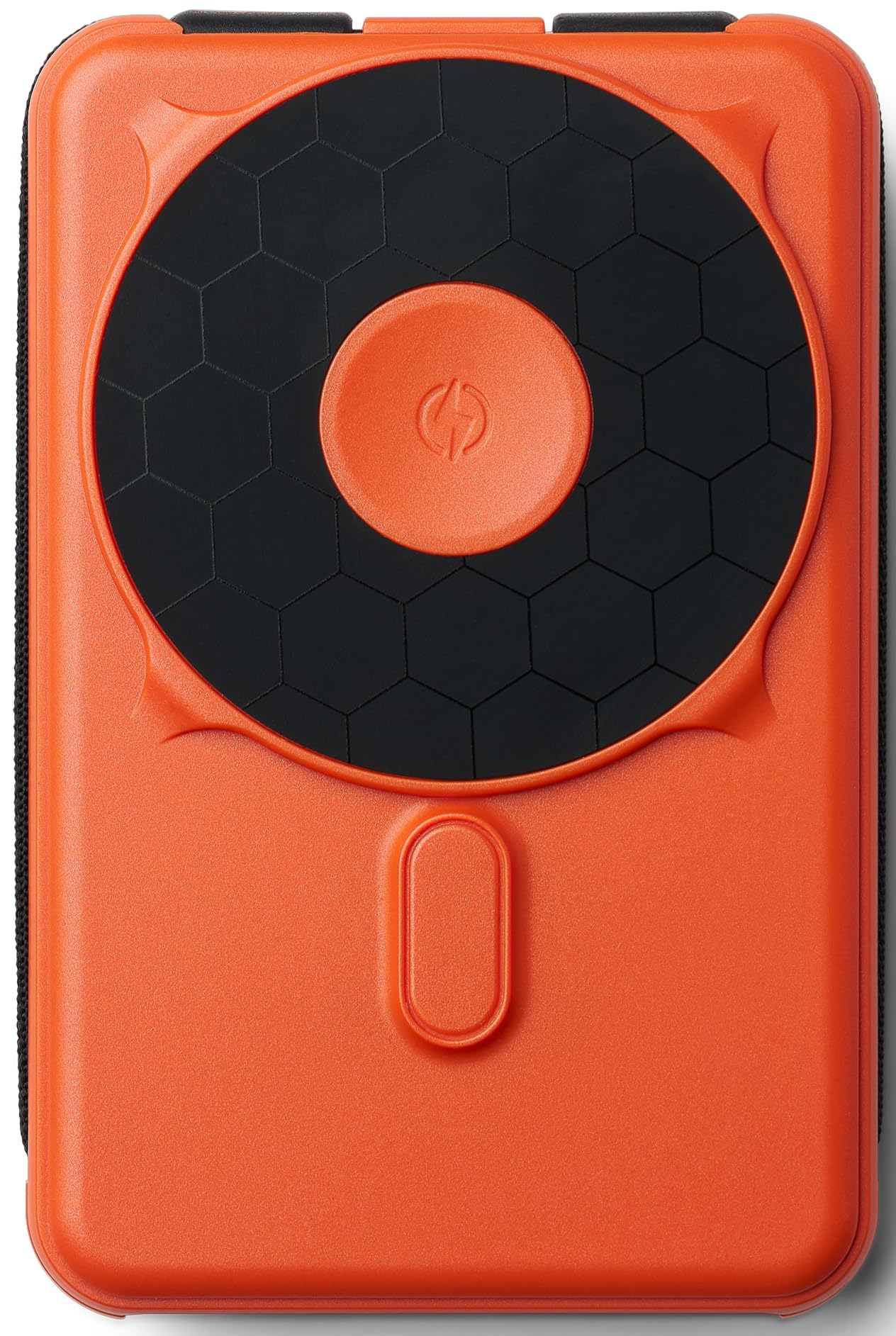
The RIDGE Magnetic Power Bank rethinks the form factor for users who prioritize everyday carry convenience over raw capacity. At 10,000mAh with dimensions of 4.13 x 2.68 x 0.63 inches and 300 grams, it’s designed to attach magnetically to the back of a MagSafe-compatible iPhone and stay there throughout the day — no cables, no dangling wires, no awkward pocket bulge. The 15W wireless charging rate is slower than wired 30W PD but makes up for it with the frictionless experience of never plugging in: you just snap the bank on and go.
The five-in-one design includes both a built-in USB-C cable and a Lightning cable retracted into the chassis, plus a dedicated Apple Watch charging puck that folds flush when not in use. This eliminates the need to carry any separate charging cord for your phone, watch, or the bank itself — the bank recharges through its own USB-C cable when plugged into a wall adapter.
The magnetic hold strength is calibrated to withstand casual jostling without detaching, yet the bank can be removed with one hand — a balance that cheaper magnetic banks often fail to achieve, either sliding off in a pocket or requiring two hands to pry apart. The LED charge status indicator shows remaining battery as a four-bar system plus a separate indicator for charge status. The Basecamp Orange colorway, along with Matte Olive and Matte Black options, uses a textured matte finish that resists fingerprints better than gloss-finished alternatives. This bank is not for power users who need three laptop charges — it’s for anyone who wants to never think about battery anxiety again during a normal day of phone and watch use.
Why it’s great
- Five-in-one design: MagSafe wireless, USB-C cable, Lightning cable, Apple Watch charger, kickstand
- Strong magnetic hold that stays attached in a pocket but removes one-handed
- Ultra-slim 0.63-inch profile disappears against the back of a phone
Good to know
- 10,000mAh capacity is half of the 20K options — adequate for one full phone charge plus top-ups
- 15W wireless charging is slower than wired PD; wired via built-in cable is faster
FAQ
Can I bring a 20,000mAh battery bank on a plane?
Does a battery bank degrade if I leave it plugged in overnight?
Why does my 20,000mAh bank only charge my phone twice instead of the advertised 3-4 times?
Final Thoughts: The Verdict
For most users, the best battery bank winner is the Anker Zolo Power Bank because it combines high-density 20,000mAh cells, a durable built-in USB-C cable, and ActiveShield 2.0 thermal management in a package that’s light enough to carry daily and reliable enough to trust for years. If you need to charge a laptop alongside your phone, grab the Baseus Blade 100W for its true 100W sustained output and laptop-sleeve-friendly profile. And for the minimalist who wants magnetic wireless convenience with built-in Apple Watch charging, nothing beats the RIDGE Magnetic Power Bank.

Mo Maruf
I created WellFizz to bridge the gap between vague wellness advice and actionable solutions. My mission is simple: to decode the research and give you practical tools you can actually use.
Beyond the data, I am a passionate traveler. I believe that stepping away from the screen to explore new environments is essential for mental clarity and physical vitality.