Our readers keep the lights on and my smoothie glass nicely filled. As an Amazon Associate, I earn from qualifying purchases.
A dead phone at dusk isn’t just an inconvenience—it’s a safety hazard when you’re miles from the trailhead. The difference between a useful camping battery and a frustrating paperweight comes down to real-world capacity, ruggedness against the elements, and the ability to juice up multiple devices over a long weekend without hunting for an outlet.
I’m Mohammad Maruf — the founder and writer behind WellFizz. I’ve spent hundreds of hours analyzing battery chemistries, output specs, and build quality to separate the gear that genuinely holds up on the trail from the marketing fluff that leaves you in the dark.
Whether you need to keep your GPS, headlamp, and phone alive for a multi-day trek or power a mini-cooler at a basecamp, this guide breaks down the top contenders for the best battery bank for camping so you can choose the right one without wasting money on hype.
How To Choose The Best Battery Bank For Camping
Not all power banks are built to handle the grit, temperature swings, and extended use that camping demands. Here are the critical factors that separate a camp-ready battery from an everyday commuter charger.
Capacity That Matches Your Trip Length
A 5,000mAh bank might top off your phone once, but it won’t last a weekend. For a 3-day trip with a phone, headlamp, and maybe a tablet, look for 20,000mAh or higher. Some units go up to 50,000mAh, which can charge a phone 8-10 times. But remember: higher capacity means more weight, so balance your power needs with how far you’re carrying it.
Weather Resistance and Durability
Camping gear gets dropped, splashed, and left out in the dew. An IP67 rating means the bank is dust-tight and can survive submersion in a meter of water for 30 minutes. Shockproof construction with a silicone sleeve or hard-shell body protects against drops on rocky ground. Skip anything without an IP rating if you plan to use it outdoors.
Output Ports and Charging Speed
You need enough ports to charge multiple devices simultaneously without slowing to a trickle. USB-C Power Delivery (PD) at 18W or higher is essential for fast charging modern phones and laptops. If you’re powering a CPAP machine or a mini-cooler, look for a unit with an AC outlet. For smaller electronics, two USB-A ports and a USB-C port are usually sufficient.
Recharging Options in the Wild
A power bank is only as good as your ability to refill it. Solar charging is a bonus for extended trips, though it’s slow (often 6+ hours for a full charge). The fastest way to recharge at camp is via a wall adapter or car charger. Some premium models support pass-through charging, letting you charge devices while the bank itself recharges.
Quick Comparison
On smaller screens, swipe sideways to see the full table.
| Model | Category | Best For | Key Spec | Amazon |
|---|---|---|---|---|
| VTOMAN Jump 600X | Power Station | Heavy-duty off-grid power | 299Wh LiFePO4, 600W AC | Amazon |
| Anker SOLIX C200 DC | Power Station | Compact, high-cycle backup | 192Wh LiFePO4, 140W USB-C | Amazon |
| GENSROCK 24,000mAh | Power Station | Laptop & device charging | 88Wh, 150W peak AC | Amazon |
| ZeroKor G120 | Power Station | Ultra-light basecamp power | 97.6Wh, 120W AC outlet | Amazon |
| SOXONO 40,000mAh Solar | Solar Power Bank | Extended solar-ready trips | 40,000mAh, built-in 4 cables | Amazon |
| YBYP 50,000mAh | Standard Power Bank | High-capacity, ultra-portable | 50,000mAh, 22.5W PD | Amazon |
| ELECOM NESTOUT 5,000mAh | Rugged Battery | Minimalist EDC & hunting | 5,000mAh, IP67, MIL-STD-810G | Amazon |
In‑Depth Reviews
1. VTOMAN Jump 600X

The VTOMAN Jump 600X is the most versatile power solution for serious campers who need more than just phone charging. Its 299Wh LiFePO4 battery delivers 600W of continuous AC power (1200W surge), which is enough to run a CPAP machine all night, power a mini-cooler for hours, or charge a laptop multiple times. The built-in car jump starter is a standout feature—it can jump-start a full-size truck even when the station itself is at 9% battery, as verified by real-world user tests. Pass-through charging means you can keep your devices powered while the station recharges from a wall outlet or solar panel.
The regulated 12V DC ports are a game-changer for setups requiring stable power, like car refrigerators or tire inflators. With three USB-A ports and a 60W USB-C PD output, you can charge up to nine devices simultaneously. The expandable capacity (up to 939Wh with an extra battery) makes this a future-proof investment for multi-day off-grid trips.
At 14.6 pounds, this is not a backpack carry—it’s designed for basecamp, car camping, or RV use. Some users noted the charging cord is thick and could be longer, but the performance and safety features (over 3,000 life cycles) far outweigh that minor inconvenience. It’s the premium pick for campers who refuse to compromise on power.
Why it’s great
- Combines power station and car jump starter in one rugged unit
- LiFePO4 chemistry offers 3,000+ cycles and safer operation in extreme temperatures
- Expandable capacity for extended off-grid living
Good to know
- Heavy at 14.6 lbs—not suited for backpacking
- Jumper cables sold separately
2. Anker SOLIX C200 DC

The Anker SOLIX C200 DC packs 192Wh of LiFePO4 power into a form factor 39% smaller than comparable power stations—making it one of the most space-efficient options for tent campers and van-lifers. Its two-way USB-C ports (140W and 100W) allow ultrafast charging of laptops and phones, and the station itself recharges to 80% in just 1.3 hours with a 140W PD charger. The 100W solar input capability means you can keep it topped off on sunny days without a wall outlet.
This unit is ideal for powering a Starlink Mini off-grid for 6-8 hours or keeping a gaming system running during a road trip. Users praise its quiet operation and reliable battery life; one delivery driver reported running it daily for 8-hour shifts without dropping below 75% charge. The five ports (3x USB-C, 2x USB-A) cover most device combinations without needing a separate hub.
The biggest catch is that the wall charger is not included, so you’ll need to buy a high-wattage USB-C adapter separately if you don’t already own one. At about 2.5 pounds, it’s light enough to carry in a daypack but still too heavy for ultralight backpacking. It’s a fantastic mid-range option for campers who value recharge speed and long battery cycle life over raw capacity.
Why it’s great
- Ultra-compact design with 140W USB-C fast charging
- LiFePO4 battery rated for 3,000 cycles and backed by a 3-year warranty
- Quick 1.3-hour recharge to 80% with a 140W charger
Good to know
- Wall charger not included in the box
- No AC outlet—all ports are USB-C and USB-A
3. GENSROCK 24,000mAh Power Station

The GENSROCK 24,000mAh power station strikes a rare balance between affordability and functionality by including two 120W AC outlets (150W peak) in a slim 2.3-pound package. It’s designed for campers who need to charge laptops, run a small fan, or power a camera battery charger without lugging a full-size generator. The 8 output ports (including 2x QC 3.0 USB-A, 1x USB-C, and 2x DC ports) provide enough flexibility to juice up a whole campsite of devices simultaneously.
Users consistently report that it holds a charge for months on standby and can charge an iPad multiple times or a laptop several times on a single full charge. The built-in BMS and cooling fan keep temperatures in check during extended use, and the SOS light mode adds a layer of safety for emergency situations. The green color and compact design make it easy to spot in a cluttered tent.
The 88Wh capacity (24,000mAh) is enough for a 3-4 day trip if you’re mostly charging phones and tablets, but it won’t power high-draw appliances like a hairdryer or space heater. Some users wished the USB-C port offered higher than 15W output for faster laptop charging. Still, for the price, it’s one of the best values for campers who need a lightweight AC outlet solution.
Why it’s great
- Two AC outlets in a lightweight 2.3 lbs form factor
- 8 total ports for charging multiple devices at once
- Excellent standby battery life lasting months
Good to know
- USB-C output limited to 15W
- Not powerful enough for high-wattage appliances
4. ZeroKor G120 Portable Power Station

The ZeroKor G120 is a ultra-portable power station that weighs just 2.2 pounds and comes with a built-in handle, making it an excellent companion for short camping trips or as a backup for home emergencies. Its 97.6Wh (26,400mAh) battery can inflate up to 5 air mattresses on a single charge or run a projector and speakers for over two hours—a feat verified by multiple happy users. The 120W AC outlet is enough to charge a laptop, run a small fan, or power a drone battery charger.
Three recharging methods (AC wall, car charger, and solar panel) give you flexibility in the field, and the digital screen shows remaining power and output status clearly. The LED flashlight includes reading and SOS modes, which are genuinely useful for night-time navigation or signaling. The BMS protection system and cooling fan ensure safe operation even during extended use.
Some users reported that the USB ports output only 5V, which means slow charging for modern phones unless you use the USB-C port. The solar charging is also slow, taking about 6 hours in full sun. Additionally, the AC and DC buttons can be confusing to operate at first. It’s a solid budget-friendly option for car campers who prioritize portability over massive capacity.
Why it’s great
- Very lightweight with a comfortable carrying handle
- 120W AC outlet provides essential power for small electronics
- Can inflate multiple air mattresses and power entertainment setups
Good to know
- USB ports limited to 5V output; slower charging for phones
- Solar recharge is slow and requires direct sunlight
5. SOXONO 40,000mAh Solar Charger Power Bank
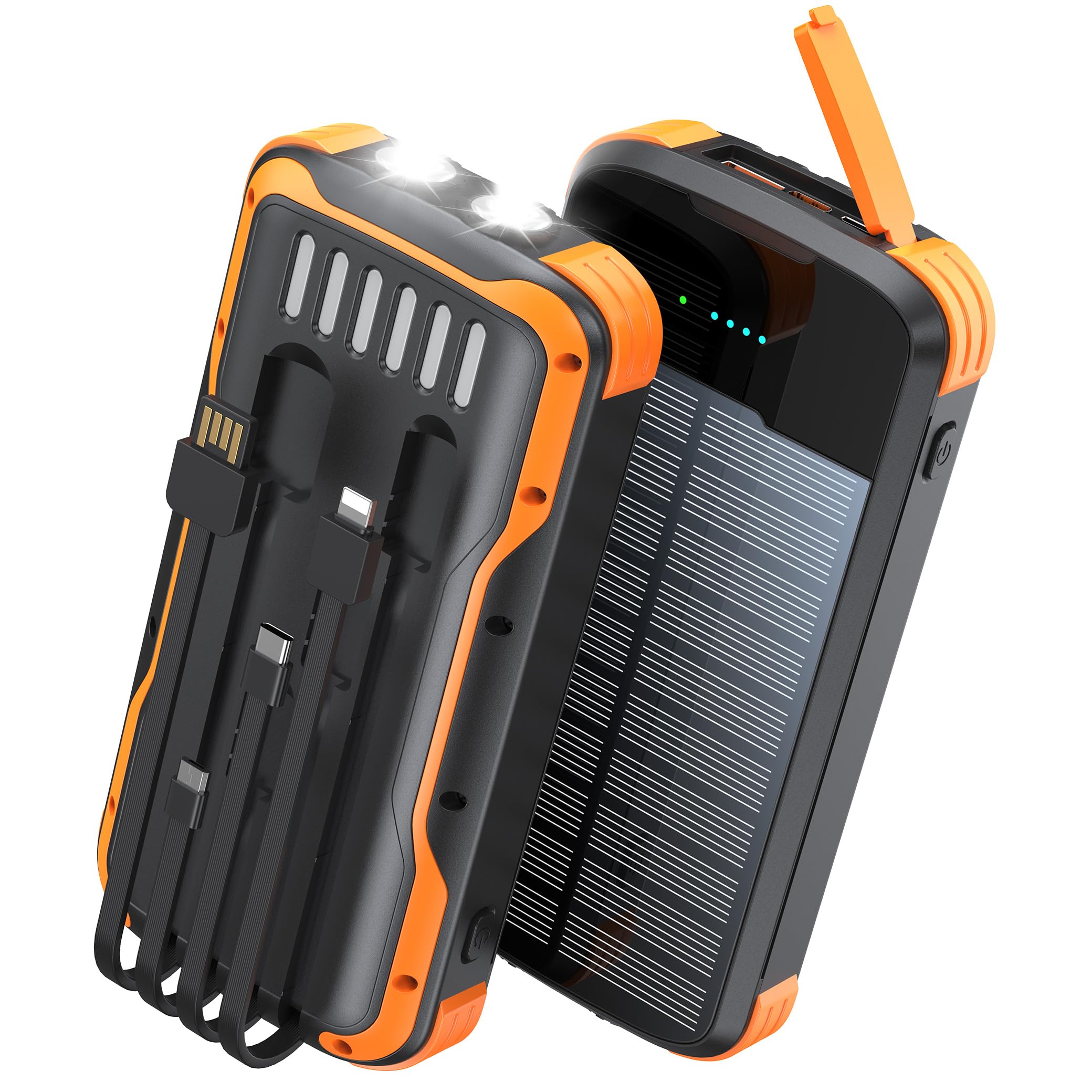
The SOXONO 40,000mAh solar power bank is built for campers who want to minimize cable clutter and maximize durability. It features four built-in charging cables (Type-C, iOS, Micro USB, and USB-A input) so you never have to remember to bring a separate cord. The IP67 waterproof and dustproof rating means it can survive rainstorms, splashes in a river, or accidental drops in mud. Two bright LED flashlights with up to 30 hours of runtime serve as emergency beacons or campsite lights.
The 20W PD fast charging via USB-C can take an iPhone 15 from zero to 65% in just 30 minutes, ensuring quick top-ups when you’re on the move. With five total output ports (including the built-in cables), you can charge up to five devices simultaneously. Users praise its ability to last 3-4 days of heavy use and its resistance to extreme heat inside a parked car.
The solar panel is a nice backup but charges slowly—expect 6+ hours of direct sun for a full charge, making it more of a trickle-fill than a primary recharge method. Some users noted a persistent plasticky-electrical smell initially, though it fades with use. At 1.17 pounds, it’s heavier than standard power banks of similar capacity, but the rugged build and included cables offset the weight for most outdoor needs.
Why it’s great
- Built-in charging cables eliminate the need to carry extras
- IP67 waterproof rating handles rain and splashes
- Dual flashlights with 30-hour runtime for emergency use
Good to know
- Solar charging is slow; may not be reliable for full recharge
- Heavier than some comparable standard power banks
6. YBYP 50,000mAh Portable Charger
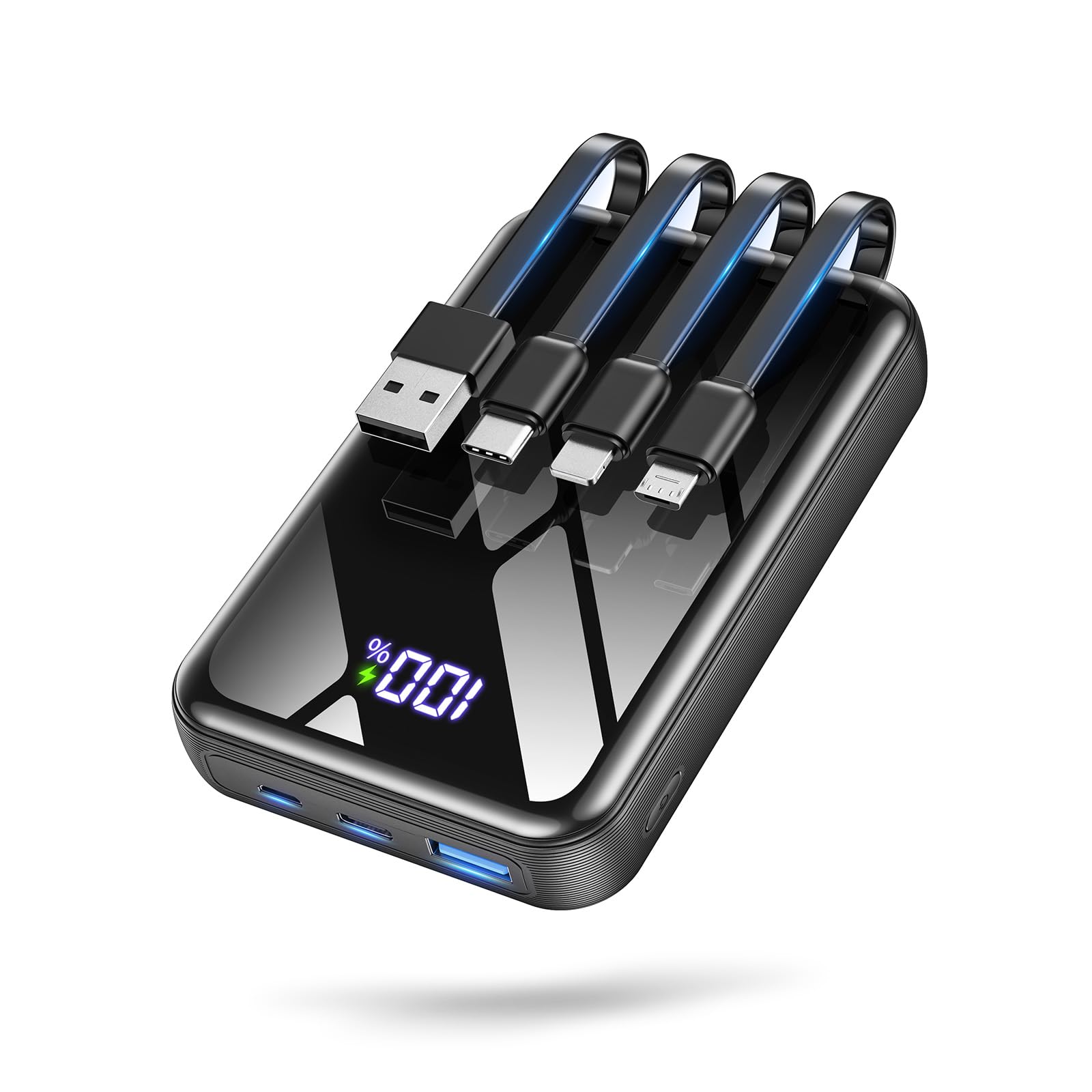
The YBYP 50,000mAh power bank delivers the highest raw capacity in this lineup, offering enough juice to charge an iPhone 17 over nine times or a Galaxy S25 over eight times. Despite the massive capacity, it measures only 4.8 x 3.1 x 1.1 inches and weighs 0.7 pounds—30% smaller than traditional high-capacity bricks. The 22.5W fast charging via USB-C can take an iPhone to 55% in 30 minutes, making it efficient for quick refuels during a hike.
Four built-in cables (Micro-B, USB-A, Type-C, and Lightning) plus three additional ports mean you can charge five devices simultaneously with zero cable hunting. The smart LED display shows exact remaining percentage, which is invaluable for rationing power over a multi-day trip. Users consistently rate it 5 stars for travel and power outages, praising its reliability and compact footprint.
The 8-layer safety protection (overcurrent, overvoltage, short-circuit, temperature control) ensures your devices stay safe even during prolonged use. The only real downside is that the built-in cables are relatively short, which can be awkward when charging devices in a tent. It’s an entry-level powerhouse that offers exceptional capacity at a budget-friendly cost without sacrificing essential safety features.
Why it’s great
- Huge 50,000mAh capacity in a surprisingly compact form factor
- Built-in Lightning, Type-C, Micro-B, and USB-A cables
- 22.5W fast charging tops off phones quickly
Good to know
- Built-in cables are short; may be awkward in some setups
- Recharge time is long (about 90 minutes) despite fast input
7. ELECOM NESTOUT 5,000mAh Rugged Power Bank
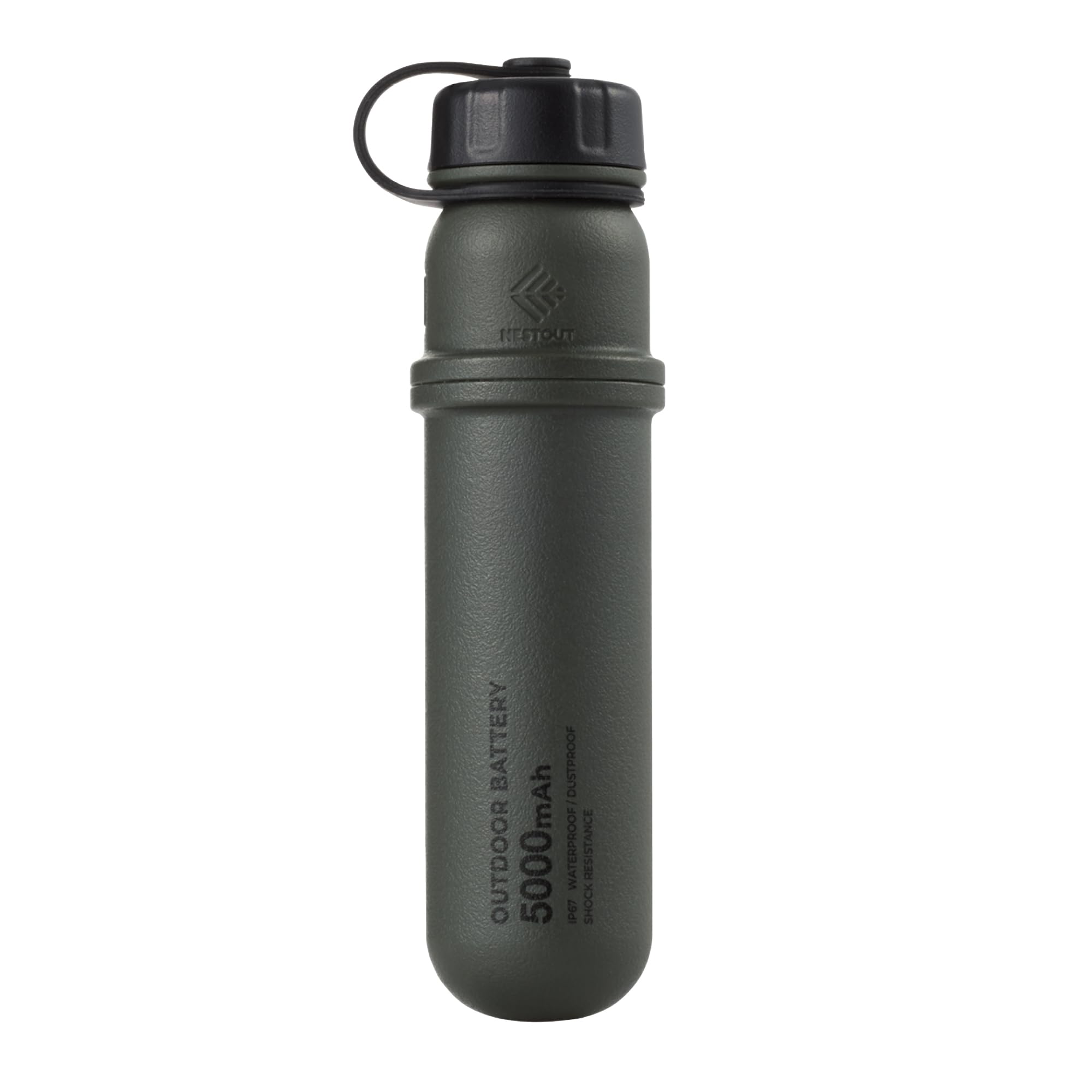
The ELECOM NESTOUT is not about raw capacity—it’s about surviving the harshest conditions. This IF Design Gold Award winner mimics the shape of a vintage fuel bottle and is built to MIL-STD-810G drop-test standards, meaning it can take a fall onto concrete from several feet without failing. The IP67 waterproof rating has been tested in real-world scenarios: one user reported it surviving a kayak capsize with zero moisture damage. It’s the go-to choice for hunters, anglers, and extreme-weather campers who need a battery that won’t quit when temperatures drop to -30°F.
The 5,000mAh capacity is modest—enough to charge a phone once or keep a headlamp and GPS running for a day. But the trade-off is a 32-gram weight and a form factor smaller than a flashlight, making it disappear into a pocket or survival kit. The bottom 1/4-20 tripod mount allows you to attach the NESTOUT LAMP-1 lantern or FLASH-1 LED panel (sold separately), turning it into a modular lighting system. The USB-C PD fast charging at 15W ensures your phone gets a meaningful top-up in under an hour.
The biggest limitation is the low capacity—some users found it couldn’t charge a modern phone past 50% before depleting. It’s designed for emergency backup, not multi-day off-grid power. The olive green color and tactical aesthetic may not appeal to everyone, but for those who prioritize ruggedness over runtime, it’s an unbeatable companion for short overnighters or emergency kits.
Why it’s great
- Extremely durable with IP67 waterproofing and MIL-STD-810G drop certification
- Ultra-lightweight at 32 grams; fits in any pocket
- Modular design with tripod mount for accessory lights
Good to know
- Only 5,000mAh capacity—not enough for extended trips
- May not fully charge larger smartphones
FAQ
How many charges will a 20,000mAh camping battery bank provide?
Is solar charging a power bank worth it for camping?
What IP rating should a camping power bank have?
Final Thoughts: The Verdict
For most users, the best battery bank for camping winner is the VTOMAN Jump 600X because it combines a high-capacity LiFePO4 battery, a 600W AC inverter, and a car jump starter in one rugged package—perfect for serious off-grid adventurers. If you want a lightweight, ultra-compact station with fast recharging, grab the Anker SOLIX C200 DC. And for ultra-durability in extreme conditions, nothing beats the ELECOM NESTOUT as a survival-ready emergency companion.

Mo Maruf
I created WellFizz to bridge the gap between vague wellness advice and actionable solutions. My mission is simple: to decode the research and give you practical tools you can actually use.
Beyond the data, I am a passionate traveler. I believe that stepping away from the screen to explore new environments is essential for mental clarity and physical vitality.