Our readers keep the lights on and my smoothie glass nicely filled. As an Amazon Associate, I earn from qualifying purchases.
A sudden power cut doesn’t just turn off the lights—it corrupts unsaved files, halts streaming, and can damage sensitive electronics in your home office or entertainment center. A battery backup UPS acts as an electrical bridge, giving you precious minutes to save work, shut down properly, or ride through brief flickers without interruption. The right model depends on your load, runtime needs, and whether your gear requires clean sine wave output.
I’m Mohammad Maruf — the founder and writer behind WellFizz. I’ve spent years analyzing electrical protection hardware, comparing VA ratings, transfer times, and battery chemistries to separate reliable units from overpriced promises.
After evaluating dozens of models across capacity, outlet configuration, and real-world runtime performance, I’ve curated this guide to the best battery backup ups for protecting computers, networking gear, and home entertainment systems during outages.
How To Choose The Best Battery Backup UPS
Three specifications define a UPS purchase: VA/watt capacity, runtime at your actual load, and output waveform. Ignoring any of these leads to either insufficient backup or a frustratingly short window to save your work.
VA vs. Watts — The Real Capacity
Volt-Amps (VA) measures total electrical flow, but Watts measures the actual power your devices consume. A 1500VA unit may only deliver 900W. Add up the wattage of everything you plug in—monitor, PC, router, external drives—and ensure the UPS watt rating exceeds that total by at least 20 percent.
Output Waveform — Simulated vs. Pure Sine Wave
Most consumer UPS units output simulated sine wave, which works fine for basic PC power supplies. Active PFC power supplies found in gaming PCs, servers, and some monitors may buzz, run hot, or shut down on simulated wave output. Pure sine wave UPS units deliver clean utility-grade electricity, preventing these issues and protecting sensitive audio/video gear.
Automatic Voltage Regulation (AVR)
AVR corrects undervoltage (brownout) and overvoltage conditions without draining the battery. This extends battery life because the UPS only switches to battery when the fluctuation exceeds the AVR correction range. In regions with frequent voltage dips, AVR is a non-negotiable feature.
Battery Chemistry and Service Life
Traditional sealed lead-acid (SLA) batteries last 3–5 years and are user-replaceable in quality units. Lithium iron phosphate (LiFePO4) batteries last 10+ years with thousands of charge cycles, but come at a higher upfront cost. Over a decade, LiFePO4 can be cheaper per year of service, especially if you plan to keep the UPS long-term.
Quick Comparison
On smaller screens, swipe sideways to see the full table.
| Model | Category | Best For | Key Spec | Amazon |
|---|---|---|---|---|
| APC BX1500M | Tower | High-capacity home office | 1500VA / 900W, 10 outlets | Amazon |
| CyberPower CP1350PFCLCD | Mini-Tower | Active PFC gaming/workstation PCs | 1350VA / 880W pure sine wave | Amazon |
| Tripp Lite OMNI1500LCDT | Tower | Long-term reliability / security systems | 1500VA / 810W, AVR, LCD | Amazon |
| GOLDENMATE 1000VA Lithium | Compact | LiFePO4 long-life / low noise | 1000VA / 600W pure sine wave | Amazon |
| CyberPower AVRG900LCD | Compact | Desktop + peripherals | 900VA / 480W, 12 outlets | Amazon |
| Amazon Basics 1000VA | Tower | Budget entry-level protection | 1000VA / 550W, 9 outlets | Amazon |
| APC BE600M1 | Compact | Light desktop / router backup | 600VA / 330W, 7 outlets | Amazon |
In‑Depth Reviews
1. APC BX1500M Back-UPS Pro 1500VA
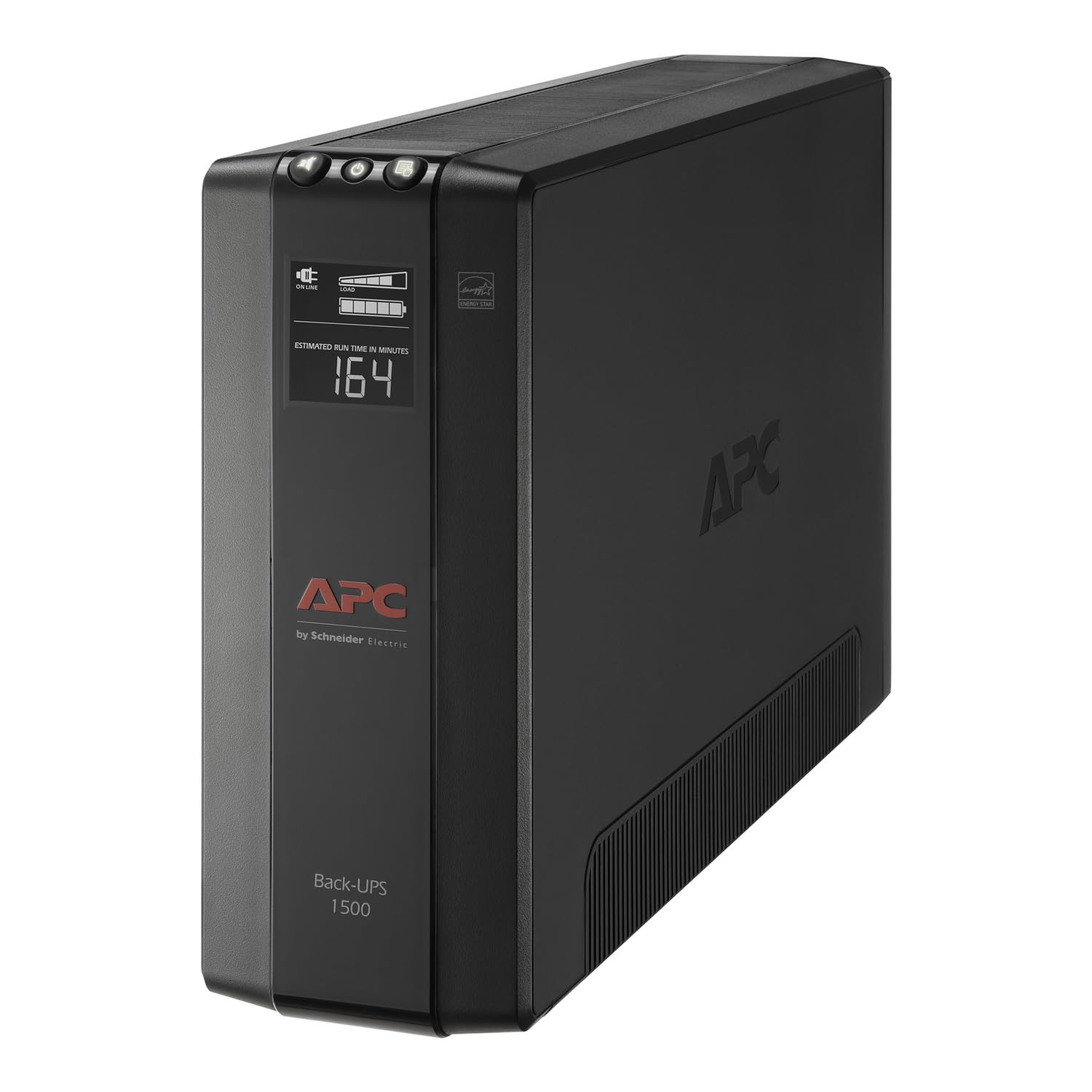
The APC BX1500M delivers the highest VA capacity commonly available for home use with 1500VA/900W output across ten outlets—five battery-backed and five surge-only. At a 300W load, you get roughly 19 minutes of runtime, enough to save work on a high-end PC and monitor during a moderate outage. The tower form factor includes coaxial and Ethernet surge protection, a welcome addition for anyone running cable or fiber-based internet.
Automatic Voltage Regulation (AVR) corrects brownouts as low as 88V and surges up to 13 percent above nominal without draining the battery, which extends the service life of the sealed lead-acid pack. Users report that the alarm can be muted via software or the front-panel button, addressing a common complaint about earlier APC models. The user-replaceable battery (APCRBC124) keeps the unit serviceable past the typical replacement cycle.
Connectivity includes USB Type-A and Type-C ports for device charging during outages, and the included PowerChute software enables automatic shutdown on Windows systems. While the LCD panel shows load level and estimated runtime, some users note that the self-test can produce a false low-battery alarm—cycling power resolves it. For the home office user who wants maximum capacity and proven reliability, this is the benchmark.
Why it’s great
- Highest home-use VA rating with 900W real power
- AVR corrects brownouts and surges without battery drain
- Coaxial and Ethernet surge protection included
- User-replaceable battery extends product lifespan
Good to know
- Simulated sine wave output—not ideal for active PFC PSUs
- Self-test can trigger false low-battery alarms on some units
- Software download link may require manual navigation
2. CyberPower CP1350PFCLCD PFC Sinewave 1350VA

If your desktop gaming rig or workstation uses an active PFC power supply, the CyberPower CP1350PFCLCD is the correct choice. Its pure sine wave output prevents the buzzing, overheating, and random shutdowns that simulated wave units can cause with modern high-efficiency PSUs. Rated at 1350VA/880W with 12 outlets (six battery-backed), it handles a demanding PC plus dual monitors comfortably.
The multifunction color LCD tilts up to 22 degrees and displays input voltage, load level, estimated runtime, and battery status clearly. AVR corrects fluctuations without switching to battery, and the 8-hour recharge time means the unit is ready for back-to-back outages. Users report that the fan remains silent on grid power and only activates during battery operation, keeping noise to a minimum in quiet home offices.
The included PowerPanel Personal Edition software provides graceful shutdown management, and the connected equipment guarantee adds serious peace of mind for expensive components. Some units arrive with a battery cable that needs a firm push to seat correctly—a minor setup step that is well documented. For anyone with a modern power supply that demands clean wave output, this CyberPower justifies the jump to the premium tier.
Why it’s great
- Pure sine wave output protects active PFC power supplies
- Color LCD panel with tilt adjustment shows detailed status
- 12 outlets with six battery-backed for expansive setups
- connected equipment warranty
Good to know
- Battery cable may require firm seating during initial setup
- Unit is heavy at over 25 pounds
- Replacement battery cost is higher than simulated wave units
3. Tripp Lite OMNI1500LCDT 1500VA

The Eaton Tripp Lite OMNI1500LCDT has a reputation among long-term UPS owners for durability that spans decades. The LCD screen cycles through runtime, wattage load, AVR status, and input voltage, giving you continuous visibility into power quality.
AVR corrects between 92V and 150V back to 120V without using battery power, which is particularly valuable in areas with frequent brownouts. The user-replaceable battery uses the RBC51 cartridge, and the metal-and-plastic tower enclosure feels industrial-grade. Owners report units lasting 5+ years with the original battery, and one user noted over 3 hours of runtime on a security camera system at low load—far exceeding typical estimates.
Data line protection includes RJ11 telephone and RJ45 Ethernet ports, though the software interface has received criticism for being difficult to discover on modern networks. Many users simply rely on the hardware features and skip the software entirely. If you want a UPS that you can set up, plug in, and forget about for half a decade, the OMNI1500LCDT earns its spot as a long-haul workhorse.
Why it’s great
- Proven track record of 5+ years of reliable service
- All 10 outlets provide battery backup, not just surge protection
- AVR handles a wide correction range (92V–150V)
- User-replaceable battery with standard RBC51 cartridge
Good to know
- Software setup can be frustrating on modern Windows
- Initial outgassing (plastic smell) for first few days
- Simulated sine wave output may not suit active PFC PSUs
4. GOLDENMATE 1000VA Lithium UPS

The GOLDENMATE 1000VA/600W lithium UPS breaks away from the lead-acid standard with a LiFePO4 battery pack rated for 10 years and 5,000+ charge cycles. The upfront cost is higher than an equivalent lead-acid unit, but the total cost of ownership drops by over 40 percent across the decade because you never buy a replacement battery. Pure sine wave output makes it suitable for sensitive electronics including gaming consoles and audio equipment.
With eight outlets and an intelligent LCD panel that shows real-time battery and power conditions, this UPS prioritizes long-term value and low maintenance. The internal BMS prevents overcharge, overdischarge, and overheating, and the unit weighs significantly less than lead-acid alternatives at the same VA rating. Users note that the cooling fan stays quiet on grid power and only becomes audible under heavy battery load—still under 50 dB.
The main trade-offs are the lack of a USB data port for automated shutdown (you won’t get graceful PC shutdown management without third-party hardware) and tightly spaced outlets that may block adjacent plugs when using bulky AC adapters. The 20ms transfer time is standard for standby UPS designs, though sensitive equipment may notice the brief gap. For buyers who plan to keep a UPS for the next decade, the LiFePO4 chemistry makes this a forward-looking investment.
Why it’s great
- LiFePO4 battery lasts 10+ years with zero replacements
- Pure sine wave output protects sensitive electronics
- Lightweight and compact for the capacity offered
- Buzzer mute function reduces noise in quiet rooms
Good to know
- No USB/network port for automated PC shutdown
- Outlet spacing is tight for bulky wall-wart adapters
- 20ms transfer time may affect extremely sensitive gear
5. CyberPower AVRG900LCD 900VA
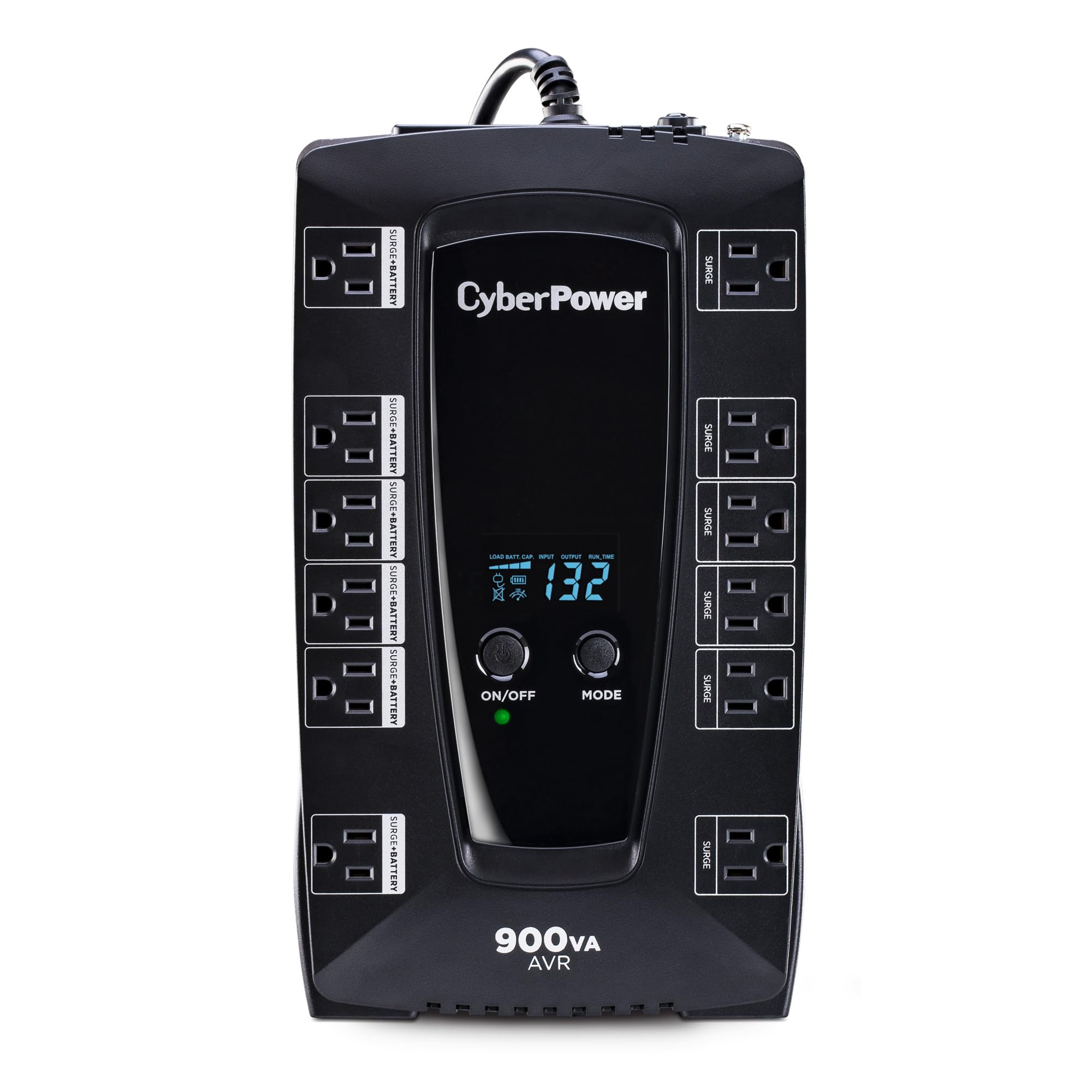
The CyberPower AVRG900LCD sits in a sweet spot for the typical desktop user who needs reliable backup without paying for capacity they won’t use. At 900VA/480W with 12 outlets (six battery-backed), it can power a desktop PC plus monitor, router, and a few peripherals simultaneously. The LCD screen displays input voltage, load level, and battery status, giving you clear visibility into how much headroom remains.
AVR corrects minor power fluctuations automatically, preventing unnecessary battery cycles that shorten lead-acid battery life. The simulated sine wave output is sufficient for standard PC power supplies, and the 5-foot right-angle input cord helps place the unit flat against a wall or under a desk. Users report that the free PowerPanel software is essential for configuring shutdown behavior—the front-panel mode button alone is not intuitive for advanced settings.
One commonly noted quirk is that the unit may beep aggressively out of the box until the battery is fully charged and the power is cycled. This is normal behavior rather than a defect, though it can be alarming on first power-up. For the home office or light workstation with moderate power needs, the AVRG900LCD delivers strong value and a proven track record from a major UPS manufacturer.
Why it’s great
- 12 total outlets provide flexibility for expanding setups
- AVR extends battery life by handling minor fluctuations
- LCD panel gives real-time load and voltage visibility
- UL certified with 3-year warranty including battery
Good to know
- Simulated sine wave output—not for active PFC PSUs
- Initial beeping until battery charges fully
- Mode button interface is less intuitive than software
6. Amazon Basics 1000VA UPS

The Amazon Basics 1000VA/550W UPS is a line interactive unit that delivers the essential protection profile at a budget-friendly point. Nine outlets total—five with battery backup and four surge-only—accommodate a standard desktop setup plus peripherals. The mini tower design with a 6-foot cord fits comfortably under most desks, and the metal enclosure feels more solid than the price suggests.
Simulated sine wave output and AVR are both included, which is uncommon at this price tier. At half load (500VA/275W), you get roughly 7 minutes of runtime—enough for a quick save and graceful shutdown. The user-replaceable lead-acid battery follows the same service model as more expensive units, though the battery life averages around 3-5 years before replacement is needed.
The primary trade-offs are the browser-based management software, which some users find dated, and reports of premature battery failure in a small percentage of units. Many owners recommend using CyberPower’s free PowerPanel software instead of Amazon’s own utility. For a spare office or secondary workstation where budget constraints are real, this unit provides basic protection without cutting the critical AVR feature.
Why it’s great
- Includes AVR at an entry-level price point
- Metal enclosure for durability in desk placement
- User-replaceable battery extends service life
- Compact tower form factor saves desk space
Good to know
- Browser-based software is clunky and may be flagged by security software
- Some units experience battery failure within the first year
- Simulated sine wave may not suit all PSUs
7. APC BE600M1 600VA

The APC BE600M1 is a compact UPS designed for lightweight desktop setups and networking gear. At 600VA/330W with seven outlets (five battery-backed, two surge-only), it is best suited for keeping a Wi-Fi router, modem, and a single desktop PC or monitor running through short outages. The 1.5A USB charging port remains active during battery operation, so you can keep a phone or tablet topped up when the power is out.
The recessed power button is a thoughtful detail that prevents a cat—or an errant elbow—from accidentally shutting down your protection. Users report that the unit keeps a router and modem running for 30-45 minutes during real outages, far longer than the rated runtime for PC loads. The user-replaceable battery (APCRBC154) is easy to swap without sending the whole unit back to the manufacturer.
This is not a unit for high-wattage gaming PCs or server racks. The simulated sine wave output is standard for this class, and there is no AVR, meaning the UPS will switch to battery more frequently during brownouts. For the specific use case of keeping internet connectivity alive during a blackout or protecting a small office PC during a flicker, the BE600M1 is a proven, reliable compact choice.
Why it’s great
- Compact footprint fits on crowded desks or shelves
- Recessed power button prevents accidental shutdown by pets or people
- USB port charges devices during outages
- User-replaceable battery with easy swap
Good to know
- No AVR—more battery cycles during brownouts
- Limited to 330W, unsuitable for gaming or high-end PCs
- Simulated sine wave output only
FAQ
Can a UPS power my entire home entertainment system during a blackout?
What does pure sine wave output actually do for my PC?
How often should I replace the battery in my UPS?
Final Thoughts: The Verdict
For most users, the best battery backup ups winner is the APC BX1500M because it combines the highest home-use VA capacity, AVR, and a proven track record at a reasonable investment. If you want pure sine wave protection for an active PFC gaming PC, grab the CyberPower CP1350PFCLCD. And for a set-it-and-forget-it long-term solution, nothing beats the Tripp Lite OMNI1500LCDT for decades of reliable service.

Mo Maruf
I created WellFizz to bridge the gap between vague wellness advice and actionable solutions. My mission is simple: to decode the research and give you practical tools you can actually use.
Beyond the data, I am a passionate traveler. I believe that stepping away from the screen to explore new environments is essential for mental clarity and physical vitality.