Our readers keep the lights on and my smoothie glass nicely filled. As an Amazon Associate, I earn from qualifying purchases.
Nothing kills a work-from-home day faster than a flickering light and the dreaded Wi-Fi dead zone. When the power goes out, your router doesn’t just slow down—it shuts off completely, taking your security cameras, smart home hub, and the kids’ school Zoom with it. A dedicated battery backup for your networking gear isn’t a luxury anymore; it’s the difference between staying productive and scrambling for a coffee shop with a half-charged laptop.
I’m Mohammad Maruf — the founder and writer behind WellFizz. I’ve spent the last several years deep-diving into hardware specs, reading through thousands of consumer reviews, and analyzing the real-world performance data of home backup solutions to separate the short-lived junk from the genuine workhorses.
After evaluating dozens of models by capacity, output stability, connector versatility, and user-reported runtime data, I’ve curated the definitive list of the best options available now. This guide covers the battery backup for wifi router market so you can choose the unit that actually keeps your network alive—not just one that looks good on a shelf.
How To Choose The Best Battery Backup For WiFi Router
Not every backup battery is built to handle the steady, low-voltage draw of a Wi-Fi router and modem. Selecting the wrong type—say, a massive tower UPS meant for a gaming PC—will leave you with wasted capacity and a massive footprint on your desk. Focus on these three criteria to find your ideal match.
Battery Chemistry: Lithium-ion vs. Sealed Lead-Acid (SLA)
Lithium-ion packs (like the 37Wh or 97.2Wh units) are lighter, charge faster, and deliver consistent voltage until the very last cell is depleted. They are ideal for the 10 to 20 watt loads of typical router setups. Sealed lead-acid (SLA) batteries, found in traditional UPS units from APC and others, are heavier, take 8 to 10 hours to recharge fully, and degrade faster when regularly deep-cycled. However, SLA units usually offer user-replaceable batteries and robust surge protection circuits. For a dedicated router backup you expect to cycle frequently during short outages, lithium is the smarter call. For a whole-desk solution that also protects a computer, SLA still makes sense.
Output Voltage and Connector Type
Routers and modems rarely use a standard AC plug. Most run on DC power adapters with barrel jacks at 5V, 9V, or 12V. A mini UPS that offers multiple DC barrel outputs (5.5mm x 2.1mm) plus USB-A and USB-C ports will let you ditch the wall warts entirely and power your network stack from a single box. Check your device’s input voltage before buying—a unit that only outputs 12V will fry a 5V router, and one that only outputs 5V won’t power a 12V modem.
Runtime at Real-World Load
Manufacturer runtime claims are often measured at absurdly low loads (like a single 5W LED). Your typical home network stack—fiber ONT, Wi-Fi 6 router, and a network switch—pulls between 18 and 30 watts. Do the math: a 56Wh battery pack running a 20W load will theoretically last 2.8 hours, but real-world efficiency losses mean you should expect about 70 to 75 percent of that. For 8+ hours of backup, target at least 90Wh (like 27000mAh at 3.7V). If you only need 30 minutes to ride through a brownout, a 425VA/255W SLA unit from APC is more than enough.
Quick Comparison
On smaller screens, swipe sideways to see the full table.
| Model | Category | Best For | Key Spec | Amazon |
|---|---|---|---|---|
| TalentCell 27000mAh | Mini UPS | Multi-device DC networks | 97.2Wh lithium-ion capacity | Amazon |
| APC BE600M1 | Tower UPS | Whole-desk computer + router | 600VA/330W surge protection | Amazon |
| Yuuki Power 18000mAh | Mini UPS | CCTV and PoE setups | 66Wh with PoE output | Amazon |
| Shanqiu Mini UPS | Mini UPS | Budget-friendly compact setup | 37Wh lithium polymer pack | Amazon |
| SKE DC20000 Plus | Mini UPS | Travel and portability | 20000mAh with AVR | Amazon |
| APC BE425M | Tower UPS | Entry-level office backup | 425VA/255W battery backup | Amazon |
| SKE SK425 | Tower UPS | High-wattage networking racks | 850VA/480W backup power | Amazon |
In‑Depth Reviews
1. TalentCell 27000mAh Mini UPS

This is the unit that keeps coming up in real-world user reports as the workhorse of the category. Packing 97.2Wh of lithium-ion capacity across twelve 18650 cells, the TalentCell delivers four dedicated DC outputs (12V, 9V), two USB-A ports, and a USB-C PD 18W port. That voltage variety means you can power a fiber ONT at 12V, a Wi-Fi router at 9V, and a smart home hub at 5V from a single brick—no wall warts, no tangled cables. Real users report back-to-back 8 to 24 hour runtimes on mixed modem-router-switch loads in the 10 to 15 watt range, which is exceptional for this form factor.
The built-in short-circuit, over-current, and over-discharge protections aren’t just marketing checkboxes—they matter when you’re plugging in sensitive networking gear. The unit also functions as a high-capacity power bank for phones and tablets, adding versatility beyond pure backup duty. At roughly 1.5 pounds, it’s light enough to toss into a go-bag for a temporary workspace. The only real catch is the DC barrel connector standard (5.5mm x 2.1mm). If your router uses a non-standard tip, you’ll need to buy a tip adapter or male-to-male cable separately, which adds a minor setup friction.
The efficiency savings alone are a hidden bonus. One meticulous user calculated that consolidating five separate power adapters into this single unit saved 19 watts of vampire draw, paying back the purchase price in under five years on electricity alone. That’s the kind of long-term value that makes the TalentCell the smartest buy for anyone serious about keeping their network alive without filling a shelf with a lead-acid tower.
Why it’s great
- High 97.2Wh capacity runs a full network stack for 8+ hours
- Four separate DC output voltages eliminate external power adapters
- USB-C PD 18W doubles as a fast power bank
Good to know
- DC barrel connectors may require tip adapters for non-standard ports
- LED battery indicator is imprecise (4 lights = approximately 85-100%)
2. APC BE600M1 UPS

When your setup includes a desktop PC that needs a graceful shutdown—not just router uptime—the APC BE600M1 is the reference standard. This 600VA/330W tower UPS supplies five battery-backed outlets plus two surge-only outlets, giving you enough headroom to plug in your modem, router, monitor, and a mini PC or laptop charger simultaneously. APC rates this unit for 23 minutes at a 100-watt load, but real-world users pushing just their networking gear (15 to 25 watts) report runtimes closer to 30 to 45 minutes—enough to ride through the vast majority of short-duration outages.
The built-in 1.5A USB-A port charges a phone while the power is out, which is a simple but genuinely useful addition for emergency scenarios. The real competitive advantage here is the user-replaceable battery (APC part APCRBC154). When the internal 12V lead-acid cell degrades after 2-3 years, you swap the battery for a fraction of the cost of buying a whole new unit. That’s not true for most lithium-based mini UPS units, which are typically sealed and discarded when the cells die. The recessed power button also prevents accidental shutdowns—a feature praised by pet owners whose cats have learned to walk across desk equipment.
On the downside, the 10-hour recharge time is slow compared to lithium competitors that refill in 2 to 3 hours. And the lead-acid chemistry means this unit weighs over 6 pounds, making it a permanent desk fixture rather than a portable solution. If you need to rotate the backup between a home office desk and a living room movie setup, the weight is a real friction point. But for a fixed station where you also protect a computer, the APC BE600M1 remains the gold standard for reliability and total lifecycle value.
Why it’s great
- User-replaceable battery extends the unit’s life by years
- Five battery-backup outlets protect your entire desk
- Proven reliability from APC with 3-year warranty
Good to know
- Heavy (6+ pounds) and not designed for travel
- 10-hour recharge is slow compared to lithium units
3. Yuuki Power 18000mAh Mini UPS
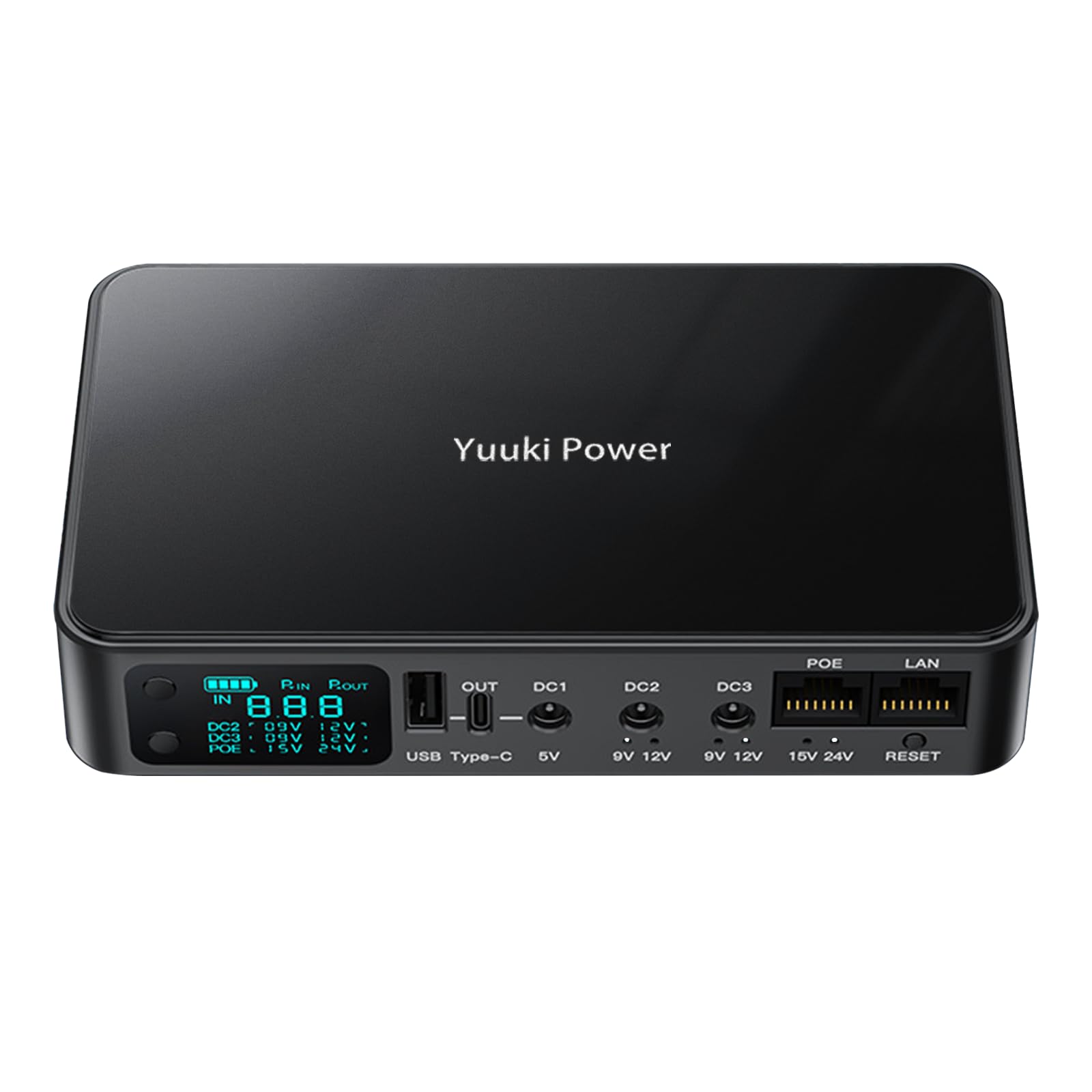
The Yuuki Power 18000mAh (66Wh) unit carves a unique niche by supporting Power over Ethernet (PoE) at both 15V/1.3A and 24V/0.8A, making it the only mini UPS on this list that can directly power a security camera or a Raspberry Pi with a PoE hat. That alone sets it apart for users who run outdoor IP cameras or home automation controllers that draw over standard USB limits. The clear LCD screen shows real-time voltage and battery percentage—a detail that rivals like the TalentCell only hint at with vague LED bars.
The build is compact at 3.78 x 6.3 x 1.3 inches and weighs just 1.15 pounds, which is remarkably light for a 66Wh pack. It includes a generous selection of six DC barrel adapters of varying sizes, which significantly reduces the frustration of finding the correct plug for your specific router or camera. User reports confirm that this unit easily keeps a modem and router running for multiple hours during an outage—one reviewer specifically cited 6+ hours with a Eufy HomeBase and router combined, which is a common smart-home configuration that other mini UPS units struggle to support without extra step-down converters.
The major limitation is the total output power limit of 24 watts. On paper, the individual ports look capable of 9V at 2A (18W) or 12V at 2A (24W), but in practice you cannot run two devices near their maximum simultaneously. A typical router (say 12V at 1.5A) plus a network switch (5V at 2A) already pushes 28 watts, which exceeds the limit and can cause the unit to drop one device or behave unreliably. This makes the Yuuki Power best suited to a single moderately powered device (like a router plus one low-draw sensor) rather than a full network rack. For dedicated router-only backup with camera support, it’s the top tier option.
Why it’s great
- Built-in PoE output for CCTV cameras and Raspberry Pi
- Clear LCD screen shows exact battery level real-time
- Comes with multiple DC tip adapters for fitment
Good to know
- Total output capped at 24 watts—limits multi-device setups
- Batteries are soldered in, not user-replaceable
4. Shanqiu Mini UPS 37Wh

The Shanqiu Mini UPS occupies a tier where price meets genuine utility for a single-device setup. Its 37Wh (10,000mAh) lithium-polymer pack is the smallest capacity on this list, but it’s paired with a surprisingly premium aluminum alloy housing that dissipates heat far better than the plastic shells of competitors at the same tier. You get a 5V DC barrel, 9V DC barrel, 12V DC barrel, and a standard USB-A output—enough to power one router (typical 10-12W draw) for about 2.5 to 3 hours of real-world runtime.
Multiple users with TP-Link Deco mesh systems and IKEA smart hubs report reliable backup for several hours, which is more than adequate for the vast majority of short-duration power blips in suburban and urban areas. The USB-C input charging is a nice convenience—you can top up the pack with your laptop charger—and the charge time is a speedy 2 hours thanks to the lithium-polymer chemistry. The form factor is genuinely pocketable at 5.87 x 4.17 x 1.26 inches, making this the best candidate for travel or temporary relocation between rooms.
The catch, and it’s a significant one, is long-term reliability. A minority of reviews describe battery failure after 4 to 6 months, with the unit unable to hold a charge or cycling its LED lights without delivering power. The support response in those cases was reportedly poor. This doesn’t make the Shanqiu a bad purchase—it makes it a calculated risk. If you need a cheap, fast-charging, compact unit for occasional use and accept that it may have a shorter service life than a mid-range option, the Shanqiu is a reasonable stopgap. It is not a set-and-forget solution for mission-critical setups.
Why it’s great
- Aluminum housing is durable and helps with thermal management
- Fast 2-hour recharge from USB-C input
- Very compact form factor for travel or desk decluttering
Good to know
- Some units fail after 4-6 months of regular use
- Only 37Wh capacity—run out within 3 hours on a 12W load
5. SKE DC20000 Plus Altair

The SKE DC20000 Plus Altair is a mid-range contender that focuses on portability and modern charging convenience. With a 20,000mAh (approximately 72Wh estimated) lithium pack, it outputs 5V, 9V, and 12V through both barrel jacks and USB-C/USB-A ports, and adds built-in Automatic Voltage Regulation (AVR) to smooth out minor power fluctuations. The AVR feature is unusual in a mini UPS at this tier and provides genuine peace of mind for sensitive networking gear that can be damaged by voltage sag before the battery even kicks in.
Real-world user feedback is strong on runtime: one user reported powering a fiber ONT for 9 hours and only dropping to 75% capacity, suggesting a potential 24+ hour runtime on a single low-power device. Another reviewer praised its ability to run an Echo Dot (at 12V) at moderate volume, confirming its versatility beyond pure networking. The long-press power button is a thoughtful design detail that prevents the unit from being accidentally shut off—a common frustration with cheaper mini UPS units that use a simple toggle switch. The slim profile (4.2 x 8.1 x 1.3 inches) and included wall-mounting brackets make it easy to attach behind a TV stand or network cabinet.
The durability record, however, is mixed. A small but notable cluster of reviews report total failure after 5 to 6 months, with the unit emitting a persistent beep and refusing to charge. Customer support for those cases was reported as unresponsive. This reliability concern is shared with the Shanqiu unit, but at nearly double the price point, the risk feels more significant here. The SKE DC20000 Plus is a good option if you prioritize modern connectors and AVR in a slim package, but you should verify the warranty and return policy before committing—or be prepared for a potential mid-life failure.
Why it’s great
- AVR protection helps stabilize incoming voltage
- Slim, wall-mountable design saves desk space
- Excellent runtime reported on single low-power devices (9+ hours)
Good to know
- Some units fail completely within 5-6 months
- Customer support has been unresponsive in reported cases
6. APC BE425M UPS

The APC BE425M is the entry-level gateway to proper surge protection and battery backup for people who want a single, trustworthy box under their desk. At 425VA/255W, it’s clearly not built for a gaming PC with a 750-watt power supply—several reviews note that it beeps and shuts down under computer loads—but for a 20-watt router and modem stack, it’s more than adequate. The six outlets are well-spaced, with four providing battery backup and surge protection and two providing surge-only, which is great for plugging in a lamp or printer that doesn’t need battery runtime.
The wall-mountable form factor (4.13 x 9.98 x 5.52 inches) is a clever space-saver for small apartments, dorm rooms, or network closets where desk real estate is precious. Users report reliable 1 to 2 hours of runtime on router-only loads (around 15 to 20 watts), which is enough to cover most brief outages that would otherwise drop a Zoom call or cut a cloud upload. The default “quiet alarm” mode means the UPS won’t beep annoyingly during small flickers—a major quality-of-life upgrade over older APC units that emitted a loud tone every time the power blinked.
The sealed lead-acid battery inside has a typical life of 2 to 3 years before it needs replacement, and while APC officially states the battery is not user-replaceable on this model, many users have successfully swapped the standard 12V 4.5Ah AGM cell themselves. The real limitations are the 8-hour recharge time and the relatively heavy weight (over 5 pounds). If your need is strictly router backup with zero computer involvement, a lithium mini UPS is lighter and charges faster. But if you want a simple, proven UPS with a 3-year warranty and connected equipment protection, the BE425M is a rock-solid entry point.
Why it’s great
- Proven APC build quality with 3-year warranty
- Quiet alarm mode eliminates beeping on flickers
- Wall-mountable saves valuable desk surface
Good to know
- 8-hour recharge is slow compared to lithium units
- Battery is officially labeled non-replaceable
7. SKE SK425 850VA UPS
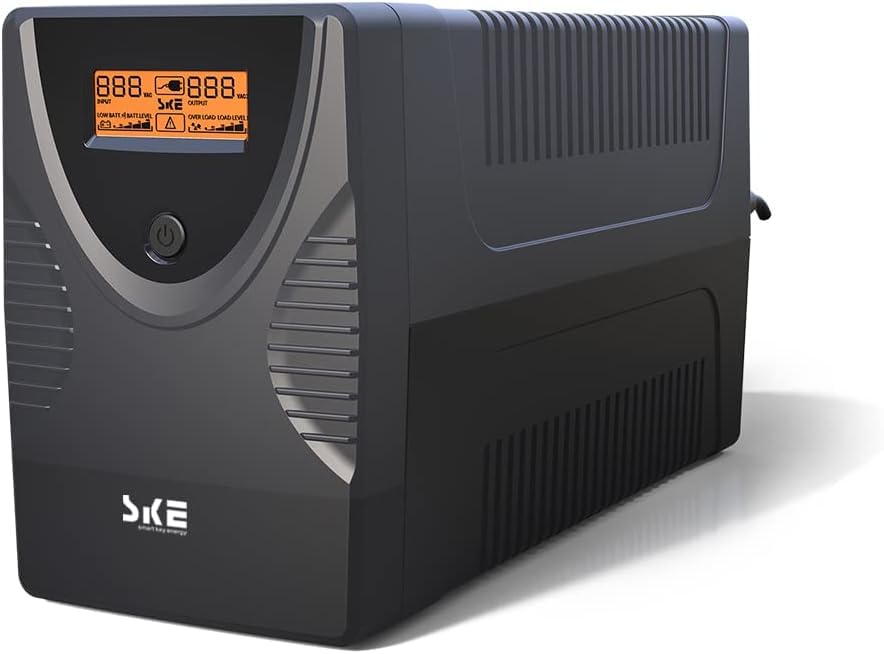
The SKE SK425 850VA/480W tower UPS is the heavyweight of this list, aimed squarely at users who run a NAS, a mini server, and a full network rack in a home office. With 6 outlets (all offering battery backup and surge protection), a built-in LCD screen for real-time load and battery status, and AVR voltage regulation, it competes directly with APC’s mid-range lineup at a lower entry point. The 480-watt capacity means you can comfortably plug in a Synology NAS, a PoE switch, a router, a modem, and a monitor without worrying about overload—something the 255W APC BE425M simply cannot handle.
User reviews consistently praise its compatibility with shutdown software across multiple operating systems, including older Windows versions and macOS. The LCD display is a genuine differentiator at this price point, showing you the input voltage, output load percentage, and estimated runtime at a glance. The unit is built with a metal enclosure (10.1 pounds) and uses standard IEC 320 connectors, which makes it easy to use standard power cords rather than proprietary cables. One user specifically noted it pairs well with a generator as an additional surge filter for sensitive appliances like a fridge or freezer.
The downsides are primarily physical. The 6 outlets are packed tightly—some users report that larger “wall wart” power adapters block adjacent outlets, requiring a power strip extender. The lead-acid battery inside takes a full 8 to 10 hours to recharge, so if you experience multiple outages in a single day, you may find yourself without backup for the second one. And at 10 pounds with a tower footprint, this is not a device you’ll want to move between rooms. For a fixed network rack or heavy desktop setup that demands both router and NAS uptime, however, the SKE SK425 offers an impressive capacity-to-price ratio that is hard to beat among traditional tower UPS units.
Why it’s great
- 480W capacity can handle a full network rack plus NAS
- LCD screen provides instant load and runtime data
- User-replaceable battery extends product lifespan
Good to know
- Outlets are tightly spaced—large adapters may block neighbors
- 10-hour recharge time for the lead-acid battery
FAQ
Can I use a standard power bank to power my router?
How long does a typical mini UPS last before the battery needs replacement?
Do I need a special cable to connect my router to a mini UPS?
Final Thoughts: The Verdict
For most users, the battery backup for wifi router winner is the TalentCell 27000mAh because it delivers 97.2Wh of lithium capacity, multiple DC voltage outputs, and a real-world runtime of 8+ hours on a typical network stack—all in a compact, portable form factor. If you want user-replaceable battery longevity and AC outlet protection for a computer, grab the APC BE600M1. And for a CCTV or PoE-powered camera setup, nothing beats the Yuuki Power 18000mAh with its integrated PoE output and clear LCD status screen.

Mo Maruf
I created WellFizz to bridge the gap between vague wellness advice and actionable solutions. My mission is simple: to decode the research and give you practical tools you can actually use.
Beyond the data, I am a passionate traveler. I believe that stepping away from the screen to explore new environments is essential for mental clarity and physical vitality.