Our readers keep the lights on and my smoothie glass nicely filled. As an Amazon Associate, I earn from qualifying purchases.
When the grid goes down, the first things you notice are the silence of the refrigerator compressor and the slow drift of your Wi-Fi router into darkness. A home battery backup bridges that gap, keeping essential circuits alive without the noise, fumes, or fuel logistics of a gas generator. The market has shifted hard toward lithium iron phosphate (LiFePO₄) chemistry, faster recharge rates, and expandable capacity stacks that turn a single unit into a whole-home buffer.
I’m Mohammad Maruf — the founder and writer behind WellFizz. This guide is the product of dozens of hours analyzing inverter topologies, battery management systems, charging curves, and port configurations across the current home backup landscape.
Whether you want to keep a refrigerator running through a multi-day outage or provide seamless UPS-grade protection for sensitive electronics, finding the right battery backup for home means matching capacity, surge capability, and recharge speed to your actual load profile.
How To Choose The Best Battery Backup For Home
Not every portable power station is built for sustained home backup. The difference between a camping accessory and a reliable home battery backup comes down to capacity, inverter quality, recharge speed, and how well the unit handles continuous loads over hours or days. Before you commit, match these factors to your home’s specific outage profile.
Match Capacity to Your Critical Load
Start by listing the devices you absolutely need during an outage — refrigerator, modem/router, a few LED lights, a CPAP machine, and maybe a well pump or sump pump. Add up their running wattage and multiply by the hours you expect to be off-grid. A 2,000 Wh unit powers a fridge (~150W) for about 13 hours, but if you also need to run a furnace fan or a freezer, step up to 3,000 Wh or more. Expandable models let you add extra battery packs later without replacing the core unit.
Inverter Type and Surge Capacity
Pure sine wave inverters are non-negotiable for sensitive electronics like refrigerators, medical devices, and computers. They produce clean AC power identical to grid electricity. The rated continuous wattage tells you what the unit can sustain, but the surge rating (often 2x continuous for a few seconds) matters for starting motors in fridges, pumps, and air conditioners. A unit rated at 2,400W continuous with a 4,800W peak handles most residential start-up surges.
Recharge Speed and Input Versatility
Fast AC recharging — under two hours to 80% — means you can top off between grid outages or during generator runtime. Solar input is valuable for multi-day scenarios; look for MPPT controllers that accept high voltage (up to 150V) so you can run panels in series. Some units now support alternator charging from a vehicle, which turns your car into a mobile recharging source during extended blackouts.
UPS Transfer Time and Pass-Through
For always-on equipment like a modem, router, or security system, the transfer time when switching from grid to battery matters. Look for units with ≤20ms switchover — anything slower may reboot your electronics. Premium models now offer ≤10ms seamless UPS behavior. Pass-through charging (running devices while the battery recharges from AC) is essential for indefinite backup without manual switching.
Quick Comparison
On smaller screens, swipe sideways to see the full table.
| Model | Category | Best For | Key Spec | Amazon |
|---|---|---|---|---|
| BLUETTI AC200L | Mid-Range | Expandable home backup | 2400W output, 2048Wh, expandable to 8192Wh | Amazon |
| EF ECOFLOW DELTA 3 Ultra Plus | Premium | Whole-house scalability | 3600W output, 3072Wh, expandable to 11kWh | Amazon |
| Jackery HomePower 3000 | Premium | Compact 3kWh backup | 3600W output, 3072Wh, 4000 cycles | Amazon |
| Jackery Explorer 2000 v2 | Mid-Range | Lightweight 2kWh backup | 2200W output, 2042Wh, 39.5 lbs | Amazon |
| Anker SOLIX C2000 Gen 2 | Mid-Range | Fast recharge, quiet operation | 2400W output, 2048Wh, 58-min full charge | Amazon |
| PECRON F3000LFP | Mid-Range | High-capacity value | 3600W output, 3072Wh, 2-hour recharge | Amazon |
| DJI Power 2000 | Premium | Ultra-quiet UPS, rugged build | 3000W output, 2048Wh, 55-min to 80% | Amazon |
| AFERIY P210 | Budget | Entry-level whole-home | 2400W output, 2048Wh, 30dB quiet | Amazon |
| VTOMAN Jump 600X | Budget | Compact backup + car jump-start | 600W output, 299Wh, expandable to 939Wh | Amazon |
In‑Depth Reviews
1. BLUETTI AC200L Portable Power Station

The BLUETTI AC200L is a 2,048Wh LiFePO₄ station that punches well above its mid-range price tag. Its 2,400W pure sine wave inverter handles a refrigerator, freezer, and home networking gear simultaneously, and the 3,600W Power Lifting mode kicks in for motor start-up surges on appliances like a window A/C or a well pump. The real headline here is expandability — you can add up to two B300K batteries to reach 8,192Wh, turning this into a multi-day home backup without swapping hardware.
AC recharge hits 0–80% in 45 minutes at 2,400W input, one of the fastest rates in this capacity class. Solar input supports up to 1,200W via MPPT, which means four 300W panels can refill the pack in under two hours of good sun. The ≤10ms UPS switch time is fast enough to keep a computer or router online during a transfer, and the 30A RV outlet makes it practical for larger trailers as well as fixed home use.
At 61.4 pounds, the AC200L is on the heavier side — you won’t want to tote it daily, but for a stationary home backup that you roll out when storms approach, the weight is acceptable. The proprietary AC adapter safety lock is a minor inconvenience, and the app, while functional, lacks some of the granular control found on EcoFlow models. Overall, the AC200L offers the best balance of capacity, expandability, and recharge speed for typical home outage scenarios.
Why it’s great
- Fast 45-minute recharge to 80%
- Expandable to 8,192Wh with add-on batteries
- 30A RV outlet integrates easily with home transfer switches
Good to know
- Heavy at 61.4 pounds for shifting around
- Proprietary AC cable lock adds a step to charging
- App interface is less intuitive than some competitors
2. EF ECOFLOW DELTA 3 Ultra Plus
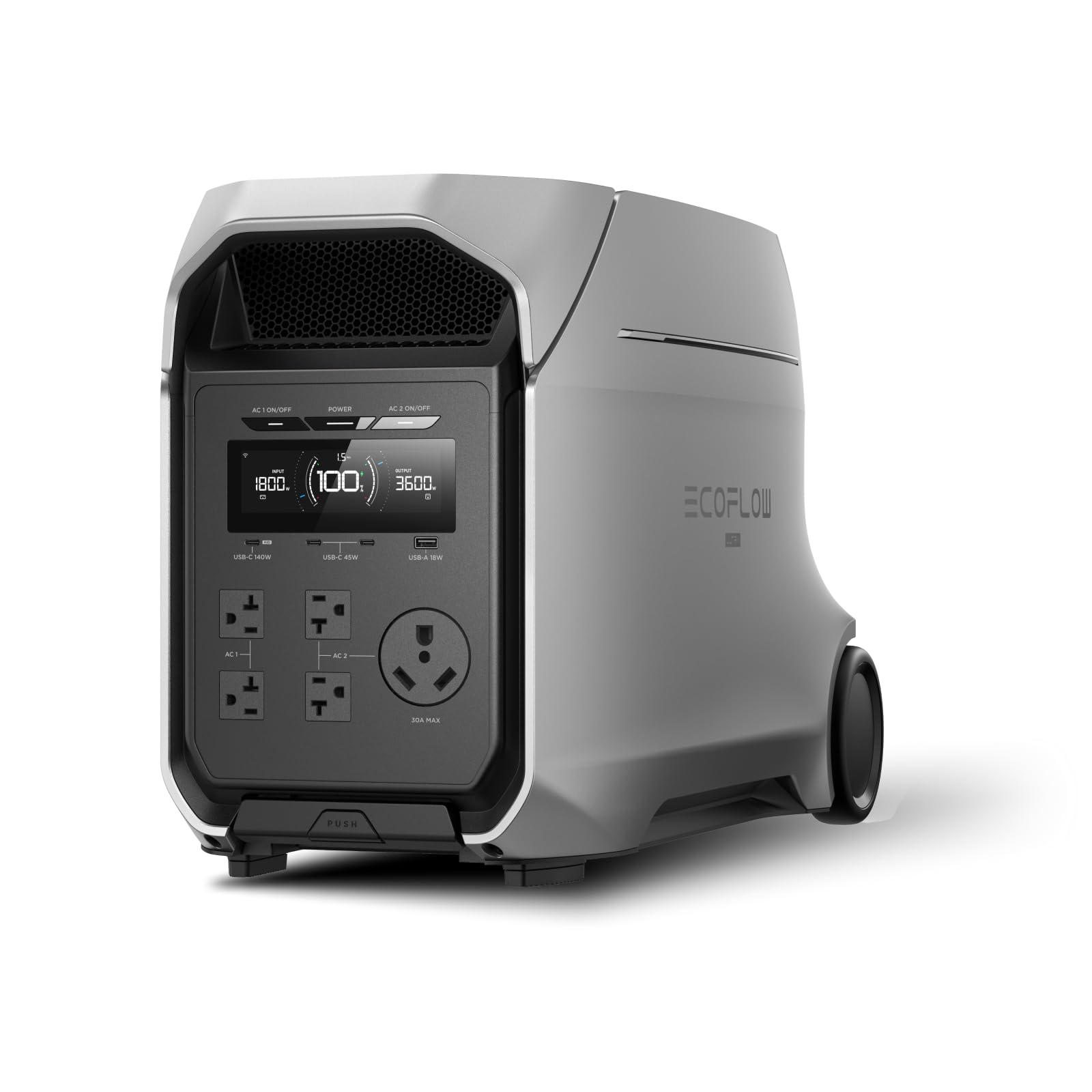
The DELTA 3 Ultra Plus is EcoFlow’s most capable home backup unit, delivering 3,600W continuous and 7,200W surge from a 3,072Wh LiFePO₄ core. That surge headroom is critical for starting a large refrigerator compressor or a 1.5-ton mini-split — most 3kWh stations peak at 6,000W or less. The X-Stream fast charging fills the pack to 80% in under an hour, and the unit scales to 11kWh by adding extra batteries, making it viable for homes that need multiple days of autonomy.
X-Quiet 3.0 technology keeps fan noise down to 25dB even under moderate load, which is barely audible indoors. The <10ms UPS switchover is verified by users running oscilloscopes on the output — it’s truly seamless for computers and networking gear. The EcoFlow app gives you granular control over charge rate, port priority, and Storm Guard (auto-charges when severe weather alerts hit your location).
The trade-off is size and weight: 74 pounds and nearly two feet long means this is a semi-permanent installation, not a portable grab-and-go. A few users noted that the unit must be warmed to room temperature before charging in cold conditions, a LiFePO₄ limitation shared by all stations in this class. For a home that wants a future-proof, expandable backbone that can later integrate with a smart panel, the DELTA 3 Ultra Plus is the strongest contender.
Why it’s great
- Massive 7,200W surge handles large motor starts
- Scales to 11kWh for multi-day outages
- 25dB quiet operation at moderate loads
Good to know
- 74 pounds — not portable in the usual sense
- No 220V output on this specific model
- Needs thermal conditioning before charging in cold weather
3. Jackery HomePower 3000
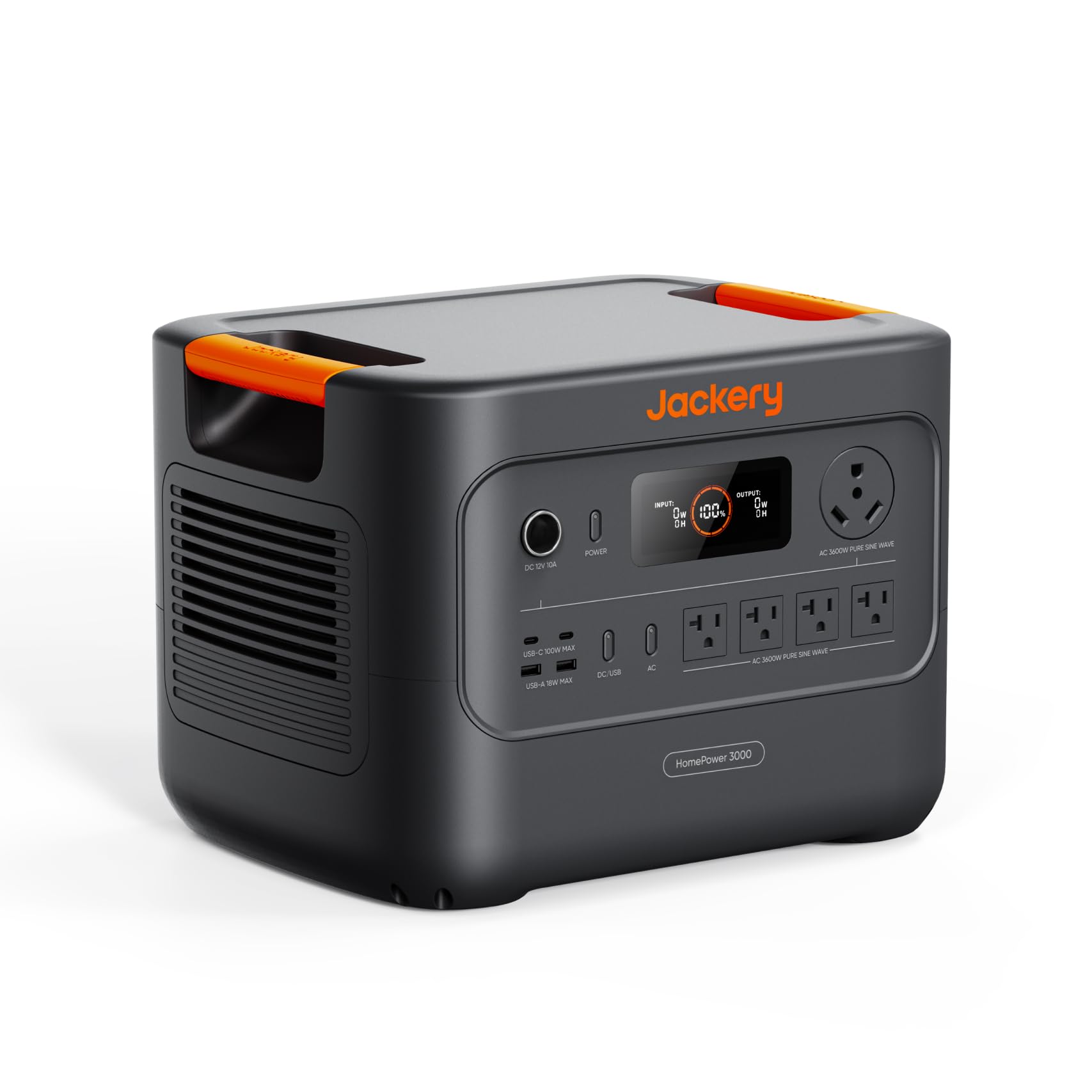
Jackery’s HomePower 3000 squeezes 3,072Wh and a 3,600W inverter into a footprint that’s 47% smaller and 43% lighter than comparable 3kWh units, thanks to CTB (cell-to-body) construction borrowed from EV battery packs. At 59.5 pounds, it’s still a heavy lift, but the dual handles and compact 16.4-by-12.8-by-12-inch chassis make it feasible to reposition around the house during an outage. The 4000-cycle LiFePO₄ pack paired with ChargeShield 2.0 algorithms aims for a 10-year usable lifespan.
Output ports include dual 100W USB-C PD, a TT-30 RV outlet, and three standard AC outlets. The ≤20ms UPS switch is UL-certified and fast enough to keep most routers and security cameras online. Hybrid AC+DC recharging fills the station in 1.7 hours — about as fast as anything in this capacity tier. Users running 30-foot travel trailers report covering three days of moderate use (fridge, microwave, TV, CPAP, lights) without dipping below 45%.
The main drawback is warranty service — Jackery’s official policy applies only to units purchased directly from its website, not from Amazon or third-party resellers. That’s a significant consideration for a premium investment. Additionally, the 20ms UPS is slower than the sub-10ms units from EcoFlow and BLUETTI, which matters if you’re protecting a desktop workstation or medical device. Still, for sheer capacity density and build quality, the HomePower 3000 is a standout.
Why it’s great
- Class-leading power-to-weight ratio using CTB tech
- 4000-cycle LiFePO₄ battery for long-term home use
- Fast hybrid recharge in under two hours
Good to know
- Warranty only honored with direct purchase from Jackery
- UPS switch at 20ms is slower than premium competitors
- No built-in wheels for its 60-pound weight
4. Jackery Explorer 2000 v2

At 39.5 pounds, the Explorer 2000 v2 is the lightest 2kWh LiFePO₄ station on the market, using the same CTB construction as the larger HomePower series to shave 41% off the weight of typical competitors. Its 2,200W inverter (4,400W surge) covers a refrigerator, sump pump, or microwave one at a time, and the 2,042Wh pack runs a modern fridge for roughly 21 hours based on real-world tests. The built-in handle makes it genuinely portable — you can carry it from the garage to the kitchen without strain.
AC fast charging hits 0–80% in 66 minutes, and an Emergency Super Charging mode via the app reaches full in 102 minutes. Silent Charging mode keeps fan noise below 30dB, ideal for overnight use in a bedroom or RV. The 20ms UPS switch is UL 1778 certified, and users report seamless pass-through operation during grid blips. Solar input is capped at 400W, which means a full solar recharge takes about six hours with two 200W panels — workable but slower than the 1,200W solar input on the BLUETTI AC200L.
Port selection is adequate but not generous: three AC outlets, two USB-C (one at 100W PD), one USB-A, and a car port. There’s no 30A RV outlet and no expandability — you get the built-in 2,042Wh and that’s it. For home backup where portability matters (moving between floors, taking to a hotel during evacuation), the Explorer 2000 v2 is unmatched. For multi-day whole-home backup, you’ll want a larger, expandable unit.
Why it’s great
- Lightest 2kWh LiFePO₄ station on the market
- Fast AC recharge — 66 min to 80%
- Silent sub-30dB charging mode
Good to know
- No capacity expansion option
- Solar input limited to 400W max
- Only three AC outlets limit simultaneous device powering
5. Anker SOLIX C2000 Gen 2
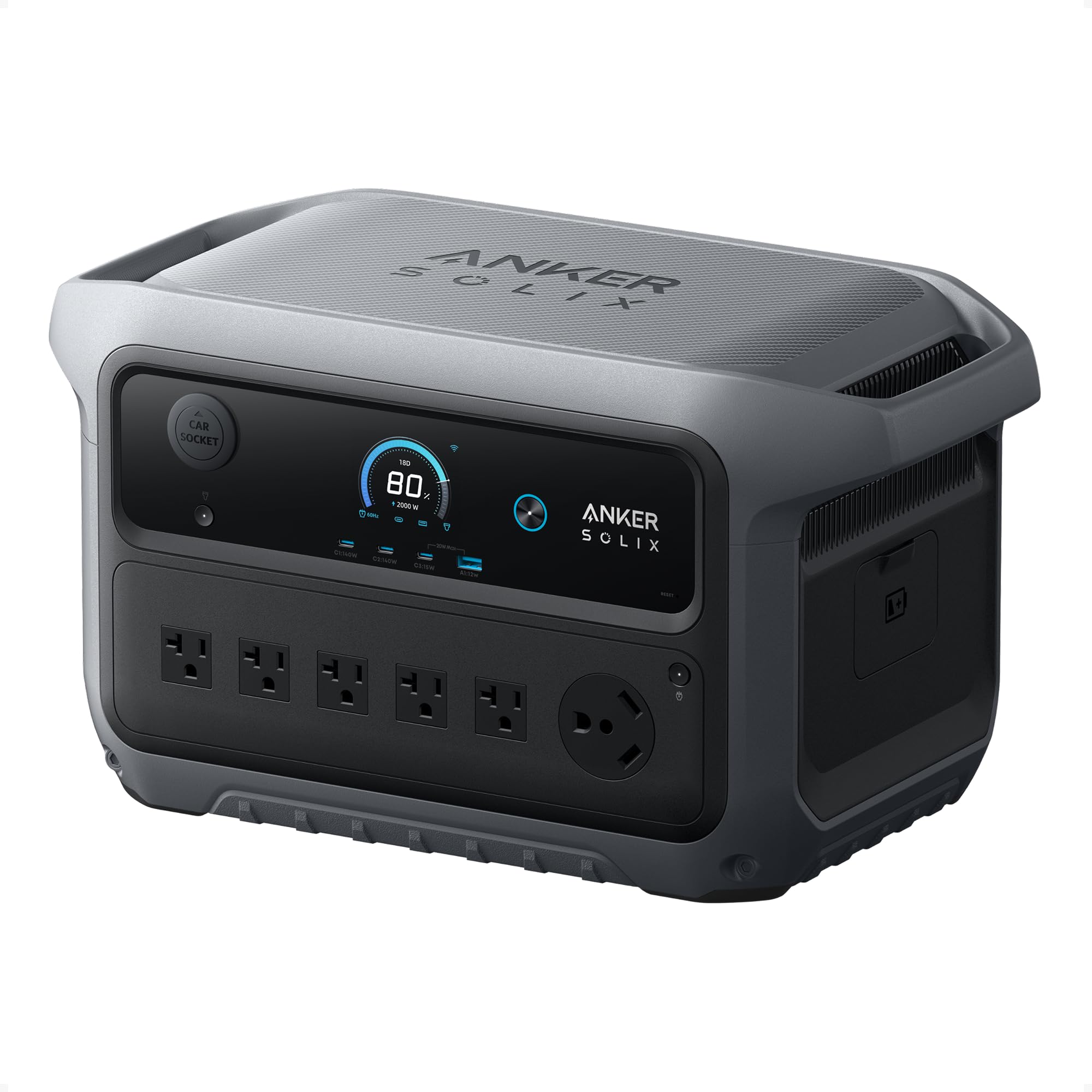
Anker’s SOLIX C2000 Gen 2 delivers 2,048Wh and 2,400W continuous (4,000W peak) in a chassis that’s 25% lighter and 29% smaller than typical 2kWh units. At 41.7 pounds, it’s the second-lightest in this tier behind the Jackery Explorer 2000 v2. The headline number is the 58-minute full recharge from AC — the fastest time-to-full in the 2kWh class, which means you can drain the battery overnight and refill it during a brief generator window or before the next outage cycle begins.
Standby power consumption is just 9W, so the unit loses almost nothing when idle. Anker claims 32 hours of runtime for a dual-door fridge on a single charge, and user reports confirm it powers a TV, modem, router, and a full-size fridge for over 10 hours with charge to spare. The companion app provides real-time monitoring and outlet control via Bluetooth. An expansion battery can be added to reach 4kWh, effectively doubling fridge runtime to 64 hours.
The main limitation is the 800W alternator charging input — while faster than most car socket connections, it still takes 3 hours to full. There’s no 30A RV outlet, and the 2,400W inverter, while sufficient for most household circuits, won’t start a large well pump or 1.5-ton A/C. For the price, the C2000 Gen 2 offers the best recharge speed and a strong value equation for home backup.
Why it’s great
- Fastest full recharge in its class at 58 minutes
- Ultra-low 9W standby consumption
- Expandable to 4kWh with add-on battery
Good to know
- No 30A RV outlet
- Alternator charging limited to 800W
- Inverter may struggle with large motor-start surges
6. PECRON F3000LFP
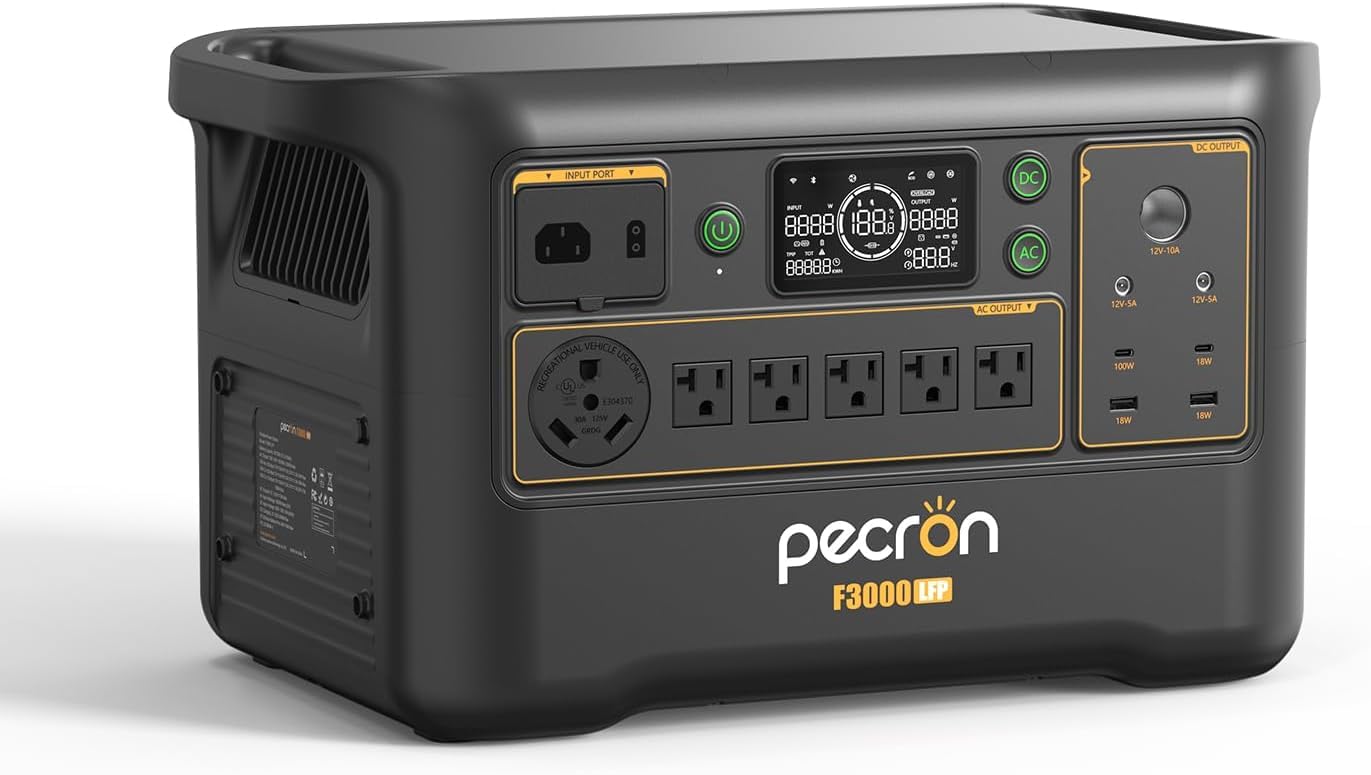
The PECRON F3000LFP offers one of the best capacity-per-dollar ratios in the home backup space, packing 3,072Wh of LiFePO₄ storage with a 3,600W pure sine wave inverter. That’s enough to run a refrigerator, freezer, lights, and a CPAP machine for a full weekend without recharging. The six AC outlets provide exceptional flexibility for distributing power across multiple circuits, and the dual 100W USB-C PD ports keep laptops and tablets charging at full speed.
AC recharge at 1,800W fills the unit from dead to full in two hours — 30% faster than most 3kWh competitors. Solar input accepts up to 1,600W at 25-120V, which means you can oversize your array for faster solar recharge. The UPS switch happens in 8-20ms depending on load, fast enough to keep a PC and router online. The app lets you monitor power flow and set charge limits, though the login requirement and English translation quality are rougher than names like EcoFlow or Anker.
The biggest downside is idle consumption: the unit draws roughly 30W per hour when turned on, even with no load attached. That’s higher than the 9W draw of the Anker SOLIX and means you lose about 720Wh per day just by leaving the unit powered on. The fan is also audible during charging — not intrusive, but noticeable if the unit is in a bedroom. For fixed home backup where you cycle the unit on only when needed, the F3000LFP delivers massive storage and power for the money.
Why it’s great
- Excellent 3kWh capacity per dollar
- Six AC outlets for broad device coverage
- Full recharge in two hours at 1800W input
Good to know
- High idle draw of ~30W when powered on
- Fan is audible during active charging
- App UI and manual could use better English localization
7. DJI Power 2000
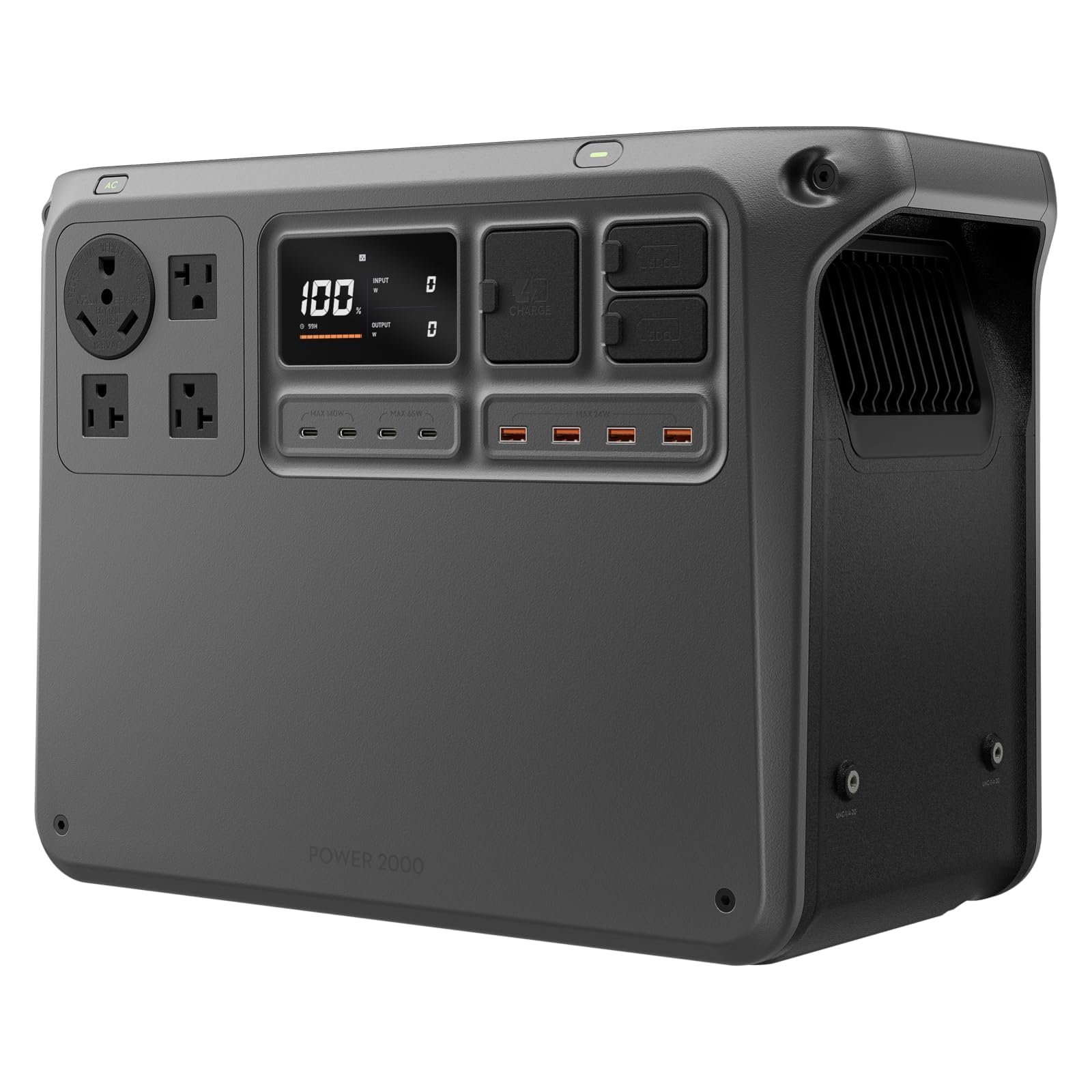
DJI enters the home backup market with the Power 2000, a 2,048Wh LiFePO₄ station that emphasizes industrial-grade safety and ultra-quiet operation. The housing is flame-retardant with sub-nano coating for moisture resistance, and the BMS uses 26 temperature sensors and 21 fuses — more than any competitor in this tier. The 3,000W continuous inverter (4,000W peak) handles 99% of home appliances per DJI’s testing, including kettles, toasters, and electric saws.
The 55-minute 0–80% recharge is bested only by the Anker C2000 Gen 2, and the 10ms UPS switch is genuinely seamless — a full 10ms faster than the Power 1000 predecessor. Noise levels stay below 30dB even under moderate load, making this one of the quietest 2kWh units for indoor use. Expansion is supported up to 22.5kWh via additional batteries, which would power a typical home for 4–6 days. The DJI Home app works without a dongle for remote monitoring and control.
The catch is the proprietary connector ecosystem: DJI uses its own SDC standard for solar and expansion connections, and the unit doesn’t include built-in MPPT or car charging modules — those require separate adapters. Some units shipped as Hong Kong gray market versions with 50Hz frequency settings, so verify your seller. If you’re already in the DJI ecosystem (drones, cameras), the integration is compelling. For standalone home backup, the proprietary lock-in is a serious consideration.
Why it’s great
- Industry-leading safety with 26 temp sensors and 21 fuses
- 55-minute 0–80% recharge
- True 10ms UPS for seamless grid-to-battery switching
Good to know
- Proprietary SDC connectors limit accessory options
- MPPT and car charging adapters sold separately
- Gray market unit risk from third-party sellers
8. AFERIY P210 Portable Power Station

The AFERIY P210 delivers 2,048Wh of LiFePO₄ storage and a 2,400W pure sine wave inverter (4,800W peak) at a price point that undercuts most 2kWh competitors by a significant margin. The 3,500-cycle battery is rated for 10 years of daily use, and the 7-year extended warranty is two years longer than the industry standard — a strong confidence signal from a newer brand. The station includes 16 ports: six AC outlets, four USB-C (one at 100W PD), two USB-A, two DC5521, a car port, and an XT60 output for higher-voltage DC loads.
The server-level UPS switches in under 10ms, which is fast enough for desktop PCs and networking equipment. Sound levels are rated at 30dB at full load and 16dB under normal conditions — genuinely silent for overnight use. The app provides energy consumption monitoring and automation scheduling. Users report successful operation for food truck equipment, RV refrigerators, and as a 1,200W UPS for sensitive electronics.
The main trade-off is the 54-pound weight: this is not a lightweight unit, and it lacks wheels or a telescoping handle. The app’s English UI is adequate but not as polished as EcoFlow or Jackery. Some users noted that charging from 0–100% at the full 1,800W AC rate causes the internal fan to run audibly. If you’re looking for a large-capacity home backup on a tight budget and can tolerate a heavier, less-refined package, the P210 offers tremendous value.
Why it’s great
- Best capacity-per-dollar in the 2kWh class
- 7-year warranty — longest in this category
- <10ms UPS switch for seamless grid transfer
Good to know
- Heavy at 54 pounds with no wheels
- Fan noise is audible at full recharge speed
- App polish lags behind premium brands
9. VTOMAN Jump 600X

The VTOMAN Jump 600X is a 2-in-1 unit that combines a 299Wh portable power station with a car jump-start port, eliminating the need for a separate jump pack in your vehicle. The 600W inverter (1,200W surge) is limited to small appliances — a CPAP machine runs for about 10 hours, and a mini fridge lasts 5+ hours on half charge. The built-in LiFePO₄ battery delivers 3,000 cycles before dropping to 80% capacity, and the expandable design accepts an add-on battery (sold separately) to reach 939Wh.
The regulated 12V/10A DC outputs are a standout feature for this price tier: they provide stable voltage suitable for car refrigerators, tire inflators, and CPAP machines without the voltage drop that unregulated ports cause. The jump-start function handles trucks and SUVs in seconds, as confirmed by user reports of starting a Dodge Ram instantly. Pass-through charging lets you power devices while the unit recharges, so it can serve as a continuous UPS for a modem and a few lights during a short outage.
AC recharge takes about three hours, and solar recharge is slower at 5–6 hours with a 110W panel. This unit is best positioned as a supplement to a larger home backup or as a dedicated emergency kit for a vehicle. If your home backup needs are limited to keeping a CPAP running and phones charged through a moderate outage, the Jump 600X is a lightweight, affordable solution.
Why it’s great
- Integrated car jump-start eliminates a separate device
- Regulated 12V DC output for sensitive 12V equipment
- LiFePO₄ battery with 3,000-cycle lifespan
Good to know
- 299Wh base capacity is too small for whole-home backup
- 600W inverter won’t run a full-size refrigerator
- Solar recharge is slow without the add-on battery
FAQ
Can a home battery backup power a refrigerator during a long outage?
Should I use solar panels to recharge my home battery backup during a storm?
Do I need a transfer switch to connect a power station to my home’s circuits?
What is the difference between UPS pass-through and standby UPS mode?
Will a LiFePO₄ battery backup work in freezing winter temperatures?
Final Thoughts: The Verdict
For most users, the battery backup for home winner is the BLUETTI AC200L because it combines a fast 45-minute recharge, expandability to 8,192Wh, and a 2,400W inverter at a price that undercuts premium offerings with similar specs. If you need whole-home scalability with massive 7,200W surge capability, grab the EF ECOFLOW DELTA 3 Ultra Plus. And for a compact, portable unit that you can easily move room to room, nothing beats the Jackery Explorer 2000 v2.

Mo Maruf
I created WellFizz to bridge the gap between vague wellness advice and actionable solutions. My mission is simple: to decode the research and give you practical tools you can actually use.
Beyond the data, I am a passionate traveler. I believe that stepping away from the screen to explore new environments is essential for mental clarity and physical vitality.