Our readers keep the lights on and my smoothie glass nicely filled. As an Amazon Associate, I earn from qualifying purchases.
A solar battery bank is the most critical decision in any off-grid or backup power system. Lithium iron phosphate (LiFePO4) chemistry has largely replaced traditional lead-acid for its weight, cycle life, and usable capacity, but not all lithium batteries are built with equal cell grade, BMS protection, or low-temperature limits. Choosing the wrong spec means wasted watt-hours and early performance degradation that no solar panel can fix.
I’m Mohammad Maruf — the founder and writer behind WellFizz. I’ve spent years analyzing cell chemistry datasheets, BMS specifications, and real-world deep-cycle tests for home solar, RV, and marine applications to separate reliable storage solutions from marketing claims.
This guide compares nine purpose-built units across capacity, BMS rating, cycle life, and cold-weather protection so you can confidently select the best batteries for solar system setups without overpaying or undersizing your storage.
How To Choose The Best Batteries For Solar System
Selecting the right battery for a solar installation means matching voltage, usable capacity, discharge rate, and chemistry to your inverter and daily load. Overlooking any of these results in throttled performance or an undersized bank that cycles too deeply and wears out quickly.
Capacity and Usable Amp-Hours
Rated amp-hours (Ah) is only half the story. LiFePO4 batteries can discharge to 100% depth-of-discharge (DOD) without damage, while lead-acid batteries degrade rapidly past 50% DOD. A 100Ah LiFePO4 battery therefore delivers roughly double the usable energy of a 100Ah lead-acid unit. For grid-tied backup or off-grid living, calculate your daily watt-hour consumption and divide by your system voltage to confirm the necessary Ah.
BMS Rating and Peak Discharge
The battery management system (BMS) determines maximum continuous discharge current. A 100Ah battery with a 100A BMS can sustain 1C discharge (100A) safely, while a 200A BMS supports a 2C rate. For high-inrush loads like trolling motors, sump pumps, or large inverters, a higher BMS rating prevents nuisance shutdowns. Many manufacturers rate peak discharge for short durations (3 to 10 seconds), so check both continuous and surge limits.
Low-Temperature Charging Protection
LiFePO4 cells suffer permanent damage if charged below freezing (32°F / 0°C). Quality batteries include a built-in low-temperature charging cutoff that disconnects charge current until internal temperature rises. Some units also feature a low-temperature discharge cutoff, typically around -4°F to -20°F, which adds safety for unheated garages, cabins, or winter RV storage. Always verify this spec if your solar array might see subfreezing conditions.
Series and Parallel Expansion
Most 12V LiFePO4 batteries support 4S (series to 48V) and 4P (parallel up to 4 units) configurations. This scalability allows you to start small and expand capacity later. For higher voltage systems (24V or 48V), pairing matched batteries from the same batch is important to avoid voltage imbalance. Some batteries also support 4S4P configuration for large banks exceeding 20kWh.
Cell Grade and Cycle Life
Grade A cells offer the tightest capacity tolerance and longest cycle life (typically 4000 to 15000 cycles at 80% DOD). Lower-grade cells (B or C) can have internal resistance mismatches that lead to early cell drift and reduced cycle count. Look for manufacturers that explicitly state A+ or automotive-grade cells, and check for independent certifications like UL, IEC, or UN38.3.
Quick Comparison
On smaller screens, swipe sideways to see the full table.
| Model | Category | Best For | Key Spec | Amazon |
|---|---|---|---|---|
| ECO-WORTHY 12V 280Ah Metal Case | Premium | High-capacity off-grid with Bluetooth | 280Ah, 200A BMS, Metal Case, Bluetooth | Amazon |
| Litime 12V 300Ah (2-Pack) | Premium | Large-capacity RV & solar with ETL cert | 300Ah each, 200A BMS, 3840Wh, ETL | Amazon |
| Dumfume 48V 100Ah LiFePO4 | Premium | 48V golf cart & off-grid upgrade | 48V / 51.2V, 200A BMS, 5.12kWh | Amazon |
| Dumfume 12V 600Ah LiFePO4 | Premium | Massive single-unit home energy storage | 600Ah, 200A BMS, 7200Wh | Amazon |
| Elefast 24V 100Ah LiFePO4 | Mid-Range | 24V marine/trolling with 20000 cycles | 24V, 100Ah, 100A BMS, 20000 cycles | Amazon |
| Dumfume 12V 150Ah (2-Pack) | Mid-Range | Scalable 300Ah bank for mid-size setups | 150Ah each, 100A BMS, 300Ah total | Amazon |
| Dyness 12V 100Ah (2-Pack) | Mid-Range | Compact 2-pack with low-temp protection | 100Ah each, 100A BMS, IP65 | Amazon |
| GRNOE 12V 100Ah (2-Pack) | Mid-Range | Versatile 2-pack with low-temp cutoff | 100Ah each, 100A BMS, UL/UN38.3 | Amazon |
| Redodo 12V 100Ah LiFePO4 | Budget-Friendly | Entry-level solar & RV with high cycle life | 100Ah, 100A BMS, 4000-15000 cycles | Amazon |
In‑Depth Reviews
1. ECO-WORTHY 12V 280Ah Metal Case LiFePO4
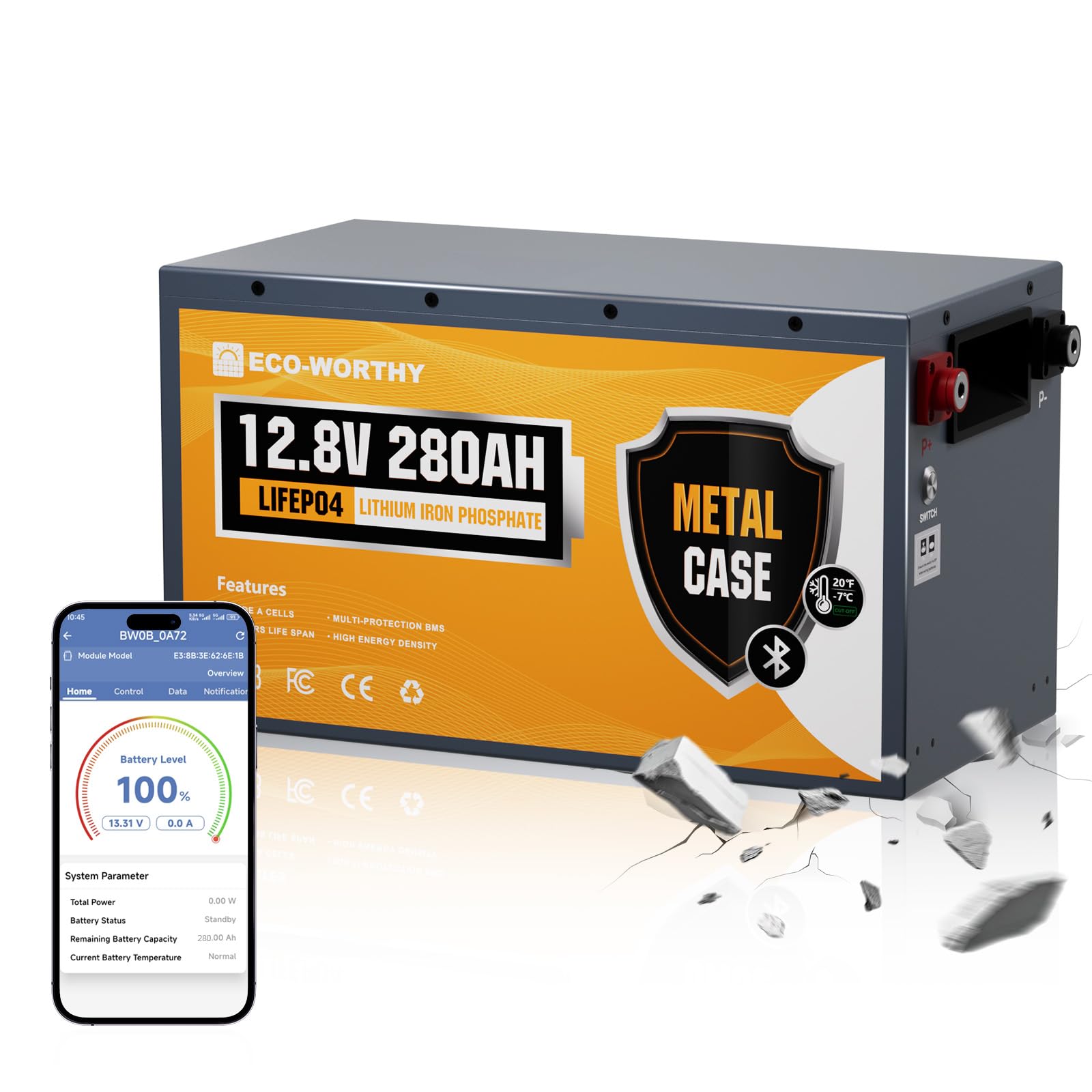
The ECO-WORTHY 280Ah delivers the highest single-unit capacity in the premium tier and is the only unit on this list with a full metal enclosure for enhanced fire safety and structural rigidity. Its 200A BMS supports 200A continuous discharge, making it suitable for large inverters and heavy loads without triggering protection mode. The built-in Bluetooth monitoring via the app gives real-time voltage, state-of-charge, and charge/discharge status directly from your phone.
Users report that the battery arrives around 25% charge, requiring a full 14.6V charge before paralleling to avoid imbalance. The metal case includes mounting feet for direct installation in an RV or camper without a battery box, and low-temperature charging cuts off automatically at 20°F to protect cells. The cells are Grade A, and the BMS is a JBD-DP04S007 200A unit isolated from the cells for better thermal management.
This battery powers microwaves, instant pots, and induction stoves at 2000W with no voltage sag, and users confirm it exceeds its rated capacity. The weak-current on/off switch is a practical safety feature for installation and maintenance. For a large-capacity solar bank where reliability and monitoring matter, this is the strongest single-unit option.
Why it’s great
- 280Ah with metal case for safety and structure
- 200A BMS handles high-inrush loads reliably
- Bluetooth app for real-time capacity monitoring
- Mounting feet allow direct install without battery box
Good to know
- Requires a 14.6V LiFePO4 charger; 12V charger won’t fully charge
- Arrives with partial charge; needs initial charge before paralleling
2. Litime 12V 300Ah LiFePO4 (2-Pack)
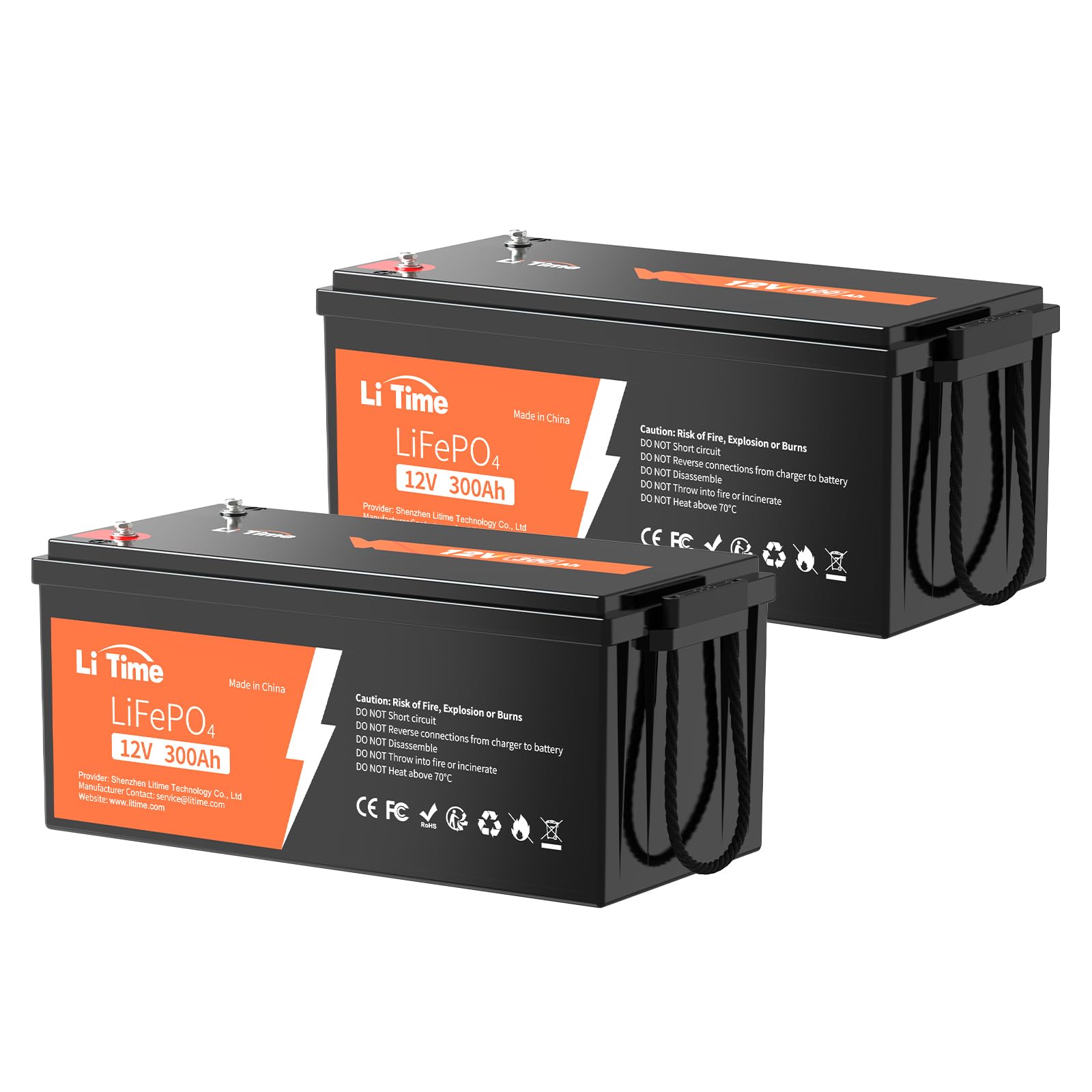
The Litime 300Ah 2-pack provides 600Ah total capacity (7.68kWh) at a 12.8V nominal voltage, enough to run an average off-grid cabin for a full day without generator backup. Each battery uses Grade A automotive LiFePO4 cells and an ETL-certified 200A BMS, ensuring third-party safety validation that many budget batteries lack. The BMS provides comprehensive overcharge, over-discharge, over-current, and short-circuit protection.
At 62.8 pounds per battery, these are relatively heavy for their capacity grade, but the weight is a direct result of the larger cell configuration and robust BMS heat sinking. Users running them in 24V or 48V series configurations note that the built-in auto-balancing drift prevention maintains cell voltage within tight tolerances. The 4S4P expansion capability supports up to 40.96kW for large systems.
A key practical note: the batteries may arrive with BMS in protect mode if depleted during shipping. A full 14.6V charge or a 0V-capable charger is required to wake the BMS—a common procedure with many LiFePO4 batteries but worth knowing before installation. For a turn-key large-capacity solar bank with verified safety certifications, this 2-pack is hard to beat.
Why it’s great
- ETL-certified 200A BMS for rigorous safety compliance
- Grade A automotive cells ensure long cycle life
- 4S4P expansion supports large 40.96kW banks
- 3840Wh per battery powers full-day off-grid needs
Good to know
- May require a 0V-capable charger or parallel jump to wake BMS
- App can be glitchy during charging, needing reconnect
3. Dumfume 48V 100Ah LiFePO4
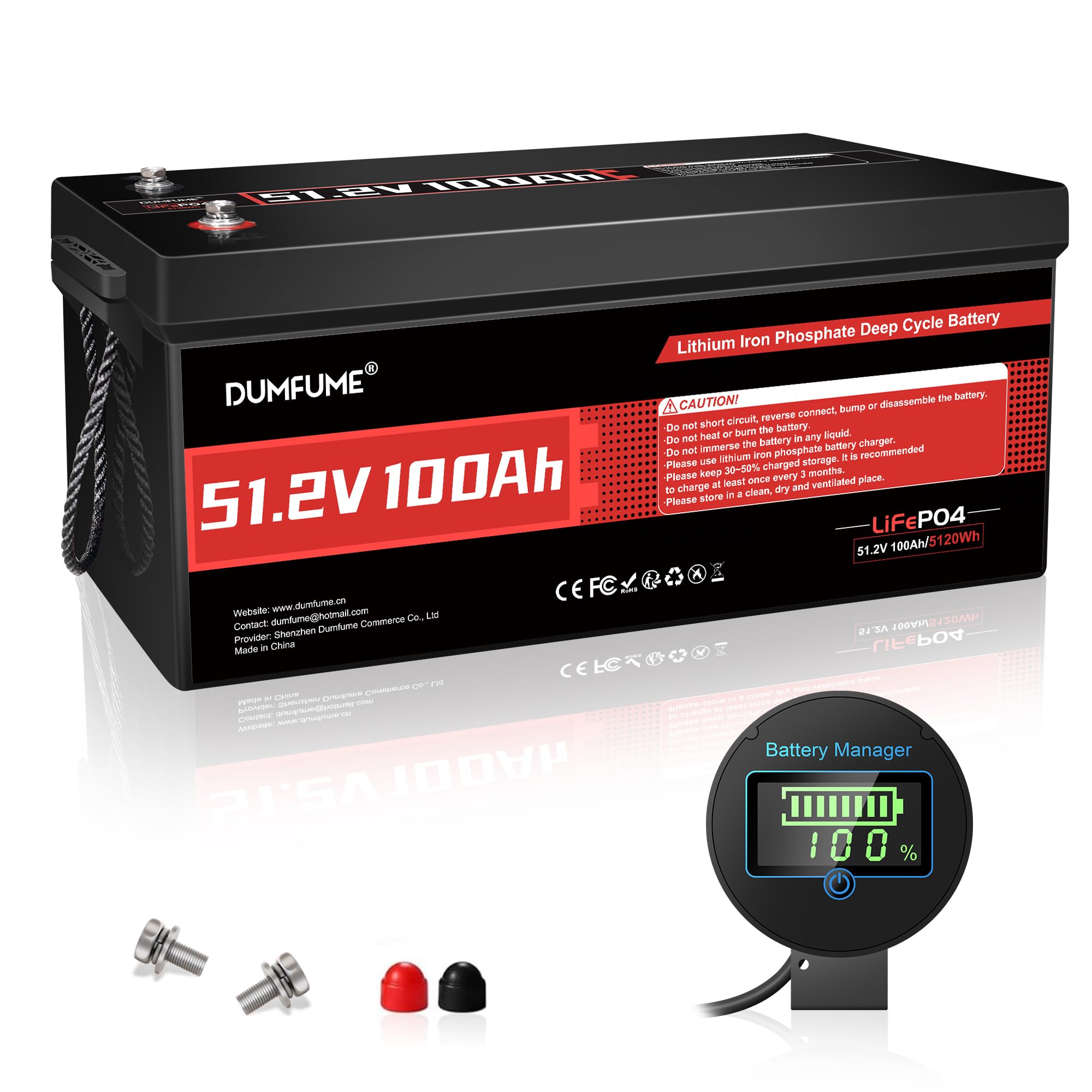
The Dumfume 48V 100Ah is the only 48-volt option in this guide, designed as a drop-in replacement for lead-acid golf cart batteries and 48V solar inverters. At 51.2V nominal (16 cells in series), it provides 5.12kWh in a single unit. The 200A BMS supports 200A continuous discharge, which translates to over 10kW peak power—ample for whole-home backup or heavy-duty traction applications.
Users upgrading from 48V lead-acid systems report a 35% weight reduction and consistent voltage throughout discharge, eliminating the sag that slows golf carts up hills. The auto-balancing BMS prevents cell drift across 15,000 cycles, and the modular cooling system helps maintain temperature stability during high-rate charging. The 5-year warranty with lifetime technical support adds long-term peace of mind.
Low-temperature charging is cut off below 41°F, and the battery should not be operated below 23°F for charging. For cold-garage installations, verify that your system’s thermal environment stays above this threshold or pair with a heating pad. This is a purpose-built high-voltage solution—not a general 12V solar battery, but ideal for 48V systems.
Why it’s great
- True plug-and-play 48V upgrade with no wiring modifications
- 200A BMS supports 10kW+ peak power for inverters
- 15,000-cycle lifespan with auto-balancing drift prevention
- 5-year warranty and lifetime technical support
Good to know
- Low-temp charging cutoff at 41°F requires controlled environment
- Not suitable for 12V systems without a DC-DC converter
4. Dumfume 12V 600Ah LiFePO4
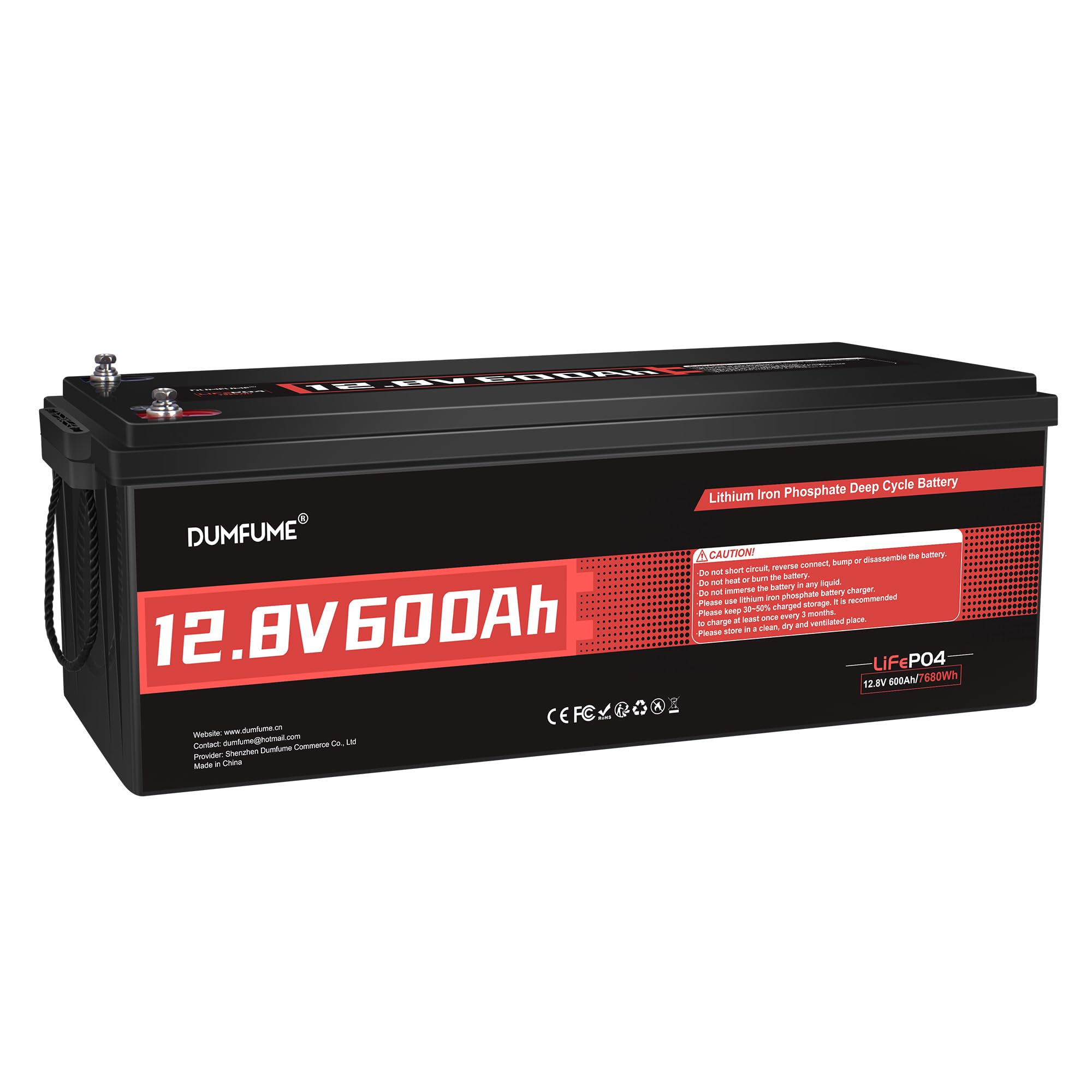
The Dumfume 600Ah is the highest-capacity single 12V battery in this list, storing 7.2kWh—enough to run a refrigerator, lighting, and small appliances for a full day. Its 200A BMS supports 200A continuous and 300A peak for 10 seconds, making it compatible with large inverters up to 2500W. The 4000+ cycles at 100% DOD and 15000 cycles at 60% DOD provide extremely long service life.
At 112 pounds, this battery is heavy and requires a sturdy mounting surface. The low-temperature charging cutoff protects cells below 0°C, and the BMS also disables discharging below -20°C. Users with parallel and series configurations confirm the BMS coordinates current distribution automatically, though mixing brands is not recommended. The lack of Bluetooth monitoring may push some buyers toward the ECO-WORTHY alternative.
For users who need one massive 12V block rather than paralleling multiple smaller batteries, this unit simplifies wiring and reduces connections that can loosen over time. The 5-year warranty provides reasonable coverage. Ensure your charger can deliver 14.6V at the appropriate current for this large capacity.
Why it’s great
- 600Ah / 7200Wh from a single 12V battery
- 200A BMS handles high-power solar inverters
- Low-temp cutoff protects cells in cold environments
- Auto-balancing BMS for parallel and series expansion
Good to know
- No Bluetooth monitoring for state-of-charge tracking
- Heavy at 112 pounds; two-person lift recommended
5. Elefast 24V 100Ah LiFePO4

The Elefast 24V 100Ah battery is built around A+ grade LiFePO4 cells that deliver what the manufacturer claims is 50% more power than ordinary A-grade cells, with a 20,000-cycle rating at 80% DOD. This is an exceptionally high cycle life specification—significantly above the industry standard of 4000-6000 cycles—making it a strong candidate for daily solar cycling where longevity directly offsets upfront cost.
The 100A BMS handles 300A inrush for 1 second, which covers trolling motor startup or inverter capacitor surges. The battery supports 2S4P expansion (series and parallel), allowing voltage or capacity growth up to 20.48kWh. At 42.5 pounds for 2.56kWh, the weight-to-energy ratio is competitive for a 24V form factor. UL and IEC testing adds confidence in cell safety.
Users running this on 24V trolling motors report all-day runtime with significant weight reduction compared to dual 12V lead-acid batteries. The low-temperature protection cuts charging below 32°F. For a mid-range 24V system with high cycle life and clear certifications, this is a compelling choice.
Why it’s great
- 20,000-cycle rating at 80% DOD for extreme longevity
- A+ grade cells provide tight voltage balance
- 300A inrush capability for motor and inverter startup
- UL and IEC tested for certified safety
Good to know
- Requires a 29.2V dedicated LiFePO4 charger for full charge
- Not compatible with standard 24V lead-acid chargers
6. Dumfume 12V 150Ah LiFePO4 (2-Pack)
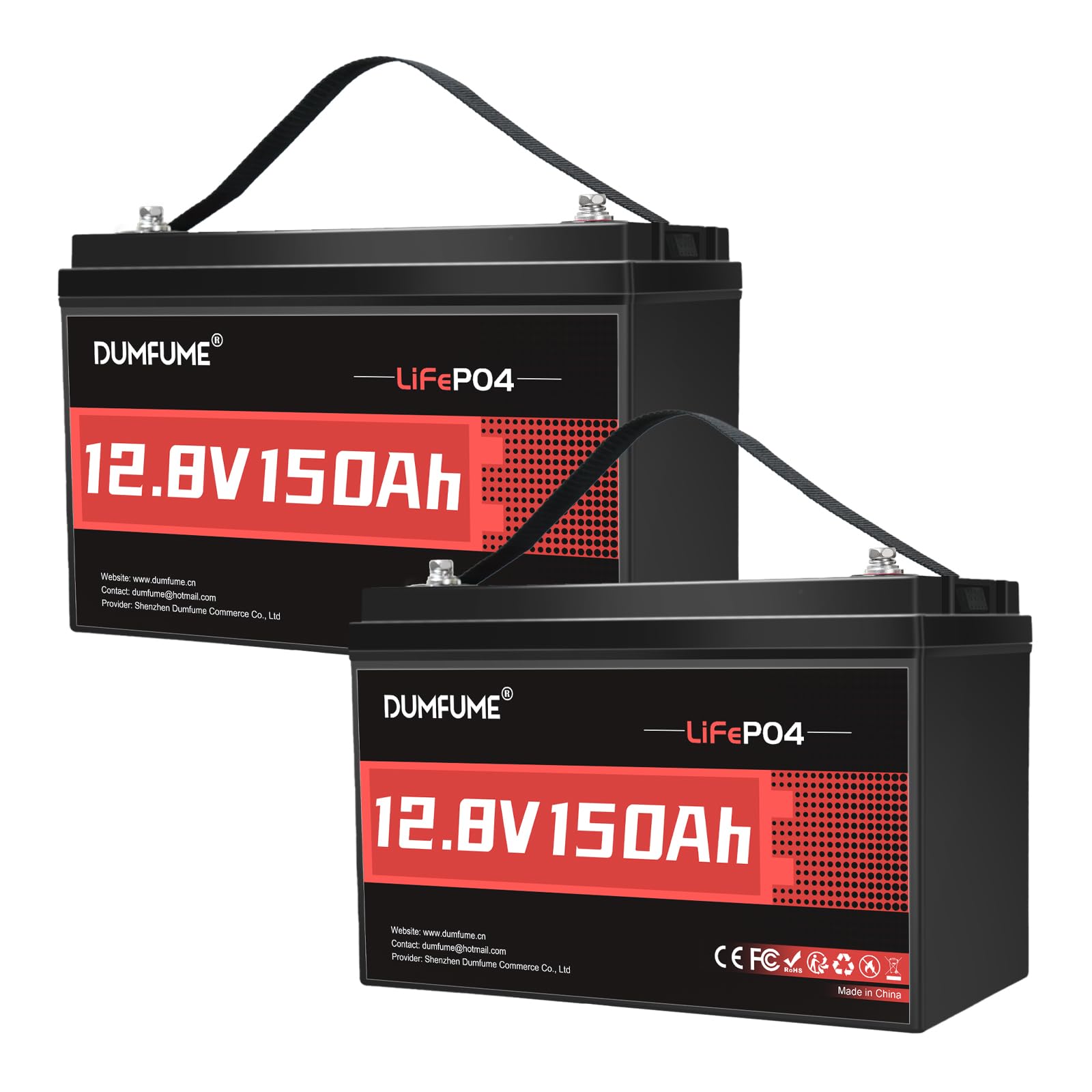
This twin-pack of Dumfume 150Ah lithium batteries creates a 300Ah bank when connected in parallel, providing 3.84kWh of usable storage at 12V. Each battery has an independent 100A BMS, so the dual-pack effectively doubles the current capability to 200A continuous. The BMS provides the standard suite of protections including overcharge, over-discharge, over-current, and short-circuit.
Users report that the actual capacity tested slightly exceeds the rated 150Ah per unit, a positive sign for cell quality. At 24.5 pounds each, these are easy to handle and install. The parallel expansion supports up to 4S4P for larger systems. The 5-year warranty covers the pack. Some units have arrived with very low voltage (12.2V) requiring a parallel jump charge to wake the BMS—a known issue with budget LiFePO4 batteries that is usually solvable.
For mid-sized solar setups on RVs, trailers, or home backup, this dual-pack offers easy scalability without the expense of a single large unit. The lack of Bluetooth or smart monitoring means you’ll need an external battery monitor or shunt for accurate state-of-charge tracking.
Why it’s great
- 300Ah total capacity from a convenient 2-pack
- Dual 100A BMS provides 200A combined continuous discharge
- Lightweight at 24.5 lbs per battery for easy handling
- Actual capacity often exceeds rated 150Ah per unit
Good to know
- May require parallel jump charge if BMS enters protect mode
- No Bluetooth monitoring; external shunt recommended
7. Dyness 12V 100Ah LiFePO4 (2-Pack)
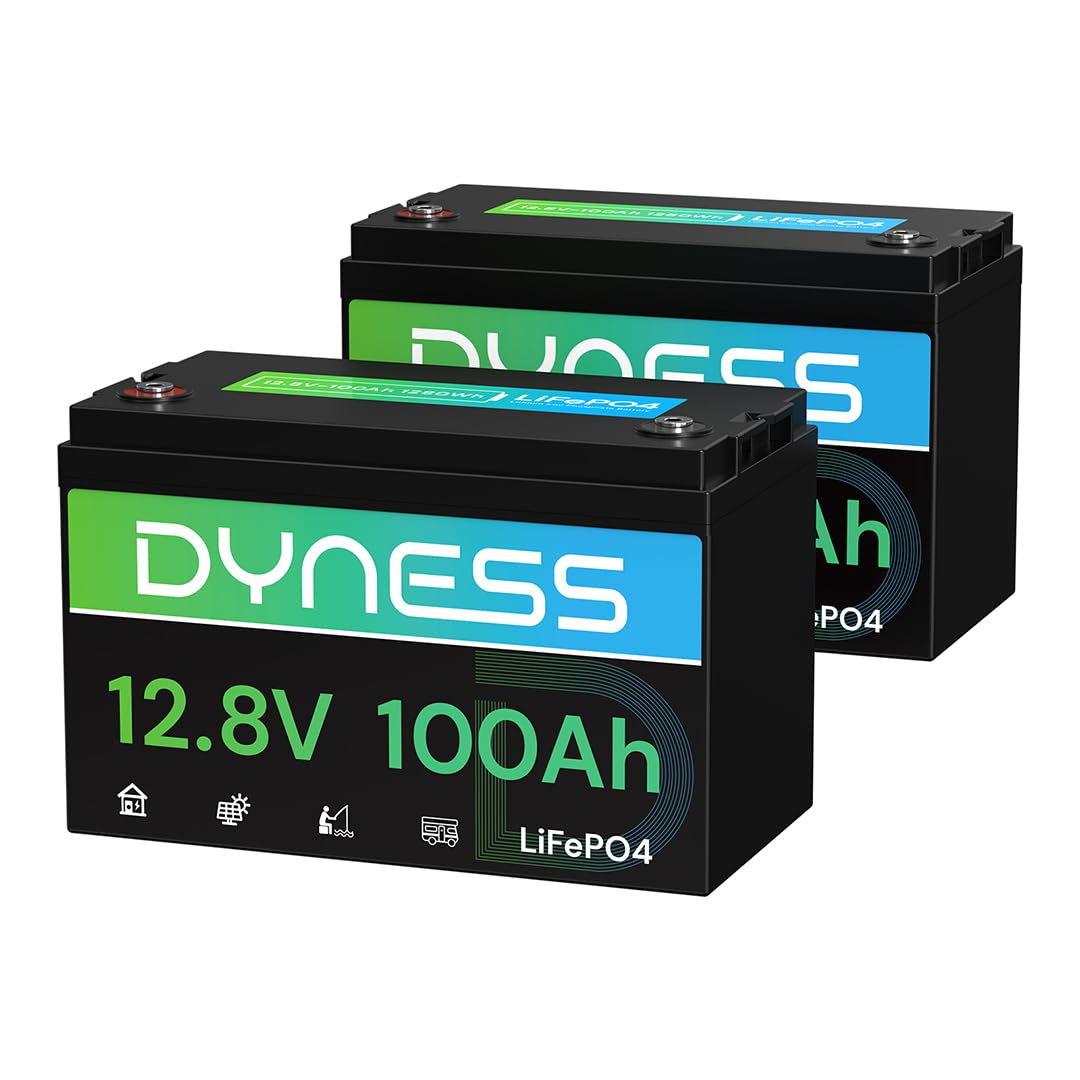
The Dyness 2-pack delivers two 100Ah Group 31 batteries in a single order, making it a direct drop-in replacement for standard lead-acid battery banks. Each unit uses A+ grade LiFePO4 cells and a 100A BMS. The IP65 waterproof rating adds protection against dust, salt spray, and light moisture, making this pack more suited for marine or outdoor solar installations than non-sealed alternatives.
Low-temperature charging protection cuts off below 32°F and resumes at 41°F, with a secondary cutoff at -4°F for discharge. This dual-threshold approach provides an extra safety layer compared to simpler single-threshold systems. Users report charging to 14.5V with a 520W solar array and maintaining voltage above 13.3V after overnight inverter loads. The 10-year lifespan and 4000+ cycle rating at 100% DOD provide long service.
The main trade-off is the relatively high cost per amp-hour compared to single-unit packs. The IP65 rating and dual low-temp protection justify the premium for harsh-environment installations. The 2-pack also makes paralleling simpler than buying separate batteries from different batches, which can cause voltage mismatch.
Why it’s great
- IP65 waterproof for marine and outdoor solar setups
- Dual low-temp protection (charging + discharge) for winter safety
- Grade A+ cells with 4000+ cycles at 100% DOD
- Pre-matched 2-pack eliminates batch voltage mismatch
Good to know
- Higher cost per amp-hour compared to single-unit packs
- Requires LiFePO4-specific charger for full capacity
8. GRNOE 12V 100Ah LiFePO4 (2-Pack)
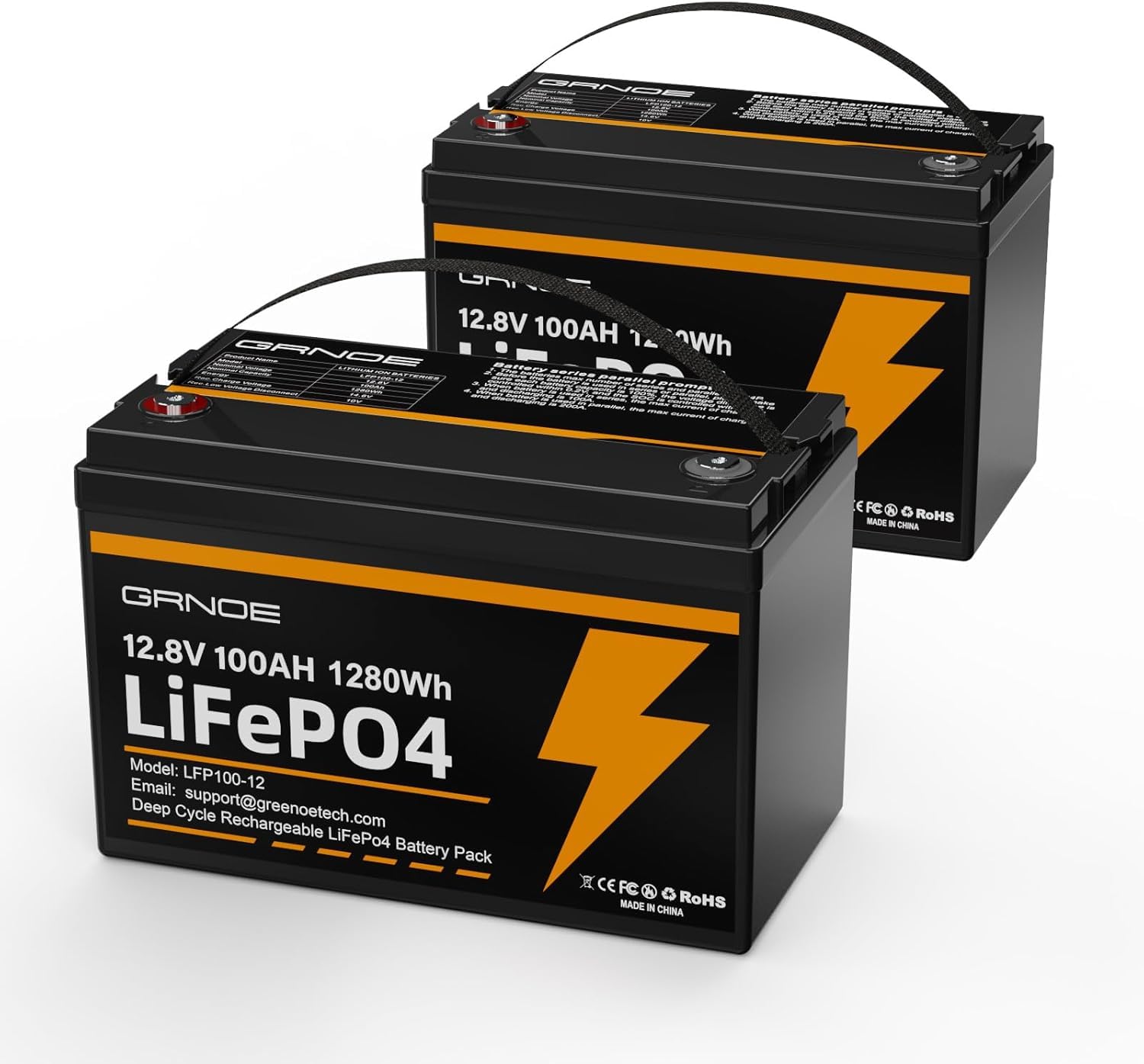
The GRNOE 2-pack offers two 100Ah LiFePO4 batteries with a 100A BMS each, providing 200Ah total storage at 12V. The batteries are UL and UN38.3 certified, adding third-party safety validation. At 22.48 pounds each, they are among the lightest 100Ah batteries available, with an energy density of 57 Wh/lb—better than typical lead-acid by a factor of three. The low-temperature cutoff stops charging below 32°F.
A unique feature is the 300A peak discharge for 3 seconds, which helps with high-inrush loads like trolling motors or small inverter capacitor banks. The IP65 rating adds basic moisture protection. Users confirm excellent performance in solar PV setups, with stable output and no voltage sag during discharge. The 3-year warranty is shorter than some competitors but matches the market average for this tier.
The 2-pack ships as two separate boxes due to weight, so they may not arrive simultaneously—worth noting if you need immediate installation. The instruction manual recommends charging every 2-3 months during storage to prevent cell degradation. For a UL-certified dual-pack at a competitive price point, this is a solid mid-range choice.
Why it’s great
- UL and UN38.3 certified for verified safety
- 300A peak discharge for 3 seconds handles inverter surges
- Lightweight at 22.48 lbs per battery for easy handling
- IP65 waterproof for basic moisture protection
Good to know
- Ships in two separate boxes; may not arrive together
- 3-year warranty is shorter than premium-tier options
9. Redodo 12V 100Ah LiFePO4
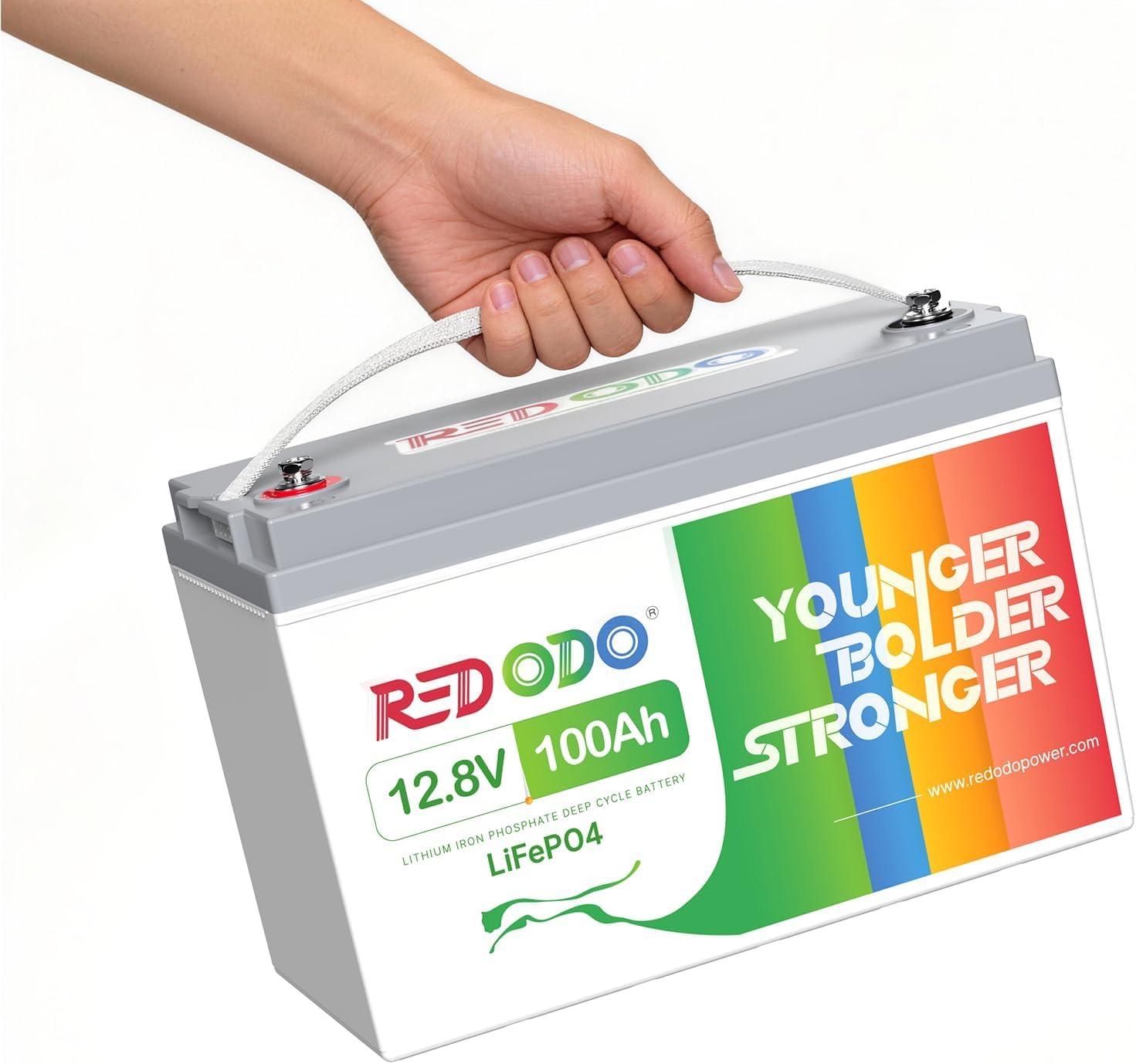
The Redodo 12V 100Ah is the most budget-friendly entry in this guide, yet it still delivers genuine LiFePO4 chemistry with a 100A BMS and a cycle life rated between 4000 and 15000 cycles depending on DOD. At 22 pounds, it is 60% lighter than an equivalent lead-acid battery and fits a BCI Group 31 box. The self-discharge rate is only 3% per month, versus 15-30% for lead-acid, making it a strong choice for seasonal or backup solar systems where the battery sits idle for periods.
The BMS covers overcharge, over-discharge, over-current, short-circuit, and high-temperature protection. Users report successful drop-in replacement for lead-acid in trolling motors, pool cleaners, and electric mowers, with all-day runtime from a single charge. The battery supports series and parallel configurations up to 4S or 4P for up to 400Ah or 48V. The M8 terminal bolts and insulating caps are included.
The trade-off is the lack of low-temperature charging protection, which is a critical omission if the battery will be charged below freezing. Additionally, the warranty is implicit through Amazon rather than a direct 3-5 year manufacturer guarantee. For warm-weather solar setups, RVs, or as a starter battery for a small off-grid system, this offers outstanding value per amp-hour.
Why it’s great
- Best value per amp-hour among tested units
- 4000-15000 cycles across DOD levels
- 22 lbs—60% lighter than lead-acid equivalent
- Low 3% monthly self-discharge for seasonal storage
Good to know
- No low-temperature charging protection; not for freezing environments
- No direct manufacturer warranty; relies on Amazon return window
FAQ
Can I mix a LiFePO4 battery with my existing lead-acid solar system?
How many amp-hours do I need for a 2000W solar inverter?
What is the difference between 100A and 200A BMS in a solar battery?
Can I charge a LiFePO4 battery with a regular lead-acid solar charge controller?
How long do LiFePO4 solar batteries last in daily use?
Final Thoughts: The Verdict
For most users, the batteries for solar system winner is the ECO-WORTHY 12V 280Ah because it combines the largest single-unit capacity with a metal case, 200A BMS, and Bluetooth monitoring for a total package that suits both off-grid RVs and home backup without needing a separate battery box. If you want extreme cycle life at 24V for heavy daily use, grab the Elefast 24V 100Ah. And for a turn-key large-capacity bank with ETL certification and true 100% DOD capability, nothing beats the Litime 12V 300Ah 2-pack.

Mo Maruf
I created WellFizz to bridge the gap between vague wellness advice and actionable solutions. My mission is simple: to decode the research and give you practical tools you can actually use.
Beyond the data, I am a passionate traveler. I believe that stepping away from the screen to explore new environments is essential for mental clarity and physical vitality.