Our readers keep the lights on and my smoothie glass nicely filled. As an Amazon Associate, I earn from qualifying purchases.
When the sun goes down, your solar panels stop producing, but your lights, fridge, and well pump don’t pause. That gap between generation and demand is where a quality battery bank earns its keep. Choosing the wrong chemistry or capacity can leave you running a generator more than you’d like, while the right stack of LiFePO4 cells can quietly power your off-grid home for a decade or more with zero maintenance.
I’m Mohammad Maruf — the founder and writer behind WellFizz. I’ve spent years analyzing battery specifications, BMS designs, and cycle-life test data from the solar energy storage market to help buyers separate genuine performance from marketing claims.
Whether you’re outfitting an RV, building a backup system for your home, or going fully off-grid, finding the right batteries for solar power storage is a high-stakes decision that directly impacts your system’s reliability and long-term cost per kilowatt-hour.
How To Choose The Best Batteries For Solar Power Storage
Picking a solar battery isn’t just about amp-hours. You need to think about voltage architecture, cycle depth, BMS smarts, and whether the unit can communicate with your inverter. Here are the critical filters.
Voltage Architecture: 12V vs 24V vs 48V
A 12V bank works fine for small RV setups or a single appliance backup. As your load grows, higher voltage systems (24V or 48V) reduce current and enable thinner wiring, less voltage drop, and better inverter efficiency. Most whole-home solar installations gravitate toward 48V server-rack batteries for scalability and balanced power draw.
Cycle Life and Depth of Discharge
LiFePO4 batteries typically deliver 3,000 to 15,000 cycles depending on the cell grade and how deeply you discharge them. A battery rated for 6,000 cycles at 80% depth of discharge will outlast one rated for 3,000 cycles at 100% DoD, even if the upfront price is higher. Look at the cycle-life table, not just the Ah sticker.
BMS Capabilities
The Battery Management System is the brain that prevents overcharge, over-discharge, short circuits, and thermal runaway. For solar storage, low-temperature cut-off is non-negotiable if you live in a climate that dips below freezing. A BMS with Bluetooth or WiFi lets you check state of charge, voltage per cell, and health from your phone without breaking out a multimeter.
Expansion and Communication
Batteries that support parallel or series connections let you grow your bank over time. If you’re pairing with a modern inverter, look for CAN/RS485 communication protocols (common with Victron, Growatt, EG4, and Sungold inverters). Closed-loop communication helps the inverter charge at the right voltage curve, extending battery life.
Quick Comparison
On smaller screens, swipe sideways to see the full table.
| Model | Category | Best For | Key Spec | Amazon |
|---|---|---|---|---|
| Battle Born BB10012 | Premium 12V | Reliable RV drop-in | 3,000-5,000 cycles @ 100% DoD | Amazon |
| ECO-WORTHY Cubix100 48V | 48V Server Rack | Home backup / off-grid | UL1973 / UL9540A listed, 5.12kWh | Amazon |
| SaiJiaoYang 16kWh 48V | Large 48V Pack | Whole-house energy storage | 314Ah, 200A BMS, CAN/RS485 | Amazon |
| HumsiENK 24V 200Ah Plus | 24V High-Capacity | Large RV / off-grid cabin | 5.12kWh, 250A BMS, IP65 | Amazon |
| yeagulch 24V 314Ah | 24V Budget Stack | High-capacity 24V build | 8,083 Wh, 200A BMS, IP65 | Amazon |
| AOUSK 48V 200Ah (2-Pack) | 48V Stack Pack | Server rack expansion | 10.24kWh, CAN/RS485, metal shell | Amazon |
| Anker SOLIX F2000 (767) | Portable Power Station | Camping / portable backup | 2,048Wh, 2,400W inverter, GaNPrime | Amazon |
| SUNGOLDPOWER SPH10048P | Hybrid Inverter | Solar + battery system core | 10,000W, 200A charge, 2 MPPT | Amazon |
| yeagulch 12V 300Ah (314Ah) | 12V Large Capacity | RV / trolling motor | 3,840Wh, 200A BMS, IP67 | Amazon |
| Dyness 24V 100Ah | 24V Mid-Range | Boat / small solar | 2,560Wh, A+ cells, 4P2S support | Amazon |
| Litime 12V 100Ah Bluetooth | Entry 12V Smart | Small RV / marine | Bluetooth 5.0, 100A BMS, IP65 | Amazon |
In‑Depth Reviews
1. Battle Born BB10012 100Ah LiFePO4
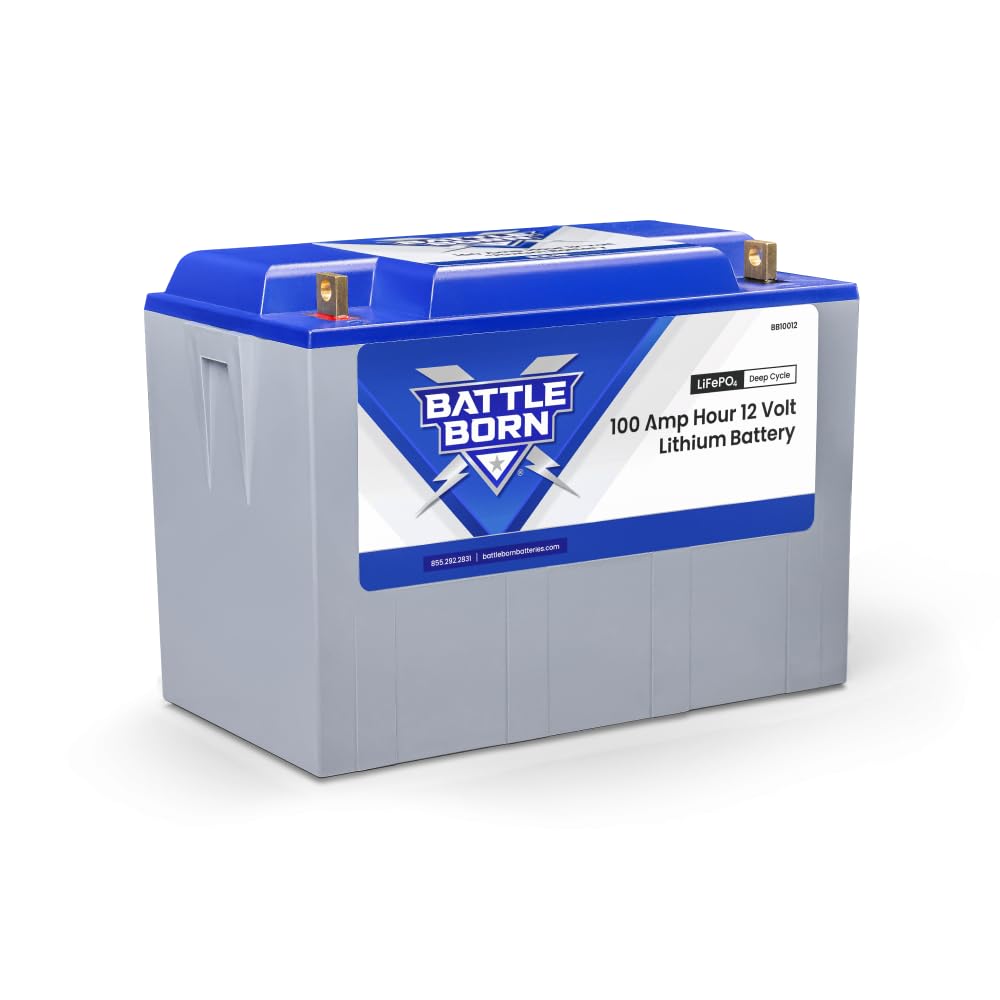
Battle Born has earned its reputation as a premium drop-in replacement for Group 27 and Group 31 lead-acid batteries, and the BB10012 lives up to it. At just 31 pounds for 100Ah of usable lithium power, it shaves roughly 70 pounds off a comparable lead-acid bank while roughly doubling the usable capacity. The internal BMS includes low-temperature protection, high/low voltage cutoffs, and short-circuit safeguards — critical for RV setups that face temperature swings.
Users consistently report zero maintenance, fast charging with 300W solar panels, and reliable performance over 3,000 to 5,000 deep discharge cycles. The real-world benefit is obvious: one reviewer ran a 450W heater for 1.5 hours, raising their RV interior by 12°F, while the same bank powered a fridge, lights, pump, and devices around the clock on a 3,000-mile trip. When a BMS issue cropped up after a year, the replacement was shipped free under the 10-year warranty — a level of post-purchase support that budget brands rarely match.
The one catch is upfront cost — this is a premium-tier investment. You’ll also need a lithium-compatible charger or solar controller, which can add roughly to a conversion. But if you want a box that works reliably for a decade and won’t strand you in the wilderness, the Battle Born is the benchmark.
Why it’s great
- 10-year warranty with responsive customer service
- Lightweight, true drop-in for Group 27/31 trays
- 100% usable capacity with robust BMS protection
Good to know
- Premium price point vs. comparable capacity packs
- May require alternator or charger upgrade for full compatibility
2. ECO-WORTHY Cubix100 48V 100Ah
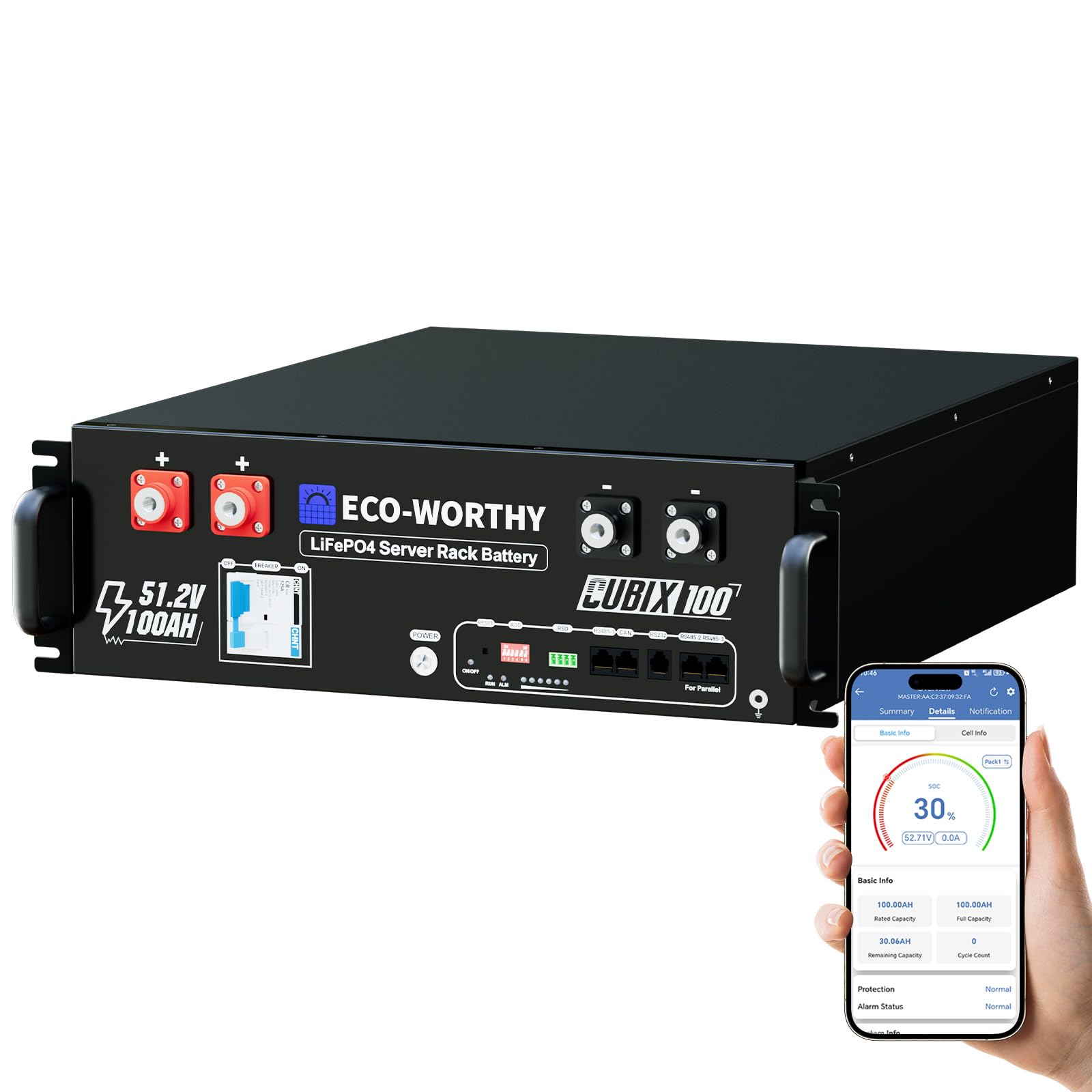
ECO-WORTHY’s Cubix100 is a 48V (51.2V nominal) server-rack battery with UL1973 and UL9540A certifications — a big deal for any home insurance or permitting process. It packs 5.12kWh of Grade A LiFePO4 cells into a compact 3U rack profile, and supports parallel connections up to 32 units for a theoretical 163.8kWh system. The integrated Bluetooth and WiFi let you monitor voltage, SOC, and temperature from the ECO-WORTHY app without crawling into a cabinet.
Closed-loop communication via CAN/RS485 means it talks directly to popular inverters like EG4 and ECO-WORTHY’s own units. One reviewer paired it with an EG4 18kpv and reported flawless handshake, powering a 2,000 sq ft house without drama. Another used it as an add-on to a Bluetti Apex 300, nearly tripling that system’s capacity. The build quality is solid, with real capacity matching the spec sheet — no phantom voltage drops.
The main downside is the lack of an onboard display; you rely entirely on the app for real-time data. Early units had a reversed terminal issue (since corrected), and the bus bars inside could use better strain relief. But for the price per kilowatt-hour in a 48V rack format, this is an exceptional value for anyone building a home solar battery room.
Why it’s great
- UL1973 and UL9540A certified for safety and insurance
- Up to 32 units parallel for massive energy scalability
- Reliable closed-loop communication with major inverters
Good to know
- Noon-board display screen; app-only monitoring
- Early builds had reversed terminal labeling
3. SaiJiaoYang 51.2V 314Ah LiFePO4
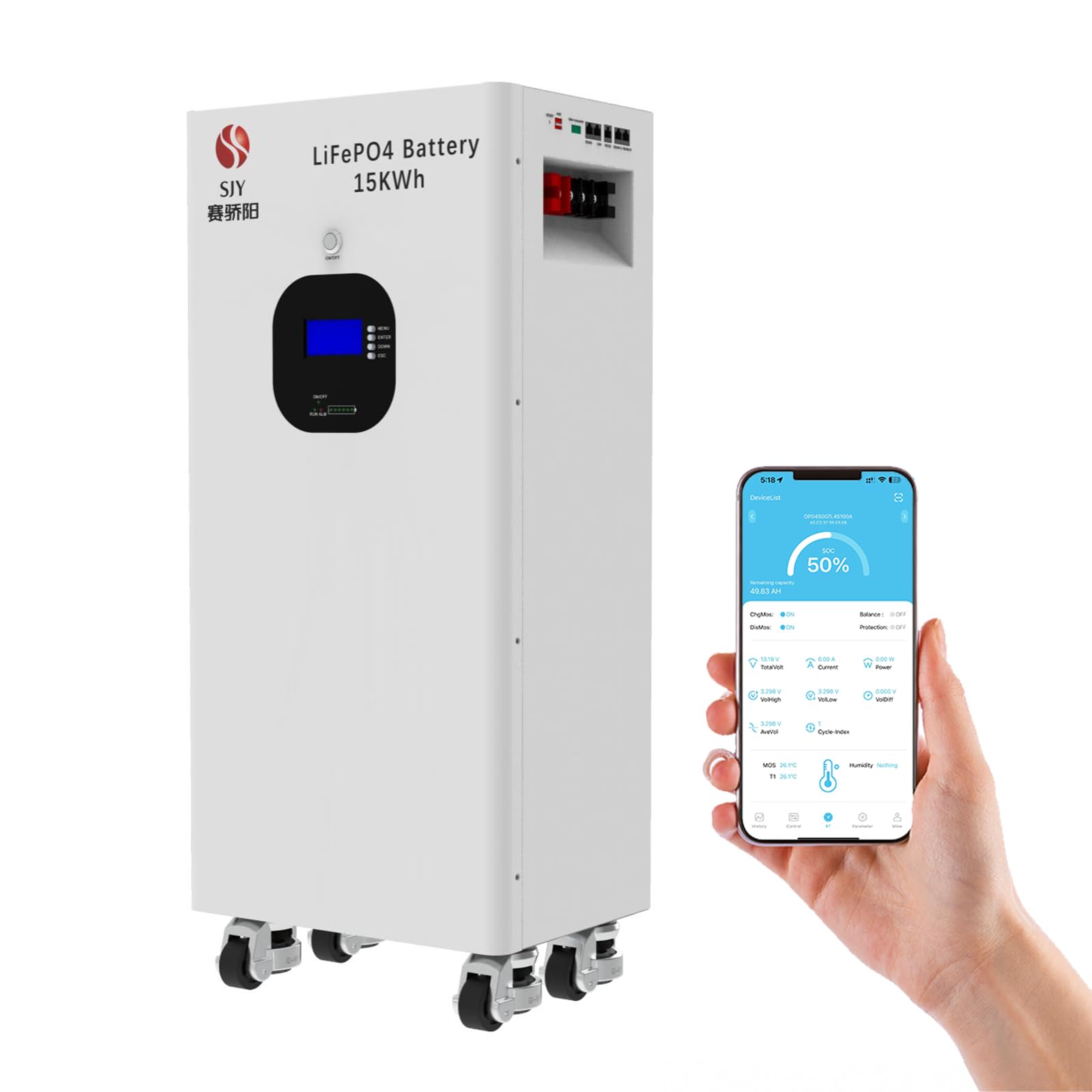
If you need a single-pack solution that can anchor a whole-house backup system, the SaiJiaoYang 16kWh 48V battery is a heavy hitter. It uses genuine Grade A prismatic cells rated at 314Ah with a built-in 200A BMS that supports CAN and RS485 communication, making it plug-and-play compatible with Growatt, Victron, SMA, Pylontech, and Lux Power inverters. The external LCD screen shows per-cell voltage, current, and real-time status — a rare convenience at this capacity tier.
Users running it with EG4 6000XP inverters report good cooperation via the Pylon protocol, though some noted that SOC readings can jump from around 85% to 100% near the top of the charge cycle, which is a BMS calibration nuance rather than a hardware defect. The battery arrives in a heavy-duty crate (around 112 kg), and the included parallel cables are adequate for moderate loads, though anyone planning a full 200A draw to a 10kW inverter should budget for thicker aftermarket wiring.
This is not a compact unit — it’s roughly the size and weight of a small server UPS — but the capacity-per-dollar ratio is hard to beat. Two of these batteries with a properly sized inverter and solar array can realistically power a medium-sized home indefinitely during daylight hours and carry it through the night on stored energy.
Why it’s great
- Massive 16kWh capacity in a single pack
- Supports multiple inverter protocols (CAN/RS485)
- LCD screen with per-cell monitoring
Good to know
- Heavy unit (112 kg) — plan for structural support
- Included cables may be undersized for full 200A draw
4. HumsiENK 24V 200Ah Plus
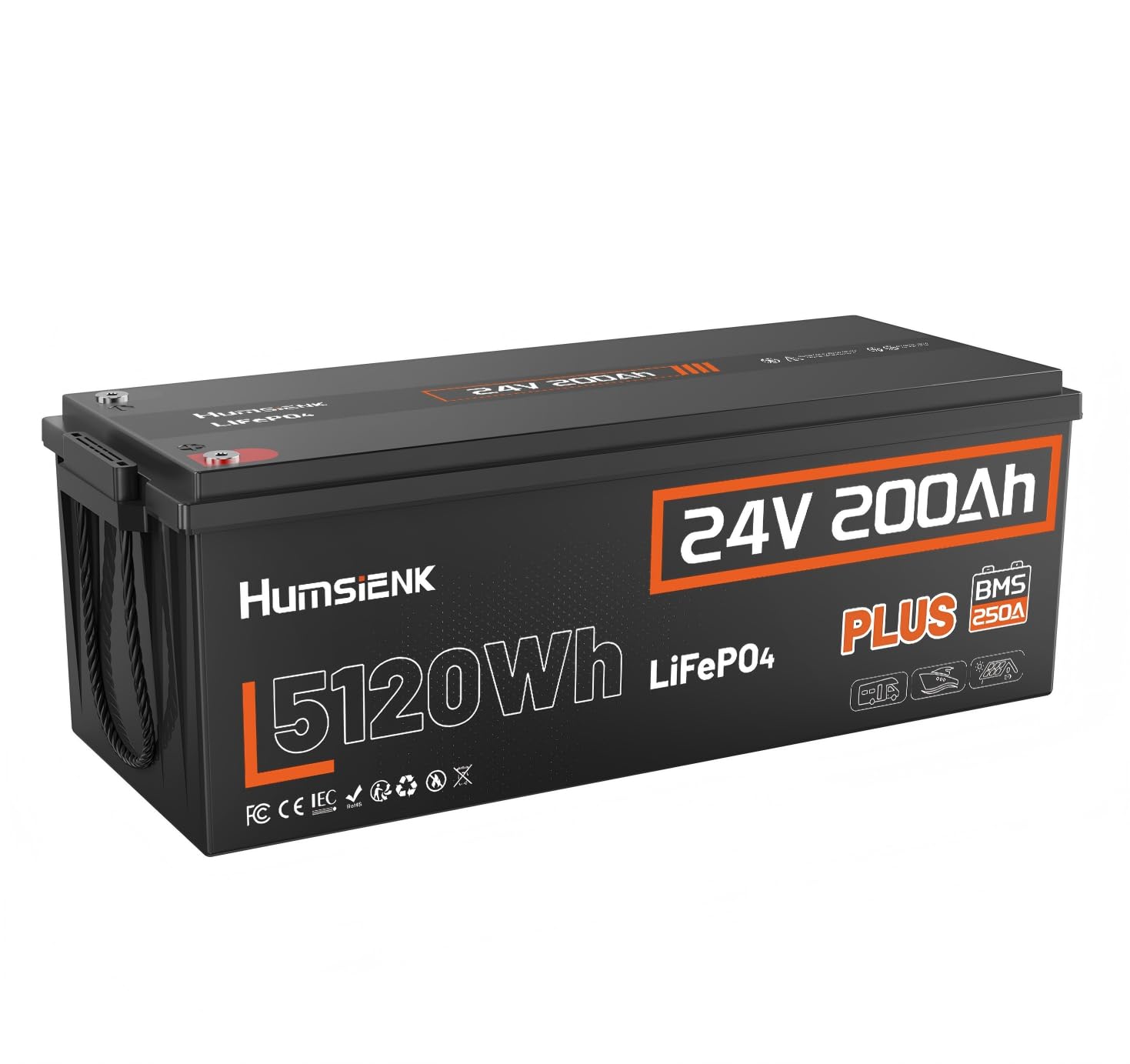
HumsiENK’s 24V 200Ah Plus delivers a 5.12kWh capacity with a beefy 250A BMS that can sustain 6,400W of continuous power output — enough to run multiple large appliances simultaneously without tripping. The IP65 rating makes it weather-resistant for outdoor enclosures or marine compartments, and the wide operating temperature range (-4°F to 140°F) ensures it keeps working through desert heat or cold snaps.
One user sent this battery to Cuba and built a home system around it, reporting superb quality in a grid-down situation. Another noted the compact size — it offers 40Ah more than two 12V LiFePO4 batteries in a similar footprint, and the Bluetooth monitoring, while functional, is described as unremarkable. The main drawback reported by a few buyers is reliability: one unit stopped holding charge after two weeks, though it’s hard to gauge whether that was a shipping or handling issue given the long-distance delivery to Cuba.
For anyone building a 24V system — common in RVs, cabins, and trolling motor setups — this battery offers a strong balance of capacity, protection features, and expansion support (up to 2S4P configurations). Just ensure you pair it with a proper LFP charger and don’t expect it to serve as an engine starter battery.
Why it’s great
- 250A BMS supports 6,400W continuous output
- IP65 weatherproof enclosure for outdoor use
- Compact 24V form factor with 5.12kWh capacity
Good to know
- Some units reported early charge-holding failure
- Bluetooth app is basic with limited data views
5. yeagulch 24V 314Ah LiFePO4
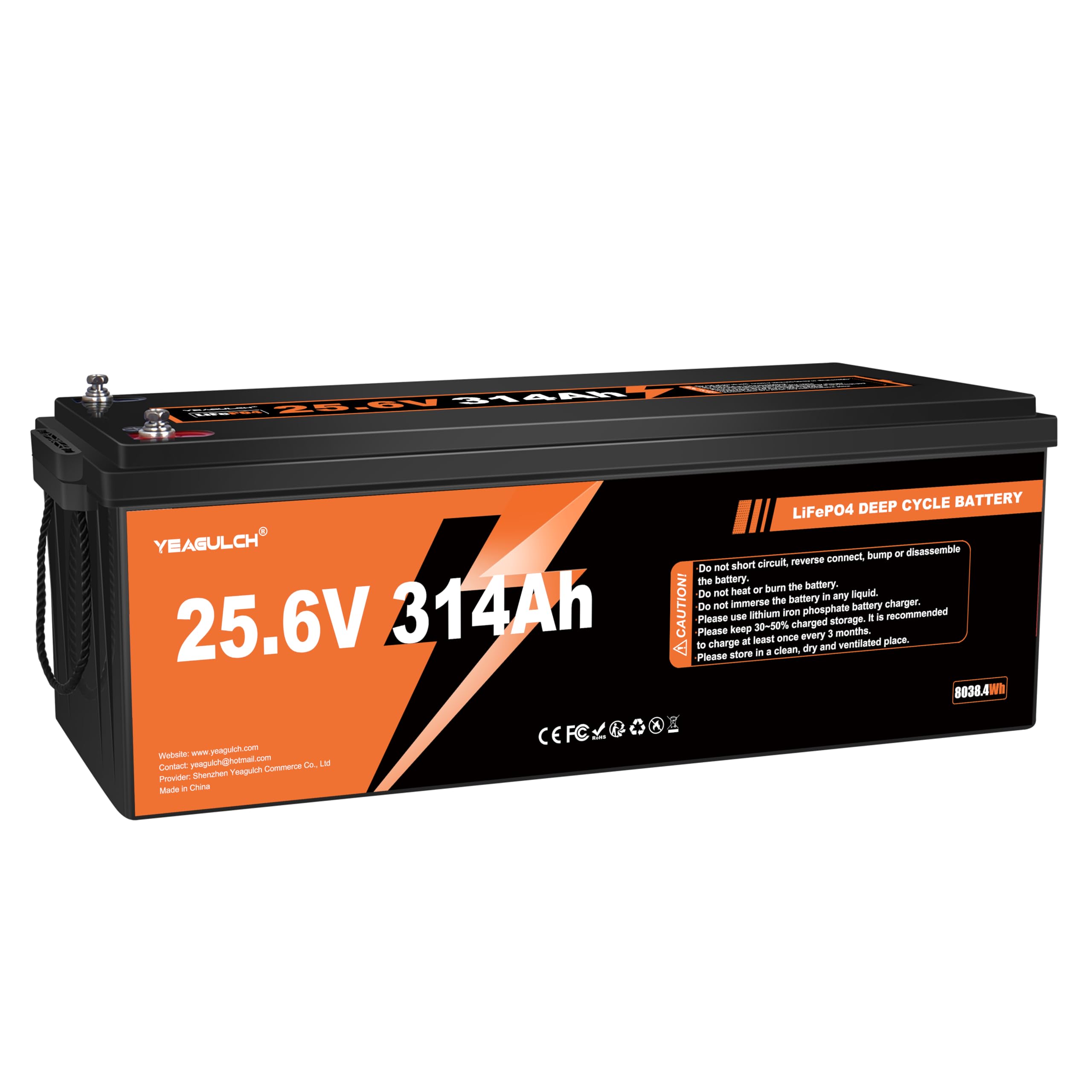
This yeagulch 24V 314Ah battery squeezes over 8kWh into a single unit, making it an attractive option for anyone who wants high capacity without stepping up to 48V. The 200A BMS includes low-temperature cut-off, high-temperature cut-off, and short-circuit protection, and the IP65-rated ABS shell is flame-retardant for added safety. It supports up to 2 units in series (48V) or 4 in parallel for up to roughly 32kWh.
Off-grid users report good results: one reviewer runs two buildings entirely from these batteries and plans to buy more. Another camper used it for a 3-day weekend without power anxiety. But the reviews also show a split — a few customers received defective units that dropped voltage under no load, and the company’s response was unhelpful in those cases. The lack of Bluetooth BMS on this model means you won’t get per-cell monitoring without adding an external device.
If you’re willing to accept some risk on quality consistency for the sake of capacity per dollar, this is a compelling option for a 24V system. Just be prepared to thoroughly bench-test the unit on arrival and verify full capacity before integrating it into your bank.
Why it’s great
- 8,083Wh capacity in a single 24V package
- 200A BMS with comprehensive protections
- Excellent value for large 24V setups
Good to know
- No Bluetooth BMS for detailed cell monitoring
- Reported quality control issues with some units
6. AOUSK 48V 200Ah (2-Pack 100Ah)
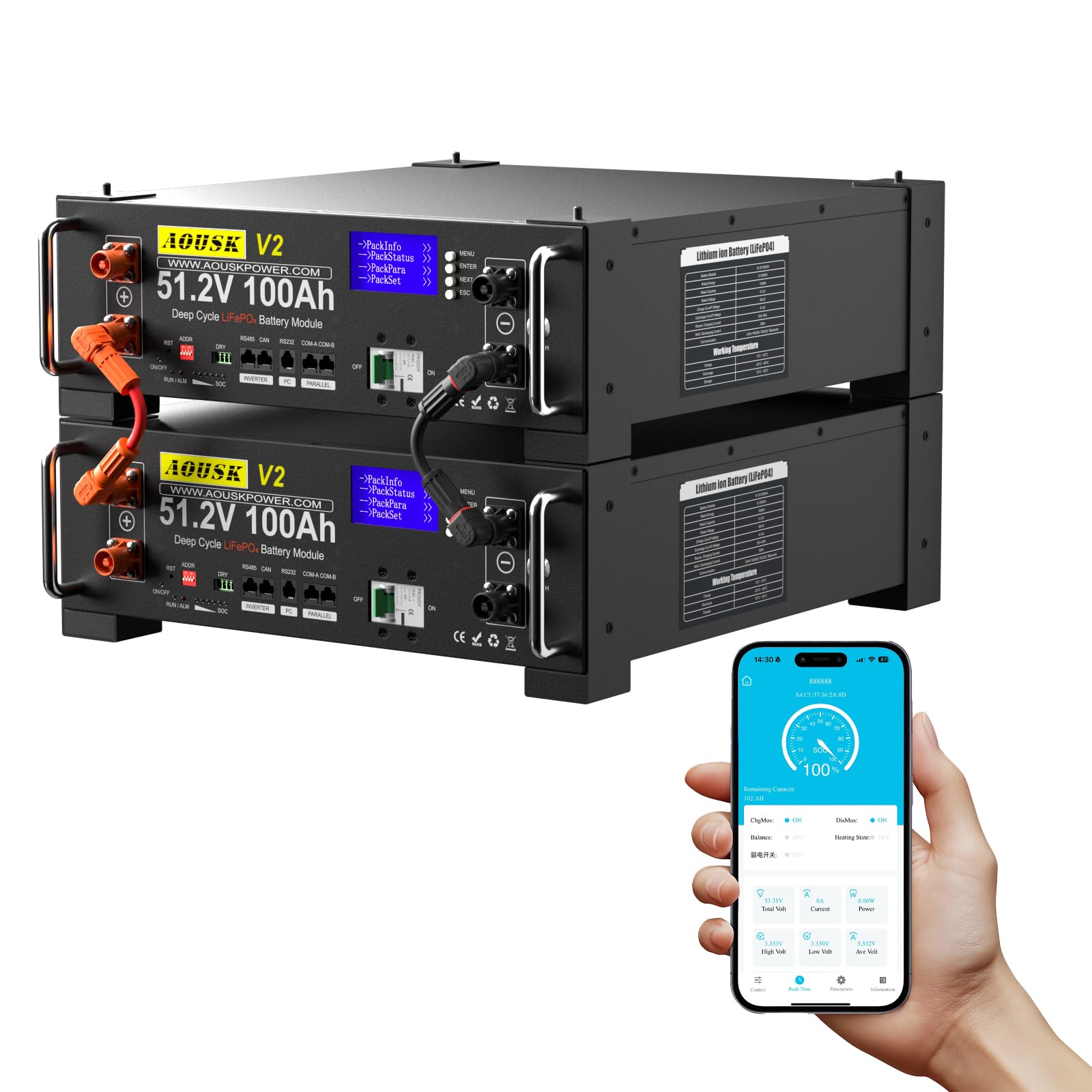
The AOUSK 48V 200Ah pack comes as two 100Ah server-rack batteries pre-configured for 10.24kWh total storage. Each unit uses Grade A prismatic cells with a compact 2U form factor that fits standard 3U cabinets, and the full-metal outer shell adds durability for rack installations. Communication via CAN/RS485 allows seamless pairing with all-in-one inverters, and the included Bluetooth app gives you SOC, voltage, and cycle data.
One user running an off-grid solar build reported that the batteries arrived well-packaged, installed in minutes, and maintained stable cell balance across multiple cycles — exactly what you want from a rack system. The 100A BMS per unit is adequate for most home scenarios, though if you plan to pull sustained high loads, you’ll want to parallel more units. The 125A air switch and separate power switch add a welcome layer of physical safety during maintenance.
The main trade-off is that each battery is limited to 100A continuous discharge (roughly 5.1kW per unit), so anyone with a high-wattage inverter will need to parallel at least two units — which this 2-pack already does. For a tidy, expandable 48V bank with modern inverter compatibility, this is a strong mid-range choice.
Why it’s great
- Pre-configured 2-pack with 10.24kWh total capacity
- Full-metal shell with integrated air switch
- CAN/RS485 for reliable inverter communication
Good to know
- 100A BMS per unit limits draw without paralleling
- Noon-board display; Bluetooth app is basic
7. Anker SOLIX F2000 (PowerHouse 767)

The Anker SOLIX F2000 is a portable power station rather than a fixed battery bank, but it’s a serious contender for anyone who wants solar storage that can roll from the garage to the campsite. With 2,048Wh of LiFePO4 capacity and a 2,400W pure sine wave inverter (SurgePad to 3,600W), it can power a full-size refrigerator for over 24 hours, and the retractable handle and wheels make it easy to move despite weighing 67 pounds.
HyperFlash fast charging takes the unit from 0 to 80% in just 1.4 hours via AC, and the 12-port array (4 AC, 3 USB-C, 2 USB-A, 2 car outlets, RV port) covers every device you’d need in a blackout. Users consistently praise the intuitive display and app connectivity, and one reviewer noted it performed flawlessly as a UPS for servers and network gear, surviving over a dozen circuit flips without interruption. The 5-year full-device warranty is stronger than most portable power stations offer.
The limitation is the fixed 2kWh capacity — it’s enough for a weekend or a short outage, but it can’t be expanded with additional puck batteries like some competitors. It’s also not a direct UPS replacement for full-home loads, since the UPS mode limits output to 1,440W. For portable solar storage with a premium build, however, the SOLIX F2000 is a top pick.
Why it’s great
- Wheeled design makes transport effortless
- HyperFlash 0-80% in 1.4 hours
- Quiet, reliable UPS mode for sensitive electronics
Good to know
- Non-expandable; limited to 2kWh built-in capacity
- UPS mode capped at 1,440W output
8. SUNGOLDPOWER SPH10048P 10kW Inverter

While not a battery itself, the SUNGOLDPOWER SPH10048P is the critical piece that ties your solar panels and battery bank into a functioning system. This 10kW split-phase hybrid inverter features dual MPPT charge controllers, up to 200A battery charging current, and the ability to output 120V/240V split phase — essential for running standard household circuits. It supports four charging modes (hybrid, solar priority, utility priority, and solar-only) and has a time-slot scheduling function that lets you optimize charging around peak/off-peak utility rates.
Users have reported powering entire homes with this unit. One reviewer in Havana runs a bakery consuming 30-40 kWh daily using this inverter paired with a 48V battery bank and 620Wp solar panels, with zero failures after 60 days. Another off-grid RV owner runs two 15,000 BTU air conditioners, an electric water heater, microwave, and an electric burner simultaneously — proof of the 20,000W peak capacity. The built-in WiFi module and RS485/USB/CAN communication allow detailed monitoring via phone app or Solar Assistant software.
The main caveat is that it requires at least 125 VDC solar input to begin charging a 48V battery, which means partial shading on a low-voltage array could delay charging. Also, the AC input terminals accept up to 8 AWG wire, but a 10kW load really calls for 4 AWG, so you’ll need to plan your wiring carefully. For a complete solar system brain, this inverter is hard to beat at this capacity level.
Why it’s great
- 10kW split-phase with dual MPPT for high solar harvest
- 200A battery charging for fast replenishment
- Time-slot scheduling for peak/off-peak optimization
Good to know
- Requires minimum 125 VDC solar input for battery charging
- AC connectors accept max 8 AWG; 4 AWG recommended for full load
9. yeagulch 12V 300Ah (314Ah) LiFePO4
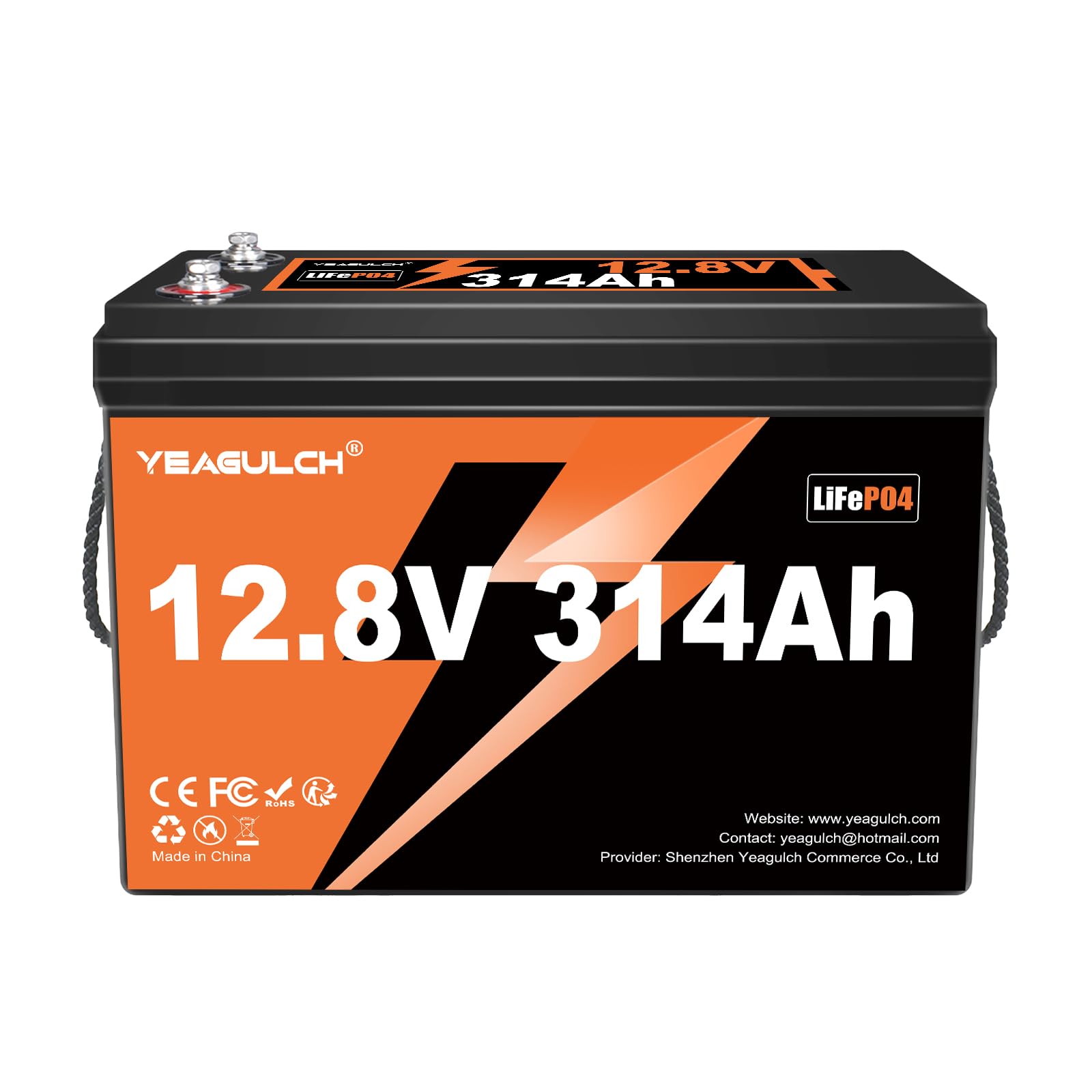
The yeagulch 12V 314Ah battery packs 3,840Wh into a single 12V unit, making it a practical choice for large RV banks or trolling motor setups where you want a single battery to replace six 100Ah lead-acid units. The 200A BMS includes low-temperature cut-off protection and short-circuit safeguards, and the IP67 waterproof rating means it can handle rain, splashes, and even temporary submersion — a real advantage in marine or outdoor compartments.
User experiences are split. On the positive side, one buyer runs a refrigerator in an off-grid cabin 24/7 for four months straight on a single charge, and another powers an 80lb trolling motor on a pontoon boat, getting four outings without recharging. The weight saving versus lead-acid is dramatic — roughly one-third the weight — and the extra voltage from LiFePO4 gives a noticeable speed boost to electric motors. But there are also reports of a defective unit that wouldn’t hold a charge and quickly dropped from 100% to 81% under minimal load, with Amazon’s non-returnable policy creating a painful situation.
Bench-testing every unit on arrival is strongly recommended. If you get a good one, the capacity-to-cost ratio is excellent. If you get a bad one, the lack of Bluetooth BMS means you won’t know until you’re already relying on it, so buy from a source with good return support.
Why it’s great
- Massive 3,840Wh in a single 12V battery
- IP67 waterproof rating for harsh environments
- Dramatically lighter than equivalent lead-acid bank
Good to know
- No Bluetooth BMS; no per-cell monitoring
- Known quality inconsistency in some units
10. Dyness 24V 100Ah LiFePO4
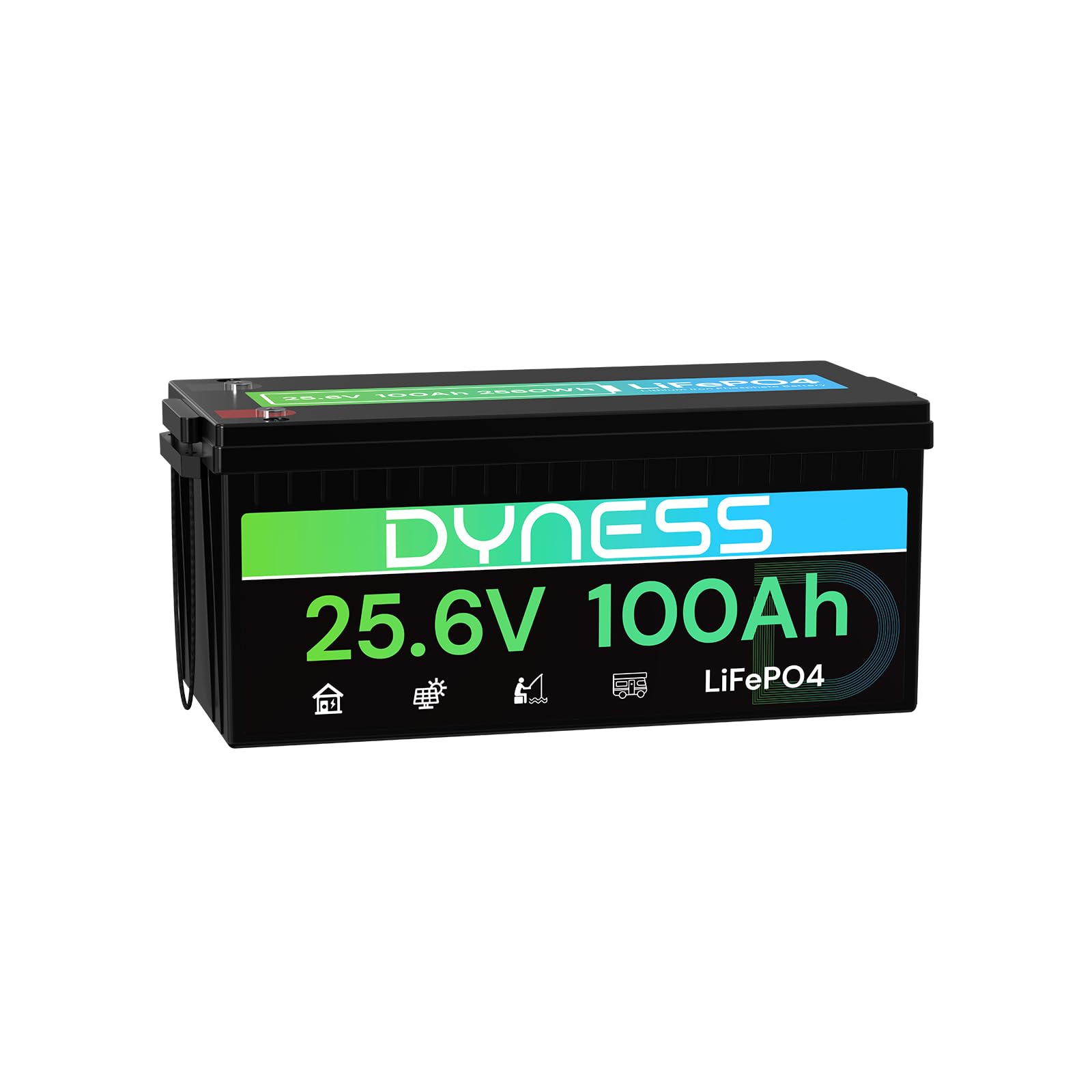
Dyness offers a clean 24V 100Ah package (2,560Wh) with A+ Grade lithium iron phosphate cells and a smart 100A BMS that includes low-temperature cut-off for cold-weather use. It supports up to 4P2S connections to scale to a 51.2V 400Ah bank (20.48kWh), giving you a path to expand. The marine terminals and compact footprint make it a natural fit for boats, RVs, and small solar sheds.
Users report reliable performance: one reviewer using two in a Ram Promaster van (200Ah total) sees no degradation so far. Another praised it for quick charging and long charge retention, perfect for solar systems and backup power. The 5-year warranty adds peace of mind, and the price point undercuts many comparable 24V batteries from more established brands. A minor note is that the battery requires at least 20A charging as printed on the case; using a lower-current charger may result in slow or incomplete charging.
This isn’t the highest-capacity 24V battery on the market, but for someone building a moderate 24V solar system who values cell quality and expansion flexibility, the Dyness is a well-rounded choice that avoids the extremes of budget inconsistency or premium overpricing.
Why it’s great
- Grade A+ cells with good consistency and safety
- Supports 4P2S expansion up to 20.48kWh
- 5-year warranty at a competitive price
Good to know
- Requires minimum 20A charging for full performance
- Noon-board Bluetooth; monitoring via external BMS
11. Litime 12V 100Ah Bluetooth LiFePO4
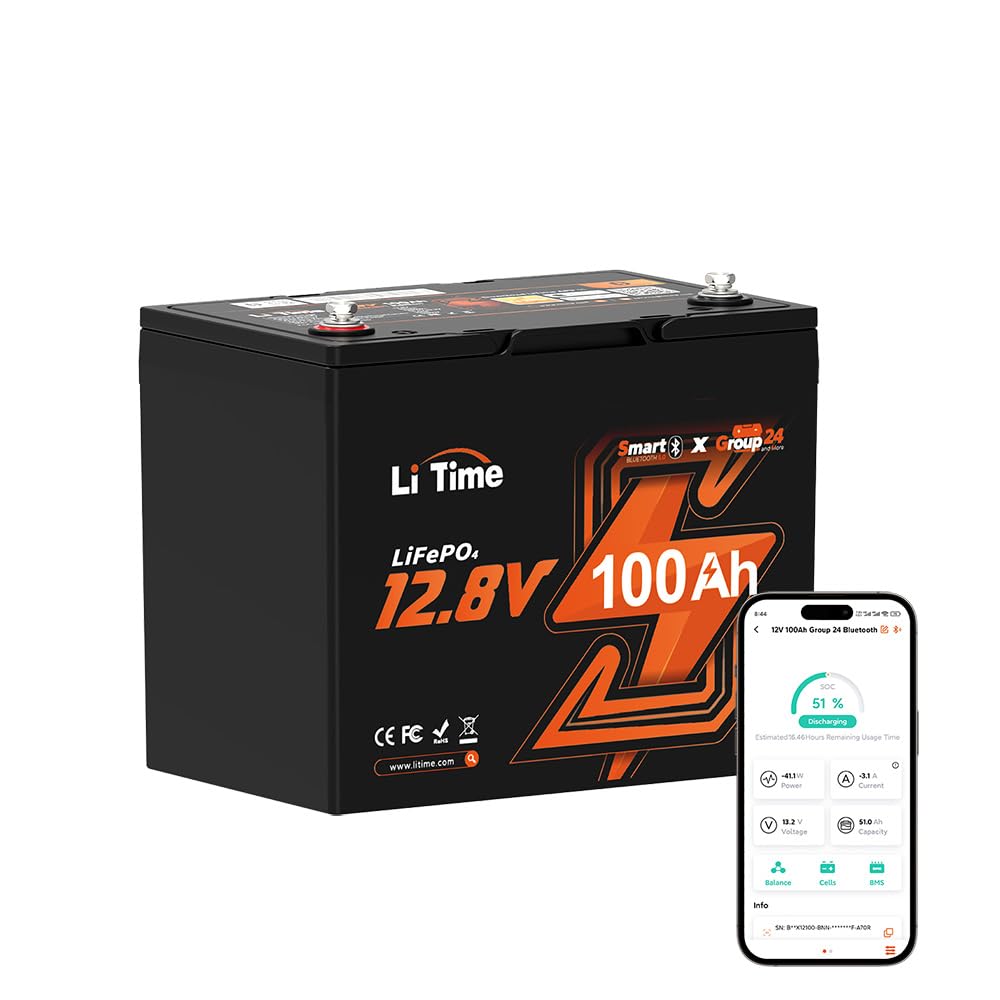
Litime’s 12V 100Ah Group 24 Bluetooth battery is an entry-level smart battery that brings Bluetooth 5.0 monitoring to the budget-friendly segment. At 21.9 pounds and roughly 35% smaller than a comparable lead-acid battery, it’s an easy conversion for anyone with a Group 24 tray. The built-in 100A BMS handles 1,280W continuous (500A peak), with overcharge, over-discharge, overcurrent, short-circuit, and low-temperature cut-off protections — a solid safety suite for the price.
Users generally praise the value and performance. One reviewer used it in a travel trailer for a year without issues, though the Litime app was described as finicky, occasionally requiring reconnection to refresh the data. The battery arrived in storage mode (BMS shutdown) at around 2.8V, requiring a 0V-capable charger or a brief jump-start from a car battery before it would wake up — a common BMS quirk, not a defect. Once active, it reliably powered a fridge and compressor in a truck for two years across 34 cycles, with Bluetooth range exceeding 50 feet.
The biggest drawback is the activation process, which can confuse first-time lithium buyers. Read the startup instructions carefully and have a lithium-compatible charger on hand. For the price, especially during sales, this is one of the most accessible ways to get into a smart LiFePO4 battery with real-time monitoring for a small solar string or RV upgrade.
Why it’s great
- Bluetooth 5.0 monitoring at a budget-friendly price
- Lightweight, perfect Group 24 drop-in replacement
- 5-year warranty from a top Amazon lithium brand
Good to know
- Arrives in BMS shutdown; requires lithium-capable charger to activate
- App connectivity can be glitchy during charging
FAQ
Can I mix old and new LiFePO4 batteries in the same bank?
What size solar panel array do I need to fully charge a 48V 100Ah battery in one day?
Is it safe to install LiFePO4 batteries indoors?
Final Thoughts: The Verdict
For most users, the batteries for solar power storage winner is the Battle Born BB10012 because its proven reliability, 10-year warranty, and effortless drop-in design make it the safest long-term bet for any RV, van, or small off-grid system. If you want massive capacity in a server-rack format with inverter communication, grab the ECO-WORTHY Cubix100 48V. And for a portable solution that rolls from garage to campsite, nothing beats the Anker SOLIX F2000.

Mo Maruf
I created WellFizz to bridge the gap between vague wellness advice and actionable solutions. My mission is simple: to decode the research and give you practical tools you can actually use.
Beyond the data, I am a passionate traveler. I believe that stepping away from the screen to explore new environments is essential for mental clarity and physical vitality.