Our readers keep the lights on and my smoothie glass nicely filled. As an Amazon Associate, I earn from qualifying purchases.
Choosing the right energy storage for an off-grid solar system means moving past vague amp-hour ratings and looking directly at cycle life, usable capacity, and cold-weather performance. A battery that dies after 500 cycles or shuts off below freezing will leave you running a generator far more often than you planned.
I’m Mohammad Maruf — the founder and writer behind WellFizz. I spend my time analyzing battery chemistries, BMS architectures, and real-world depth-of-discharge data to separate marketing claims from actual energy storage hardware.
This guide covers lithium iron phosphate (LiFePO4) units that can handle daily deep cycling without voltage sag, including options with low-temperature charging protection and scalable parallel configurations. After comparing cell grades, BMS ratings, and cold-weather cutoffs, these are the best batteries for off grid solar available today.
How To Choose The Best Batteries For Off Grid Solar
An off-grid battery bank is a multi-year investment. Getting the right one means understanding depth-of-discharge ratings, BMS limits, cold-weather behavior, and how chemistry affects usable capacity over time. Below are the four factors that separate a reliable bank from one that leaves you without power mid-winter.
Depth of Discharge and Cycle Life
A lead-acid battery typically lasts 300 to 500 cycles if you discharge it to 50%. A LiFePO4 battery can handle 4000 cycles at 100% DoD before its capacity drops to 80%. For off-grid use where you cycle the bank daily, the LiFePO4 chemistry pays for itself within two years simply by avoiding replacement costs. Always compare cycle life at 100% DoD or 80% DoD, not the shallow-cycle numbers manufacturers sometimes advertise.
BMS Current Rating vs Inverter Draw
The battery management system protects the cells from overcurrent, over-discharge, and over-temperature. A 100A BMS on a 12V battery can deliver roughly 1280W continuously. If your inverter peaks at 2000W or more, you need a battery with a 200A BMS or you will hit a hard shutdown when starting a refrigerator compressor or microwave. Match the BMS rating to your inverter’s surge and continuous draw.
Low-Temperature Charging Protection
Charging a LiFePO4 battery below freezing (32°F / 0°C) causes permanent lithium plating inside the cells, destroying capacity within a few cycles. A battery with built-in low-temperature protection disconnects the charger automatically until the cells warm up. If your system operates in a cold garage, cabin, or northern climate, this feature is non-negotiable. Some batteries also include discharge down to -4°F, which matters for power delivery even when charging is disabled.
Scalability and Voltage Matching
Most 12V batteries support parallel connections for increased capacity and series connections for higher system voltage. Check the maximum series and parallel count before buying. A 24V or 48V bank reduces wiring losses and allows smaller-gauge cables for the same power level. If you plan to expand later, choose a battery that supports at least 4 in parallel so you can grow without replacing the entire bank.
Quick Comparison
On smaller screens, swipe sideways to see the full table.
| Model | Category | Best For | Key Spec | Amazon |
|---|---|---|---|---|
| ECO-WORTHY 12V 280Ah | Premium | Large RV banks with Bluetooth | 3584Wh, 200A BMS, metal case | Amazon |
| Litime 12V 300Ah | Premium | Long runtime, EV-grade cells | 3840Wh, 200A BMS, 4000 cycles | Amazon |
| Anker SOLIX C2000 Gen 2 | Ultra-Portable | Portable backup & camping | 2048Wh, 2400W inverter, 58 min charge | Amazon |
| Dyness 12V 100Ah (2-Pack) | Mid-Range | Compact 200Ah starter bank | 100A BMS, low-temp cutoff, IP65 | Amazon |
| GRNOE 12V 100Ah (2-Pack) | Mid-Range | Lightweight RV & marine use | 22.48 lbs each, 100A BMS | Amazon |
| DUMFUME 24V 100Ah | Mid-Range | 24V solar systems, higher voltage | 2.56kWh, 100A BMS, 48 lbs | Amazon |
| DUMFUME 12V 150Ah (2-Pack) | Value | Budget 300Ah bank for solar | Dual 100A BMS, 8000 cycles | Amazon |
| Rvpozwer 12V 300Ah | Budget | Large capacity on a budget | 200A BMS, 15000 cycles at 60% DoD | Amazon |
| BLUETTI Elite 100 V2 | Compact | Quiet CPAP, router backup | 1024Wh, 1800W inverter, 30 dB | Amazon |
In‑Depth Reviews
1. ECO-WORTHY 3584Wh 12V 280Ah LiFePO4
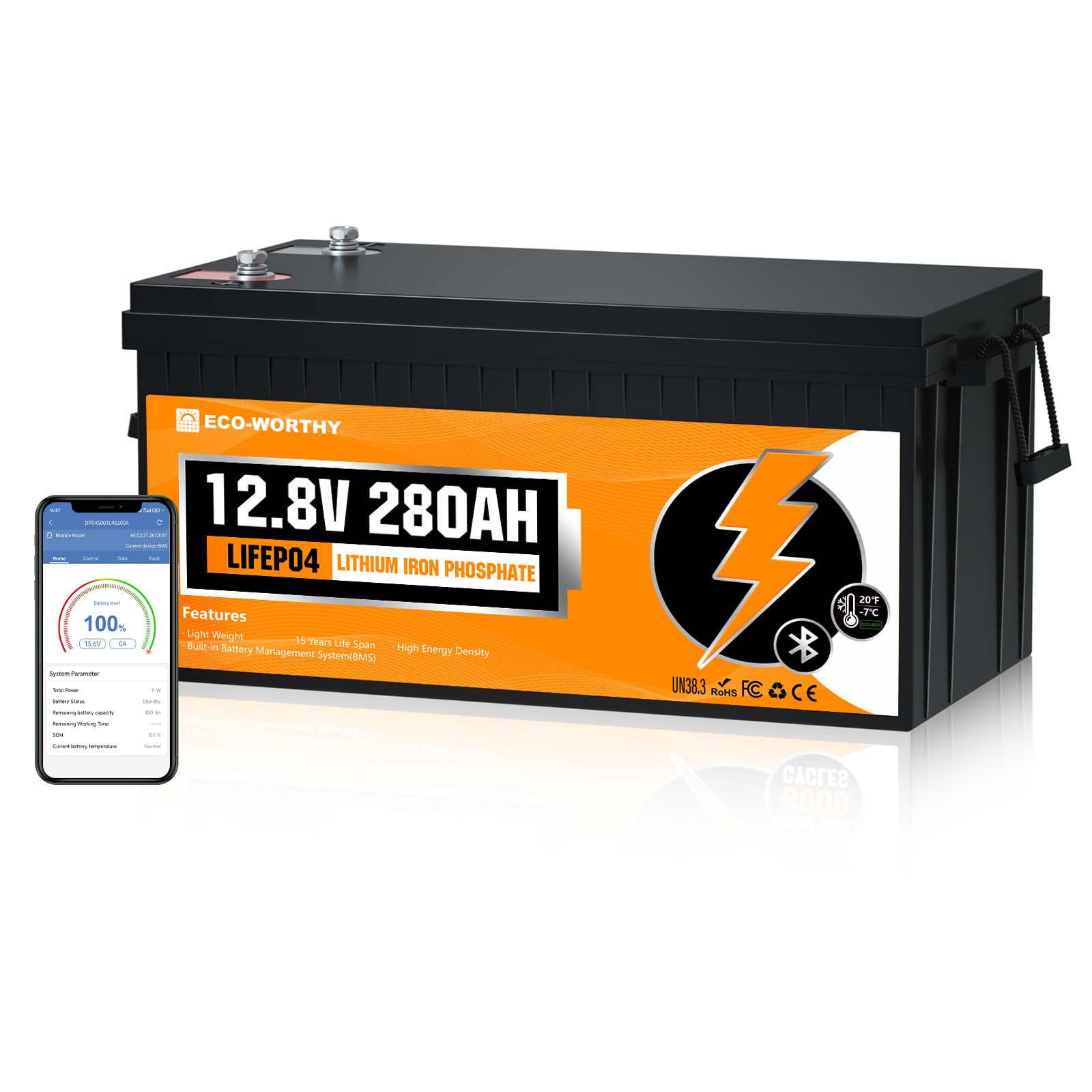
This battery packs 3584Wh of usable energy into a rigid metal case with internal compression plates that prevent cell swelling over thousands of cycles. The 200A BMS handles continuous loads up to 2560W, which easily covers a mid-size inverter running a refrigerator, lights, and small appliances simultaneously. Bluetooth monitoring through the ECO-WORTHY app gives real-time voltage, current, and state-of-charge data without needing a separate shunt.
Low-temperature charging protection kicks in at 19.4°F (-7°C), making this unit viable for unheated garages and northern cabins. The discharge cutoff at -4°F (-20°C) means you can still draw power even when charging is blocked. Up to four batteries can be connected in parallel for a 1120Ah / 12V bank, or four in series for a 48V system, which covers almost any residential off-grid architecture.
At 61.7 pounds, this is not a lightweight carry battery, but the metal case includes tie-down brackets and front-facing terminals that simplify installation in an RV compartment or utility room. Owner reports confirm the real-world capacity often exceeds the rated 280Ah, and the JBD-based BMS allows deeper diagnostics via compatible third-party apps.
Why it’s great
- Metal case with compression fixture prevents cell expansion
- 200A BMS supports high-draw inverters without shutdown
- Bluetooth app provides live SoC data without extra hardware
- Low-temp cutoff at 19.4°F protects cells in cold environments
Good to know
- Heavy at 61.7 lbs, requires secure mounting
- Initial charge needed before paralleling to balance cells
2. Litime 12V 300Ah LiFePO4
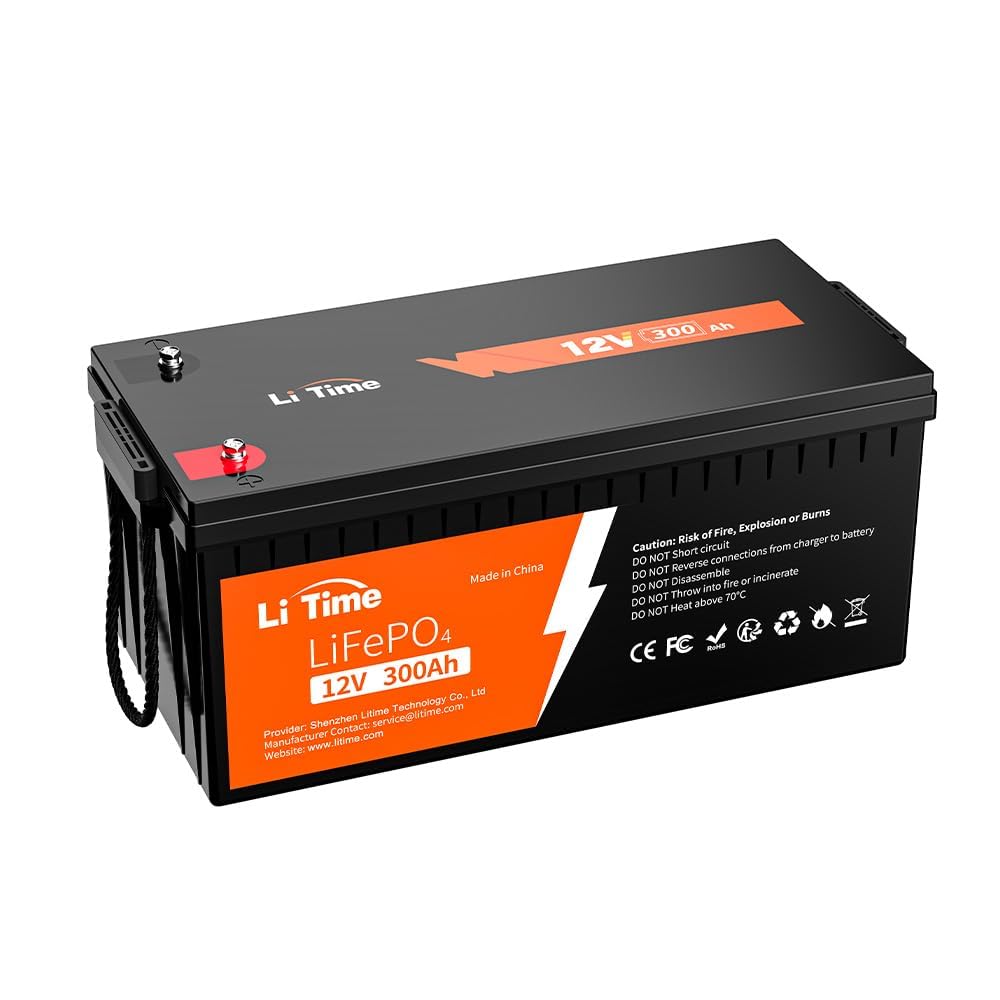
Litime uses EV-grade cells tested to ETL standards, giving this 300Ah battery a higher safety margin than many budget-priced alternatives with generic cells. The 200A BMS protects against overcharge, over-discharge, and short circuits while allowing continuous loads up to 2560W, which matches a 2000W inverter with headroom for surge draws. Total usable energy sits at 3840Wh, enough to run a medium RV setup for 12 to 18 hours between solar charging cycles.
Rated for 4000 cycles at 100% DoD, this battery will last over a decade under daily deep cycling. The energy density is roughly double that of an equivalent lead-acid bank while weighing only a third as much at 62.8 pounds. For off-grid homes needing a large single battery rather than multiple paralleled units, the Litime 300Ah simplifies wiring and reduces connection points that can loosen over time.
Scalability supports up to four batteries in parallel (1200Ah total) or four in series for 48V systems, giving you 40.96kWh of total storage. Some owners report the BMS arriving in sleep mode after shipping, requiring a jump-start from a charged battery or a LiFePO4-specific charger to wake the unit — a common quirk among high-capacity LiFePO4 batteries.
Why it’s great
- EV-grade cells with ETL-tested 200A BMS for safety
- 4000 cycles at full depth of discharge
- 61.14 Wh/lb energy density beats lead-acid by 2X
- Expandable to 40.96kWh via 4P4S configuration
Good to know
- BMS may arrive in sleep mode and need a wake charge
- No Bluetooth monitoring included on the base model
3. Anker SOLIX C2000 Gen 2

This is a complete portable power station rather than a bare battery, which makes it ideal for off-grid setups that need a plug-and-play solution without wiring a separate inverter and charge controller. The 2048Wh LiFePO4 pack feeds a 2400W pure sine wave inverter with a 4000W peak, enough to start a small RV air conditioner or run a full-size refrigerator for over 24 hours. The unit recharges from AC in 58 minutes or from 800W alternator input in about three hours, solving the problem of slow solar-only charging on cloudy days.
At 41.7 pounds and measuring 18.1 x 9.8 x 10.1 inches, this is 25% lighter than comparable 2kWh power stations, thanks to the updated Gen 2 cell packaging. The standby draw of only 9W means the battery retains most of its charge when left idle for weeks — a real advantage for seasonal off-grid use. Optional expansion batteries double the capacity to 4kWh without replacing the main unit.
The Anker app provides remote monitoring and can control charging speeds, but some users report that the Bluetooth connection range is shorter than expected. The six recharging methods (AC, solar, car, alternator, generator, and dual AC+solar) give this unit flexibility that standalone batteries cannot match, though the proprietary casing limits DIY cell replacement.
Why it’s great
- 2400W inverter with 4000W peak runs small A/C units
- 58-minute full recharge from AC for quick turnaround
- 9W standby preserves charge during long storage
- Expansion battery doubles to 4kWh
Good to know
- Proprietary casing prevents user cell replacement
- Bluetooth range may be limited in some installations
4. Dyness 12V 100Ah LiFePO4 (2-Pack)
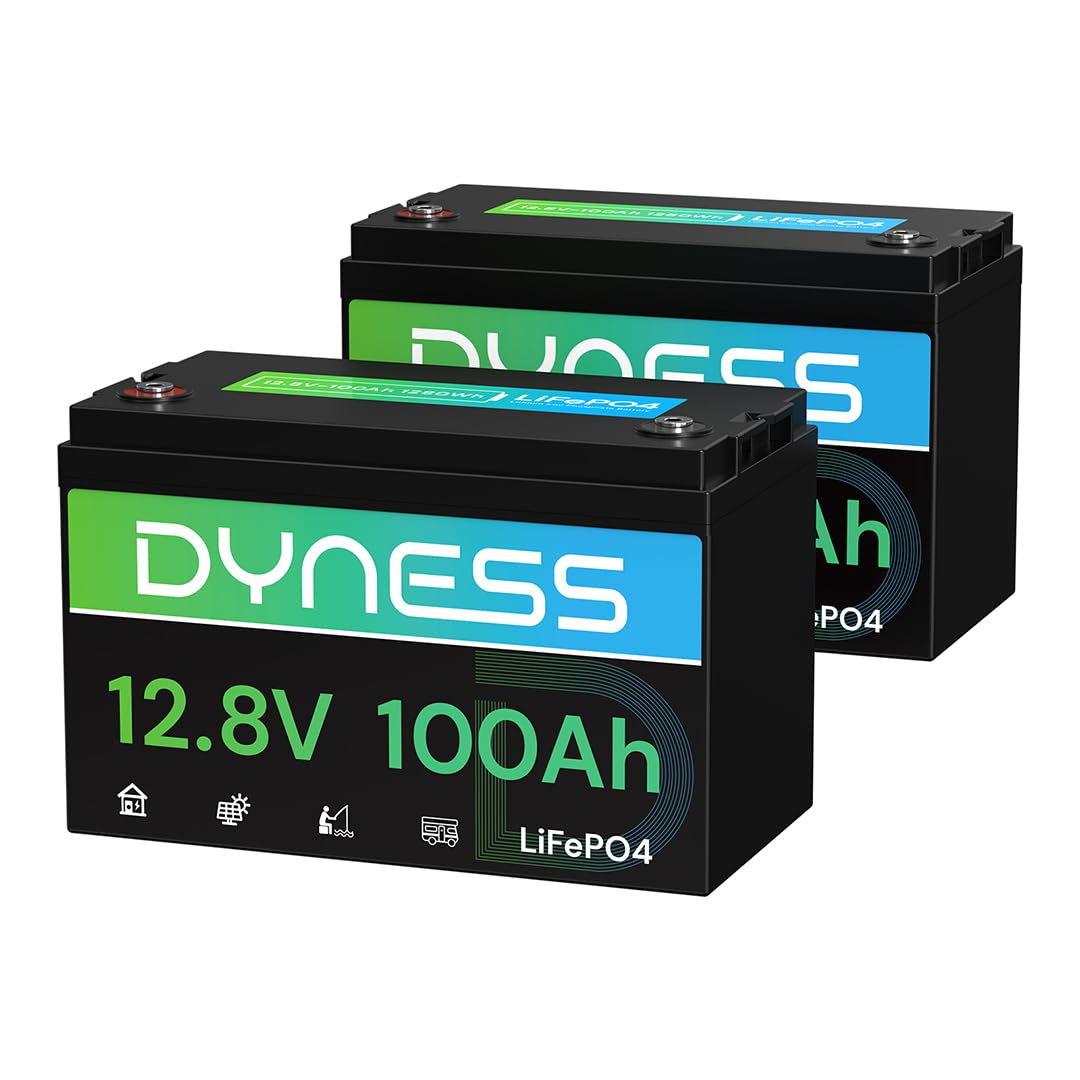
This two-pack gives you 200Ah of LiFePO4 capacity at 12V in a footprint 50% smaller and 65% lighter than lead-acid equivalents. Each battery measures just 13 x 6.77 x 8.42 inches and weighs 25.3 pounds, making it easy to install in tight RV battery compartments or under a bench seat. The smart 100A BMS provides the full suite of protections including overcharge, over-discharge, overcurrent, and short circuit, plus IP65 waterproofing that handles marine humidity and road spray.
Low-temperature charging protection automatically stops charging below 32°F (0°C) and resumes at 41°F (5°C), preventing lithium plating damage during cold-weather storage. The A+ grade cells are rated for 4000+ deep cycles at 100% DoD, giving a realistic ten-year lifespan under daily use. Each battery supports up to 4 in series or 4 in parallel, so this two-pack can expand to a 20.48kWh bank without replacing the original units.
Real-world owners report that the batteries arrived at around 50% state of charge and needed a full charge cycle before paralleling. The built-in BMS communicates through simple LED indicators rather than Bluetooth, which is fine for users who prefer a no-app setup but limits remote diagnostics.
Why it’s great
- Near 50% smaller footprint than lead-acid batteries
- IP65 rating handles moisture and weather exposure
- Low-temp cutoff protects cells in cold climates
- Two-pack reaches 200Ah with room to expand to 20.48kWh
Good to know
- No Bluetooth monitoring for real-time SoC tracking
- Requires LiFePO4-specific charger for optimal charging speed
5. GRNOE 12V 100Ah LiFePO4 (2-Pack)
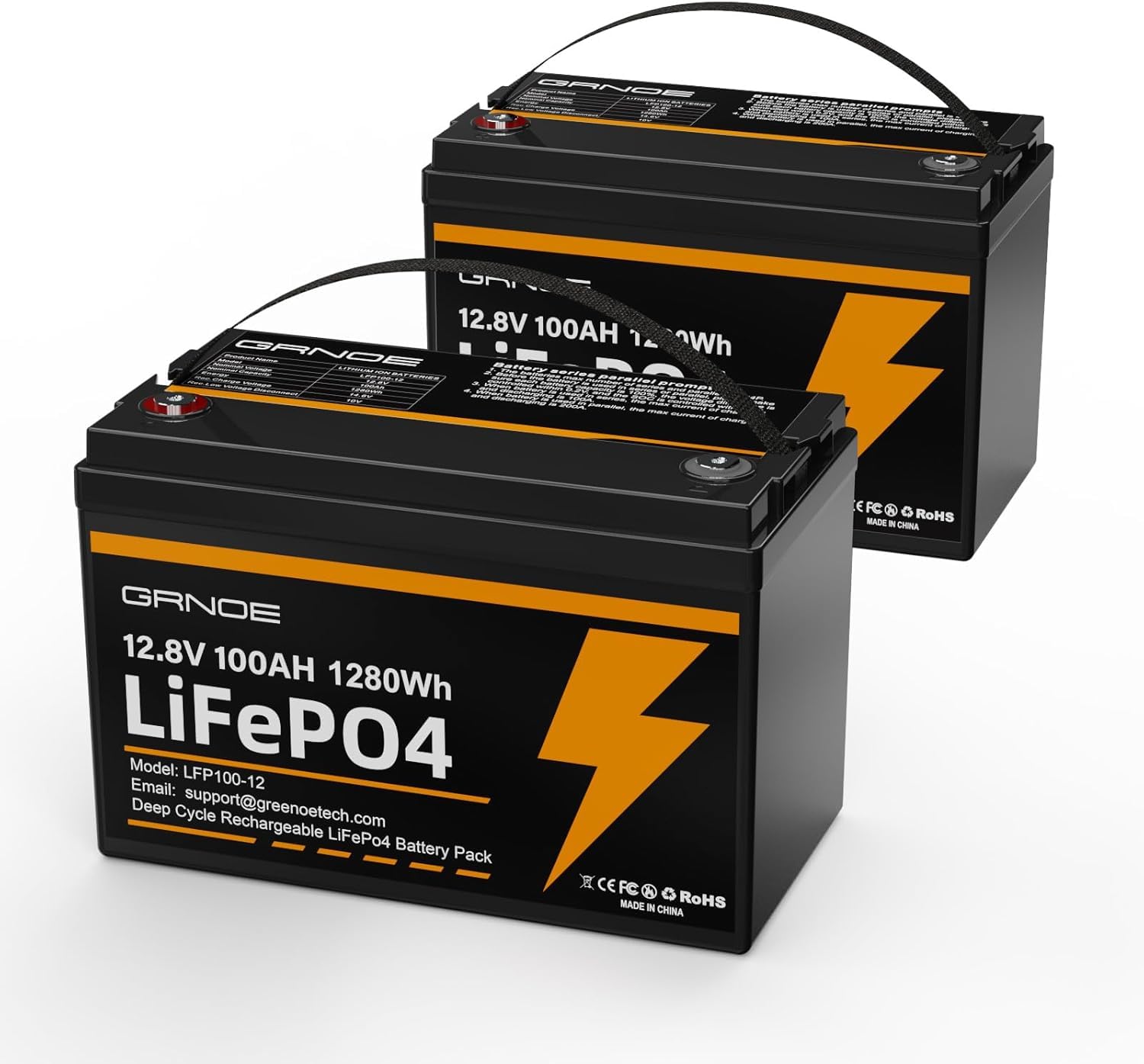
At 22.48 pounds each, these are among the lightest 100Ah LiFePO4 batteries available, making them a strong choice for weight-sensitive applications like pop-up campers or boat transoms where every pound matters. The energy density works out to 57 Wh per pound, which means you get the same usable power as a 70-pound lead-acid battery at a third of the weight. The BCI Group 31 case fits standard battery trays without modification.
The 100A BMS includes low-temperature charging cutoff at 32°F (0°C) and allows discharge down to -4°F (-20°C), so the battery still provides power for lights and controls even when the charger is locked out. UL and UN38.3 certification verifies the cells meet basic safety standards, and the three-year warranty covers manufacturing defects without the hassle of returning through Amazon’s non-returnable policy.
Some users note that the terminal posts use non-standard M8 bolts that require eyelet terminals rather than standard post clamps. The battery also must be activated with a 14.6V lithium charger before first use; trying to charge it with a standard 12V lead-acid charger will leave the BMS in a locked state and the battery at low voltage.
Why it’s great
- Lightest 100Ah option at 22.48 lbs for portability
- UL/UN38.3 certified cells for basic safety compliance
- Discharge down to -4°F while charging protected at 32°F
- Three-year warranty backed by responsive support
Good to know
- Requires 14.6V LiFePO4 charger for initial activation
- Non-standard M8 terminals need eyelet ring connectors
6. DUMFUME 24V 100Ah LiFePO4
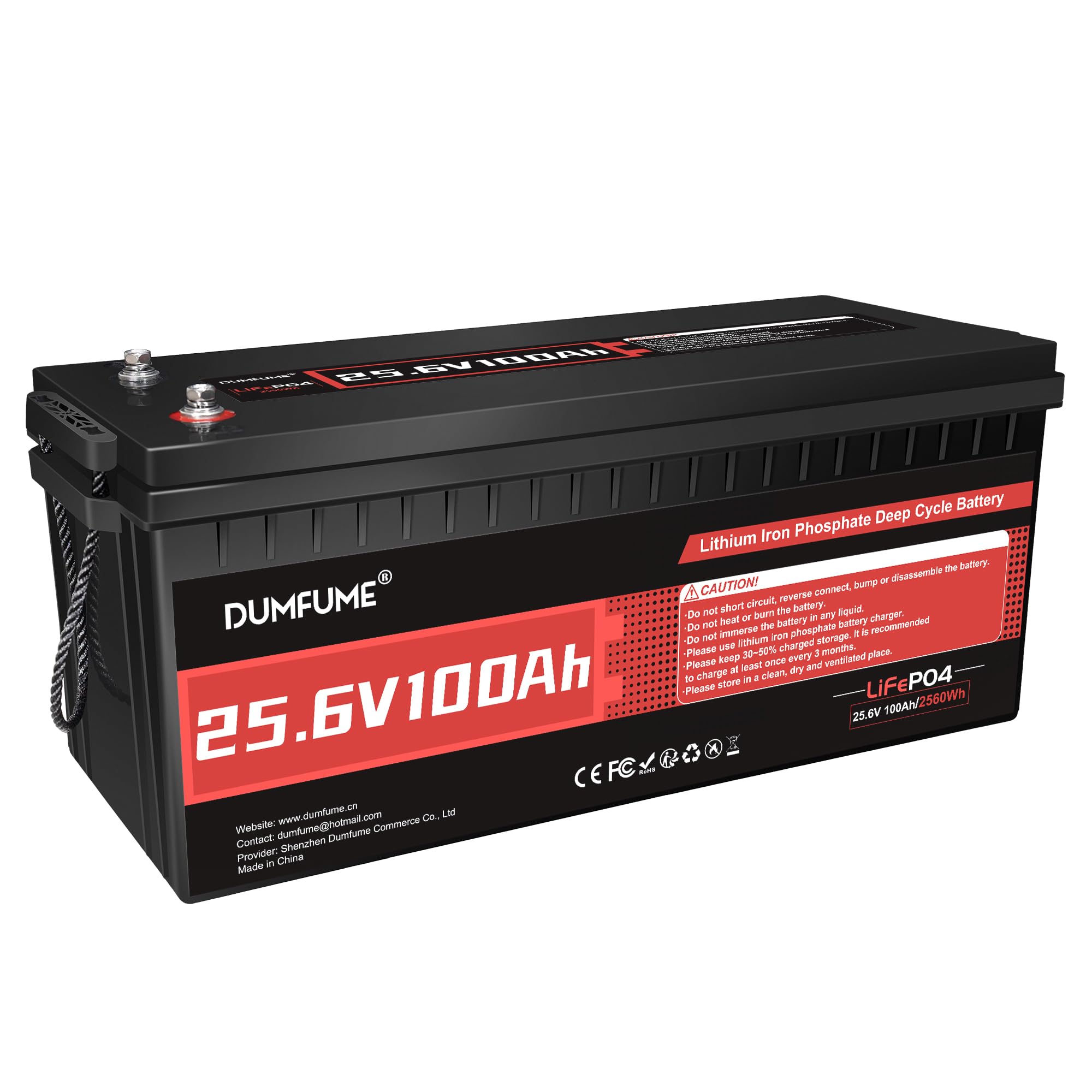
A 24V battery bank cuts wiring losses in half compared to 12V, allowing thinner cables and lower voltage drop over long runs between solar arrays and the inverter. The DUMFUME 24V 100Ah delivers 2.56kWh of storage in a single unit, equivalent to two 12V 100Ah batteries wired in series, while saving space and reducing wiring complexity. The 100A BMS at 24V provides 2560W of continuous power, enough to run a 2000W inverter with headroom for small surge loads.
The battery uses Grade-A LiFePO4 cells and is rated for 4000 deep cycles at 100% DoD, which translates to roughly ten years of daily cycling. Weighing 48.06 pounds, it is heavier than a single 12V 100Ah battery but still manageable for one-person installation. The scalable design supports 2S4P configurations, so you can expand to a 48V 400Ah bank over time without replacing existing units.
Owner experiences are generally positive, though some report batteries arriving at a low state of charge requiring a parallel jump-start from a charged battery. Low-temperature protection cuts charging at 41°F (5°C), and the manufacturer warns that return shipping is not covered for cold-related issues, so this battery is best used in climate-controlled spaces or mild climates.
Why it’s great
- Single 24V unit reduces wiring losses vs 12V bank
- 2560W continuous power from a compact 48 lb package
- 4000 cycles at 100% DoD for long-term reliability
- Scalable to 48V 400Ah via 2S4P connections
Good to know
- Low-temp charging cutoff at 41°F, not suitable for freezing garages
- Some units arrive at low voltage needing a jump-start
7. DUMFUME 12V 150Ah LiFePO4 (2-Pack)
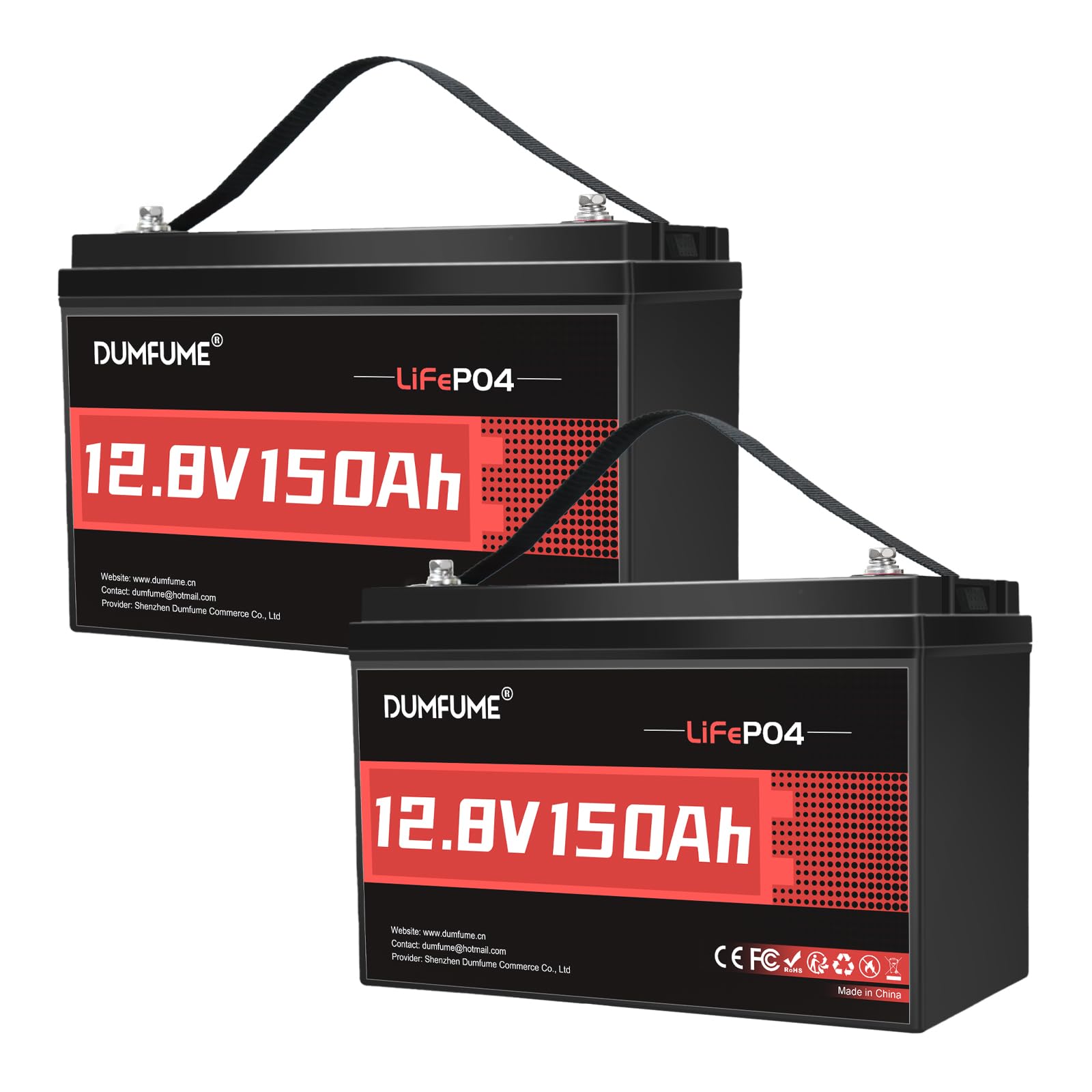
This two-pack combines two 150Ah batteries into a 300Ah bank, which translates to roughly 3840Wh of usable LiFePO4 storage at 12V. Each battery has its own independent 100A BMS, providing redundancy that protects the entire bank if one BMS trips. The dual-BMS approach also means each battery manages its own cell balancing, reducing the risk of imbalance that can occur in large parallel banks using a single BMS.
The batteries support parallel expansion up to 4S4P, giving you the option to build a 48V 600Ah system from four pairs of these units. At roughly 24.5 pounds per battery, the pair weighs about 49 pounds total, making installation and repositioning manageable. The five-year warranty covers manufacturing defects, though some owners report that warranty claims through Amazon require going directly to the manufacturer rather than using Amazon’s return center.
A few users report receiving units at voltages between 12.2V and 12.4V, which required a parallel connection to a charged battery to wake the BMS. The batteries are non-smart with no Bluetooth or display, so state-of-charge tracking relies on an external shunt or battery monitor.
Why it’s great
- Two 150Ah batteries provide 300Ah total capacity out of the box
- Independent dual BMS adds redundancy for large banks
- Lightweight at 24.5 lbs per battery for easy handling
- Expandable to 48V 600Ah via 4S4P configuration
Good to know
- Some batches arrive at low voltage needing a BMS wake-up
- No Bluetooth or display; requires external battery monitor
8. Rvpozwer 12V 300Ah LiFePO4

For buyers who need maximum amp-hour capacity per dollar, the Rvpozwer 300Ah delivers 3840Wh in a single Group 31-compatible case with a 200A BMS that can handle continuous loads up to 2560W. The BMS covers overcharge, over-discharge, and short-circuit protection, and the Grade-A LiFePO4 cells are rated for 4000 cycles at 100% DoD, 6000 at 80% DoD, and up to 15000 cycles at 60% DoD — a useful spectrum for users who want to match the battery’s longevity to their typical daily depth of discharge.
The operating temperature range of -20°C to 65°C (-4°F to 149°F) is wider than many competitors, with low-temperature charging protection that cuts charging below freezing. The ergonomic nylon handle makes the 56.3-pound unit easier to carry than the weight suggests, and the standard Group 31 footprint fits existing battery trays without modification.
Support experiences are mixed: while some owners report responsive service and replacement of DOA units, others describe frustrating back-and-forth requests for data before warranty resolution. A small number of users report actual capacity around 281Ah rather than the rated 300Ah, which is within acceptable manufacturing tolerance for Grade-A cells but worth noting for systems that depend on precise capacity calculations.
Why it’s great
- 200A BMS supports 2560W continuous loads for mid-size inverters
- 15000-cycle rating at 60% DoD extends usable life
- Wide operating range from -4°F to 149°F
- Group 31 footprint fits standard trays with nylon carrying handle
Good to know
- Warranty support may require extensive documentation
- Real-world capacity can be slightly below rated 300Ah
9. BLUETTI Elite 100 V2
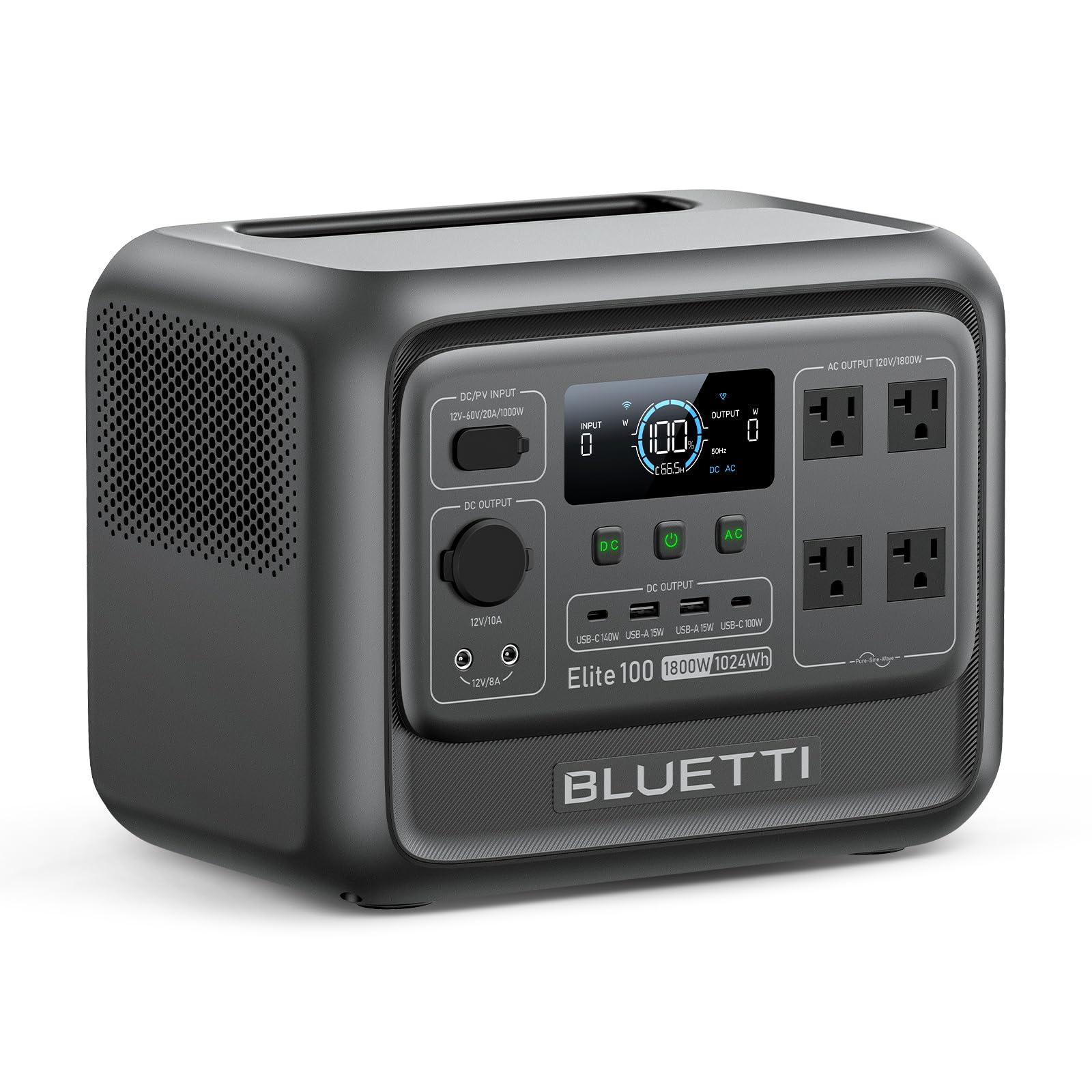
The Elite 100 V2 is a self-contained power station with a 1024Wh LiFePO4 battery and a 1800W pure sine wave inverter capable of 3600W surge. At 25 pounds and a volume of 17 liters, this is one of the most space-efficient 1kWh options for off-grid scenarios that don’t justify a full battery bank — think weekends in a truck camper, CPAP backup, or running a router and modem during short outages. The unit charges fully from AC in 70 minutes or from 1000W solar input in roughly the same time, which is faster than many comparable units.
UPS mode switches in under 10 milliseconds, so connected equipment never restarts during a flicker or grid drop. The fan stays at library-level 30 dB under light loads, making it acceptable for bedroom or van-life use where quiet operation matters. The hidden carry handle and compact footprint make it easy to store behind a passenger seat or on a closet shelf.
The ELite 100 V2 does not include wireless charging or a built-in light, features found on some competitors. The 1800W inverter will struggle with large inductive loads like full-size refrigerators or well pumps, so it is best matched to small electronics, CPAP machines, mini fridges, and entertainment gear.
Why it’s great
- 1800W inverter with 3600W surge handles startup loads
- 70-minute full recharge from AC for quick turnaround
- UPS switchover under 10ms protects sensitive electronics
- 30 dB fan keeps operation quiet in living spaces
Good to know
- 1024Wh capacity limits runtime for large appliances
- No wireless charger or integrated light included
FAQ
Can I charge a LiFePO4 battery with a standard lead-acid charger?
What happens if I charge a LiFePO4 battery below freezing temperature?
How many 100Ah batteries do I need for a typical off-grid cabin?
Is it safe to connect LiFePO4 batteries in series for 24V or 48V?
Final Thoughts: The Verdict
For most users, the best batteries for off grid solar is the ECO-WORTHY 12V 280Ah because it combines a 200A BMS, Bluetooth monitoring, a protective metal case, and low-temperature charging cutoff in a single expandable unit that works for both 12V and 48V systems. If you need the absolute longest runtime per battery and prioritize EV-grade cell safety, grab the Litime 12V 300Ah. And for a portable, all-in-one backup that recharges in under an hour, nothing beats the Anker SOLIX C2000 Gen 2.

Mo Maruf
I created WellFizz to bridge the gap between vague wellness advice and actionable solutions. My mission is simple: to decode the research and give you practical tools you can actually use.
Beyond the data, I am a passionate traveler. I believe that stepping away from the screen to explore new environments is essential for mental clarity and physical vitality.