Our readers keep the lights on and my smoothie glass nicely filled. As an Amazon Associate, I earn from qualifying purchases.
That hollow, flat audio from your TV speakers is robbing your movies and music of their emotional punch. A proper system doesn’t just play sound — it delivers the deep, tactile rumble of an explosion and places dialog with pinpoint accuracy, transforming your living room into a private cinema. The challenge is sifting through a sea of wattage claims, channel counts, and proprietary tech to find the one setup that delivers clean, room-shaking bass without distortion.
I’m Mohammad Maruf — the founder and writer behind WellFizz. I’ve spent hundreds of hours analyzing frequency response charts, amplifier topologies, and real-world owner feedback on surround sound systems to cut through the marketing hype and identify the hardware that genuinely delivers on its promises.
After evaluating dozens of models across every major brand, I’ve compiled the definitive guide to the best bass surround sound system for a range of room sizes and budgets, focusing on the systems that produce deep, clean low-end and immersive spatial audio.
How To Choose The Best Bass Surround Sound System
Buying a system for deep bass and immersive surround is different from buying a simple 2.1 soundbar. You are investing in a multi-speaker ecosystem where the subwoofer’s driver size, the amplifier’s power, and the room calibration technology all matter more than the brand name on the box. Here is how to evaluate each critical component.
Subwoofer Driver Size and Cabinet Design
The subwoofer is the heart of any bass-focused system. The diameter of the driver is the most reliable indicator of potential output, but it is not the only variable. An 8-inch driver in a ported enclosure can produce deep frequencies, but a 10-inch or 12-inch driver with a larger cabinet will move more air and produce lower distortion at high volumes. Look for systems with at least a 10-inch driver if you want bass that you can feel in your chest during action scenes. Also, consider whether the subwoofer is front-firing or down-firing; this affects how the low frequencies interact with your flooring and furniture.
Channel Count for True Immersion
The numbers in a system like “5.1.4” or “11.1.4” tell you the speaker layout. The first number is the number of ear-level channels, the second is the number of dedicated subwoofers, and the third is the number of upward-firing or overhead channels for height effects. For a convincing Dolby Atmos experience, a configuration with at least two height channels (.2) is the baseline. Systems with four height channels (.4) create a more seamless bubble of sound, making objects like rain or helicopters feel continuously overhead rather than popping between two points.
Wireless vs. Wired Surrounds
True wireless surround speakers connect to the main soundbar via a dedicated radio frequency, like 5GHz, and only need a power outlet. This offers the cleanest installation. Other systems rely on the satellites connecting via a cable to the subwoofer, which then communicates wirelessly with the soundbar. These are still more convenient than running speaker wire across a room but create a trip hazard. Check the connectivity protocol: speakers that use standard Bluetooth can introduce audio lag, while those with proprietary low-latency wireless provide a synchronized experience.
Room Calibration and EQ Features
Your room’s shape, wall materials, and furniture placement significantly affect how sound waves reflect and cancel each other. Automatic room calibration uses a microphone to listen to test tones and adjust the system’s output to compensate for these issues. This is crucial for getting a balanced bass response because standing waves can make certain bass notes disappear or become boomy in a specific listening position. Systems with manual graphic or parametric EQ also give you the power to fine-tune the subwoofer level and frequency curve to your taste.
Amplifier Power and Headroom
Peak power ratings are often inflated marketing numbers. What truly matters is the system’s continuous power handling, sometimes listed as RMS. Ample headroom allows the system to handle dynamic peaks in a movie soundtrack without clipping or distortion. A system with a higher-quality amplifier (like the GaN amplifiers found in a few modern designs) will run cooler and deliver cleaner power, which directly translates to tighter, more controlled bass. Focusing on systems with robust power supplies is a better strategy than chasing the highest peak wattage number.
Quick Comparison
On smaller screens, swipe sideways to see the full table.
| Model | Category | Best For | Key Spec | Amazon |
|---|---|---|---|---|
| ULTIMEA Skywave X50 | Soundbar System | High performance per dollar | 8″ Sub, 760W Peak, GaN Amp | Amazon |
| Sonos Arc Ultra | Soundbar | Ecosystem + music quality | 9.1.4ch, Sound Motion tech | Amazon |
| Samsung Q990D | Soundbar System | Crowd-pleasing surround bubble | 11.1.4ch, 4 up-firing channels | Amazon |
| Nakamichi Shockwafe Ultra 9.2.4 | Soundbar System | Dual sub, massive bass | Dual 10″ Subs, 1300W Peak | Amazon |
| Klipsch Reference 5.2 | Passive Speaker Set | Pure audiophile passive system | Dual 12″ Subs, Horn Tweeters | Amazon |
| Sony BRAVIA Theater System 6 | Soundbar System | Reliable brand with clear vocals | 5.1ch, Dedicated center | Amazon |
| JBL Bar 500MK2 | Soundbar System | Dialogue clarity with power | 10″ Sub, PureVoice 2.0 | Amazon |
| Polk Audio MagniFi Max AX SR | Soundbar System | Multi-source home theater hub | 10″ Sub, SDA 3D technology | Amazon |
| Hisense AX5140Q | Soundbar System | Budget entry to Atmos | 6.5″ Sub, 5.1.4ch | Amazon |
In‑Depth Reviews
1. ULTIMEA Skywave X50 5.1.4ch Wireless Surround Sound System for TV
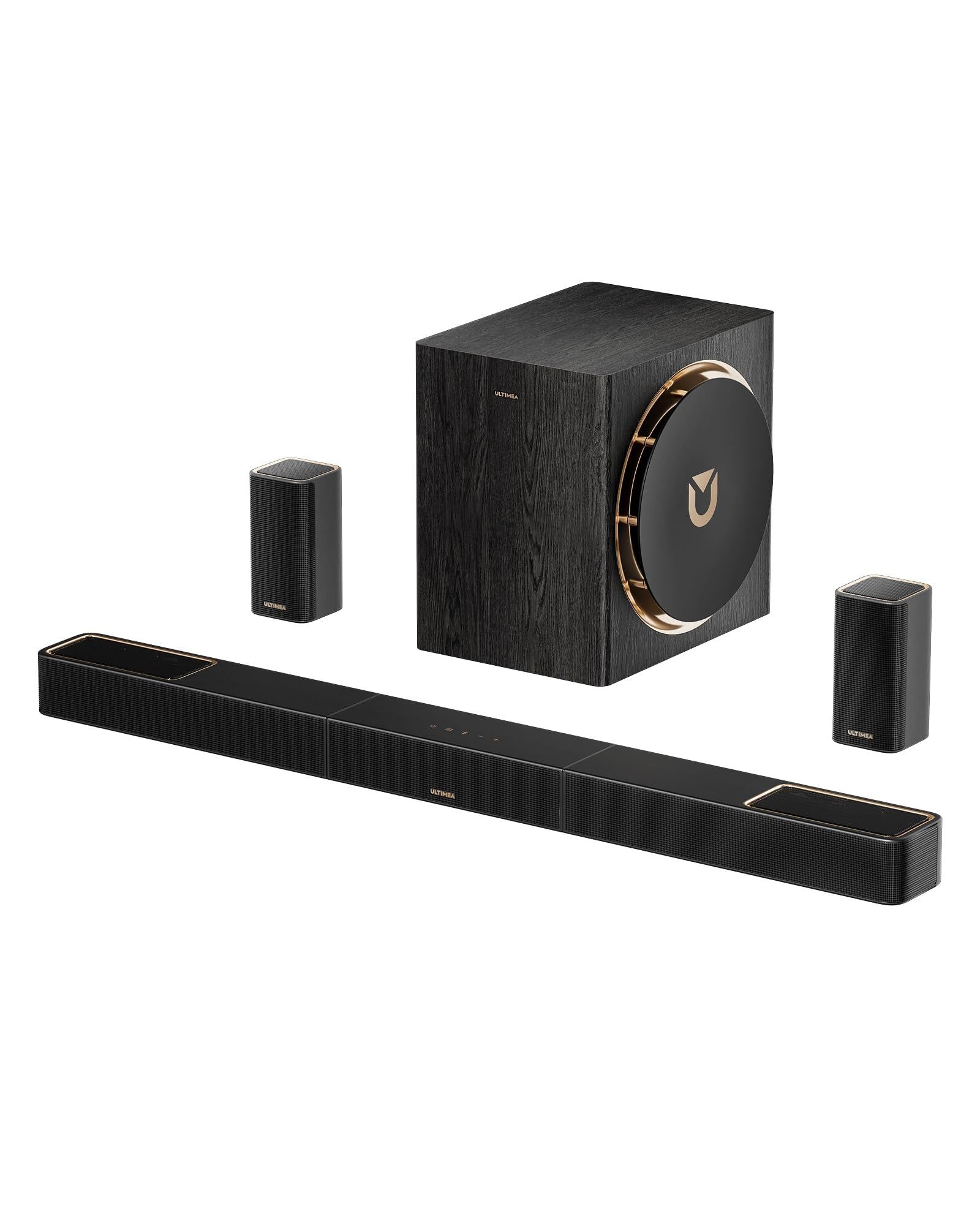
The ULTIMEA Skywave X50 is an engineering-led system that punches well above its tier. The standout feature is its GaN (Gallium Nitride) amplifier, which delivers up to 98% efficiency and significantly lower distortion than traditional silicon amps. This translates to cleaner power to the 8-inch subwoofer, allowing it to hit a deep 28Hz without muddiness. The Gravus Ultra-Linear Bass Technology uses an oversized waveguide to maintain that low-end authority even when you crank the volume.
The wireless implementation is a highlight. The system uses dual 5GHz wireless transmission for the surround speakers and subwoofer, which minimizes interference and dropouts compared to standard Bluetooth. The NEURACORE multi-channel audio engine, powered by a triple-core DSP, handles 24-bit/192kHz audio processing, creating a precise soundstage. The wood-crafted subwoofer and metal grille with gold accents also bring a premium aesthetic that blends into a modern living room.
Real-world owners consistently report an effortless plug-and-play setup and bass that shakes floors and walls without distortion. The wireless rears are praised for their stability, a common pain point on cheaper systems. While the system is a 5.1.4 configuration, the soundbar itself uses advanced beamforming to create a convincing front soundstage. For those wanting the best raw bass performance and clean power delivery for the price, this is the current benchmark.
Why it’s great
- GaN amplifier provides clean, efficient power for deep, distortion-free bass.
- Dual 5GHz wireless ensures stable connection for surrounds and subwoofer.
- Premium design with metal grille and wood-crafted subwoofer.
Good to know
- Peak power rating of 760W is theoretical; continuous RMS is the real performance metric.
- Some users may prefer the brand recognition of Sony or JBL for peace of mind.
2. Sonos Arc Ultra Soundbar with Dolby Atmos

The Sonos Arc Ultra is the pinnacle of the Sonos ecosystem, designed for those who prioritize a seamless multi-room audio experience and exceptional spatial audio. Its “Sound Motion” technology allows for a higher number of drivers in a slim profile, delivering a 9.1.4 channel experience from a single soundbar. The bass performance is surprisingly robust for a single enclosure, thanks to the new acoustic architecture, though it lacks the visceral punch of a dedicated subwoofer.
Setup is a hallmark of the Sonos experience. The Sonos app guides you through Trueplay tuning, which uses the microphone on your iPhone to analyze the room and adjust the soundstage. The AI-driven Speech Enhancement is class-leading, making dialogue incredibly clear without sounding artificial. However, the true cost of entry here is understanding the Arc Ultra is the center of an expandable system. Adding the Sonos Sub and Era 300 rears is expensive but unlocks the full 9.1.4 experience.
Owner reviews are overwhelmingly positive about the sound quality and ease of use, noting it is the best-sounding soundbar many have ever heard, but they also consistently warn about the high cost of the full ecosystem. The Arc Ultra by itself is a premium product for music and movies, but to get the rumbling, room-filling surround sound that matches a dedicated system, you need to invest significantly more. It is the best choice for those already in the Sonos ecosystem or those who value minimalistic design and flawless software integration.
Why it’s great
- Industry-leading software and multi-room integration via the Sonos app.
- AI-powered Speech Enhancement delivers the clearest dialogue on the list.
- Trueplay tuning automatically optimizes the sound for your specific room.
Good to know
- The 9.1.4 performance is primarily from the soundbar; a sub and rears are needed for full immersion.
- Premium price tag that quickly escalates with the addition of ecosystem components.
3. SAMSUNG Q990D 11.1.4ch Soundbar w/Wireless Dolby Atmos Audio

The Samsung Q990D is the most feature-complete soundbar system in its class, offering a true 11.1.4 channel configuration that many systems half its price try to emulate. The key differentiator is the inclusion of up-firing rear speakers. Most systems have only upward-firing drivers in the soundbar, but the Q990D’s rear satellites also fire upward, creating a dense and convincing layer of overhead audio. The result is a sound bubble that feels continuous rather than directional.
Samsung’s Q-Symphony feature is a genuine benefit for owners of compatible Samsung TVs, as it uses the TV’s own speakers in concert with the soundbar to create a wider soundstage. SpaceFit Sound Pro automates the calibration by analyzing the room’s acoustics to adjust the audio in real time. The Game Mode Pro is excellent for gamers, automatically optimizing the sound for 3D positional audio when you launch a game on a compatible Samsung TV. The system is also equipped with HDMI eARC and supports 4K HDR passthrough.
Owner reports are ecstatic, with many calling it the best soundbar they’ve ever owned and praising the bass and dialogue clarity. A significant and recurring issue, however, is random audio dropouts on some units, particularly when connected via eARC. While not universal, this potential for a one-second dropout is the only major flaw in an otherwise stellar system. If you get a perfect unit and own a Samsung TV, this is the go-to choice for a bombastic, all-encompassing surround experience.
Why it’s great
- True 11.1.4 channel configuration with up-firing rear speakers for excellent Atmos.
- Q-Symphony integrates seamlessly with Samsung TVs for a wider soundstage.
- Game Mode Pro automatically optimizes audio for a more immersive gaming experience.
Good to know
- Some users report random one-second audio dropouts, a potential reliability issue.
- Auto firmware updates can cause problems; manual updates via USB are often recommended.
4. Nakamichi Shockwafe Ultra 9.2.4 Channel Soundbar System
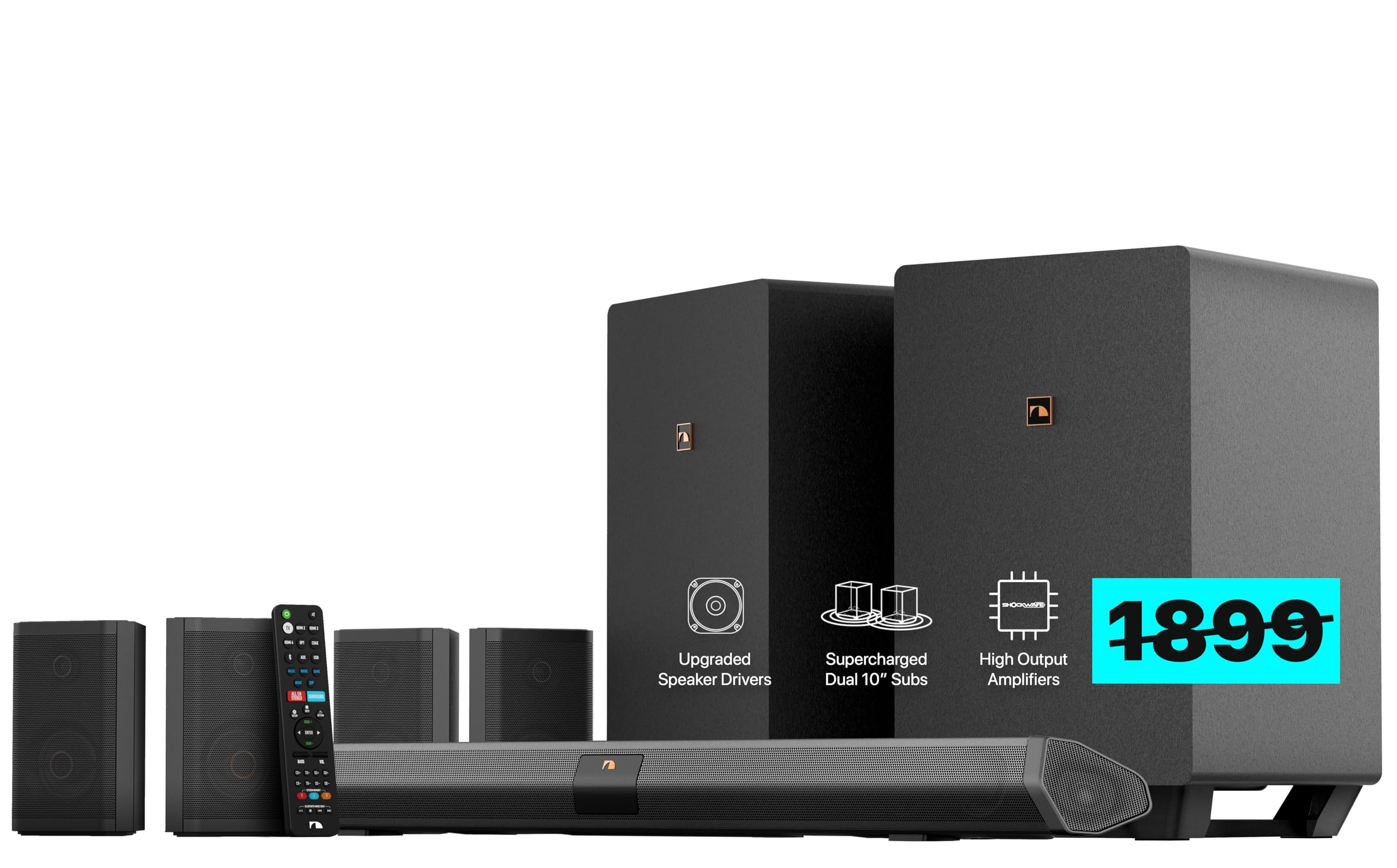
The Nakamichi Shockwafe Ultra 9.2.4 is a specialist system built for one primary purpose: delivering the absolute most impactful and room-filling bass possible from a soundbar-based setup. The “9.2.4” designation is not just marketing fluff; it means two dedicated 10-inch wireless subwoofers. This dual-subwoofer configuration is unique in the consumer soundbar market and is the single most effective way to achieve even, chest-thumping bass throughout a large room without localization.
The system also has a high part count. In addition to the dual subs, it includes four modular surround speakers that connect to the subwoofers via RCA cables. This creates a true 360-degree sound field, though it sacrifices some installation cleanliness for performance. The SSE MAX (Spatial Surround Elevation) engine processes Dolby Atmos and DTS:X to create a convincing bubble of sound. The HDMI eARC and 3 HDMI inputs provide flexibility for multiple source devices.
Owner reviews are passionate, with many calling it a true theater experience that rivals dedicated passive setups. The common sentiment is that the bass is felt, not just heard, and that the clarity of dialogue remains excellent even at loud volumes. The main trade-off for this performance is the physical footprint: each speaker cable tethers a surround to a subwoofer, and each subwoofer needs a power outlet. It is a setup for those who prioritize physics-defying bass above all other considerations.
Why it’s great
- Unique dual 10-inch subwoofer design delivers unmatched low-end impact and headroom.
- Four dedicated surround speakers create a wide, 360-degree sound field.
- Long-standing, trusted brand with a dedicated following for performance.
Good to know
- Surround speakers are wired to the subwoofers, limiting placement flexibility.
- Large physical footprint requires significant floor and shelf space.
5. Klipsch Reference 5.2 Dolby Atmos Home Theater System

The Klipsch Reference 5.2 system represents a fundamentally different approach: it is a set of passive speakers meant to be paired with an external AV receiver (AVR). This is the choice for the audiophile who wants to choose their own amplification and achieve performance that is impossible from a soundbar. The system includes the R-625FA Dolby Atmos floorstanding towers, an R-52C center channel, R-41M bookshelf surrounds, and two massive R-12SW 12-inch powered subwoofers.
The hallmark of Klipsch sound is the Tractrix horn-loaded tweeter. This design provides extremely high efficiency (high sensitivity), meaning the speakers can produce louder sound with less power from the amplifier. The dual 12-inch subwoofers are the kings of this list, capable of moving a massive volume of air for deep, effortless bass that can pressurize a large room. The sound is dynamic and lively, with a characteristic “live music” energy that is addictive for movies and concerts.
Owner feedback is overwhelmingly positive, emphasizing the value for the performance level. The sound is described as clear, powerful, and capable of producing details previously unheard in familiar movie scenes. A common note is that the system requires a good AVR with room correction software (like Audyssey) to sound its best, and that the speakers need a real break-in period. This is not a simple plug-and-play solution. It is a commitment to a dedicated home theater, rewarding owners with a sound quality ceiling far beyond any soundbar system.
Why it’s great
- Dual 12-inch subwoofers provide the deepest, most powerful bass of any system on this list.
- Horn-loaded tweeters deliver high efficiency, low distortion, and dynamic sound.
- The modular, passive design allows for future upgrades and custom amplification.
Good to know
- Requires an external AV receiver (AVR), which is an additional cost and setup step.
- Floorstanding towers are large and heavy, requiring dedicated space in the room.
6. Sony BRAVIA Theater System 6, 5.1ch Home Theater System

The Sony BRAVIA Theater System 6 (HT-S60) is a 5.1 channel system that prioritizes simplicity and reliable performance over chasing specs. It is a traditional wired system where the subwoofer connects to the soundbar and the rear speakers connect to the subwoofer. This wired approach ensures a rock-solid audio connection with zero latency, a benefit for purists who dislike the potential for wireless interference. The soundbar is compact and designed to fit seamlessly in front of most TVs.
Sony brings its audio processing expertise to the table. The system supports Dolby Atmos and DTS:X, creating a convincing sound field through virtual processing since there are no dedicated height channels. The dedicated center-channel speaker is excellent for dialogue, and the “Voice Zoom 3” feature, which works with compatible BRAVIA TVs, provides fine-grained control over vocal clarity. The system also up-mixes stereo music for a richer listening experience, which is a nice touch for those who listen to a lot of tracks.
Customer reviews highlight the ease of setup and the significant improvement over TV speakers. The bass is described as powerful and clean, capable of shaking the room, and the surround effect is immersive for a 5.1 system. The primary criticisms are cable management: the subwoofer must be placed near the TV, and the speaker wires to the rears are not wireless. It is also a 5.1 channel system, so it lacks the overhead channel drivers of larger setups. This is the right pick for those who value a straightforward, high-quality upgrade from a brand known for audio engineering.
Why it’s great
- Rock-solid wired connection with no potential for wireless audio drops or lag.
- Dedicated center channel speaker and Voice Zoom 3 for excellent dialogue clarity.
- Compact, low-profile soundbar design fits well with most TV setups.
Good to know
- Subwoofer must be wired to the soundbar, limiting placement flexibility near the TV.
- 5.1 channel system lacks physical up-firing speakers for true overhead Atmos effects.
7. JBL Bar 500MK2-5.1 Channel Soundbar System with Dolby Atmos
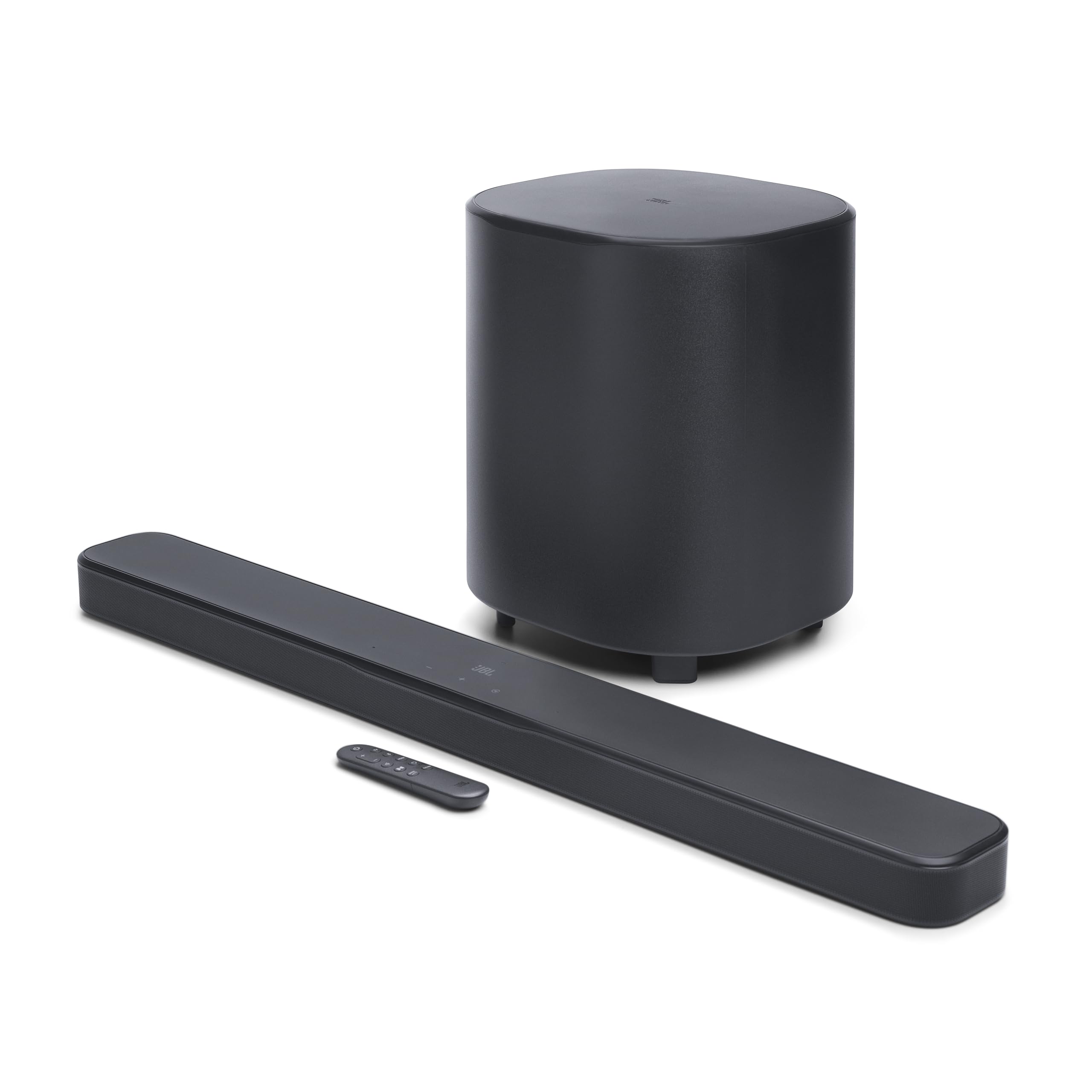
The JBL Bar 500MK2 is a formidable 5.1 channel system anchored by a massive 10-inch wireless subwoofer. JBL is a heritage audio brand, and this system demonstrates their experience in delivering high-impact sound. The 10-inch subwoofer provides deep, authoritative bass that can pressurize a medium-to-large living room. The soundbar itself uses MultiBeam 3.0 technology to create a wide soundstage from a single front unit, simulating surround effects without rear speakers.
A standout feature is JBL’s PureVoice 2.0 technology. This is not a simple dialog enhancer; it automatically analyzes the ambient sound in the scene and the system’s volume to optimize the vocal frequencies in real time. This ensures dialog is always crisp, even during scenes with loud explosions or background music. The system also features SmartDetails, which enhances subtle audio cues in a film’s mix. For wireless streaming, it supports Apple AirPlay, Google Cast, and Spotify Connect, making it a smart hub for music.
Owner reviews are highly enthusiastic, with many noting it outperforms older, more expensive systems from brands like Bose and Sonos. The bass is consistently praised for being powerful and distortion-free. The main critique revolves around the mandatory use of the JBL ONE app for deeper control of the EQ and sound calibration, which some users find less intuitive. The system also lacks rear satellite speakers in the box, meaning the surround effect is virtualized rather than discrete. It is an ideal choice for those who want thunderous bass and flawless dialogue clarity from a single soundbar purchase.
Why it’s great
- 10-inch wireless subwoofer delivers deep, room-filling bass with minimal distortion.
- PureVoice 2.0 provides the best automatic dialogue enhancement in its class.
- Excellent multi-room streaming support with AirPlay, Google Cast, and Spotify Connect.
Good to know
- The 5.1 surround effect is simulated (MultiBeam) and not as discrete as systems with rear speakers.
- Full sound customization requires using the JBL ONE app, which may be less convenient.
8. Polk Audio MagniFi Max AX SR 7.1.2 Channel Sound Bar

The Polk Audio MagniFi Max AX SR is a full 7.1.2 channel system that includes the soundbar, a wireless 10-inch subwoofer, and SR2 wireless surround speakers. This package offers a complete, discrete surround sound solution out of the box. Polk’s patented SDA 3D technology works with the two up-firing drivers in the soundbar to create a convincing Dolby Atmos and DTS:X sound field. The included wireless rear speakers ensure you get a true wraparound audio experience, not just a simulated one.
One of the best features is Polk’s VoiceAdjust technology. Unlike simple dialog boosters, this technology specifically increases the center channel output to make voices stand out without affecting the rest of the soundtrack. This is fantastic for watching late-night movies at low volumes. The system also functions as a strong audio hub with three 4K HDMI inputs, offering plenty of connectivity for gaming consoles and streaming devices. It supports Apple AirPlay 2 and Chromecast for whole-home audio.
Owner reviews are very positive, with many praising the sound clarity and the robust, room-filling audio. The system is noted for its ability to fill a large, 25×30 foot space without strain. The wireless surrounds are praised for their hassle-free setup and stable connection. Some users note that the 10-inch subwoofer, while powerful, may not match the output of a dedicated larger box for extreme bass heads. The price point puts it in a competitive spot, but the inclusion of the SR2 rears and the solid connectivity make it a compelling all-in-one package.
Why it’s great
- Includes wireless rear surround speakers for a true, discrete 7.1.2 setup out of the box.
- VoiceAdjust technology provides excellent dialogue clarity without compromising the sound mix.
- Three 4K HDMI inputs offer robust connectivity for multiple source devices.
Good to know
- The 10-inch subwoofer is good but may not satisfy those looking for extreme, chest-thumping bass.
- Some users have reported reliability issues with the subwoofer’s wireless connection.
9. Hisense AX5140Q 5.1.4ch Home Theater Soundbar
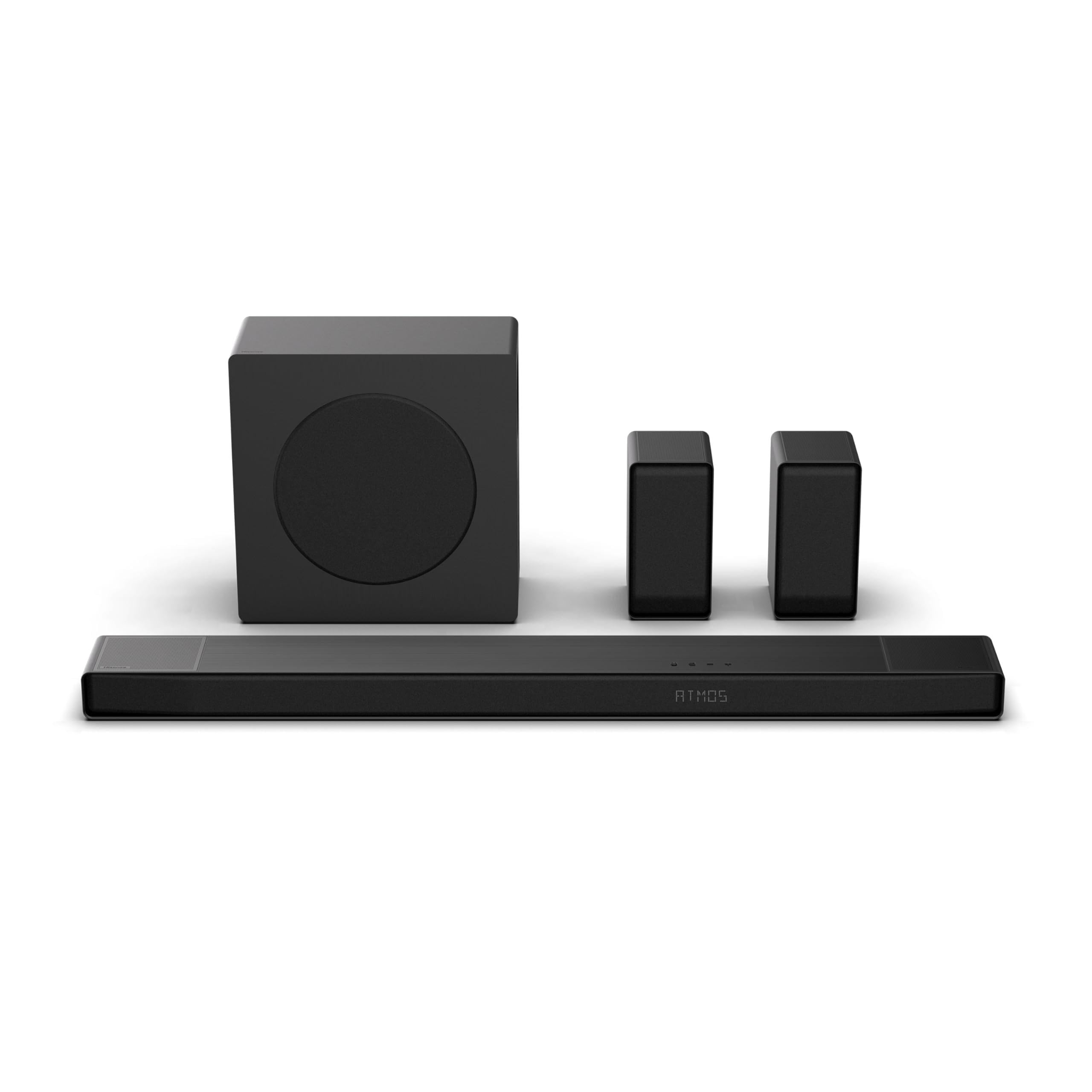
The Hisense AX5140Q is the most accessible entry point into true Dolby Atmos surround sound. It is a 5.1.4 channel system that includes a soundbar, a wireless 6.5-inch subwoofer, and wireless rear surround speakers. The “5.1.4” designation on a budget model is significant: it includes up-firing drivers in the soundbar and two surround speakers, providing a more complete object-based audio experience than most systems at its price level. This system is designed to bring the immersive bubble to a wider audience.
The subwoofer is a 6.5-inch driver that aims for a low-frequency response down to 40Hz. While it won’t shake the walls like a 10-inch or 12-inch driver, it provides a noticeable and powerful bass improvement over any TV. The system features HDMI eARC for single-cable connection and 4K HDR passthrough. The “Quick Touch EQ Modes” offer seven presets tailored for music, movies, and news. A room calibration feature helps tune the sound to your listening environment, a feature usually reserved for more expensive systems.
Customer feedback is very positive, with users praising the easy setup and the significant audio upgrade it provides. The bass is described as punchy and deep, and the surround effect from the rear speakers is immersive. Some users note that the rear speakers can feel slightly underpowered in a very large room, which is expected at this point. There is an occasional report of a minor Bluetooth quirk. For anyone on a tighter budget who wants true Dolby Atmos with physical rear speakers, this system delivers remarkable value.
Why it’s great
- True 5.1.4 channel configuration with up-firing speakers and wireless rears at a low cost.
- Excellent value for the price, delivering a complete Atmos setup.
- Includes room calibration to optimize the sound for your listening space.
Good to know
- 6.5-inch subwoofer lacks the deep, room-pressurizing bass of larger drivers.
- Rear surround speakers may struggle to fill a large space with sound.
FAQ
What is the difference between a 5.1 and a 5.1.2 surround sound system?
Do I need an AV receiver for a passive speaker system like the Klipsch Reference 5.2?
Can a soundbar system with virtual surround sound replace a system with physical rear speakers?
How important is the room calibration feature in a bass surround sound system?
Final Thoughts: The Verdict
For most users, the best bass surround sound system winner is the ULTIMEA Skywave X50 because it delivers a rare combination of deep, clean bass from its 8-inch subwoofer and GaN amplifier technology with a stable wireless connection, all at a price that undercuts much of the competition. If you want the best in class for music and a seamless smart home ecosystem, grab the Sonos Arc Ultra. And for the ultimate in physical, room-shaking bass and true audiophile performance, nothing beats the Klipsch Reference 5.2 system paired with a quality AV receiver.

Mo Maruf
I created WellFizz to bridge the gap between vague wellness advice and actionable solutions. My mission is simple: to decode the research and give you practical tools you can actually use.
Beyond the data, I am a passionate traveler. I believe that stepping away from the screen to explore new environments is essential for mental clarity and physical vitality.