Our readers keep the lights on and my smoothie glass nicely filled. As an Amazon Associate, I earn from qualifying purchases.
That moment when the kick drum lands but you only feel a suggestion of its weight — that’s the gap a dedicated bass speaker fills. Whether you’re trying to reproduce the lowest note of a pipe organ or feel the room pressurize during an explosion in your favorite film, the subwoofer is the single component that transforms a polite sound system into a physically engaging one. Selecting the right one for your space, however, involves more than just picking the biggest driver you can afford.
I’m Mohammad Maruf — the founder and writer behind WellFizz. After analyzing hundreds of hours of customer feedback and cross-referencing specifications across nine distinct subwoofer models, I’ve mapped out exactly how power, driver size, cabinet design, and connectivity determine real-world performance.
This guide cuts through the marketing noise to help you find the perfect bass speakers for home, whether you’re building a reference-grade stereo setup or a cinematic home theater system.
How To Choose The Best Bass Speakers For Home
Subwoofer selection starts with a single question: what kind of bass do you prioritize? Music listeners often prefer tight, articulate low-end that vanishes into the mix, while home theater fans typically want room-pressurizing rumble that makes action sequences visceral. Your room’s dimensions, your receiver’s capabilities, and your tolerance for cabinet footprint all influence the final choice.
Driver Size and Cabinet Design
An 8-inch driver can deliver satisfying bass in a small to medium room, particularly in a sealed cabinet that prioritizes speed and accuracy over sheer volume. A 10-inch or 12-inch driver moves more air and can reach deeper frequencies, but the cabinet design matters immensely. Sealed enclosures produce tighter, more controlled bass and are easier to place in a room without “boomy” nodes. Ported (or vented) enclosures extend bass output by several Hertz at the cost of slightly looser transient response and larger physical size.
Amplifier Power and DSP
Look at RMS (continuous) wattage, not peak. A 100-watt RMS amplifier in a well-designed cabinet can sound more authoritative than a 300-watt peak rating on a flimsy driver. Modern subwoofers often include digital signal processing (DSP) that allows precise tuning of crossover points, phase alignment, and parametric EQ. Smartphone app control, found on certain premium models, lets you fine-tune from your listening chair without walking back and forth.
Connectivity and Integration
Basic RCA line-level inputs work with nearly all AV receivers and stereo amplifiers. Some subwoofers include high-level (speaker wire) inputs for systems without a dedicated sub output. LFE input or unfiltered RCA bypasses the subwoofer’s internal crossover, leaving bass management to your receiver. Bluetooth connectivity, while rare on studio-grade subwoofers, adds convenience for wireless music streaming without a source cable.
Quick Comparison
On smaller screens, swipe sideways to see the full table.
| Model | Category | Best For | Key Spec | Amazon |
|---|---|---|---|---|
| Nakamichi Shockwafe Ultra 9.2.4 | Soundbar System | Cinematic home theater | Dual 10″ subs, 600W total | Amazon |
| SVS SB-1000 Pro | Sealed Sub | Music reference & small rooms | 12″ driver, 325W RMS | Amazon |
| Polk Monitor XT12 | Ported Sub | Home theater value | 12″ driver, 100W RMS | Amazon |
| Audioengine S8 | Desktop/Studio Sub | Desktop music & gaming | 8″ driver, 250W RMS | Amazon |
| PreSonus Eris Sub 8BT | Studio Sub | Music production & hi-fi | 8″ driver, 100W RMS | Amazon |
| Edifier T5s | Compact Sub | Desktop system upgrade | 8″ driver, 70W RMS | Amazon |
| Klipsch Reference R-8SW | Compact Sub | Small room/apartment | 8″ driver, 150W peak | Amazon |
| Rockville Rock Shaker 10 | Value Sub | Budget home theater | 10″ driver, 300W RMS | Amazon |
| Bose SoundLink Plus | Portable Speaker | On-the-go bass | Battery-powered, 20hrs | Amazon |
In‑Depth Reviews
1. Nakamichi Shockwafe Ultra 9.2.4
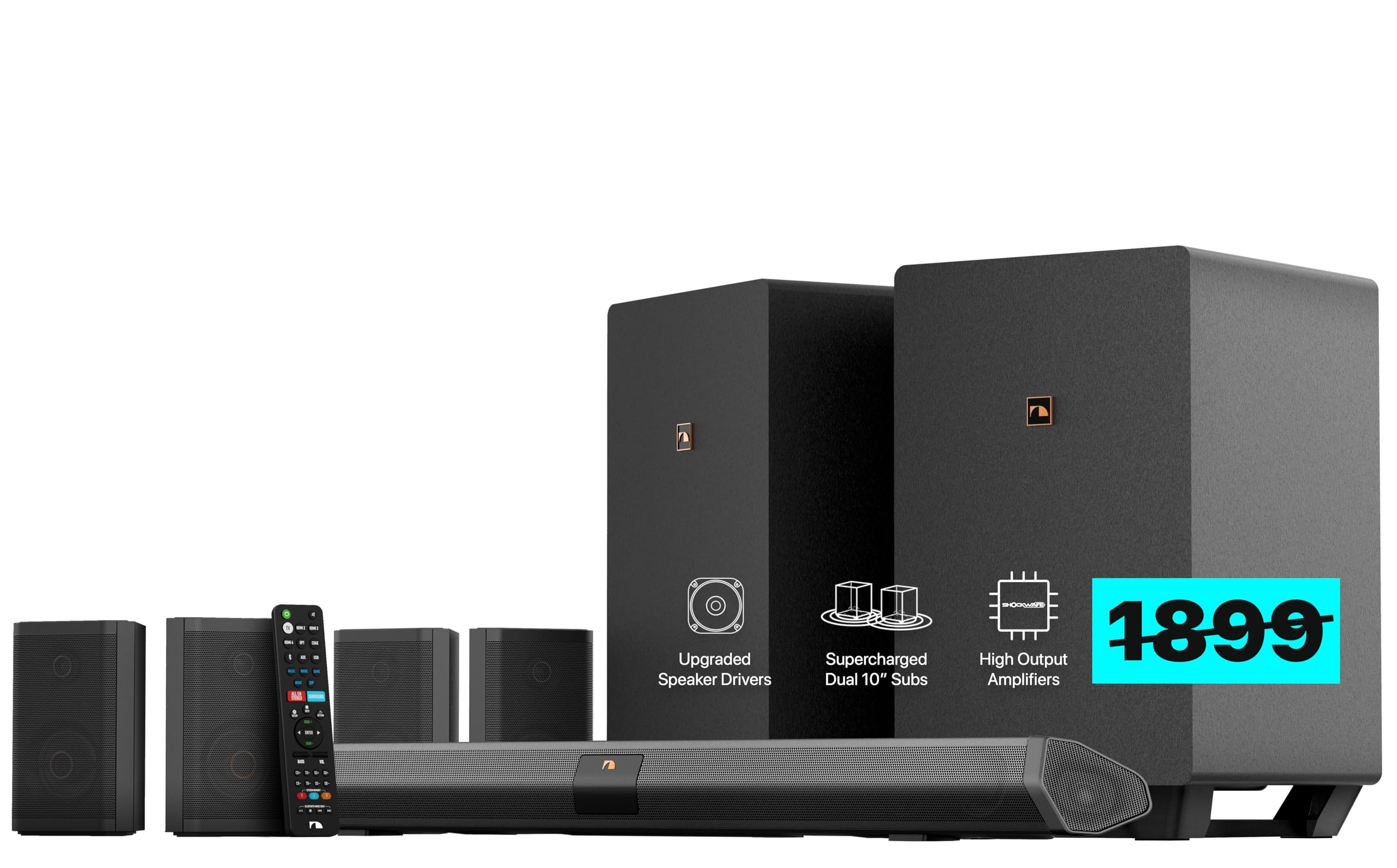
This complete soundbar system redefines what a home theater setup can deliver without requiring a separate AV receiver and wired speakers. The dual 10-inch wireless subwoofers, each rated at 300 watts maximum, produce room-filling bass that minimizes localization — you feel the pressure waves evenly throughout the space rather than identifying a single bass source. The included four modular surround speakers attach to dipole stands for a compact footprint or can be separated for wider immersion.
Proprietary SSE MAX hardware handles Dolby Atmos and DTS:X decoding with convincing overhead effects, while HDMI eARC passes through Dolby Vision and 4K HDR from your sources. Setup takes roughly 45 minutes with the included 32-foot RCA cables, and the backlit remote makes low-light adjustments easy. The 45.5-inch soundbar accommodates 65-inch and larger TVs.
At this price point, no other consumer system offers dual 10-inch subs and four dedicated surround speakers in a package that requires only a single power outlet. The bass hits hard enough to shake furniture during action sequences, yet dialogue remains clear and centered. A worthy upgrade for those moving beyond basic soundbars.
Why it’s great
- Dual 10-inch subwoofers eliminate bass localization for even room pressurization
- Four surround speakers create a truly immersive 360-degree sound field
- HDMI eARC support ensures flawless 4K HDR video passthrough
Good to know
- Surround speakers are wired to subwoofers, not truly wireless
- Subwoofer cabinets are large (20 inches tall) and require floor space
- Soundbar is over 45 inches wide, requiring a wide media console
2. SVS SB-1000 Pro
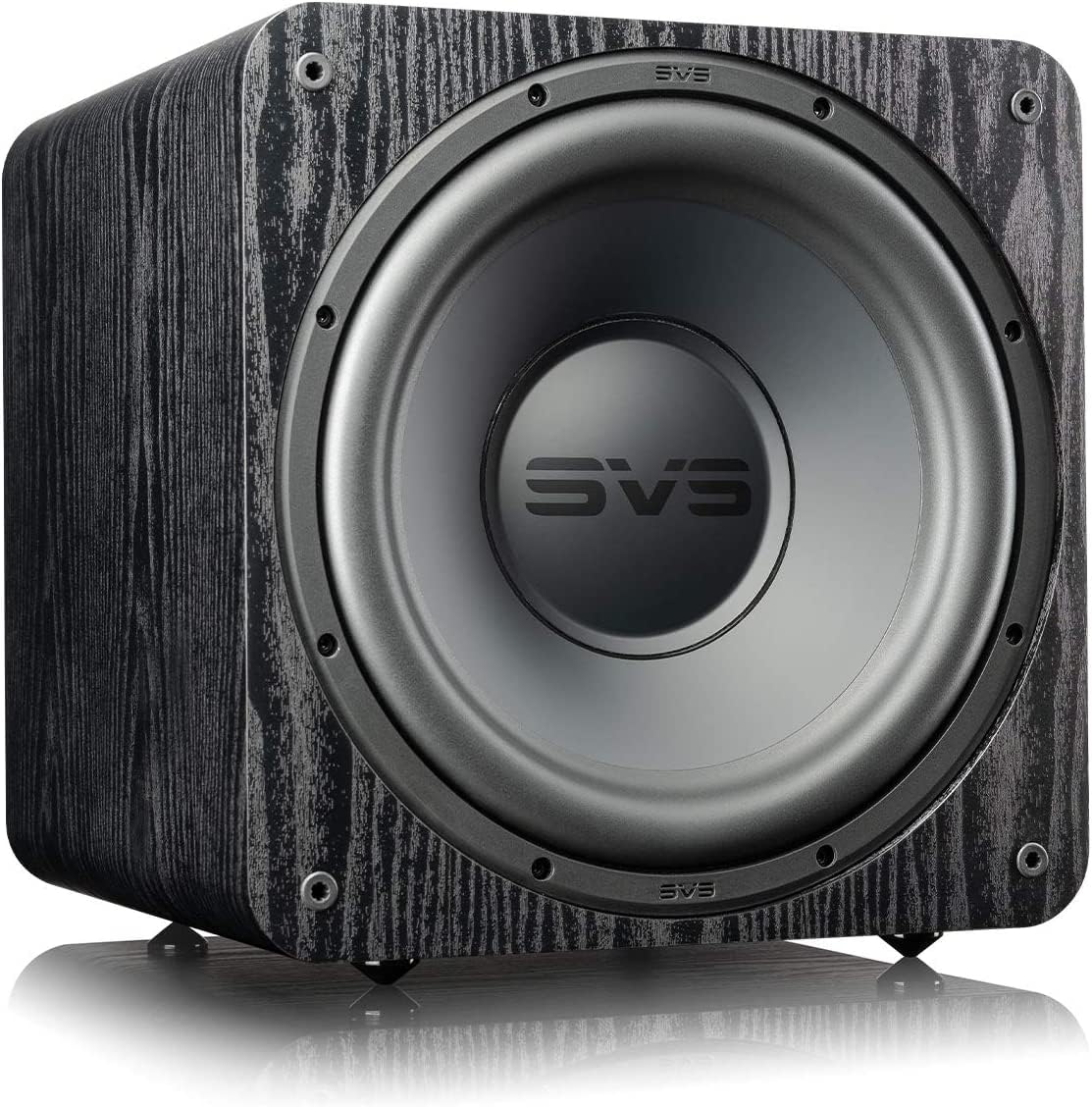
The SB-1000 Pro marries a high-excursion 12-inch driver with a 325-watt RMS Sledge STA-325D amplifier inside a rigid, sealed cabinet. This combination delivers tight, articulate bass that extends to 20 Hz, making it equally adept at reproducing a double bass pedal run and an earthquake scene. The sealed design ensures that even in a near-field desktop placement, the bass remains controlled and doesn’t bloom into the room.
The SVS Subwoofer DSP Smartphone App is the standout feature here — you can adjust volume, set custom presets, fine-tune parametric EQ, and manage crossover settings from your listening position. The 50MHz Analog Devices DSP renders pinpoint frequency response and room correction. The rigidly braced MDF cabinet with an extra-thick front baffle eliminates panel resonance even at high output levels.
For music listeners who demand accuracy, this subwoofer disappears into the soundstage, adding low-end extension without calling attention to itself. Auto-on/off works reliably, and the compact sealed cabinet fits in tight spaces. Adding a second SB-1000 Pro eliminates directional bass and smooths out room nodes for an even more seamless integration.
Why it’s great
- Smartphone app control with full DSP and parametric EQ for room tuning
- Pristine 20 Hz extension from a compact sealed cabinet
- 325 watt RMS amplifier provides authoritative, distortion-free output
Good to know
- Sealed design trades some peak SPL for accuracy vs. ported alternatives
- App control is excellent but does not include automatic room EQ
- Price positions it as a true premium option for serious listeners
3. Polk Monitor XT12

The Monitor XT12 delivers 12-inch bass extension down to 24 Hz through a long-throw Dynamically Balanced woofer, powered by a 100-watt Class A/B amplifier. The critically braced MDF cabinet with a removable precision-fit grille minimizes cabinet resonances, allowing the woofer to produce clean, tight bass even at moderate gain. Variable crossover adjustment from 80 to 160 Hz and phase polarity switching (0/180 degrees) give you fine control over integration.
Compatibility with Dolby Atmos and DTS:X receivers is seamless via line-level RCA or LFE input, which bypasses the internal low-pass filter for receiver-managed bass. The down-firing port design helps reduce floor vibrations and simplifies placement near walls. At its price point, the XT12 offers exceptional value for home theater use, delivering chest-thumping impact during action sequences without the muddy overhang of cheaper designs.
Pairing a second Monitor XT12 creates a uniform bass field across larger rooms, and the timbre-matched design ensures seamless blending with other Monitor XT series speakers. Auto-on/off sensing works reliably, though a front-facing status LED is absent. For buyers prioritizing raw low-frequency extension over app-based control, this subwoofer provides high-output performance at a competitive price.
Why it’s great
- 12-inch driver reaches down to 24 Hz for deep home theater rumble
- Rigidly braced MDF cabinet with removable grille reduces resonance
- Accepts both LFE and line-level RCA inputs for flexible system integration
Good to know
- 100W RMS amplifier is lower than some competitors, but efficiently paired
- No app control or DSP; all adjustments are rear-panel knobs
- Ported design may produce a slightly looser transient than sealed alternatives
4. Audioengine S8

The Audioengine S8 packs a 250-watt RMS amplifier and an 8-inch down-firing woofer into an enclosure smaller than a typical desktop PC tower. Despite its compact footprint, this subwoofer produces deep, clean bass that extends significantly below the useful range of bookshelf speakers like the Audioengine A5+ or A2+. The down-firing design channels bass energy directly into the floor, which couples well with hard flooring and minimizes localized bass detection.
Sleep mode automatically powers down the amplifier after a period of inactivity, and the rear-panel controls include variable crossover and phase adjustment. RCA inputs accept line-level signals from any source, and the built-in amplifier is precisely matched to the driver for clean output even at high volumes. The textured black finish and minimal design allow it to sit discreetly under a desk or next to a media console.
Users consistently report that the S8 adds the missing fundamental to A-series speakers, transforming a good desktop system into a genuinely full-range experience. Crossover integration requires careful adjustment to avoid mid-bass overlap, but once dialed in, the subwoofer disappears acoustically. The sharp pointed feet can scratch hardwood floors, so a small protective pad is a smart addition.
Why it’s great
- 250W RMS output from a compact enclosure ideal for desktop placement
- Down-firing design minimizes footprint and blends well with flooring
- Automatic sleep mode saves energy without manual toggling
Good to know
- Sharp metal feet may scratch hardwood or tile floors
- No app control or Bluetooth connectivity for wireless streaming
- Best suited for small to medium rooms, not large home theaters
5. PreSonus Eris Sub 8BT

The Eris Sub 8BT brings studio-grade monitoring to the home listening environment, featuring an 8-inch woven-composite woofer in a front-firing configuration that reaches down to 30 Hz. The 100-watt RMS Class-D amplifier is paired with both highpass and lowpass filter controls, letting you match the subwoofer’s crossover perfectly to your satellite speakers. The front-panel 1/8-inch stereo aux input and headphone output make it convenient for quick device switching without crawling behind equipment.
Bluetooth 5.0 wireless connectivity sets this sub apart from most studio-focused options — you can pair a phone or tablet for casual listening without connecting cables. The 1/4-inch TRS balanced inputs and unbalanced RCA inputs cover both pro audio gear and consumer electronics. A power-saver mode engages after 40 minutes of idle activity to reduce standby consumption. High- and low-frequency tuning controls on the rear panel let you compensate for room acoustics and personal preference.
Pairing this sub with PreSonus Eris 3.5BT or Edifier MR4 speakers results in a cohesive near-field system that translates to accurate mixes. The subwoofer’s crossover circuit can introduce a slight delay when used with non-PreSonus speakers via USB, so traditional RCA or TRS connections are recommended. For content creation and critical listening, this subwoofer delivers flat, uncolored bass extension.
Why it’s great
- Studio-flat frequency response down to 30 Hz for accurate mixing
- Bluetooth 5.0 adds wireless convenience for casual playback
- Flexible inputs include 1/4″ TRS, RCA, and front-panel aux
Good to know
- Bluetooth playback may introduce slight latency unideal for video editing
- Power-saver mode engages quickly, requiring signal to wake it
- Not intended for room-shaking home theater output levels
6. Edifier T5s
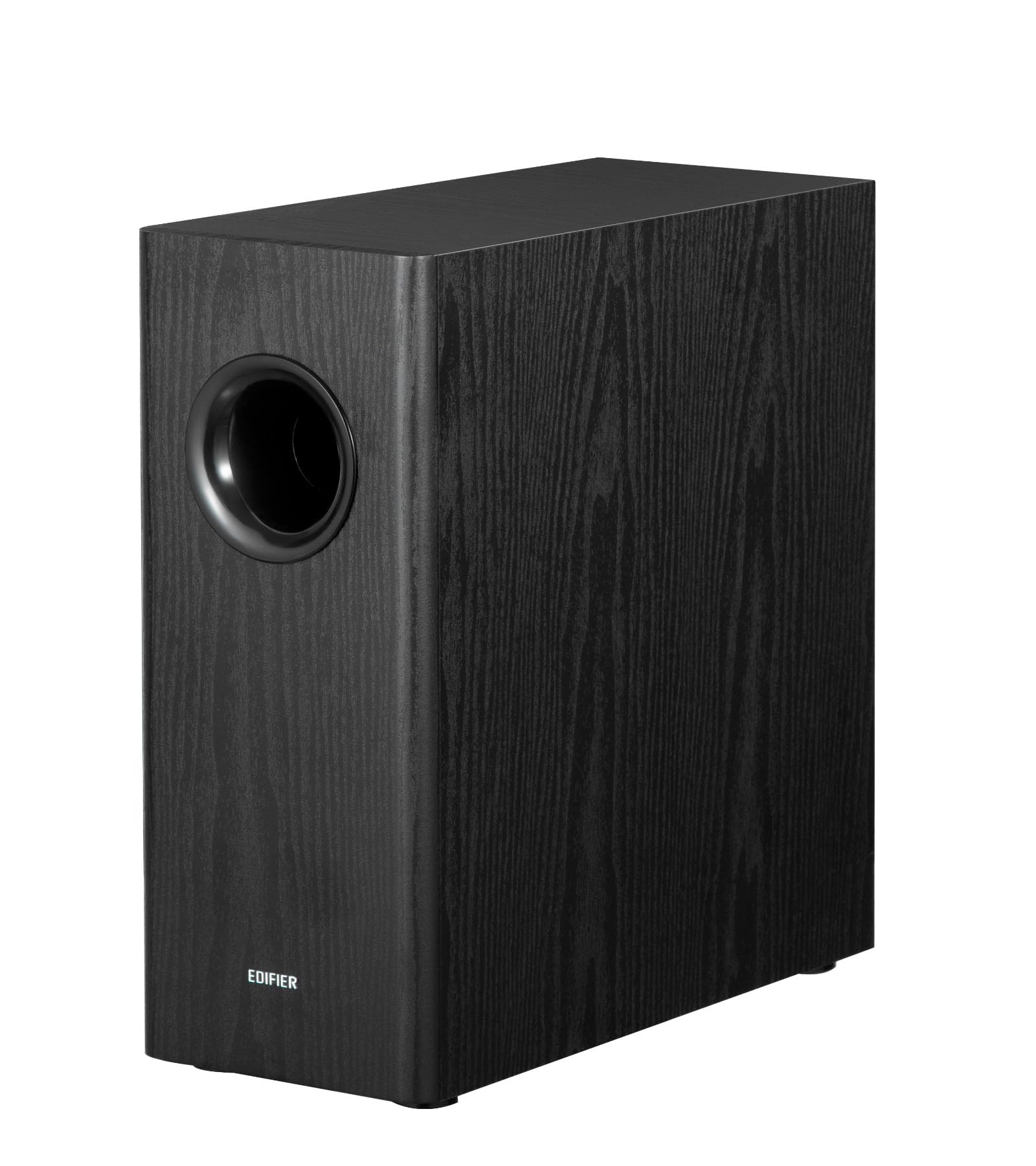
Edifier’s T5s is engineered specifically to augment desktop bookshelf speakers, pairing an 8-inch long-throw woofer with a 70-watt RMS Class-D amplifier. The front-firing driver and right-firing acoustic port are housed in an 18mm MDF cabinet with a wood-grain finish that blends with home decor. The low-pass filter adjusts from 30 Hz to 160 Hz, and the phase selector (0 or 180 degrees) helps integrate with speakers already positioned near listening height.
Setup flexibility is a core strength: speakers with a subwoofer output connect via a single RCA cable, while systems lacking a sub out can connect in series by routing the audio source through the T5s first. Auto-standby engages after 15 minutes to save power. The vertical cabinet design, roughly the size of a medium computer tower, allows placement in tight desk corners where a traditional square subwoofer might not fit.
Customer feedback confirms that the T5s extends the range of Edifier R1280Ts and R1700BTs speakers significantly, adding depth to music playback without overwhelming the near-field presentation. The subwoofer handles low-bass passages well down to 35 Hz but struggles with sub-35 Hz tones found in some electronic music. As a musical-bass augment for a desktop system, it provides accurate, low-distortion performance at an accessible price point.
Why it’s great
- Vertical cabinet design fits in tight desk spaces and corner placements
- Series connection option works with speakers lacking subwoofer output
- Auto-standby saves power and runs without external receiver
Good to know
- 70W RMS output is lower than larger subs for living room use
- Cannot reproduce sub-35Hz frequencies present in some electronic tracks
- Works best with Edifier speakers; pairing may vary with other brands
7. Klipsch Reference R-8SW

The Reference R-8SW packs an 8-inch spun-copper IMG woofer and all-digital amplifier into a brushed black vinyl cabinet with a compact footprint, making it a strong candidate for small living rooms and apartments. The down-firing driver projects bass energy through the bottom of the cabinet, which helps couple the subwoofer to the floor for increased perceived output without needing excessive size. The copper-colored driver is a signature Klipsch aesthetic that stands out against the black cabinet.
Setup is straightforward with RCA line-level or LFE inputs, and the rear-panel controls include volume, variable low-pass crossover, and phase polarity. The all-digital amplifier is efficient and creates minimal heat, allowing the cabinet to remain sealed and compact. At half gain, the subwoofer delivers impactful bass that enhances music and movies without bleeding through adjacent walls, making it a practical choice for apartment dwellers.
The 8-inch driver limits absolute deep bass extension compared to larger models, and the subwoofer can produce a pop sound when powered off, a quirk reported by several users. It works best when paired with a receiver that handles the crossover, set around 80 Hz. For users wanting a subtle low-end foundation rather than room-shaking output, this subwoofer’s size and performance profile hit a practical sweet spot.
Why it’s great
- Compact size with down-firing driver ideal for small spaces
- Efficient digital amplifier produces clean bass at moderate levels
- Classic Klipsch copper-driver design adds visual appeal
Good to know
- 8-inch driver lacks deep extension for very large rooms
- May produce a pop sound when powering off
- Gain must be kept moderate to avoid overpowering small rooms
8. Rockville Rock Shaker 10

The Rockville Rock Shaker 10 delivers an enormous performance-per-dollar ratio, featuring a 10-inch woofer driven by a 300-watt RMS Class-D amplifier inside a stout MDF enclosure. The built-in controls include volume, adjustable crossover frequency, and 0/180-degree phase selection, alongside RCA line inputs, outputs, and high-level speaker wire connections. The detachable foam grill protects the driver while allowing the vinyl finish to maintain a simple aesthetic.
At moderate gain levels (around 50%) in a 30-by-30-foot room, this subwoofer produces tight, chest-thumping bass that rivals units costing significantly more. The Class-D amplifier runs cool and efficiently, and the auto-off function prevents idle power draw. Customers consistently praise the “mega bass” output and note that the 600-watt peak rating undersells the perceived impact. The Rock Shaker pairs well with budget bookshelf speakers and AV receivers, creating a home theater system capable of shaking the room.
The crossover control is a shelf-style adjustment rather than a true high/low-pass filter, which can muddy the mid-bass if set high. Connecting both high-level and low-level inputs simultaneously is not recommended. For buyers seeking maximum low-end output at an entry-level investment, the Rock Shaker 10 is a proven choice that sets a high baseline for budget subwoofer performance.
Why it’s great
- 300W RMS output from a 10-inch driver at an exceptionally low cost
- Accepts both RCA and high-level speaker wire inputs for any system
- Detachable foam grille protects the woofer without muffling output
Good to know
- Crossover is a shelf control, not a true filter, risking mid-bass muddiness
- Build quality and finish are budget-level compared to premium brands
- Not ideal for music purists seeking tight, articulate low-end accuracy
9. Bose SoundLink Plus

The SoundLink Plus is a portable Bluetooth speaker that defies its size class by delivering bold, resonant audio with a genuinely impactful bass presence. An IP67 rating certifies it against dust, water, shock, and rust, making it suitable for poolside gatherings, camping trips, and outdoor parties. The 20-hour battery life and USB-C charge-out port let you keep your phone powered while the speaker plays all day.
Bose SimpleSync technology pairs the speaker with compatible Bose smart soundbars for expanded home audio, and pairing two SoundLink Plus speakers activates Stereo Mode for balanced left/right output or Party Mode for simultaneous audio. The Bose app gives you access to a three-band EQ (bass, mid, treble) so you can nudge the low-end response to your taste. The unit weighs just over three pounds, with a carrying loop that makes tossing it into a backpack effortless.
At its price point, the SoundLink Plus offers clarity, construction, and bass extension that remain rare in the portable category. The deep, distortion-free low-end handles electronic and hip-hop tracks with unexpected authority, while vocal presence stays clear. The 5-hour recharge time is lengthy for a portable device, but the 20-hour playback window makes it a reliable daily driver for bass-forward outdoor listening.
Why it’s great
- IP67 waterproof, dustproof, and shock-resistant for all-weather use
- 20-hour battery with USB-C charge-out to power mobile devices
- Bose SimpleSync pairs with smart soundbars for whole-home audio
Good to know
- Portable design limits low-end extension compared to dedicated subwoofers
- Heavy at over three pounds, not ultra-light for hiking backpacks
- Full recharge takes approximately 5 hours via USB-C
FAQ
Do I need a powered or passive subwoofer for a home audio setup?
What crossover frequency should I set my subwoofer to?
Should I buy a sealed or ported subwoofer for music?
Final Thoughts: The Verdict
For most users, the bass speakers for home winner is the Nakamichi Shockwafe Ultra 9.2.4 because its dual 10-inch subwoofers and four surround speakers create the most immersive cinematic experience without requiring separate components. If you want reference-grade musical accuracy and app-based room tuning, grab the SVS SB-1000 Pro. And for a budget-friendly entry into deep bass that still delivers chest-thumping output, nothing beats the value of the Rockville Rock Shaker 10.

Mo Maruf
I created WellFizz to bridge the gap between vague wellness advice and actionable solutions. My mission is simple: to decode the research and give you practical tools you can actually use.
Beyond the data, I am a passionate traveler. I believe that stepping away from the screen to explore new environments is essential for mental clarity and physical vitality.