Our readers keep the lights on and my smoothie glass nicely filled. As an Amazon Associate, I earn from qualifying purchases.
Whether you prefer the precision of a digital readout or the tactile charm of a mechanical dial, the right barometer turns atmospheric data into actionable insight.
I’m Mohammad Maruf — the founder and writer behind WellFizz. I’ve spent years analyzing sensor accuracy, transmission ranges, and calibration methods across dozens of home weather instruments to separate genuine performance from decorative guesswork.
After comparing seven top contenders side by side for precision, build, and real-world usability, I’ve narrowed the field to the best barometer for home use that balances accuracy with practical daily features.
How To Choose The Best Barometer For Home Use
Selecting a home barometer requires matching the instrument type to your lifestyle. Are you a data lover who wants 24-hour pressure graphs on a color screen, or do you prefer a mechanical dial that doubles as wall art? Three factors separate the weather gadgets from the weather instruments.
Digital vs. Mechanical (Aneroid) Barometers
Digital barometers display pressure as a precise numerical value — often down to the hundredth of an inch of mercury (inHg). They include trend arrows or bar graphs showing whether pressure is rising or falling, which directly correlates to incoming weather. Mechanical aneroid barometers use a sealed metal cell that expands or contracts with pressure changes, moving a needle across a dial. They require a gentle finger tap to overcome friction (called the “tap test”) and demand regular calibration against a known reference. For absolute accuracy with zero interpretation, go digital. For a classic aesthetic that sparks conversation, choose mechanical.
Pressure Range and Trend Tracking
Standard sea-level barometric pressure sits around 29.92 inHg (1013 hPa). A home barometer should cover at least 28.0 to 31.0 inHg to account for storms and high-pressure ridges. Even more useful than a single reading is the trend data — a digital station’s 24-hour bar graph shows if pressure is dropping quickly (storm coming) or rising steadily (clearing skies). Mechanical barometers have a movable marker needle you set to the current pressure so you can visually check later if the main needle has moved left or right.
Sensor Placement and Wireless Connectivity
For digital weather stations, barometric pressure is measured inside the main console — it doesn’t require an outdoor sensor for that reading. But if you want temperature, humidity, and wind data too, look for at least one remote sensor with a transmission range of 200-330 feet. Radio frequency (433 MHz or 868 MHz) signals travel through walls better than Wi-Fi for multi-room setups. For mechanical barometers, placement matters: avoid direct sunlight, exterior walls, and HVAC vents, which can cause temperature fluctuations that skew the pressure cell’s accuracy.
Quick Comparison
On smaller screens, swipe sideways to see the full table.
| Model | Category | Best For | Key Spec | Amazon |
|---|---|---|---|---|
| La Crosse V21-WTH | Digital Wi-Fi | Full wind/pressure suite with app | Wi-Fi with AccuWeather data | Amazon |
| Sainlogic SA6 | 12-in-1 Digital | Professional-grade rain/wind data | ±1mm rainfall accuracy | Amazon |
| Ambient Weather BA212 | Liquid Storm Glass | Artisan wall piece & conversation starter | Wood frame, liquid storm glass | Amazon |
| Lily’s Home Analog | Analog 4-in-1 | Decorative gift with Galileo thermometer | Galileo spheres + clock + barometer | Amazon |
| U UNNI Weather Station | Digital Atomic | Easy-read digital with mold index | Patented 330 ft wireless range | Amazon |
| Newentor Q3 | Digital Color | Vivid color display & 3-channel support | 7.5″ color LCD, atomic time sync | Amazon |
| AMTAST AW008A | Mechanical 3-in-1 | Budget mechanical with separate gauges | 8.2″ dial, pure mechanical | Amazon |
In‑Depth Reviews
1. La Crosse Technology V21-WTH
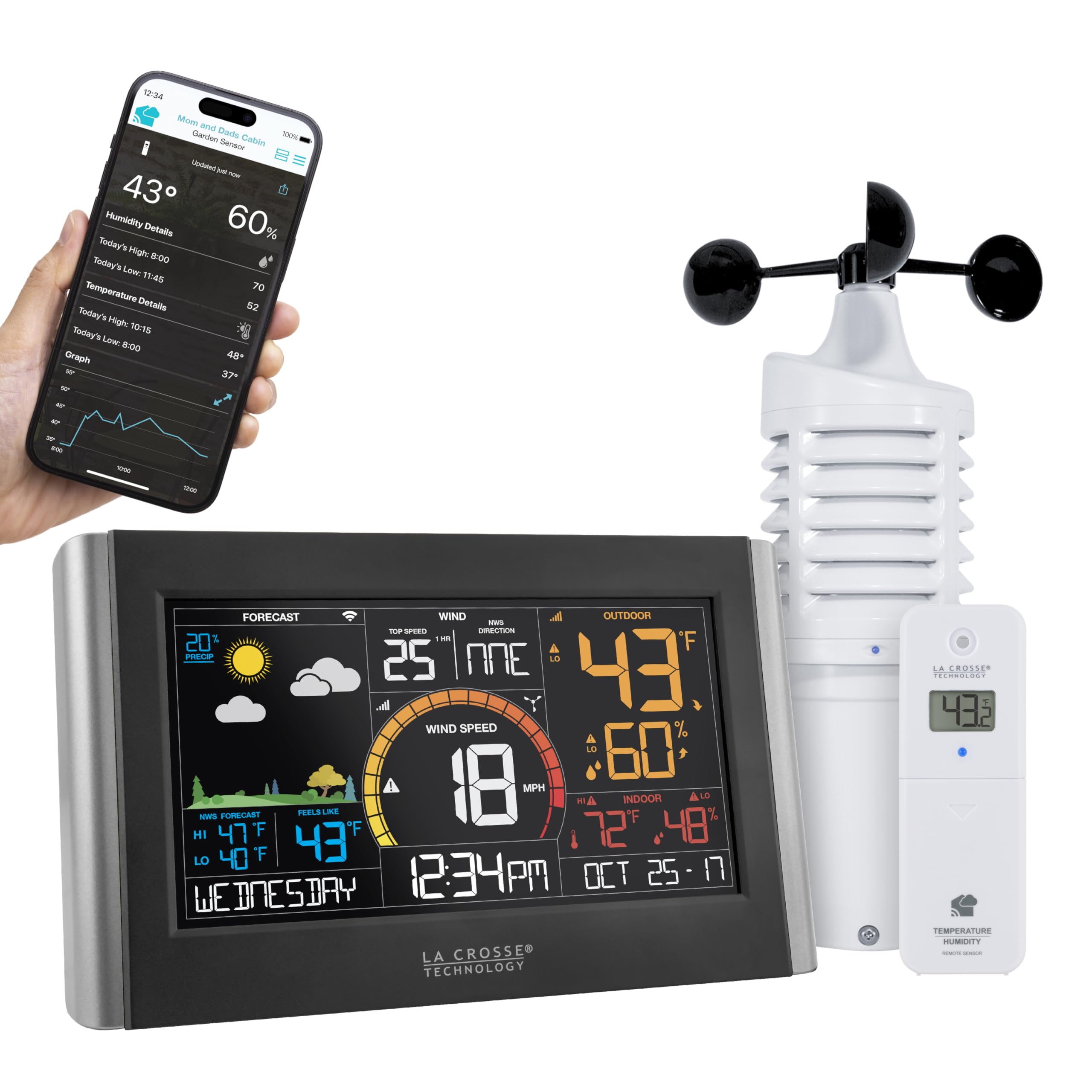
The La Crosse V21-WTH is the most complete weather monitoring package for the serious home meteorologist. It measures indoor/outdoor temperature and humidity, barometric pressure with a dynamic forecast icon and tendency indicator, and pairs with a separate wind sensor to track speed and direction history over multiple time windows. The Wi-Fi connectivity links to the La Crosse View app for remote monitoring and push alerts, and it pulls in AccuWeather data for enhanced internet-based forecasting.
The color LCD is bright from head-on viewing, though off-angle visibility narrows compared to some monochrome displays. The 2.4 GHz Wi-Fi connection is stable once set up, but the initial pairing process can be fussy on mesh networks — the SoftAP method requires patience. Wind speed history includes 1-hour, 24-hour, 7-day, monthly, and yearly records, which is rare at this level. The separate sensors require 2 AA and 2 C batteries, so plan for ongoing power costs.
Reviews highlight the excellent accuracy of the temperature and humidity readings (within 1°F and 3%RH), and the wind sensor keeps up well in high-wind areas, recording gusts up to 42 mph without dropouts. Some users report durability concerns with the wind sensor after a year, but La Crosse’s tech support is responsive. For a feature-rich station that doesn’t rely on a paid subscription for its core data, this is the benchmark.
Why it’s great
- Wi-Fi connectivity with free app for remote monitoring and NWS weather data
- Full wind speed history with alerts — rare at this price tier
- Accurate temperature/humidity readings within 1°F out of the box
Good to know
- Wi-Fi setup requires 2.4 GHz band and can be tricky on dual-band mesh routers
- Off-angle viewing on the LCD is limited
- Wind sensor longevity is a concern in coastal or high-UV environments
2. Sainlogic 12-in-1 SA6

The Sainlogic SA6 is a 12-in-1 professional-grade weather station that delivers barometric pressure, wind speed/direction, rainfall, indoor/outdoor temperature and humidity, dew point, feels-like temperature, moon phase, and more on a single 6.5-inch HD color display. Its rain gauge is certified to ±1mm accuracy for rainfall under 15mm, and it logs hourly, daily, weekly, monthly, and total rainfall data — a spec usually found on equipment costing three times as much.
The display console offers adjustable backlighting for daytime and night viewing. The outdoor sensor array mounts on a single pole or fence post and communicates wirelessly with the console. Setup is straightforward if you follow the manual, though the instructions are poorly translated and some steps require trial and error. The station does not use Wi-Fi, so you won’t get remote app access unless paired with an external platform like Weather Underground.
Customer feedback consistently praises the large, bright display and the value-for-money proposition. Build quality is decent for the price point, though the plastic sensor housing may degrade in prolonged direct desert sun. A few users reported a failed solar panel in the outdoor unit, but Sainlogic replaced it quickly. If you want serious rainfall and barometric data without stepping up to a station, this is it.
Why it’s great
- Professional rain gauge with ±1mm accuracy below 15mm — excellent precision
- 12 sensor functions including barometric pressure, wind, rainfall, and dew point
- Large 6.5″ HD color display with adjustable backlight
Good to know
- No built-in Wi-Fi or app connectivity — data is local only unless using WU
- Instruction manual is poorly translated, causing setup confusion for some
- Plastic outdoor sensor may not withstand long-term UV exposure in desert climates
3. Ambient Weather BA212

The Ambient Weather BA212 takes a completely different approach to barometric measurement — it uses a sealed liquid storm glass rather than an aneroid cell. As atmospheric pressure changes, the water level inside the glass spout rises or falls, offering a visual, almost poetic indicator of incoming weather. Housed in a cherry-finish wood frame that measures 18 inches tall, it functions equally as a fine decor piece and a functional instrument.
The unit also includes a “comfortmeter” — a combination thermometer and hygrometer with a comfort zone indicator that tells you if the room is dry, comfortable, or humid. Filling the storm glass with water requires careful attention: the instructions are clear, but it’s possible to overfill or underfill, which affects accuracy. Calibration involves knowing your local barometric pressure (easily found from a nearby airport or Weather Underground) and marking the water level accordingly.
Owners love the aesthetic value and report that it accurately predicts storms — the water rises in the spout noticeably before rain arrives. However, the wood and glass construction feels lower-quality than the price suggests to some buyers, and the included mounting screws are flimsy. This is not a precision instrument for data logging; it’s a beautiful, old-world conversation piece that also happens to tell you if a low-pressure system is moving in.
Why it’s great
- Unique liquid storm glass design — visual and educational way to track pressure changes
- Attractive cherry wood frame complements traditional or nautical decor
- Comfortmeter adds temperature and humidity readings in one glance
Good to know
- Requires manual filling and calibration — not accurate straight from the box
- Construction quality (wood and glass) feels somewhat fragile for the price
- Included mounting hardware is low quality; provide your own anchors and screws
4. Lily’s Home Analog Weather Station
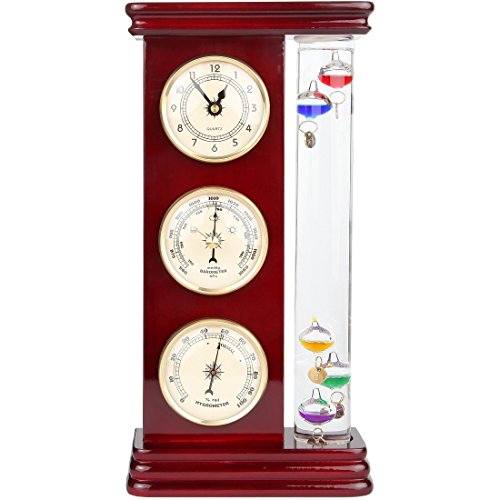
Lily’s Home bundles four classic weather instruments into one elegant wall-mounted unit: a Galileo thermometer with five colored spheres, a precision quartz clock, an analog barometer, and a hygrometer. The 12-inch tall wood frame with gold accents looks striking in a study, library, or living room, and the Galileo thermometer provides a fascinating scientific demonstration of temperature-dependent buoyancy.
The barometer is an aneroid type with an easy-to-read analog face, but like all mechanical barometers, it requires a gentle tap to overcome internal friction before taking a reading. Several reviewers noted that the barometer needle didn’t move at all until tapped — that’s normal for this design, not a defect. The Galileo thermometer works within a 64°F to 80°F range in 4-degree increments, so it’s not suited for extreme temperature environments. The clock runs on a single battery (not included), and a few units ship with a stripped battery compartment screw, rendering the clock useless.
This station prioritizes aesthetics and conversation value over absolute precision. The hygrometer’s accuracy is approximate compared to a digital sensor, and the barometer’s value is directional (rising/falling) rather than absolute. It makes a wonderful gift for a grandparent, new homeowner, or weather enthusiast who already trusts their local forecast and wants a beautiful desk piece, not a data center.
Why it’s great
- Beautiful four-in-one design with Galileo spheres, clock, barometer, and hygrometer
- Makes an excellent decorative gift for weather-curious friends or family
- Galileo thermometer is a functional science demonstration on your wall
Good to know
- Barometer requires tapping before each reading — normal but easily missed
- Galileo thermometer only works in 64°F-80°F range
- Battery compartment screw quality is inconsistent; may arrive stripped
5. U UNNI Weather Station
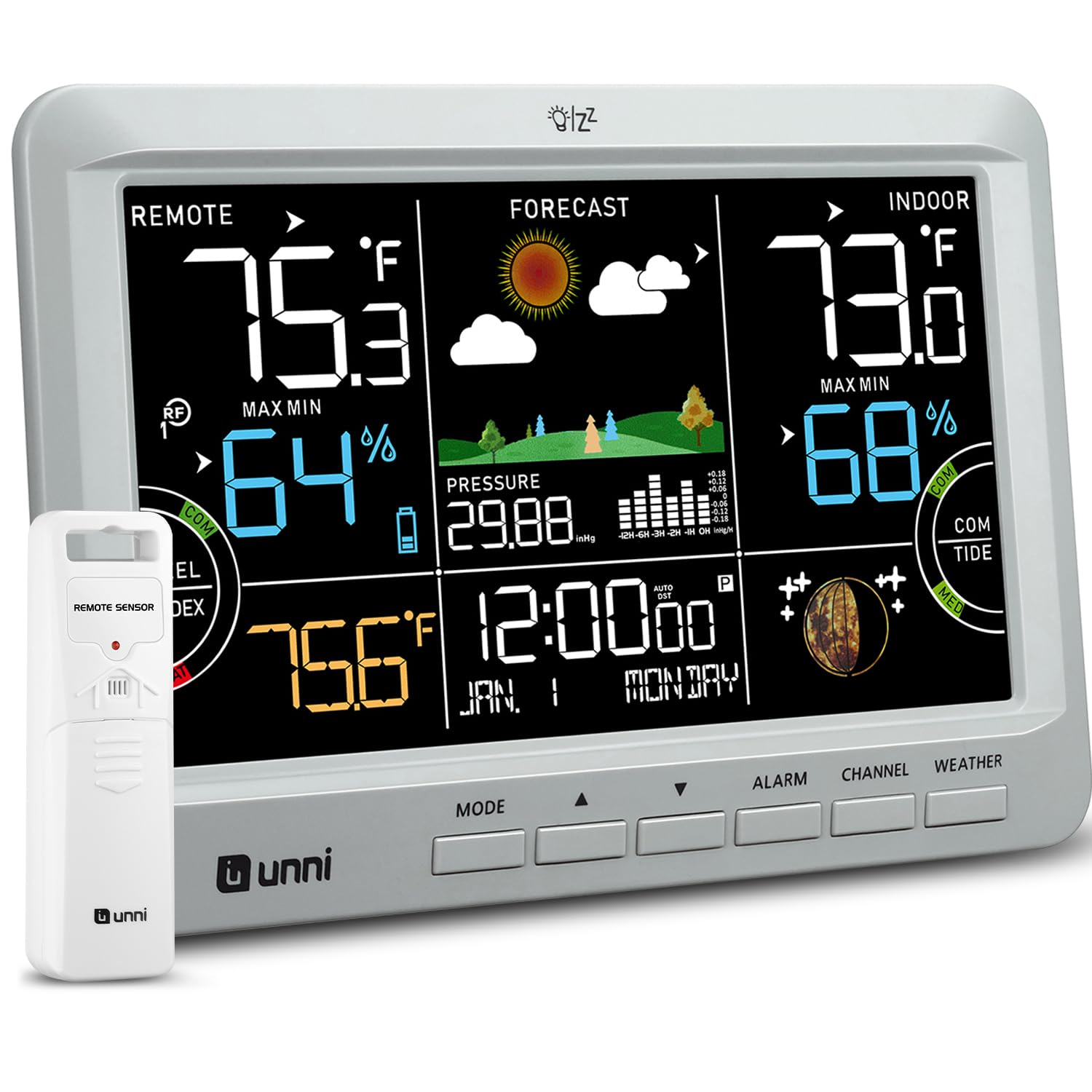
The U UNNI weather station packs an impressive array of features into a clean, 7.5-inch LCD display. Beyond the standard indoor/outdoor temperature and humidity readings, it delivers barometric pressure, dew point, heat index, comfort level, tide phase, moon phase, and a mold index — a rare and genuinely useful metric for homeowners battling damp basements or bathrooms. The atomic clock syncs daily with the WWVB signal for automatic daylight saving time adjustment.
Wireless transmission uses Unni’s patented technology with a 330-foot radius in open air, updating readings every 30 seconds. The display remains continuously on when plugged into AC power (adapter included), and brightness is adjustable across multiple levels. On battery backup only, the screen dims to conserve power and requires a tap to illuminate for 15 seconds — a common trade-off in this category. The black-background screen offers high contrast and large fonts that are readable from across a room.
Customer feedback is overwhelmingly positive, with users noting the straightforward 5-minute setup, accurate temperature readings within 2°F, and the comprehensive data suite at a budget-friendly price point. The included remote sensor requires AA batteries (not included), and the outdoor sensor should be placed in a shaded spot for accurate temperature readings. For a digital station that delivers barometric trend data plus extras like mold risk and tide phase, this is the value leader.
Why it’s great
- Includes mold index, heat index, and tide phase — unique extras at this price
- Patented 330 ft wireless range with 30-second updates
- Atomic clock auto-syncs for accurate time and automatic DST adjustment
Good to know
- Backlight only stays on continuously when plugged into AC power
- Requires 5 AA batteries (not included) for sensor and backup power
- Outdoor sensor needs shade for accurate temperature readings
6. Newentor Q3 Weather Station

The Newentor Q3 offers one of the most vibrant color displays in the digital home weather station category. Its 7.5-inch LCD shows indoor and outdoor temperature and humidity, barometric pressure, a 12-24 hour weather forecast, moon phase, and an atomic clock with dual alarms — all organized in a clean, colorful layout that’s easy to interpret at a glance. The display features four adjustable brightness levels and can be set to always-on mode when plugged into the included adapter.
The station supports up to three remote sensors (one included) for monitoring multiple locations like a garage, greenhouse, and nursery simultaneously. The atomic time sync locks onto the WWVB signal, though some users report it struggles compared to dedicated La Crosse units. The forecast calculation uses a 7-10 day calibration period for your specific location, so accuracy improves after the first week. The indoor unit can be wall-mounted with the built-in keyhole or placed on a desk stand — but the included wall screw mount lets the unit swing freely, and many owners opt for adhesive Velcro strips instead for a secure fit.
Colorful and well-constructed, the Q3 earns high marks for its visual appeal and intuitive data layout. The forecast icon blinks constantly for the first week until calibration completes — this is normal but unnerving if you aren’t aware. Barometric pressure data is presented numerically and as a trend arrow, but there is no 24-hour bar graph found on some competitors. For a bright, easy-to-read station with multi-sensor expandability, the Newentor Q3 is a top contender.
Why it’s great
- Beautiful 7.5″ color LCD with clear, well-organized data layout
- Supports up to 3 remote sensors for multi-location monitoring
- Atomic clock with dual alarms and 4-level adjustable backlight
Good to know
- Atomic time sync may be less reliable than competing models from La Crosse
- No barometric pressure trend graph — only a single numeric reading and arrow
- Wall mount design causes the unit to swing; Velcro recommended for secure mounting
7. AMTAST AW008A 3-in-1

The AMTAST AW008A is a no-frills mechanical barometer that combines a barometer, thermometer, and hygrometer into an 8.2-inch diameter silver dial. It runs on pure mechanical power — no batteries, no wires, no screens. The barometer measures atmospheric pressure from 28.75 to 31.0 inHg, the thermometer covers -10°F to 130°F, and the hygrometer spans 0% to 100% relative humidity. Each gauge is marked with the imperial system (Fahrenheit and inHg) for users who prefer traditional units.
Setup requires calibrating the barometer against a known local reading using the included adjustment tool on the back. The dial includes a movable marker needle so you can set it to the current pressure and check later if the main needle has moved left (falling) or right (rising). The thermometer and hygrometer are pre-calibrated and generally accurate out of the box, though the hygrometer may differ from digital sensors by a few percentage points. The all-metal body is sturdy and easy to clean, and the unit can be mounted horizontally or vertically.
Critical feedback is mixed: while many owners report accurate readings that match local weather station data after calibration, a small number of units arrive with a completely non-functional barometer needle that never moves. The hygrometer needle moves slowly and can be hard to read precisely. This is, fundamentally, a budget instrument — it requires patience, periodic tapping, and a willingness to calibrate. For the price, it’s a decent entry point into mechanical barometers for home use, but it’s not a set-and-forget device.
Why it’s great
- Pure mechanical operation — no batteries or power cords needed
- Large 8.2″ dial is easy to read from a distance
- Includes movable marker needle for tracking pressure trend visually
Good to know
- Quality control is inconsistent; some units ship with a stuck barometer needle
- Requires manual calibration and periodic tapping for the needle to respond
- Hygrometer accuracy is approximate compared to a digital sensor
FAQ
Why does my mechanical barometer need tapping before I read it?
Can I use a home barometer to predict the weather without internet?
How do I calibrate my new home barometer to my location?
Final Thoughts: The Verdict
For most users, the barometer for home use winner is the La Crosse V21-WTH because it delivers Wi-Fi connectivity, an accurate wind sensor, and full barometric trend data in a package that’s accessible to weather enthusiasts and casual users alike. If you want professional-grade rainfall precision without the premium price, grab the Sainlogic SA6. And for a beautiful analog conversation piece that also forecasts storms, nothing beats the Ambient Weather BA212.

Mo Maruf
I created WellFizz to bridge the gap between vague wellness advice and actionable solutions. My mission is simple: to decode the research and give you practical tools you can actually use.
Beyond the data, I am a passionate traveler. I believe that stepping away from the screen to explore new environments is essential for mental clarity and physical vitality.