Our readers keep the lights on and my smoothie glass nicely filled. As an Amazon Associate, I earn from qualifying purchases.
Finding a subwoofer that delivers chest-thumping low end without draining your wallet is the holy grail of budget audio. The market is flooded with “value” options that promise deep bass but deliver muddy, distorted noise at high volumes. A true bargain subwoofer must balance cone excursion, amplifier damping factor, and enclosure volume to produce clean, articulate lows rather than just a one-note drone.
I’m Mohammad Maruf — the founder and writer behind WellFizz. I’ve spent years dissecting amplifier topologies, driver materials, and cabinet resonances across hundreds of models to identify which entry-level and mid-range subs genuinely outperform their price tags.
Whether you’re filling a small home theater or finishing a near-field desktop setup, this guide to the best bargain subwoofer options will help you find a unit that adds real depth without demanding a second mortgage.
How To Choose The Best Bargain Subwoofer
The right budget subwoofer depends on your room size, audio goals, and whether you prioritize deep extension or tight, punchy response. Crossover and phase adjustments are not optional extras — they are the difference between a sub that disappears into the soundstage and one that calls attention to itself.
Driver Size and Room Volume
An 8-inch driver can pressurize a small to medium room (up to roughly 200 square feet) with satisfying output, especially in a ported enclosure. A 10- or 12-inch driver moves more air, which helps reach lower frequencies in larger spaces, but a poorly matched amplifier can make a larger driver sound slow and uncontrolled. Match driver size to your listening area and expected playback levels.
Amplifier Power: RMS Over Peak
Marketing departments love to print four-digit peak wattage numbers, but the RMS (continuous) power rating is what determines clean output over time. A subwoofer with 150–200 watts RMS is plenty for most residential rooms. Class-D amplifiers are now common at this price tier and offer high efficiency with low heat, which allows for a smaller cabinet footprint without sacrificing headroom.
Quick Comparison
On smaller screens, swipe sideways to see the full table.
| Model | Category | Best For | Key Spec | Amazon |
|---|---|---|---|---|
| Rockville Rock Shaker 10 Black | Powered | Home Theater Punch | 300W RMS / 10″ Woofer | Amazon |
| Dayton Audio CS1200 | Powered | Deep Extension / Music | 200W RMS / 12″ / 26 Hz | Amazon |
| Dayton Audio CS1000 | Powered | Small-Medium Room | 180W RMS / 10″ / 28 Hz | Amazon |
| Fluance DB10 | Powered | Clean Musical Bass | Ported / 10″ Long-Throw | Amazon |
| PreSonus Eris Sub 8BT | Studio | Music Production | 100W RMS / 30 Hz / BT | Amazon |
| Edifier T5s | Powered | Desktop / Near-Field | 70W RMS / 8″ / 35 Hz | Amazon |
| Rockville Rock Shaker 8 White | Powered | Budget Home Theater | 200W RMS / 8″ / 20 Hz | Amazon |
| Pioneer TS-A3000LB | Car Audio | Vehicle / Shallow Mount | 400W RMS / 12″ / 2Ω SVC | Amazon |
| JBL Bar 2.1 Deep Bass MK2 | Soundbar System | TV / All-In-One | 300W System / 6.5″ Sub | Amazon |
In‑Depth Reviews
1. Rockville Rock Shaker 10 Black 600W Powered Subwoofer

The Rockville Rock Shaker 10 Black delivers an aggressive combination of output and adjustability that is rare at this price point. Its 300W RMS (600W peak) Class-D amplifier pushes the 10-inch woofer hard enough to pressurize a medium-to-large living room, and user reports confirm room-shaking performance at just 50% gain. The volume, crossover, and phase controls are functional and accessible, allowing fine tuning to match most AV receivers and bookshelf speakers.
Build quality is solid for the tier: an MDF cabinet with a vinyl wrap and a detachable foam grille. The auto-on feature is a welcome convenience, though some users note the crossover behaves more like a shelf filter than a true low-pass, meaning careful setting is required to avoid upper-bass muddiness. At typical listening levels, the Rock Shaker 10 stays tight and articulate, only loosening slightly at near-maximum drive.
Flexible connectivity with both RCA line and high-level speaker inputs means it integrates easily into legacy systems without a dedicated subwoofer output. For buyers who want maximum bass extension per dollar in a home theater setup, this is the benchmark the competition must beat.
Why it’s great
- High 300W RMS output for room-filling bass.
- Three adjustable controls allow precise system integration.
- Copes well with both RCA and speaker-level inputs.
Good to know
- Crossover is a shelf-type, not a true variable high/low pass.
- May need break-in time to reach full smoothness.
2. Dayton Audio Classic CS1200 – 12″ 200W Powered Subwoofer
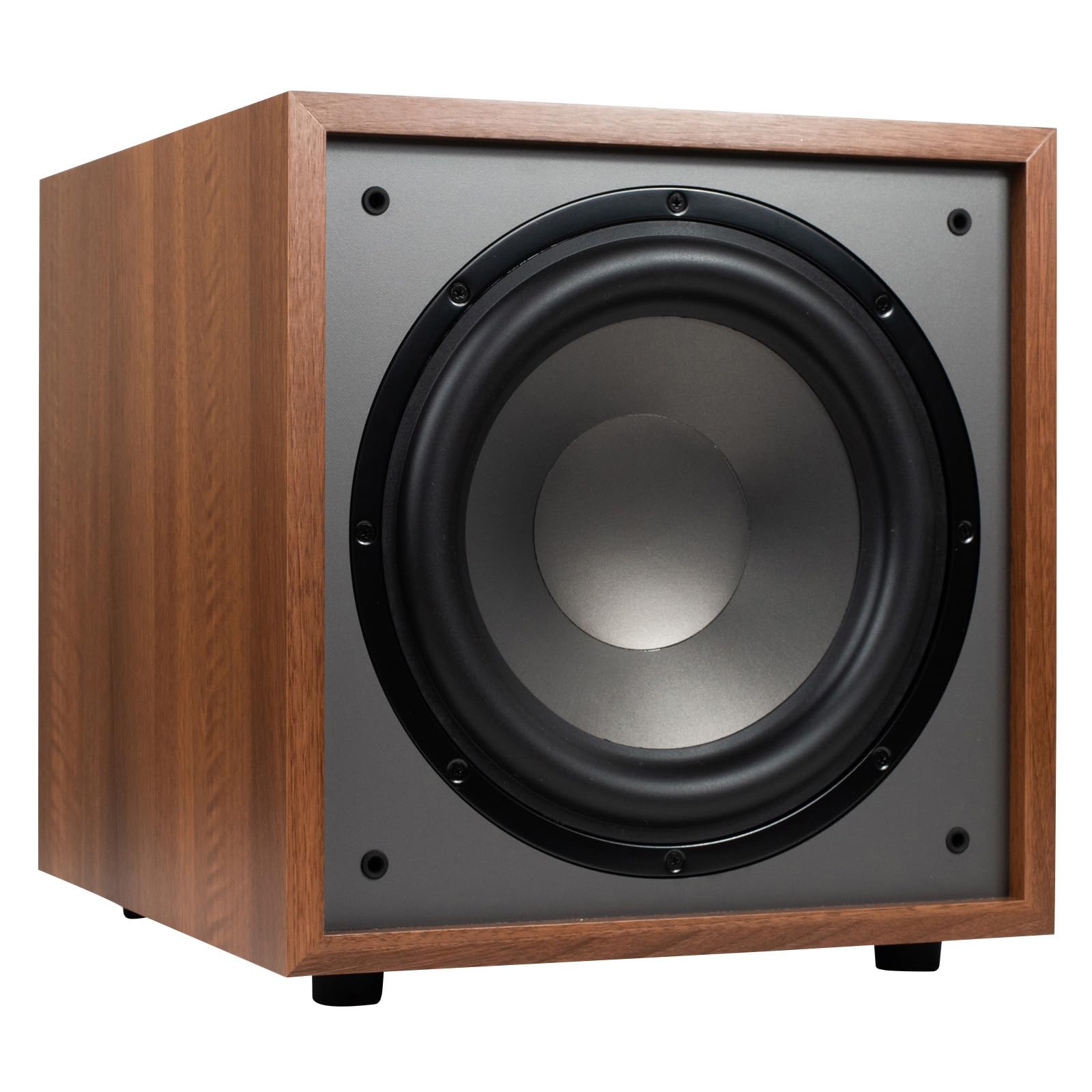
The Dayton Audio CS1200 uses a larger 12-inch driver and a 200W RMS Class-D amplifier to dig down to 26 Hz, giving it genuine sub-bass extension that smaller budget subs cannot match. The rigid, braced MDF cabinet is exceptionally heavy and deadens panel resonance effectively, contributing to the clean, non-bloomy low end praised by users in small to medium rooms. The auto-on circuit is silent and fast, unlike some competitors that produce a pop or delay.
Connectivity covers stereo RCA, LFE, and speaker-level inputs, making integration straightforward. The included gray grille is swappable, and the wood-grain finish adds a furniture-like appearance that blends better than bare black boxes. Some users note the grille cloth feels less robust than the rest of the construction, but the 5-year warranty offers long-term assurance at this price tier.
Placement and phase adjustment are critical with the CS1200 — it can sound slightly boomy before calibration, but once dialed in, it provides deep, musical bass that outperforms many units costing considerably more. It is the best choice for listeners who prioritize frequency extension over maximum SPL.
Why it’s great
- Reaches 26 Hz for genuine sub-bass performance.
- Solid, heavy cabinet stays inert at high drive levels.
- Backed by a 5-year warranty.
Good to know
- Grille cloth feels less durable than the cabinet.
- Requires careful placement to avoid boominess.
3. Dayton Audio Classic CS1000 – 10″ 180W Powered Subwoofer
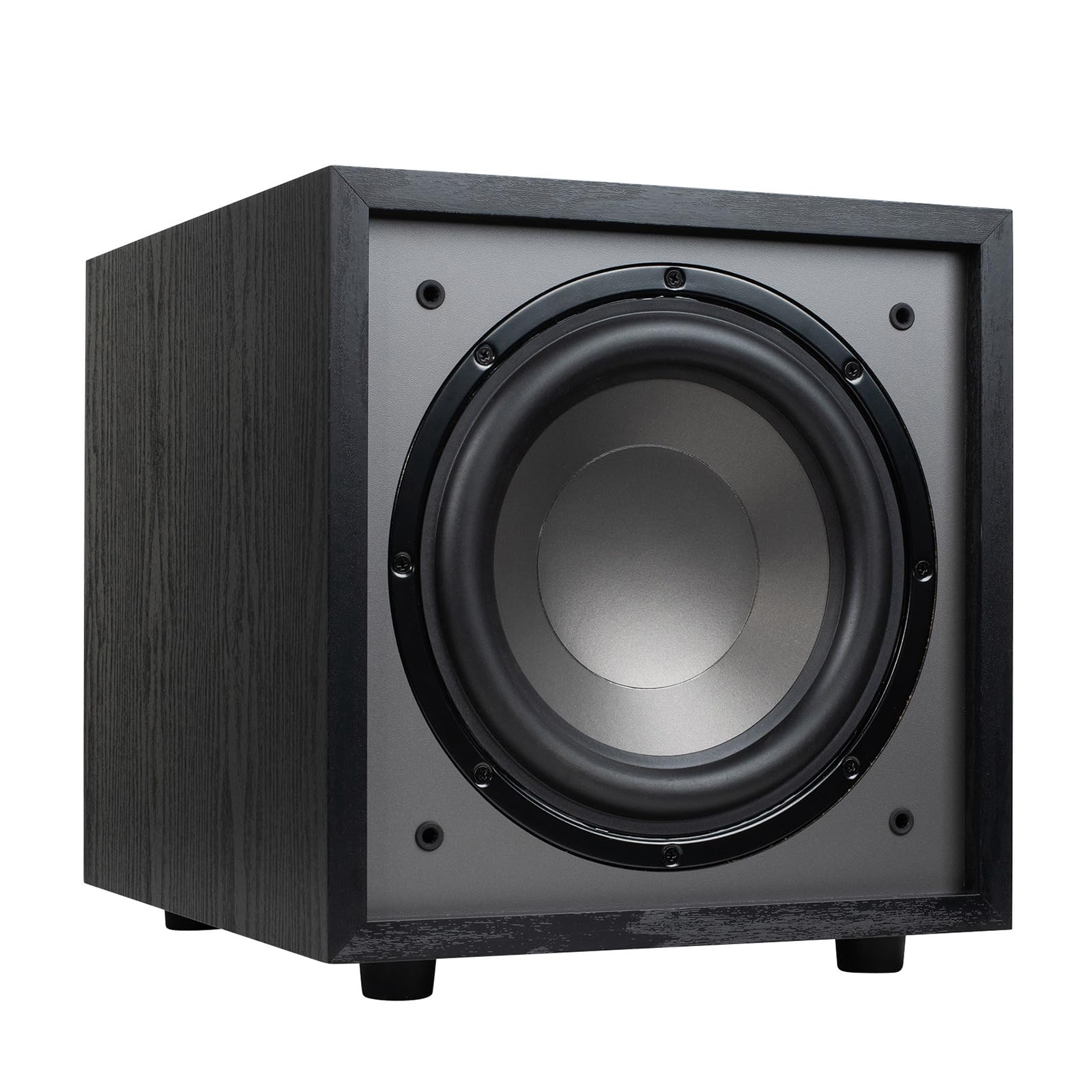
The Dayton Audio CS1000 takes the same engineering philosophy as its larger sibling — rigid MDF cabinet, Class-D amplifier, auto-on circuit — and packages it in a 10-inch form factor that fits more comfortably in tight spaces. Its 180W RMS output reaches down to 28 Hz, which is exceptional for a driver this size at this price. User feedback consistently highlights the tight, controlled bass with no audible hum or noise floor.
The swappable grille system and clean black finish make it visually unobtrusive, and the speaker-level inputs allow integration with older receivers that lack LFE outputs. The crossover and gain controls are stepped and positive, giving repeatable settings once dialed in. Some users note a slight bulge in the grille fabric, but this does not affect performance.
For small to medium systems — a desktop near-field setup or a modest 5.1 home theater — the CS1000 provides a musical foundation that punches above its displacement. It is the most balanced performer in this lineup for buyers who want extension without the cabinet size of a 12-inch model.
Why it’s great
- Excellent 28 Hz extension for a 10-inch driver.
- Dead-silent noise floor and clean amplifier.
- Versatile inputs including speaker-level.
Good to know
- Grille fabric can bulge slightly at the corners.
- Prefers careful placement for best integration.
4. Fluance DB10 10-Inch Powered Subwoofer

The Fluance DB10 focuses on clean, punchy mid-bass rather than subterranean extension, making it an ideal match for music lovers who want to reinforce the low end without turning their system into a rumbling mess. The front-firing ported design allows placement closer to a wall compared to rear-ported alternatives, and the auto power-on circuit is responsive without false triggers.
User reports consistently note that the advertised 38 Hz extension is accurate — the DB10 delivers solid output down to about 35-40 Hz before rolling off. The long-throw driver handles dynamic peaks without bottoming out, and the precision-crafted MDF cabinet stays inert. A break-in period of 15-20 hours is often recommended for the suspension to loosen fully.
Finish quality is above average for this price tier, with a black ash veneer that looks more expensive than it is. The 2-year warranty and lifetime customer support from Fluance add peace of mind. For users who value musicality and speed over sheer depth, the DB10 is a compelling option.
Why it’s great
- Fast, punchy mid-bass ideal for music reproduction.
- Front port allows flexible placement near walls.
- High-quality black ash finish.
Good to know
- Limited sub-35 Hz extension compared to larger units.
- Requires break-in time for optimal performance.
5. PreSonus Eris Sub 8BT — 8″ Powered Studio Subwoofer

The PreSonus Eris Sub 8BT is built for accuracy first, output second. Its 8-inch paper-composite driver and 100W RMS amplifier reach down to 30 Hz with tight, controlled response that does not smear the mid-bass region — critical for mixing or critical listening. The variable low-pass filter and highpass filter (crossover) allow precise frequency matching with your main monitors, eliminating the muddy overlap that plagues less configurable subs.
Bluetooth 5.0 wireless input adds convenience for casual listening without sacrificing audio quality. The front-panel ⅛-inch aux input and headphone output with dedicated amplifier make it versatile for studio and desktop use. Balanced ¼-inch TRS and unbalanced RCA inputs ensure compatibility with professional interfaces and consumer gear alike.
At moderate levels the Eris Sub 8BT delivers impressively deep response for its size, but it is not designed for high-SPL home theater impact. The power-saver mode engages after 40 minutes of inactivity. It is the definitive choice for content creators and audiophiles who want reference-grade low end in a compact footprint.
Why it’s great
- Flat, accurate response suitable for music production.
- Bluetooth connectivity and flexible pro-audio I/O.
- Built-in headphone amplifier with front-panel jack.
Good to know
- Not intended for high-volume home theater use.
- Limited sub-30 Hz output for pipe-organ bass.
6. Edifier T5s Powered Active Subwoofer – 8″
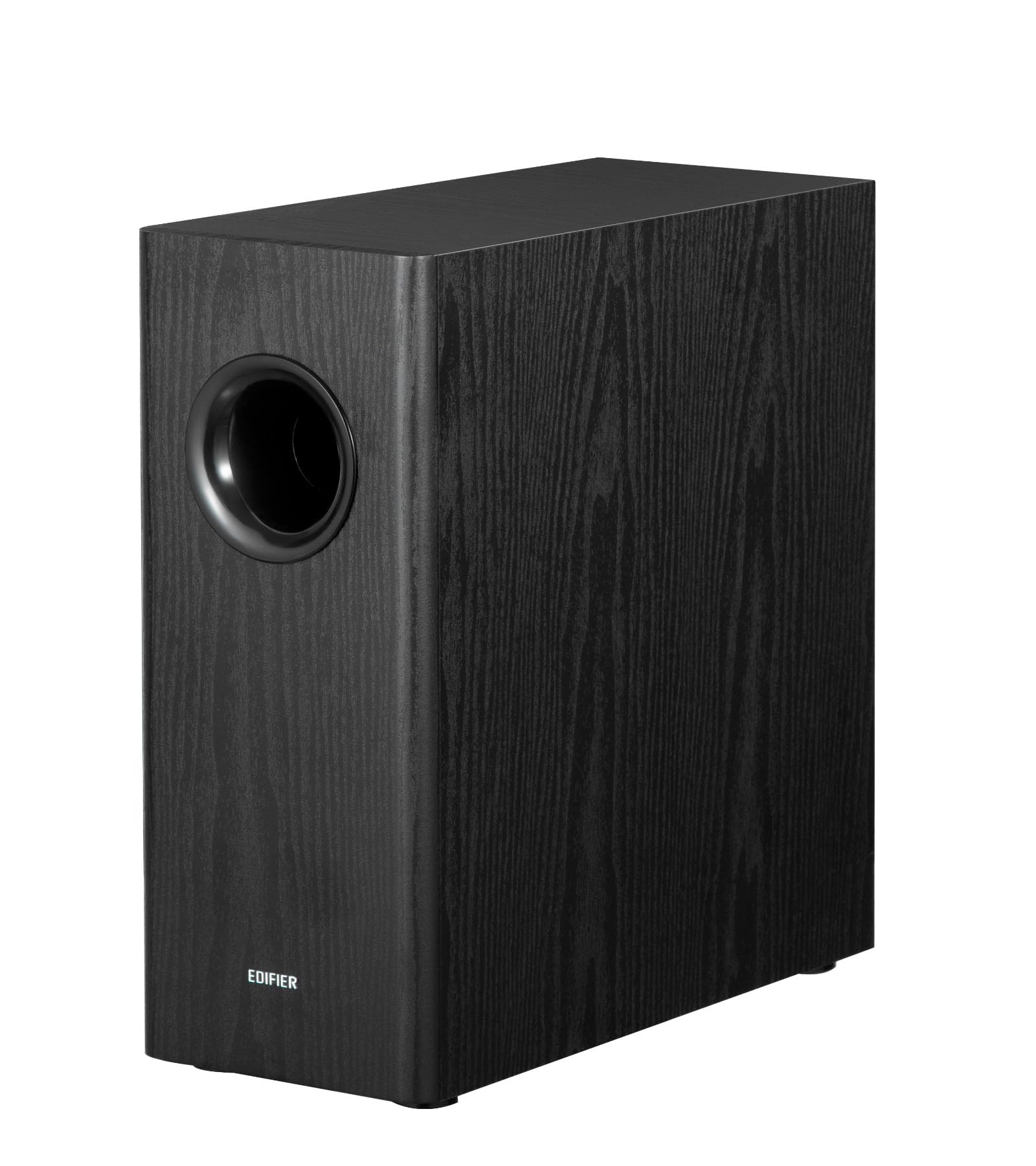
The Edifier T5s is purpose-built for near-field desktop use, designed specifically to augment Edifier’s bookshelf speakers but compatible with any system that has RCA subwoofer or line outputs. Its 8-inch long-throw driver and 70W RMS Class-D amplifier produce 35 Hz deep bass that fills a small to medium room without overwhelming the listening space. The vertical cabinet design saves desk footprint and positions the driver for optimal near-field coupling.
Phase select (0°/180°) and variable low-pass filter (30–160 Hz) give enough control to blend seamlessly with most bookshelf speakers. Auto-standby engages after 15 minutes, cutting standby power draw. Included RCA cables and a 3.5mm-to-RCA adapter simplify out-of-box setup. Edifier’s build quality is consistently high, with an MDF cabinet wrapped in a wood-grain finish that looks premium.
While the T5s lacks the raw headroom for large home theater applications, its bass is tight and articulate — accurately reproducing bass lines like Tracy Chapman’s “Fast Car” without the one-note drone typical of budget subs. It struggles with sub-35 Hz content (pipe organ, certain electronic sub-harmonics), but for its intended desktop role it is exceptional value.
Why it’s great
- Compact vertical profile ideal for desktop setups.
- Clean, musical bass with good articulation.
- Includes all necessary cables for fast setup.
Good to know
- Not suitable for large rooms or high SPL demands.
- Limited extension below 35 Hz.
7. Rockville Rock Shaker 8″ White 400W Powered Subwoofer

Rockville’s smaller Rock Shaker 8 packs a 200W RMS (400W peak) Class-D amplifier and an 8-inch woofer with a Y30 magnet into a white MDF cabinet that stands out visually from the usual black boxes. Despite its compact size, user feedback confirms tight, clean bass that is free of the bloated boominess that plagues many entry-level subs. The claimed 20 Hz extension is optimistic under real-world conditions, but the unit does pressurize a small room effectively at moderate volumes.
RCA and high-level inputs provide flexibility, and the adjustable volume, phase, and crossover controls help with integration. Build quality is lighter than the more expensive options — some users note the cabinet feels less dense. A power cord upgrade from the stock cable reportedly reduces upper-bass bloat, suggesting the included cable is a weak link. For desktop or small home theater use where budget is the primary constraint, the Rock Shaker 8 delivers respectable performance.
Multiple verified reviews highlight its value for adding substantial low end to small speakers. It is an excellent entry point for listeners who want to feel their bass without spending aggressively.
Why it’s great
- Very low entry cost for real sub-bass output.
- White finish offers an aesthetic alternative.
- Multiple control knobs for system tuning.
Good to know
- Stock power cord may introduce bass bloat.
- Cabinet feels lighter than premium competitors.
8. Pioneer A-Series TS-A3000LB 12” Pre-Loaded Subwoofer

The Pioneer TS-A3000LB is a shallow-mount 12-inch subwoofer in a sealed pre-loaded enclosure, targeting vehicle installation where space is at a premium. Its 400W RMS power handling and 2Ω single voice coil design pair well with compact car amplifiers. Users consistently praise its surprisingly good output given the slim 6.75-inch enclosure depth, with many fitting it under truck seats or behind standard cab rear seats.
Build quality is solid, featuring a glass-fiber and mica-reinforced IMPP cone that resists flex under high power. The included adhesive feet and threaded feet allow vertical, horizontal, or down-firing orientation. Some users report the enclosure dimensions are slightly different from advertised, so measuring the intended space beforehand is recommended. The unit is passive and requires an external amplifier, which is standard for car audio.
While a small minority experienced disappointing output in certain vehicle arrangements, most reviewers describe the TS-A3000LB as an excellent value for adding substantial low end to a car audio system without sacrificing cargo space. It is not designed for home use, but for mobile applications it is a strong contender.
Why it’s great
- Shallow enclosure fits in tight vehicle spaces.
- High 400W RMS power handling for its footprint.
- Multiple mounting orientations offered.
Good to know
- Passive design requires an external amplifier.
- Enclosure dimensions may vary slightly from listed specs.
9. JBL Bar 2.1 Deep Bass (MK2) Soundbar with Wireless Subwoofer

The JBL Bar 2.1 Deep Bass MK2 is an integrated solution: a 2.1-channel soundbar paired with a wireless 6.5-inch subwoofer delivering 300W total system power. This is not a standalone subwoofer — it is the bass half of a complete TV audio upgrade. The wireless subwoofer connection is reliable and free of lag, and the 6.5-inch driver produces surprisingly punchy low end for its small diameter, with adjustable bass levels (Low/Mid/High).
Sound quality is characterized by clean mids and highs from the soundbar, with the subwoofer adding depth without overwhelming. Dolby Digital decoding provides a genuine cinematic feel for movies and TV. Setup is genuinely simple: HDMI ARC or optical connection, then pair the sub wirelessly. A small number of units experienced intermittent static that resolved with a power cycle, but the majority of reviews are overwhelmingly positive.
For users who want to upgrade their TV sound without the complexity of separate components, the JBL Bar 2.1 Deep Bass MK2 offers a compelling package. It is not for audiophiles chasing extension below 40 Hz, but for the living room it provides satisfying, hassle-free bass.
Why it’s great
- Complete soundbar system with no external amp needed.
- Wireless subwoofer simplifies placement and setup.
- Adjustable bass level and Dolby Digital support.
Good to know
- 6.5-inch subwoofer limited in deep extension.
- Rare reports of static requiring power cycling.
FAQ
Can I use a budget home subwoofer for car audio?
What crossover frequency should I set on my budget subwoofer?
Do I need a subwoofer cable or will any RCA cable work?
Final Thoughts: The Verdict
For most users, the best bargain subwoofer winner is the Rockville Rock Shaker 10 Black because it offers the best combination of RMS power, driver size, and adjustability at a very low entry cost. If you want deeper extension for music and movies, grab the Dayton Audio CS1200. And for a desktop or near-field setup, nothing beats the Edifier T5s.

Mo Maruf
I created WellFizz to bridge the gap between vague wellness advice and actionable solutions. My mission is simple: to decode the research and give you practical tools you can actually use.
Beyond the data, I am a passionate traveler. I believe that stepping away from the screen to explore new environments is essential for mental clarity and physical vitality.