Our readers keep the lights on and my smoothie glass nicely filled. As an Amazon Associate, I earn from qualifying purchases.
The right entry-level camera is the difference between missed moments and portfolio-worthy shots. For anyone stepping into photography or vlogging, the sensor size, autofocus speed, and lens compatibility define your ceiling — not the sticker price. A smart buy in this tier means prioritizing interchangeable lenses and reliable image processing over flashy features you will never use.
I’m Mohammad Maruf — the founder and writer behind WellFizz. I’ve spent years analyzing mirrorless and DSLR sensor performance, AF point counts, and real-world battery endurance to separate the real contenders from the marketing noise.
Whether you’re upgrading from a phone or building your first kit, finding the right best bargain camera comes down to matching sensor resolution with your most common shooting environment.
How To Choose The Best Bargain Camera
Bargain-tier cameras force trade-offs. Your job is to accept the right ones. Prioritize image quality and lens flexibility over gimmicks like built-in effects or higher megapixel counts that outpace your lens’s resolving power.
Sensor Size and Body Type
APS-C sensors dominate this price tier because they balance cost with real low-light capability. A 24MP APS-C sensor with a decent kit lens will outshoot any smartphone in dynamic range, especially after sunset. Mirrorless bodies are lighter and offer superior video autofocus, while DSLRs give longer battery life and optical viewfinders. Choose the form factor that matches how you actually carry a camera.
Autofocus Performance
Phase-detection AF points across most of the frame matter more than just the number of points. Look for hybrid AF systems that track subjects smoothly during video. Contrast-only AF on older, budget models will hunt in dim light and frustrate anyone shooting moving subjects. A solid 9- or 49-point system with face or eye detection is the baseline for a usable bargain camera.
Quick Comparison
On smaller screens, swipe sideways to see the full table.
| Model | Category | Best For | Key Spec | Amazon |
|---|---|---|---|---|
| Fujifilm X-T30 III | Mirrorless | Everyday carry & film simulations | 26.1MP APS-C X-Trans CMOS 4 | Amazon |
| Canon EOS Rebel T7 Kit | DSLR | First-time shooters & Wi-Fi sharing | 24.1MP APS-C CMOS / DIGIC 4+ | Amazon |
| Panasonic LUMIX G100 | Mirrorless | Vloggers who need great audio | 20.3MP Micro Four Thirds / 4K 24p | Amazon |
| Nikon Z 30 | Mirrorless | Streamers & 4K video creators | 20.9MP APS-C / 209-point Hybrid AF | Amazon |
| Sony ZV-E10 Bundle | Mirrorless | Vlogging with accessory kit | 24.2MP APS-C Exmor / 425-point AF | Amazon |
| Canon EOS 2000D Bundle | DSLR | Value kit with multiple lenses | 18MP APS-C CMOS / 9-point AF | Amazon |
| Nikon D3200 | DSLR | Learning photography on a budget | 24.2MP DX-format CMOS / 11-point AF | Amazon |
| SJCAM C400 | Action Cam | Travel vlogging & underwater use | 4K30fps / 6-Axis EIS / 30M Waterproof | Amazon |
| DJI Mini 4K | Drone | Aerial footage & beginner flying | 4K UHD / 3-Axis Gimbal / Under 249g | Amazon |
In‑Depth Reviews
1. Canon EOS Rebel T7 DSLR Camera Kit
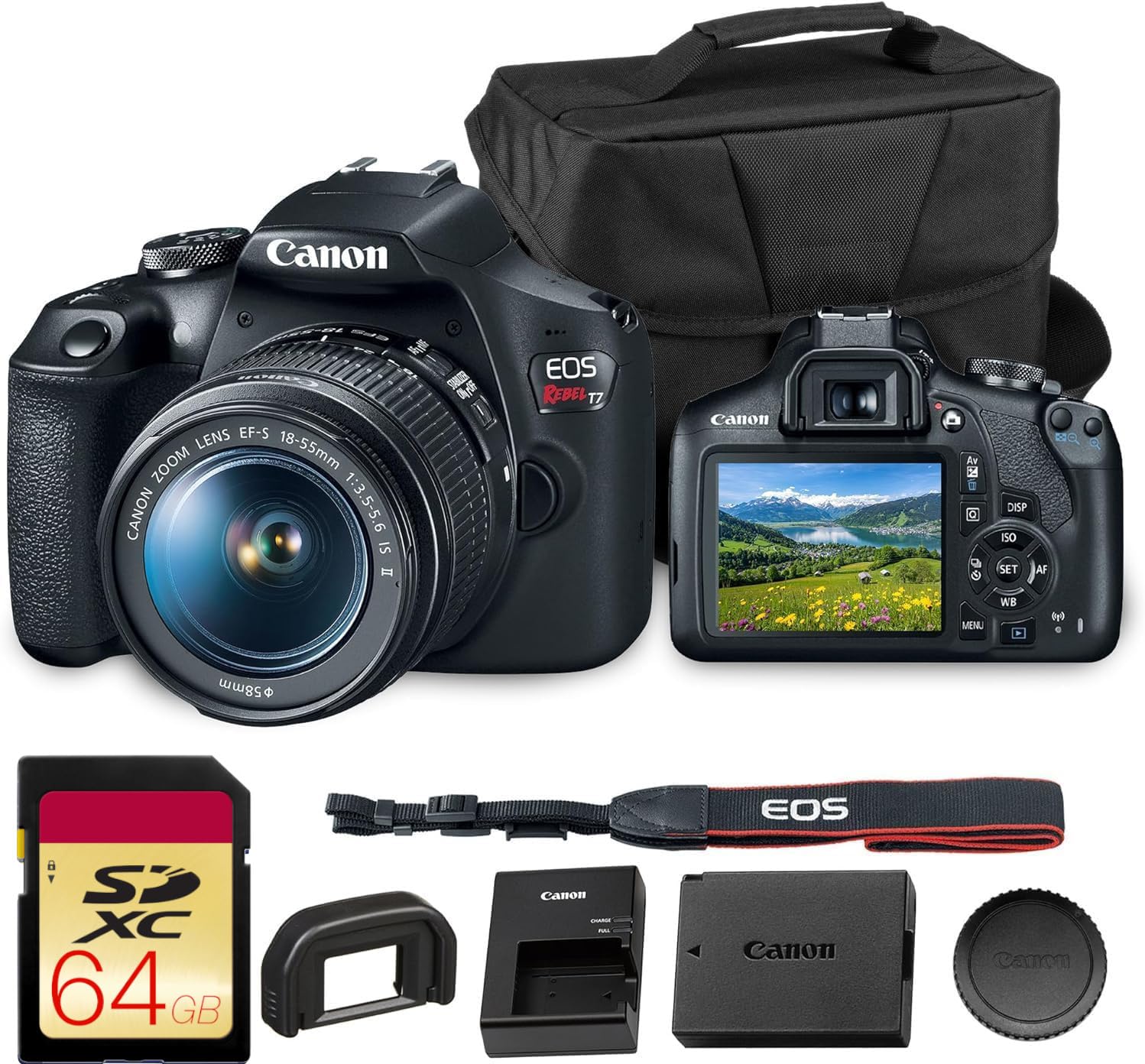
The Canon EOS Rebel T7 remains the standard for entry-level DSLR value. Its 24.1MP APS-C sensor paired with the DIGIC 4+ image processor delivers consistent color accuracy and usable images up to ISO 3200. The included 18-55mm kit lens covers everyday focal lengths, and the bundled 64GB card and shoulder bag mean you can shoot immediately without extra purchases.
For beginners transitioning from smartphone photography, the optical viewfinder offers a true through-the-lens experience that teaches composition without lag. The 9-point autofocus system is basic by modern mirrorless standards, but it locks reliably in good light and the hybrid AF during Live View supports face detection for casual portraits.
Wi-Fi and NFC connectivity through the Canon Camera Connect app make transferring full-resolution JPEGs to your phone seamless. Battery life is excellent, rated for roughly 500 shots per charge, so you can leave the charger at home during day trips. The main trade-off is video — 1080p at 30fps with no external mic jack limits audio upgrade paths for serious vloggers.
Why it’s great
- Best image quality at this price point with a proven APS-C sensor
- Complete kit includes bag, card, and battery — ready out of the box
- Wi-Fi sharing is fast and intuitive via the Canon app
Good to know
- No 4K video recording limits video content
- No external microphone input for better audio
2. Fujifilm X-T30 III Mirrorless Camera

The Fujifilm X-T30 III packs a 26.1MP X-Trans CMOS 4 sensor into a compact, retro-styled body that weighs under 400 grams. Its 20 built-in Film Simulations — including classic PROVIA, Velvia, and the newer Nostalgic Neg — produce distinctive colors straight out of camera, reducing editing time for social media content. The included XC13-33mm OIS kit lens adds optical stabilization for handheld video.
AI-powered subject detection autofocus covers human faces and eyes, animals, birds, cars, and more. The hybrid AF system with phase-detection points across nearly the entire frame keeps focus locked during fast-paced street photography or family gatherings. The 4K 30fps video output is solid, with F-Log recording available for color grading.
The physical dials for ISO, shutter speed, and exposure compensation make manual shooting intuitive for learners and satisfying for experienced shooters. The X-mount lens ecosystem gives access to excellent primes like the 23mm f/1.4 and 35mm f/1.4, both affordable in the used market. The trade-off is battery life — around 380 shots per charge — so carry a spare for full-day shoots.
Why it’s great
- Film Simulations produce beautiful JPEGs with no editing required
- AI autofocus is rare at this tier and works reliably
- Compact, lightweight body with dedicated manual dials
Good to know
- No built-in flash; external hotshoe flash required
- Battery life is below average for mirrorless cameras
3. Panasonic LUMIX G100 Mirrorless Camera

The LUMIX G100 is a Micro Four Thirds mirrorless camera purpose-built for vloggers who prioritize audio quality. Its built-in 360-degree microphone with subject tracking automatically adjusts recording focus from wide scenes to close-up dialogue, eliminating the need for an external mic in many situations. The 20.3MP sensor paired with 5-axis hybrid image stabilization produces stable handheld footage.
The camera shoots 4K 24p and 30p with no crop, and the intelligent Auto (iA) mode handles exposure and focus automatically for beginners. The 49-point contrast-detection AF system is reliable in good light, though it hunts slightly in dim interiors. The included 12-32mm retractable lens keeps the package pocket-friendly at roughly 350 grams total.
A frame marker feature overlays social-media aspect ratios (1:1, 4:5, 16:9) on the rear screen, helping you compose for Instagram or TikTok without guessing. USB-C connectivity lets it double as a high-quality webcam for streaming. The major limitation is a 4K recording time cap of roughly 10 minutes before the sensor overheats — a hard miss for long interview sessions.
Why it’s great
- Best built-in microphone system in its price class
- Ultra-compact body fits in a jacket pocket
- Social media frame markers simplify vlogging composition
Good to know
- 4K video recording is limited to 10 minutes per clip
- Contrast-detect AF can hunt in low light
4. Nikon Z 30 Mirrorless Camera

The Nikon Z 30 is the company’s most compact mirrorless body, designed with vloggers and streamers as the primary audience. The 20.9MP DX-format sensor delivers crisp 4K 30p video with eye-tracking autofocus for people and pets. The flip-out touchscreen selfie monitor and red REC light make it easy to confirm recording without looking at the LCD.
Plug-and-play operation over USB-C provides smooth Full HD 60p streaming for Zoom, OBS, or Teams, and the camera stays powered over the same connection for marathon sessions. The 209-point hybrid AF system covers most of the frame and transitions smoothly between subjects. The Z mount gives access to Nikon’s full line of S-Line lenses, including fast primes and affordable 24-70mm f/4 zooms.
The body lacks in-body image stabilization, so handheld footage requires a gimbal or steady hands. There is no built-in viewfinder — composition relies entirely on the rear LCD. Battery life is adequate at roughly 320 shots, but USB-C charging means you can top up from a power bank in the field.
Why it’s great
- Excellent autofocus with reliable eye-tracking for humans and animals
- USB-C plug-and-play streaming with unlimited recording time
- Compact body with selfie-friendly flip-out screen
Good to know
- No in-body image stabilization requires a gimbal for smooth video
- Lack of electronic viewfinder limits shooting in bright sun
5. Sony ZV-E10 Mirrorless Camera Bundle

The Sony ZV-E10 bundles a 24.2MP APS-C Exmor CMOS sensor with a 425-point Fast Hybrid AF system that includes Real-Time Eye Tracking for people and animals. This refurbished kit includes the 16-50mm power zoom lens, two 64GB SD cards, a LED video light, tripod, steady grip pod, filter kit, macro attachment, and telephoto and wide-angle converter lenses — everything needed to start creating immediately.
The sensor’s high-ISO performance is excellent for an APS-C camera, producing clean images up to ISO 6400. The Background Defocus button instantly switches between a deep and shallow depth of field, and the Product Showcase Setting pulls focus smoothly when you hold an object in front of the lens — both features are rare at this tier and extremely useful for content creators.
The side flip-out touchscreen works well for overhead vlogging and video calls. The kit’s accessories, while not individually premium, provide enough coverage to learn what gear you actually need before investing in higher-end components. The main downside is the built-in microphone quality — it picks up handling noise and wind, so plan to add an external mic early in your upgrade path.
Why it’s great
- Outstanding autofocus with Real-Time Eye Tracking for video
- Incredibly feature-packed bundle for beginners
- Great low-light performance for an APS-C sensor
Good to know
- Built-in microphone is poor; external mic recommended
- Refurbished unit with 1-year seller warranty
6. Canon EOS 2000D / Rebel T7 Bundle

The Canon EOS 2000D (Rebel T7) is an 18MP APS-C DSLR that focuses on simplicity and affordability. This 20-piece bundle throws in a 32GB SanDisk card, tripod, case, and wide-angle and telephoto adapter lenses, making it the most complete beginner kit in this lineup. The 18-55mm kit lens covers standard focal ranges for everyday photography.
Wi-Fi and NFC connectivity via the Camera Connect app allows instant photo transfer and remote control from a smartphone. The optical viewfinder provides a clear, lag-free viewing experience for fast-moving subjects. The 9-point autofocus is reliable in good light, but the sensor’s 18MP resolution is noticeably lower than the 24MP class — cropping reveals softer details.
The camera includes a built-in flash and Scene Intelligent Auto mode that adjusts settings automatically for beginners. It also supports Canon’s huge EF/EF-S lens ecosystem, giving you access to affordable primes like the 50mm f/1.8 STM. The primary limitation is video output — only 1080p at 30fps with no external microphone port, so audio quality is capped at what the built-in mic delivers.
Why it’s great
- Extensive accessory bundle includes nearly everything you need
- Canon EF lens ecosystem offers cheap, excellent lenses
- Wi-Fi sharing and remote control work smoothly
Good to know
- 18MP sensor limits cropping and large prints
- No external microphone input and no 4K video
7. Nikon D3200 DSLR with 18-55mm Lens
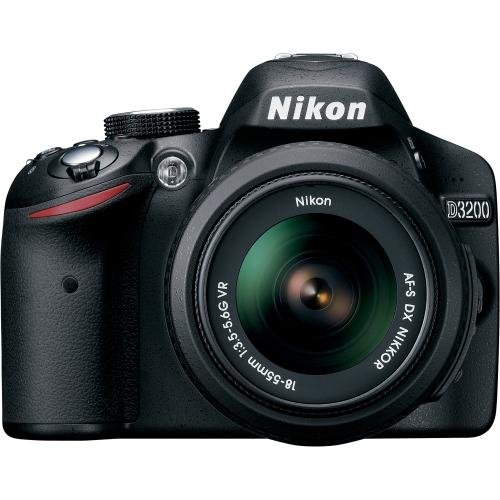
The Nikon D3200 is a 24.2MP DX-format DSLR that has aged into the perfect entry-level bargain. The refurbished body comes with the 18-55mm AF-S DX NIKKOR kit lens and includes a 90-day warranty. The EXPEED 3 image processor delivers reliable color and detail up to ISO 3200, and the 11-point autofocus system with contrast detection covers the most common framing situations.
The camera shoots full HD 1080p video at 30fps with one-touch recording. The Guide Mode steps beginners through exposure, composition, and depth-of-field decisions in plain language, making it an excellent learning tool before graduating to manual controls. The 3-inch LCD has 921K dots, providing sharp playback review for focus checking.
The Nikon F-mount is one of the largest lens ecosystems ever made, with cheap manual-focus primes and affordable AF-S lenses available everywhere. The camera uses SD cards, which keeps storage costs low. The refurbished condition means some units show minor cosmetic wear, and the package does not include a bag or manual — read the listing carefully before ordering.
Why it’s great
- 24.2MP sensor delivers photo quality matching modern mid-range cameras
- Guide Mode teaches photography fundamentals in-camera
- Enormous F-mount lens selection with cheap options
Good to know
- No Wi-Fi or NFC for wireless photo transfer
- Only 1080p video; no 4K or external mic input
8. SJCAM C400 4K Travel Vlogging Camera
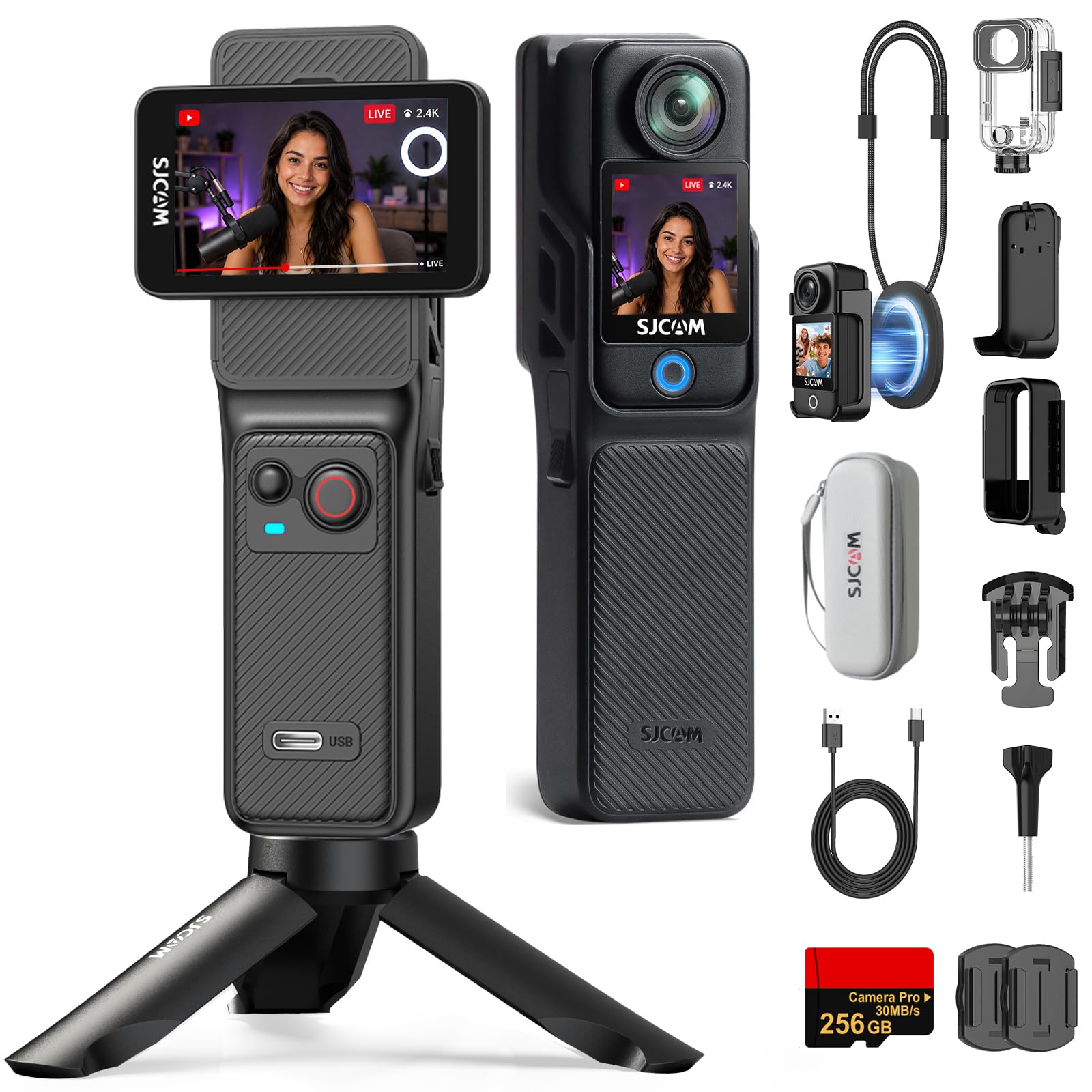
The SJCAM C400 is a compact action camera that records 4K UHD video at 30fps through a 154-degree wide-angle lens. The f/2.0 aperture improves low-light performance for an action cam, while the 6-axis Electronic Image Stabilization with horizon correction smooths out walking and bike vibration. The included 256GB card and carrying case make it a grab-and-go vlogging solution.
A 7-hour battery life on a single charge means full-day events without recharging. The 2.29-inch touchscreen provides intuitive menu navigation, and the 5G Wi-Fi module transfers files quickly to the companion app for editing. The camera is waterproof to 30 meters without an extra housing, which makes it functional for snorkeling, surfing, and rain conditions.
The C400 supports loop recording, slow motion, time-lapse, burst shooting, and pre-recording modes. Video quality at 4K is solid for the price but falls short of brand-name action cameras in color science and sharpness — the 2K mode actually looks cleaner in some comparisons. The wireless remote preview works up to 10 meters away, helping with framing in hard-to-reach positions.
Why it’s great
- 7-hour battery life covers full-day adventures
- 30-meter waterproof rating without external housing
- Includes 256GB card and carrying case
Good to know
- 4K video quality is softer than premium brand action cams
- Audio quality is usable but not studio-grade
9. DJI Mini 4K Drone with 3-Axis Gimbal

The DJI Mini 4K packs a 4K UHD camera with a 3-axis mechanical gimbal into a sub-250-gram frame, exempting it from FAA registration and Remote ID compliance for recreational use. The 3-axis gimbal provides buttery-smooth stabilization that contrasts sharply with electronic-only stabilization found on cheaper drones. The 31-minute maximum flight time per battery gives you roughly 20-25 minutes of real-world capturing time.
The camera is derived from the DJI Mini 2 sensor, so expect sharp 4K video with good dynamic range in golden-hour lighting. The 10-kilometer Ocusync 2.0 video transmission system keeps a clean feed even behind light tree cover. Four intelligent flight modes — Helix, Dronie, Rocket, Circle, and Boomerang — automate cinematic moves that would require a pilot license to execute manually.
The Mini 4K handles Level 5 winds (38 kph) thanks to its brushless motors, making it functional in breezy coastal or mountain conditions. GPS Return to Home triggers automatically at low battery or signal loss. The learning curve is gentle — beginners can achieve publishable aerial footage within a few flights. The main limitation is the single battery in the base kit — purchasing the Fly More Combo with extra batteries extends sessions dramatically.
Why it’s great
- 3-axis mechanical gimbal delivers pro-caliber aerial stabilization
- Weighs under 250g; no FAA registration required for recreational use
- Intelligent QuickShots automate complex flight maneuvers
Good to know
- Base kit includes only one battery; extra batteries recommended
- No obstacle avoidance sensors like on higher-end units
FAQ
Can a bargain camera actually outperform a modern smartphone camera?
What is the minimum autofocus system I should accept in a budget camera?
Why do most budget cameras lack 4K 60fps video?
Final Thoughts: The Verdict
For most users, the best bargain camera winner is the Canon EOS Rebel T7 DSLR Camera Kit because it combines a proven 24.1MP sensor, complete accessory bundle, and the largest lens ecosystem on the market at a price that leaves room for your first prime lens. If you want film simulations and compact size for everyday carry, grab the Fujifilm X-T30 III. And for pure vlogging and streaming versatility, nothing beats the Nikon Z 30 for its plug-and-play USB-C operation and reliable eye-tracking autofocus.

Mo Maruf
I created WellFizz to bridge the gap between vague wellness advice and actionable solutions. My mission is simple: to decode the research and give you practical tools you can actually use.
Beyond the data, I am a passionate traveler. I believe that stepping away from the screen to explore new environments is essential for mental clarity and physical vitality.