Our readers keep the lights on and my smoothie glass nicely filled. As an Amazon Associate, I earn from qualifying purchases.
After a cut or surgical incision, the real work begins — keeping the wound edges perfectly aligned so healing can proceed cleanly. Butterfly closures, adhesive strips, and transparent film dressings each handle this job differently, and picking the wrong one can mean re-opening a wound or dealing with stubborn adhesive residue.
I’m Mohammad Maruf — the founder and writer behind WellFizz. I spend my time reading adhesive polymer data sheets, comparing peel-strength ratings across medical-grade bands, and cross-referencing customer experiences on wound types from C-section scars to deep lacerations.
This article narrows the field to the five most reliable options for wound edge approximation. Whether you’re managing a post-surgical incision or a wilderness cut, here are the bandages for stitches that hold, breathe, and release without pulling your skin off.
How To Choose The Best Bandages For Stitches
Not every wound closure is designed for the same job. A butterfly strip works best for shallow cuts with straight edges, while a zip-stitch mechanism handles uneven tension better. Transparent film dressings protect sutured areas from water but do little to keep edges approximated — they are a secondary layer, not a primary closure. Match the closure type to your specific injury profile.
Adhesive Strength vs. Gentle Removal
Strong adhesion keeps the wound closed for days, but if the adhesive bonds across the entire wound surface, removal can pull sutures or disturb the healing edge. Look for closures where the adhesive sits on the skin around the incision, not directly on the wound line itself. Butterfly strips and zip-stitch designs typically have this “bridge” construction; transparent film dressings do not.
Size and Shape for Body Location
A closure that works on a forearm may fail on a knee joint or an abdomen. Joints need stretchable, conformable strips that move with flexion without peeling. Flatter areas can take longer, wider strips for more holding power. Check the dimensions of each product: ⅜-inch by 1-13/16-inch butterfly strips suit small cuts, while 4-inch by 4.75-inch film dressings cover large surgical incisions.
Moisture Management and Breathability
Trapped moisture slows epithelialization and increases infection risk. Breathable closures let the wound dry naturally while still protecting it from dirt. Zip-stitch designs with raised center bridges allow airflow under the closure. If you need waterproof protection for showering, use a transparent film dressing over the primary closure — never replace the primary closure with a non-breathable film.
Quick Comparison
On smaller screens, swipe sideways to see the full table.
| Model | Category | Best For | Key Spec | Amazon |
|---|---|---|---|---|
| SurviveX Zip Stitch 3-Pack | Zip Closure | Tension control on uneven cuts | Zip mechanism with release button | Amazon |
| Niceful Transparent Film 100-Count | Film Dressing | Waterproof coverage for sutures | 2.3-inch x 2.7-inch clear dressing | Amazon |
| MAGID American White Cross 100-Pack | Butterfly Strip | Small cuts and C-section seams | ⅜-inch x 1-13/16-inch adhesive strips | Amazon |
| Carbou Transparent Film 50-Count | Film Dressing | Large incisions and port covers | 4-inch x 4.75-inch waterproof patch | Amazon |
| Dotodo Wound Closure 4-Pack | Zip Closure | Emergency wilderness kits | Stretchable strip with snap-back | Amazon |
In‑Depth Reviews
1. SurviveX Zip Stitch Wound Closure Strips (3-Pack)

The SurviveX Zip Stitch differentiates itself with a physical zip mechanism that cinches wound edges together in all three dimensions — not just pulling laterally like a butterfly strip. A release button lets you dial in tension without over-tightening, which is critical on irregular cuts where one edge sits higher than the other. The raised cotton bridge in the center lifts off the wound, preventing the adhesive from sticking to the cut itself.
Users report 4-5 day wear time even on active individuals, with the plastic connectors holding firm through sweat and movement. The edges are soft cotton, so there is no abrasive tape digging into healthy skin. Removal is clean — the adhesive releases without leaving a sticky residue carpet, which matters when you are reapplying a fresh strip every few days during the healing window.
This kit only includes three units, so it is best reserved for emergencies or small cuts rather than large surgical incisions. At this tier, you are paying for the engineering of the zip-lock mechanism and the peace of mind that comes with adjustable tension. For hikers, campers, or anyone who works with sharp tools, this is the first thing you grab after cleaning the wound.
Why it’s great
- Adjustable tension via release button
- Raised bridge protects wound from adhesive
- Stays on 4-5 days without peeling
Good to know
- Only 3 strips per pack
- Not reusable after one application
2. Niceful 100 Count Transparent Film Dressing (2.3-inch x 2.7-inch)

The Niceful transparent film dressing is a waterproof secondary barrier designed to protect sutured wounds during showering, swimming, or exposure to contaminants. The polyurethane layer is ultra-thin — almost invisible on the skin — and allows oxygen exchange while blocking liquid ingress. Each dressing measures 2.3 inches by 2.7 inches, making it appropriate for small- to medium-sized incisions, IV sites, or dialysis ports.
Users highlight its adhesion on smooth skin and its ability to stay put for days without peeling at the edges. The latex-free construction reduces irritation for sensitive skin types, and removal typically leaves no sticky residue. A few reviews note that the adhesive covers the entire surface, so if you apply it directly over stitches without a gauge pad underneath, removal can pull on the suture material itself.
With 100 dressings in one box, this is the most cost-effective option for long-term wound care. Use it as a protective layer over butterfly strips or zip closures — never as a standalone closure for a gapping wound. For anyone managing a post-surgical incision or a catheter site that needs daily waterproofing, this bulk pack is a reliable staple.
Why it’s great
- Bulk 100-count lasts for weeks
- Waterproof and breathable simultaneously
- Latex-free and gentle on skin
Good to know
- Can stick to stitches if placed directly
- Not a primary closure for open wounds
3. MAGID American White Cross Butterfly Wound Closures (100-Pack)
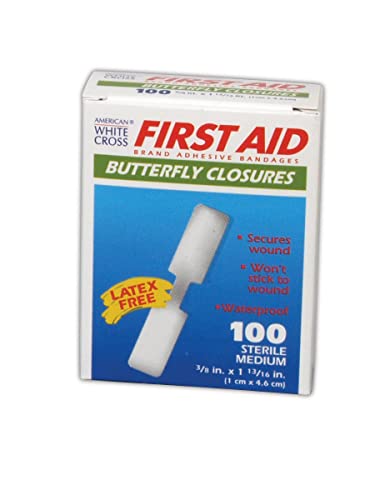
The American White Cross butterfly strips are the traditional paper-tape style closure that has been a first-aid mainstay for decades. Each strip is 3/8-inch wide by 1-13/16-inch long, designed to bridge small wound edges. The adhesive is aggressive — it holds cuts closed effectively and stays put through showers and daily activity, as confirmed by users who applied them to C-section scars and deep leg lacerations.
The strip’s non-woven backing breathes well, though the center section that sits directly over the wound can trap moisture, preventing scab formation if left on too long. Users recommend removing them after a day or two once the wound edges have fused. The flesh tone makes them discreet enough for visible body areas. Each 100-count box offers plenty of reserves for multiple injuries or long-term care.
For a simple, no-mechanism closure that relies on dead-reckoning adhesion, these butterfly strips deliver consistent results. They work best on clean, straight cuts where the edges meet naturally. If you need to bridge a gap or manage uneven tension, a zip mechanism will serve you better. At this quantity and build, they are the entry-level standard for any household first-aid kit.
Why it’s great
- Proven performance on surgical scars
- 100 strips for extended use
- Discreet flesh tone color
Good to know
- Center section can trap moisture
- Not designed for tension adjustment
4. Carbou Transparent Film Dressing (4-inch x 4.75-inch, 50-Pack)

The Carbou transparent film dressing offers the largest footprint in this lineup — 4 inches by 4.75 inches — making it the go-to choice for covering large incisions, dialysis catheters, or tattoo aftercare. The adhesive is a medical-grade polyurethane that sticks aggressively to smooth skin, providing a waterproof seal that holds through multiple showers. The pre-cut release paper makes single-handed application feasible.
Users with cancer patients and dialysis ports report using each dressing for two days before replacement, with no edge lifting. The 50-count box balances quantity against size, giving you enough to cover a large wound for several weeks. The film is breathable enough to prevent maceration, though users note that hairy skin significantly reduces adhesion — trimming around the area helps.
Like all transparent film dressings, this is a secondary barrier. Place a non-stick pad or primary closure underneath before sealing with the Carbou film. The large size is particularly useful for abdominal incisions where smaller dressings leave gaps. If your priority is total liquid protection over a broad area, this is the best fit in the group.
Why it’s great
- 4-inch by 4.75-inch coverage
- Holds through multiple showers
- Breathable polyurethane construction
Good to know
- Adhesion drops on hairy skin
- Not a standalone wound closure
5. Dotodo Emergency Wound Closure Kit (4-Pack)
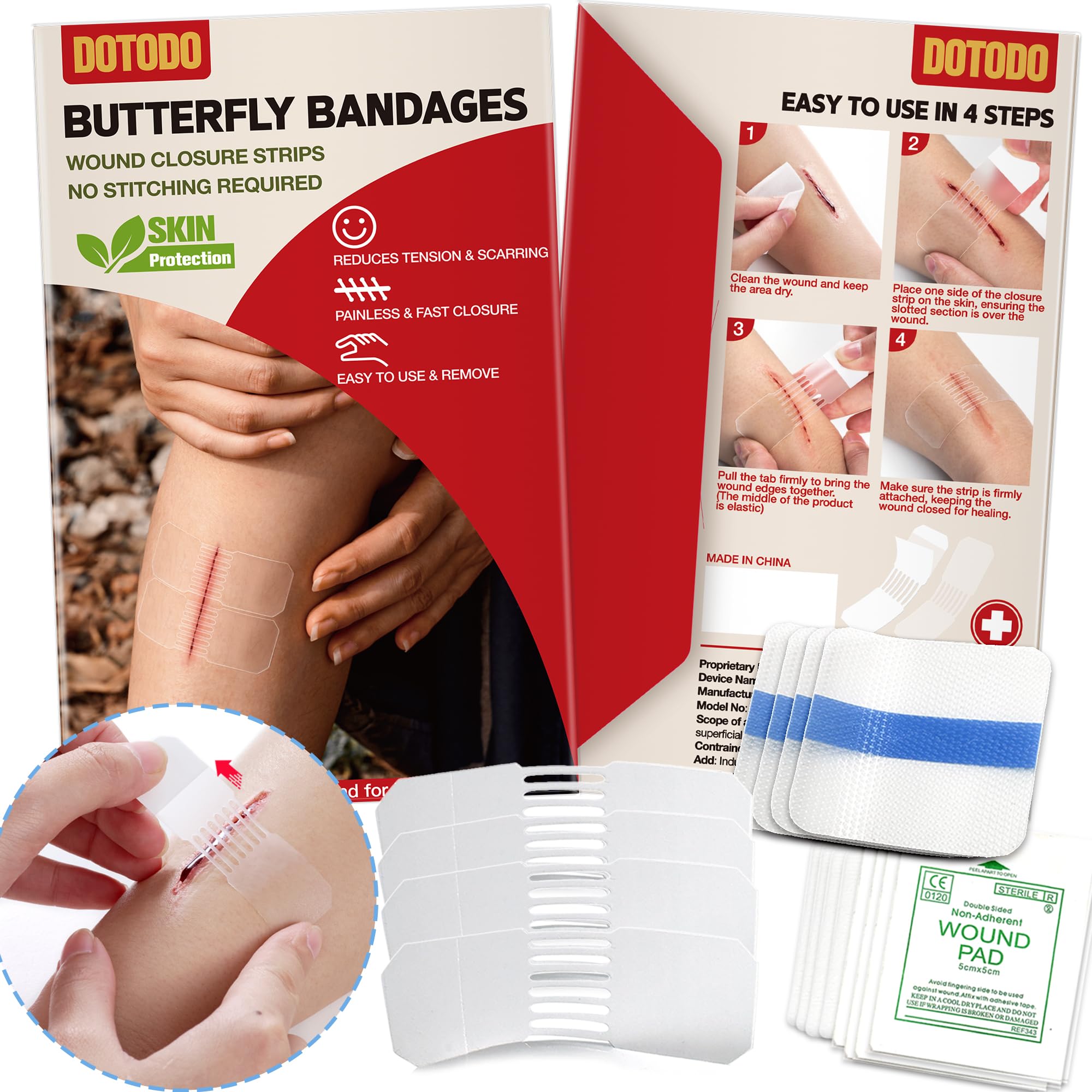
The Dotodo wound closure kit uses a stretchable, snap-back mechanism that delivers even tension across the wound line. Each closure is designed for one-handed application — peel the backing, stretch the strip over the wound, and let the material shrink back to hold the edges together. The kit also includes four waterproof dressing pads and four gauze pads for comprehensive wound management.
User feedback is strong for emergency scenarios where stitches are unavailable. One review describes closing a deep leg cut during COVID lockdowns that healed cleanly. Another user applied them post-surgery when sutures loosened, and the strips held despite being on a moving knee joint. The flexible material conforms better to curved body surfaces than rigid plastic mechanisms, and removal is straightforward with minimal adhesive residue.
The 4-pack size limits this to emergency use rather than ongoing care, but the inclusion of waterproof dressings and gauze pads adds real value for a wilderness first-aid kit. The stretch-and-release design is intuitive — no instructions needed in a stressful moment. This is the budget-conscious choice among the primary closures here, offering function parity with higher-priced zip systems at a lower entry point.
Why it’s great
- One-handed snap-back application
- Includes waterproof dressings and gauze
- Stretches well over joints
Good to know
- Only 4 closures per kit
- Not intended for deep gapping wounds
FAQ
Can I use butterfly closures on a deep wound that still bleeds?
How long should I leave a wound closure strip on?
Do transparent film dressings help heal the wound or just protect it?
Final Thoughts: The Verdict
For most users, the bandages for stitches winner is the SurviveX Zip Stitch 3-Pack because the adjustable zip mechanism delivers precise tension control that fixed adhesive strips cannot match, and the raised bridge prevents wound adhesion. If you want pure waterproof coverage for a large surgical incision, grab the Carbou Transparent Film 50-Pack. And for a budget-friendly emergency kit that fits in a hiking pack, nothing beats the Dotodo 4-Pack for one-handed snap-back application in stressful moments.

Mo Maruf
I created WellFizz to bridge the gap between vague wellness advice and actionable solutions. My mission is simple: to decode the research and give you practical tools you can actually use.
Beyond the data, I am a passionate traveler. I believe that stepping away from the screen to explore new environments is essential for mental clarity and physical vitality.