Our readers keep the lights on and my smoothie glass nicely filled. As an Amazon Associate, I earn from qualifying purchases.
Standing all day at a desk isn’t the magic fix for a sedentary lifestyle—it often just trades one set of aches for another. The real unlock for static standing is micro-movement, and that’s where a dedicated balance board comes in, forcing your ankles, knees, and hips to make constant tiny adjustments that fire stabilizing muscles and banish the energy-sapping stiffness of a rigid stance.
I’m Mohammad Maruf — the founder and writer behind WellFizz. I’ve spent the last five years dissecting ergonomic accessories, analyzing foam densities, wood-ply counts, and rocker geometries to separate products that actually deliver functional movement from those that are just nice-looking floor mats.
Whether you’re recovering from an injury, fighting plantar fasciitis, or simply trying to stay alert through a long workday, nailing the right balance board for standing desk comes down to understanding your personal stability needs and the specific movement pattern your body craves.
How To Choose The Best Balance Board For Standing Desk
Not every board belongs under a standing desk. The wrong choice can feel either terrifyingly unstable or so forgiving that it does nothing for your body. Here are the three specs that separate a good office board from a garage-sale gimmick.
Rocker vs. Wobble: Which Movement Pattern Fits Your Focus?
Rocker boards tilt along a single axis (forward/backward or side-to-side), offering a predictable, gentle sway that keeps your brain on spreadsheets instead of survival. Wobble boards with a hemispherical base rotate 360 degrees and demand constant, multi-directional balancing — great for a quick workout but disruptive during a video call. For all-day desk use, a rocker board or a board with adjustable stoppers (limiting the tilt range) is the smarter, safer call.
Surface Grip and Material Density
Your board’s top surface determines whether you can use it in socks or need shoes. Textured EVA foam or rubberized coatings provide grip without being abrasive, while raw wood surfaces can feel slippery. On the bottom, a non-skid pad or rubber base prevents the board from sliding on hardwood, tile, or low-pile carpet — a dealbreaker for both safety and concentration.
Weight Capacity and Durability Build
Thin, clip-together plastic boards flex and creak under sustained use. Look for models made from pressed birch plywood, Lauan hardwood, or solid bamboo with a published weight capacity near or above 300 pounds. The number of screws connecting the top to the base (on adjustable models) and the thickness of the rocker rails are direct indicators of whether this board will wobble quietly for years or start rattling within a month.
Quick Comparison
On smaller screens, swipe sideways to see the full table.
| Model | Category | Best For | Key Spec | Amazon |
|---|---|---|---|---|
| StrongTek Professional | Wood Wobble | All-day office stability | 350 lbs capacity, 17.5″ x 13.5″ deck | Amazon |
| PROIRON Upgraded | TPE Wobble | Portable beginner board | 330 lbs capacity, 16.34″ diameter | Amazon |
| Yes4All Foam Pad | Foam Rocker | Ultra-gentle, cushioned stance | 20″ x 13.9″, 2.25″ thick EVA foam | Amazon |
| Flycoop with Adjustable Stoppers | Wood Wobble | Progressive difficulty training | 330 lbs capacity, 15-layer pressed wood | Amazon |
| Theraband Rocker | Plastic Rocker | PT-prescribed single-axis rehab | 30° tilt angle, 14″ x 13.125″ deck | Amazon |
| Sportneer 7-Mode | Wood Wobble | Advanced athlete training | 450 lbs capacity, birch wood build | Amazon |
| Mobo Board | Bamboo Rocker | Foot/ankle rehab precision | 300 lbs capacity, Toe Box Technology | Amazon |
In‑Depth Reviews
1. StrongTek Professional Wooden Balance Board

The StrongTek board splits the difference between a challenging wobble trainer and a sensible office accessory better than any competitor in this field. Its cross-shaped base allows 360-degree tilt without the extreme pitch of a hemispherical ball, giving you multi-directional movement that stays manageable during focused work. The 17.5 by 13.5-inch Lauan hardwood deck offers enough room for a comfortable shoulder-width stance, and the non-slip surface holds securely whether you’re in dress shoes or barefoot.
What really sets this board apart is the 350-pound weight rating backed by solid plywood construction—not a hollow shell. Users report it surviving daily use for years without creaking or delaminating. The 3-inch height sits low enough to slide under most standing desks without lifting your knees awkwardly, and the compact footprint stores vertically against a wall when your shift ends.
A few owners note the adhesive on the corner edge protectors loosens over time, which is a minor nuisance but not a structural issue. If you want one board that works equally well for rehab calf stretches, active standing, and occasional squats without dominating your office footprint, this is the most balanced pick in the lineup.
Why it’s great
- Spacious deck fits wider stances without feet hanging off edges
- Dense Lauan wood holds up to years of daily rocking without flexing
- 360-degree rotation adds core engagement without being too aggressive
Good to know
- Corner pad adhesive may need re-gluing after extended use
- Requires practice to master full multidirectional tilt control
2. Sportneer Balance Board 7 Modes

The Sportneer is the most versatile board in this review, and its premium build quality justifies the higher investment for dedicated trainers and athletes. Crafted from high-quality birch wood, it supports an impressive 450 pounds, making it the strongest deck here. The real differentiator is the seven-mode system: you get a solid rubber ball for standard wobble, a roller for dynamic lateral slides, and four magnetic stoppers that snap into place to limit tilt range—letting you dial difficulty from beginner-safe to advanced-unstable.
The textured EVA surface delivers excellent grip even during sweat-inducing workouts, and the roller and ball won’t collect hair or scratch hardwood floors. At 30 inches long and 11.8 inches wide, the board is intentionally narrow to mimic a surfboard or snowboard profile, which feels natural for sport-specific training but may feel tight for pure office standing.
The magnetic rails are tool-free to reposition, but the half-circle fence pieces lack grip indentions, making them slightly tricky to pop out. This board shines brightest if you want a single platform that transitions from gentle desk fidgeting in the morning to intense balance circuits after work—but if your use case is strictly office-only, the narrower deck might feel restrictive.
Why it’s great
- 450-pound capacity exceeds all other boards in this roundup
- Seven difficulty modes with magnetic stoppers offer true progressive training
- Non-slip EVA surface grips securely in bare feet or athletic shoes
Good to know
- Narrow deck may feel cramped for broader stances during all-day standing
- Half-circle stoppers are hard to remove without a prying tool
3. Theraband 23300 Rocker Balance Board
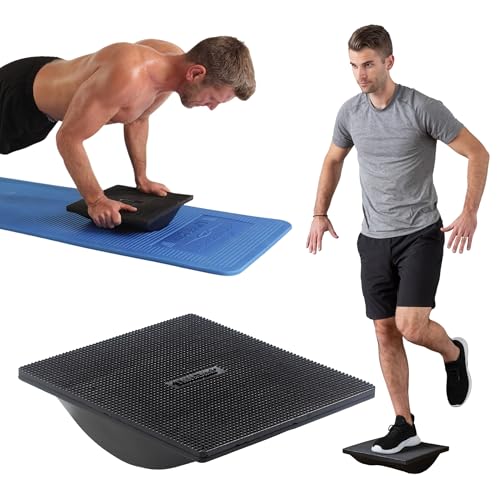
If your primary goal is rehabilitation—coming back from ankle surgery, knee replacement, or chronic plantar fasciitis—the Theraband Rocker is the clinical gold standard that cheaper boards try to copy. It rocks on a single plane (forward/back or side-to-side) rather than wobbling in all directions, which gives you controlled, predictable instability perfect for PT-prescribed exercise routines. The 30-degree angle of deflection is steep enough to challenge your proprioception but controlled enough that you won’t feel like you’re fighting for balance every second.
The black molded plastic deck is surprisingly durable and weighs only 3.5 pounds, making it the most portable option here. The tactile surface on top provides grip without being abrasive, and the anti-skid bottom holds firm on carpet and yoga mats alike. The attached exercise guide with 37 movements adds genuine value for users rehabbing at home without constant therapist supervision.
This board intentionally lacks 360-degree movement, which limits its appeal as an all-day standing desk tool—you won’t get the micro-movement variety of a wobble board. But for anyone whose doctor or physical therapist prescribed single-axis rocking, this is the only board on this list designed by a clinical rehabilitation brand, and that pedigree matters for insurance-mandated or post-surgery recovery.
Why it’s great
- Trusted clinical brand used by physical therapists for decades
- Lightweight and compact enough to toss into a gym bag or carry to the office
- Illustrated 37-exercise guide eliminates guesswork for rehab routines
Good to know
- Single-axis movement limits variety compared to multi-directional wobble boards
- Molded plastic deck may feel less premium against wooden competitors
4. PROIRON Upgraded Wobble Balance Board

The PROIRON balance board punches well above its price tier by combining a high-friction TPE (thermoplastic elastomer) base with a reinforced 12-screw connection system that eliminates the wobble-and-creak problem common in budget rotating boards. The spherical bottom allows a full 360-degree rotation with a tilt range up to 22 degrees, giving you serious balance challenge at a fraction of the cost of premium wood models. The 16.34-inch diameter is compact enough to tuck under standard standing desks without bumping your calves.
The bump-textured surface doubles as a mild foot massager during use, though several users note it can feel slippery in socks—you’ll want bare feet or grippy shoes for secure stance. The dual handles on the sides unlock additional exercises like push-ups and Russian twists, adding versatility that stationary rocker boards can’t match. At just 1.2 kilograms, it’s the lightest full-feature wobble board here, making it a strong pick for carrying between home and office.
The TPE base protects hardwood floors from scratches, but the material collects dust and hair more readily than smooth plastic or wood. The included exercise ball is smaller than on premium competitors, limiting some advanced progression moves. Still, for someone dipping their toes into wobble training for the first time without wanting to overspend, this is the most accessible entry point in the lineup.
Why it’s great
- 12-screw reinforced base prevents wobble-plate separation over time
- Dual handles unlock push-up and twist exercises beyond basic standing
- Textured bump surface provides gentle foot stimulation during extended use
Good to know
- Surface can feel slippery in socks without aggressive grip
- Smaller ball accessory limits advanced progression range
5. Yes4All Wobble Balance Board / Anti-Fatigue Foam Pad
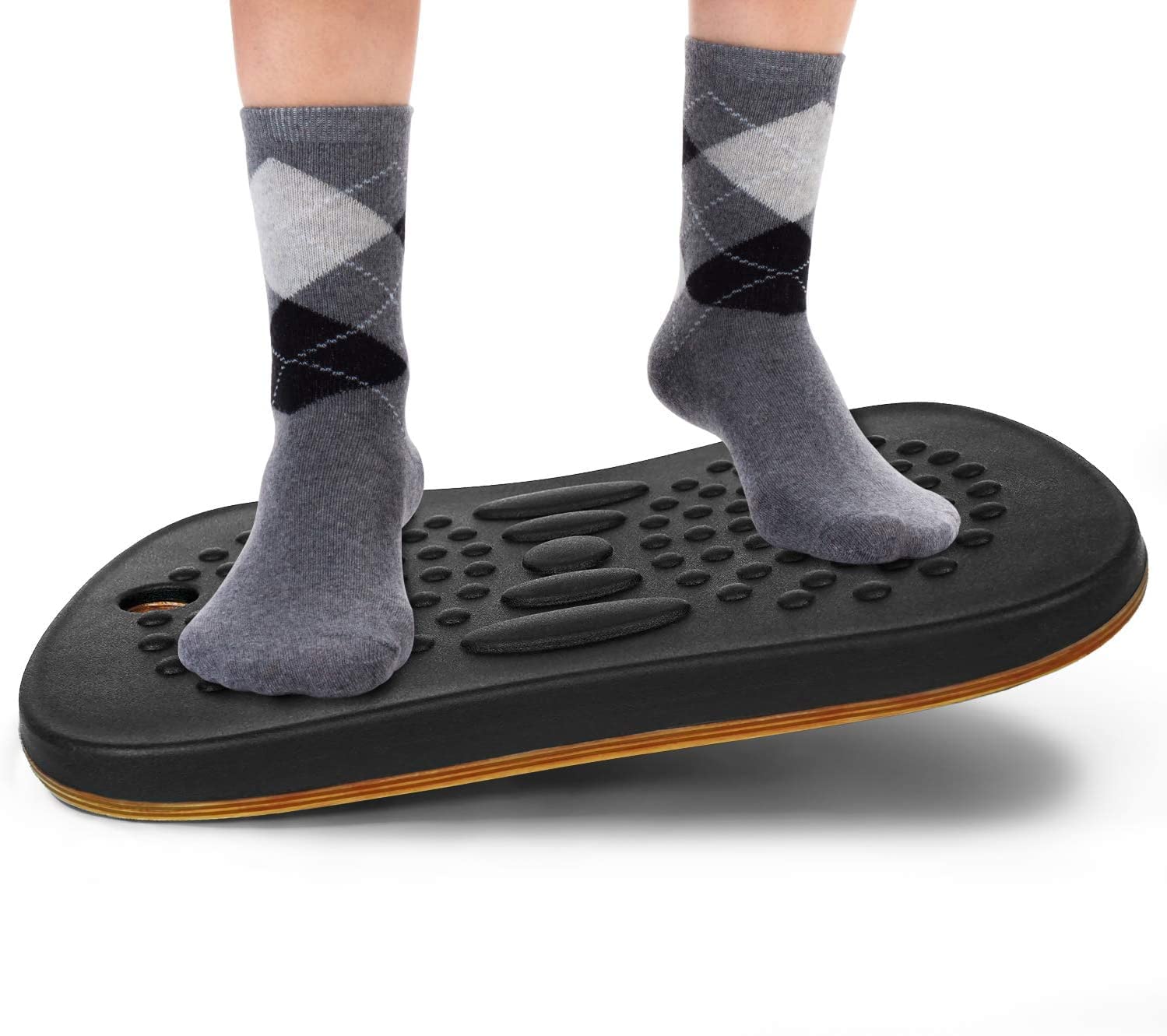
The Yes4All takes a fundamentally different approach than every other board here: instead of a hard platform on a rocker, it’s a thick slab of closed-cell EVA foam that sits directly on the floor. This design trades extreme tilt range for a cushioned, gentle instability that’s perfect for users with joint sensitivities or for those who want to stand for hours without the fatigue of a rigid wood board. The 20-inch length and 13.9-inch width give you a generous platform that accommodates larger feet without your toes hanging off the edge.
The textured pebbled surface provides reliable grip even in socks, and the 2.25-inch thickness offers enough compression to create a subtle wobble that keeps your ankles and hips engaged without distracting your brain from work. Because there’s no central rocker knob or hemispherical base, you can step on and off safely without catching your heel—a significant safety advantage in a busy office. The foam also absorbs sound, making it the quietest option for shared workspaces.
Experienced balance trainers may find the wobble too forgiving—it won’t deliver the sharp proprioceptive challenge of a wood wobble board. The foam also compresses permanently over months of daily use, so it won’t last as long as a wood or plastic alternative. But for a zero-learning-curve way to introduce micro-movement into your workday, especially if you have knee or back sensitivity, this is the most comfortable and accessible option on the list.
Why it’s great
- Cushioned foam surface reduces joint strain during all-day standing sessions
- Generous 20-inch platform accommodates larger feet without overhang
- Silent operation won’t distract coworkers or disrupt quiet office environments
Good to know
- Mild wobble may feel too easy for experienced balance trainers after a few weeks
- Foam material compresses over time, reducing lifespan compared to wood boards
6. Flycoop Balance Board with Adjustable Stoppers
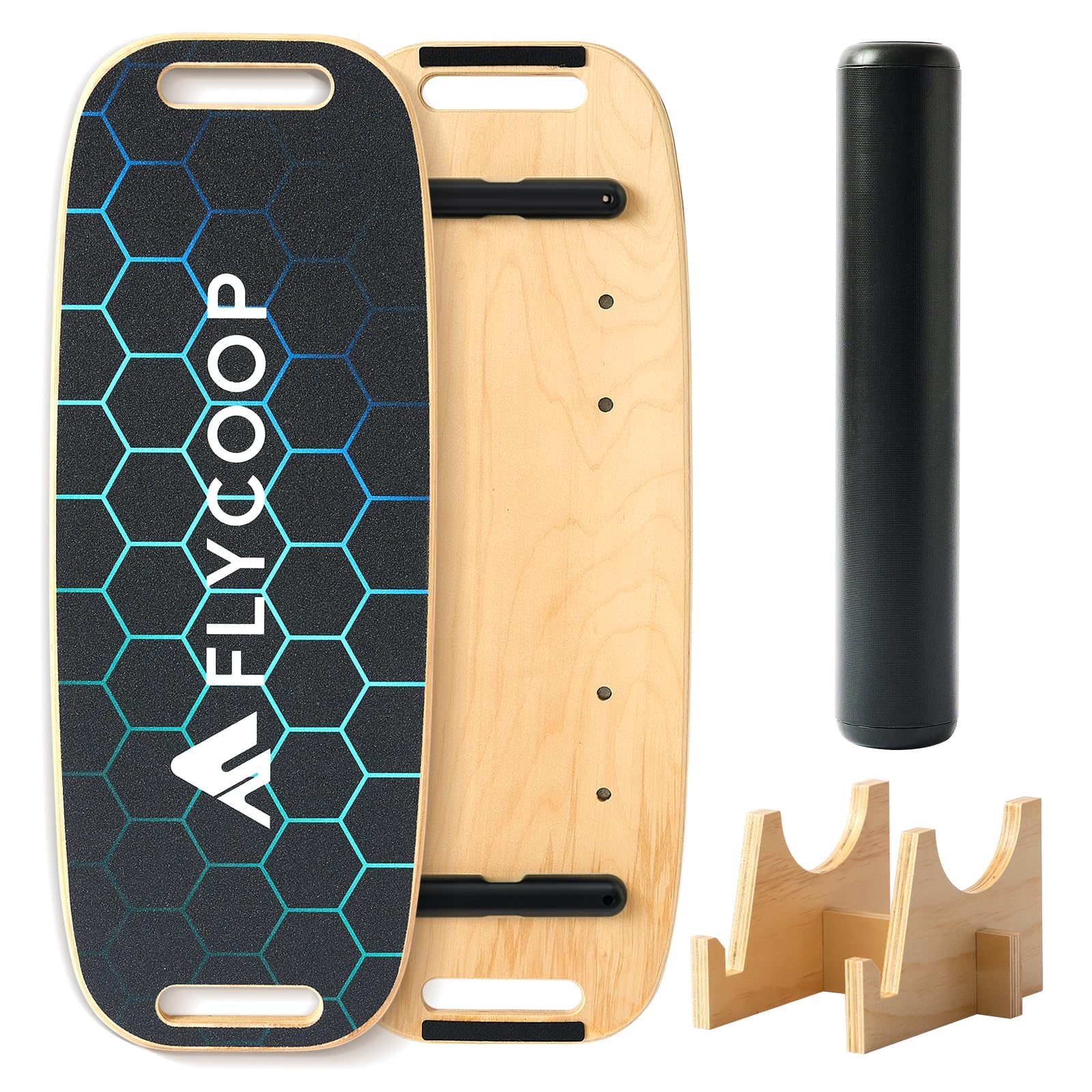
The Flycoop board stands out for its three-mode adjustable stoppers, which let you physically limit the tilt range from beginner-friendly to expert-level instability without swapping out components. Constructed from 15 layers of pressed wood and rated to support up to 330 pounds, this board has a reassuring density that absorbs movement without wobbling on its own axis. The top surface is coated with high-grit sandpaper that provides exceptional grip, rivaling skateboard deck traction for those who want zero foot slip.
The unique back design includes holes and magnetic brackets that allow you to attach resistance bands (not included) for dynamic pulling exercises, adding an entirely new dimension beyond static balance work. Two side holes double as handles for push-ups or band anchor points, making this board a genuine portable gym tool. Despite its heavy-duty build, it’s lighter than most wood wobble boards, making it realistically portable for travel or moving between rooms.
The sandpaper surface, while grippy, can be abrasive on bare feet or delicate shoe soles over long periods. Adjusting the stoppers requires bending down and re-seating magnetic brackets—not a quick on-the-fly change. This board delivers maximum versatility for the price, but the aggressive grip texture makes it better suited for short high-intensity sessions than all-day barefoot standing.
Why it’s great
- Three adjustable stopper positions allow instant difficulty progression without tools
- High-grip sandpaper surface eliminates any risk of foot slippage during dynamic moves
- Built-in holes and brackets support resistance band attachment for full-body workouts
Good to know
- Abrasive top surface is uncomfortable for extended barefoot use
- Magnetic stoppers require manual repositioning, not a quick in-use adjustment
7. Mobo Board

The Mobo Board is not a general-purpose wobble platform—it’s a precision foot-rehab tool designed by biomechanics expert Jay Dicharry that directly targets big-toe mobility and arch stability. Its unique Toe Box Technology features an anatomical cutout and rocker rails that force your toes to grip and articulate independently, addressing the root cause of many plantar fasciitis and knee-compensation issues. The natural bamboo construction is sustainably sourced and aesthetically beautiful, with precision-fit parts that assemble and break down flat for travel.
Users recovering from double knee replacements and chronic plantar fasciitis report dramatic improvements in balance and pain reduction within weeks, with one runner noting pain-free 16-mile runs after years of struggling past 14 miles. The board collapses completely flat, making it the most portable option here—you can slide it into a laptop bag or suitcase. The included exercise guide, written by Dicharry himself, targets specific foot-muscle weaknesses that generic wobble boards completely ignore.
The rocker rails lack sufficient grip on slick surfaces like polished hardwood or tile, requiring a yoga mat underneath for safety. And the price is undeniably high for a board that offers no multi-axis wobble or resistance band compatibility. But if your goal is to fix a specific foot or ankle dysfunction rather than general core engagement, the Mobo Board’s targeted anatomical design is unmatched in the market.
Why it’s great
- Anatomical toe cutout directly improves big-toe mobility and arch engagement
- Designed by a leading foot biomechanics expert with clinical exercise protocol
- Folds completely flat for effortless travel and storage in any bag
Good to know
- Rocker rails slip on smooth floors without a mat underneath
- Higher price and narrower use case than general-purpose wobble boards
FAQ
Can I use a balance board all day at my standing desk?
Should I choose a rocker board or a wobble board for the office?
Will a balance board help with plantar fasciitis or flat feet?
How do I clean and maintain my balance board?
Final Thoughts: The Verdict
For most users, the best balance board for standing desk winner is the StrongTek Professional because it nails the perfect middle ground between manageable office wobble and legitimate core training, supported by a durable hardwood deck that outlasts cheaper alternatives. If you want maximum difficulty progression and sport-specific training, grab the Sportneer 7-Mode. And for targeted foot or ankle rehab with a clinical pedigree, nothing beats the Mobo Board.

Mo Maruf
I created WellFizz to bridge the gap between vague wellness advice and actionable solutions. My mission is simple: to decode the research and give you practical tools you can actually use.
Beyond the data, I am a passionate traveler. I believe that stepping away from the screen to explore new environments is essential for mental clarity and physical vitality.