Our readers keep the lights on and my smoothie glass nicely filled. As an Amazon Associate, I earn from qualifying purchases.
A wobbly disc of wood or foam can feel intimidating when you first step onto it. Your ankles fire, your core tightens, and that slight sway is the exact signal your body needs to build stability. The right board for a beginner does not throw you into a full 360-degree tilt right away—it lets you find your center gradually.
I’m Mohammad Maruf — the founder and writer behind WellFizz. I research home fitness gear by analyzing material specs, weight capacities, and the progression path each product offers, so you know exactly what you’re stepping onto.
The market is crowded with options that range from simple rocker boards to multi-direction wobble platforms. This guide cuts through the noise to help you find the balance board for beginners that matches your strength level, rehab needs, and daily routine.
How To Choose The Best Balance Board For Beginners
A first balance board does not need to be expensive, but it does need to match your current stability level and your reason for training. Here are the core factors to consider before clicking buy.
Rocker vs. 360-Degree Wobble: Which motion suits you
A rocker board moves only forward-and-back or side-to-side. It is the most forgiving option for absolute beginners because you control the direction. A 360-degree wobble board tilts in every direction, engaging more stabilizer muscles from the start. If you are returning from an ankle injury, a rocker board gives you a safer reintroduction to movement. For core training and general balance, a 360-degree board accelerates progress faster.
Weight capacity and platform footprint
Most quality boards for adults support between 300 and 350 pounds. That range covers nearly all body types safely. Platform width matters just as much—a board under 15 inches in diameter can feel narrow for larger feet, while 17-inch long platforms accommodate men’s size 13 shoes without your toes hanging off the edge. Always check the length and width in the technical specs, not just the diameter.
Surface grip and floor protection
The top surface should have texture—either sandpaper-like PVC, rubberized foam, or carved grooves—to prevent your foot from sliding during micro-adjustments. The bottom of the board should include non-slip pads or EVA foam to protect hardwood floors and keep the board from skating away. Some models use adhesive rubber nubs that can peel off over time; check customer feedback for long-term durability on bottom traction.
Progression options within one board
Some boards now come with detachable side panels or interchangeable bases that let you switch from a gentle slant board to a full wobble platform. If you plan to use the board for both calf stretching and balance work, a modular design saves space and money. Beginners benefit most from a board that can grow with their skill level rather than forcing an upgrade after a few weeks.
Quick Comparison
On smaller screens, swipe sideways to see the full table.
| Model | Category | Best For | Key Spec | Amazon |
|---|---|---|---|---|
| StrongTek Wooden Balance Board | Progression Board | Beginners who want a next-level 360 challenge | 350 lbs capacity, 17.5×13.5 inch platform | Amazon |
| ProsourceFit Wooden Balance Board | 360-Degree Wobble | All-around balance and core training at home | 300 lbs capacity, 15.75 inch diameter | Amazon |
| 3-in-1 Slant Board & 180°/360° Balance Board | Calf Stretcher + Balance | Stretching tight calves while building balance | 300 lbs capacity, 11-ply poplar core | Amazon |
| Woodure Balance Board Professional | Entry Rocker Board | Basic side-to-side balance for seniors or rehab | 350 lbs capacity, 13.5×17 inch platform | Amazon |
| Vive Oval Balance Pad | Foam Stability Pad | Low-risk balance work for knee rehab or seniors | 300 lbs capacity, TPE foam construction | Amazon |
In‑Depth Reviews
1. StrongTek Wooden Balance Board

The StrongTek board bridges the gap between a simple rocker and a full round-base wobble board. Its cross-shaped base offers more floor contact than a traditional 360-degree board, which makes the multi-directional tilt feel controlled rather than chaotic. Beginners who are intimidated by a round dome underfoot will find this approachable.
Built from lauan hardwood plywood, the platform measures 17.5 inches long by 13.5 inches wide—room enough for size 13 shoes. The textured top surface grips well even during barefoot use, and the 350-pound weight capacity covers the vast majority of adult users. Non-slip pads on the bottom corners protect floors, though a few users report the adhesive could be stronger over time.
The board offers two difficulty options out of the box: a basic side-to-side rocker and a more advanced 360-degree wobble. This dual-mode design lets you build confidence on the simpler axis before stepping up to full rotation. For a beginner who wants room to grow without buying a second board, this is the smartest investment.
Why it’s great
- Dual-mode base allows gradual progression from rocker to full 360 wobble
- Large platform fits men’s size 13 shoes without overhang
- 350-pound capacity supports nearly all body types safely
Good to know
- Corner pad adhesive can loosen over time; some users re-glue them
- Requires a handhold like a counter to mount for absolute beginners
2. ProsourceFit Wooden Balance Board

The ProsourceFit board is a classic round wobble platform that has been a steady seller for years. Its 15.75-inch diameter sits right in the sweet spot for most adults—wide enough to feel stable underfoot but compact enough to tuck under a couch. The textured surface works well with shoes or bare feet, and the 300-pound rating is sufficient for the majority of home users.
Weighing roughly three pounds, this board is light enough to move between rooms or toss in a gym bag. The round base allows full 360-degree rotation, which challenges your core and ankle stabilizers in every plane of motion. It is not recommended for acute injury rehab, but for general fitness and standing desk use, it delivers consistent performance.
One note for hardwood floors: the board can skate slightly if you are not wearing shoes. A non-slip rug underneath solves this immediately. Users report the board holds up well even after a year of daily use, with no cracking or warping. If you want a no-fuss wobble board that does the job without extra parts, this one is a solid pick.
Why it’s great
- Lightweight and portable at only 3 pounds
- Durable construction holds up to daily use for over a year
- Affordable entry point for 360-degree balance training
Good to know
- Can slide on hardwood without a rug underneath
- Not designed for rehabilitation or high-risk balance cases
3. 3-in-1 Slant Board & Balance Board

This unit from ODCPN is three tools in one: a calf stretch slant board, a 180-degree rocker, and a 360-degree wobble board. The 11-ply AA-grade poplar core feels dense and solid at 4.5 pounds, with a 300-pound capacity. Its 6 angle settings range from a gentle 20-degree incline up to a steep 45 degrees, covering everyone from post-run stretchers to physical therapy patients.
The magnetic side panels snap on and off quickly, so switching between modes takes seconds rather than wrestling with screws. When folded flat, the board stores easily under a bed or behind a door. The PVC sandpaper top surface provides serious grip, even in socks, though the cut-through handles on both sides can create a slight gap sensation when standing sideways in bare feet.
For beginners dealing with plantar fasciitis, Achilles tightness, or ankle recovery, this board offers a gradual path from static stretching to dynamic balance work. A training poster is included with safe tips, which removes the guesswork for new users. If you want one piece of gear that handles both flexibility and stability, this is the most versatile option.
Why it’s great
- Converts between slant board, rocker, and wobble modes in seconds
- 6 incline angles allow progressive calf stretching
- Includes a training poster with proper form guidance
Good to know
- Cut-through handle grooves can feel odd when standing sideways in socks
- Lowest 20-degree incline may still feel steep for very tight muscles
4. Woodure Balance Board Professional

The Woodure board is a straightforward rocker board—it tilts forward and back or side to side, but does not offer full 360-degree rotation. This limitation is actually a feature for absolute beginners or seniors who need a controlled single-axis movement to rebuild confidence. The 13.5 x 17 inch platform provides a stable base, and the 350-pound weight capacity is generous for this price tier.
Assembly is required, but the pre-drilled holes make it a five-minute job with your own screwdriver. The anti-slip surface feels secure underfoot, and the bottom pads protect floors from scratches. Users recovering from vestibular issues or mild balance problems report noticeable improvement after a few weeks of daily use.
The main trade-off is the limited tilt angle. More athletic users or those with decent baseline balance may find the rocker motion too easy after a short time. The listing does not specify the exact tilt degree, which makes it hard to judge progression. For a gentle reintroduction to balance work, this board works as intended.
Why it’s great
- Controlled single-axis rocker ideal for seniors and rehab beginners
- High 350-pound capacity without sacrificing portability
- Simple assembly with pre-drilled screw holes
Good to know
- Tilt angle may not be challenging enough for users with existing balance
- Listing does not specify the exact pitch degree
5. Vive Oval Balance Pad
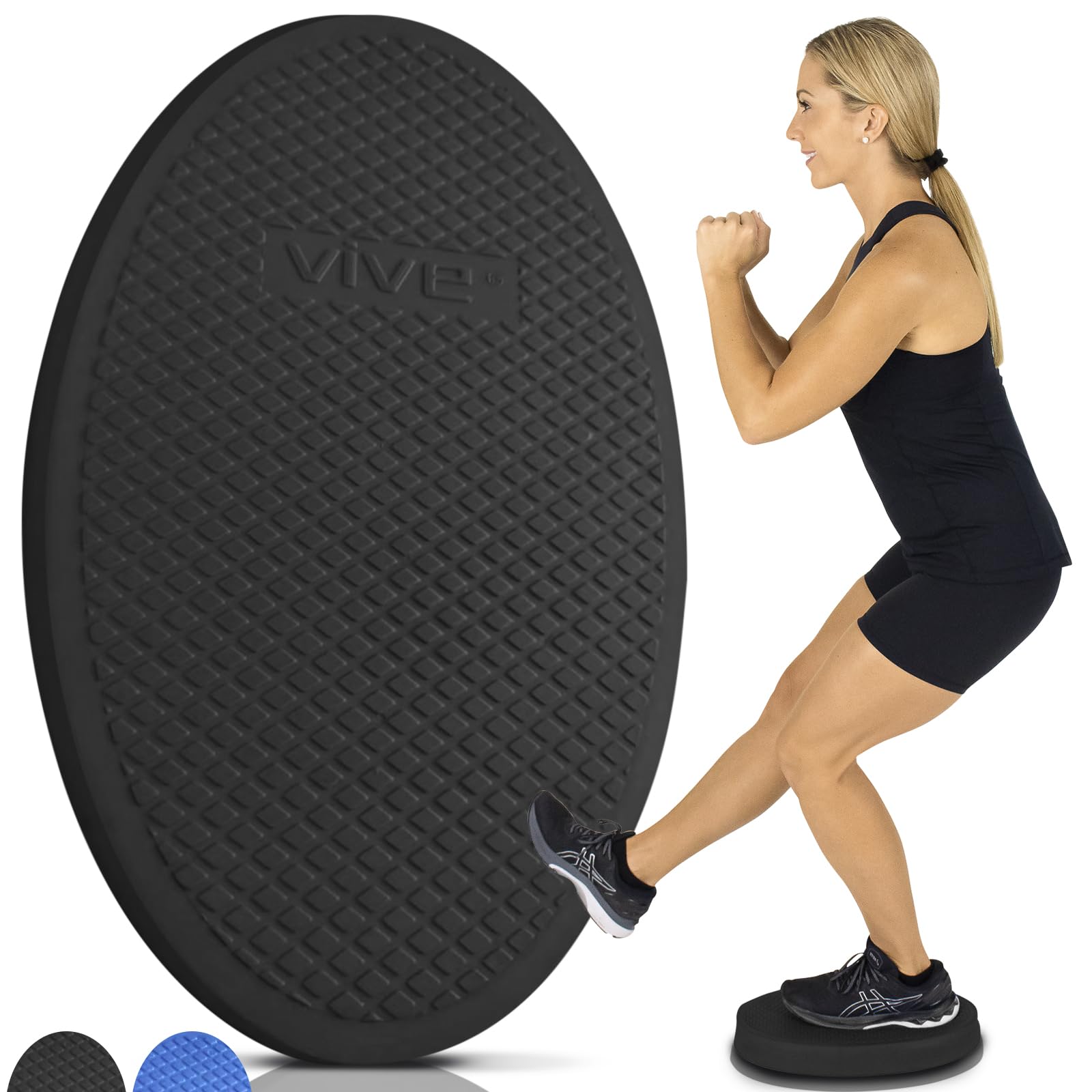
The Vive balance pad takes a completely different approach—instead of a hard wooden platform, it uses a dense TPE foam cushion that creates instability through compression rather than tilt. This makes it the safest option for absolute beginners, seniors, or anyone returning from knee or hip surgery who cannot risk a hard fall. The foam is firm enough to challenge your stabilizers but soft enough to absorb a misstep.
Unlike inflatable balance discs, this pad does not lose air or develop leaks over time. It weighs very little and rolls up for storage or travel. The oval shape gives you a clear front-to-back orientation, which helps during single-leg stabilization exercises. Users with knee pain from arthritis or post-PT protocols find the forgiving surface comfortable for daily two-minute sessions.
The trade-off is that the instability level is capped—you cannot make the pad more challenging as you improve. Once you master standing on one leg for a full minute, you will need a wooden board to continue progressing. For the first few weeks of balance training or as a low-risk supplement to standing desk work, this pad is a smart starting point.
Why it’s great
- Foam construction is safer for seniors and post-surgery recovery
- More durable than inflatable discs with no air loss over time
- Lightweight and portable for easy carrying between rooms
Good to know
- Limited progression ceiling once basic balance is mastered
- Firmer than physical therapy pads found in a clinic setting
FAQ
How long should a beginner use a balance board each day?
Can a balance board help with ankle sprain recovery?
Should I use a balance board at a standing desk?
Final Thoughts: The Verdict
For most users, the balance board for beginners winner is the StrongTek Wooden Balance Board because it offers a controlled 360-degree wobble that beginners can grow into without buying a second board. If you want a calf stretcher that also builds balance, grab the 3-in-1 Slant Board. And for seniors or post-surgery rehab where safety is the top priority, nothing beats the forgiving foam of the Vive Oval Balance Pad.

Mo Maruf
I created WellFizz to bridge the gap between vague wellness advice and actionable solutions. My mission is simple: to decode the research and give you practical tools you can actually use.
Beyond the data, I am a passionate traveler. I believe that stepping away from the screen to explore new environments is essential for mental clarity and physical vitality.