Our readers keep the lights on and my smoothie glass nicely filled. As an Amazon Associate, I earn from qualifying purchases.
A toddler’s first bike shouldn’t wobble, weigh a ton, or scare them before they even sit on it. The wrong balance bike—with a high frame, hard seat, or fixed geometry—can turn a fun milestone into a frustrating struggle for both parent and child. The best models solve this with ultra-low step-through frames, adjustable seat heights measured in inches (not general age recommendations), and tires that grip indoor floors without leaving rubber marks.
I’m Mohammad Maruf — the founder and writer behind WellFizz. I’ve analyzed the geometry, material specs, and real-world feedback on dozens of balance bike models to find which ones actually deliver on their promise of building early coordination and confidence.
This guide breaks down seven contenders with specific detail on frame materials, wheel types, seat post ranges, and safety features so you can confidently choose the right balance bike for kids.
How To Choose The Best Balance Bike For Kids
Choosing a balance bike involves more than picking a color. The right geometry lets a toddler stand flat-footed with slightly bent knees, a position that builds the confidence to push and glide. Focus on these three factors to narrow your search.
Seat Height Adjustability is the King Spec
Ignore the “ages 2-5” label and look at the minimum seat height. A bike with a seat that drops to 11 inches fits an 18-month-old with a 12-inch inseam, while a minimum of 14 inches makes the same bike useless for a younger toddler. Look for a range of at least 3.5 inches so the bike grows with the child over 2-3 years.
Frame Weight and Material Trade-offs
Aluminum frames hover around 3.5-6.5 lbs and resist rust, while steel models weigh 7-10 lbs but offer more durability against rough drops. A heavier bike (over 8 lbs) can frustrate a 2-year-old who needs to pick it up after a tip-over. For smaller toddlers, lighter is almost always better.
Wheel Material Defines the Ride
EVA foam wheels are puncture-proof, quiet, and work well indoors without marking floors. Solid rubber tires offer more grip on pavement but add weight. Pneumatic tires provide the smoothest ride over bumps but require air pumps and can go flat. For mostly indoor or sidewalk use, EVA wheels are the low-maintenance winner.
Quick Comparison
On smaller screens, swipe sideways to see the full table.
| Model | Category | Best For | Key Spec | Amazon |
|---|---|---|---|---|
| Retrospec Cub | Premium | Indoor/outdoor all-terrain durability | Seat range 11-14.5 in | Amazon |
| Banana Bike LT | Mid-Range | Lightweight beginner for 2-year-olds | Frame weight 6.4 lbs | Amazon |
| Radio Flyer Steady Start | Premium | Super stable 3-wheel design for new walkers | 3-wheel config | Amazon |
| KRIDDO Mini Cruiser | Premium | First birthday gift for 1-year-olds | 3.6 in wide PU wheels | Amazon |
| Gotrax KS12 | Mid-Range | Older toddlers (3-5) needing LED fun | Seat range 16.5-18.3 in | Amazon |
| Bobike | Budget | Budget-friendly cruiser for 2-4 year olds | Carbon steel frame | Amazon |
| SEREED Colorful Lighting | Budget | Lightweight first bike for 12-24 month olds | Frame weight 3.6 lbs | Amazon |
In‑Depth Reviews
1. Retrospec Cub Toddler Balance Bike

The Retrospec Cub nails the most important spec for a toddler balance bike: a seat that adjusts from 11 to 14.5 inches. That low 11-inch minimum means an 18-month-old with a short inseam can stand flat-footed, while the tall end stretches to fit a kid approaching pedal-bike age. The airless, puncture-proof tires eliminate the flat-tire headache entirely, and the low-step frame makes mounting and dismounting feel natural for small riders.
At roughly 10 pounds, the Cub sits at the heavier end for a balance bike, but the steel frame absorbs rough treatment from drops and bangs without bending. The quick-release handlebar clamp and seat post Allen bolt let you adjust height in seconds without tools. Rounded edges and non-slip grips add a layer of safety that’s reassuring for first-time riders.
Parents report the bike holds up well after a year of daily use, with the solid wheels maintaining their shape on pavement and grass alike. The lack of a brake simplifies the learning curve—kids stop by putting their feet down. For anyone wanting a single bike that spans the widest age range without sacrificing build quality, this is the pick.
Why it’s great
- Widest seat range (11-14.5 in) fits the longest growth window
- Puncture-proof tires mean zero maintenance
- Durable steel frame survives years of drops
Good to know
- Heavier than aluminum competitors at 10 lbs
- No brake model requires feet-down stopping
2. banana bike LT Balance Bike

The banana bike LT shaves weight down to 6.4 pounds, making it one of the lightest aluminum-frame balance bikes available. That low mass matters enormously for a 2-year-old who needs to steer, lift, and carry the bike after every tip-over. The distinctive “banana” curved frame lowers the center of gravity, which helps the child step through easily without catching a foot on a top tube.
The seat adjusts from 12.2 to 15.7 inches via a quick-release clamp, and the handlebar height follows suit. The 11-inch EVA wheels roll smoothly over hardwood and concrete without leaving scuffs. Parents report that toddlers progress from tentative walking to confident gliding within a few weeks on this bike, largely because they can handle the weight unassisted.
Some users note the steering can feel slightly gritty straight out of the box, and the axle threading isn’t the tightest fit for the wheel bearings. For the weight savings and price point compared to a Strider, though, these are minor compromises. If your priority is a bike your child can actually manage on their own, this is the front-runner.
Why it’s great
- Extremely lightweight at 6.4 lbs, ideal for small toddlers
- Low banana frame makes step-through mounting easy
- Quick-release seat clamp enables fast height changes
Good to know
- Steering can feel slightly gritty out of box
- Axle bearings not the most precise fit
3. Radio Flyer Steady Start Balance Bike

Radio Flyer takes a different approach with a wide front wheel and dual rear wheels that give the bike a three-point stance. It stands on its own without a kickstand—no falling over when a toddler parks it mid-play. This extra stability is a game-changer for 1-year-olds who are still wobbly on their feet, as the bike won’t tip sideways during mounting or dismounting.
The treaded wheels are wide and quiet, rolling smoothly over hardwood, carpet, and cement without that loud plastic-on-floor noise. The padded seat adjusts tool-free, and the comfort grips fit small hands well. At 7 pounds, it’s not the lightest, but the stability trade-off is worth it for the youngest riders who need maximum confidence.
Some parents note the three-wheel design limits tight turning radius compared to two-wheelers, and the maximum weight of 42 pounds means it’s outgrown sooner. For a first bike for a 1-2 year old, though, the stability advantage is unmatched. It’s a transition tool that builds balance before they move to a two-wheeler.
Why it’s great
- Three-wheel design eliminates tipping worries entirely
- Tool-free adjustable seat grows with child
- Wide, quiet wheels work on all indoor surfaces
Good to know
- Limited turning radius compared to two-wheelers
- 42 lb max weight means shorter lifespan
4. KRIDDO Mini Cruiser Balance Bike

The KRIDDO Mini Cruiser is purpose-built for the youngest riders, with a recommended age of 12 months to 2.5 years. Its defining feature is the 3.6-inch wide PU rear wheel, which provides a broad contact patch that resists tipping even when the child leans off-center. The eco-friendly TPR handlebar grips shaped like animal ears give tiny hands a soft, easy-to-hold surface that encourages fine motor control.
The carbon steel frame and fully widened TPU back wheel create a low center of gravity that feels planted. Parents report the bike stands upright when parked, thanks to the wide rear wheel base, and the seat and handlebars extend as the child grows. The BPA-free materials and compliance with American toy standards add peace of mind for safety-conscious buyers.
Several customers note the bike runs slightly taller than some competitors, so a true 12-month-old with a very short inseam may struggle to touch the ground flat-footed. For children around 18 months and up, though, the stability and build quality make it a standout first-birthday gift that gets used daily without breaking down.
Why it’s great
- Wide 3.6 in rear PU wheel provides exceptional stability
- BPA-free, eco-friendly materials meet safety standards
- Animal-ear grips are perfect for tiny hands
Good to know
- Runs slightly tall for 12-month-olds
- Not suitable for children over 2.5 years
5. Gotrax KS12 Balance Bike
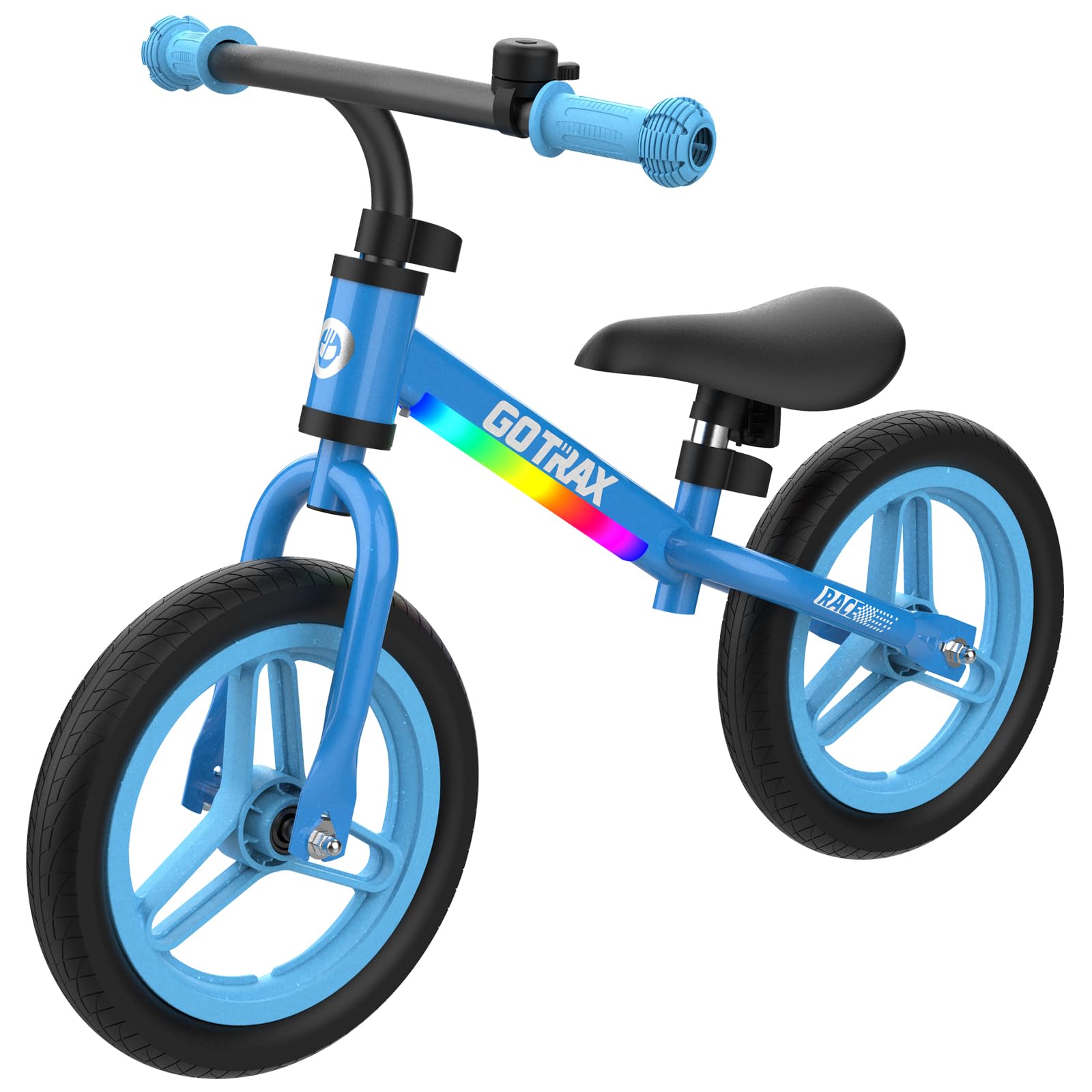
The Gotrax KS12 targets the older toddler range with a seat height adjustable from 16.5 to 18.3 inches and a handlebar that goes up to 26 inches. That geometry suits 3-to-5-year-olds who have outgrown smaller balance bikes but aren’t ready for pedals. The built-in LED wheels light up when spinning, adding a visual reward that keeps kids engaged during practice sessions.
Thicker seat cushioning and silicone handlebar grips improve comfort for longer rides, and the integrated bell gives kids a sound cue to announce themselves. The 12-inch EVA wheels are flat-free and handle asphalt, concrete, and packed dirt without issue. At 8.6 pounds, the iron frame is heavier than aluminum models, but the higher weight capacity of 110 pounds means this bike can serve a child for multiple years.
A few customers point out that the Amazon listing states ages 2-5 while the included paperwork says 3+. The seat at its lowest setting is roughly 16.5 inches, which may be too tall for a 25-month-old child. For parents of older toddlers, though, the LED lights, bell, and adjustable ergonomics make this a high-engagement training tool.
Why it’s great
- LED wheels add excitement and encourage longer practice
- Thicker padded seat and silicone grips improve comfort
- Wide height adjustment fits 3-5 year olds well
Good to know
- Min seat height of 16.5 in is too tall for most 2-year-olds
- Iron frame makes it heavier at 8.6 lbs
6. Bobike Toddler Balance Bike

The Bobike uses a carbon steel frame that offers durability at a lower price point than aluminum options. The adjustable seat and handlebar accommodate toddlers up to 40 pounds, and the enclosed non-slip wheels prevent foot injuries during aggressive scooting. The 135-degree steering limit reduces the chance of sharp turns that cause tip-overs—a smart safety feature for beginners.
Assembly takes a few minutes with basic tools, and the classic bike styling with a vintage color palette appeals to parents who want a traditional look. The coaster brake gives older toddlers a way to stop without dragging their feet, which can be a helpful transition skill before moving to a pedal bike with hand brakes.
Buyers should be aware that the “Bobike” brand on Amazon is listed by a Chinese seller, not the Dutch Bobike company. Customer service responsiveness varies, and one reviewer noted a misleading seller description. The bike itself is well-regarded for its sturdiness and value, but check the seller details before ordering to avoid confusion.
Why it’s great
- Carbon steel frame is sturdy and budget-friendly
- 135° steering limiter prevents dangerous sharp turns
- Coaster brake introduces stopping skills early
Good to know
- Seller is a Chinese company, not the Dutch Bobike brand
- Assembly requires some effort with included tools
7. SEREED Colorful Lighting Baby Balance Bike

At just 3.6 pounds, the SEREED is the lightest balance bike in this lineup by a wide margin. The aluminum alloy frame makes it easy for a 12-month-old to maneuver, and the colorful lighting wheels (no batteries required—they spin to glow) add a visual hook that delights toddlers. The fully enclosed wheel design prevents any foot or toe from slipping into the spokes, and the 135-degree steering limiter keeps the bike stable.
The EVA wheels are silent and non-destructive on hardwood floors, making this an excellent indoor-first bike. Assembly requires no tools at all and takes about one minute. The non-slip TPU handles and softly cushioned seat keep the ride comfortable for short sessions. Parents consistently report that kids start scooting almost immediately because the bike is so light to push.
The seat is not adjustable, which limits the growth window. At 3.6 pounds, the bike is best suited for 12-to-24-month-olds who need maximum lightness. Older toddlers will quickly outgrow the fixed geometry. For families who want a no-fuss, ultra-light first bike with a fun lighting feature, this is a solid entry-level choice.
Why it’s great
- Ultra-light at 3.6 lbs, perfect for the youngest riders
- No-tool assembly in under 60 seconds
- Spoke-less glowing wheels are safe and engaging
Good to know
- Seat is not adjustable, limiting growth range
- Best for indoor use only; EVA wheels slip on wet grass
FAQ
Is a balance bike better than training wheels for learning to ride?
What inseam measurement does my child need to fit a balance bike?
Final Thoughts: The Verdict
For most users, the balance bike for kids winner is the Retrospec Cub because its 11-to-14.5-inch seat range fits the widest age span and its puncture-proof tires eliminate maintenance worries. If you want an ultra-light model for a 2-year-old just starting out, grab the banana bike LT at 6.4 pounds. And for a first bike for a 1-year-old who needs maximum stability, nothing beats the Radio Flyer Steady Start with its trike-like three-wheel stance.

Mo Maruf
I created WellFizz to bridge the gap between vague wellness advice and actionable solutions. My mission is simple: to decode the research and give you practical tools you can actually use.
Beyond the data, I am a passionate traveler. I believe that stepping away from the screen to explore new environments is essential for mental clarity and physical vitality.