Our readers keep the lights on and my smoothie glass nicely filled. As an Amazon Associate, I earn from qualifying purchases.
At two years old, a child’s center of gravity is shifting, their stride is quickening, and their world is begging for motion. A balance bike strips away the complexity of pedals and training wheels, letting a toddler focus on the single skill that matters most: keeping upright while moving. The wrong bike—too heavy, too tall, or with cheap bearings—can make that first glide a battle rather than a breakthrough.
I’m Mohammad Maruf — the founder and writer behind WellFizz. I’ve spent years analyzing market data and consumer reviews on toddler mobility products, focusing specifically on how frame geometry, wheel materials, and adjustability affect a two-year-old’s learning curve.
The goal of this guide is to help you cut through the noise and identify the best balance bike for 2 year old that will build confidence, not frustration, from that first tentative push.
How To Choose The Best Balance Bike For 2 Year Old
Selecting the right balance bike for a two-year-old requires more than just picking the cutest color. At this age, a child’s inseam is typically between 12 and 16 inches, and their upper body strength is still developing. A bike that is too large or too heavy will prevent them from building the confidence they need to glide.
Seat Height and Adjustability
For a two-year-old, the bike seat must be low enough that they can place both feet flat on the ground with a slight bend in their knees. The bottom of the seat should ideally sit at or just below the child’s inseam. Look for a bike with a minimum seat height of around 11 to 12 inches. A tool-free quick-release clamp is a major convenience, as you will be adjusting the height frequently as your child grows. A wide adjustment range, from about 11 inches up to 18 inches, ensures the bike lasts through the age of 4 or 5.
Weight and Frame Material
A toddler cannot safely or confidently control a bike that weighs more than about 30% of their body weight. For the average 2-year-old (roughly 25 to 30 pounds), the bike should weigh no more than 9 to 10 pounds. Carbon steel frames are durable and affordable but are on the heavier side. Aluminum frames offer a significant weight advantage, often shaving off 2 to 3 pounds, which makes a world of difference for a small child trying to pick up and turn the bike.
Tire Type and Terrain
This decision comes down to maintenance versus traction. Airless, puncture-proof tires (EVA foam or solid rubber) are maintenance-free and work well on pavement, hardwood floors, and packed dirt. They never go flat and provide a smooth ride. Air-inflated rubber tires offer superior grip and shock absorption on grass, gravel, and uneven trails, but they require occasional inflation and are susceptible to punctures. For a 2-year-old just starting out, low-maintenance puncture-proof tires are the safer and more practical choice.
Safety Features
Two safety features are non-negotiable for this age group. The first is a steering limiter, which prevents the handlebars from turning a full 360 degrees. This stops the dreaded “jackknife” fall when a toddler yanks the bars too hard. The second is a footrest — a small platform or peg welded to the frame behind the seat — where the child can rest their feet once they start gliding. Without a footrest, they tend to drag their feet or tuck them up, which can throw off their balance.
Quick Comparison
On smaller screens, swipe sideways to see the full table.
| Model | Category | Best For | Key Spec | Amazon |
|---|---|---|---|---|
| Retrospec Cub | Premium | Lightest Build For Small Toddlers | Seat Range 11–14.5″ | Amazon |
| Radio Flyer Steady Start | Premium | Ultimate Stability For Beginners | 3-Wheel Design | Amazon |
| banana bike LT | Premium | Ultra-Lightweight Aluminum Frame | Weight 6.4 lbs | Amazon |
| Gotrax KS12 | Mid-Range | LED Fun & Lightweight Ride | Bike Weight 8.6 lbs | Amazon |
| Bobike | Mid-Range | Budget-Friendly Vintage Style | 135° Steering Limit | Amazon |
| KRIDDO | Value | Customizable Plates On A Budget | Seat Range 14.17–18.5″ | Amazon |
| RIDYEE | Value | Motocross Styling & Storage | Seat Range 13.4–15.8″ | Amazon |
In‑Depth Reviews
1. Retrospec Cub Toddler Balance Bike

At the top of the list, the Retrospec Cub nails the most important spec for a 2-year-old: the seat height starts at just 11 inches. This means even a petite toddler with a 12-inch inseam can stand flat-footed with a bend in the knee, which is the foundational posture for learning to glide. The 12-inch puncture-proof tires eliminate the worry of flats, and the low-slung alloy steel frame keeps the center of gravity low for natural stability.
The quick-release seat clamp makes tool-free adjustments a reality, so you can raise the seat as your child grows up to the 14.5-inch max. The 10-pound weight is reasonable for this tier, and the bike includes a footrest, which is a crucial detail that many budget models omit. Parents report that the bike survived a full year of drops, dragging, and weather exposure without any structural issues.
Where the Cub falls short is its lack of a steering limiter. A two-year-old’s enthusiastic yank on the handlebars can still result in a face-plant if they turn too sharply. The bike also lacks a brake, but that is standard for this age group—they stop with their feet. For the combination of low seat height, durability, and airless tires, this is a top-tier investment.
Why it’s great
- Lowest seat height (11″) fits smaller toddlers perfectly
- Puncture-proof tires require zero maintenance
- Durable alloy steel frame withstood a year of abuse
- Includes a footrest for proper gliding posture
Good to know
- No steering limiter to prevent sharp turns
- No brake; child stops with feet only
- Seat maxes out at 14.5″, less growing room
2. Radio Flyer Steady Start Balance Bike

Radio Flyer re-engineered the balance bike concept for absolute beginners with the Steady Start. Instead of a traditional two-wheel layout, it uses a wide front wheel and dual rear wheels that create a stable tripod stance. This means the bike stands upright on its own without a kickstand, and a hesitant toddler can mount and dismount without tipping. It is the single best option for a child who is still wobbly on their feet.
The tool-free adjustable padded seat and comfort grips are sized for ages 1 to 3, and the treaded wheels deliver a quiet ride across hardwood floors, carpet, and pavement. The 7-pound weight is lighter than most two-wheel models, making it easy for a child to steer and lift. The alloy steel frame is wrapped in classic red, and the brand’s century-long reputation for durability is evident in the welds and finish.
The trade-off is that the three-wheel configuration makes this bike wider and less maneuverable in tight spaces than a traditional balance bike. It also lacks a footrest, so kids tend to drag their feet as they scoot, which can slow momentum. Once a child gains confidence and wants to lean into turns, they may outgrow this design’s learning curve and need a two-wheel upgrade.
Why it’s great
- Three-wheel design eliminates tip-overs entirely
- Lightweight at 7 lbs for easy handling
- Quiet treaded wheels suitable for indoor use
- Tool-free seat adjustment
Good to know
- Wider frame is less maneuverable in tight spaces
- No footrest for gliding practice
- Best for ages 1-3; outgrown sooner than 2-wheel bikes
3. banana bike LT Balance Bike

The banana bike LT is the gold standard for weight-sensitive parents. At just 6.4 pounds, it is the lightest bike on this list, thanks to its aluminum frame and 11-inch EVA tires. This weight difference may not seem significant on paper, but in practice it transforms how a 2-year-old handles the bike. They can lift it over a curb, steer it one-handed, and carry it up a porch step without help. The low banana-shaped frame also makes stepping through the bike easy, even for children with short legs.
The seat adjusts from 12.2 to 15.7 inches via a quick-release clamp, which covers the growth of most children from age 2 to 5. The bike comes with a child-proof handlebar locking hex clamp and extra-safe grips. The powder-coated paint is vibrantly colored and holds up well to scrapes and scuffs. Professional cyclists in the customer reviews have praised the geometry and build quality as superior to the Strider brand at a more accessible price point.
The main complaint involves the headset bearing, which some users report feels gritty during steering. The axles are also slightly undersized for the wheel bearings, which can cause a subtle wobble over extended use. For the short-term ownership window of a toddler bike (12–18 months of heavy use), these issues are minor. If you value a featherlight build that a child can truly master, this is the pick.
Why it’s great
- Ultra-lightweight 6.4 lb aluminum frame
- Low step-through frame for easy mounting
- Quick-release seat adjustment for growing kids
- High-quality powder-coated finish
Good to know
- Headset bearing can feel gritty at times
- Axle size may cause slight wheel wobble over time
- No steering limiter included
4. Gotrax KS12 Balance Bike
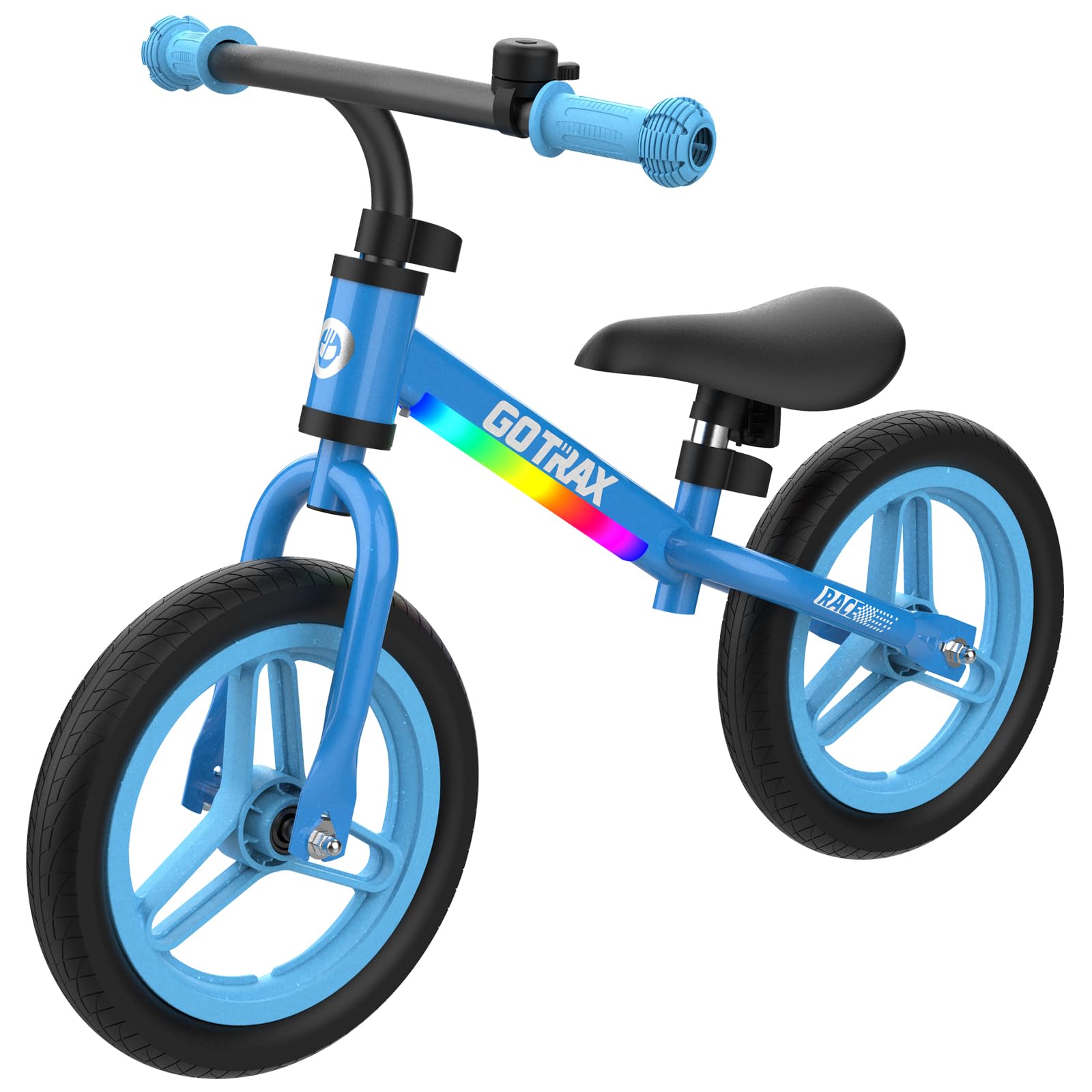
The Gotrax KS12 brings a dose of high-tech fun to the balance bike category with its integrated LED lights in the wheels and a working bell. For a 2-year-old, these features are not just gimmicks—they build excitement and engagement. The lights activate as the wheels spin, creating a visual reward that encourages the child to keep moving. The bike weighs 8.6 pounds, which is very manageable for a toddler, and the iron frame is sturdy enough to handle a max load of 110 pounds.
The seat adjusts from 16.5 to 18.3 inches, and the handlebar adjusts from 22.8 to 26 inches, providing a broad range for growing children. The 12-inch EVA wheels are puncture-proof and roll smoothly over pavement and packed dirt. The thicker seat cushion and silicone handlebars add comfort that standard bikes lack. Assembly takes about five minutes, and the 1-year manufacturer warranty provides security against defects.
The most significant caveat is that the bike’s paperwork states a minimum age of 3, although the Amazon listing says 2 years. The seat at its lowest setting is 16.5 inches from the ground, which will be too tall for a child with an inseam under 16 inches. This effectively disqualifies most 2-year-olds unless they are on the taller side (38 inches or above). For a child who meets the height requirement, this bike delivers unmatched fun per square inch.
Why it’s great
- LED lights and bell increase engagement
- Thicker padded seat and silicone grips
- Puncture-proof EVA tires
- Very fast 5-minute assembly
Good to know
- Seat at lowest setting (16.5″) too tall for average 2-year-old
- Paperwork recommends age 3+ despite Amazon listing
- No steering limiter or footrest
5. Bobike Toddler Balance Bike

The Bobike stands out for its old-school aesthetic and inclusion of a 135-degree steering limiter, a rarity at this price point. The steering limiter is a physical stop that prevents the handlebars from turning too far, which virtually eliminates the “jackknife” crash that happens when a child over-rotates the front wheel. The enclosed non-slip wheels are fully covered, protecting small feet from getting caught in the spokes. It is ASTM F963-11 and EN71 certified for safety.
The adjustable seat and handlebar accommodate children up to 4 years old, and the carbon steel frame is heavy but incredibly durable. Assembly takes only a few minutes with minimal tools. The bike works both indoors and outdoors on flat surfaces. The design is classic, almost vintage, and the pink color option is especially popular among young riders. Customer reviews mention that a 2-year-old picked up balancing and steering within days.
The main issue is brand authenticity: several customers reported that the bike is manufactured by a Chinese company despite being marketed under the “Bobike” name, and the actual Bobike company refused to honor support. This makes warranty claims uncertain. The bike also lacks a footrest, and the heavy steel frame can be cumbersome for an average 2-year-old to lift. If you are willing to risk the brand confusion for the safety features, it delivers good value.
Why it’s great
- 135° steering limiter prevents sharp turns
- Enclosed non-slip wheels protect feet
- Classic vintage design that looks clean
- Very affordable entry point
Good to know
- Brand authenticity and warranty support are questionable
- Heavy steel frame is harder for toddlers to lift
- No footrest for gliding
6. KRIDDO Toddler Balance Bike
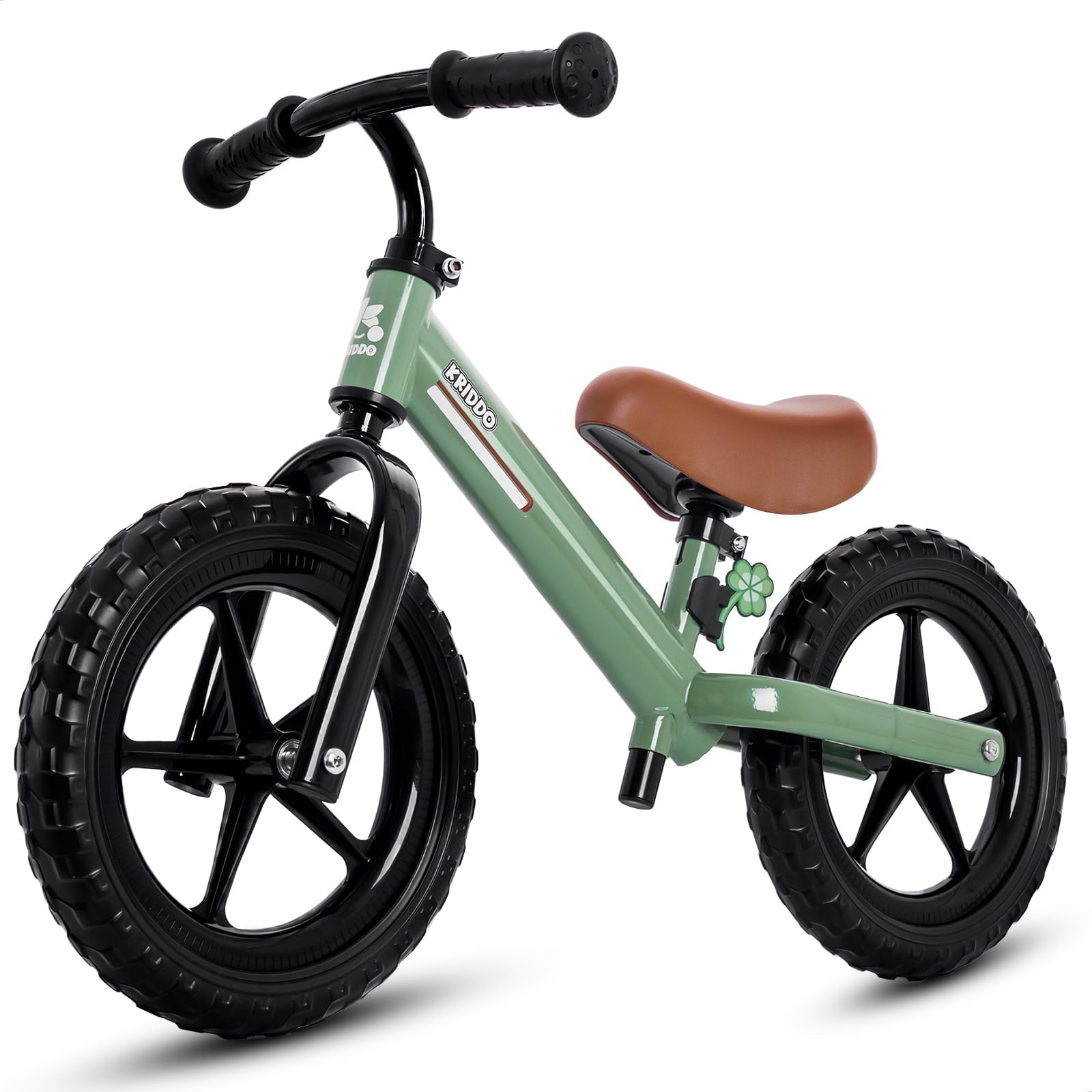
KRIDDO brings personality to the balance bike with two cute plates (a flower and a clover) that attach under the seat, letting a toddler customize their ride. The dual-bearing wheels are a standout spec at this price tier. Most entry-level bikes use plastic bushings, which create friction and resistance. Dual ball bearings reduce rolling resistance significantly, meaning the child glides further with each push, building momentum without exhausting their short legs.
The 12-inch puncture-proof tires work on tracks, grass, carpets, pavements, and wood floors, giving parents flexibility for indoor and outdoor use. The carbon steel frame is sturdy and has received consistent praise in reviews for its build quality. The seat adjusts from 14.17 to 18.5 inches, and the handlebar adjusts from 20.08 to 21.65 inches, offering plenty of growing room for ages 2 to 5. Gender-neutral green color adds to its appeal.
The seat’s minimum height of 14.17 inches is the highest on this list. For a 2-year-old with a typical inseam of 12 to 14 inches, this seat will be too tall to allow flat-footed standing. The child will likely be on their tiptoes, which delays the learning process. If your child is on the taller side or already in the higher percentile for height, this is a fantastic budget-friendly option. For smaller 2-year-olds, look for a lower minimum seat height.
Why it’s great
- Dual-bearing wheels for smooth, low-friction glide
- Customizable name plates for personalization
- Multi-terrain puncture-proof tires
- Sturdy carbon steel frame
Good to know
- Seat minimum height (14.17″) is too tall for short toddlers
- No footrest or steering limiter
- Heavier than aluminum options
7. RIDYEE Toddler Balance Bike
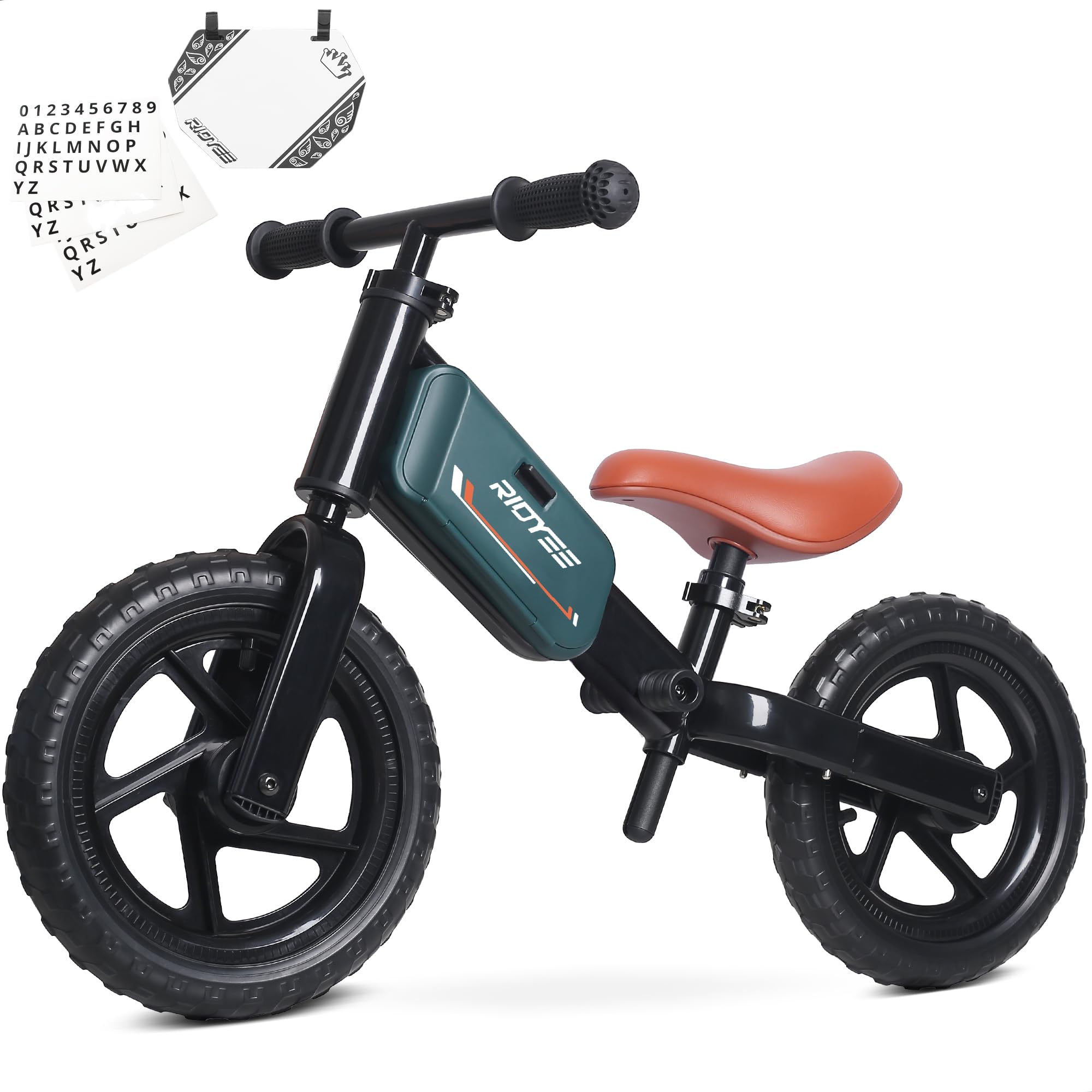
The RIDYEE is the only bike on this list that looks like a miniature motocross machine, complete with a fuel-tank-style storage compartment and a customizable front plate with letter and number stickers. That storage box is a genuinely useful feature—kids love collecting rocks, sticks, and “treasures” during rides. The design is a massive conversation starter and makes the bike feel like a real dirt bike rather than a training toy.
The adjustable seat ranges from 13.4 to 15.8 inches and uses a tool-free clamp for quick changes. The 135-degree safety angle limit prevents over-steering, which is a critical safety feature for this age group. The shock-absorbing seat and all-terrain tires ensure comfort on bumpy surfaces. The carbon steel frame is sturdy, and reviews highlight that the bike is easy to assemble in about 20 minutes. Many parents note that their child went from hesitant to confident within a week.
The primary downsides are weight and the fact that the frame is bulky for a 2-year-old. The bike feels heavier than its price bracket counterpart from KRIDDO, and some 2-year-olds struggle to maneuver it initially. The steering is also less precise than premium models, earning a 4-star review from a customer who tested several bikes. If your child is on the older side of 2 or particularly strong, the style and storage make this a compelling entry-level pick.
Why it’s great
- Unique motocross design with storage compartment
- Customizable name plate with stickers
- 135° steering limiter for safety
- Shock-absorbing seat for comfort
Good to know
- Heavier build is tough for smaller 2-year-olds
- Steering less precise than higher-end models
- No footrest included
FAQ
Can a 2-year-old with short legs really ride a balance bike?
Should I get a balance bike with a footrest or without?
How much should I expect to spend on a decent balance bike for a 2-year-old?
Final Thoughts: The Verdict
For most families, the balance bike for 2 year old winner is the Retrospec Cub because its 11-inch minimum seat height fits the widest range of toddlers, and the puncture-proof tires require zero maintenance. If you want the lightest possible build that a child can throw around like a toy, grab the banana bike LT. And for a beginner who is still very wobbly, nothing beats the stability of the Radio Flyer Steady Start three-wheel design.

Mo Maruf
I created WellFizz to bridge the gap between vague wellness advice and actionable solutions. My mission is simple: to decode the research and give you practical tools you can actually use.
Beyond the data, I am a passionate traveler. I believe that stepping away from the screen to explore new environments is essential for mental clarity and physical vitality.