Our readers keep the lights on and my smoothie glass nicely filled. As an Amazon Associate, I earn from qualifying purchases.
The difference between a good homemade pizza and a great one comes down to one thing: the surface it touches. A baking steel transfers heat into dough with a speed and intensity that a ceramic stone simply cannot match, giving you that leopard-spotted, puffy-yet-crisp crust without needing a 900°F brick oven.
I’m Mohammad Maruf — the founder and writer behind WellFizz. I’ve spent years analyzing the thermal performance, material density, and surface finishing of baking steels to understand exactly what separates a ¼-inch carbon steel plate from a lifetime kitchen tool.
Whether you are chasing pizzeria-quality Neapolitan pies or a sourdough loaf with a shattering crust, this guide breaks down the options, the specs, and the trade-offs to help you find the right baking steel for your oven.
How To Choose The Best Baking Steel
Not all baking steels are created equal. While they all share the same basic physics — a slab of steel that absorbs and radiates heat — subtle differences in thickness, size, surface finish, and seasoning determine how well they perform for your specific baking style. Here is what to look for.
Thickness: The Thermal Mass Trade-Off
A ¼-inch steel offers the best balance of heat retention and preheat time for most home ovens. Thinner steels around 0.1-inch heat up faster (in sync with the oven) but lose temperature more quickly when you load a cold pizza or loaf. Thicker options, like ½-inch, store massive amounts of heat for back-to-back bakes but require significantly longer preheat — often over an hour at 500°F. For the average home cook, ¼-inch is the sweet spot that delivers restaurant-quality crust without an extended warm-up.
Size and Oven Fit
Measure your oven rack depth before you buy. A 16-by-14-inch steel fits most standard residential ovens and gives you room for a 12-to-14-inch pizza. A 14-inch square is more compact and leaves clearance around the edges for air circulation, but it limits pizza size. Larger steels also weigh more — expect 15 to 16 pounds for a full-size ¼-inch plate. Make sure you can safely handle that weight, especially when it is hot.
Pre-Seasoned vs. Raw
Pre-seasoned steels arrive with a factory-applied oil coating that has been baked on at high temperature, creating an immediate non-stick surface. Raw or unseasoned steel requires you to apply multiple thin layers of oil and bake them off yourself before first use. Pre-seasoned saves time and ensures an even initial layer, which is particularly helpful if you plan to bake bread or pastries that stick easily.
Quick Comparison
On smaller screens, swipe sideways to see the full table.
| Model | Category | Best For | Key Spec | Amazon |
|---|---|---|---|---|
| The Original Baking Steel | Premium | Pizzeria-quality crust & versatility | ¼-inch, 15 lbs, pre-seasoned | Amazon |
| Artisan Steel | Premium | Low-friction surface for easy loading | ¼-inch, 16 lbs, made in USA | Amazon |
| UMAID Pizza Steel | Mid-Range | Large surface + included recipe booklet | ¼-inch, 14.5 lbs, pre-seasoned | Amazon |
| Brod & Taylor Bread Steel | Mid-Range | Lightweight handling & fast preheat | 0.1-inch, 5.6 lbs, pre-seasoned | Amazon |
| Onlyfire Pizza Steel | Value | Budget-friendly large format | 0.24-inch, 16×14 inch, carbon steel | Amazon |
| Old Stone Pizza Steel | Value | Dual-sided use with grease moat | ¼-inch, 12.5 lbs, square 14×14 | Amazon |
| Chef Pomodoro Pizza Steel | Budget | Entry-level 16-inch steel | ¼-inch, 14.6 lbs, pre-seasoned | Amazon |
In‑Depth Reviews
1. The Original Baking Steel (14x16x¼)

This is the steel that started the category in 2012, and it remains the benchmark for home oven baking. At ¼-inch thick and 15 pounds, it provides the thermal mass needed to sear a Neapolitan pizza in under 8 minutes while maintaining enough residual heat for a second or third pie. The hand-applied pre-seasoning is consistent out of the box, meaning you can skip the initial oil-curing ritual and start baking immediately.
The 14×16-inch footprint fits most standard ovens and leaves room for a 12 or 13-inch pizza with manageable clearance. Customers who upgraded from ceramic stones consistently report a dramatic improvement in bottom crust browning and leoparding — the steel transfers heat roughly 20 times faster than a stone. The 1000°F max temperature rating means it can handle your oven’s self-cleaning cycle or a broiler blast without warping.
It is heavy, and users with limited hand strength may struggle to slide it in and out of a hot oven. Storage can also be a challenge given its size and weight. But for anyone serious about pizza or artisan bread, this is the one-time purchase that replaces a dozen other bakeware items.
Why it’s great
- Ultra-conductive ¼-inch steel delivers crisp, leopard-spotted crust.
- Pre-seasoned by hand and ready to use immediately.
- Virtually indestructible — made from solid American steel.
Good to know
- Heavy at 15 pounds — requires careful handling when hot.
- Large footprint may be tight in smaller ovens.
2. Artisan Steel Pizza Steel (16×14.25x¼)

The Artisan Steel is a no-nonsense, American-made carb steel plate designed for bakers who want maximum thermal conductivity without paying a premium for branding. At 16 pounds, it has slightly more mass than the Original Baking Steel, which translates to better heat retention during back-to-back bakes. The surface comes raw, requiring you to season it yourself — but that also gives you control over the seasoning layer thickness.
Users report that after a proper initial seasoning (a vegetable oil wipe followed by an hour at 375°F and then an hour at 550°F), the surface becomes slick enough to slide a pizza onto without sticking. The 16×14.25-inch dimensions provide useful extra width compared to square steels, making it easier to maneuver larger pizzas on a peel. Cracker-crust pizzas cook in about 7 minutes at 550°F with excellent bottom browning.
The raw finish means you should expect some dark gray residue during the initial cleaning and seasoning process. A few users noted that paper towel fibers can stick to the surface when drying after the first wash. It also requires routine oiling to maintain the seasoning, especially if you live in a humid environment.
Why it’s great
- Made in the USA from solid steel — built to last.
- Low-friction surface once properly seasoned.
- Heavier mass maintains heat for multiple pizzas.
Good to know
- Requires initial seasoning and routine maintenance.
- Heavy at 16 pounds — challenging for some to handle.
3. UMAID Pizza Steel (16×13.4x¼)
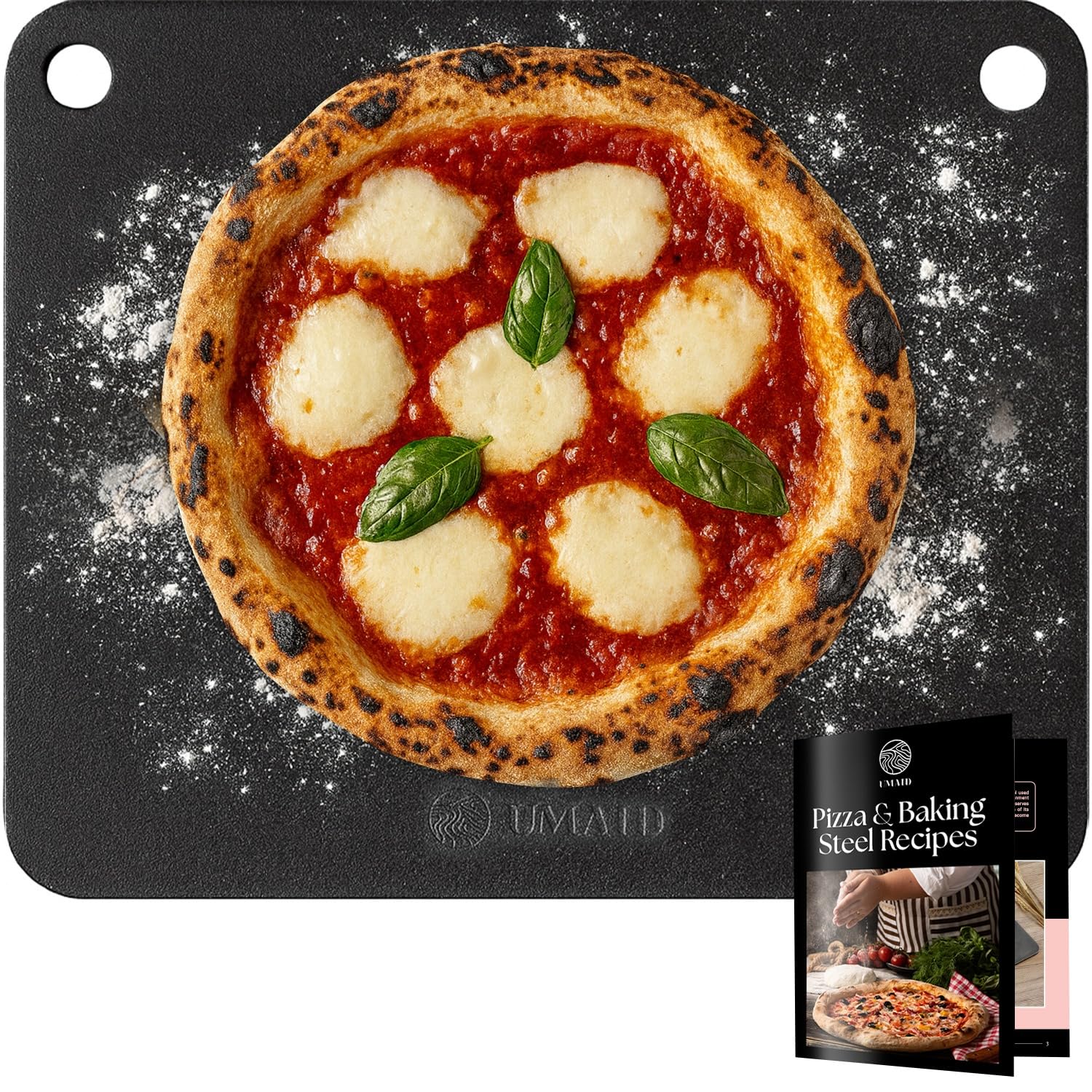
The UMAID steel brings a solid ¼-inch thickness and a pre-seasoned surface at a competitive price point, making it a strong option for home bakers who want performance without the premium label. The 16×13.4-inch dimensions fit large pizzas comfortably, and the steel’s 14.5-pound weight provides enough thermal mass to bake artisan loaves and multiple pizzas in a single session.
Out of the box, the pre-seasoning is even and ready to go — users report crisp, golden-bottom crusts on the first bake without any sticking. The included 15-recipe booklet is a thoughtful addition, especially for beginners who want to explore beyond pizza into sourdough, flatbreads, and even cookies. The steel works on grills and stovetops as well, adding versatility for outdoor cooking and searing.
Some users note that the steel is extremely heavy, making it difficult for smaller individuals to lift, especially when hot at 500°F. A few also mention that the surface can develop minor rust spots if not dried thoroughly after washing, which is typical for carbon steel but worth noting if you prefer low-maintenance tools.
Why it’s great
- Pre-seasoned and ready for immediate use.
- Large rectangular surface fits full-size pizzas.
- Comes with a printed recipe booklet for inspiration.
Good to know
- Heavy — requires caution when handling at high heat.
- Carbon steel needs thorough drying to prevent rust.
4. Brod & Taylor Bread Steel (14x14x0.1)

The Brod & Taylor Bread Steel is a deliberate departure from the heavy ¼-inch standard. At just 0.1-inch thick and weighing only 5.6 pounds, it is designed for bakers who prioritize handling ease and fast preheat over maximum thermal mass. The steel reaches baking temperature in sync with the oven, eliminating the typical hour-long preheat required by thicker plates. For daily bread bakers or those with limited hand strength, this is a meaningful advantage.
The 14-inch square shape is ideal for artisan loaves, providing a stable surface that fits comfortably in standard ovens. Users who previously relied on Dutch ovens for sourdough report that the Bread Steel eliminates the awkwardness of maneuvering a heavy preheated pot. It produces crisp, well-browned crusts on bread and hearth-style pizzas, though the lower mass means it cools faster when loading cold dough, adding 1–2 minutes to bake time compared to thicker steels.
The pre-seasoned flax oil coating is ready to use, but some users note that it is worth applying an additional thin oil layer before the first bake for extra insurance against sticking. Because of its slim profile, the steel can warp slightly under extreme heat — keeping it below 550°F is advisable.
Why it’s great
- Light enough for one-handed handling.
- Preheats in sync with the oven — no extended wait.
- Excellent for sourdough and artisan bread.
Good to know
- Lower thermal mass means faster heat loss between bakes.
- May warp at very high temperatures above 550°F.
5. Onlyfire Pizza Steel (16x14x0.24)

The Onlyfire steel is a budget-conscious entry that does not skimp on critical specs. At 0.24-inch thick (very close to the standard ¼-inch) and sized at 16×14 inches, it offers the same large baking surface and heat-absorption physics as more expensive competitors. The heavy-gauge carbon steel construction resists warping and cracking, even at the high temperatures needed for Neapolitan-style pizza.
Users who have compared it directly to traditional ceramic stones report a night-and-day difference in crust quality — faster cooking times, crispier bottoms, and even browning across the entire pie. The steel’s smooth surface develops a natural patina over time that improves non-stick performance. Cleaning is simple: a wipe while warm and a light oil rub keeps the seasoning intact. A few users mention that the corners and edges are somewhat sharp, and a quick pass with a Dremel or fine-grit sandpaper can smooth them out for safer handling.
The steel is not pre-seasoned in the same way as premium options, so the first few bakes may benefit from a manual oil wipe and an initial high-heat burn-in. Some bakers choose to leave it in the oven permanently for its heat-stabilizing effect on the oven cavity, though it should be removed when baking cookies or other delicate items to avoid excessive bottom browning.
Why it’s great
- Large 16×14-inch surface at a very accessible price.
- Near-¼-inch thickness provides excellent heat retention.
- Naturally non-stick patina develops with use.
Good to know
- Edges can be sharp out of the box.
- Not fully pre-seasoned — requires initial care.
6. Old Stone Pizza Steel (14x14x¼)

The Old Stone steel stands out with a unique dual-sided design. One side is a flat baking surface for pizza, bread, and pastries, while the reverse side features an integrated moat that catches oils and fats during cooking. This moat is particularly useful when searing steaks or cooking oily foods on a grill, as it prevents grease from dripping onto burners and causing flare-ups.
At 14×14 inches square and ¼-inch thick, the steel weighs 12.5 pounds — slightly lighter than the rectangular alternatives, which can be an advantage for those who need to move it frequently. The steel is pre-seasoned with vegetable oil and cured at high temperatures, so it arrives ready to cook. Users report that it bakes cauliflower-crust pizza and standard doughs with equal effectiveness, producing crisp results in 5–8 minutes depending on toppings.
The square shape is a compromise if you typically make large round pizzas, as the usable area for a round pizza is limited to a 13-inch diameter to maintain clearance. The 20x faster heat conduction claim versus ceramic stones holds true, but some users note that the pre-seasoning can leave paper towel fibers on the surface during the initial wipe-down, which requires a careful rinse before first use.
Why it’s great
- Dual-sided design with grease-catching moat.
- Pre-seasoned and ready to use immediately.
- Slightly lighter than full-size rectangular steels.
Good to know
- Square shape limits maximum pizza diameter to about 13 inches.
- Initial seasoning can leave lint on the surface.
7. Chef Pomodoro Pizza Steel (16×13.25x¼)

The Chef Pomodoro steel delivers the full ¼-inch thickness and a generous 16×13.25-inch surface at an entry-level price that makes it accessible for bakers who are not yet ready to invest in a premium brand. It arrives pre-seasoned and ready to use, with a dark gray finish that resists sticking from the first bake. The 14.6-pound weight provides the thermal mass necessary for crisp, evenly cooked pizza crusts and well-risen sourdough loaves.
Users consistently report that it replaces the desire for a dedicated pizza oven, producing NYC-style pies in 4-6 minutes with a crunchy bottom and no soggy center. The steel’s high-temperature tolerance (rated up to 932°F) means it can handle broiler use and grill applications without risk of damage. The lifting hole on one side is a practical touch for safer handling, though the steel is still heavy enough that two hands are recommended when transferring it in and out of a hot oven.
Some users note that the seasoning can be delicate initially and may require a thin oil wipe after each use to maintain the non-stick layer. The steel can also develop surface rust if stored in a humid environment without proper drying. These are typical carbon steel maintenance requirements and do not detract from the performance for the price.
Why it’s great
- Full ¼-inch thickness at an accessible price.
- Large rectangular surface fits 12-14 inch pizzas.
- Pre-seasoned and ready for immediate baking.
Good to know
- Seasoning may need periodic oil maintenance.
- Can rust if not dried thoroughly after cleaning.
FAQ
Can I leave my baking steel in the oven all the time?
How do I clean a baking steel without ruining the seasoning?
Why does my baking steel need a full hour to preheat?
Final Thoughts: The Verdict
For most users, the winner in the baking steel category is the The Original Baking Steel because it delivers proven thermal performance, a pre-seasoned surface, and a lifetime build quality that justifies its premium standing. If you want a lighter steel that preheats quickly and handles bread beautifully, grab the Brod & Taylor Bread Steel. And for an entry-level ¼-inch steel that does not cut corners on size or thickness, nothing beats the value of the Chef Pomodoro Pizza Steel.

Mo Maruf
I created WellFizz to bridge the gap between vague wellness advice and actionable solutions. My mission is simple: to decode the research and give you practical tools you can actually use.
Beyond the data, I am a passionate traveler. I believe that stepping away from the screen to explore new environments is essential for mental clarity and physical vitality.