Our readers keep the lights on and my smoothie glass nicely filled. As an Amazon Associate, I earn from qualifying purchases.
The promise of a weed-free, moisture-retentive vegetable garden often starts with a bag of mulch, but the wrong bagged material can actually acidify your soil, stunt seedling growth, or harbor weed seeds that defeat its own purpose. The key difference lies in choosing a bagged amendment that feeds the soil biology while you feed your plants, not one that simply sits on top.
I’m Mohammad Maruf — the founder and writer behind WellFizz. I’ve spent years analyzing soil amendments, compost specs, and organic certifications, breaking down which bagged products actually deliver measurable nutrient density and microbial activity for edible gardens.
This guide focuses on the five most effective options for enriching your plot, offering a clear look at the best choices for a productive harvest. Choosing the right bagged mulch for vegetable garden means matching your crop’s needs to a product that balances texture, pH, and nutrient release rate.
How To Choose The Best Bagged Mulch For Vegetable Garden
Unlike decorative bark or rubber mulches, a vegetable garden requires a product that decomposes at a controlled rate, adds organic matter, and maintains a neutral to slightly acidic pH around 6.0–7.0. The right mulch also needs to suppress weeds without introducing pathogens or harboring pests. Focus on three core criteria: nutrient content, particle size, and proven organic integrity.
Nutrient Density and Organic Certification
Vegetables are heavy feeders. A bagged mulch that doubles as a soil amendment — like a well-composted manure or a marine-based blend — provides nitrogen, calcium, and trace minerals that leafy greens and fruiting crops demand. Always look for an OMRI (Organic Materials Review Institute) listing or a clear statement that the product is certified for organic use. This ensures no synthetic pesticides, herbicides, or GMO residues are present in the bag.
Particle Size and Moisture Retention
For a vegetable bed, the ideal mulch particle size ranges from ¼ inch to 1 inch. Particles this small integrate easily into the topsoil, allow water to percolate rather than bead up, and break down within a single growing season to feed the soil food web. Large bark chunks can tie up nitrogen as they decompose and are better suited for ornamental pathways than edible beds.
Fungal vs. Bacterial Dominance
Vegetable gardens thrive in bacterially dominant soil. Manure-based composts and coco coir both promote bacterial activity, which is ideal for annual crops like tomatoes, peppers, and squash. Woody mulches, such as pine bark, create a fungal-dominant environment that is better for perennials and fruit trees. Match the microbial profile of your mulch to the lifecycle of your vegetables for the best growth.
Quick Comparison
On smaller screens, swipe sideways to see the full table.
| Model | Category | Best For | Key Spec | Amazon |
|---|---|---|---|---|
| Espoma Organic Land and Sea | Premium Compost | General vegetable beds & transplanting | 24 lb bag; lobster & crab meal; Myco-Tone | Amazon |
| Brut Cow Compost | Organic Compost | Heavy feeders (tomatoes, squash) | 10 qt; OMRI listed; odor-free | Amazon |
| MODELLOR Coco Coir Brick | Coco Coir | Moisture-retentive seed starting | 10 lb; expands to 72–80 qt; pH balanced | Amazon |
| R&M Organics Premium Compost | Manure Compost | Top dressing for raised beds | 10 lb bag; low odor; fine texture | Amazon |
| Rio Hamza Houseplant Mulch | Bark Mulch | Container top-dressing only | 8 qt bag; small wood chips; decorative | Amazon |
In‑Depth Reviews
1. Espoma Organic Land and Sea Gourmet Compost

The Espoma Land and Sea blend is the most biologically active bagged amendment in this lineup. Its combination of lobster and crab meal provides a slow-release source of nitrogen and calcium carbonate, which sweetens acidic soil without requiring lime. The inclusion of Myco-Tone — a proprietary blend of endo and ecto mycorrhizae — jumps starts root colonization the moment you mix it into the planting hole.
Weighing in at 24 pounds per bag, this is a dense, granular product that feels more like a soil conditioner than a fluffy mulch. It works best when tilled into the top 3–4 inches of a raised bed before transplanting tomatoes, peppers, or flowers. The particle size is fine enough to integrate fully but textured enough to improve aeration in heavy clay soils.
Experienced growers will appreciate the dual-action formula: the marine meals feed the plant directly while the mycorrhizae expand the root system’s reach. It is not designed as a thick top-dressing mulch; think of it as a nutrient-packed planting mix that enriches every cubic inch of soil it touches.
Why it’s great
- Dual marine-protein source delivers nitrogen and calcium in a single application
- Myco-Tone blend actively colonizes roots for better nutrient uptake
- Fine granular texture integrates seamlessly into native garden soil
Good to know
- Heavier bag weight may be less convenient for gardeners with mobility concerns
- Not ideal for use as a purely decorative top-dressing layer
2. Brut Cow Compost – Nutrient-Rich Composted Cow Manure

Brut Worm Farms delivers a pure composted cow manure that is fine-sifted and entirely additive-free. At 10 quarts per bag, the volume is modest for large beds, but the nutrient concentration is high enough that a ¼-inch layer around your tomatoes or peppers can produce visible results within a week — yellow leaves turn green, and new growth pushes steadily.
The texture is what sets Brut apart: it is silty and soil-like without any clumps, making it easy to incorporate as a soil amendment or to use as a side-dressing during the growing season. Because it is fully composted and aerated during production, the risk of nitrogen burn is virtually zero, even when used directly around delicate seedlings.
Users report strong results mixing it at a 3:2 ratio with potting soil for container vegetables. The OMRI listing provides peace of mind for organic gardeners who need to avoid synthetic inputs. While the bag size means it works best for targeted feeding rather than broad-bed coverage, its potency makes it a top-tier choice for edible crops.
Why it’s great
- OMRI certified organic and completely additive-free
- Fine, silty texture allows easy incorporation into existing soil without clumping
- Odor-free and safe for direct contact with seedling roots
Good to know
- 10-quart bag covers a limited area, best for targeted use in smaller beds
- Lower bulk density than some other manure blends on the market
3. MODELLOR Premium Super Washed Coco Coir Brick
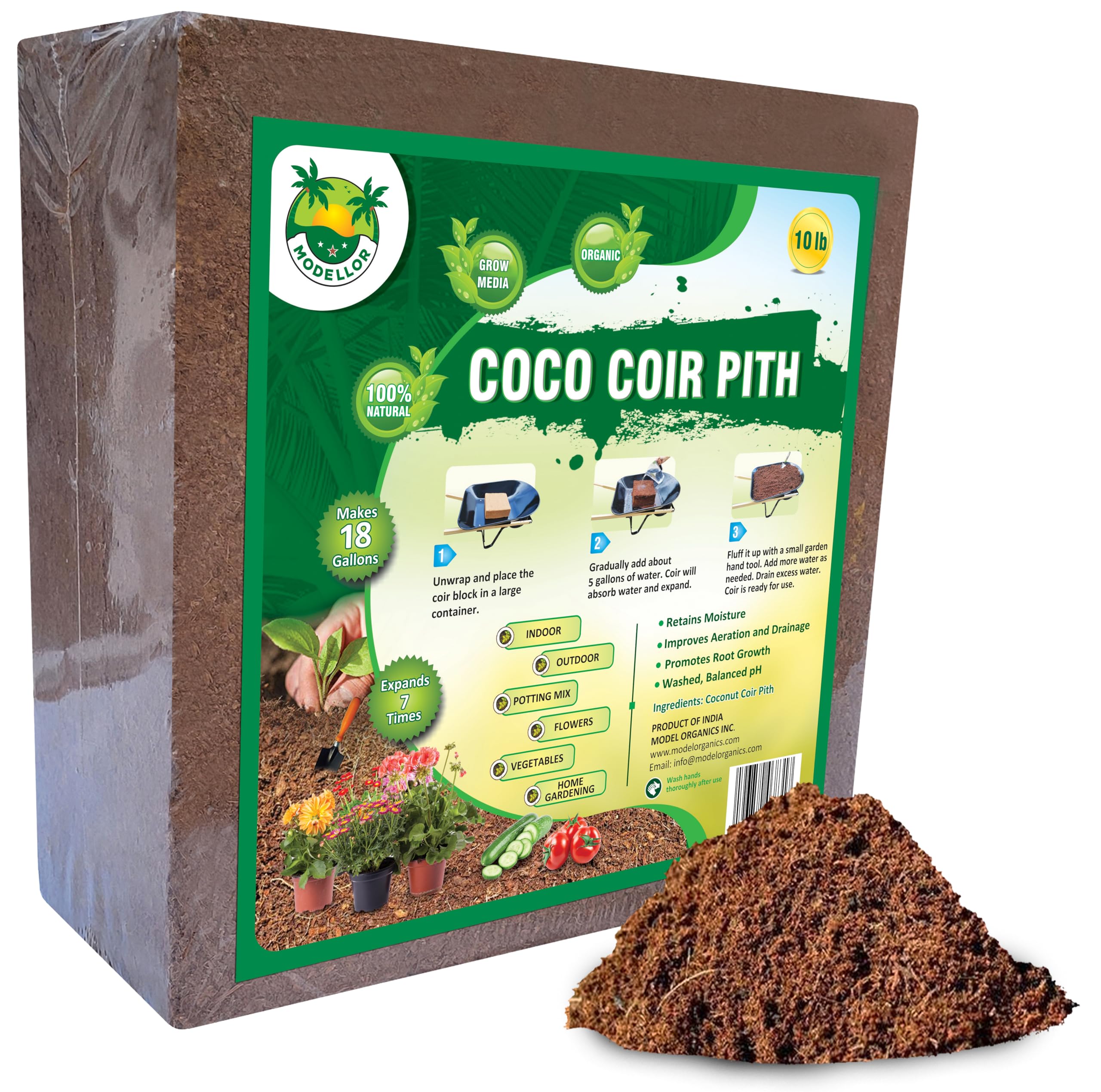
This 10-pound compressed coir brick is the volume-to-value champion of the list. Once hydrated, it fluffs up to 72 to 80 quarts of growing medium — enough to fill several large raised beds or dozens of nursery pots. The triple-washing process removes excess salts, a common issue with lower-grade coir, and the pH is buffered to a neutral range suitable for vegetables.
Coco coir functions differently from compost: it holds up to 10 times its weight in water while maintaining a fluffy, aerated structure that promotes rapid root development. For seed starting, it outperforms peat moss because it rehydrates easily and does not form a crust on the surface. Mix it with a balanced organic fertilizer or compost to provide the nutrients coir lacks naturally.
Gardeners who struggle with moisture consistency on hot summer days will find this coir invaluable. It can be used as a top-dressing mulch to reduce evaporation or blended into native soil to improve water retention in sandy conditions. The compact brick format also saves storage space — a single brick replaces several bulky bags of loose mulch.
Why it’s great
- Massive expanded volume from a single compact brick, offering exceptional coverage per bag
- Triple-washed and pH balanced; no rinsing required before use
- Superior water retention makes it ideal for drought-prone or sandy garden beds
Good to know
- Nutrient-free on its own — must be mixed with compost or fertilizer for feeding crops
- Requires hydration time and a large container to expand fully
4. R&M Organics Premium Organic Compost
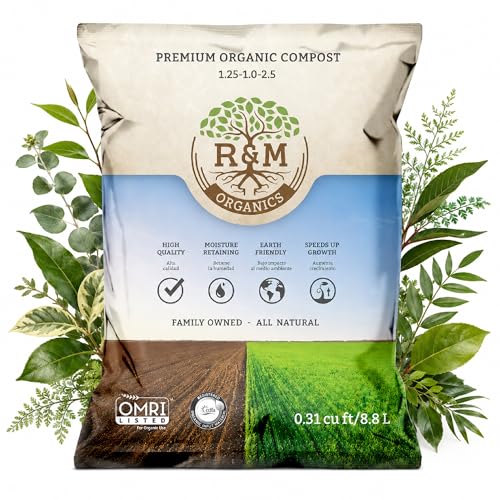
R&M Organics uses dairy cow manure processed through a continuous aeration system that eliminates the strong ammonia smell often associated with raw manure. The final product has a clean, earthy scent and a fine topsoil consistency that spreads evenly. With a mixing ratio of 5:1, a little goes a long way in revitalizing tired raised-bed soil.
Gardeners have used this compost to rescue azaleas suffering from chemical runoff and to revive tomato plants with yellowing leaves. The key is its ability to replenish micronutrients while improving soil structure. A ¼-inch layer applied as a top dressing slowly releases nutrients over several weeks, reducing the need for liquid fertilizers during the peak growing season.
The 10-pound bag size is manageable for small to medium garden projects, though larger operations may find it cost-prohibitive for broad-area coverage. For container gardeners and raised-bed enthusiasts who value soil health above raw volume, this compost delivers consistent, measurable results without the risk of burning tender roots.
Why it’s great
- Fully composted with continuous aeration, resulting in a low-odor, user-friendly product
- Fine topsoil texture that spreads easily and integrates well with native soil
- Demonstrated ability to quickly reverse nutrient deficiencies in stressed plants
Good to know
- Small bag size limits application area for large garden beds
- Premium pricing structure makes it more of a targeted amendment than a bulk mulch
5. Rio Hamza Trading Houseplant Mulch

Rio Hamza’s houseplant mulch is a decorative bark chip product designed primarily for indoor potted plants and patio containers. The chips are small — roughly the size of coarse gravel — and provide a consistent visual layer that helps prevent soil splash during watering. Users report no pest introduction and a natural color that does not fade quickly.
For a vegetable garden, this product occupies a niche role. It works well as a top-dressing for container-grown herbs or compact tomato pots where you want to suppress weed germination and retain moisture without giving up floor space to a large compost layer. However, its 8-quart volume only covers about 2 to 3 medium-sized pots, so it is not an economical choice for in-ground beds.
As a wood-based mulch, it may cause a minor nitrogen drawdown if mixed into soil rather than left on the surface. Keep it strictly as a surface layer and pair it with a nutrient-rich compost underneath. For its intended use — decorative coverage on houseplants — it performs beautifully, but it is the least versatile option for full vegetable garden applications in this comparison.
Why it’s great
- Clean, uniform bark chips that do not introduce pests or mold into containers
- Longer-lasting than coir or compost as a surface layer, reducing the need for reapplication
- Easy to pour and apply without creating dust or mess
Good to know
- Small bag volume and higher cost per quart compared to bulk compost options
- Wood-based material can tie up soil nitrogen if tilled in rather than used as a top dressing
FAQ
Can I use standard wood bark mulch in my vegetable garden?
How often should I reapply bagged compost to my raised beds?
Does bagged mulch ever contain weed seeds or pathogens?
Final Thoughts: The Verdict
For most users, the best bagged mulch for vegetable garden is the Espoma Organic Land and Sea because its marine-meal formula feeds both the plant and the soil food web in a single application. If you want a volume-driven, moisture-retentive base for seed starting and raised beds, grab the MODELLOR Coco Coir Brick. And for targeted, high-potency feeding of heavy feeders like tomatoes and peppers, nothing beats the Brut Cow Compost.

Mo Maruf
I created WellFizz to bridge the gap between vague wellness advice and actionable solutions. My mission is simple: to decode the research and give you practical tools you can actually use.
Beyond the data, I am a passionate traveler. I believe that stepping away from the screen to explore new environments is essential for mental clarity and physical vitality.