Our readers keep the lights on and my smoothie glass nicely filled. As an Amazon Associate, I earn from qualifying purchases.
The moment the grid goes dark, every appliance in your house becomes a test of your backup plan. A refrigerator full of food, a sump pump in a storm, or a medical device that cannot stop—these are the real-world stakes that separate a capable backup power system from an expensive disappointment. Choosing the right system means matching your loads, fuel strategy, and budget to a solution that fires up when you need it most.
I’m Mohammad Maruf — the founder and writer behind WellFizz. I have spent over a decade analyzing portable power station chemistries, inverter topology, and generator engine displacement to help homeowners make informed, long-term investments in home energy resilience.
After reviewing dozens of portable power stations and fuel-powered generators across multiple capacity tiers, one model consistently delivers the best balance of fast recharge, silent operation, and expandable capacity for most households — that is the unit I consider the best backup power for home on the market today.
How To Choose The Best Backup Power For Home
Home backup power is not a one-size-fits-all purchase. The ideal setup for a suburban house with gas appliances differs drastically from what an all-electric home with a well pump needs. Understanding your critical loads, your fuel preferences, and your tolerance for noise will define the right system for you.
Capacity and Runtime: Match the Watt-Hours to Your Loads
A 1000Wh power station can handle a modem, a few lights, and a laptop for a night. A 3000Wh+ system or a 10,000-watt generator can keep a refrigerator, a furnace blower, a sump pump, and a chest freezer running for days. Calculate the running watts of your essential appliances (add a 20% safety margin) and multiply by the hours you want to cover. For fuel-powered generators, the fuel tank size and load percentage directly determine runtime. Portable power stations with LiFePO4 chemistry offer 3000–7000 recharge cycles, making them a decade-long investment.
Fuel Type: Electric, Gas, Propane, or Natural Gas
Electric power stations (battery + inverter) are silent, emission-free, and safe for indoor use. They recharge from a wall outlet or solar panels, making them ideal for short outages and daily UPS duty. Gas generators offer unlimited runtime with refueling but require outdoor placement, produce noise around 70 dB, and require maintenance (oil changes, fuel stabilization). Propane and natural gas generators burn cleaner, store indefinitely, and tie into home gas lines — ideal for multi-day outages but involve higher upfront costs and installation complexity.
Transfer Switch and Output Configuration
If you want to power hardwired circuits (a well pump, a furnace, or a dedicated refrigerator circuit), you need a generator with a 240V outlet (NEMA 14-50R or L14-30R) and a transfer switch or interlock kit. Portable power stations at 120V only can run extension cords to individual appliances but cannot backfeed a panel legally. Check the outlet type: 50A outlets handle larger loads, while 30A outlets are adequate for most essential circuits. For whole-home readiness, a dual-voltage inverter with a 50A outlet and clean sine wave output (under 3% THD) is the gold standard.
Quick Comparison
On smaller screens, swipe sideways to see the full table.
| Model | Category | Best For | Key Spec | Amazon |
|---|---|---|---|---|
| Jackery Explorer 2000 v2 | Portable Power Station | Mid-sized home backup & camping | 2042Wh / 2200W / 20ms UPS | Amazon |
| Anker SOLIX C2000 Gen 2 | Portable Power Station | Fast-charging & expandable home backup | 2048Wh / 2400W / 58-min charge | Amazon |
| Jackery HomePower 3000 | Portable Power Station | Whole-home essential circuits | 3072Wh / 3600W / ≤20ms UPS | Amazon |
| EF ECOFLOW DELTA Pro Extra Battery | Expansion Battery | Expanding DELTA Pro capacity | 3600Wh / 1800W DC charge | Amazon |
| EF ECOFLOW Delta 3 Classic | Portable Power Station | Sensitive electronics & UPS duty | 1024Wh / 1800W / <10ms UPS | Amazon |
| BLUETTI Elite 100 V2 | Portable Power Station | Compact home & RV backup | 1024Wh / 1800W / 30dB noise | Amazon |
| AFERIY P210 | Portable Power Station | Large capacity & food truck use | 2048Wh / 2400W / <10ms UPS | Amazon |
| PowerSmart 7000W Inverter | Gas Inverter Generator | Heavy appliances & RV 50A | 7000W peak / 6000W rated / <3% THD | Amazon |
| DuroMax XP13000HXT | Tri-Fuel Generator | Whole-home with fuel flexibility | 13,000W peak / 500cc / Tri-Fuel | Amazon |
| Westinghouse iGen11000DFc | Dual-Fuel Inverter Generator | Clean power for whole house & EV | 11,000W peak / <3% THD / 50A | Amazon |
| Westinghouse WGen14500TFc | Tri-Fuel Generator | Large home backup on natural gas | 18,000W peak / 713cc / Tri-Fuel | Amazon |
In‑Depth Reviews
1. Jackery Explorer 2000 v2 Portable Power Station

The Jackery Explorer 2000 v2 hits the sweet spot of capacity and portability for home backup. At 39.5 pounds — 41% lighter than typical 2kWh units — it uses CTB (Cell-to-Body) technology common in EVs to achieve a compact footprint (13.2 x 10.4 x 11.5 inches) without sacrificing the 2042Wh LFP battery that powers a refrigerator for over 21 hours in real-world testing. Its 2200W pure sine wave inverter handles three AC ports simultaneously, while the 100W USB-C PD port charges laptops and drones at full speed without a separate adapter.
Charging flexibility is exceptional: AC Fast Charging hits 80% in 66 minutes, and Emergency Super Charging (via the app) reaches full charge in 102 minutes. The Silent Charging mode runs at under 30 dB — quieter than a library — making it suitable for overnight use in bedrooms or apartments during outages. The ≤20ms UPS switchover is UL1778 certified, so your PC, router, and security cameras experience no interruption when the grid falters. Solar charging at 400W takes about 6 hours to full, giving off-grid users a viable replenishment path.
Jackery’s app integration provides remote monitoring of battery level, charge scheduling, and load management. While the handle improves carry ergonomics, the unit is still a two-handed lift for some. The warranty covers the LFP battery for 10 years (4000 cycles to 70% capacity). For most homeowners, this is the ideal mid-capacity backup — enough for essentials, light enough to relocate, and fast enough to recharge before the next outage window closes.
Why it’s great
- Exceptional power-to-weight ratio (2042Wh at 39.5 lbs)
- Super-fast AC charging to 80% in 66 minutes
- UL-certified UPS with ≤20ms seamless switchover
Good to know
- No expansion battery port for capacity stacking
- Solar charging speed limited by 400W panel input
2. Anker SOLIX C2000 Gen 2 Portable Power Station

The Anker SOLIX C2000 Gen 2 redefines recharge speed in the 2kWh class. A full charge from empty takes just 58 minutes via AC — the fastest in this roundup — and it supports 800W alternator charging, which tops up the battery in 3 hours while driving, 8 times faster than a standard 12V socket. With a 2048Wh LiFePO4 core and a 2400W rated inverter (4000W peak), it can run a dual-door refrigerator for up to 32 hours on a single charge, expanding to 64 hours when paired with the optional expansion battery (4kWh total).
The Gen 2 design sheds 25% of the weight and 29% of the volume compared to its predecessor, coming in at 41.7 pounds and measuring 18.1 x 9.8 x 10.1 inches. The standby draw is only 9W — a meaningful efficiency gain for long-term placement between outages. The six recharge methods (AC, solar, car, alternator, generator, and USB-C) provide unmatched flexibility for emergency scenarios. Solar input up to 1000W is generous, allowing full recharge in under 2 hours with sufficient panel wattage.
Real-world owners report powering a 30-quart fridge for 5–7 days on one charge, and the unit reliably runs window AC units thanks to the 4000W surge headroom. The app-based monitoring is intuitive, though the lack of a printed manual is a minor inconvenience. At this price point, the C2000 Gen 2 competes directly with the Jackery 2000 v2 but wins on recharge speed and expansion capability — ideal for those who anticipate multi-day outages or frequent power fluctuations.
Why it’s great
- Industry-leading 58-minute full AC recharge
- Expandable to 4kWh for extended runtime
- 800W alternator charging for on-the-road top-up
Good to know
- Heavier than some 2kWh competitors (41.7 lbs)
- No 240V output for hardwired circuits
3. Jackery HomePower 3000 Portable Power Station
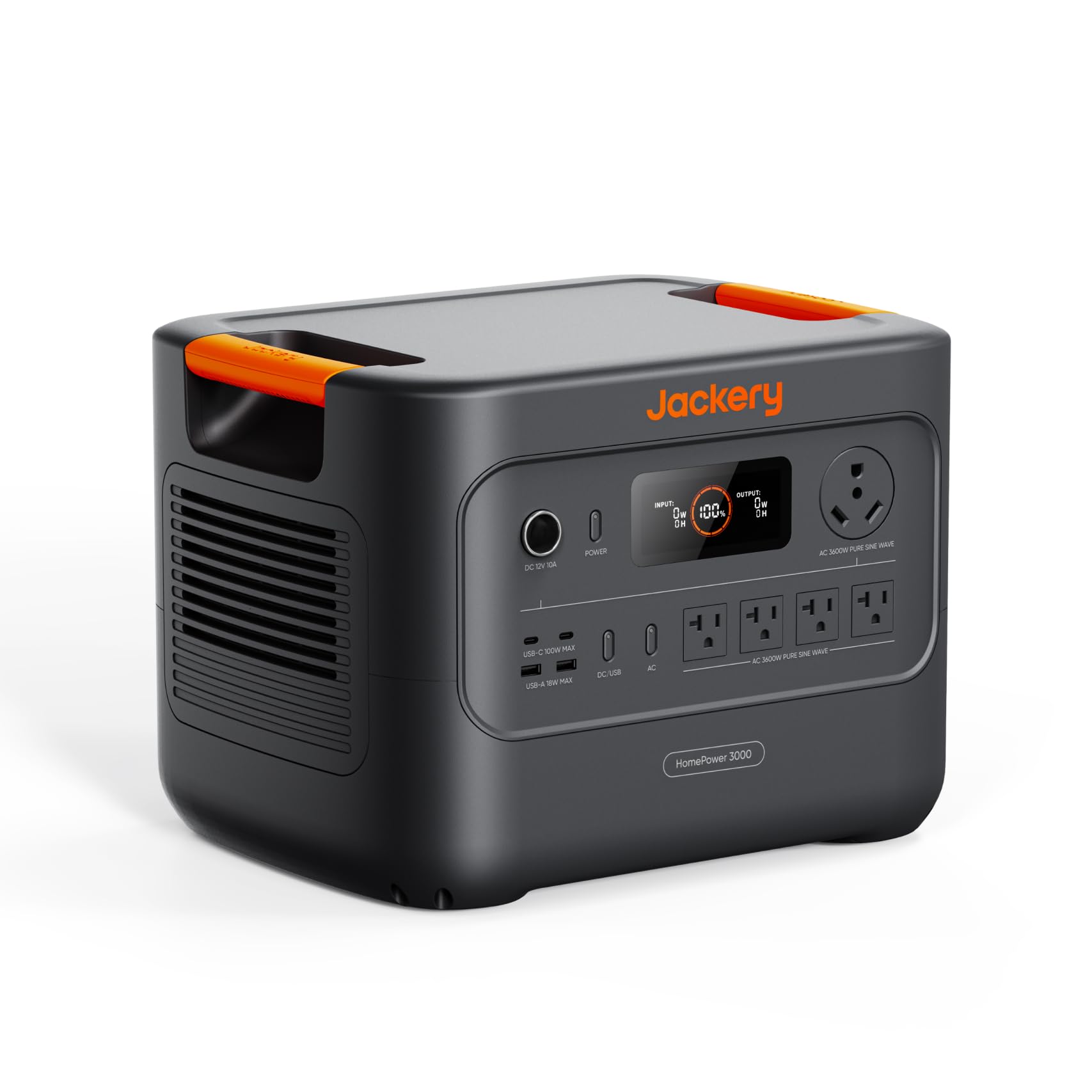
The Jackery HomePower 3000 is a serious step into whole-home backup territory within the portable power station world. With a 3072Wh LiFePO4 battery and a 3600W inverter (7200W surge), it can handle a household’s essential circuits for up to 15 hours — including a refrigerator, furnace blower, well pump, lights, and Wi-Fi router. The built-in TT-30 RV port provides plug-and-play 30A power for RVs, eliminating the need for a separate adapter when using the unit on the road.
The CTB (Cell-to-Body) construction makes this the world’s first 3kWh portable power station that integrates the battery cells into the structural body, improving space efficiency by 14% and making it 47% smaller and 43% lighter than comparable 3kWh units. At 59.5 pounds, it is manageable with two handles but not truly portable for daily relocation. The ChargeShield 2.0 AI algorithm optimizes charging speed while extending the LFP battery’s lifespan to 4000 cycles (70% capacity retention) — roughly a decade of daily use.
The ≤20ms UPS switchover is UL-certified, protecting sensitive medical refrigerators, security cameras, and home servers during grid drops. Dual 100W USB-C PD ports charge laptops and tablets at full speed simultaneously. Hybrid charging (AC + solar) reaches full in 1.7 hours. The main drawback is the weight — it is best placed in a semi-permanent location near your main panel or RV connection. For homeowners who want battery backup without the noise and fumes of a gas generator, the HomePower 3000 delivers near whole-home capability.
Why it’s great
- World’s lightest 3kWh power station (59.5 lbs)
- 7200W surge handles well pumps and AC units
- Dual 100W USB-C PD and built-in TT-30 RV port
Good to know
- Heavy for frequent relocation despite CTB design
- Warranty only honored if purchased directly from Jackery
4. EF ECOFLOW DELTA Pro Extra Battery 3600Wh
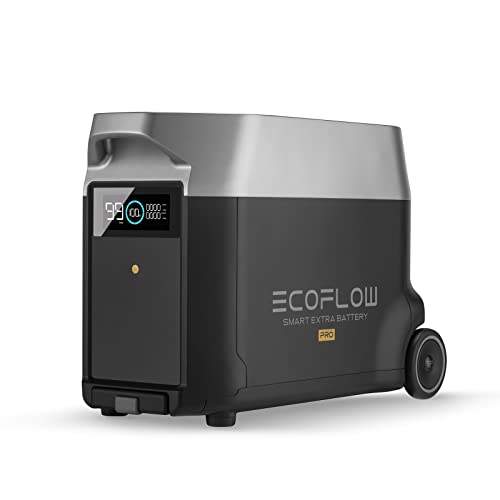
The DELTA Pro Extra Battery is not a standalone power station — it is a capacity expansion module for the EcoFlow DELTA Pro ecosystem. Adding one unit doubles the whole system from 3.6kWh to 7.2kWh, giving you days of backup for essential appliances. The connection is plug-and-play: once linked, both units charge and discharge in unison, keeping the battery percentage level across both. The 1800W DC fast charge port even allows recharging directly from an EcoFlow Smart Generator without the main unit.
Each extra battery weighs 105 pounds and measures 25 x 11.2 x 16.4 inches — it is a substantial chunk of LiFePO4 chemistry that requires a dedicated space. The bright LCD screen on the front displays output, input, remaining charge, and time remaining, while the EcoFlow app provides remote monitoring and control. Owners report pairing two extra batteries with a DELTA Pro to run a 1,000-watt portable air conditioner for about 6 hours on low, or running a typical home backup load (fridge, lights, fans, modem) for over 24 hours.
The main advantage is the ability to scale without buying a second inverter — you add pure battery capacity at a lower cost per watt-hour than a full power station. The main challenge is physical: at 105 pounds, incorporating wheels or a hand truck is essential for any movement. EcoFlow offers firmware updates through the app; users should keep the units updated to avoid phantom error reports. This is a specialized add-on for DELTA Pro owners who need multi-day autonomy rather than a first purchase for new buyers.
Why it’s great
- Seamless plug-and-play expansion to 7.2kWh total
- DC fast charge from Smart Generator without main unit
- LCD display and full app integration
Good to know
- Very heavy (105 lbs) — requires wheeled dolly
- Requires DELTA Pro main unit to function
5. EF ECOFLOW Delta 3 Classic Portable Power Station
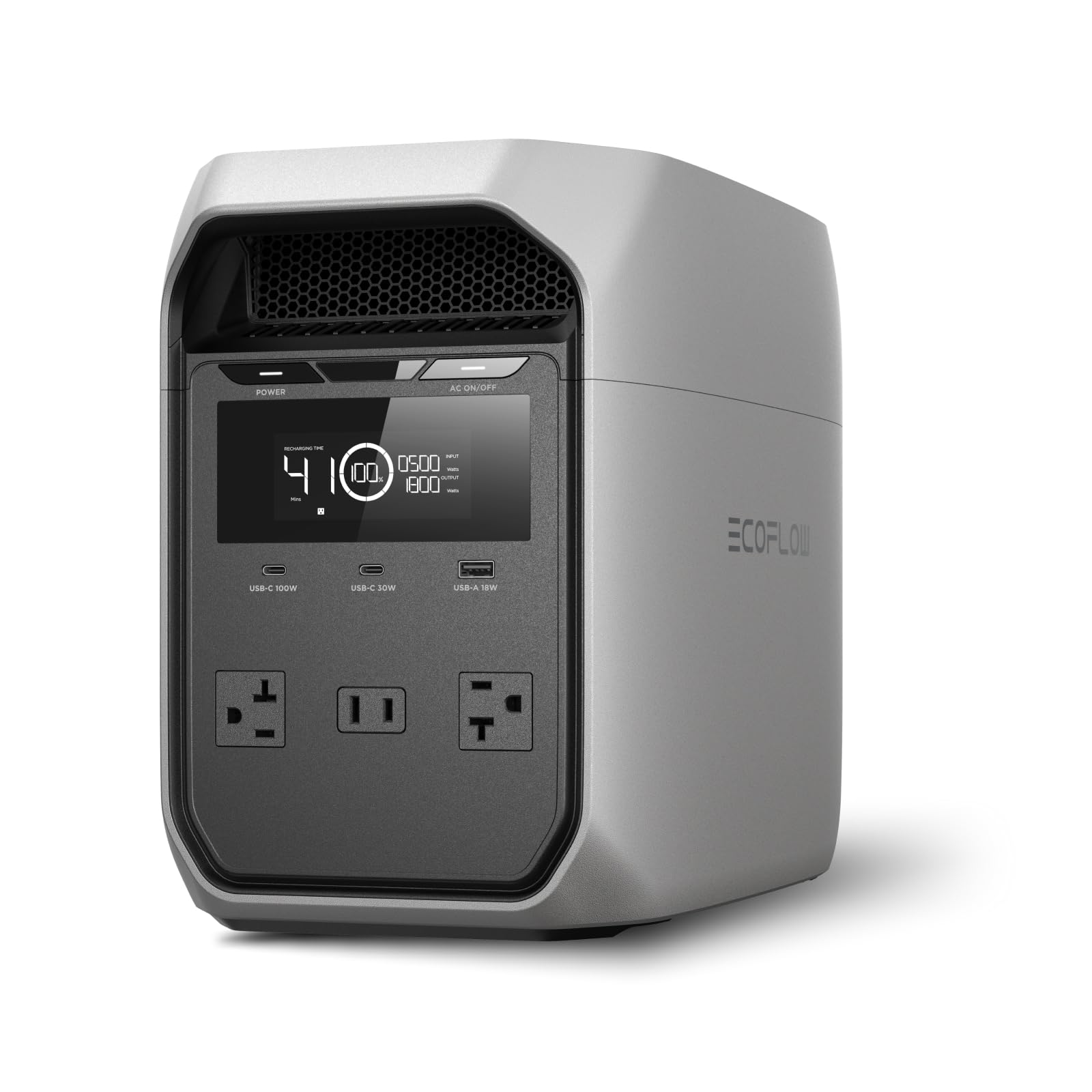
The EcoFlow DELTA 3 Classic packs 1024Wh of LiFePO4 capacity and an 1800W inverter (3600W surge with X-Boost) into a compact, thoughtfully designed chassis that weighs about 33 pounds. The standout feature is the sub-10ms UPS switchover, which is faster than many dedicated UPS units — ideal for protecting sensitive electronics like PCs, servers, and medical devices from data loss or shutdown during utility flickers. The X-Stream AC charging fills the battery from 0–80% in just 45 minutes, making it one of the fastest recharge times in the 1kWh class.
Solar input up to 500W recharges fully in 2.5 hours with an optional panel, and the unit supports smart app scheduling, storm alert mode, and self-powered mode. The 15 outlets include multiple AC ports, USB-A, USB-C (100W), and DC5521 outputs — enough to run a mini fridge, a fan, and several devices simultaneously. Real-world users report powering an electric leaf blower and an electric grill for 2–3 hours with over 50% battery remaining, or a mini fridge and fan for 5 hours with 50% left.
The build quality is excellent: dual handles with non-skid pads, a swing-up input cover, and soft-touch manual bag reflect EcoFlow’s attention to detail. The EV-grade CTC (Cell-to-Chassis) design improves thermal management and structural rigidity. The 10-year battery lifespan (daily cycling) makes this a long-term investment. However, the unit is not expandable like the larger Delta Pro, so capacity is capped at 1024Wh. For apartment dwellers, office backup, or overnight camping, the Delta 3 Classic is a near-ideal small system.
Why it’s great
- Ultra-fast 0–80% charge in 45 minutes
- <10ms UPS switchover protects sensitive electronics
- Compact and well-designed with dual handles
Good to know
- Not expandable — capacity limited to 1024Wh
- Incompatible with Delta 2 or Delta 3 extra batteries
6. BLUETTI Elite 100 V2 Portable Power Station
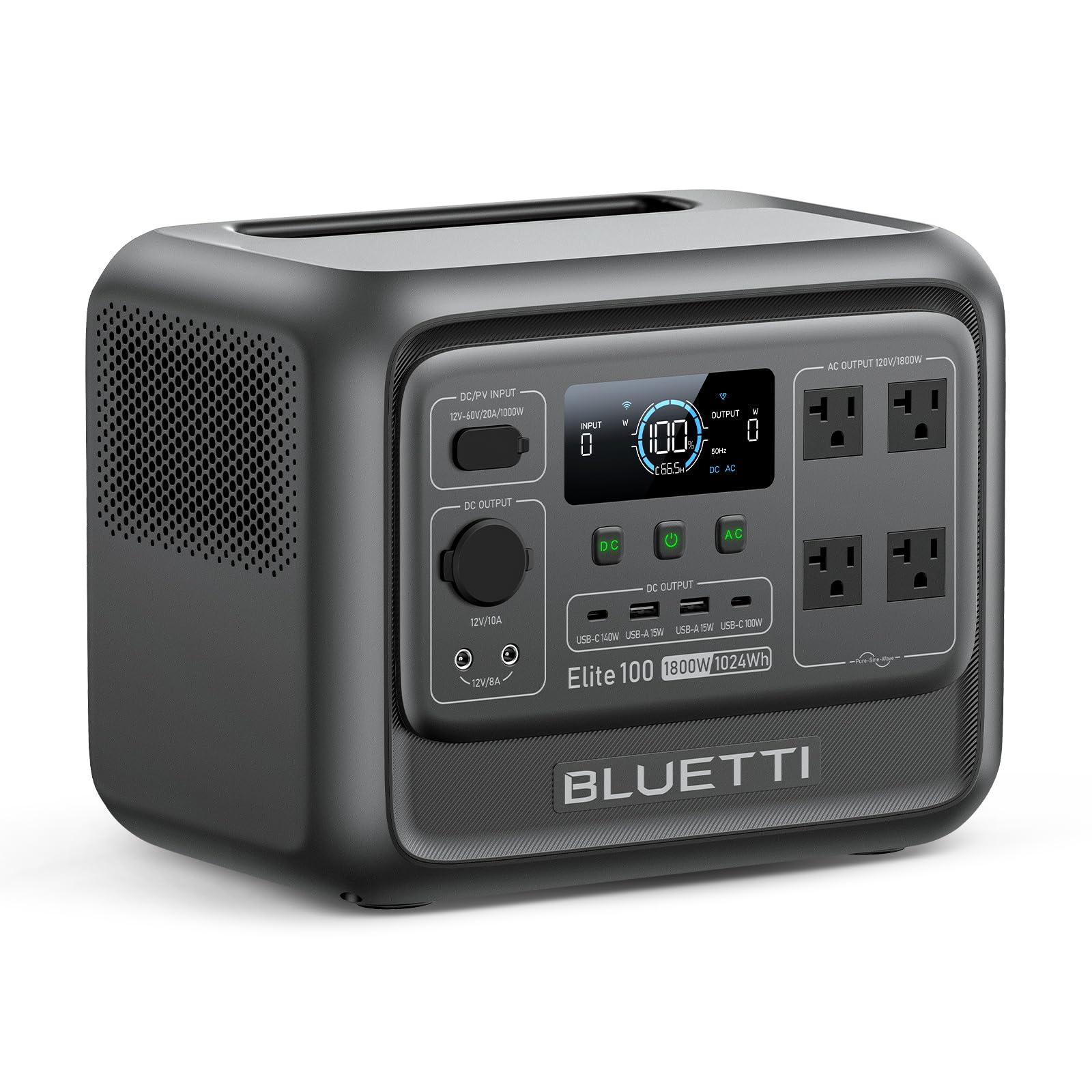
The BLUETTI Elite 100 V2 is a 1024Wh portable power station that prioritizes compactness and quiet operation. It is 35% smaller and 30% lighter than its predecessor, weighing just 25 pounds with a volume of 17 liters — small enough to grab one-handed by the hidden handle. The 1800W AC inverter (3600W surge) powers 11 devices simultaneously across 4 AC ports, USB-A, USB-C, and DC outlets. The ≤10ms UPS switchover keeps routers and PCs running through brief grid interruptions, and the unit operates at a library-quiet 30dB under light loads.
Charging versatility is strong: 1000W solar input fills the battery in about 70 minutes, while 1200W TurboBoost AC charging achieves the same. The 4000+ cycle LiFePO4 battery ensures a decade of service life. Owners report seamless integration into mobile notary businesses, powering laptops, printers, and hotspots for a full workday, as well as running mini fridges and basic power tools on camping trips. The weight-to-capacity ratio is one of the best in the 1kWh class, making it easy to move from home office to campsite.
The app provides monitoring and control, though some users note it cannot turn on AC output via Bluetooth or Wi-Fi — a minor functional limitation. There is no built-in light or wireless charging pad. The fan ramps up noticeably under heavy loads above 500W or during AC charging, but under normal loads it remains nearly silent. For users who need a lightweight, quiet, and reliable 1kWh backup for occasional outages and weekend trips, the Elite 100 V2 is an outstanding choice.
Why it’s great
- Best weight-to-capacity in 1kWh class (25 lbs)
- Library-quiet 30dB operation under light loads
- Fast 70-min full charge via solar or AC
Good to know
- No built-in light or wireless charger
- App cannot remotely turn on AC output
7. AFERIY P210 Portable Power Station

The AFERIY P210 brings a 2048Wh LiFePO4 battery and a 2400W pure sine wave inverter (4800W surge) to the mid-capacity segment at a compelling price point. With 16 ports — 6 AC outlets, 2 USB-A, 4 USB-C (including one 100W PD), 2 DC5521, a car outlet, and an XT60 port — it handles simultaneous charging of up to 16 devices. The <10ms UPS response makes it a viable backup for sensitive electronics, and the pure sine wave AC output (both input and output) ensures clean power identical to wall outlets.
Noise levels are exceptionally low: under 30dB at full load and only 16dB under normal load, which is virtually silent — ideal for bedroom or outdoor use without disturbing sleep. The AFERIY app provides energy management and automation settings. The 3500+ cycle life (10-year durability) is backed by a 7-year extended warranty, which is 2 years longer than most competitors. Owners report excellent value for food truck operations, RV UPS use, and home backup, with fast 2-hour AC recharge times.
The unit is also compact for its capacity and includes a dust cover, MC4 solar cable, and a wire pouch. At 48.5 pounds, it is heavier than the Jackery 2000 v2 but lighter than many other 2kWh options. The main compromise is the lack of a high-speed alternator charging option and a slightly lower solar input rate. For budget-conscious buyers who want 2kWh of silent, clean power with an industry-leading warranty, the P210 is a strong value proposition.
Why it’s great
- High 16-port capacity with 2400W inverter
- Exceptional 7-year extended warranty
- Near-silent operation at 16dB normal load
Good to know
- Heavier than some 2kWh competitors (48.5 lbs)
- No high-speed alternator charging option
8. PowerSmart 7000W Open Frame Inverter Generator
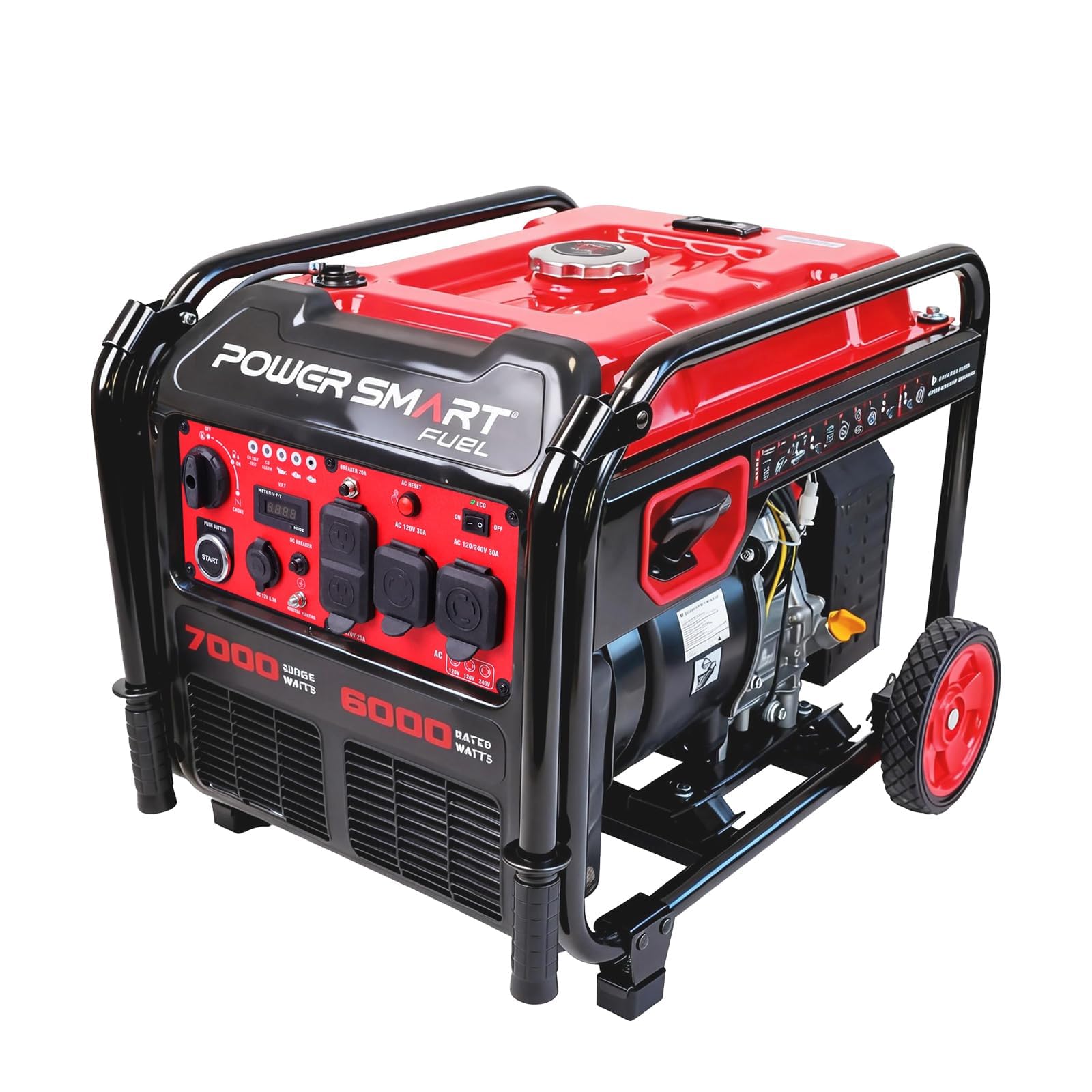
The PowerSmart 7000W Inverter Generator bridges the gap between noisy conventional generators and premium inverters. Producing 7000 surge / 6000 rated watts with less than 3% total harmonic distortion (THD), it safely powers sensitive electronics like laptops, phones, and smart TVs — something standard open-frame generators cannot do without risking damage. The 322cc 4-stroke OHV engine features electric push-button start (battery included) with a recoil backup, and the 3.2-gallon fuel tank delivers 6 hours of runtime at 50% load.
The 120/240V dual-voltage capability with a selector switch makes it transfer-switch ready for whole-house backup or RV 50-amp service. The panel includes AC outlets and a 12V DC output (25A rated current) for charging batteries or running DC devices. The open-frame design provides superior airflow and cooling, extending engine life under sustained heavy loads. At 113.5 pounds with a compact footprint (25.9 x 19 x 19 inches), it is manageable with the included wheel kit. Noise measures 70dB(A) at 23 feet — quieter than traditional generators but louder than a power station.
Real-world owners report running an 8-inch planer without issues and powering a freezer plus two refrigerators during outages. The generator runs on gasoline only, but some users have successfully adapted it for propane (aftermarket modification). The CO sensor, low-oil shutdown, and overload protection add safety layers. The main downsides are the weight (requires a dolly for frequent moves) and the need to stabilize fuel for seasonal storage. For budget-minded homeowners who need 240V capability, clean inverter power, and high wattage, this is an excellent entry-level gas generator.
Why it’s great
- Clean <3% THD inverter power for electronics
- Dual voltage 120/240V with transfer switch readiness
- Electric push-button start with recoil backup
Good to know
- Gasoline only — no factory dual fuel option
- Needs 10-minute warm-up before high-wattage loads
9. DuroMax XP13000HXT Tri Fuel Generator
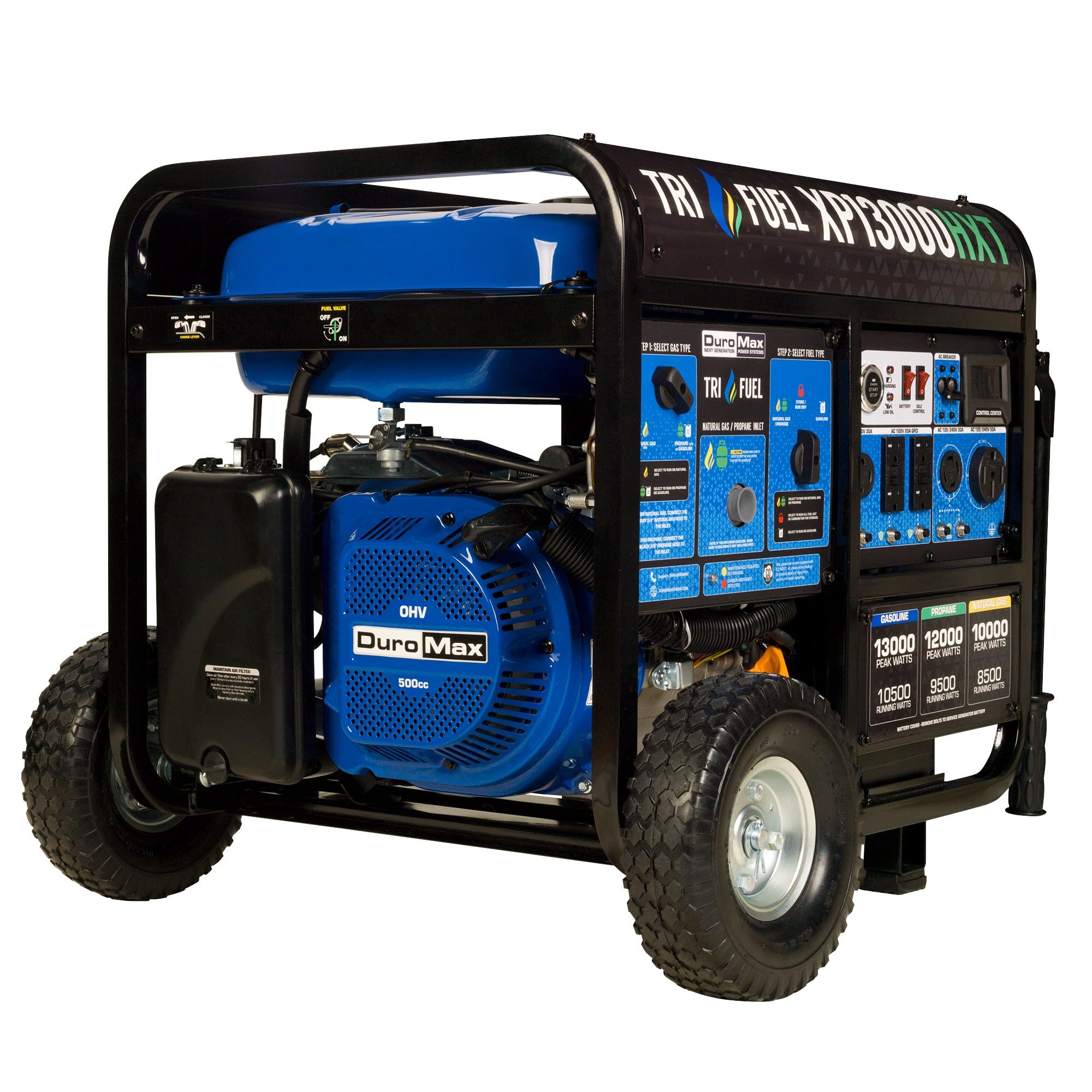
The DuroMax XP13000HXT is a brute-force whole-home generator that runs on gasoline, propane, or natural gas — the ultimate fuel flexibility for extended outages. The 500cc OHV engine delivers 13,000 peak watts (10,000 running watts on gasoline), enough to power an entire house including central AC, a well pump, a furnace, and all major appliances simultaneously. The push-button start with remote control adds convenience, and the front-facing interface allows fuel type changes in seconds without tools.
The 50-amp outlet (NEMA 14-50R) is transfer-switch ready, and the unit includes a complete tri-fuel kit with a natural gas hose and propane regulator. The CO alert sensor provides critical safety protection against carbon monoxide buildup. Real-world owners report running four refrigerators, a furnace, security lights, and security cameras at just 25–30% load, or powering a whole house for 6 hours on 2.2 gallons of gas. The remote start works from about 50 feet, and the digital display shows voltage, frequency, and lifetime hours.
The downsides are significant: the XP13000HXT weighs 240 pounds, requires assembly (wheels, handle, oil), and is loud — typical for a 500cc engine. The included battery may discharge during storage, and the fuel selector knob can be stiff when switching fuels. Natural gas users need a 3/4-inch line with sufficient BTU capacity (225K BTU/hr minimum). For homeowners who need true whole-home backup with multiple fuel options and are willing to manage the weight, noise, and outdoor storage requirements, this DuroMax delivers unmatched power per dollar.
Why it’s great
- Runs on gas, propane, or natural gas with included kit
- 13,000W peak powers full home including central AC
- Remote start and push-button convenience
Good to know
- Very heavy (240 lbs) with moderate assembly needed
- Loud operation typical of large open-frame units
10. Westinghouse iGen11000DFc Dual Fuel Inverter Generator

The Westinghouse iGen11000DFc combines the power output of a whole-home generator with the clean power quality of an inverter. With 11,000 peak watts (9,000 running) on gasoline and 10,000 peak (8,100 running) on propane, it produces less than 3% THD — safe for sensitive electronics, medical equipment, and even electric vehicle charging. The 457cc Westinghouse engine features a cast iron sleeve for long life, and the dual-fuel capability (gasoline or propane) provides fuel flexibility for extended outages.
The remote electric start with key fob, push-button, and recoil backup ensures reliable startup in any condition. The 9.8-gallon fuel tank provides up to 17 hours of runtime on gasoline at light loads. The outlet panel includes two GFCI 120V 20A household outlets, a 120V L14-30R 30A outlet, and a 120/240V 14-50R 50A outlet — both transfer-switch ready. The LED data center displays fuel level, power output, remaining runtime, voltage, and lifetime hours. The CO sensor adds safety by automatically shutting down the generator if carbon monoxide builds up.
Real-world owners report charging a Tesla at 20–25 miles per hour via the 50A outlet while running household loads — a unique capability for a portable generator. The unit weighs 187 pounds with integrated wheels and a foldable handle, making it easier to move than the DuroMax. Noise is measured at around 64 dBA — notably quieter than non-inverter generators of similar output. The main downside is the premium price point, which is justified by the clean inverter power, dual-fuel flexibility, and EV charging compatibility. For homeowners who want the best power quality in a gas generator, the iGen11000DFc is the top choice.
Why it’s great
- Clean <3% THD inverter power for sensitive electronics and EV charging
- Dual fuel (gasoline/propane) with 17-hour runtime
- 50A outlet for transfer switch and EV charging
Good to know
- Heavy (187 lbs) despite wheels and handle
- Propane hose connection on regulator side can be awkward
11. Westinghouse WGen14500TFc Tri Fuel Generator
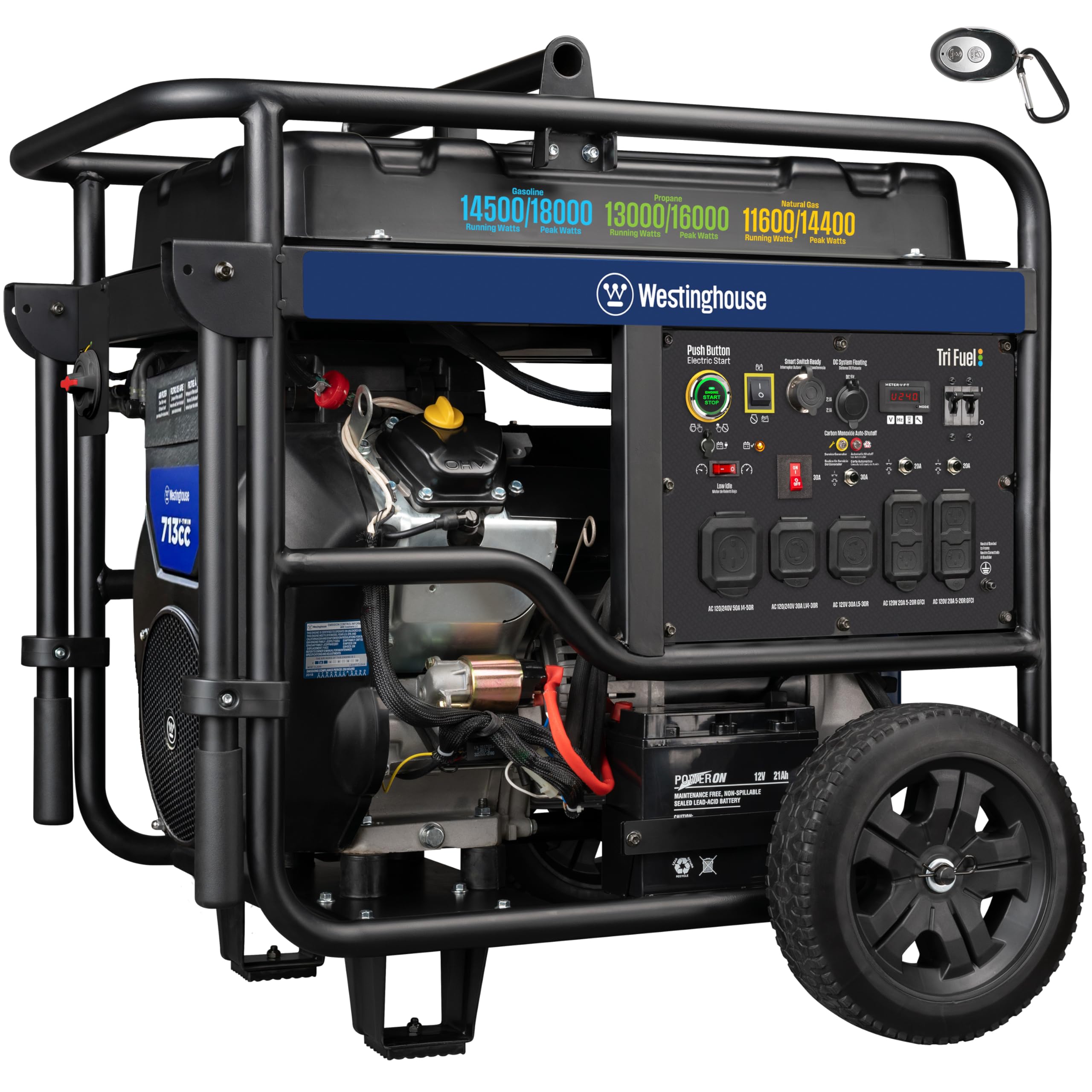
The Westinghouse WGen14500TFc is the flagship tri-fuel generator in this roundup, delivering staggering output: 18,000 peak watts / 14,500 running on gasoline, 16,000 peak / 13,000 running on propane, and 14,400 peak / 11,600 running on natural gas. The 713cc V-Twin OHV engine provides the torque needed to start and run large central AC units, well pumps, and electric water heaters simultaneously. The tri-fuel capability means you can choose the cheapest or most available fuel in an emergency — gasoline for portability, propane for clean storage, or natural gas for unlimited runtime via a home gas line.
The remote electric start with key fob makes activation convenient from a distance, while the push-button and recoil backup ensure reliability. The 10.5-gallon fuel tank provides up to 16 hours of runtime at 25% load on gasoline. The outlet panel includes a 120/240V 50A (NEMA 14-50R) outlet and a 120/240V 30A (L14-30R) outlet — both transfer-switch and interlock-kit ready — plus a 120V 30A outlet, two GFCI 120V 20A duplex outlets, and two USB ports. THD is under 5%, which is safe for most electronics but not as clean as the Westinghouse inverter generators (which achieve under 3%).
At 348 pounds and measuring 30.3 x 34.9 x 34.3 inches, this is a stationary unit that requires a permanent outdoor location or a heavy-duty wheel kit with lift bar. Owners report running full 11kW loads on natural gas at stable 60Hz frequency with 5.5–5.8% THD. The CO sensor ensures automatic shutdown if exhaust accumulates. The main compromises are weight, noise (around 74 dBA), and the lack of a pre-installed NG hose (sold separately). For large homes with high electrical demands where fuel flexibility is paramount, the WGen14500TFc is the ultimate portable backup generator.
Why it’s great
- Highest power output in this guide (18,000W peak)
- Tri-fuel: gasoline, propane, or natural gas
- Remote start with key fob and 50A transfer switch readiness
Good to know
- Very heavy (348 lbs) — effectively stationary
- No factory-installed NG hose; THD at 5%+
FAQ
Can I run my central air conditioner on a portable power station?
How do I safely connect a generator to my home’s electrical panel?
How many watt-hours do I need to run a refrigerator for 24 hours?
What is the difference between a dual fuel and a tri-fuel generator?
Final Thoughts: The Verdict
For most users, the best backup power for home winner is the Jackery Explorer 2000 v2 because it delivers 2042Wh of clean, silent power in the lightest 2kWh package available, with UL-certified UPS protection and ultra-fast AC charging — the ideal balance of capacity, portability, and recharge speed for the average household. If you want the fastest recharge and the ability to expand to 4kWh, grab the Anker SOLIX C2000 Gen 2. And for whole-home backup with tri-fuel flexibility and massive power output, nothing beats the Westinghouse iGen11000DFc — a dual-fuel inverter generator that can even charge your EV during an outage.

Mo Maruf
I created WellFizz to bridge the gap between vague wellness advice and actionable solutions. My mission is simple: to decode the research and give you practical tools you can actually use.
Beyond the data, I am a passionate traveler. I believe that stepping away from the screen to explore new environments is essential for mental clarity and physical vitality.