Our readers keep the lights on and my smoothie glass nicely filled. As an Amazon Associate, I earn from qualifying purchases.
A storm rolls in, the lights flicker, and then everything goes dark. The silence that follows is a reminder that your home’s entire rhythm depends on a single, fragile grid connection. Choosing the right backup power means deciding how deeply you want that dependency to affect your family’s safety, food storage, and comfort during the next outage.
I’m Mohammad Maruf — the founder and writer behind WellFizz. I’ve spent countless hours analyzing the horsepower, fuel systems, battery chemistries, and safety protocols that separate a reliable home backup from a frustrating paperweight.
Whether you need to keep a refrigerator running or power an entire house for days, understanding the real-world trade-offs between fuel-burning generators and solar battery systems is essential. This guide cuts through the specs to help you select the precise backup generator for home that matches your actual outage scenario and budget comfort.
How To Choose The Best Backup Generator For Home
Selecting a home backup generator boils down to three core decisions: how much power you need simultaneously, how long you expect outages to last, and whether you want fuel independence or plug-and-play simplicity. Portable gas generators offer high wattage at a lower upfront cost but require fuel storage and ventilation. Battery power stations provide silent, fume-free operation with zero maintenance, but capacity and recharging speed become your limiting factors. Understanding your home’s critical load — the sum of wattage required by your refrigerator, lights, internet, and perhaps a well pump — is the starting point. Anything below that number means you will be tripping breakers during an outage.
Fuel Type Determines Runtime and Logistics
Gasoline is widely available but degrades over weeks, making it less ideal for emergency storage. Propane stores indefinitely and burns cleaner, but you lose roughly 10% of your generator’s peak wattage when running on it. Solar battery systems require zero fuel and operate silently indoors, yet their total energy is capped by battery capacity and solar panel recharging rates. For a multi-day outage without sun, a battery station is only as good as its stored kilowatt-hours. Dual-fuel generators give you the flexibility to switch between gasoline and propane depending on what is available, making them a pragmatic middle ground for most homes.
Wattage Ratings Are Not All Equal
Every generator lists two numbers: running watts and surge (peak) watts. Running watts is the continuous power the unit can sustain, while surge watts covers the extra kick needed to start motor-driven appliances like refrigerators, air conditioners, and well pumps. A refrigerator may draw 700 running watts but spike to 2200 surge watts during compressor startup. Underestimating surge requirements is the most common mistake buyers make. Match the generator’s surge wattage to the single largest starting load in your home, plus the sum of all other running loads, to avoid constant shutdowns.
Transfer Switch or Extension Cords
A manual transfer switch hardwires your generator to your home’s electrical panel, allowing you to power hardwired circuits like a furnace or well pump safely. Extension cords work for smaller portable generators but limit you to individual plug-in appliances. If you plan to power a central air conditioner, electric water heater, or any 240V appliance, a transfer switch is not optional — it is a code and safety requirement. Battery power stations with UPS functionality can switch within milliseconds, making them ideal for sensitive electronics and medical devices without any electrical work.
Quick Comparison
On smaller screens, swipe sideways to see the full table.
| Model | Category | Best For | Key Spec | Amazon |
|---|---|---|---|---|
| Generac Guardian 22kW | Standby | Whole-house automatic backup | 22,000 running watts, 999cc engine | Amazon |
| Westinghouse 12500W | Dual-Fuel Portable | High-power portable with remote start | 12,500 peak watts, 457cc engine | Amazon |
| GROWATT 2x HELIOS 3600 | Solar Battery System | Whole-house dual-unit parallel setup | 7200W AC output, expandable to 36kWh | Amazon |
| OSCAL PowerMax 6000 | Solar Generator | Dual voltage 120/240V with solar panels | 6000W running, 9000W surge | Amazon |
| ECO-WORTHY 10240Wh | Battery + Inverter Kit | DIY whole-home battery bank | 5000W inverter, 10240Wh LiFePO4 | Amazon |
| EF ECOFLOW DELTA Pro | Portable Power Station | Expandable 3600W mobile workstation | 3600Wh capacity, 3600W AC output | Amazon |
| Jackery HomePower 3000 | Solar + Battery Bundle | All-in-one solar kit with panels | 3072Wh LFP, 7200W surge | Amazon |
| AFERIY P310 3840Wh | Portable Power Station | High capacity fast-charge backup | 3840Wh, 3600W output, 1.5H recharge | Amazon |
| Jackery Explorer 2000 v2 | Portable Power Station | Lightweight 2kWh silent UPS | 2042Wh LiFePO4, 2200W output | Amazon |
| Anker SOLIX C2000 Gen 2 | Portable Power Station | Ultra-fast recharge 58-min full | 2048Wh, 2400W rated, 4000W peak | Amazon |
| WEN DF8000X | Dual-Fuel Portable | Budget-friendly dual fuel workhorse | 8000 surge watts, 340cc engine | Amazon |
In‑Depth Reviews
1. Generac Guardian 22kW with 200A Transfer Switch
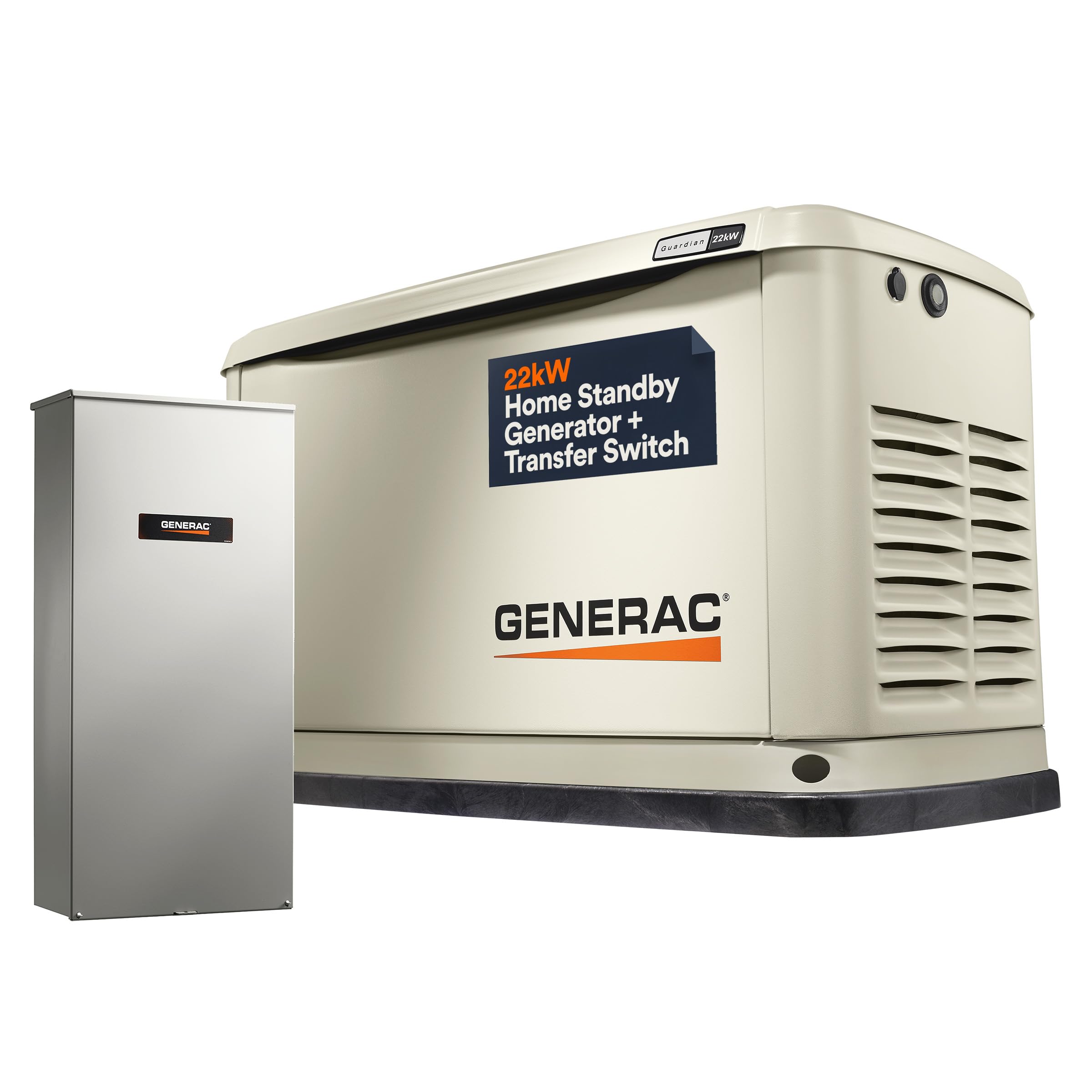
This is the gold standard for whole-house peace of mind. The 22,000-watt Generac Guardian turns on automatically when the grid fails, powers your entire home — including central AC, well pump, and electric oven — and runs on natural gas or liquid propane so you never have to store gasoline. The included 200-amp NEMA 3R smart transfer switch simplifies installation for a licensed electrician, and the G-Force 999cc engine is designed to handle hundreds of hours of annual use without excessive wear. True Power Technology delivers under 5% total harmonic distortion, meaning sensitive electronics like your television and computer see clean, stable power.
The WiFi-enabled Mobile Link lets you check system status, run schedules, and receive maintenance alerts from your phone. Owners report that this unit covers nearly every circuit in a typical 3,000-square-foot home, running everything simultaneously during multi-day outages. The 5-year limited warranty provides long-term assurance, though professional installation — required for code compliance — adds to the overall investment. At 466 pounds, this is a permanent fixture, not a portable unit, and it demands a concrete pad and permits. For families who experience frequent, prolonged outages and want zero interaction during a blackout, this is the definitive solution.
One important caveat: the onboard computer and WiFi module are sensitive to power surges, so a dedicated surge protector on the control panel is recommended. A single reviewer noted the mandatory app and cloud connectivity as a reliability concern for true off-grid scenarios. Still, for grid-tied homes, the convenience of automatic startup, unlimited fuel supply from a gas line, and the ability to power heavy 240V loads make this the most capable single solution on this list.
Why it’s great
- Automatic transfer switch included for seamless whole-house backup
- Runs on natural gas or propane with no fuel storage needed
- Clean sine wave output under 5% THD for sensitive electronics
Good to know
- Requires professional installation and a concrete pad
- Heavy 466-pound unit is permanent, not portable
- Onboard computer can be vulnerable to power surges
2. Westinghouse 12500W Dual Fuel Portable Generator

If you need serious portable power with the convenience of remote start, the Westinghouse 12500W delivers 12,500 peak watts on gasoline and 11,200 watts on propane. The 457cc cast-iron sleeve engine is built for longevity, and the electric start with included key fob means you can fire it up from inside the garage before heading outside in bad weather. The 6.6-gallon fuel tank provides up to 12 hours of run time at half load, and the dual-fuel capability gives you the option to tap a propane tank when gasoline runs scarce. The outlet panel includes a 50-amp RV-ready receptacle and a 30-amp twist lock for transfer switch connection.
Assembly is straightforward — attach the wheels, add oil and battery, and it is ready to run within 30 minutes. Owners consistently praise the automatic low-oil shutdown and CO sensor that automatically kills the engine if dangerous carbon monoxide levels build up. At 212 pounds, the wheel kit makes it movable, but it is still a two-person job to get it down stairs or into a truck bed. The noise level is comparable to a gas-powered lawn tractor, so expect to manage neighbor relations during overnight use. A high-altitude kit is required for operation above 2,000 feet.
The remote start works reliably up to about 100 feet, and the digital hour meter helps you track maintenance intervals. Westinghouse backs it with a 3-year limited service, labor, and parts warranty. Several reviewers mention that the included oil funnel and tool kit make first-time setup easy, and that the unit has started on the first pull even after months of storage. For the homeowner who wants near-whole-house power without the permanent installation cost, this is a balanced, mid-range workhorse.
Why it’s great
- Remote start key fob offers convenience from inside the house
- Cast-iron sleeve engine extends operating life significantly
- CO sensor and auto shutdown add critical safety protection
Good to know
- Weighs 212 pounds; moving it alone is challenging
- Requires high-altitude kit above 2,000 feet
- Operating noise is similar to a gas lawn mower
3. GROWATT 2x HELIOS 3600 with Double Voltage Hub
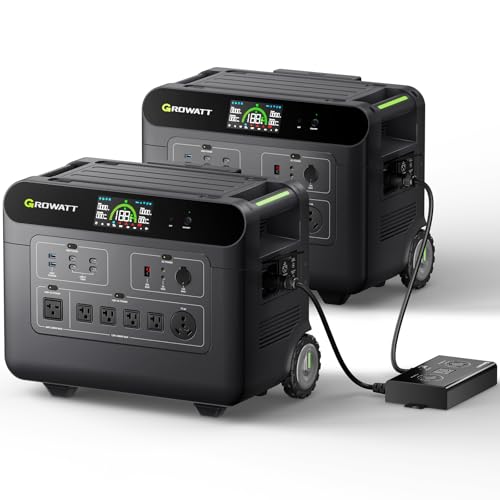
The GROWATT dual-unit kit gives you 7200W of clean AC output and the ability to run 240V appliances by pairing two 3600Wh power stations with a split-phase connector. This is a solar battery system designed for homeowners who want whole-house backup without a permanent generator install. Each unit features EV-grade LiFePO4 cells with a 4000-cycle lifespan, and the system can be expanded to 36kWh total capacity when you add extra batteries. The <15ms EPS switchover means your computer, router, and medical devices never notice a blip during an outage.
Recharging is flexible and fast: you can plug into a standard 120V outlet, use a 240V dryer outlet for a full charge in 1.5 hours, or connect solar panels for off-grid replenishment. The cold-start technology works down to -22°F, so this system is viable even in harsh winter climates. Owners report running an 8,000 BTU air conditioner for about five hours on a single unit, and with both units in parallel, a full-size refrigerator, lights, and well pump run for over 24 hours. The app provides real-time monitoring, though some early units had Bluetooth connectivity quirks.
The 100-pound weight per unit makes it portable but heavy, and the handle and wheel positioning could be better. The parallel hub disables the EPS function when connected, meaning you lose seamless switchover in dual-unit mode. GROWATT backs the system with responsive US-based customer service, and the UL certification adds safety confidence. For homes that want to avoid gasoline, propane, and engine noise, this provides the most scalable all-electric backup path on the market.
Why it’s great
- Dual units parallel for 7200W 240V whole-house power
- LiFePO4 cells with 4000 cycles for 10+ year lifespan
- Fast 1.5-hour recharge via 240V AC input
Good to know
- Each unit weighs 100 pounds; awkward to carry
- EPS function disabled when connected to parallel hub
- Some units have had Bluetooth/Wi-Fi pairing issues
4. WEN 8000-Watt Dual Fuel Portable Generator DF8000X
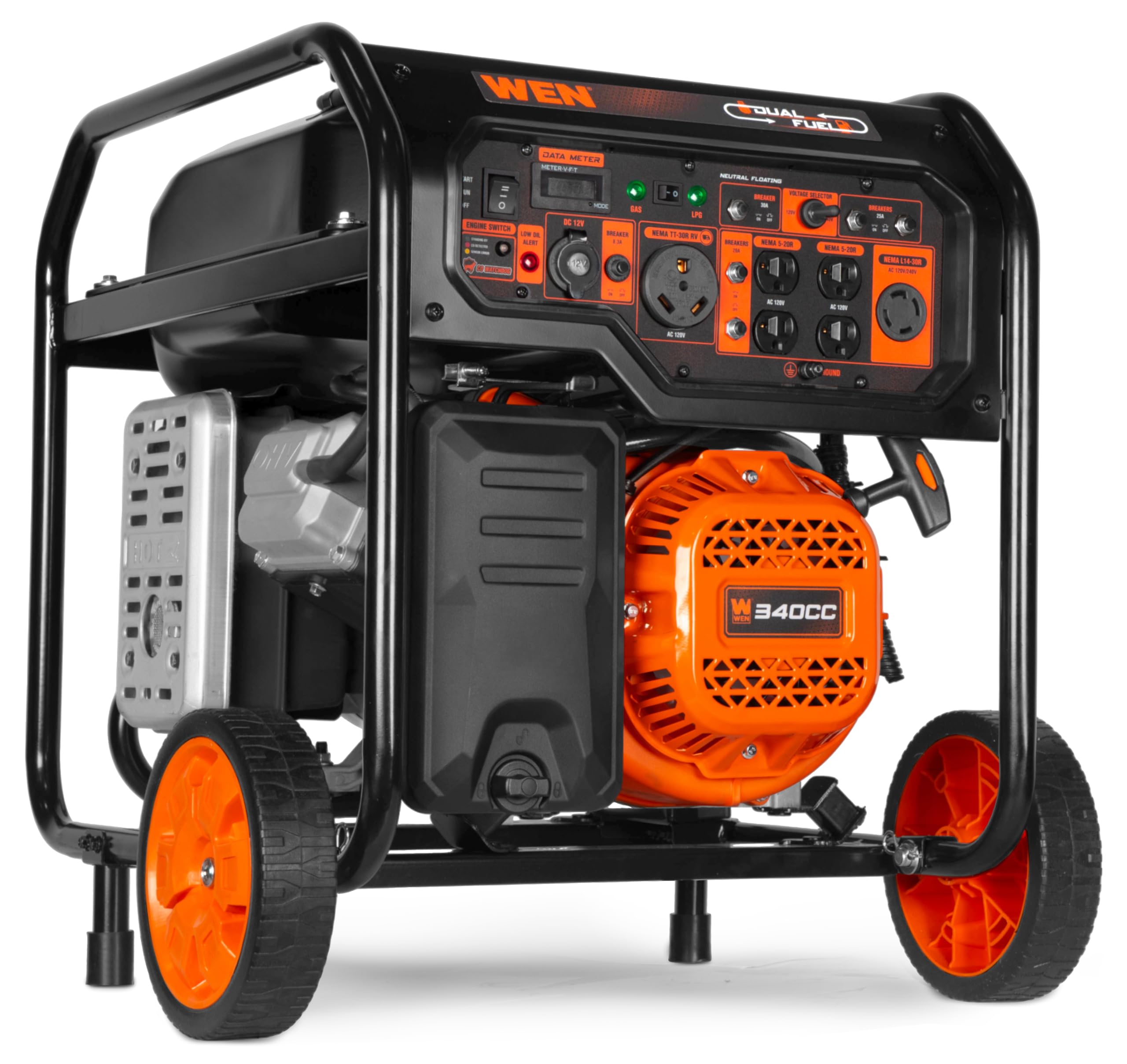
The WEN DF8000X delivers 8,000 surge watts on gasoline and 7,200 on propane, making it a strong entry-level choice for powering a refrigerator, sump pump, and several lights during an outage. The electric push-button start eliminates the frustration of pull-cord recoil, and the 340cc engine runs for up to 10.5 hours on a full 6.7-gallon tank at half load. The Watchdog CO Shutdown Sensor automatically kills the engine if carbon monoxide reaches dangerous levels, a critical safety feature if you are running it near the house. The outlet panel includes a 30-amp RV outlet and a 30-amp twist-lock receptacle for transfer switch connection.
Assembly requires basic tools and about 20 minutes. Owners report that the unit starts reliably on the first or second attempt, and the dual-fuel operation lets you switch fuels at the turn of a knob without draining the carburetor. The open-frame design makes oil changes and carburetor draining straightforward for seasonal storage. The noise level measures around 82 dB, comparable to a push mower, so ear protection is advisable for extended use. Some users note that the fuel shutoff rocker switch does not stop the engine — you must close the fuel valve and let the carburetor run dry to prevent stale fuel issues.
Long-term reviewers have logged thousands of hours with proper maintenance, and WEN’s customer service has replaced units under warranty when manufacturing defects appeared. The included wheel kit and handle make rolling it across a flat driveway manageable, though the 120-pound weight is still significant. For the homeowner on a tighter budget who needs dual-fuel flexibility and reliable starting, this is the most cost-effective path to mid-range backup power.
Why it’s great
- Dual-fuel flexibility at a highly accessible price point
- Co watchdog sensor provides automatic carbon monoxide shutdown
- Electric start with push button eliminates pull-cord hassle
Good to know
- Open-frame design requires outdoor use with ventilation
- Noise level around 82 dB, similar to a push mower
- Engine shutoff requires closing fuel valve manually
5. ECO-WORTHY 10240Wh Home Power Station
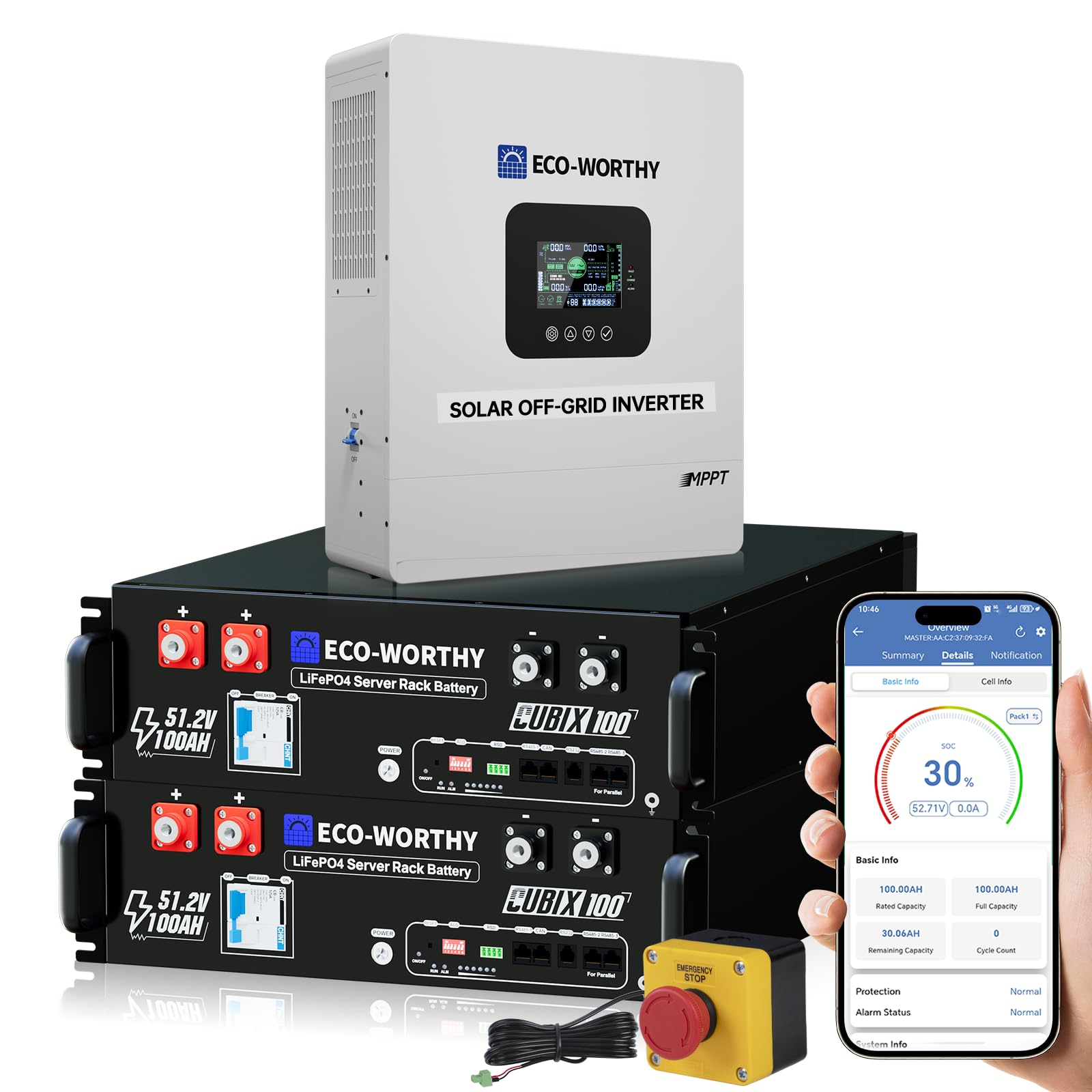
This kit is for the serious DIY homeowner who wants a modular battery bank, not a plug-and-play power station. The ECO-WORTHY system includes two 51.2V 100Ah LiFePO4 batteries and a 5000W MPPT hybrid inverter, delivering 10,240Wh of storage capacity and 5,000W of continuous AC output. The inverter is a 3-in-1 unit: pure sine wave inverter, 100A MPPT solar charge controller, and a 100A battery charger. You can expand to 32 batteries and 6 inverters in parallel for up to 163.84kWh and 30kW output, making this a true whole-home platform.
Both the battery and inverter have passed UL1973 and UL1741 testing, so they meet North American safety standards. The closed-loop communication between battery and inverter uses CAN/RS485 protocols, allowing the system to optimize charging automatically. The built-in Bluetooth and WiFi let you monitor state of charge, voltage, and temperature through the ECO-WORTHY app. Owners report that setting up the system takes a couple of hours with proper wiring, and the inverter handles 240V loads when two units are paralleled — one user ran an electric dryer and well pump without issues.
The 223.8-pound combined weight means this is not a portable system; it belongs in a garage, basement, or utility room. The instructions are functional but could be clearer, especially regarding the AC input current limit setting for US 110V circuits. Customer support has been responsive for troubleshooting. If you are comfortable with basic electrical wiring and want a scalable battery system that can grow with your energy needs, this delivers the best price-per-kilowatt-hour of any option here.
Why it’s great
- Massive 10,240Wh capacity at a very competitive price per kWh
- Expandable up to 32 batteries and 6 inverters for whole-home use
- UL certified with closed-loop BMS communication for safety
Good to know
- Heavy (224 lbs) and requires dedicated installation space
- Setup requires basic electrical knowledge and proper wiring
- Instructions could be more detailed for first-time users
6. EF ECOFLOW DELTA Pro 3600Wh Portable Power Station
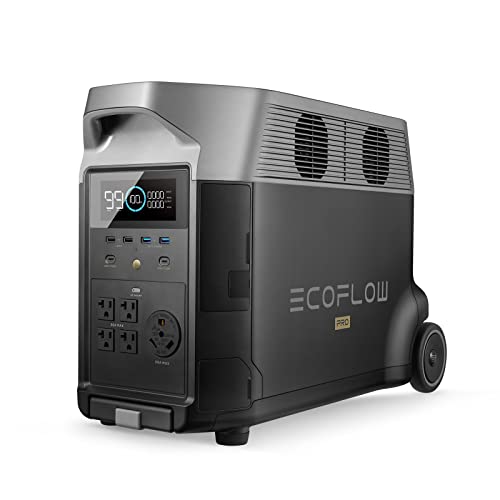
The DELTA Pro is the most established name in high-capacity portable power stations, and for good reason. Its 3600Wh LFP battery delivers 3600W continuous AC output, expandable to 4500W using X-Boost technology, and you can pair two units for 7200W. The X-Stream fast charging replenishes the battery from 0 to 80% in just 1.8 hours using a 240V outlet, or 2.7 hours from a standard 120V wall outlet. Solar charging with four 400W panels fully refills the battery in roughly 2.8 hours, thanks to 23% solar conversion efficiency.
You get 15 output ports: five 120V AC outlets, two USB-C 100W PD ports, USB-A, DC outlets, and a car port. The system supports EV station charging, making it a versatile option for road trips and mobile work. The smart app lets you monitor individual port status, adjust charging speeds, and set custom discharge limits. Owners use the DELTA Pro to run refrigerators, freezers, coffee makers, and medical devices during power outages, and the pass-through UPS mode auto-switches in under 20ms, so your equipment never resets.
At 99 pounds, it is heavy but manageable with the integrated handle. The cooling fan is audible but not disruptive during normal operation. Some users note that the wall charging time is on the slower side at 7 hours when using a standard 120V outlet, though the fast 240V charging mitigates this. Expansion batteries add significant cost, but the modular ecosystem lets you start with a single unit and grow. For those who want a proven, feature-rich battery generator with rapid recharge and expandability, the DELTA Pro remains a top contender.
Why it’s great
- X-Stream fast charging reaches 80% in 1.8 hours on 240V
- X-Boost extends output to 4500W for heavy appliances
- Pass-through UPS with <20ms switchover protects electronics
Good to know
- Weighs 99 pounds, which makes regular moving a workout
- Expansion batteries are a significant additional investment
- Standard 120V wall charging is relatively slow at 7 hours
7. Jackery HomePower 3000 with 2x 200W Solar Panels
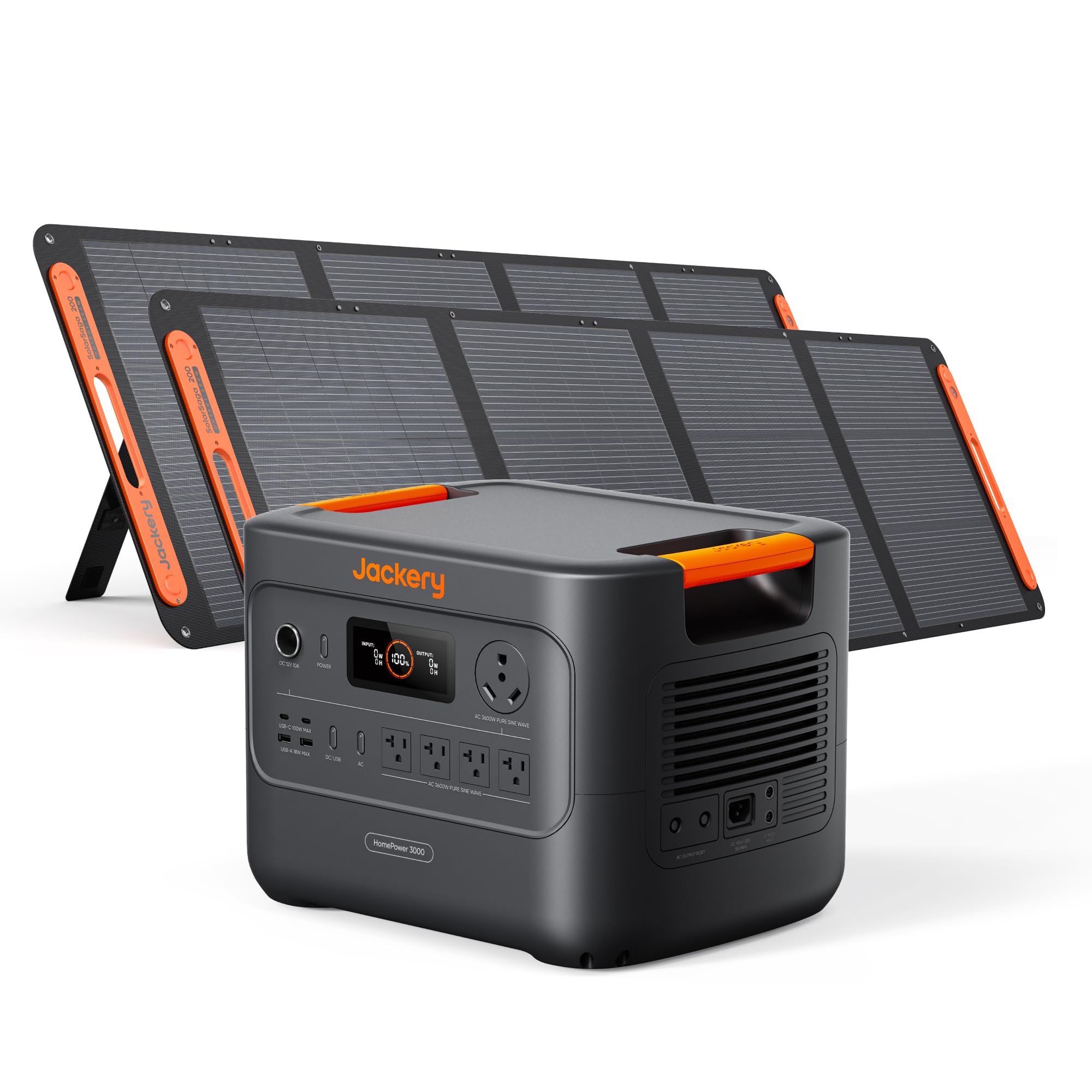
The Jackery HomePower 3000 combines a 3072Wh LiFePO4 battery with two 200W SolarSaga panels in one bundled package. Its 3600W continuous output (7200W surge) can run a refrigerator, lights, router, and a fan simultaneously for up to 15 hours. The UL-certified UPS switches within ≤20ms, so your security cameras and medical fridge stay on without interruption. Jackery’s ChargeShield 2.0 AI algorithm optimizes charging speed and extends the battery cycle life to 4,000 charges while retaining 70% capacity.
This is the lightest 3kWh-class power station on the market at 59.5 pounds, thanks to CTB (Cell-to-Body) technology borrowed from the EV industry. The integrated PV and inverter design reduces bulk, and the honeycomb bottom shell adds structural rigidity. The bundled solar panels charge the unit from 0 to 80% in about 9 hours on a sunny day. You also get dual 100W USB-C PD ports for fast phone and drone charging, a TT-30 RV port for travel trailer hookup, and standard AC outlets for home appliances.
Owners report that the unit runs a small RV’s essential loads (fridge, lights, water pump) for 2–3 days without solar top-up. The main limitation is that you cannot expand capacity with an extra battery — what you buy is what you get. The 60-pound weight is manageable for one person but still heavy for daily moving. Jackery’s after-sales support is well-regarded, and the included 2-year warranty adds confidence. For anyone wanting a complete solar backup system that works out of the box, this bundle delivers unmatched convenience.
Why it’s great
- Complete solar bundle with two 200W panels included
- Lightest 3kWh power station at just 59.5 pounds
- LiFePO4 battery rated for 4,000 cycles with AI management
Good to know
- Capacity is not expandable with additional batteries
- Solar charge to 80% takes about 9 hours on sunny days
- Best for essential loads, not whole-house 240V circuits
8. AFERIY 3840Wh Portable Power Station P310

With 3840Wh of LiFePO4 storage and 3600W continuous output (7200W peak), the AFERIY P310 sits in a sweet spot between compact portable stations and full-home battery banks. Its standout feature is the rapid recharge time: a full charge from AC in just 1.5 hours, supported by adjustable charging speed levels in the app. The UPS backup switches in under 10ms, making it suitable for computers, medical freezers, and security systems. The smart app lets you monitor charge state, adjust input/output, and schedule charging times.
You get 15 output ports including five AC outlets, dual USB-C PD 100W, USB-A, DC5521, and a 12V car socket. The integrated pull handle and wheels make the 80-pound weight manageable for moving between rooms or loading into a vehicle. Owners report that the unit powers a full-size refrigerator for about 17 hours on a single charge, and when paired with solar panels, it serves as a reliable off-grid power source for RV living. The build quality of the included cables and accessories is notably high, with rugged connectors and thick wiring.
Some early users encountered a display issue where LCD segments went dark, though the unit still functioned normally and AFERIY support offered prompt replacement or repair. The fan noise while charging is audible but not excessive. The dust cover flap on the AC panel can interfere with plug insertion on larger adapters. The 7-year support period is a strong value proposition, and the unit qualifies for federal clean energy tax credits if used with solar panels. For those who prioritize fast recharge and high capacity in a mobile form factor, this is a compelling contender.
Why it’s great
- Full recharge in just 1.5 hours via AC input
- Large 3840Wh capacity covers most essential home loads
- 10ms UPS switchover for sensitive electronics protection
Good to know
- 80-pound unit is heavy despite wheeled pull handle
- AC outlet dust cover can obstruct plug insertion
- Some units have reported LCD display anomalies
9. Jackery Explorer 2000 v2 Portable Power Station

The Explorer 2000 v2 is Jackery’s most portable 2kWh-class power station, weighing just 39.5 pounds thanks to CTB technology. It packs 2042Wh of LiFePO4 storage with a 2200W inverter (4400W surge), making it suitable for running a refrigerator, medical CPAP, lights, and small appliances during a 12–24 hour outage. The unit charges from 0 to 80% in just 66 minutes using AC fast charging, and the silent charging mode reaches full charge in 5 hours at under 30 dB, so it won’t disturb sleep.
Three AC outlets, two USB-C PD 100W ports, and a 12V car outlet give you plenty of device connections. The UPS function provides seamless 20ms switching, certified to UL1778 standards. Owners report that it keeps a full-size fridge running for over 21 hours and powers CPAP machines for multiple nights without interruption. The integrated handle is well-designed for carrying, and the unit is 41% lighter and 34% smaller than typical 2kWh power stations. The app provides remote monitoring and emergency super charging mode selection.
The main trade-off is capacity: 2kWh is sufficient for essential loads but not heavy appliances like a well pump or electric heater. Solar charging with a 200W panel is relatively slow, taking over 6 hours for a full charge. The price per kWh is higher than larger stations, but the lightweight design and fast recharge make it an excellent choice for apartment dwellers, small homes, or anyone who needs a portable, silent alternative to a gas generator for short outages.
Why it’s great
- Ultra-light 39.5 pounds for easy portability
- Fast 66-minute charge to 80% via AC input
- Whisper-quiet silent charging mode at <30 dB
Good to know
- 2kWh capacity limits runtime for larger homes
- Solar charging is slow with standard 200W panels
- Higher cost per kWh compared to larger stations
10. Anker SOLIX C2000 Gen 2 Portable Power Station

The Anker SOLIX C2000 Gen 2 is built for speed. Its 2048Wh LiFePO4 battery recharges from 0 to 100% in just 58 minutes — the fastest full recharge in its class. With 2,400W rated output and 4,000W peak, it can handle high-surge appliances like window air conditioners and refrigerators. The standby draw is exceptionally low at only 9W, meaning power is not wasted when the unit is idle. A dual-door refrigerator can run for up to 32 hours on a single charge, and adding the optional expansion battery doubles that runtime to 64 hours.
You get six ways to recharge: AC wall, solar, car alternator (800W ultra-fast alternator charging reaches 100% in 3 hours), and generator. The 41.7-pound weight and compact 18.1 x 9.8 x 10.1-inch footprint make it 25% lighter and 29% smaller than comparable models. The companion app provides detailed usage tracking, battery health monitoring, and charging schedule control. Owners praise the near-silent cooling fans and the ability to power a 30-quart fridge for 5–7 days on a single charge during camping trips.
The metal and plastic construction feels premium, though the lack of a printed manual in the box disappointed some users. The app-based setup is straightforward for anyone comfortable with smartphone interfaces. At this capacity point, 2kWh is still best for essential loads rather than whole-house backup, but the fast recharge and expansion capability make it a standout for frequent travelers or those who need rapid power restoration. The Anker brand reputation for customer support adds confidence for long-term ownership.
Why it’s great
- Full recharge in just 58 minutes, the fastest in its class
- Ultra-low 9W standby draw prevents wasted power
- Compact and lightweight at 41.7 pounds for easy carrying
Good to know
- 2kWh capacity best for essential loads, not whole-house
- No printed manual included; relies on app-based setup
- Expansion battery sold separately adds significant cost
11. OSCAL PowerMax 6000 Solar Generator with 3x400W Panels
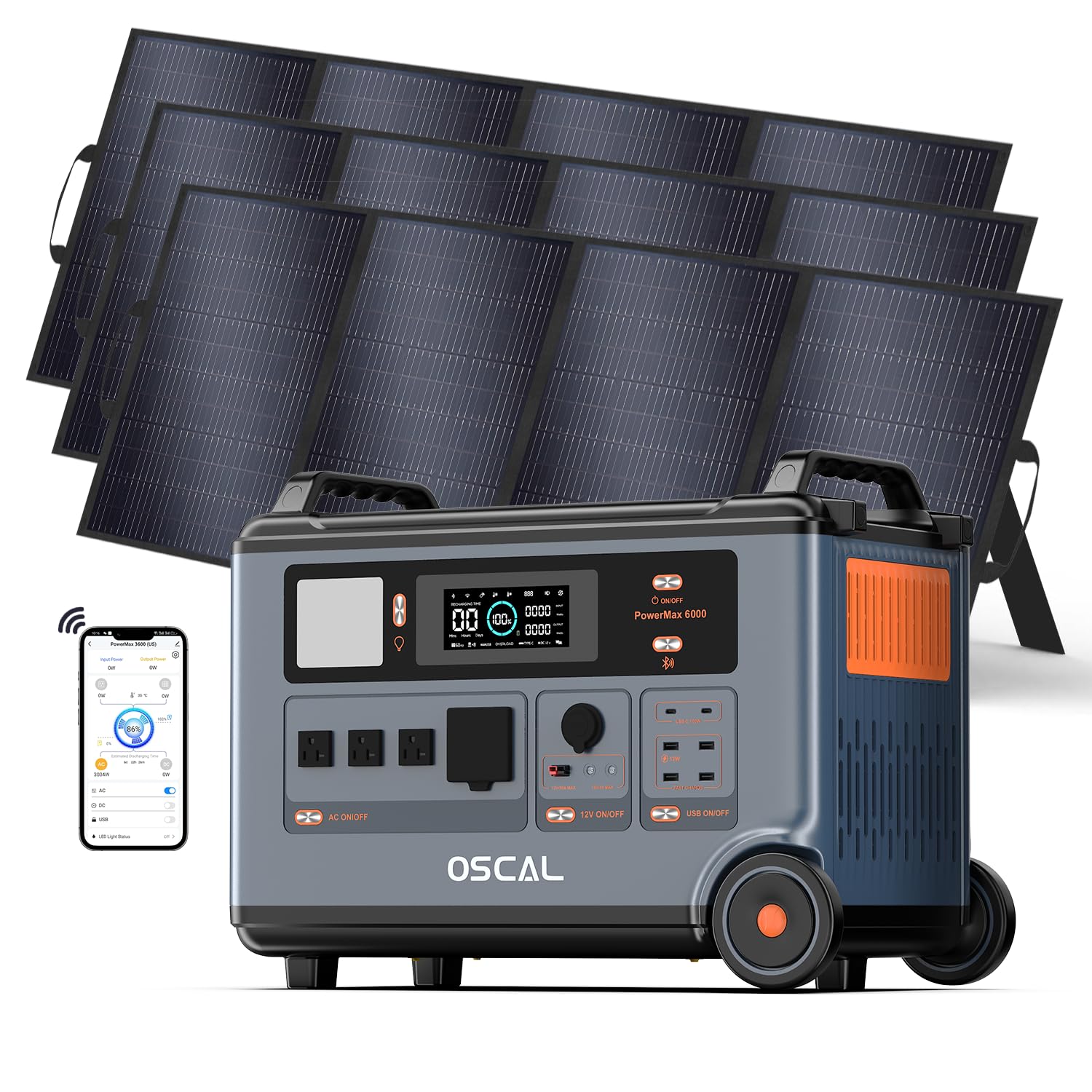
The OSCAL PowerMax 6000 is a complete solar backup ecosystem that includes three 400W solar panels and a 3600Wh power station capable of 6000W continuous output (9000W surge). Its standout feature is the 120V/240V split-phase dual voltage output, allowing it to power both standard household circuits and large 240V appliances like dryers and well pumps. The bi-directional inverter enables 2200W AC fast charging, reaching full charge from 0 to 100% in just 1.44 hours. Solar charging at 2400W tops it off in similar time under optimal sun.
The EPS (Emergency Power Supply) switchover happens in 5–8 milliseconds, so your computers and network gear never drop during a blackout. The LiFePO4 battery is rated for 3,500 charge cycles with a service life of up to 25 years. The app provides full remote control over charging schedules, output management, and system monitoring. With 14 output ports including four AC outlets, USB-C PD, and DC, you can run multiple devices simultaneously. The integrated handle and wheels make the 100-pound unit relatively easy to move around the garage or campsite.
Some early reviewers noted that a single LED bulb drained the battery from 100% to 85% in two hours, which suggests either a high idle draw or panel inefficiency. The included solar charging cables are short, requiring an MC4 extension for flexible panel placement. The 240V feature works for woodworking tools and AC units, but the system cannot sustain 6000W continuously without triggering thermal limits. For the homeowner who wants high dual-voltage output bundled with substantial solar panels in one purchase, this is a complete solution that reduces setup complexity.
Why it’s great
- 120/240V split-phase output powers heavy 240V appliances
- Complete bundle with three 400W solar panels included
- Ultra-fast 1.44-hour recharge via 2200W AC input
Good to know
- Heavy 100-pound unit; handle and wheels improve mobility
- Included solar cables are short and may need extensions
- Some reviewers report high idle power consumption
FAQ
Can a portable generator power my central air conditioner?
How often should I change the oil in a gas generator?
Can I run a generator in my garage during a storm?
What is the difference between a power station and a generator for home use?
Final Thoughts: The Verdict
For most users, the backup generator for home winner is the Westinghouse 12500W because it balances high power output, dual-fuel flexibility, and remote start convenience at a realistic mid-range investment. If you want fully automatic whole-house coverage with no manual intervention, grab the Generac Guardian 22kW. And for silent, fume-free operation with the ability to expand capacity over time, nothing beats the GROWATT 2x HELIOS 3600.

Mo Maruf
I created WellFizz to bridge the gap between vague wellness advice and actionable solutions. My mission is simple: to decode the research and give you practical tools you can actually use.
Beyond the data, I am a passionate traveler. I believe that stepping away from the screen to explore new environments is essential for mental clarity and physical vitality.