Our readers keep the lights on and my smoothie glass nicely filled. As an Amazon Associate, I earn from qualifying purchases.
You’re three hours from the trailhead, the sky is turning gray, and your route is a faint line on a map you can’t zoom into. That moment separates a capable backpacking GPS watch from an expensive mistake. The wrong watch gives you battery anxiety on day two and maps that lag when you need them most. The right one extends your range, tracks your ascent in real time, and gets you home when the sun drops behind the ridge.
I’m Mohammad Maruf — the founder and writer behind WellFizz. I’ve spent years analyzing the hardware specifications of GPS watches for demanding outdoor use, from satellite chipsets to battery chemistries, so you can buy with confidence rather than guesswork.
After comparing battery endurance, mapping capabilities, and durability across nine leading models, I’ve identified the absolute best backpacking gps watch for every type of trail-based adventure.
How To Choose The Best Backpacking GPS Watch
Picking the wrong watch for trail navigation is like packing a cotton sleeping bag for a wet canyon. You might survive, but you won’t enjoy it. The right watch for backpacking must balance three competing forces: battery endurance under constant GPS load, mapping detail for unfamiliar terrain, and physical ruggedness for the inevitable rock scrape. Let’s break down the specific specs that separate a real backcountry tool from a glorified step counter.
Battery Life in Full GPS Mode
This is the single most important spec for a backpacking watch. Smartwatch-mode battery claims (which measure days with minimal screen use) are nearly irrelevant. What matters is how many hours the watch will track your route with GPS active. For a weekend trip, look for at least 30 hours of continuous GPS tracking. For week-long expeditions, aim for 50 hours or more. Some watches offer solar charging or extended battery modes that trade tracking frequency for endurance, but always verify the “best GPS mode” number rather than the marketing headline.
Mapping and Navigation Features
Not all maps are created equal. A good backpacking watch stores offline topographical maps that show contour lines, water sources, and trail names. Turn-by-turn navigation is invaluable when you’re navigating a junction without pulling out your phone. The ability to import GPX routes from apps like Komoot or AllTrails and follow a breadcrumb trail directly on the watch face saves time and battery. Some highest-tier models also allow point-of-interest search (e.g., “find nearest water source”) without a phone connection.
Durability and Display Type
Your watch will get banged against granite, submerged in creek crossings, and exposed to temperature swings. A sapphire crystal lens, a metal or fiber-reinforced polymer bezel, and a MIL-STD-810G rating for thermal and shock resistance are all strong indicators of backcountry readiness. For the display, you face a trade-off: AMOLED screens look vibrant and are easier to read in low light but draw more power, while Memory-in-Pixel (MIP) displays are less power-hungry and remain perfectly readable in direct sunlight but lack color saturation. MIP is generally the safer choice for multi-day trips where every percentage point of battery counts.
GPS Accuracy and Satellite Systems
In deep canyons, under dense tree cover, or near steep rock walls, a basic GPS chip can lose lock or drift significantly. Look for dual-band or multi-band GNSS receivers that access multiple satellite constellations (GPS, GLONASS, Galileo, BeiDou) simultaneously. This technology triangulates your position using multiple frequency bands, reducing error to under 10 feet even in challenging terrain. If your hiking routes regularly take you through slot canyons or alpine forests, dual-band is not a luxury — it’s a necessity.
Quick Comparison
On smaller screens, swipe sideways to see the full table.
| Model | Category | Best For | Key Spec | Amazon |
|---|---|---|---|---|
| Garmin Instinct 2X Solar | Premium | Infinite battery with sun exposure | Solar-charged, unlimited smartwatch mode | Amazon |
| COROS NOMAD | Mid-Range | Adventure journal & voice notes | 50 hours GPS battery life | Amazon |
| Amazfit T-Rex 3 Pro | Mid-Range | Rugged build with offline maps | 1.4” Sapphire AMOLED display | Amazon |
| SUUNTO Vertical | Premium | Extended tour-mode battery | 500 hours tour mode GPS tracking | Amazon |
| SUUNTO Race 2 | Premium | AMOLED screen & endurance racing | 1.5” AMOLED, 32GB offline maps | Amazon |
| Garmin fēnix 8 47mm | Premium | Best-in-class mapping & dive-rated | Multi-band GPS with SatIQ | Amazon |
| Apple Watch Ultra 3 | Premium | Satellite SOS & cellular connectivity | Dual-frequency GPS, 49mm titanium | Amazon |
| COROS PACE Pro | Mid-Range | Best value with AMOLED display | 1.3” AMOLED, 38 hours GPS | Amazon |
| POLAR Grit X | Mid-Range | Lightweight, Hill Splitter analysis | 64g weight, 40 hours GPS tracking | Amazon |
In‑Depth Reviews
1. Garmin Instinct 2X Solar – Tactical Edition

The Garmin Instinct 2X Solar redefines what a backpacking watch can do by eliminating the single biggest worry on multi-day trips: running out of power. Its Power Glass solar lens generates enough energy to sustain infinite smartwatch mode with just three hours of direct sunlight per day, and the 50mm fiber-reinforced polymer case shrugs off the thermal, shock, and water resistance tests of U.S. military standard 810. For long-distance hikers who spend consecutive days in open terrain, this watch removes the need to carry a backup battery pack for your wrist.
Navigation is handled by multi-band GPS with SatIQ technology, which automatically adjusts between satellite frequency bands to optimize accuracy and battery draw. The 3-axis compass and barometric altimeter provide reliable heading and elevation data even when you’re deep in a valley where single-band watches lose lock. The built-in LED flashlight with variable intensities and an SOS strobe mode adds daily utility for pre-dawn pack-ups or emergency signaling — a feature that proves far more useful on the trail than any 24/7 wellness score.
Customer feedback from real-world use in extreme conditions — including military deployments in the Middle East — confirms the watch’s near-indestructible build and exceptional battery endurance. The main trade-off is the display: it’s a large, high-contrast MIP screen that remains readable in direct sun, but it lacks the vibrancy of an AMOLED panel. If you want a watch that literally keeps going as long as the sun rises, this is the one.
Why it’s great
- Battery life extends indefinitely with daily solar exposure
- Multi-band GPS maintains lock in steep terrain
- Built-in flashlight with SOS strobe adds real trail utility
- MIL-STD-810G tested for extreme conditions
Good to know
- MIP display lacks the color vibrancy of AMOLED
- Setup can be non-intuitive for first-time users
- Solar charging is less effective under heavy tree canopy
2. COROS NOMAD Outdoor GPS Smartwatch
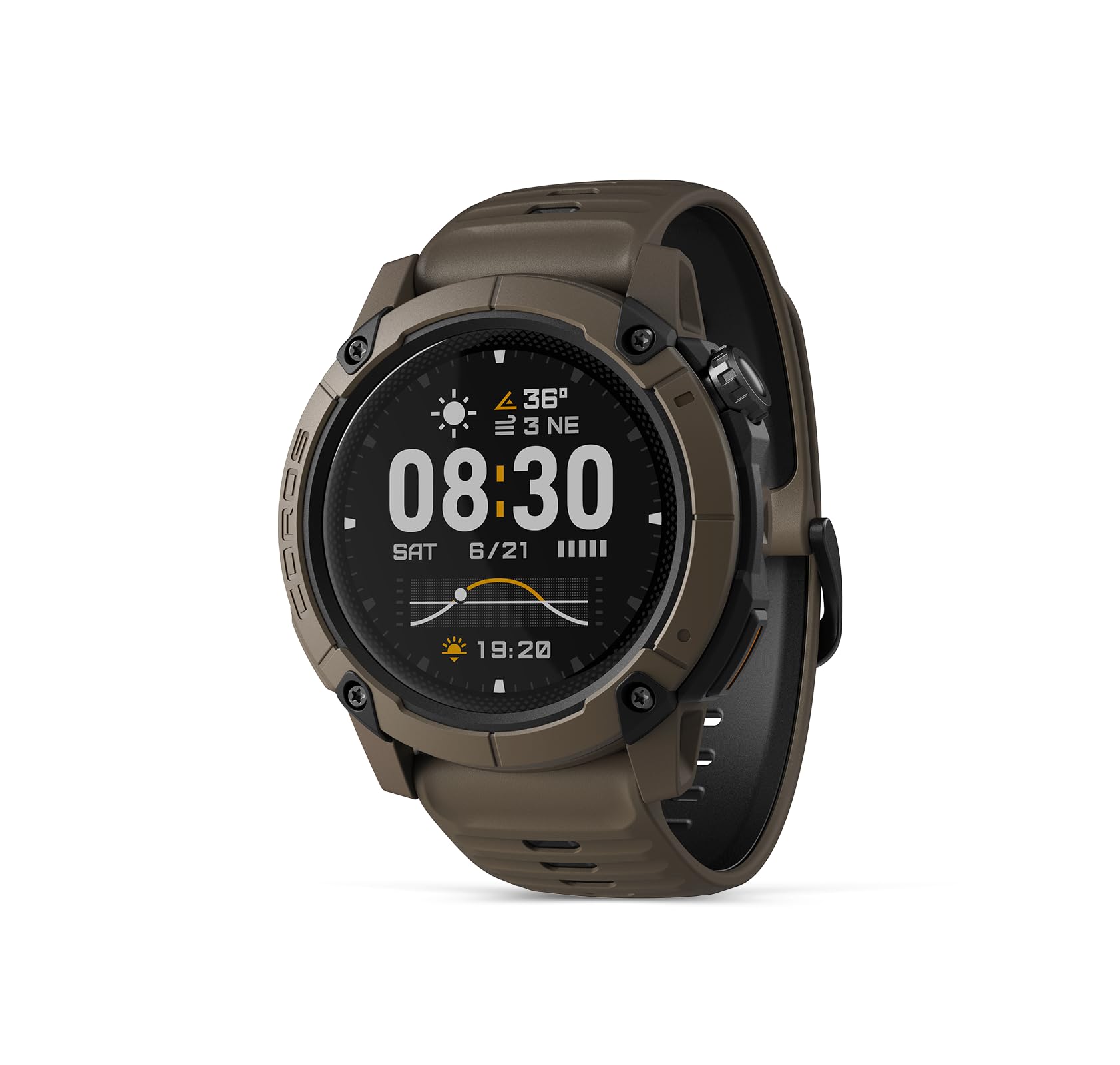
The COROS NOMAD brings a unique angle to the Backpacking GPS Watch category by focusing on the experience of the journey itself, not just the metrics. Its built-in Adventure Journal lets you record voice notes, tag locations, and even add photos within an activity — a feature that captures the memory of a summit push or a campfire conversation long before it fades. The 1.3-inch Memory-in-Pixel (MIP) display delivers high contrast in direct sunlight while drawing minimal power, and the dual-layer polymer and aluminum alloy bezel feels both robust and surprisingly light on the wrist.
Battery life is a genuine asset here: 50 hours of continuous GPS tracking and 22 days of daily use mean you can leave the charger at home for a week-long traverse. The watch also includes pre-loaded global maps with street names, real-time weather and environmental data, and a Back-to-Start navigation function that creates a route back to your trailhead without needing a phone. For anglers, the ability to log catches and mark fishing spots directly on the watch is a thoughtful niche addition that many dedicated outdoor watches overlook.
Users consistently praise the weeks-long battery life and the accuracy of the altimeter, barometer, and compass — the ABC sensors that matter most for off-trail navigation. The main drawbacks are the dim flashlight mode and the fact that some weather data still requires a phone connection to update. If you value capturing the story of your hike as much as the stats, the NOMAD stands alone in this segment.
Why it’s great
- Adventure Journal with voice notes and photo tagging is unique
- 50 hours of GPS battery life supports multi-day trips
- Pre-loaded global offline maps with street names
- Lightweight construction at a mid-range price point
Good to know
- Flashlight is dim compared to the Garmin Instinct 2X
- Weather data updates require smartphone sync
- Large case size may feel bulky on smaller wrists
3. Amazfit T-Rex 3 Pro Outdoor Smart Watch
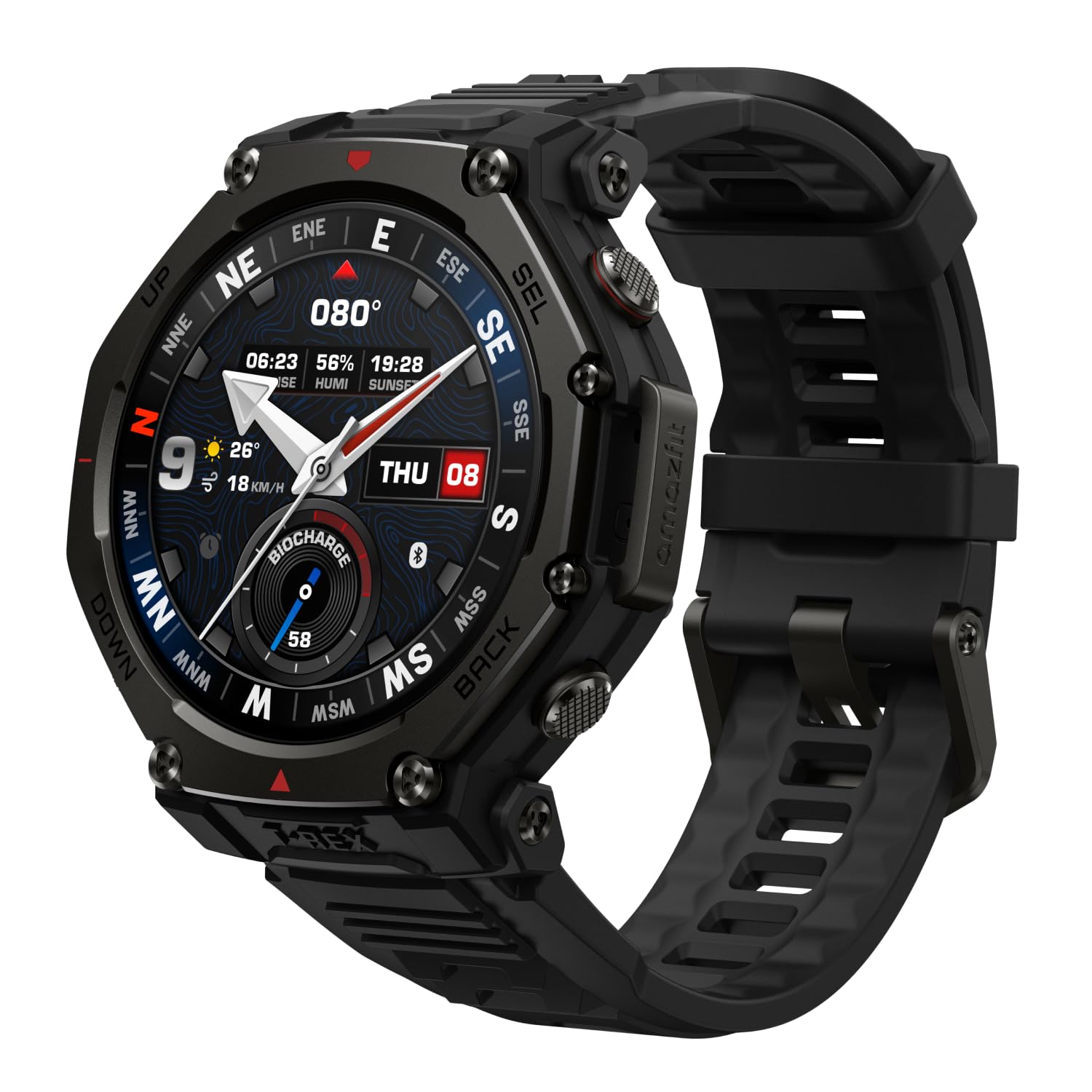
The Amazfit T-Rex 3 Pro proves you don’t have to spend flagship money to get a truly capable Backpacking GPS Watch. Its 48mm case combines a titanium alloy bezel with sapphire glass — the same lens material found in watches three times the price — and a 3000-nit AMOLED display that remains clearly visible even under direct summer sunlight. The dual-band GPS supports six satellite systems simultaneously, delivering fast and accurate positioning in dense tree cover and narrow canyon terrain where budget watches typically struggle.
Offline maps with point-of-interest search and auto-rerouting make navigation intuitive, and the built-in two-color flashlight (white and soft red) is genuinely useful for preserving night vision in camp or signaling in an emergency. The BioTracker optical heart rate sensor tracks with good consistency for outdoor use, and integration with the Helio Strap accessory expands recovery monitoring if you want deeper training data. Battery life reaches up to 25 days in smartwatch mode, though heavy GPS use for multi-day hikes will pull that number down closer to the single-day range for extended tracking.
Reviews from former Garmin and Apple Watch users consistently highlight the T-Rex 3 Pro’s premium physical build and exceptional value proposition, with some calling it a worthy alternative to the Fenix line at a fraction of the investment. The software, however, lags behind Garmin and COROS for advanced metrics like training load analysis and route recalculation mid-activity. If your priority is a rugged, beautiful screen and solid navigation for weekend trips, this is the smart buy.
Why it’s great
- Sapphire glass and titanium alloy bezel at a mid-range price
- 3000-nit AMOLED display is ultra-bright in sunlight
- Dual-band GPS with six satellite systems for accurate tracking
- Built-in two-color flashlight with SOS mode
Good to know
- Software less polished than Garmin or COROS for training metrics
- Route recalculation during activities rarely works as intended
- Screen can be difficult to unlock with wet or cold fingers
4. SUUNTO Vertical GPS Adventure Watch

The SUUNTO Vertical is engineered for one thing above all else: staying alive on the trail longer than any other watch in this category. In tour mode — which takes position readings at longer intervals to preserve power — it can track continuously for up to 500 hours, or roughly 20 days. Even in the most accurate GPS mode using dual-band GNSS, it holds a 60-hour continuous tracking window. That kind of endurance fundamentally changes how you plan a long-distance backpacking trip, eliminating the daily sun-tracking ritual that solar-dependent watches require.
The watch comes with free, pre-loaded global color offline maps that display contour lines, trails, water sources, and landmarks, and its navigation suite includes breadcrumb trails, point-of-interest markers, and bearing guidance. The large 49mm color touchscreen is clear and legible, though it lacks the buttery responsiveness of an AMOLED display. The titanium solar charging model extends battery life further by roughly 30 percent on sunny days, though under dense forest canopy the solar gain is minimal — realistic expectations for solar charging are essential here.
User feedback is overwhelmingly positive regarding the battery life and accuracy in alpine environments, but some complaints cite the short and fragile charging cable, the lack of watch face customization, and a sleep tracking algorithm that occasionally fails to register REM cycles. The Suunto Vertical is a niche tool: ideal for the expedition hiker or thru-hiker who measures trips in weeks, not days, but less well-rounded than some competitors for daily wear and casual fitness tracking.
Why it’s great
- 500 hours of GPS tracking in tour mode for multi-week expeditions
- Free global offline maps with contour lines and POIs
- Dual-band GNSS maintains accuracy in difficult terrain
- Solar charging extends battery up to 30% on sunny days
Good to know
- Charging cable is short, fragile, and can block optical sensors
- Sleep monitoring is less accurate than competitors
- Watch face customization is very limited
5. SUUNTO Race 2 GPS Sports Watch
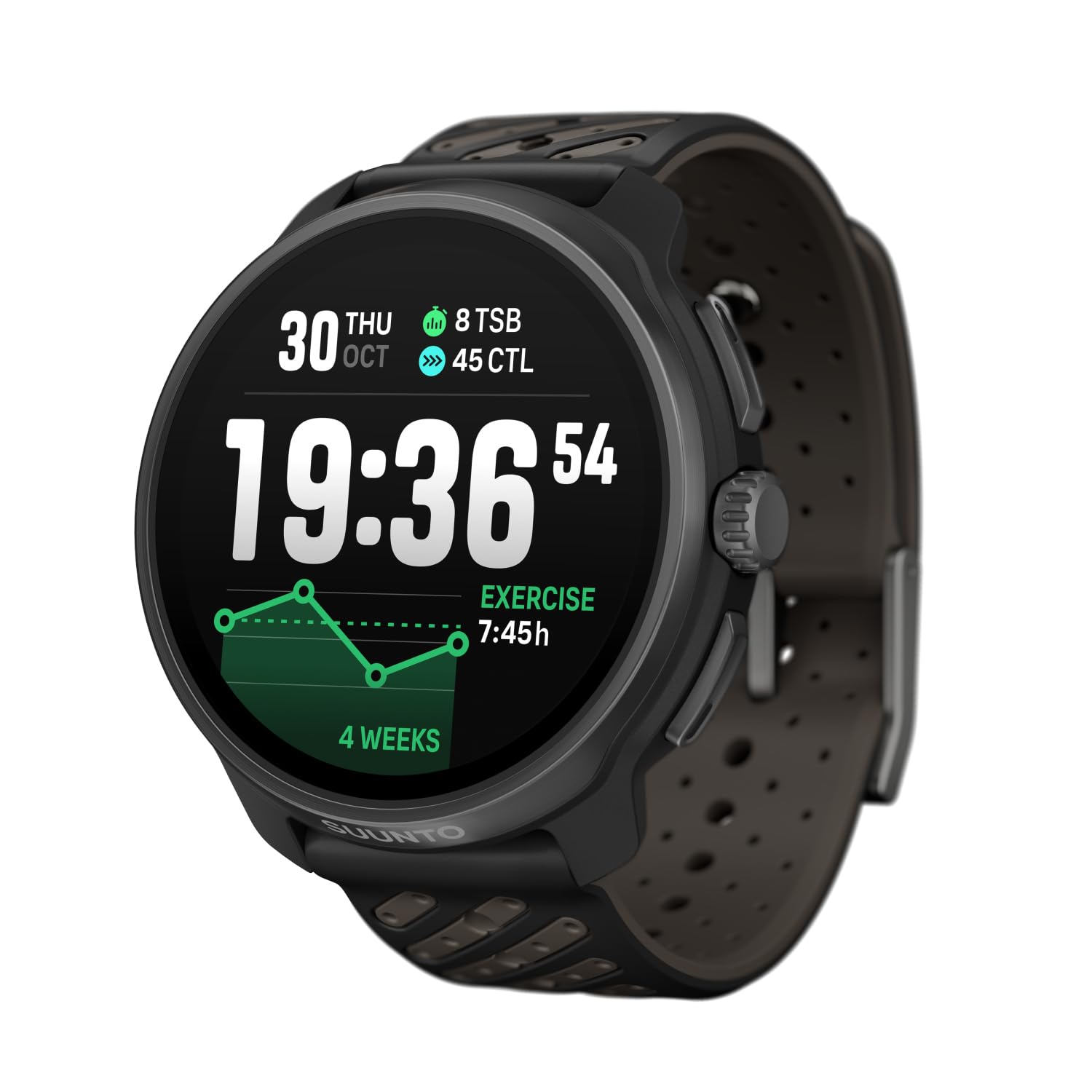
The SUUNTO Race 2 refines the brand’s adventure-watch formula with a gorgeous 1.5-inch AMOLED touchscreen, a titanium case that cuts weight without sacrificing strength, and a massive 32 gigabytes of internal storage for offline maps. That storage space is a genuine differentiator for backpackers who want to download multiple regions of topographical maps before leaving home, ensuring navigation data is available even in the most remote backcountry. The dual-band GNSS engine, combined with ClimbGuidance, delivers real-time ascent and distance-to-summit data that keeps you informed on long, technical climbs.
Battery life lands at up to 16 days in daily use and up to 55 hours in the best GPS tracking mode — enough for a multi-day trail run or a long backpacking loop. The watch supports over 115 sport modes, including dedicated profiles for trail running, hiking, cycling, and swimming, and the Suunto Coach feature provides tailored training plans that adjust based on your performance. Its crown-style control, combined with the touchscreen, makes map zooming and scrolling feel responsive and intuitive, a welcome departure from button-only navigation.
Owners consistently praise the Race 2’s crisp display and significantly improved heart rate accuracy over the original Race, along with the simple, uncluttered Suunto app ecosystem that many find easier to navigate than Garmin’s sprawling Connect interface. The trade-offs are minor: the bezel design is less overtly rugged than the Garmin fēnix 8, and some users report that customizing data fields requires a bit of trial and error. If you want an AMOLED screen that looks as good on a summit selfie as it functions on the trail, the Race 2 delivers.
Why it’s great
- 32GB of internal storage for extensive offline map libraries
- 1.5-inch AMOLED display is bright and responsive
- ClimbGuidance provides real-time ascent and summit distance data
- Improved wrist-based HR accuracy over previous SUUNTO models
Good to know
- Data screen customization can be non-intuitive to set up
- Slightly less rugged bezel than Garmin fēnix 8
- No onboard music storage or contactless payment
6. Garmin fēnix 8 – 47mm AMOLED

The Garmin fēnix 8 represents the current standard for premium Backpacking GPS Watch design, combining a bright 1.4-inch AMOLED display with the navigation chops that have defined the fēnix line for years. Its multi-band GPS with SatIQ technology intelligently switches between satellite frequency bands based on your environment, conserving battery in open fields and cranking up accuracy under tree cover or near rock walls. The stainless steel bezel and leakproof metal buttons are dive-rated to 40 meters, meaning this watch will survive a river crossing, a monsoon, or an accidental plunge into an alpine lake without a hiccup.
Navigation features include dynamic round-trip routing — set a target distance and the watch generates a loop back to your start point with turn-by-turn directions that adjust on the fly — and a built-in 3-axis compass, gyroscope, and barometric altimeter. The LED flashlight, now a hallmark of Garmin’s outdoor line, offers variable intensities and a red-light mode for preserving night vision. For athletes, the real-time stamina tracking and targeted strength training plans add a layer of performance insight that extends beyond basic hiking metrics. The ECG app, where available, provides another health monitoring dimension for those who want it.
Real-world user feedback is emphatically positive: owners report 14-16 days of battery life with regular use, extremely intuitive mapping, and the kind of durable build quality that inspires confidence on multi-year ownership. The primary consideration is cost — this is a significant investment compared to the mid-range competition. But for backpackers who also dive, trail run, and train seriously, the fēnix 8 justifies its premium tier with a breadth of features that no other single watch in this list can match.
Why it’s great
- SatIQ multi-band GPS optimizes accuracy and battery draw dynamically
- 40-meter dive rating and leakproof metal buttons
- Dynamic round-trip routing creates loops with turn-by-turn directions
- ECG app and advanced training features for serious athletes
Good to know
- Premium price point is a significant investment
- AMOLED display draws more power than MIP equivalents
- Setup is complex due to the sheer volume of features
7. Apple Watch Ultra 3 [GPS + Cellular 49mm]
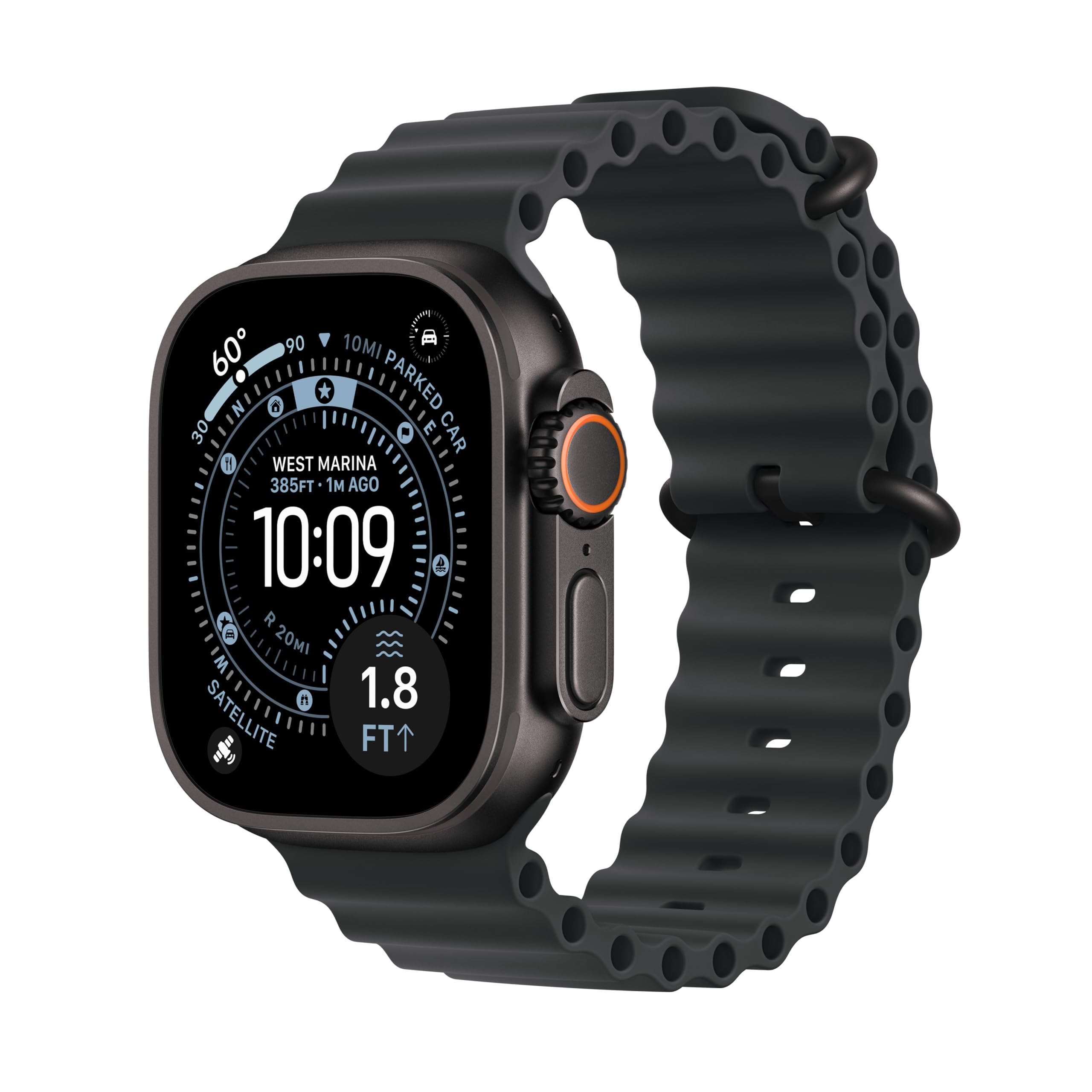
The Apple Watch Ultra 3 brings a unique value proposition to the Backpacking GPS Watch category: satellite SOS messaging that works without a cellular signal. When you’re beyond the reach of Wi-Fi and cell towers, the built-in satellite communications allow you to text emergency services directly from your wrist — a safety net that no other watch on this list offers without a subscription. The 49mm titanium case is tough enough for high-speed water sports and submersion down to 100 meters, and the dual-frequency GPS provides precision tracking even in the mixed terrain of a backcountry traverse.
Battery life reaches up to 42 hours in normal use and up to 72 hours in Low Power Mode, with up to 20 hours of full GPS and heart rate tracking in that mode. While those numbers don’t match the marathon endurance of the SUUNTO Vertical or the infinite solar capability of the Garmin Instinct 2X, they are more than sufficient for a standard weekend trip. The watch also includes fall detection, car crash detection, and the Vitals app for tracking sleep apnea, hypertension, and heart rhythm irregularities — making it the most comprehensive health-monitoring device in this lineup.
Users transitioning from previous Apple Watches consistently highlight the dramatically improved battery life and the premium feel of the titanium build. The main limitation for serious backpackers is the comparatively shorter battery life under continuous GPS load — you will need a power bank for trips longer than three days unless you’re diligent about using Low Power Mode. If your priority is staying in touch with the outside world and you are already embedded in the Apple ecosystem, the Ultra 3 is the safest and most connected choice for the trail.
Why it’s great
- Satellite SOS messaging works without cellular or Wi-Fi
- 49mm titanium case is extremely durable and water-resistant to 100m
- Best-in-class health tracking with fall and crash detection
- Dual-frequency GPS with precision tracking in mixed terrain
Good to know
- GPS battery life is shorter than dedicated outdoor watches
- Requires iPhone for full functionality
- Metal bands can scratch the sapphire display
8. COROS PACE Pro GPS Sport Watch

The COROS PACE Pro enters the Backpacking GPS Watch conversation as a lightweight, feature-dense option that delivers a premium AMOLED experience at an accessible price point. Its 1.3-inch always-on display hits 1500 nits of brightness, making it clearly legible under direct sun, and the new satellite chipset delivers what COROS calls its most precise GPS performance yet — a claim backed by user reports of distance accuracy within 10 feet per mile. The processor is more than twice as fast as previous PACE models, resulting in snappy map rendering and instant gesture-activated backlighting.
Battery life is 38 hours in full GPS mode and up to 20 days in daily smartwatch use, though the always-on AMOLED display will draw that down to about six days between charges. The watch supports turn-by-turn navigation with topographical and landscape maps that you can create in the COROS app and send directly to the watch — a clean workflow that doesn’t require third-party apps. The USB-C charging port, complete with a keychain adapter, means one less cable to carry for backpackers who already travel with USB-C for their phone and headlamp.
Customer reviews consistently highlight the PACE Pro’s speed, accurate metrics, and long battery life, with many users preferring its streamlined interface over the more complex Garmin ecosystem. The trade-offs for backpacking are that the 22mm silicone band feels stiff out of the box, and the watch has fewer dedicated outdoor navigation features than the NOMAD or the Instinct 2X — there is no Adventure Journal or solar charging. However, for hikers who want a watch that works equally well for daily training and weekend trail navigation, the PACE Pro offers outstanding value.
Why it’s great
- Bright 1500-nit AMOLED display is highly visible in sunlight
- 38 hours of GPS tracking supports multi-day trips
- Fast processor and responsive touchscreen for map navigation
- USB-C charging with keychain adapter reduces cable load
Good to know
- Silicone band is stiff and may require break-in period
- Fewer dedicated outdoor navigation features than COROS NOMAD
- Always-on display mode reduces battery life to about six days
9. POLAR Grit X – Rugged Multisport GPS Smart Watch

The POLAR Grit X stakes its claim as the lightest serious outdoor GPS watch on this list, weighing just 64 grams — roughly 20 to 30 percent less than comparable adventure watches. For backpackers and trail runners who obsess over every gram in their pack, this weight reduction is immediately noticeable on the wrist during long days of movement. The plastic case has passed MIL-STD-810G testing for thermal, shock, and water resistance, and the 100-meter water rating means it can handle any river crossing or rainstorm you throw at it.
Battery life reaches up to 40 hours with full GPS and heart-rate tracking, and up to 100 hours with power-save options, which is competitive for the mid-range. The navigation suite includes real-time turn-by-turn route guidance with Komoot integration, a compass, and barometric altitude in training mode. The standout feature for hilly terrain is the Hill Splitter, which automatically detects uphill and downhill sections and breaks down your performance by ascent speed, distance, and elevation gain per segment — giving you actionable data for pacing climbs.
Real-world reviews praise the Grit X for its lightweight comfort, accurate GPS elevation in hilly regions, and the Polar Flow ecosystem for training analysis. The main drawbacks are a wrist-based heart rate sensor that is less accurate during high-intensity intervals than a chest strap (auto-pairing with the Polar H10 solves this), and some users report the battery dropping faster than expected after about five days of mixed use. For the weight-conscious adventurer who wants detailed ascent analysis, this is a focused and capable tool.
Why it’s great
- Weighs only 64 grams — the lightest in this category
- Hill Splitter provides detailed ascent and descent performance data
- 40 hours GPS battery with 100-hour power-save option
- Komoot integration for turn-by-turn route guidance
Good to know
- Wrist-based heart rate accuracy lags behind chest strap during intervals
- Some users report faster-than-expected battery drain after a few days
- Navigation features are less comprehensive than Garmin or COROS
FAQ
How many hours of GPS battery do I need for a typical backpacking trip?
Is an AMOLED display worth the battery trade-off for backpacking?
What does dual-band GPS actually do for accuracy on trails?
Final Thoughts: The Verdict
For most backpackers, the best backpacking gps watch winner is the Garmin Instinct 2X Solar because it eliminates battery anxiety entirely for anyone who spends daylight hours on exposed trails, combining solar-charged endurance with proven multi-band accuracy and the most rugged build in the segment. If you want a bright AMOLED display and offline map storage for weekend trips, grab the Amazfit T-Rex 3 Pro. And for the solo hiker or alpine climber who needs a satellite SOS lifeline without a subscription, nothing beats the Apple Watch Ultra 3.

Mo Maruf
I created WellFizz to bridge the gap between vague wellness advice and actionable solutions. My mission is simple: to decode the research and give you practical tools you can actually use.
Beyond the data, I am a passionate traveler. I believe that stepping away from the screen to explore new environments is essential for mental clarity and physical vitality.