Our readers keep the lights on and my smoothie glass nicely filled. As an Amazon Associate, I earn from qualifying purchases.
A dead phone miles from the trailhead isn’t just an inconvenience—it’s a safety risk. Backpack solar chargers promise off-grid power, but real-world wattage often falls short of the label, leaving you with a useless slab of fabric and silicon just when you need juice most. The difference between a panel that works and one that frustrates comes down to cell efficiency, port output specs, and how the whole thing packs down in your pack.
I’m Mohammad Maruf — the founder and writer behind WellFizz. I’ve spent dozens of hours parsing monocrystalline cell data, real customer wattage reports, and folded-dimension specs to separate the backpack solar chargers that actually earn their weight from the ones that just look good in product photos.
This guide cuts through the marketing to help you find the best backpack solar charger for your specific carry needs, device loadout, and budget.
How To Choose The Best Backpack Solar Charger
Choosing a panel for your backpack isn’t the same as buying one for your roof. Weight, folded size, and real-world wattage in less-than-perfect sun matter far more than the peak number on the box. Here’s what to look at first.
Cell Efficiency and Material
Monocrystalline silicon is the standard for portable panels because it packs more power into a smaller physical area. Look for cells rated at 23% efficiency or higher. The coating on top — ETFE vs. PET — affects longevity: ETFE resists yellowing and abrasion better, so the panel lasts through seasons of trail use rather than degrading after one trip.
Port Outputs and Charging Protocol
A panel with USB-A ports only might trickle-charge a phone, but if you want to top up a power bank or tablet in reasonable time, you need USB-C PD (Power Delivery). PD 3.0 pushes 18W to 60W, which actually makes a dent in larger batteries. Multiple ports let you charge two devices at once, but the total panel wattage is shared — two USB-A ports both at 5V/3A max means only 30W total, regardless of the panel’s rating.
Folded Size and Kit Weight
Backpack space is finite. A panel that folds to the size of a tablet and weighs under two pounds fits easily into a side pocket or against a frame sheet. Heavier panels over 3.5 pounds are better suited for basecamp or car camping than multi-day carries. Also check the included accessories: carabiners for hanging, a built-in pouch for cables, and adjustable kickstands that let you angle the panel toward the sun without propping it on rocks.
Quick Comparison
On smaller screens, swipe sideways to see the full table.
| Model | Category | Best For | Key Spec | Amazon |
|---|---|---|---|---|
| Renogy 100W E.Flex | Premium | Power station replenishment | 25% N-type cell efficiency | Amazon |
| Anker Solix PS30 | Mid-Range | Phone and small device charging | 30W output, IP65 rated | Amazon |
| LUMOPAL 60W | Value | High-wattage on a budget | PD60W USB-C output | Amazon |
| FlexSolar 60W | Mid-Range | Camping and small generators | IP67 waterproof, 6 folds | Amazon |
| SunJack 25W | Premium | Rugged all-weather use | ETFE coating, IP67 rated | Amazon |
| BigBlue 25W | Ultra-Portable | Ultralight backpacking | 0.84 lbs, pocket-sized | Amazon |
| ELECOM NESTOUT 28W | Premium Design | Modular outdoor system | IF Design Gold, SunPower cells | Amazon |
In‑Depth Reviews
1. Renogy 100W E.Flex Portable Solar Panel

Renogy’s 100W E.Flex takes a premium approach to portable power with N-type cell technology that pushes conversion efficiency to 25% — notably higher than the 22.5% found in standard 9BB panels. The quadfold design packs down to 22.99 by 22.54 by 1.57 inches, and at 7.28 pounds it’s the lightest panel in the 100-watt class. Magnetic closure replaces traditional snaps or Velcro, making setup and teardown noticeably quicker in tight camper or tent vestibule spaces.
Three device outputs include a 45W USB-C PD port and two USB-A ports (18W and 15W), plus MC4 connectors that let you feed a portable power station or 12V battery system directly. Built-in adjustable kickstands offer three angles (40°/50°/60°) for optimal solar capture without propping the panel on uneven gear. Real-world customer reports show consistent 80-100W in direct full sun, with some users running two units in series to avoid clipping on high-input power stations.
The IP65 dust and water resistance is sufficient for rain and trail dust, though the USB jacks are not fully sealed for continuous wet exposure. The 2-year material and workmanship warranty and UL 61730 certification add confidence for those planning heavy off-grid use. For anyone needing to recharge power banks or small appliances, this panel delivers the highest watt-per-pound ratio in this roundup.
Why it’s great
- Highest cell efficiency (25%) among portable panels tested
- MC4 output enables direct charging of power stations and 12V batteries
- Integrated kickstands allow precise angle adjustment for maximum sunlight capture
Good to know
- Heavier than sub-30W panels at 7.28 pounds for long backpack carries
- USB ports are not fully waterproof; use MC4 in sustained rain
2. SunJack 25W Foldable Solar Panel

SunJack’s 25-watt panel is built for those who treat their gear rough and expect it to survive. The ETFE (ethylene tetrafluoroethylene) surface layer resists abrasion and UV yellowing far better than standard PET coatings, while the IP67 rating means the panel can handle submersion in shallow water — a serious advantage for kayak trips, monsoon-season camping, or any scenario where splashes are unavoidable. Folded size is 7.8 by 11 by 1 inch, and weight sits at 1.7 pounds, making it easy to wedge into a hydration sleeve or daypack top pocket.
Dual 5V/3A USB ports with adaptive current sensing provide up to 25W total, though real-world output in full sun typically lands around 18-22W — enough to fast-charge a Pixel 6 or similar phone in direct conditions. A built-in smart IC chip adjusts current to prevent overcharging, and short-circuit protection adds a safety buffer when you’re connecting devices on the move. Customers note that the panel feels rigid and durable compared to flimsier fabric-based competitors, and the included two-year hassle-free warranty backs up that build promise.
The lack of USB-C PD is the main design limitation here. If your power bank or phone relies on USB-C for fast charging, you’ll be limited to 5V/3A out of the USB-A ports. For those still in the USB-A ecosystem or using an intermediary battery pack, however, this is a bombproof, long-lasting solar panel that won’t quit mid-trip.
Why it’s great
- IP67 rating provides full dust and temporary water immersion protection
- ETFE coating offers superior scratch and UV resistance over PET panels
- Rigid construction feels much more durable than floppy fabric alternatives
Good to know
- USB-A only; no USB-C PD for modern fast-charging protocols
- Heavier than the BigBlue per watt at 1.7 pounds for 25W output
3. LUMOPAL 60W Foldable Solar Panel
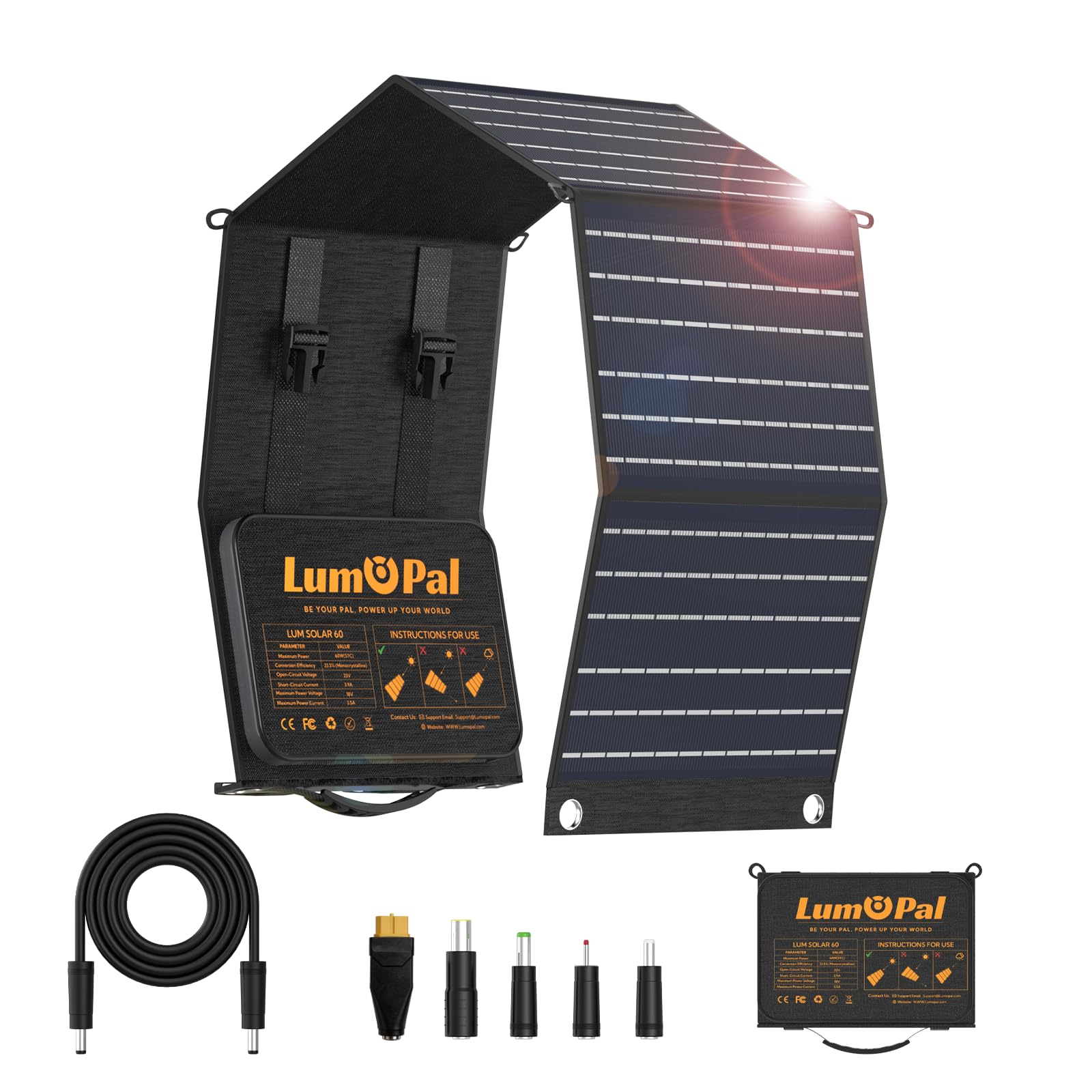
LUMOPAL’s 60W panel punches well above its price tier, offering a PD USB-C port rated at 60W max alongside dual QC3.0 USB-A ports (22W max) and an 18-20V DC barrel output. The monocrystalline cells achieve 23.5% conversion efficiency — competitive with panels costing significantly more. When folded, the unit measures 6.7 by 9.5 inches and weighs 3.42 pounds, with a surprising 176-pound compression resistance that protects the cells if gear stacks on top inside your pack. The ETFE lamination and IP65-rated nylon fabric add weather resilience for damp forest or coastal conditions.
Real-world customer reports show the panel delivering 39-40W in evening sun and up to 60W in direct overhead conditions, enough to recharge a 27,000mAh battery pack in a few hours. The integrated DC connector kit includes XT60 and 5521 adapters, giving you direct compatibility with Jackery and other power station inputs without extra dongles. A built-in smart chip identifies connected devices and adjusts output for overcurrent, overheat, and short-circuit protection — useful when daisy-chaining multiple gadgets.
One tradeoff: the junction ports are not waterproof, so the panel needs to be kept dry during active charging in rain. The included accessories are generous, but there’s no USB-C cable in the box, so pack one separately. For hikers or overlanders who need 60W of reliable output without paying premium-tier prices, this is the value sweet spot.
Why it’s great
- 60W USB-C PD output supports rapid charging for larger power banks
- 176lb compression resistance allows safe packing under other gear
- Includes XT60 and 5521 DC adapters for direct power station connectivity
Good to know
- Junction box and ports are not waterproof despite IP65 panel rating
- No USB-C cable included in the package
4. FlexSolar 60W Portable Solar Panel

FlexSolar’s 60W panel uses a six-fold design that compresses to laptop-like dimensions: 9.8 by 12 by 0.7 inches when folded, with a total weight of 2.6 pounds. That’s impressively compact for a 60W-rated unit, though the unfolded footprint at 54.8 by 12 inches requires some ground space. The surface uses an E-film laminated over A+ monocrystalline cells for up to 24% conversion efficiency, with IP67 dust and water resistance that keeps the panel functional in rain — the junction box is the only vulnerable point.
Output ports include QC3.0 USB-A (18W), PD3.0 USB-C (40W), and a DC barrel at 20-28V (60W max). The integrated LED indicator glows red when light is sufficient for charging, removing guesswork about panel placement. Real-world tests from customers in Colorado show 40-45W output to an Ecoflow Delta via the XT60 adapter, and 8W at sunset while laid flat — decent low-light sensitivity thanks to the cell quality. The included carabiners and solar charging cable provide what you need for immediate setup.
One notable drawback is the absence of built-in kickstands. Without them, you need to angle the panel against rocks, a backpack, or a tent to catch optimal sun, which reduces flexibility in open terrain. FlexSolar recommends this unit for camping and car-camping over extended backpacking due to the six-panel layout. For a lightweight 60W option that stuffs into a laptop sleeve and charges mid-size power stations directly, this is a strong candidate.
Why it’s great
- Folds to laptop-like dimensions for easy backpack storage
- IP67 rating provides reliable performance in rainy conditions
- LED indicator confirms sufficient sunlight level for charging
Good to know
- No kickstands; requires external propping for optimal sun angle
- Six-panel design needs a larger ground area to unfold fully
5. Anker Solix PS30 Solar Panel

Anker’s Solix PS30 brings brand reliability and tempered-glass construction to the 30W portable solar segment. The panel folds to 10.7 by 8.8 by 1.7 inches and weighs 2.2 pounds, with an aluminum frame and monocrystalline cells that provide consistent output across the day. An IP65 weather resistance rating means it can handle rain, splashes, and dust without issue, making it a solid choice for car camping, basecamp power, and emergency kits.
Dual output ports — USB-A and USB-C — support simultaneous charging of two devices. The USB-C port provides fast charging for phones and smaller tablets, while real-world customer tests show a phone moving from 15% to full in about 1.5 hours under good sun. The foldable design uses a unique hinge system that customers praise for its compact nesting, though a few reports note that the hinges can be fragile if over-flexed or packed with too much pressure.
The 30W ceiling means this panel won’t directly charge larger power stations or run laptops requiring 60W+ input. It works best paired with an intermediary battery pack — charge the pack during the day, then use the pack to top off devices at night. For day hikers or car campers who just want to keep phones and cameras alive, the Anker Solix PS30 delivers the peace of mind that comes with a reliable brand name and clean design.
Why it’s great
- Trusted Anker build quality with tempered glass and aluminum frame
- Fast-charges a phone from 15% to 100% in roughly 90 minutes in good sun
- IP65 resistance means you can leave it out in light rain without worry
Good to know
- 30W output is insufficient for direct power station replenishment
- Hinges may be fragile under repeated or aggressive folding
6. BigBlue 25W Solar Panel Charger

The BigBlue 25W panel redefines portable for the ultralight crowd. Weighing just 0.84 pounds and folding down to 4.65 by 6.42 by 1.38 inches — roughly the size of a compact tablet — this panel disappears into a pack pocket or hydration sleeve. Despite its small size, the N-type solar cells deliver up to 25.4% conversion efficiency, among the highest in any panel under 30W. The IP68 water and dust resistance means it can survive a drop in a puddle or stream crossing without issue.
Output ports include USB-A (5V/2.4A) and USB-C (5V/3A), allowing simultaneous charging of two devices — a phone and a power bank, for example. Real-world testing shows it can top off a 10,000mAh power bank in around six hours of direct sun, and on overcast Southern California days it still trickles enough to make a dent. The inclusion of a USB-C cable, two carabiners, and an elastic strap means you can hang it from a backpack loop or tent line immediately out of the box.
The main limitation is wattage: 25W is fine for small electronics, but it won’t charge a power station or run a laptop. Some customers note that the USB-C maxes out at 15W (5V/3A) rather than the implied 25W, so real-world output is closer to 20W total. For thru-hikers or day-trippers who prioritize grams over gigawatts, this is the lightest, most packable solar charger available at this power level.
Why it’s great
- Weighs less than a pound and folds to tablet size for true pocketability
- IP68 rating provides full dust protection and submersion resistance
- Included carabiners and strap allow immediate backpack or tent rigging
Good to know
- Real-world total output is closer to 20W rather than the advertised 25W
- Insufficient wattage for power stations or laptop charging
7. ELECOM NESTOUT 28W Portable Solar Panel

ELECOM’s NESTOUT 28W panel is as much a design statement as it is a charging tool, winning the IF Design Gold Award for its retro-inspired esthetic that echoes vintage fuel bottles. Beneath the looks, SunPower MAXEON cells deliver up to 24% more efficiency than traditional solar cells, translating to better low-light performance and faster top-ups. The panel folds to 11 by 6.1 by 2.4 inches and weighs 1.7 pounds, with a water-resistant ripstop nylon bag that includes two mesh storage pouches for cables and small accessories.
Dual USB-A ports (5V/2.4A each) provide a total of 28W, though a built-in LED current checker displays real-time generation so you know exactly how much power is flowing. Two adjustable stands let you angle the panel for optimal sun exposure, and three exterior loops mean you can hang it from a tree branch, tent pole, or backpack daisy chain. The entire NESTOUT system is modular — it pairs with ELECOM’s 5000mAh battery pack and lantern, creating a unified outdoor power ecosystem that stores neatly in the Baltero65 external pouch.
The lack of USB-C PD is the biggest functional miss here; modern phones and power banks that rely on USB-C fast charging won’t see peak speeds from this panel. Customer feedback also notes that instructions are printed in Japanese, and the price sits at a notable premium compared to similarly rated panels. For design-conscious outdoor enthusiasts building a coordinated kit, the NESTOUT is a beautiful piece of kit — but pure pragmatists will get more watt-per-dollar elsewhere.
Why it’s great
- SunPower MAXEON cells provide excellent low-light and partial-shade performance
- Built-in current display shows real-time power generation at a glance
- Modular system integrates with NESTOUT battery pack and lantern
Good to know
- USB-A only; no USB-C PD support for modern fast-charging devices
- Premium price tier compared to similar-spec competitors
FAQ
Can a backpack solar charger charge a laptop directly?
How long does it take to charge a phone with a 25W panel?
What does IP rating mean for a solar panel?
Should I leave my solar panel hanging on my backpack while hiking?
Can I use a portable solar panel to charge a power station or deep-cycle battery?
Final Thoughts: The Verdict
For most users, the best backpack solar charger winner is the Renogy 100W E.Flex because it combines the highest cell efficiency (25%) with MC4 connectivity for power stations and USB-C PD for devices, all in a lightweight quadfold package with integrated kickstands. If you want an ultralight, packable companion that disappears into a pocket, grab the BigBlue 25W. And for the best watt-per-dollar in a 60W form factor that charges power stations directly, nothing beats the LUMOPAL 60W.

Mo Maruf
I created WellFizz to bridge the gap between vague wellness advice and actionable solutions. My mission is simple: to decode the research and give you practical tools you can actually use.
Beyond the data, I am a passionate traveler. I believe that stepping away from the screen to explore new environments is essential for mental clarity and physical vitality.