Our readers keep the lights on and my smoothie glass nicely filled. As an Amazon Associate, I earn from qualifying purchases.
Lower back pain doesn’t announce itself—it just shows up one morning and refuses to leave. Whether it’s a herniated disc, sciatica, or the slow creep of a desk-job posture, the right lumbar support belt can mean the difference between chronic ache and a functional day. But not all braces deliver equal stability; some are just fabric with good marketing.
I’m Mohammad Maruf — the founder and writer behind WellFizz. I spend my time dissecting support hardware, from the rigidity of built-in stays to the breathability of neoprene blends, so you can skip the guesswork.
After combing through dozens of models, measuring strap systems, and reading real-world feedback on spinal stenosis and disc recovery, I’ve narrowed it down to the five braces that actually earn their place. This is your definitive guide to the best back brace for real, lasting relief.
How To Choose The Best Back Brace
A back brace isn’t just a strap you pull tight—it’s a mechanical support system that fights gravity, poor sitting habits, and muscle fatigue every second you wear it. Choose wrong, and you’ll get fabric that slides up, digs in, or fails to stabilize the very spot that hurts.
Built-in Stays vs. Lumbar Pads
Vertical stays (usually reinforced polypropylene or nylon bones) prevent your spine from rolling forward and limit unwanted bending. They are the structural skeleton of any serious brace. A lumbar pad, on the other hand, adds direct, cushioned pressure against the lower curve of your back, filling the gap between your spine and the chair. You want both: stays for stability, a pad for targeted compression.
Width, Compression, and Discretion
A 10-inch-wide brace wraps your stomach and lumbar region but can feel bulky under a dress shirt. A 4-inch belt is invisible under clothes but offers less moment-to-moment correction. Know your setting—workplace discretion demands narrow neoprene; heavy lifting demands a full-width body with double compression bands.
Breathability for All-Day Wear
Closed-cell neoprene traps heat and sweat, which is why perforated mesh panels or four-way stretch elastic fabrics matter if you plan to wear the brace for more than two hours. Moisture-wicking and cooling are not luxuries; they determine whether you actually keep the brace on through a full shift.
Quick Comparison
On smaller screens, swipe sideways to see the full table.
| Model | Category | Best For | Key Spec | Amazon |
|---|---|---|---|---|
| Sparthos Back Brace | Mid-Range | All-day work & recovery | Adjustable lumbar pad + vertical stays | Amazon |
| Fit Geno Back Brace | Premium | Post-surgery & strenuous activity | 0.51 kg weight, extra compression bands | Amazon |
| TESETON Back Brace | Mid-Range | Work & sports protection | 8 built-in reinforced support bones | Amazon |
| SOLOEVER Copper Brace | Budget-Friendly | Lightweight daily comfort | Ergonomic PP strips, copper infusion | Amazon |
| Cybryeh Lightweight Brace | Value | Discreet wear under clothes | 4-inch width, 220g weight | Amazon |
In‑Depth Reviews
1. Sparthos Back Brace
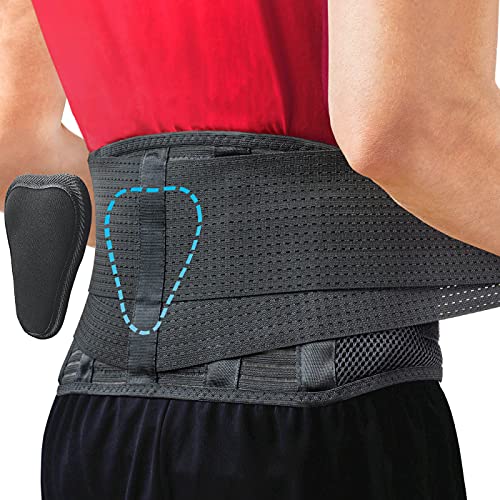
The Sparthos brace hits the sweet spot between clinical-grade support and everyday wearability. Its defining feature is the adjustable lumbar pad that provides extra compression exactly where your lower back curves inward — a level of targeted pressure that most braces at this price tier skip entirely. The vertical support stays on either side prevent the fabric from rolling up when you bend or twist, which keeps the brace locked in position through a full workday.
Breathability is surprisingly good for a brace with this much structure. The nylon shell allows airflow, and the hook-and-loop closure system gives you micro-adjustments without losing tension after four hours. Many users with spinal stenosis and osteoarthritis report they can walk without a cane while wearing it — a powerful testament to its mechanical reliability.
The Velcro tabs are exceptionally strong, which is a double-edged sword: they hold securely but can be tough to undo one-handed. If you have limited hand strength, ask someone to help you loosen it before removal. Otherwise, this is the most versatile, durable brace for chronic pain, recovery, and active work.
Why it’s great
- Adjustable lumbar pad adds targeted compression to the spine curve
- Vertical stays prevent fabric roll and stabilize the lower back during movement
- Strong, durable construction holds up under 8–10 hours of daily wear
Good to know
- Bulky under form-fitting clothes; best worn under looser shirts
- Very strong Velcro is difficult to release one-handed
2. Fit Geno Back Brace
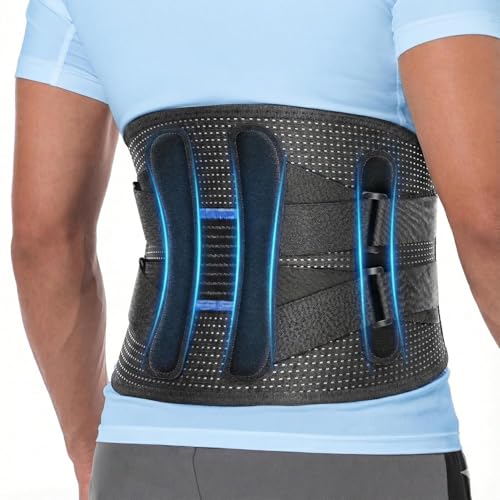
The Fit Geno brace is built for people who do not have the luxury of resting their back. With its dual-layer compression straps and heavier construction (0.51 kg), this brace delivers the kind of rigidity you expect from a medical device. It is particularly effective for post-surgery recovery and for supporting conditions like spondylolisthesis where spinal bones have shifted out of alignment.
Users report being able to stand for chores like washing dishes and mopping without pain — activities that would normally trigger a flare-up. The adjustable Velcro system is intuitive and allows you to dial in exactly the right tension without guesswork. The fabric is breathable enough for extended wear, though the brace’s thickness means it is most comfortable under relaxed-fit clothing.
The trade-off is precision: a few users note that if the brace is not positioned exactly right on the hips, the support feels less comfortable. Once you find the sweet spot, this brace becomes an essential tool for anyone whose back would otherwise fail them during daily activity.
Why it’s great
- Heavy-duty compression straps provide hospital-grade stability
- Effective for post-surgery recovery and spondylolisthesis management
- Comfortable enough for 24/7 wear if needed
Good to know
- Requires precise positioning on hips for optimal comfort
- Heavier and more substantial than lightweight daily belts
3. TESETON Back Brace

The TESETON brace is the widest contender in this lineup at 10 inches, offering coverage that spans from the lower stomach to the upper pelvis. Its eight built-in reinforced bones form a 360-degree vertical support cage that prevents muscle rolling during lifts, squats, and prolonged standing. This makes it a top choice for outdoor work, powerlifting, or any scenario where your spine needs multi-directional resistance.
The double-layer compression bands are noticeably sturdier than standard single-strap belts, wrapping firmly around both the lower back and abdominal muscles. The outer fabric blends nylon and spandex for stretch, with cooling mesh panels that reduce sweat retention during physical activity. Users note that the brace provides an immediate sense of alignment when worn over a thin base layer.
Some buyers found the brace runs slightly large relative to standard sizing charts, so measure your waist before ordering rather than guessing based on pants size. The broader Velcro design helps accommodate this, but a snug fit is critical for the support bones to work as intended.
Why it’s great
- Eight reinforced bones provide 360° vertical support against muscle roll
- 10-inch width covers stomach and lumbar region for full-core stability
- Double-layer compression bands are firm enough for heavy lifting
Good to know
- Sizing can run large; measure your waist carefully
- Neoprene-based fabric may require a thin camisole underneath for comfort
4. SOLOEVER Copper Back Brace
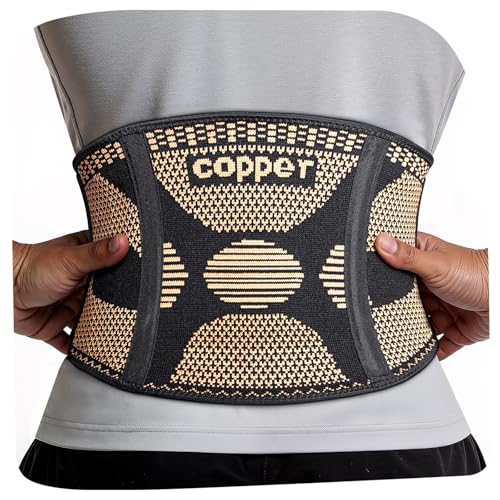
The SOLOEVER copper-infused brace takes a different approach: instead of relying on heavy bones, it uses ergonomic polypropylene strips on both sides to provide flexible lumbar support that moves with you. This makes it a smart choice for parents, older users, or anyone who needs a brace that is lightweight enough to forget about but still offers real structural help against sciatica and disc pain.
The four-way stretch elastic material, built with 3D weaving, delivers superior breathability. Users as old as 82 report that it is easy to put on without assistance and comfortable enough to sleep in — a rare quality for a back brace. The copper infusion is marketed for odor resistance and durability, though the real win here is the slim profile that disappears under a shirt.
The main durability concern involves the vertical stays: a few buyers noted that the edges poke through the bottom seam after repeated use. This is not universal, but if you plan to wear this brace daily for heavy tasks, reinforcing the seam with a stitch or two can extend its lifespan significantly.
Why it’s great
- Lightweight and breathable for all-day wear under clothing
- Easy to put on without assistance, ideal for seniors
- Flexible PP strips provide support without restricting movement
Good to know
- Vertical stays may poke through the bottom seam with heavy use
- Not as rigid as wider braces for heavy lifting scenarios
5. Cybryeh Lightweight Back Brace

The Cybryeh brace is designed for one specific job: to be worn under your clothes all day without anyone noticing. At just 4 inches wide and weighing 220 grams, it is the slimmest option here. The bottom strap is made from high-quality neoprene that conforms to the unique curve of your pelvis, while dual elastic straps provide gentle, adjustable compression for moderate lower back relief.
This brace shines in situations where a bulky lumbar belt would get in the way — think golfing, light gardening, office work, or lounging at home. The perforated neoprene is breathable enough for extended wear, though new braces may have a mild rubber odor that dissipates after airing out for a couple of days. Users who need discreet, on-the-go support appreciate how quickly it can be put on or removed.
It is important to understand the limit of this brace: it provides moderate, not heavy, support. Your physical therapist will likely recommend against wearing it full-time, as the muscles can become dependent on external compression. Use it for specific activity windows, not as a 24/7 crutch.
Why it’s great
- Extremely slim and lightweight at 220 grams, invisible under clothing
- Neoprene bottom strap conforms perfectly to the pelvic curve
- Quick on/off with dual elastic compression straps
Good to know
- Offers moderate support only — not for heavy lifting
- Should not be worn full-time as per physical therapy guidelines
FAQ
How tight should I wear my lower back brace?
Can I sleep while wearing a back brace for sciatica?
How do I clean a neoprene back support belt?
Final Thoughts: The Verdict
For most users, the best back brace winner is the Sparthos Back Brace because its adjustable lumbar pad and vertical stays deliver clinical-grade support without requiring a prescription. If you need post-surgery rigidity and don’t mind extra bulk, grab the Fit Geno Back Brace. And for discreet everyday relief that stays hidden under a work shirt, nothing beats the Cybryeh Lightweight Brace.

Mo Maruf
I created WellFizz to bridge the gap between vague wellness advice and actionable solutions. My mission is simple: to decode the research and give you practical tools you can actually use.
Beyond the data, I am a passionate traveler. I believe that stepping away from the screen to explore new environments is essential for mental clarity and physical vitality.