Our readers keep the lights on and my smoothie glass nicely filled. As an Amazon Associate, I earn from qualifying purchases.
Living with scoliosis as an adult means navigating a persistent curve that shifts your center of gravity, often causing muscle fatigue and joint strain on one side of your body. The right brace doesn’t just squeeze your torso—it counteracts the rotational pull of your spine and redistributes load to keep you upright longer, whether at a desk or on your feet.
I’m Mohammad Maruf — the founder and writer behind WellFizz. My research focuses on parsing orthopedic design specifications, comparing load-bearing panel rigidity and pneumatic compression logic, to separate true medical-grade braces from generic belts that merely compress the abdomen.
This guide evaluates seven braces on fit, adjustability, and spinal-stabilization mechanics so you can confidently choose the best back brace for scoliosis adults that matches your curve pattern and daily activity level.
How To Choose The Best Back Brace For Scoliosis Adults
Adult scoliosis differs from adolescent idiopathic scoliosis in that the spine has often already fused or developed degenerative changes. A generic elastic back belt will not correct an adult curve—you need a brace that stabilizes the specific vertebral segments where your curve apex sits. Focus on three factors: the brace’s rigidity level, its adjustment mechanism, and its PDAC or medical certification.
Identify Your Curve Pattern First
If your primary curve is in the lumbar spine (L1–L5), an LSO (Lumbo-Sacral Orthosis) with rigid posterior panels and a sacral base extension works best. For curves that extend into the thoracic spine (T4–T12), you need a TLSO (Thoraco-Lumbo-Sacral Orthosis) that reaches higher and includes shoulder straps to counteract upper-body rotation. Wearing the wrong height of brace can leave your actual curve apex unsupported, which aggravates rather than relieves pain.
Compression Type: Pulley vs. Pneumatic vs. Mechanical
Pulley systems (like the BaxMAX or the Timtakbo LSO) provide multi-directional compression that can be tightened incrementally without twisting your torso—valuable for adults with limited grip strength or arthritis. Pneumatic belts (like the DDS Decompression Belt) use an air bladder to create gentle distraction between vertebrae, which can relieve nerve root impingement. Rigid braces with removable panels (VertebrAlign, Comfyorthopedic) offer the most predictable stabilization, but they are bulkier and may restrict bending during seated work.
PDAC Approval and Sizing Precision
PDAC (Product Data Advisory Committee) approval means the brace has been reviewed against Medicare coding guidelines (L0631, L0648, L0650, L0456). This is strong evidence that the brace is built to a medical-grade standard with materials that maintain their stiffness over months of daily use. Sizing must be done at the navel—not your pant size—and you should verify that the brace offers separate width and height adjustments, not just a single strap, so it tracks your individual torso length.
Quick Comparison
On smaller screens, swipe sideways to see the full table.
| Model | Category | Best For | Key Spec | Amazon |
|---|---|---|---|---|
| Comfyorthopedic LSO | Premium LSO | Post-op & herniated disc with scoliosis | PDAC L0648/L0631; detachable back & side pads | Amazon |
| Brace Align TLSO | TLSO | Thoracic scoliosis & compression fractures | PDAC L0456/L0457; shoulder straps; 23-50″ waist | Amazon |
| DDS 300 Decompression | Pneumatic | Spinal decompression during daily wear | Pneumatic air bladder; adjustable inflation | Amazon |
| VertebrAlign (Brace Align) | Medical LSO | All-day lumbar stabilization | PDAC L0631–L0650; one-handed pulley; 23-50″ | Amazon |
| Timtakbo LSO | Bionic Arch LSO | Severe spasm & postural correction | 26° bionic arch; dual pulley; abdominal plate | Amazon |
| BaxMAX | Lightweight Pulley | Active movement & chiropractic support | 5:1 pulley; nylon/kevlar; 5 oz; 3-way wear | Amazon |
| NEENCA Lower Back Brace | Budget Lumbar | Mild scoliosis & sciatica relief | Multi-point elastic; metal rear stay; low-profile | Amazon |
In‑Depth Reviews
1. Comfyorthopedic LSO Back Brace

This LSO brace earned the top slot because of its PDAC approval across four codes (L0631, L0637, L0648, L0650) and its patented one-size design that adjusts from 25 to 48 inches in abdominal circumference. For adults with scoliosis whose curve pattern may shift with weight changes, this eliminates the need to buy a second brace. The foam body contains a removable hard back cushion that contours to the lumbar curve, plus two detachable side support pads that provide lateral stability—critical for countering the coronal imbalance of adult scoliosis.
The dual medical-grade drawstrings on each side allow asymmetric tightening, which means you can apply more compression on the convex side of your curve and less on the concave side. This targeted pressure can reduce the rotational torque that pulls your rib cage into the scoliotic posture. Reviewers recovering from discectomy reported that the brace effectively prevented slouching and poor lifting form during the first three weeks of wear, which is exactly the kind of positional control needed for curve-related instability.
One limitation: the brace height is not adjustable, and a few taller users noted the rigid back pad sits too high or too low for their torso length. If your T-spine curve extends above the LSO’s top edge, you may need the TLSO instead. Otherwise, the build quality—double-stitched Velcro, reinforced eyelets, and a full one-year warranty against manufacturer defects—makes this the most reliable ready-to-wear medical brace for adults with lumbar-dominant scoliosis.
Why it’s great
- PDAC approved for four L-codes; insurance reimbursable with proper documentation.
- Detachable back and side pads allow you to customize the rigidity profile for your specific curve apex.
- Dual drawstring system enables asymmetric compression for rotational curve control.
Good to know
- Torso height is fixed; may not align properly for very tall or very short users.
- Dry clean only; the foam padding degrades if machine washed.
2. Brace Align TLSO Full Back Brace

Adults whose scoliosis curve apex sits in the mid-to-upper back (T4–T10) need thoracic extension—something no LSO brace provides. This TLSO from Brace Align features shoulder straps that run over the acromioclavicular joint, anchored to a rigid posterior frame that extends from the sacrum up to the lower thoracic spine. The PDAC certification under L0456 and L0457 confirms it meets medical standards for post-op support after spinal fusion or compression fracture management, which often accompanies degenerative scoliosis.
The frame uses adjustable compression straps that can be trimmed to length, plus removable side panels that allow you to dial in the lateral stiffness. Because thoracic scoliosis often involves rib hump rotation, the ability to loosen the shoulder straps on one side while tightening them on the other can help de-rotate the upper trunk. The fabric is a ventilated mesh that stays comfortable during all-day wear, and the entire brace fits waists from 23 to 50 inches without needing an extension kit.
Setup takes a few minutes the first time—the shoulder Velcro closures require some patience to align, and users who needed help from a caregiver reported better results than those who tried to self-fit. Once dialed in, the brace is indistinguishable from what a hospital brace clinic would dispense for TLSO bracing. If your scoliosis curve extends into the upper back, this is the most accessible medical-grade TLSO on the market without a prescription.
Why it’s great
- Only brace in this list with thoracic shoulder straps for true T-spine scoliosis support.
- PDAC L0456/L0457 certified; identical to clinic-dispensed units.
- Breathable ventilated mesh prevents overheating under clothing.
Good to know
- Shoulder Velcro can be difficult to adjust independently; a second person helps.
- Bulky profile makes sitting in low-backed chairs or car seats uncomfortable.
3. VertebrAlign LSO Lumbar Back Brace (Brace Align)
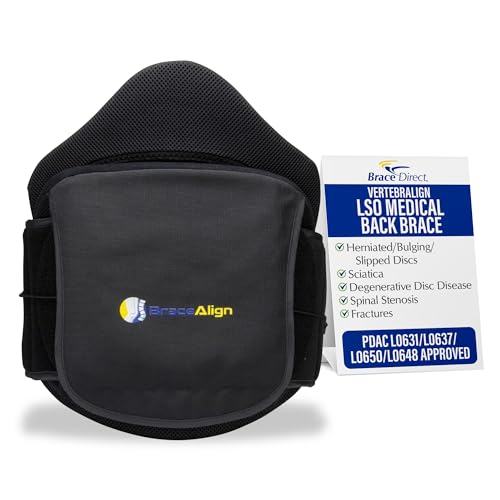
The VertebrAlign is the most versatile LSO brace for adults who need to adjust support multiple times per day. Its one-handed pull-tab pulley system lets you tighten or release compression without contorting your body—especially useful in the morning when scoliosis-related muscle stiffness is highest. The brace is PDAC approved for four L-codes (L0631, L0637, L0648, L0650), meaning it covers everything from post-op lumbar fusion rehabilitation to daily stabilization of degenerative scoliosis.
What sets it apart is the removable rigid panel system: you can run the brace with full stiffness (both posterior and side panels inserted) for heavy-lifting days, or remove the side panels for seated desk work where you need more hip mobility. The neoprene fabric is reinforced at the pull-tab anchor points, which prevents the common failure mode of fraying straps under repeated tension. The brace comes with a hygiene carrying bag and an IFU (instructions for use) that clearly explains panel placement for different conditions.
Some users reported that the pull-strings do not retract automatically, so if you loosen the brace fully, you have to manually feed the strings back through the pulley eyelets—a minor inconvenience during daily donning and doffing. The back padding also tends to detach from the Velcro loop field after months of use, but the company offers a free video fitting session to help dial in the fit before that becomes an issue. For the price point, the combination of PDAC certification and modular panel design is unmatched.
Why it’s great
- One-handed pulley system ideal for seniors or anyone with grip weakness.
- Removable panels let you switch between rigid stabilization and flexible daily wear.
- American-owned company with free video fitting support.
Good to know
- Pulley strings don’t self-retract, making full loosening cumbersome.
- Back pad can detach from the loop fabric over long-term use.
4. Timtakbo LSO Back Brace

The Timtakbo brace uses a proprietary bionic decompression plate that you can adjust to three different arch angles, with the most aggressive setting providing a 26-degree lumbar extension. For adults with scoliosis who have lost lumbar lordosis—a common co-condition—this arch action creates a corrective extension force that pulls the pelvis into anterior tilt, counteracting the flattening effect of the spinal curve. The dual-pulley system uses finger-tab pulls that require very little hand strength, making it accessible for users with arthritis or post-surgical grip limitations.
The abdominal support includes an extension Velcro panel and a removable soft plastic plate, which is rare in scoliosis braces because it adds frontal containment that prevents the brace from riding up when you bend. Reviewers with severe lower back spasms reported that the brace immobilized about 80% of their movement, allowing them to function during acute flare-ups. The brace is especially effective for adults whose scoliosis is complicated by a herniated disc or spinal stenosis, because the arch plate creates space between the affected vertebrae.
The biggest trade-off is bulk: this is not a brace you can wear discreetly under a fitted shirt. The abdominal plate and arch mechanism add about 1.5 pounds of material, and the brace height may interfere with some office chair backs. Sizing is critical—the 2XL/3XL fits a 47–59 inch belly, but the arch plate’s height is fixed, so users significantly above or below average torso length may find the arch doesn’t align with their lumbar apex. For those who need aggressive positional correction, however, the Timtakbo offers functionality that standard flat-backed braces cannot.
Why it’s great
- Adjustable arch plate (up to 26°) provides active lumbar extension correction.
- Dual-pulley system with finger tabs requires minimal hand strength to operate.
- Abdominal extension panel prevents brace migration during bending or lifting.
Good to know
- Significantly bulkier than flat-panel braces; hard to conceal under clothing.
- Arch plate height is fixed; may misalign with lumbar apex for atypical torso lengths.
5. DDS 300 Back Decompression Belt

The DDS 300 works on an entirely different principle from the other braces in this list: instead of compressing the abdomen to stabilize the spine, it uses an inflatable air bladder that pushes the lumbar vertebrae forward, creating gentle traction that separates the vertebral bodies. For scoliosis patients who have nerve root impingement (leg pain, numbness, or sciatica on the curve’s concave side), this decompression can relieve pressure on the dorsal root ganglion without requiring rigid immobilization. The pneumatic system allows you to dial in the exact distraction force with a hand bulb pump.
Because the belt is made of flexible fabric with no rigid posterior panels, it can be worn during activities where a hard brace would be impractical—nursing a baby, driving with a seatbelt, or sleeping. Postpartum users with curve-related back pain reported that the DDS belt was the only option that provided relief because its curved shape conformed to the lordotic arch without pressing on the ribs. The belt is also much lighter than any LSO or TLSO, which matters if you need to wear it for six to eight hours continuously.
There are two catches. First, sizing is critical and the belt offers limited adjustability—if you buy the wrong circumference, the air bladder will not sit at the correct spot on your lumbar spine. Second, the pneumatic effect is temporary: once you deflate the bladder, the distraction disappears, so it is a relief tool rather than a structural support for heavy lifting or prolonged standing. Over ten years of daily use, some users wore through three belts, indicating that the air bladder has a finite lifespan. As a supplemental decompression device, it is invaluable; as a primary scoliosis brace, it lacks the rigidity some curve types demand.
Why it’s great
- Pneumatic bladder creates active vertebral distraction for nerve root relief.
- Lightweight and flexible; can be worn while nursing, driving, or sleeping.
- Fits under clothing without visible bulk.
Good to know
- Sizing is sensitive; limited adjustability means the bladder may miss the lumbar apex if fit is off.
- Air bladder lifespan is finite—heavy users may replace the belt every few years.
6. BaxMAX Adjustable Back Brace
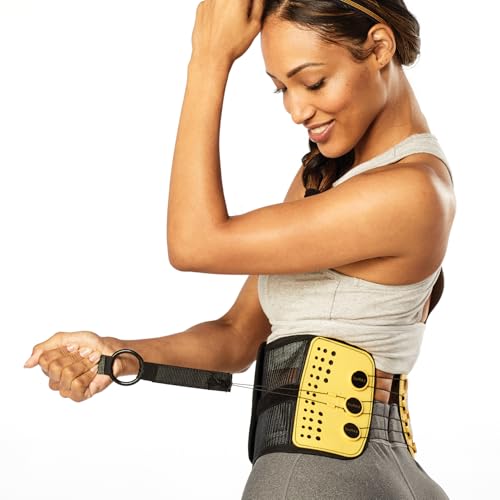
The BaxMAX is purpose-built for adults with scoliosis who need spinal support during movement, not just while sitting. Its patented 5-to-1 pulley system amplifies manual pulling force five times, so a slight tug delivers high-compression support without straining your hands.
Chiropractors have recommended this brace for 15 years, and it is used in over 3,000 clinics. The three-way wearing position allows you to adjust the compression angle depending on whether you are seated, standing, or moving. For scoliosis, the ability to bias the compression slightly toward the convex side of the curve can help reduce the muscular fatigue that builds up from trying to self-correct posture. The Kevlar cable is durable enough to withstand months of daily adjustment without fraying.
The trade-off is comfort during seated tasks: the nylon mesh material can roll up at the lower edge when you bend into a seated position, which concentrates pressure in a narrow band rather than distributing it across your lumbar spine. Users with larger midsections also reported that the hook-and-loop closure can cut into the skin if tightened excessively. The BaxMAX excels during standing and moving activities, but for prolonged desk work, a wider LSO with a non-rolling edge may serve you better.
Why it’s great
- 5:1 pulley system provides maximum compression with minimal hand force.
- Ultra-lightweight nylon-kevlar mesh is breathable and weighs only 5 oz.
- Three wearing positions allow you to adjust compression for standing, sitting, or moving.
Good to know
- Material rolls up at the lower edge when seated, creating a pressure band.
- Hook-and-loop closure can dig into skin for users with larger waist proportions.
7. NEENCA Lower Back Brace

The NEENCA brace is the budget-friendly entry point for adults with mild scoliosis who need basic lumbar support without the complexity of pulleys or pneumatic systems. It uses a multi-point elastic design with a single metal rear stay that provides gentle sagittal-plane stabilization. The brace is made from medical-grade polyester and spandex with a slim profile that fits easily under clothing—critical for users who want to wear it during the workday without announcing their condition.
Its primary strength is simplicity: two elastic Velcro straps let you adjust tension in seconds, and the brace is machine washable, which matters when sweat accumulates during daily wear. Reviewers with sciatica and bulging discs found that the metal stay effectively reduced the forward bend that compresses the affected nerve root. The sizing range is generous, from a 25.9-inch waist up to 65 inches, with clear instructions to measure at the navel rather than by pant size.
What limits the NEENCA for scoliosis-specific use is the lack of lateral or rotational control. The single posterior stay addresses flexion but does not resist the coronal-plane shift or rotational torque that defines scoliosis. Users with moderate-to-severe curves may outgrow this brace within weeks, as the elastic fabric provides only light to medium support. For very mild curves or as a secondary brace for days when a rigid LSO is too cumbersome, the NEENCA offers excellent value and comfort.
Why it’s great
- Low-profile design fits discreetly under work clothes.
- Machine washable and easy to clean without degrading the elastic.
- Generous sizing with clear navel-level measurement guide.
Good to know
- Single metal stay provides only sagittal support; lacks lateral or rotational control for scoliosis.
- Elastic fabric offers light-to-medium support; insufficient for moderate-to-severe curves.
FAQ
Will an LSO brace straighten my adult scoliosis curve?
How many hours per day should I wear a scoliosis brace as an adult?
Should I buy a TLSO or LSO for my scoliosis?
Can I wear a scoliosis brace while lifting weights or doing manual labor?
What does PDAC approved mean and does my insurance require it?
Final Thoughts: The Verdict
For most users, the best back brace for scoliosis adults winner is the Comfyorthopedic LSO because it combines PDAC-grade certification with detachable side panels and an asymmetric drawstring system that directly addresses the rotational nature of an adult curve. If you need thoracic extension for a high apex curve, grab the Brace Align TLSO with its shoulder straps and full posterior frame. And for decompression-specific relief on days when nerve root pain dominates, nothing beats the DDS 300 Pneumatic Belt that gently distracts the lumbar segments without immobilizing your entire torso.

Mo Maruf
I created WellFizz to bridge the gap between vague wellness advice and actionable solutions. My mission is simple: to decode the research and give you practical tools you can actually use.
Beyond the data, I am a passionate traveler. I believe that stepping away from the screen to explore new environments is essential for mental clarity and physical vitality.