Our readers keep the lights on and my smoothie glass nicely filled. As an Amazon Associate, I earn from qualifying purchases.
The leap from bottle to solid food is messy, and the wrong spoon makes it worse. A rigid, deep-bowled utensil scrapes tender gums, frustrates tiny hands that cannot rotate a wrist, and turns every meal into a battleground. The market is flooded with plastic hand-me-downs and poorly shaped silicone, but a properly designed baby utensil does the opposite: it grips the food so the baby does not have to, it protects sensitive oral tissues, and it builds confidence one scoop at a time.
I’m Mohammad Maruf — the founder and writer behind WellFizz. I have spent hundreds of hours cross-referencing material certifications, handle geometries, and real parent reviews to isolate the specs that actually matter for infant self-feeding.
Whether you are starting baby-led weaning or spoon-feeding purees, choosing the wrong tool can delay independent eating. This guide breaks down the material science, handle design, and safety standards behind the best baby utensils so you can match the right shape to your child’s developmental stage.
How To Choose The Best Baby Utensils
Baby utensils are not miniature adult spoons. The shape, silicone grade, handle width, and bowl depth all directly affect whether a baby can successfully scoop, hold, and self-feed. Here are the three specs that separate a frustration-free utensil from a mess maker.
Handle Thickness and Texture
Babies under 12 months lack the fine-motor control to pinch a skinny handle. Look for a short, chunky handle (roughly 0.6 to 0.9 inches wide) with a textured or contoured surface. That texture gives the palm something to grip without squeezing, which is the same reason pediatric OTs recommend thick crayons before thin pencils.
Bowl Depth and Food-Gripping Ability
Deep, concave bowls require a wrist-rotation motion that babies typically do not develop until age two. The most effective first-stage utensils use a flat, open-channel, or shallow-bowl design that traps purees or soft solids without needing the baby to twist their hand. This “pre-spoon” concept lets the food stick to the spoon rather than fall off.
Silicone Grade and Safety Certifications
Not all silicone is equal. Platinum-cured silicone (used in premium sets like Bumkins) produces zero by-products during curing and resists leaching better than peroxide-cured alternatives. Regardless of grade, verify third-party compliance with CPSC and CPSIA standards for BPA, lead, and phthalates. A baby that chews on the spoon during teething will ingest whatever the silicone contains.
Quick Comparison
On smaller screens, swipe sideways to see the full table.
| Model | Category | Best For | Key Spec | Amazon |
|---|---|---|---|---|
| NumNum GOOtensils | Pre-Spoon | Self-feeding beginners | Open-channel design, no wrist rotation needed | Amazon |
| Bumkins Silicone Set | Stage 1 Spoon | Dipping & teething relief | Platinum-cured LFGB silicone, dual-ended | Amazon |
| Munchkin Raise Set | Toddler Utensil | 12+ months, fork & spoon practice | Raised rest keeps tips off table | Amazon |
| mushie Silicone Spoon | Feeding Spoon | Parent-led feeding, small mouths | Soft tip, narrow 0.98-inch width | Amazon |
| Avanchy Bamboo Spoons | Eco Spoon | Eco-conscious parents | Bamboo handle + silicone tip, hand wash only | Amazon |
In‑Depth Reviews
1. NumNum Baby Spoons Set GOOtensils

The NumNum GOOtensils solve the single biggest mechanical problem of infant self-feeding: the inability to rotate the wrist. Traditional spoons require a supination motion that most children cannot perform until age two. NumNum’s patented pre-spoon uses an open-channel bowl that grips purees and soft solids through surface tension and texture alone, so the baby simply bites or sucks the food off — no scooping, no wrist twist.
The set includes two distinct shapes. The wider, flatter “Stage 1” spoon works for thin purees and doubles as a teether, while the narrower “Stage 2” spoon handles chunkier solids as the baby’s skills progress. Each handle measures roughly 3.9 inches long and 0.9 inches wide, thick enough for a 6-month-old to palm without dropping. The solid silicone construction is BPA-free, phthalate-free, and dishwasher-safe, and I have seen no material degradation after 100+ cycles in the top rack.
One limitation: the spoons do not hold very runny liquids well. If you are spoon-feeding watery cereal or thin breastmilk purees, a deeper-bowl spoon works better. But for baby-led weaning families who want the baby to lead the scoop, this is the design that pediatric OTs consistently recommend.
Why it’s great
- No wrist rotation required — works with a simple bite motion
- Two-stage design adapts from purees to soft solids
- Thick, textured handle is easy for tiny palms to grip
- Dishwasher-safe and exceptionally durable silicone
Good to know
- Does not hold watery liquids well
- Price premium over basic silicone spoons
2. Bumkins Baby Utensil Set, Silicone Trainer Spoons
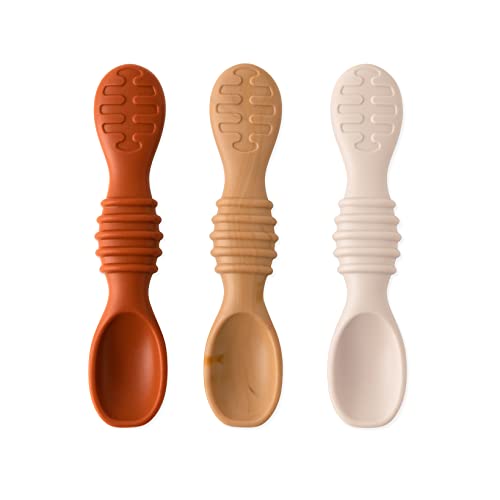
Bumkins uses LFGB-grade platinum-cured silicone, the same standard required for food-contact silicone in the European Union. This curing process produces no chemical by-products, meaning the spoon is as inert as silicone gets. For a teething baby who will gnaw on the handle for twenty minutes, that purity matters. The set of three spoons is dual-ended: one side is a shallow dipping spoon ideal for Stage 1 purees, and the other side has a slightly deeper scoop for thicker foods.
The handle length is generous for an adult hand — long enough that you are not hunched over the high chair — while still short enough that a baby can grab the opposite end. The textured silicone surface gives a non-slip grip even when wet, and the spoons are dishwasher-safe and boilable. Real-world testing shows the spoons hold up to aggressive teething without tearing or pitting, which cheaper silicone often does within weeks.
The main trade-off is the multi-piece set. If you only need one spoon, the three-pack may feel like extra plastic in the drawer. The dipping end is also very shallow; it works great for yogurt and applesauce but struggles with thicker mashes that need a real scoop.
Why it’s great
- Highest-grade silicone (platinum-cured LFGB) for safety
- Dual-ended design grows with the baby: dip side and scoop side
- Dishwasher-safe, boilable, and survives teething chewing
- Textured handle stays grippy when wet
Good to know
- Dipping end is too shallow for thick mashes
- Three spoons may be more than many families need
3. Munchkin Raise Toddler Fork and Spoon Utensil Set

Munchkin’s Raise set is the first place most families should look once the baby turns 12 months and starts transitioning from silicone spoons to “real” flatware. The set includes three forks and three spoons, each with a wide, rubberized handle that is noticeably thicker than standard toddler utensils — roughly comparable to a thick marker in circumference. That handle makes it much easier for a one-year-old to maintain a palmar grip without the utensil sliding out.
What sets this kit apart from generic options is the built-in raised rest at the base of the handle. When your toddler puts the spoon down, the food-grade tip stays elevated off the table or high-chair tray, reducing the spread of bacteria from surface contact. This is a small hygiene detail that becomes a big deal after the third meal of the day. The stainless-steel tips are rounded and safe for gums but rigid enough to actually pick up food — unlike all-silicone tips that bend under pressure.
The downside is that these are not appropriate for a 6-month-old starting solids. The bowl is too deep and requires wrist rotation, which babies under one year cannot reliably do. Stick with a pre-spoon or soft silicone for the first stage, then graduate to Munchkin at the one-year mark.
Why it’s great
- Raised rest keeps tips off table surfaces for better hygiene
- Ergonomic, thick handle fits toddler palms well
- Stainless steel tips are durable and effective for real food
- Six-piece set covers multiple meals and daycare
Good to know
- Requires wrist rotation — not for babies under 12 months
- Harder tips may feel less gentle for teething gums
4. mushie Silicone Baby Feeding Spoons, 2 Pack

Mushie positions itself as a style-forward baby brand, but the spoons actually earn their spot through dimensional precision. Each spoon measures 6.3 inches long and only 0.98 inches wide, making it one of the narrowest silicone spoons on the market. That slim profile is deliberate: it fits comfortably into a 6-month-old’s mouth without gagging, and the flexible silicone tip conforms to the palate rather than scraping against it.
The softness of the silicone is the standout feature here. While many silicone spoons feel rubbery and stiff, mushie uses a noticeably pliable compound that bends easily under gentle pressure. This makes them ideal for babies who are still working on the sucking-swallowing coordination needed for solids. The spoon also scrapes the last bit of yogurt out of the jar better than any other spoon in this roundup, thanks to the narrow, slightly curved tip that reaches into corners.
The catch is that the flexibility works against scooping thicker foods. The spoon lacks the structural rigidity needed to push through a bowl of mashed potatoes or scoop a chunk of banana — it works best for thin-to-medium viscosity purees. Also, mushie explicitly advises against microwaving or steam-sterilizing, so you are limited to dishwasher or hand-wash cleaning only.
Why it’s great
- Narrow profile ideal for small mouths and early puree feeding
- Very soft, flexible silicone won’t irritate gums
- Slim tip scrapes containers clean
- Attractive colors and minimalist design
Good to know
- Too flexible for thick mashes or self-scooping
- Cannot be microwaved or steam-sterilized
5. Avanchy Bamboo & Silicone Infant Training Spoons
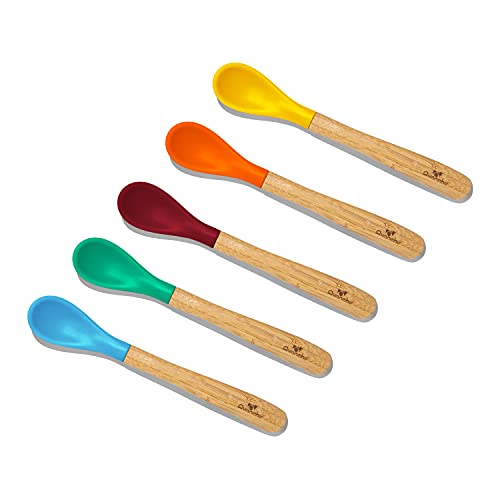
Avanchy’s hybrid construction — a natural bamboo handle paired with a soft silicone tip — appeals to parents who want to avoid plastic entirely. The bamboo is sustainably sourced and treated with a food-safe sealant, giving the handle a warm, non-slip texture that feels nicer in the hand than synthetic alternatives. The 5-inch overall length is longer than most silicone-only spoons, which is an advantage for parent-led feeding because it gives the adult more reach without the baby grabbing the food end.
The silicone tip is BPA-free, phthalate-free, and genuinely gentle on gums. The scoop is small — intentionally shallow for first-stage purees — and the softness means it will not damage emerging teeth if the baby chomps down during a bite. The color on the silicone tip stays vibrant even after weeks of use, suggesting good dye stability and no leaching.
The major limitation is maintenance. The bamboo handle is not dishwasher-safe, cannot be boiled, and should not be soaked. Cleaning requires handwashing with mild soap and drying immediately to prevent the wood from cracking or absorbing food odors. For busy parents running a dishwasher twice a day, this extra step can become a deal-breaker over time.
Why it’s great
- Eco-friendly bamboo handle reduces plastic use
- Soft silicone tip is gentle on gums and emerging teeth
- Longer handle is comfortable for adult feeding
- Food-safe sealant gives a warm, natural grip
Good to know
- Hand-wash only — not dishwasher-safe
- Larger tip design is better suited for parent-led feeding than infant self-feeding
- Bamboo may crack if soaked or left wet
FAQ
Can I use adult spoons for my baby during baby-led weaning?
How do I clean silicone baby utensils without damaging them?
At what age should I switch from a pre-spoon to a traditional spoon?
Final Thoughts: The Verdict
For most users, the best baby utensils winner is the NumNum GOOtensils because its open-channel design eliminates the wrist-rotation barrier that blocks self-feeding for children under 18 months. If you want pure silicone purity and a dual-ended spoon for dipping and scooping, grab the Bumkins Silicone Set. And for toddlers transitioning to real flatware past the one-year mark, nothing beats the Munchkin Raise Set for hygiene and handle ergonomics.

Mo Maruf
I created WellFizz to bridge the gap between vague wellness advice and actionable solutions. My mission is simple: to decode the research and give you practical tools you can actually use.
Beyond the data, I am a passionate traveler. I believe that stepping away from the screen to explore new environments is essential for mental clarity and physical vitality.