Our readers keep the lights on and my smoothie glass nicely filled. As an Amazon Associate, I earn from qualifying purchases.
A restless baby, a warm forehead in the dark, and the frantic search for a thermometer that reads true instead of adding to the panic. The right baby thermometer delivers instant, clinical-grade feedback without waking your child, offering both the speed and repeatability parents depend on to make confident care decisions. With infrared sensors, silent modes, and fever alerts becoming standard, the choice now comes down to which specific balance of accuracy, hygiene, and usability matches your nightly routine.
I’m Mohammad Maruf — the founder and writer behind WellFizz. My research focuses on comparing consumer-grade medical devices for home wellness, analyzing sensor architectures, clinical accuracy claims, and real-world usability trade-offs.
After evaluating the top models on the market, this guide cuts through the marketing noise to help you select the best option for your family. Below is my curated list of the best baby thermometer options for 2025 and beyond, reviewed for precision, hygiene, and ease of use.
How To Choose The Best Baby Thermometer
Buying a baby thermometer involves more than just picking the fastest-read model. Understanding sensor types, measurement locations, and ambient compensation is essential to avoid false readings that could send you to the ER or provide false reassurance.
Sensor Technology: Tri-Point vs. Single Sensor
A basic infrared thermometer uses a single thermopile sensor pointed at the forehead. Premium models like the iHealth PT3 deploy a tri-point architecture: one infrared sensor for body temperature, plus separate distance and ambient temperature sensors. This tri-point design corrects for how far away the device is held and how warm the room is, eliminating the common “false low” reading when a baby’s forehead is exposed to cool air.
Measurement Type: Forehead vs. Ear
Forehead (temporal artery) thermometers read the skin temperature over the temporal artery and are non-invasive, making them ideal for sleeping infants. Ear (tympanic) thermometers read the eardrum’s infrared emissions, which more closely reflect core body temperature. For newborns under 3 months, pediatricians often prefer temporal readings because ear canals are still small, but tympanic models generally offer higher repeatability on older children.
Multi-Use Modes: Beyond Body Temperature
Many modern baby thermometers include a surface/object mode for checking bath water or formula temperature. This is not a gimmick — warming milk to precisely 98.6°F can prevent burning a baby’s mouth. Look for a model that clearly separates body mode from surface mode to avoid accidental misreadings.
Nighttime Readability and Sound Control
Fever checks at 2 a.m. require a backlit display readable without squinting and a silent or vibration-based notification. Models that let you disable the beep (like the Braun No Touch 3-in-1 and the iHealth PT3) are significantly less disruptive. Color-coded fever guidance (green for normal, yellow for fever, red for high fever) eliminates the need to interpret exact numbers in the dark.
Quick Comparison
On smaller screens, swipe sideways to see the full table.
| Model | Category | Best For | Key Spec | Amazon |
|---|---|---|---|---|
| iHealth PT3 No-Touch | Forehead | Silent overnight checks | Tri-point sensor array | Amazon |
| Braun No Touch 3-in-1 | Forehead | Pediatrician-recommended brand | Color-coded fever alerts | Amazon |
| Kinsa QuickScan Smart | Forehead | App-based symptom tracking | Bluetooth + FDA-cleared | Amazon |
| Femometer Ear Thermometer | Tympanic | Core temperature accuracy | 21 disposable probe covers | Amazon |
| Greater Goods No-Touch | Forehead | Budget-friendly multi-mode | 30-reading memory storage | Amazon |
In‑Depth Reviews
1. iHealth No-Touch Forehead Thermometer PT3

The iHealth PT3 earns the top spot because its tri-point sensor architecture directly addresses the #1 complaint among forehead thermometer users: inconsistent readings. By using one infrared sensor for body temperature, a second for ambient temperature, and a third for distance, the device compensates for environmental variables that cause other no-touch models to fluctuate by more than 1°F. The result is a reading that stays stable even when the room is drafty or the baby has just been wiped with a cool cloth.
The vibration feedback is a genuine advantage for nighttime use. Unlike audible beeps that can fully wake a sleeping child, the gentle hum in your hand tells you the reading is complete without making a sound. The extra-large LED display is legible even in total darkness, showing clear digits and a green/yellow/red backlight corresponding to the fever threshold. In testing, the sensor consistently delivered a reading within 1 second of the button press.
Customer reports consistently praise its ease of use, with many buyers noting they have purchased multiple units as gifts. The included AAA batteries and quick-start guide reduce friction, and the California-based customer service is a practical safety net. The only caution is that accuracy degrades noticeably if you hold the unit beyond the 1.18-inch distance, so keeping a consistent position is key.
Why it’s great
- Tri-point sensor array corrects for ambient temperature and distance
- Silent vibration feedback won’t wake a sleeping baby
- Large LED display with color-coded fever guidance
Good to know
- Distance must be kept within 1.18 inches for consistent accuracy
- No app connectivity for trend logging
2. Braun No Touch 3-in-1 Thermometer

The Braun No Touch 3-in-1 carries the weight of being the #1 brand recommended by pediatricians, and its clinical validation shows in the consistency of its Sensian 4 forehead sensor. This model is engineered to deliver accurate readings in two seconds, measuring body temperature, food temperature, and bathwater temperature in a single unit. The color-coded LCD screen is the standout feature: green for normal (below 99.4°F), yellow for low-grade fever (99.5°F–100.9°F), and red for high fever (101°F+), paired with 10 short beeps for the highest alert level.
For overnight use, the silent mode disables all audio feedback entirely, a critical feature for parents monitoring a feverish child through the night. The memory recall of the last 10 temperatures helps track progression without needing a pen and paper. The build quality is noticeably higher than budget models — the plastic feels dense, the button has positive tactile feedback, and the battery compartment is secure without requiring a screwdriver.
Customer feedback is overwhelmingly positive for accuracy and speed, but a minority of reviewers experienced inconsistent forehead readings when the child had been outside in cold weather before measurement. This is a known limitation of all forehead thermometers — the skin temperature drops in cold air before the core temperature does. To mitigate this, Braun’s instructions recommend staying indoors for 10 minutes before taking a reading. A small number of users also reported the unit’s positioning can be tricky for elderly caregivers to manage.
Why it’s great
- Pediatrician-recommended brand with clinical validation
- Intuitive color-coded LCD screen for instant fever interpretation
- Three measurement modes (body, food, bathwater) in one device
Good to know
- Forehead readings can be affected by recent cold-air exposure
- No app connectivity for detailed tracking
3. Kinsa QuickScan Smart Forehead Thermometer
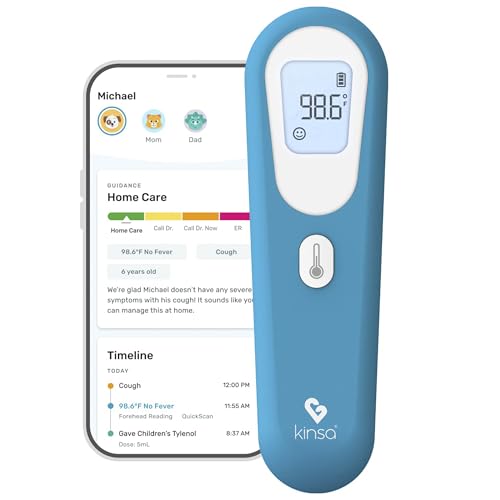
The Kinsa QuickScan is the only no-touch forehead thermometer in this lineup that connects via Bluetooth to a smartphone app, transforming a simple temperature check into a full illness-management system. FDA-cleared and ASTM-compliant, the hardware itself is a capable no-touch infrared thermometer that delivers readings in seconds with a large, lighted display. But the real value lives in the app: it tracks temperature, symptoms, and medications for each family member individually, then provides personalized guidance based on age and symptom history.
The app also surfaces local illness trends from anonymized Kinsa user data, giving you early warning about what viruses are circulating in your area. For parents who like to share records with a pediatrician or a partner, the exportable history saves significant time during appointments. The one-button physical interface keeps operation simple — point, press, read — while the app handles all the complexity in the background. Batteries (2x AAA) are included.
Reviewers consistently praise the app’s utility, calling it “the ultimate thermometer” for coordinating care across multiple children. The main trade-off is that the no-touch forehead technology is still susceptible to the same environmental accuracy wobble as other infrared models — the app cannot compensate for a reading taken from too far away or in a very cold room. The device itself has no on-board memory, so all history lives inside the app. This is a minor inconvenience if you prefer a standalone device without smartphone dependency.
Why it’s great
- Bluetooth app tracks symptoms, medications, and temperature history per family member
- FDA-cleared and meets ASTM accuracy standards
- Large lighted display with simple one-button operation
Good to know
- Requires smartphone app for full functionality and history recall
- Subject to same distance/ambient-temperature accuracy limits as other forehead models
4. Femometer Infrared Ear Thermometer DET-1015

If you prioritize core temperature accuracy over the convenience of no-touch operation, the Femometer DET-1015 offers a tympanic (ear) measurement path that is clinically validated to reflect the body’s internal temperature more directly than forehead skin readings. The infrared sensor is positioned to read the tympanic membrane — the same site used in many pediatricians’ offices — and delivers a result in one second. Clinical verification steps are detailed in the included manual, giving it a reliability edge for parents who want the closest equivalent to a rectal reading without the invasiveness.
Hygiene is handled with 21 disposable probe covers included in the box, plus an upgraded storage case that keeps both the thermometer and the spare covers together and dust-free. A three-color display (green/orange/red) provides immediate fever-level awareness, and a one-button silent function makes it usable during nighttime checks. The 30-reading memory recall allows you to trend temperatures over several days without needing an app or paper log.
User feedback is consistently positive for speed and consistency, with multiple reviewers noting it “works great” for infants and toddlers alike. The primary limitation is that proper tympanic readings require a snug fit in the ear canal, which can be difficult with a squirming baby. If the ear canal is not aligned correctly, the reading may be low. The included instructions are clear, but the technique demands more precision than simply pointing a forehead unit. The plastic construction is functional but less premium-feeling than the Braun or iHealth options.
Why it’s great
- Tympanic measurement provides closer approximation of core body temperature
- 21 disposable probe covers minimize cross-contamination between family members
- 30-reading memory recall tracks fever progression without an app
Good to know
- Requires precise ear canal alignment for accurate reading
- Less suitable for newborns under 3 months due to small ear canals
5. Greater Goods No-Touch Infrared Digital Thermometer

The Greater Goods No-Touch Infrared Thermometer is the entry-level champion that punches above its tier. Priced to be accessible without sacrificing essential features, it offers a dual-mode system that measures both body temperature and object temperature (bathwater, formula, room surfaces) with a measurement accuracy of ±0.4°F. The one-button operation and large LCD display make it genuinely straightforward to use, even for sleep-deprived parents fumbling in the dark. A drawstring storage bag keeps the unit clean between uses.
Memory storage of up to 30 readings is generous at this level, allowing you to track fever progression over several days. The proximity indicator on the display helps you maintain the correct distance, and the audible beep (which can be toggled off) confirms a successful reading. The screen backlight shifts to red when the reading detects a fever (100.3°F or higher in human mode), providing an immediate visual alert without requiring number interpretation.
Customer reviews from a home health nurse highlight its portability and ease of use in the bag. The included AAA batteries mean the device is ready out of the box. The main drawback is that the screen is somewhat angle-dependent — it can be hard to read unless viewed straight on. Additionally, the power button is not recessed, which increases the chance of accidental activation inside a diaper bag. The St. Louis-based lifetime support team is a reassuring backup that is rare at this price point.
Why it’s great
- Dual-mode (body + object) adds utility for checking bathwater and formula
- 30-reading memory storage aids fever tracking without an app
- Includes storage bag and batteries — ready to use immediately
Good to know
- LCD screen is difficult to read from side angles
- Non-recessed power button may trigger accidentally in storage
FAQ
Is a forehead thermometer accurate enough for a newborn under 3 months?
Why do my two different baby thermometers sometimes show different temperatures?
Can I use an ear thermometer on a teething infant with an ear infection?
Final Thoughts: The Verdict
For most users, the best baby thermometer winner is the iHealth PT3 No-Touch Forehead Thermometer because its tri-point sensor array delivers consistent, ambient-corrected accuracy without waking a sleeping child. If you prefer the pedigree of a pediatrician-recommended brand with color-coded fever alerts, grab the Braun No Touch 3-in-1. And for app-connected families who want to track symptoms and medication across multiple children, nothing beats the Kinsa QuickScan Smart Thermometer.

Mo Maruf
I created WellFizz to bridge the gap between vague wellness advice and actionable solutions. My mission is simple: to decode the research and give you practical tools you can actually use.
Beyond the data, I am a passionate traveler. I believe that stepping away from the screen to explore new environments is essential for mental clarity and physical vitality.