Our readers keep the lights on and my smoothie glass nicely filled. As an Amazon Associate, I earn from qualifying purchases.
Starting solids at six months means choosing a spoon that won’t irritate sensitive gums or chip emerging teeth—an all-silicone or silicone-tipped design is non-negotiable at this stage. The wrong material can turn mealtime into a battle, while the right spoon helps your baby focus on learning to scoop and swallow.
I’m Mohammad Maruf — the founder and writer behind WellFizz. I’ve spent years analyzing feeding-gear specs and real parent feedback to identify which silicone formulations, handle geometries, and scoop depths actually work for transitional eaters.
This guide walks you through the safest, most functional options so you can buy with confidence — starting with baby spoons for 6 month old that balance softness with durability for self-feeding success.
How To Choose The Best Baby Spoons For 6 Month Old
At six months, a spoon is more than a utensil—it’s a teether, a training tool, and your baby’s first real test of grip and coordination. Here’s what separates a smart buy from a frustrating one.
Material Safety: Silicone Grade Matters
Look for 100% food-grade silicone labeled BPA-free, phthalate-free, and PVC-free. Lower-grade silicone can develop a sticky film or absorb odors, and some cheap plastics contain additives that leach during dishwasher cycles. Premium spoons in this category use platinum-cured silicone, which stays inert even after repeated heating.
Scoop Depth and Handle Geometry
Spoons designed for 6-month-olds should have a shallow, narrow scoop that holds about a pea-sized portion—anything deeper forces too much puree into their mouth at once. The handle should be short enough for a palm grip (around 4–5 inches) with a textured surface so small fingers don’t slip. Handles that are too long or smooth make self-feeding frustrating.
Quick Comparison
On smaller screens, swipe sideways to see the full table.
| Model | Category | Best For | Key Spec | Amazon |
|---|---|---|---|---|
| Busy Baby Teething Spoon | Premium | Self-Feeding + Teething Combo | 2-in-1 w/ tether hole | Amazon |
| Avanchy Bamboo & Silicone | Premium | Eco-Conscious Parents | Bamboo handle + silicone tip | Amazon |
| Simka Rose 6-Pack Silicone | Mid-range | High Volume / Value Sets | 6 spoons per pack | Amazon |
| mushie Silicone Feeding Spoons | Mid-range | Minimalist Aesthetic | 6.3 in length, 0.98 in width | Amazon |
| Sperric Self Feeding Spoons | Budget | Dual Teether + Spoon Design | 2-in-1 teether spoon | Amazon |
In‑Depth Reviews
1. Busy Baby Teething Spoon
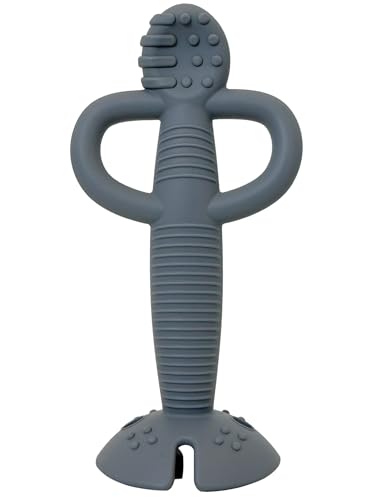
This 100% food-grade silicone spoon earns the top spot because it genuinely does double duty as both a feeding utensil and a teether without compromising either function. The textured handle gives tiny fingers plenty of grip, and the shallow scoop holds exactly the right amount of puree for early eaters — about half a teaspoon per load.
The integrated hole at the handle end lets you attach it to a Busy Baby mat or bib tether, which parents of determined spoon-droppers will quickly appreciate. It measures larger than typical starter spoons, but the oversized base actually helps it stand upright on the table without rolling, so baby can pick it up independently.
Customers consistently note that the textured base provides sensory stimulation while teething, and the silicone withstands gnawing without showing wear. The only real decision point is whether you want a single spoon or a full set — this one is sold individually, so it works best as a primary spoon paired with a backup.
Why it’s great
- Certified BPA/BPS/phthalate-free food-grade silicone
- Tether-compatible design keeps spoon off the floor
- Textured handle promotes grip and sensory engagement
Good to know
- Sold singly — you’ll want multiple if feeding multiple meals
- Slightly larger head may feel bulky for tiny mouths at first
2. Avanchy Bamboo & Silicone Infant Training Spoons
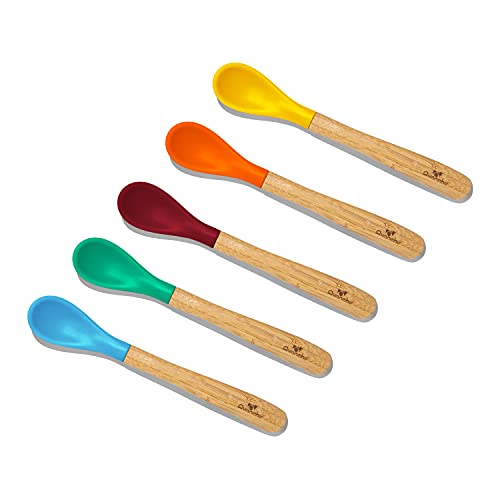
The Avanchy combines a natural bamboo handle with a soft silicone tip, making it one of the few plastic-free options in this category. The bamboo is smooth but slim enough for a baby’s palm, and the silicone tip is notably gentle — it bends easily against gums without resistance, which is ideal for the first weeks of solids.
The handle is longer than most all-silicone spoons (roughly 5.5 inches), which makes it excellent for parents feeding their child but slightly awkward for self-feeding. Several customer reviews note that the small scoop works well for purees and very soft mashes, though the tip may feel a bit large for a 6-month-old’s mouth until they get used to it.
The main trade-off is care: bamboo can crack or warp in the dishwasher, so hand-washing with mild soap is required. Over time, the bamboo develops a natural patina, but the silicone tip stays bright and odor-free. This set comes individually, so factor in the higher per-unit cost if you need multiple spoons for daycare or travel.
Why it’s great
- Plastic-free and eco-friendly construction
- Soft silicone tip is exceptionally gentle on gums
- Long handle gives parents good control during feeding
Good to know
- Hand-wash only — not dishwasher safe
- Scoop is slightly large for very small mouths
3. Simka Rose Silicone Baby Spoons 6-Pack
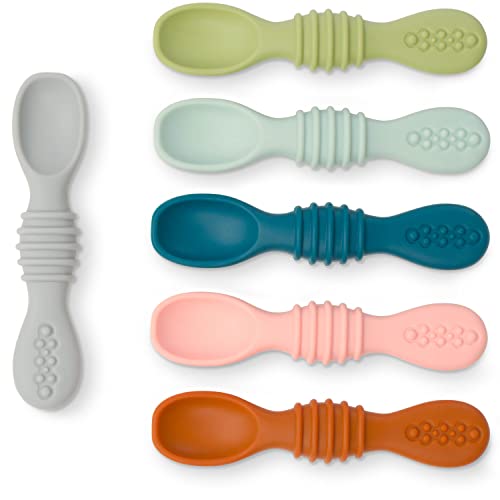
If you need multiple spoons across different meals or for daycare, the Simka Rose 6-pack is the most practical mid-range option. Each spoon features a ribbed handle that gives tiny fingers a clear grip point, and the textured end doubles as a teething surface — parents report their babies gnaw on the handle between bites without damaging the silicone.
The scoops are shallow and narrow, holding about a pea-sized portion, which makes them appropriate for babies just learning to open their mouths for food. The entire set is dishwasher-safe (top rack recommended), and the colors are vibrant enough to stay visually engaging after many cycles.
A common observation from long-term reviews is that these spoons remain flexible and stain-free after two years of use. The ribbed design does collect some food residue in the grooves, so occasional hand-scrubbing between dishwasher runs helps keep them clean. For the quantity and quality, this pack offers the best per-spoon value in the guide.
Why it’s great
- Six spoons cover all meals and backups for daycare
- Ribbed handle improves grip for self-feeding practice
- Dishwasher safe and holds up to repeated washing
Good to know
- Ribbed grooves can trap puree if not rinsed promptly
- Colors vary by pack — check listing for current options
4. mushie Silicone Baby Feeding Spoons 2-Pack

Mushie’s spoons are the minimalist’s pick — a clean, matte silicone finish in muted tones (Cambridge Blue and Shifting Sand) that blends into a modern kitchen aesthetic. The 6.3-inch length and 0.98-inch width make them longer and slightly wider than typical starter spoons, which works well for parents feeding their baby but gives a bit more handle for a baby learning to palm-grip.
The silicone is notably flexible; it bends like a spatula when scraping the bottom of a jar, so you waste less puree. Customers highlight that the softness makes it safe for babies with no teeth or emerging incisors, and the surface doesn’t develop that sticky feel some lower-grade silicones get after a few washes.
One important care note: mushie explicitly advises against microwaving or steam sterilizing these spoons, and recommends discarding at the first sign of weakness. The 2-pack is priced at a mid-range point per spoon, so this is more of a curated aesthetic choice than a bulk-buy solution. If you value visual simplicity and have a narrow color preference, this is a solid everyday option.
Why it’s great
- Elegant matte silicone in designer-neutral colors
- Flexible scoop acts like a spatula for jar feeding
- Soft enough for newborn gums and new teeth
Good to know
- Not microwave or steam sterilizer safe
- Only 2 spoons per pack — limited quantity for the price
5. Sperric Baby Spoons Self Feeding 6+ Months
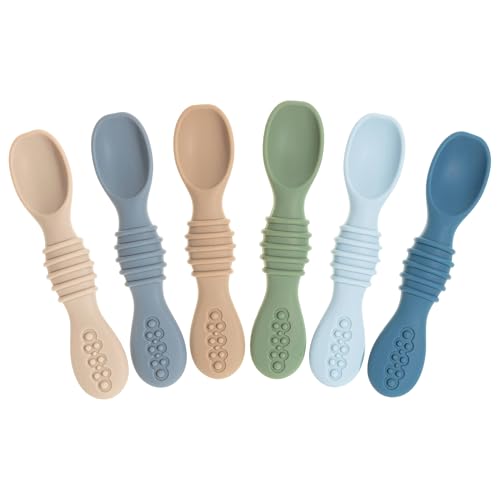
This budget-friendly option from Sperric packs a 2-in-1 design: one end functions as a shallow feeding spoon, while the opposite end is a textured teether that babies can gum between bites. The dual-ended configuration means you can pre-load a small amount of puree on the spoon side and let baby chew on the teether side while they work up to the next bite.
Parents report that the spoon is lightweight enough for a 6-month-old to hold independently, and the silicone is soft enough to bend without breaking. The handle has a gentle curve that fits a palm grip, and the overall length is short — about 5 inches — which suits self-feeding practice better than longer-handled options.
The main compromise is durability: some users note that the silicone can show minor surface wear after several months of aggressive teething, though this is expected at this price tier. It’s dishwasher safe, BPA-free, and comes in bright colors that babies seem to enjoy grabbing. For families on a tight budget who want a dual-function spoon, this is a practical starter choice.
Why it’s great
- Integrated teether end extends spoon’s usefulness
- Lightweight and short — ideal for baby-led weaning
- Dishwasher safe and BPA-free materials
Good to know
- Silicone may show light wear after months of use
- Single spoon per purchase — buy multiple for coverage
FAQ
Can I use metal or plastic spoons for my 6-month-old?
How many spoons do I need for starting solids?
Are silicone spoons safe for teething babies to chew on?
Final Thoughts: The Verdict
For most users, the baby spoons for 6 month old winner is the Busy Baby Teething Spoon because it combines a safe, textured silicone design with teether functionality and a tether hole that keeps it off the floor. If you want an eco-friendly plastic-free option for parent-led feeding, grab the Avanchy Bamboo & Silicone. And for high-volume value with multiple spoons for daycare or backup, nothing beats the Simka Rose 6-Pack.

Mo Maruf
I created WellFizz to bridge the gap between vague wellness advice and actionable solutions. My mission is simple: to decode the research and give you practical tools you can actually use.
Beyond the data, I am a passionate traveler. I believe that stepping away from the screen to explore new environments is essential for mental clarity and physical vitality.