Our readers keep the lights on and my smoothie glass nicely filled. As an Amazon Associate, I earn from qualifying purchases.
Every parent knows that sinking feeling of tiptoeing into the nursery to check if their baby is still breathing. That anxiety, while natural, can shatter your sleep and rob you of precious rest. A dedicated baby oxygen monitor offers a technological ally that watches over your little one’s vitals through the night, providing real-time data and instant alerts so you can rest easier.
I’m Mohammad Maruf — the founder and writer behind WellFizz. I’ve spent years analyzing medical-grade sensors, wearable tech, and contact-free monitoring systems to separate the signal from the noise in the baby safety market.
Whether you choose a wearable sock, a diaper clip-on sensor, or a contact-free overhead camera, this guide breaks down the specs and real-world performance of the top contenders to help you find the absolute best baby oxygen monitor for your family’s peace of mind.
How To Choose The Best Baby Oxygen Monitor
Selecting the right baby oxygen monitor is about balancing sensor technology, comfort, and your family’s specific sleep setup. Here are the critical factors to evaluate before you buy.
Sensor Type: Medical-Grade vs. Movement-Only
The most important distinction is whether a monitor tracks actual blood oxygen saturation (SpO₂) using medical-grade pulse oximetry, or simply detects abdominal breathing movements. Devices like the Owlet Dream Duo use FDA-cleared pulse oximetry to measure both oxygen level and heart rate, while clip-on options such as the Snuza Hero and Sense-U Pro track the rise and fall of the belly. The former provides a direct vital sign; the latter infers breathing through motion. For parents with specific medical concerns, SpO₂ tracking offers a deeper layer of safety data.
Wearable vs. Contact-Free Design
Wearable monitors — from socks like the Owlet Dream Sock to diaper clips like the Snuza — sit directly on the baby’s body. They provide continuous feedback but can shift during sleep, causing false alarms or discomfort. Contact-free monitors like the Miku Pro use SensorFusion radar technology to track breathing through blankets and clothing without touching the baby at all. This eliminates the risk of sensor displacement and lets you monitor without ever interfering with your baby’s sleep position.
False Alarm Rates and Alert Systems
No parent wants a monitor that screams bloody murder because the sensor slipped slightly off the skin. Look for devices with graduated alert systems: first a gentle vibration (like the Snuza and Sense-U) to stimulate breathing, followed by an audible alarm only if no movement is detected. Devices with customizable SpO₂ thresholds, like the Wellue O2Ring, let you set your own “low oxygen” alert level to reduce nuisance alarms while still catching genuinely concerning dips.
Battery Life and Data Storage
Overnight monitoring requires a device that won’t die halfway through the night. Clip-on units like the Sense-U Pro offer roughly 7 days of battery life per charge, while rechargeable pulse oximeters like the Wellue O2Ring-S push 24 hours. Some handheld units burn through AAA batteries in 24 hours, making them less ideal for nightly use. Built-in data storage is also valuable — the ability to review overnight SpO₂ trends across multiple nights helps you identify patterns and share data with your pediatrician.
Quick Comparison
On smaller screens, swipe sideways to see the full table.
| Model | Category | Best For | Key Spec | Amazon |
|---|---|---|---|---|
| Owlet Dream Duo (Gen 3) | Premium Bundle | Complete 360° monitoring | FDA-cleared SpO₂ & HR sock + 2K camera | Amazon |
| Miku Pro | Contact-Free | Wearable-free breathing tracking | SensorFusion radar, no wearables needed | Amazon |
| Wellue O2Ring-S | Ring Sensor | Compact continuous SpO₂ tracking | 24hr battery, patented silicone ring | Amazon |
| Wellue Checkme O2 Max | Ring Sensor | All-day monitoring with smart alerts | 72hr battery, free APP & PC software | Amazon |
| Sense-U Pro | Clip-On | Breathing & rollover detection | App connectivity, 7+ days battery | Amazon |
| Nanit Pro | Smart Camera | Video + sensor-free breathing band | 1080p HD, 256-bit AES encryption | Amazon |
| Snuza Hero SE | Clip-On | Simple movement-only monitoring | Patented direct-touch sensor, 6mo battery | Amazon |
| Manhero Continuous Pulse Oximeter | Handheld | Whole-family SpO₂ monitoring | Dual power, 0-18 month infant probe | Amazon |
| MedChirrup Pulse Oximeter | Handheld | Budget continuous SpO₂ monitoring | ±1% accuracy, 500 data set storage | Amazon |
In‑Depth Reviews
1. Owlet Dream Duo (Gen 3)

The Owlet Dream Duo is the most complete monitoring ecosystem available, combining the FDA-cleared Dream Sock with a 2K HD Dream Sight camera into a single connected app. The sock uses medical-grade pulse oximetry to track pulse rate and oxygen levels in real time, sending alerts directly to your phone if readings fall outside presets. The Predictive Sleep Technology learns your baby’s wake windows to help establish healthier routines — a feature backed by the brand’s claim that 94% of parents report improved sleep after using it.
The Dream Sight camera delivers sharper detail than standard 1080p monitors, with a 130-degree wide-angle lens and 4x zoom that lets you check in from anywhere. The entire system is protected by 256-bit AES encryption and holds the SGS Cybersecurity Mark, so your data and video stream remain secure. The sock fits babies from 6 to 30 pounds (approximately 1 to 18 months), and the camera continues serving as a toddler monitor long after the sock is outgrown.
Setup requires a 2.4 GHz Wi-Fi network for the sock, and the base station must stay within about six feet of the device — something to consider for larger homes. Some users note that the base alarm sound is relatively quiet, and advanced trend data requires the optional Owlet360 subscription. But for a true all-in-one solution that tracks actual blood oxygen saturation rather than just movement, the Dream Duo sets the gold standard.
Why it’s great
- FDA-cleared pulse oximetry provides medical-grade SpO₂ and heart rate data
- All-in-one app manages both the sock and the 2K HD camera
- Predictive Sleep Technology helps optimize wake windows and family sleep
Good to know
- Base station needs to be within close proximity (approx. 6 feet) of the sock for Bluetooth connectivity
- Advanced reports and trend data require a monthly subscription (Owlet360)
- Premium price reflects the bundled hardware — you are investing in the complete system
2. Miku Pro Smart Baby Monitor
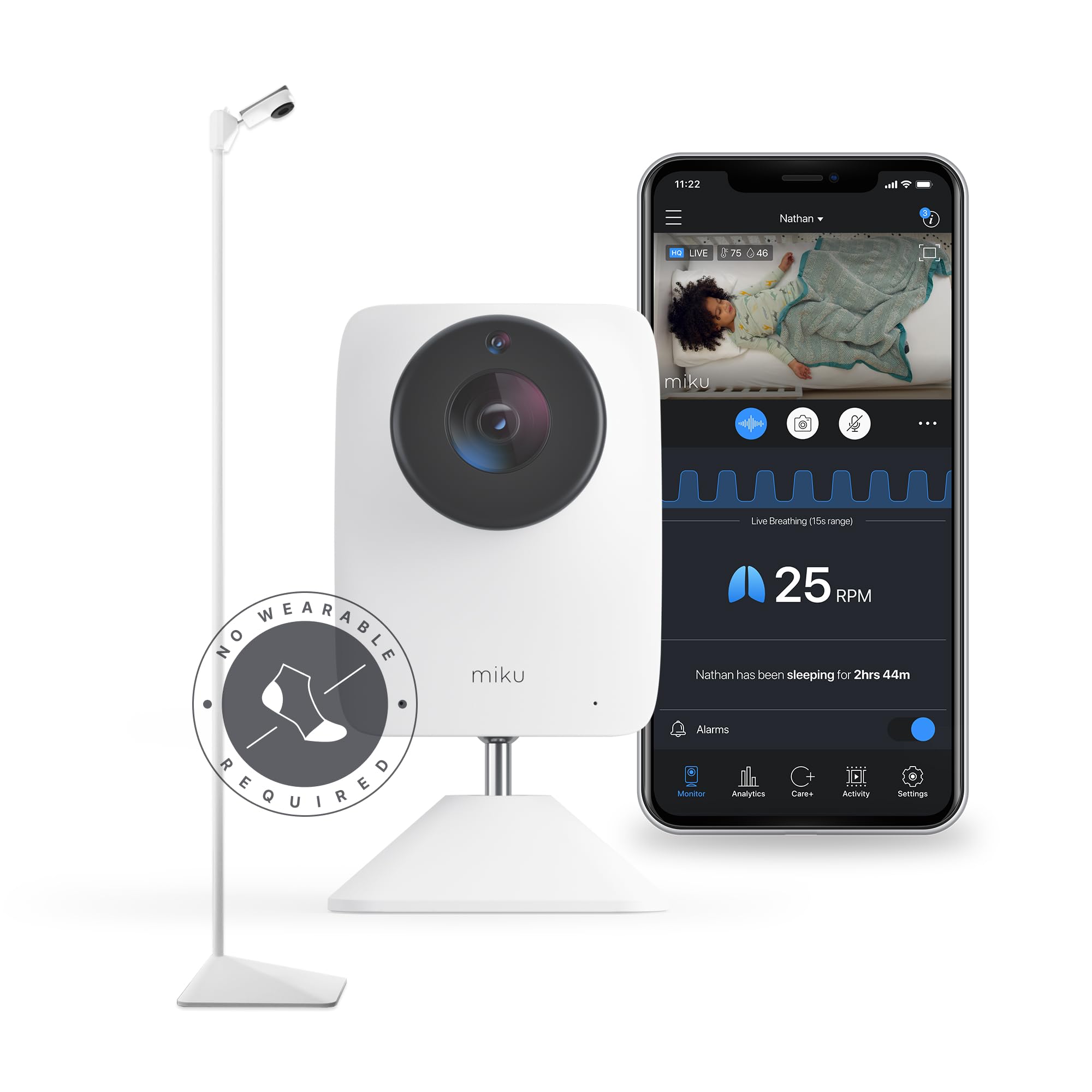
The Miku Pro solves one of the biggest pain points of baby oxygen monitoring: the need for wearables that can slip, shift, or fall off during the night. Its SensorFusion technology tracks breathing through blankets, stuffed animals, and any sleep position using radar — not image processing — so accuracy remains consistent as your baby grows. This is a true contact-free solution that works from newborn well past age three, and you never have to charge a sock or clip.
The video side is equally robust: 1080p HD with excellent night vision, two-way audio, and built-in lullabies. The included wall mount and floor stand make setup simple, and the Qualcomm chipset supports dual-band Wi-Fi and Bluetooth for stable connectivity. While the basic monitoring is free, a -per-month Miku Membership unlocks deeper sleep analytics, extended video storage, and advanced breathing trend reports — useful for parents who want granular data.
The main trade-off is that the Miku does not measure SpO₂ or heart rate directly — it monitors breathing rate and movement patterns. For parents seeking blood oxygen saturation data, this is a limitation worth noting. Some users have also reported occasional connectivity hiccups with the app, though the contact-free breathing tracking is widely praised for its reliability. If your priority is non-invasive monitoring without straps or sensors touching your baby, this is the top choice.
Why it’s great
- True contact-free breathing tracking works through blankets and any sleep position
- High-quality 1080p video with excellent night vision and two-way audio
- Includes both wall mount and floor stand for flexible placement
Good to know
- Does not track blood oxygen saturation (SpO₂) or heart rate — only breathing rate and motion
- Full sleep analytics and video storage require a monthly subscription
- Some users report occasional app connectivity issues
3. Wellue O2Ring-S
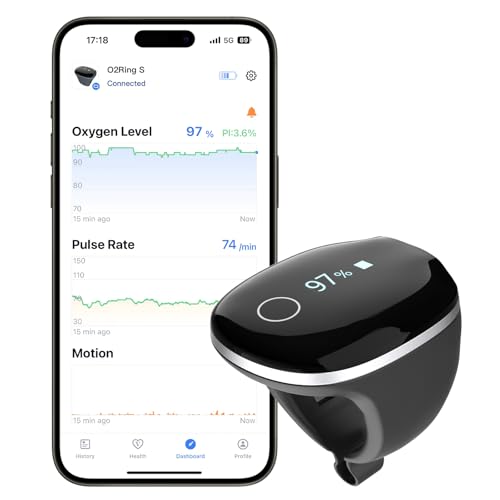
The Wellue O2Ring-S takes the well-regarded ring-style pulse oximeter concept and refines it for smaller fingers — a critical detail when monitoring infants or children with petite digits. It uses a soft, patented silicone ring sensor that stays put without causing numbness or slipping off during sleep. The device samples data at a high 200Hz rate, storing four groups of 10-hour data that automatically sync to the free ViHealth app or O2 Insight Pro software for generating detailed PDF or CSV reports.
Battery life reaches up to 24 hours on a single charge, which covers a full day of monitoring including the overnight stretch. The vibration alert system is fully customizable: you can set the SpO₂ and heart rate thresholds that trigger a gentle vibration, and the ring will mark those events in the report for later review. The compact design makes it highly portable, and the ring fits finger perimeters between 1.65 and 2.36 inches.
One important note: the O2Ring-S is officially marketed for sports and aviation use, not as a medical device. While user reviews consistently report accuracy that matches hospital equipment, this distinction matters for parents seeking an FDA-cleared solution. Also, the proprietary USB-C cable can be a minor inconvenience if lost. For continuous SpO₂ tracking in a small, comfortable form factor, this is a strong mid-range contender.
Why it’s great
- Patented silicone ring stays on comfortably without causing finger numbness
- 200Hz high-resolution sampling delivers detailed overnight SpO₂ and HR data
- Free PC software and app provide comprehensive CSV/PDF report generation
Good to know
- Marketed for sports and aviation use — not FDA-cleared as a medical device
- Requires a proprietary USB-C cable for charging; standard cables may not fit
- One-size ring may fit loosely on very small baby fingers or tightly on adult fingers
4. Wellue Checkme O2 Max

The larger sibling to the O2Ring-S, the Wellue Checkme O2 Max pushes battery life to an impressive 72 hours on a single charge — enough for three full nights of monitoring without needing to recharge. It also features a patented soft silicone ring sensor designed to avoid the numbness and slippage common with hard plastic fingertip clips. The device tracks SpO₂, pulse rate, and motion with stated accuracy that matches medical-grade expectations in practice, even if the label says “for Sports and Aviation use.”
The smart vibration and audio reminder system lets you set custom SpO₂ and heart rate thresholds. If readings drop below your defined level, the device first vibrates and then emits an audible “drip” sound — both adjustable for intensity. The built-in memory stores four groups of 10-hour data, automatically syncing via Bluetooth to the Vihealth app and O2 Insight Pro software for detailed trend analysis.
A notable design concern is the protruding charging cord connection, which some users report as fragile after several months of use. The app also requires staying open in the background for real-time alerts, meaning you might need to dedicate an old phone to the task if you want wake-up alarms. For parents who value extended battery life and a comfortable ring sensor over the convenience of a diaper clip, the O2 Max delivers serious uptime.
Why it’s great
- 72-hour battery life covers multiple nights of continuous monitoring between charges
- Soft silicone ring sensor prevents finger numbness and stays secure during sleep
- Free companion app and PC software with detailed trend reporting
Good to know
- Protruding charging port can be a weak point with repeated use
- App alerts require the app to remain open in the background on your phone
- Not FDA-cleared — labeled for sports and aviation applications
5. Sense-U Pro Baby Monitor
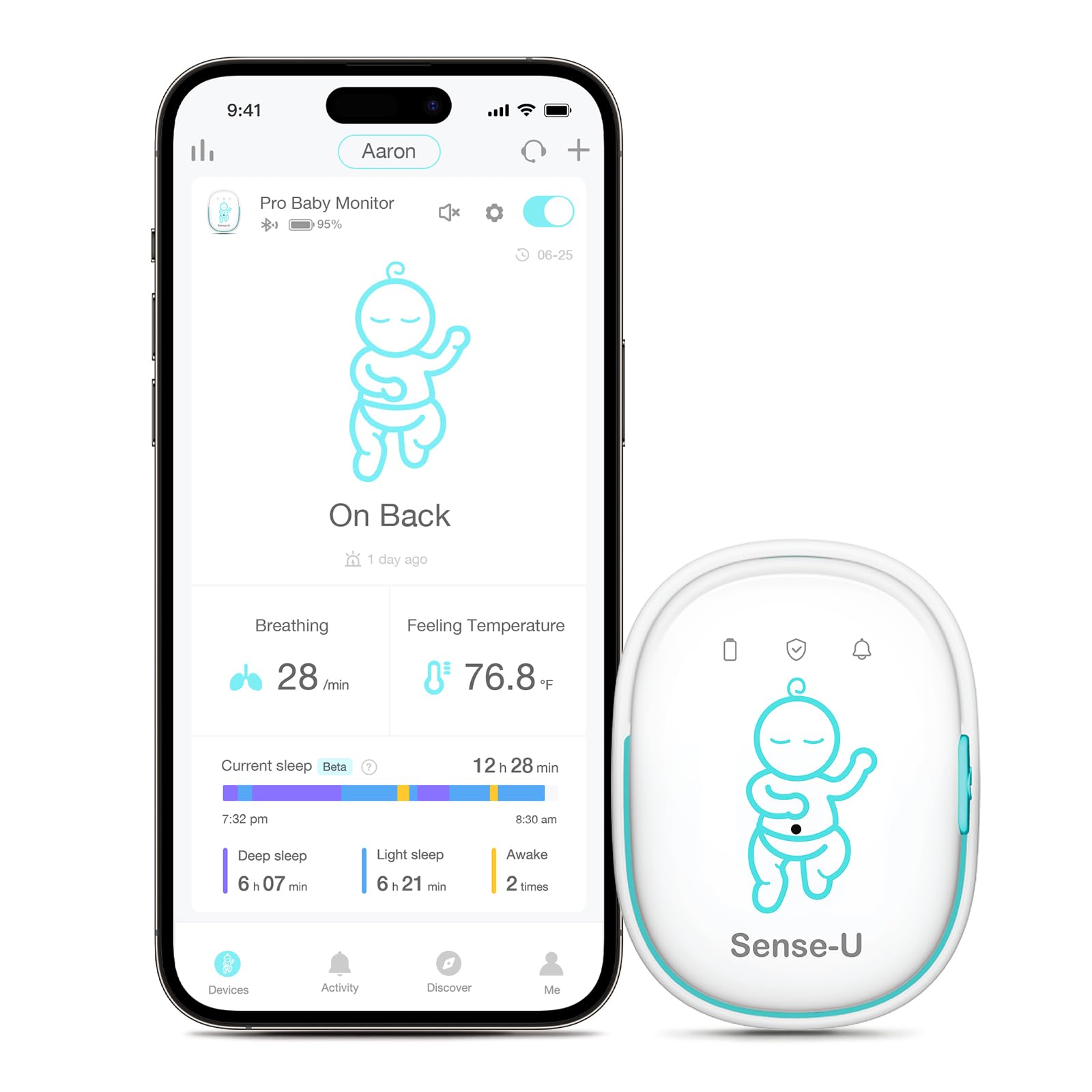
The Sense-U Pro takes the clip-on diaper sensor concept and adds Bluetooth smart connectivity, giving you the ability to check your baby’s breathing status and sleep data directly on your smartphone. Unlike some monitors that only detect the effect of distress (like a lower heart rate), the Sense-U detects the cause — slow breathing movement, stomach sleeping, or overheating — and triggers a graduated alert system. If no abdominal movement is detected for 15 seconds, the device gently vibrates to try to stimulate breathing; if movement still doesn’t resume, it escalates to an audible alarm and pushes a notification to your phone.
Battery life is a standout feature here: the Sense-U Pro lasts over 7 days on a single charge, making it far more practical for nightly use than monitors that need daily recharging. The device also tracks room temperature and can alert you if conditions fall outside your preset comfort zones. The app provides detailed sleep cycle analysis, including deep and light sleep stages and overall sleep quality, helping you understand your baby’s natural rhythms.
It uses Bluetooth Low Energy (BLE 4.0+), which means you need to stay within approximately 50 feet for a reliable connection — generally fine for same-room monitoring but a limitation if you regularly sleep in a separate wing of the house. The device is not a medical-grade SpO₂ tracker; it monitors abdominal movement, position, and temperature. For parents who want a direct breathing motion sensor with smartphone notifications and a long battery life, the Sense-U Pro is a compelling mid-range pick.
Why it’s great
- Over 7 days of battery life on a single charge reduces recharging fatigue
- Graduated alert system (vibration first, then alarm) can stimulate breathing without panicking parents
- App provides detailed sleep cycle analysis and temperature/position tracking
Good to know
- Bluetooth range is limited to about 50 feet — best for same-room monitoring
- Does not track actual blood oxygen saturation (SpO₂) — only abdominal movement, position, and temperature
- Not a medical device; intended for use with healthy children up to 12 months
6. Nanit Pro Smart Baby Monitor

The Nanit Pro sits at the intersection of premium video monitoring and breathing tracking, using a sensor-free Breathing Band worn around the baby’s chest to detect respiratory motion. The band contains no electronics — it simply provides a visual pattern that the Nanit camera reads using computer vision. This means you get breathing tracking without a wearable that needs charging, pairing, or cleaning. The overhead camera view gives you a full picture of the crib, and the 1080p HD video is crisp with reliable night vision.
The companion app is polished and intuitive, offering sound, motion, and cry notifications along with sleep insights that help you track patterns over time. The Flex Stand included in this variant is portable and adjustable, making the Nanit equally useful at home or while traveling. Security is handled with 256-bit AES encryption and two-factor authentication, ensuring your video feed stays private. The two-way audio is clear and responsive, letting you soothe your baby from another room.
While the Nanit’s video and software are top-tier, the breathing tracking depends on the baby wearing the band correctly — and some parents find the band slides out of position on active sleepers. The camera itself has been noted by some users to occasionally disconnect from Wi-Fi, with reliability hovering around 70% uptime for some. It is also one of the more expensive options when you factor in the required Insights subscription for detailed sleep reports. For parents who want a premium video monitor with breathing overlay, Nanit delivers, but it is not a replacement for a dedicated SpO₂ monitor.
Why it’s great
- Breathing band is sensor-free — no batteries, charging, or electronics near baby
- Crystal-clear 1080p HD video with excellent night vision and overhead crib view
- Polished app with detailed sleep insights and sound/motion/cry notifications
Good to know
- Breathing band can shift out of position on active sleepers, affecting accuracy
- Some users report periodic Wi-Fi disconnections affecting reliability
- Detailed sleep insights require an additional Insights subscription
7. Snuza Hero SE Baby Movement Monitor

The Snuza Hero SE is the most straightforward, no-nonsense baby movement monitor on the market. It uses patented direct-touch sensor technology that attaches directly to the baby’s diaper to detect abdominal movement — no Wi-Fi, no apps, no cords, and no sensor pads to place under the mattress. The simplicity is its superpower: you clip it on, check for the green flashing light confirming movement detection, and go to sleep. When the optional ticking sound is activated, you can audibly hear each breath, providing an extra layer of passive reassurance.
The alarm system is graduated and intuitive. After 15 seconds of no movement, the device vibrates gently to stimulate breathing — this alone often resolves the issue without waking parents. If movement remains undetected for another 5 seconds (20 seconds total), a loud audible alarm sounds. This two-stage alert gives you time to respond without immediate panic. The replaceable battery lasts up to six months, making this essentially a set-it-and-forget-it device with minimal maintenance.
The Snuza does not track SpO₂, heart rate, or room temperature — it is purely a movement detector. False alarms can occur if the sensor loses contact with the baby’s belly, typically when the diaper slips or the baby moves to a side-sleeping position. The device is also small and portable, fitting easily into a diaper bag for travel. For parents who want a minimal, reliable, and battery-efficient monitor that focuses solely on breathing movement, the Snuza Hero SE remains a beloved classic.
Why it’s great
- Extremely simple setup — no Wi-Fi, no apps, no cords required
- Replaceable battery lasts up to six months for near-zero maintenance
- Graduated alert system (vibration then alarm) minimizes false panic
Good to know
- Does not track SpO₂, heart rate, or temperature — movement detection only
- False alarms can occur if the sensor loses proper belly contact
- Best used with a swaddle or diaper that keeps the sensor securely in place
8. Manhero Continuous Pulse Oximeter
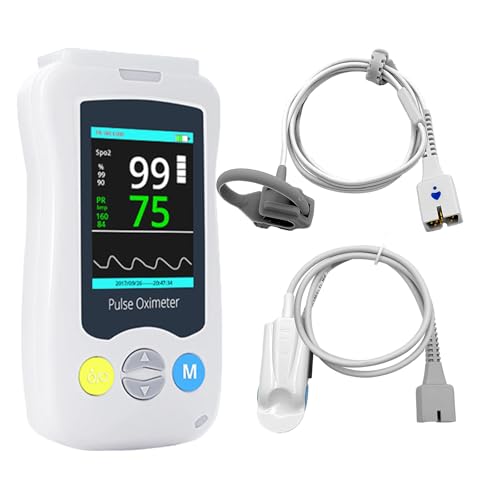
The Manhero Continuous Pulse Oximeter is designed as a whole-family monitoring solution, with separate probes for adults and infants (0 to 18 months). The infant probe uses a soft, wrap-style sensor that stays securely on small feet or hands, making it suitable for overnight use. The 2.4-inch HD display offers nine levels of brightness adjustment, ensuring readability in both bright daylight and dark nurseries. The device supports dual power: it runs on three AAA batteries for portability or can be plugged in via a data cable for continuous use without battery drain.
When set to continuous monitoring mode, the oximeter tracks SpO₂ (70-99% range, ±2% accuracy) and pulse rate (30-240 bpm, ±1 bpm). The intelligent alarm system triggers an audible alert if SpO₂ drops below 90% or heart rate falls below 50 bpm, and you can customize these thresholds to your own preferences. The device stores up to 500 data sets, allowing you to review historical trends and download them for sharing with your pediatrician.
Battery life is a notable weakness: even with fresh AAA batteries, some users report only 24 hours of use before needing a replacement set. The included USB cable is also quite short, making it hard to place the unit on a nightstand while plugged in. The infant probe connector can feel somewhat fragile, and some users have reported it pulling out easily. For the price point, the Manhero offers continuous SpO₂ monitoring for both baby and adults, but expect to keep it plugged in and handle the probes with care.
Why it’s great
- Includes dedicated probes for both infants (0-18 months) and adults
- Bright 2.4-inch display with 9-level brightness adjustment for any lighting condition
- Customizable alarm thresholds for SpO₂ and heart rate
Good to know
- AAA battery life is short — expect to plug in via USB for overnight use
- Included USB cable is quite short, limiting placement options
- Infant probe connector can feel fragile and may disconnect easily
9. MedChirrup Pulse Oximeter

The MedChirrup Pulse Oximeter is an entry-level handheld device that brings continuous SpO₂ monitoring to a wider audience. It offers a ±1% accuracy rating for SpO₂ measurements in the 70-100% range and a ±1 bpm accuracy for heart rate from 25 to 250 bpm — specifications that match higher-priced units on paper. The 2.4-inch HD display presents data clearly, and the rechargeable USB-C battery delivers up to 8 hours of continuous operation, enough for a full night’s sleep.
The device includes adjustable alarms for both SpO₂ and pulse rate, allowing you to set your own safe ranges and receive audible alerts if readings go outside those boundaries. It also stores up to 500 data sets with 20-hour continuous monitoring logs, making it possible to review trends over time. The adult fingertip probe is designed for spot-checking on fingers, but some users report that the probe struggles to stay properly positioned for continuous overnight use on restless sleepers.
The MedChirrup’s main limitation is its probe design: the fingertip clip is bulkier than ring-style sensors and may not stay securely attached on babies or small children during active sleep. For adults and older children, it works reliably for continuous monitoring, but for infant use, the Manhero’s dedicated infant probe is a more practical choice. The rechargeable battery is a welcome upgrade over disposable AAA models, though 8 hours means you’ll need to charge it daily. For budget-conscious families who need basic continuous SpO₂ tracking for adults, this device gets the job done.
Why it’s great
- Rechargeable USB-C battery eliminates the need for disposable AAA batteries
- ±1% SpO₂ accuracy matches more expensive competitors on paper
- Stores 500 data sets for tracking overnight trends
Good to know
- Fingertip probe is designed for adults and may not stay on restless babies
- 8-hour battery life requires daily charging for overnight use
- Some users report the probe does not stay properly seated during sleep for stable continuous readings
FAQ
Can a baby oxygen monitor prevent SIDS?
What is the difference between a movement monitor and a pulse oximeter for babies?
How do I reduce false alarms on my baby oxygen monitor?
Final Thoughts: The Verdict
For most users, the best baby oxygen monitor winner is the Owlet Dream Duo (Gen 3) because it combines FDA-cleared pulse oximetry with a premium 2K HD camera and sleep analytics in a unified system that offers true 360-degree monitoring. If you want completely wearable-free breathing tracking that works through any sleep position, grab the Miku Pro. And for a simple, no-app, long-battery movement monitor that just works, nothing beats the Snuza Hero SE.

Mo Maruf
I created WellFizz to bridge the gap between vague wellness advice and actionable solutions. My mission is simple: to decode the research and give you practical tools you can actually use.
Beyond the data, I am a passionate traveler. I believe that stepping away from the screen to explore new environments is essential for mental clarity and physical vitality.