Our readers keep the lights on and my smoothie glass nicely filled. As an Amazon Associate, I earn from qualifying purchases.
Whether you are piecing together your first dedicated home theater or breathing new life into a stack of floor-standing speakers, the AV receiver remains the central nervous system of your system. A strong amplifier section, clean video passthrough, and a room calibration suite that actually works separate a coherent soundstage from a muddy mess. More than just a switching hub, the right receiver defines whether dialogue cuts through action sequences and whether your surround speakers disappear into the room.
I’m Mohammad Maruf — the founder and writer behind WellFizz. I have spent hundreds of hours cross-analyzing manufacturer spec sheets, decoding HDMI 2.1 feature sets, and comparing real-world room correction algorithms across the mid-range and premium receiver tiers to cut through the marketing noise. This guide focuses on the measurable differences that actually impact your listening experience.
The goal is to help you identify the av receiver that matches your speaker requirements, gaming needs, and room size without paying for channels or power you will never use.
How To Choose The Best AV Receiver
An AV receiver is a long-term investment that anchors your entire system. Prioritizing the wrong specification — like raw wattage instead of clean channel separation — often leads to disappointment when the system is stressed during loud movie passages. Focus on three core areas: amplifier power and channel count, HDMI 2.1 compatibility for future-proofing, and the quality of the automatic room calibration system.
Channel Count and Amplifier Power
A 5.2-channel receiver powers a left, center, right, two surround speakers, and two subwoofers. Moving to 7.2 adds rear surrounds, enabling true 5.1.2 Dolby Atmos with overhead or up-firing speakers. A 9.2-channel unit allows 5.1.4 or 7.1.2 configurations. Pay attention to the power rating measured with two channels driven at 8 ohms — this metric is more honest than the inflated single-channel figures some brands publish.
HDMI 2.1 and Gaming Features
If you own a PlayStation 5, Xbox Series X, or a high-refresh-rate PC, HDMI 2.1 with 40 Gbps or 48 Gbps bandwidth is non-negotiable. It enables 4K/120Hz and 8K/60Hz passthrough, Variable Refresh Rate (VRR) to eliminate screen tearing, and Auto Low Latency Mode (ALLM) for lag-free gaming. Without these features, your console will be limited to 4K/60Hz, which defeats the purpose of a high-end display.
Room Correction Technology
Automatic calibration systems such as Audyssey MultEQ, YPAO R.S.C., and Dirac Live measure your speaker distances, levels, and crossover points, then apply precise EQ filters to correct for room acoustics. Dirac Live, found on premium units like the Onkyo TX-RZ50, offers the most granular control by adjusting frequency response across multiple listening positions. A bad calibration can make even expensive speakers sound dull or boomy, so the quality of this system matters more than many buyers realize.
Quick Comparison
On smaller screens, swipe sideways to see the full table.
| Model | Category | Best For | Key Spec | Amazon |
|---|---|---|---|---|
| Pioneer VSX-935 | Mid-Range | Value-focused 5.1.2 setups | 7.2 Ch, 80W/Ch, 8K HDMI 2.1 | Amazon |
| YAMAHA RX-V6A | Mid-Range | Multi-room MusicCast systems | 7.2 Ch, 100W/Ch, MusicCast | Amazon |
| Onkyo TX-NR6100 | Mid-Range | THX-certified home theater | 7.2 Ch, 210W/Ch, THX Select | Amazon |
| JBL MA710 | Mid-Range | Turntable-friendly setups | 7.2 Ch, 110W/Ch, Phono Input | Amazon |
| Marantz NR1510 | Mid-Range | Compact 5.1 entertainment | 5.2 Ch, 50W/Ch, Slim Chassis | Amazon |
| Denon AVR-S770H | Mid-Range | All-around family theater | 7.2 Ch, 75W/Ch, HEOS | Amazon |
| Denon AVR-S970H | Premium | Medium room 7.2 with phono | 7.2 Ch, 90W/Ch, Phono Input | Amazon |
| Sony STR-AN1000 | Premium | Spatial Sound Mapping | 7.2 Ch, 165W/Ch, 360 SSM | Amazon |
| Onkyo TX-RZ50 | Premium | Advanced Dirac Live calibration | 9.2 Ch, 120W/Ch, Dirac Live | Amazon |
| Yamaha RX-A4A | Premium | AVENTAGE build quality | 7.2 Ch, 110W/Ch, Surround:AI | Amazon |
| Sony STRAZ1000ES | Premium | Reference-level home cinema | 7.2 Ch, 100W/Ch, ES Build | Amazon |
In‑Depth Reviews
1. Pioneer VSX-935 7.2 Channel Network Receiver
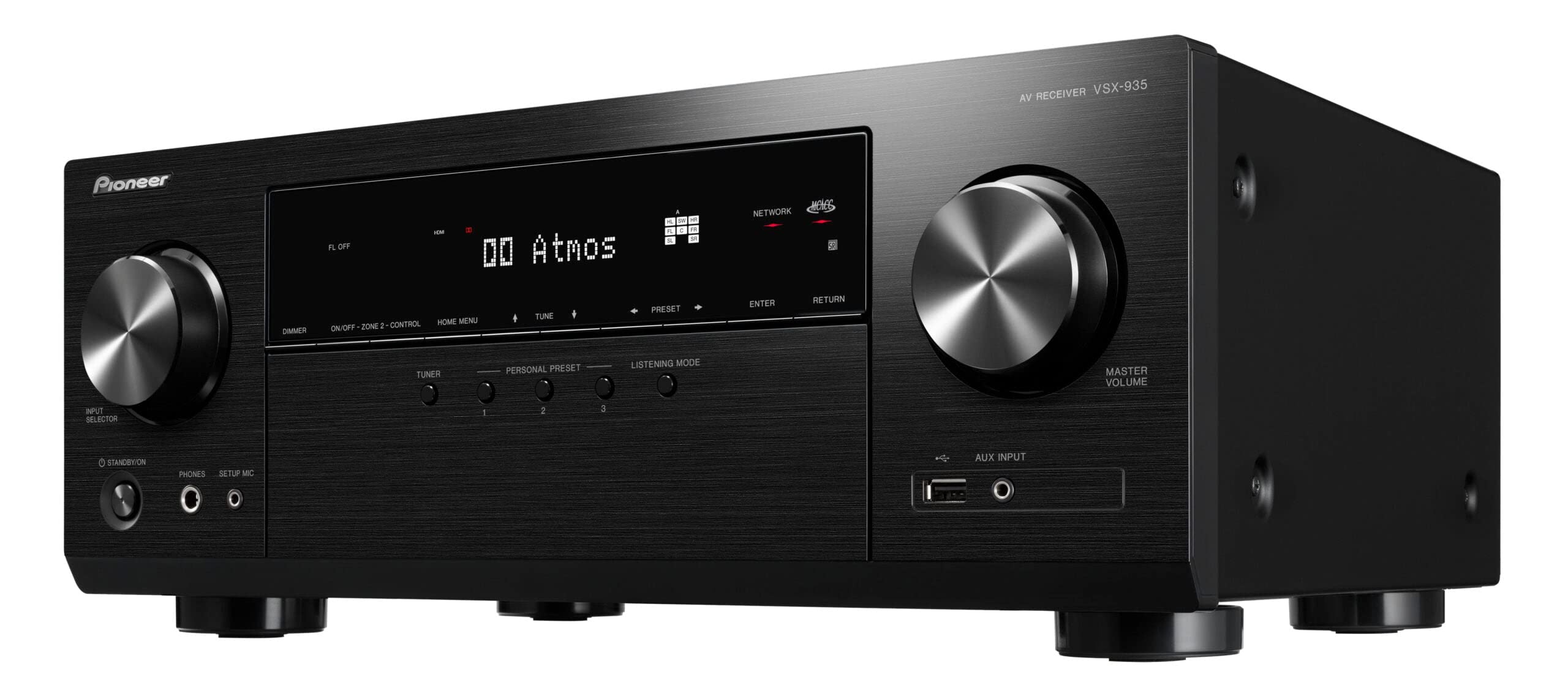
The Pioneer VSX-935 delivers a strong balance of connectivity and audio performance for a mid-range price. Its 7.2-channel amplifier provides clean separation across the front soundstage, and the inclusion of HDMI 2.1 with 8K passthrough ensures it stays relevant with modern gaming consoles and streaming devices. Dolby Atmos Height Virtualization creates a convincing overhead effect without needing ceiling speakers, which is a genuine advantage for rooms that cannot accommodate in-ceiling hardware.
Customers consistently report crisp dialogue reproduction and a wide sound field during action-heavy scenes. The dual-zone output is a practical feature for powering a second set of speakers in another room, and the RF remote offers better range than standard IR models. Some users noted that initial firmware updates are required to stabilize the Bluetooth handshake and that the on-screen menus feel dated compared to competitors.
For anyone building a 5.1.2 system on a measured budget, the VSX-935 offers more usable features per dollar than most alternatives. It does not include THX certification or a premium room correction suite like Dirac Live, but its standard calibration mic produces a listenable balance out of the box. This is a smart, future-proofed entry point that leaves room for speaker upgrades later.
Why it’s great
- HDMI 2.1 with 8K/60Hz and 4K/120Hz support
- Dolby Atmos Height Virtualization works without ceiling speakers
- Reliable RF remote and dual-zone output
Good to know
- On-screen menu interface feels dated
- Bluetooth connectivity can be finicky out of the box
- No THX certification or advanced room correction
2. YAMAHA RX-V6A 7.2-Channel AV Receiver with MusicCast

The Yamaha RX-V6A brings the brand’s renowned MusicCast multi-room ecosystem to a 7.2-channel platform, making it a strong choice for households that want synchronized audio across multiple zones. Its YPAO R.S.C. room calibration with multipoint measurement does a respectable job of equalizing frequency response, particularly in rooms with challenging standing-wave issues. The amplifier section delivers clean power at 100 watts per channel into 8 ohms, which is sufficient for most bookshelf and tower speakers in medium-sized rooms.
Feedback from users highlights the intuitive setup process and the usable interface that does not require a smartphone app to complete. The HDMI 2.1 inputs support 8K/60Hz and 4K/120Hz, making it a viable partner for high-refresh-rate gaming. The inclusion of AirPlay 2, Spotify Connect, and voice control via Alexa or Google Assistant adds everyday convenience. A common complaint involves the learning curve for eARC integration with certain TV brands, where the receiver does not always auto-power on with the television.
If multi-room streaming and a reliable user experience matter more than absolute power output, the RX-V6A is a solid investment. Its build quality is typical of Yamaha’s mid-range — sturdy, with a clean front panel and a remote that feels substantial. Just be prepared to spend a half-hour dialing in HDMI-CEC settings if your TV is not a recent Sony or LG model.
Why it’s great
- MusicCast allows seamless multi-room audio streaming
- YPAO R.S.C. provides reliable room calibration
- HDMI 2.1 with 8K/60Hz and 4K/120Hz passthrough
Good to know
- eARC auto-power-on can be finicky with some TVs
- No front-panel HDMI input for quick connections
- Learning curve for advanced HDMI-CEC settings
3. Onkyo TX-NR6100 7.2 Channel THX Certified AV Receiver
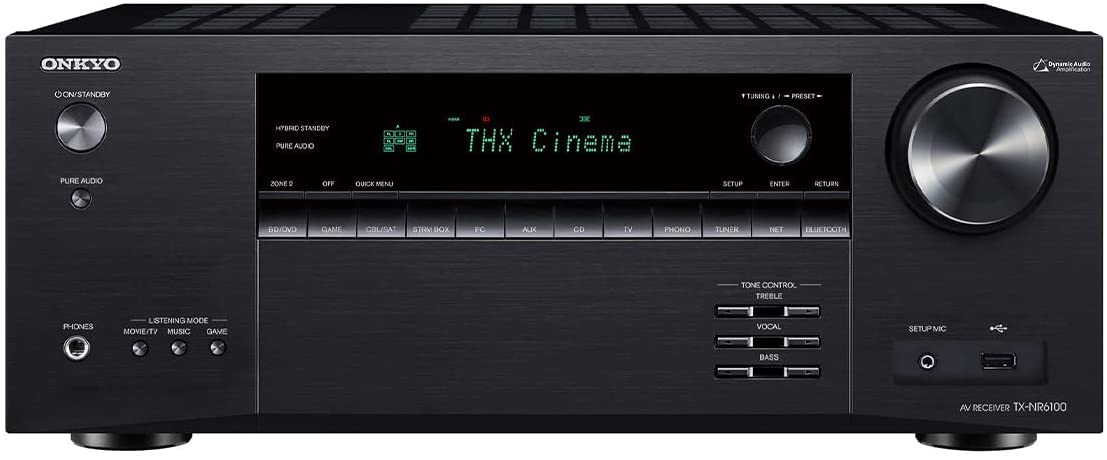
The Onkyo TX-NR6100 earns its THX Select certification by delivering reference-level dynamics in rooms up to 2,000 cubic feet. Its high-current amplifier rated at 210 watts per channel provides the headroom needed to drive demanding four-ohm speakers without distortion during intense action sequences. The inclusion of three HDMI 2.1 inputs with 40 Gbps bandwidth ensures full compatibility with PS5 and Xbox Series X at 4K/120Hz, which is a significant advantage for gamers.
Owners frequently praise the loud, clear output when paired with Klipsch or Polk speaker packages, and the AccuEQ room calibration generally produces a balanced soundstage without excessive bass bloom. The built-in streaming services and Apple AirPlay 2 add convenience, though the remote control lacks a backlight, which makes navigation in a dark theater room frustrating. Some long-term users report HDMI 2.1 switching issues after extended use, so keeping firmware current is essential.
For a dedicated home theater build where THX certification assures consistent performance across a wide volume range, the TX-NR6100 outperforms many similarly priced competitors. Its zone 2 HDMI switching is a rare feature at this price point, allowing separate content in a second room. Just factor in the non-backlit remote and plan for firmware maintenance.
Why it’s great
- THX Select certification guarantees reliable dynamics
- Three HDMI 2.1 inputs at 40 Gbps
- High-current amplifier drives demanding speakers
Good to know
- Remote control lacks backlighting
- HDMI 2.1 switching may glitch without firmware updates
- Zone 2 limits available channels in main room
4. JBL MA710 7.2 Channel 8K AV Receiver

The JBL MA710 stands out in the mid-range segment by including a moving magnet phono input, a feature rarely found outside of dedicated stereo amplifiers. This makes it an ideal hub for users who want to integrate a turntable alongside their home theater without purchasing a separate phono preamp. The 110-watt-per-channel amplifier drives floor-standing speakers with authority, and the 6 HDMI inputs with eARC support provide plenty of capacity for modern sources.
Buyers note that initial setup can be confusing because the receiver requires a significant firmware update before the configuration menu appears on screen. Once updated, the system works reliably, with automatic input switching via HDMI-CEC that responds quickly to TV remote commands. The shallow chassis depth is a practical advantage for media consoles with limited rear clearance. On the downside, the remote is not backlit, and some users find the front panel LED too bright in dark rooms.
If vinyl playback is part of your entertainment routine, the MA710 eliminates the need for extra boxes and cables. Its wireless streaming via Chromecast and AirPlay 2 rounds out a well-balanced feature set. Be prepared for the initial firmware hurdle, and keep a small dimming sticker handy for the front display if you watch movies in complete darkness.
Why it’s great
- Built-in moving magnet phono input for turntables
- Shallow chassis fits tight media consoles
- eARC with reliable HDMI-CEC switching
Good to know
- Initial firmware update is mandatory and not quick
- Remote control lacks backlighting
- Bright front panel display in dark rooms
5. Marantz NR1510 Slim 5.2 Channel AV Receiver

At just over four inches tall, the Marantz NR1510 is purpose-built for shallow cabinets and minimalist setups where a full-height receiver simply will not fit. Its 5.2-channel configuration delivers 50 watts per channel into 8 ohms, which is adequate for a modest 5.1 system with efficient bookshelf speakers. Despite the compact size, it includes a phono input, Bluetooth, Wi-Fi, and built-in HEOS for multi-room streaming, making it one of the most feature-dense slim receivers available.
Users consistently praise the warm, musical sound signature that Marantz is known for, with clean stereo separation that makes two-channel listening enjoyable. The on-screen setup assistant is genuinely helpful for first-time owners, guiding through speaker detection and HDMI ARC configuration. The slim chassis does run warm during extended listening, so adequate ventilation is necessary. HDMI support is limited to 4K/60Hz with no 8K or 4K/120Hz passthrough, so gamers with next-gen consoles will need to look elsewhere.
For a secondary system, a bedroom setup, or a primary living room with a 5.1 speaker package and 4K TV, the NR1510 is a refined choice that does not compromise on audio quality. It is not designed for high-SPL home theater or future 8K upgrades, but its form factor and phono input make it a standout in its niche.
Why it’s great
- Ultra-slim chassis fits tight spaces
- Includes phono input and HEOS streaming
- Warm, musical sound signature
Good to know
- No HDMI 2.1 — limited to 4K/60Hz
- Runs warm; requires ventilation clearance
- Only 50W per channel — needs efficient speakers
6. Denon AVR-S770H 7.2 Ch Home Theater Receiver

The Denon AVR-S770H is one of the most well-rounded entry-level receivers for families who want both movie immersion and multi-room music streaming. Its Audyssey MultEQ room calibration takes accurate measurements across multiple positions to smooth out room-induced frequency peaks. The 75-watt-per-channel amplifier is conservative by spec but delivers surprisingly dynamic performance in a 5.1.2 configuration, with Dolby Atmos and DTS:X decoding for object-based audio.
Owners appreciate the straightforward setup assistant, which walks through speaker configuration and HDMI ARC pairing without manual page-flipping. The HEOS platform enables grouping with other Denon wireless speakers for whole-home audio, and the receiver supports voice control through Alexa. A minority of users report random volume drops or HDMI handshake issues after firmware updates, though these occurrences seem isolated and often resolved by a factory reset.
For a first-time home theater builder or a family upgrading from a soundbar, the AVR-S770H provides an easy on-ramp with enough power and features to support a 7.2 speaker system for years. It lacks premium room correction and the highest wattage figures, but its software integration and reliability make it a safe, satisfying choice.
Why it’s great
- Audyssey MultEQ provides reliable room calibration
- HEOS multi-room streaming built in
- Supports 5.1.2 Dolby Atmos and DTS:X
Good to know
- Occasional firmware-related volume drop issues
- Only 75W per channel; not ideal for large rooms
- No phono input for turntables
7. Denon AVR-S970H 8K 7.2 Channel AV Receiver

The Denon AVR-S970H sits a step above the S770H, offering 90 watts per channel, a built-in phono input, and an additional HDMI output for dual-display setups. It still uses Audyssey MultEQ rather than the more advanced MultEQ XT found in the X-series, but the calibration delivers a balanced response for most living rooms. The inclusion of a phono stage means vinyl enthusiasts can connect a turntable directly without an external preamp, a feature missing from the S770H.
Reviewers note that the receiver runs cooler than its predecessor, which is a welcome improvement for enclosed entertainment centers. The HEOS multi-room system works seamlessly with Spotify and TIDAL, and the Apple HomeKit compatibility allows basic control via Siri. Powered Zone 2 operation uses the rear surround channels, limiting the main room to 5.1 when a second zone is active — a limitation worth planning around if you intend to run both zones simultaneously.
For users who need a phono input and want a little extra headroom over the S770H without jumping to the X-series price bracket, the S970H is the logical step up. It retains the user-friendly setup and stable software platform that Denon has refined over generations, making it a dependable choice for a mixed-use entertainment system.
Why it’s great
- 90W per channel with phono input included
- Runs cooler than earlier Denon models
- Dual HDMI outputs for TV and projector
Good to know
- Powered Zone 2 reduces main room to 5.1
- Standard Audyssey MultEQ, not XT version
- No dedicated TV power button on remote
8. Sony STR-AN1000 7.2 CH Surround Sound Home Theater 8K A/V Receiver

Sony’s STR-AN1000 brings the company’s digital cinema audio calibration technology to a competitive mid-premium price point. Its 360 Spatial Sound Mapping creates virtual surround channels that fill the room with convincing height and width, even when using a standard 5.1 speaker layout. The Digital Cinema Auto Calibration IX system measures speaker distances and applies EQ filters with more precision than most competitors in this price range, and the results are immediately audible in the form of locked-in dialogue and seamless panning effects.
Users upgrading from older Sony receivers consistently report a noticeable improvement in soundstage depth and vocal clarity. The six HDMI 2.1 inputs support 8K and 4K/120Hz passthrough with VRR and ALLM, making it a strong companion for both PS5 and Xbox Series X. Some owners note that the front display is too small to read the sound field format from a seating position, and the calibration mic measured subwoofer distance inaccurately for a few users. The lack of a phono input is a miss for vinyl fans.
If you prioritize immersive sound processing and already own a standalone phono preamp or do not spin vinyl, the STR-AN1000 delivers some of the best spatial audio technology available under the premium threshold. Its integration with Sonos systems adds flexibility for multi-room setups, and the build quality reflects Sony’s engineering heritage.
Why it’s great
- 360 Spatial Sound Mapping creates convincing virtual height channels
- D.C.A.C. IX calibration is precise and easy to run
- Full HDMI 2.1 with VRR, ALLM, and 4K/120Hz
Good to know
- No built-in phono input for turntables
- Front display text is very small
- Calibration mic can misread subwoofer distance
9. Onkyo TX-RZ50 9.2-Channel AV Receiver with Dirac Live

The Onkyo TX-RZ50 is the most cost-effective route to Dirac Live, a room correction system that offers granular control over frequency response across multiple listening positions — a feature typically reserved for receivers costing significantly more. Its 9.2-channel processing capability enables 5.1.4 or 7.1.2 Atmos layouts, and the THX certification guarantees that the amplifier stage adds no coloration to the source material. The 120 watts per channel into 8 ohms provide ample current for driving full-range towers without strain.
Enthusiasts who have moved from standard AccuEQ or Audyssey systems consistently note that Dirac Live transforms the soundstage, removing bass bloat and sharpening imaging in ways that make familiar movies and music sound fresh. The receiver’s HDMI 2.1 implementation includes 4K/120Hz and 8K/60Hz passthrough with VRR and ALLM, covering all modern gaming requirements. A few owners report that the initial Dirac Live calibration process can be finicky via the smartphone app, but the results are worth the effort. The unit is heavy and runs quietly under load.
For anyone building a serious Atmos theater and willing to invest the time in proper calibration, the TX-RZ50 outperforms receivers at double its price in terms of sound quality improvement from room correction. It lacks a built-in phono stage and the second zone is limited, but as a core theater processor, it is exceptionally difficult to beat at this tier.
Why it’s great
- Dirac Live room correction transforms soundstage clarity
- 9.2-channel processing for 5.1.4 or 7.1.2 Atmos
- THX certified with full HDMI 2.1 gaming support
Good to know
- No built-in phono input
- Dirac Live smartphone app calibration can be finicky
- Heavy unit — requires sturdy shelf or rack
10. Yamaha RX-A4A AVENTAGE 7.2-Channel AV Receiver

The Yamaha RX-A4A sits in the AVENTAGE line, which means it benefits from a rigid chassis construction, premium internal components, and anti-vibration heat sinks that reduce mechanical noise. Its Surround:AI technology analyzes audio scenes in real-time and adjusts the surround channel balance to emphasize dialogue or effects depending on the content. The YPAO R.S.C. 3D calibration with multipoint measurement and precision EQ provides accurate room tuning without requiring a laptop or third-party microphone.
Users who have made the jump from Yamaha’s RX-V series report a cleaner, more open mid-range and tighter bass control, especially when paired with higher-end speakers. The seven HDMI inputs include three that support 8K/60Hz and 4K/120Hz with 40 Gbps bandwidth, covering current and future gaming needs. The MusicCast app remains one of the most polished multi-room control platforms available. The firmware update process requires a USB flash drive, which some owners find cumbersome compared to over-the-air updates.
If build quality and real-time sound optimization matter more than raw channel count, the RX-A4A is a premium investment that will age gracefully. Its phono input and comprehensive streaming support make it equally suited to music listening and home theater, and the mechanical isolation reduces vibration artifacts that can muddy lower frequencies at high volumes.
Why it’s great
- Surround:AI dynamically optimizes sound in real-time
- AVENTAGE chassis reduces vibration and noise
- YPAO R.S.C. 3D calibration with precision EQ
Good to know
- Firmware updates require a USB flash drive
- No front-panel HDMI input
- Higher price than similarly specced competitors
11. Sony STRAZ1000ES Premium ES 7.2 CH 8K A/V Receiver

The Sony STRAZ1000ES belongs to the company’s Elite series, built to exacting standards with a reinforced chassis, premium capacitors, and a robust thermal management system that allows it to sustain high output levels without thermal throttling. Its Digital Cinema Auto Calibration IX with 360 Spatial Sound Mapping is the most advanced version of Sony’s calibration system, creating a remarkably cohesive sound field that makes the speaker locations seem to disappear. The 100 watts per channel (8 ohms, 2ch driven) provides clean, controlled power that reveals the character of high-end speakers.
Early adopters report exceptional imaging and dialogue clarity, with the upmixing engine doing a convincing job of elevating stereo music into a spacious presentation without sounding artificial. The integration with Sonos systems via Works with Sonos certification is seamless, and the HDCP 2.3 compliance ensures compatibility with the latest 4K Blu-ray players and streaming devices. The receiver runs hot during extended listening sessions, so an external cooling fan is recommended for enclosed installations. It lacks HDR10+ support, which may be a consideration for users with Samsung or Panasonic displays.
For the discerning home theater enthusiast who values build integrity and advanced digital signal processing above all else, the STRAZ1000ES represents the pinnacle of Sony’s consumer AVR engineering. It is a long-term investment in reference-level performance that will pair beautifully with high-end speaker systems and projectors, though the omission of HDR10+ and the heat output are worth factoring into your setup decision.
Why it’s great
- ES-series build quality with premium components
- 360 Spatial Sound Mapping creates immersive soundstage
- Seamless Sonos integration and advanced calibration
Good to know
- Runs hot; external cooling fan recommended in cabinets
- No HDR10+ support for Samsung/Panasonic TVs
- Premium price reflects the ES badge
FAQ
Do I need a 9.2-channel receiver for a 5.1.2 Atmos setup?
What is the difference between Audyssey MultEQ and Dirac Live?
Can I use a turntable with any AV receiver?
Final Thoughts: The Verdict
For most users, the av receiver winner is the Pioneer VSX-935 because it bundles HDMI 2.1, Dolby Atmos Height Virtualization, and dual-zone output at a value that undercuts the competition without sacrificing core performance. If you want Dirac Live room calibration for the most accurate sound in a challenging room, grab the Onkyo TX-RZ50. And for a compact solution that fits a shallow cabinet while still driving a 5.1 system with authority, nothing beats the Marantz NR1510.

Mo Maruf
I created WellFizz to bridge the gap between vague wellness advice and actionable solutions. My mission is simple: to decode the research and give you practical tools you can actually use.
Beyond the data, I am a passionate traveler. I believe that stepping away from the screen to explore new environments is essential for mental clarity and physical vitality.