Our readers keep the lights on and my smoothie glass nicely filled. As an Amazon Associate, I earn from qualifying purchases.
Finding a receiver that delivers real surround sound, 4K video switching, and modern streaming without pushing past a sensible ceiling is the central challenge of the mid-range home theater build. The gap between a bare-bones amp and a feature-heavy powerhouse is full of compromises, and the wrong pick leaves you with tinny audio or a box that refuses to talk to your TV.
I’m Mohammad Maruf — the founder and writer behind WellFizz. I’ve spent countless hours combing through spec sheets, customer test results, and real-world setup complaints to isolate the handful of receivers that actually deliver on their promises for this price bracket.
This guide breaks down the nine most capable models you can buy today, each vetted for power output, codec support, HDMI capability, and day-to-day reliability so you can confidently choose the best av receiver under $500 for your specific room and speaker layout.
How To Choose The Best AV Receiver Under $500
Picking a receiver in this price band means balancing channel count, video passthrough capabilities, and streaming features against a tight budget. The models that succeed here are those that skip unnecessary frills while nailing the fundamentals: clean amplification, solid HDMI board, and reliable codec support.
Channel Count and Speaker Configuration
A 5.2-channel receiver drives five main speakers plus two subwoofers and is the sweet spot for most living rooms. If you plan to add height channels for Dolby Atmos, look for a 7.2 model that supports a 5.1.2 layout. Going beyond that pushes you out of this price tier entirely.
HDMI Version and Gaming Features
HDMI 2.1 with 4K120 pass-through is essential if you own a PlayStation 5 or Xbox Series X. For streaming-only setups, HDMI 2.0b with eARC is sufficient and often cheaper. Check that HDCP 2.3 is present for 4K streaming services and UHD Blu-ray playback.
Room Calibration and Auto-EQ
Automatic speaker calibration systems like YPAO, Audyssey, or AccuEQ measure your room’s acoustics and adjust timing, level, and EQ for each channel. This feature alone can transform a muddy setup into a precise soundstage, especially in irregularly shaped rooms.
Quick Comparison
On smaller screens, swipe sideways to see the full table.
| Model | Category | Best For | Key Spec | Amazon |
|---|---|---|---|---|
| Yamaha RX-V4A | Mid-Range | Balanced 5.2 with streaming | 70W per channel (8 ohms) | Amazon |
| Sony STRDH590 | Mid-Range | Simple 5.2 with 4K HDR | 145W per channel (6 ohms) | Amazon |
| JBL MA310 | Mid-Range | Budget 5.2 with Bluetooth | 60W per channel (8 ohms) | Amazon |
| Onkyo TX-NR5100 | Mid-Range | 7.2 with 8K and Atmos | 80W per channel (8 ohms) | Amazon |
| Denon AVR-X1700H | Premium | Best 7.2 with Audyssey | 80W per channel (8 ohms) | Amazon |
| Yamaha RX-V6A | Premium | 7.2 with YPAO and 8K | 100W per channel (8 ohms) | Amazon |
| Denon AVR-S670H | Premium | 5.2 with HEOS and 8K | 75W per channel (8 ohms) | Amazon |
| Marantz NR1510 | Premium | Slim 5.2 with phono input | 50W per channel (8 ohms) | Amazon |
| Pioneer VSX-935 | Mid-Range | 7.2 with 8K gaming | 80W per channel (8 ohms) | Amazon |
In‑Depth Reviews
1. Yamaha RX-V4A 5.2-Channel AV Receiver with MusicCast

The RX-V4A strikes the hardest balance in this bracket: 70 watts per channel into eight ohms, YPAO automatic room calibration, and full MusicCast multi-room streaming over dual-band Wi-Fi. The HDMI section includes 4K60 and 8K60B pass-through with HDCP 2.3 and eARC, so your TV apps send lossless audio back without an extra optical cable. Bluetooth, AirPlay 2, and Spotify Connect round out the wireless suite, and voice control works with Alexa, Google Assistant, and Siri.
Real-world listening reveals clean, detailed power that drives tower speakers with authority. The YPAO mic detects phase errors and corrects timing, which tightens the soundstage noticeably in untreated rooms. CEC/ARC integration is reliable once configured, and the MusicCast app provides a stable control layer when the tiny remote buttons become frustrating. The 5.2 layout is ideal for most living rooms, and the unit itself runs cool enough for a closed media cabinet.
Setup menus have a slight delay that can confuse first-timers, and the remote buttons are small and poorly spaced. A few users report HDMI handshake issues with certain TV models, though firmware updates have resolved most cases. For the feature-per-dollar ratio, the RX-V4A is the safest bet for someone building a 5.2 system with streaming and future 8K readiness.
Why it’s great
- YPAO calibration delivers precise timing and clarity
- 8K60B and eARC ready for future displays
- Stable MusicCast multi-room and AirPlay 2
Good to know
- Remote control is small with stiff buttons
- Setup menus have a slight input lag
- HDMI handshake issues on rare TV pairings
2. Sony STRDH590 5.2 Channel Surround Sound Home Theater Receiver
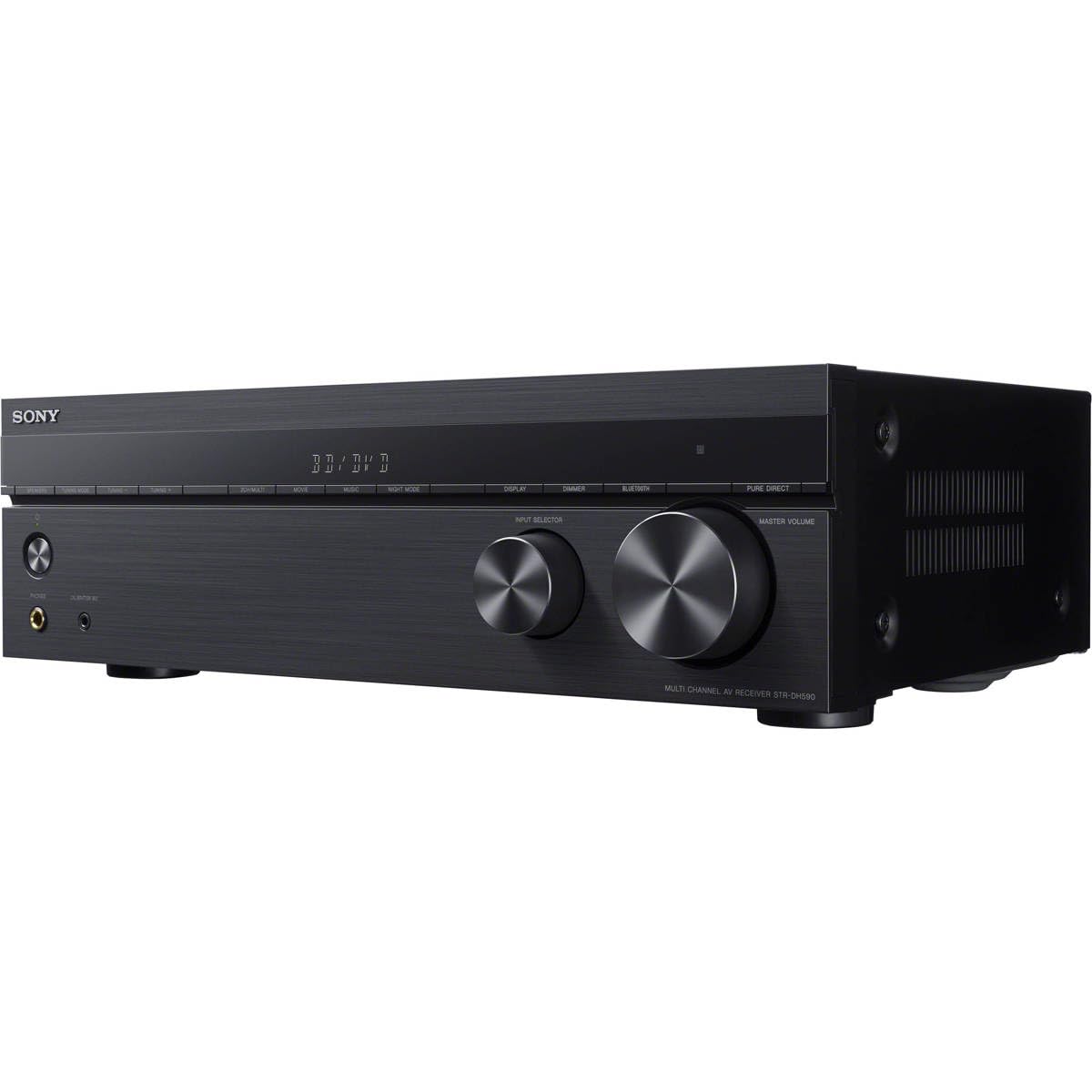
Sony’s STRDH590 delivers 145 watts per channel into six ohms, making it one of the most powerful entries in this guide for driving lower-impedance speakers. The 5.2-channel layout supports 4K HDR passthrough with HDCP 2.2, and S-Force PRO virtual surround can simulate a wider soundstage from just two speakers. Bluetooth standby lets you wake the receiver from your phone, and the simple on-screen menu keeps setup straightforward for first-time buyers.
Audio performance is clean and detailed, particularly with music sources like turntables and FM radio. The auto-calibration microphone adjusts speaker distance and level reasonably well, though the system lacks the more granular EQ found on Yamaha or Denon units. The front display is bright and readable with an adjustable dimmer, and the remote has a one-button press for switching between FM, TV, and Bluetooth sources.
The STRDH590 lacks a phono input and AM tuner, and the input jacks on the rear panel are slightly cramped for thicker cables. There is no dedicated dialogue enhancement feature, so vocal clarity in movies depends on your center channel quality. For a no-fuss 5.2 system with solid power and reliable 4K switching, the Sony is a strong budget-conscious pick.
Why it’s great
- High power output drives low-impedance speakers well
- Simple remote with direct source buttons
- Bluetooth standby for phone streaming
Good to know
- No phono input for turntables
- Rear input jacks are tightly spaced
- Lacks dedicated dialogue mode
3. JBL MA310 5.2 Channel (60 Watt x 5) 4K AV Receiver

The JBL MA310 is a shallow-profile 5.2-channel receiver that fits neatly into tight media consoles. Each of the five channels delivers 60 watts into eight ohms, enough to drive in-wall and bookshelf speakers in small to medium rooms. It decodes Dolby and DTS surround formats natively and passes 4K video through four HDMI inputs with ARC support. Bluetooth 5.1 with Low Energy provides wireless streaming from any phone or tablet.
Setup requires an on-screen menu accessible only through the HDMI output, which is intuitive once connected. The auto-on/off function with HDMI ARC works reliably with modern TVs. Sound quality is impressive for the price, with JBL’s tuning leaning toward a warm, musical character that pairs well with budget speaker packages. The compact chassis runs relatively cool and weighs just over 11 pounds.
The remote is not backlit, making navigation difficult in a dark theater room. The default auto shut-off timer is set to 20 minutes and must be manually extended. Additionally, the MA310 does not downsample DTS-HD Master Audio to 2.1 channels, limiting its utility for stereo-only listeners who want high-resolution DTS soundtracks.
Why it’s great
- Shallow depth fits tight AV cabinets
- Warm, musical sound signature
- Reliable HDMI ARC with TV auto-switching
Good to know
- Remote lacks backlighting
- Auto shut-off default is only 20 minutes
- No DTS-HD downmix to 2.1
4. Onkyo TX-NR5100 7.2 Channel Network A/V Receiver (Renewed)

The Onkyo TX-NR5100 is a 7.2-channel receiver that supports Dolby Atmos and DTS:X with a 5.1.2 speaker layout. It features HDMI 2.1 inputs with 8K60 and 4K120 pass-through, making it a strong match for current-gen gaming consoles. Klipsch Optimize Mode tailors the EQ to Klipsch Reference speakers, and the unit integrates with Alexa, Google Assistant, and Apple AirPlay 2. Access to Spotify, TIDAL, and Pandora is built in.
Sound quality is powerful and detailed, especially after the included AccuEQ calibration mic adjusts for room acoustics. The height channel jacks support both up-firing Atmos speakers and rear surround configurations. The front display is clear, and the overall build feels dense at over 23 pounds. Owners pairing it with Klipsch systems report excellent synergy.
This is a renewed unit, and quality control is inconsistent — some buyers report DOA units or subwoofer output failures. The app interface looks dated and could be more responsive. For the price, you get a feature set that typically costs more new, but the refurb gamble means you should test thoroughly within the return window.
Why it’s great
- HDMI 2.1 with 8K60 and 4K120 pass-through
- Klipsch Optimize Mode for matched systems
- Full Dolby Atmos and DTS:X support
Good to know
- Renewed condition has variable quality control
- App interface feels outdated
- Some units arrive with hardware defects
5. Pioneer VSX-935 7.2 Channel Surround Sound Network Receiver Dolby Atmos
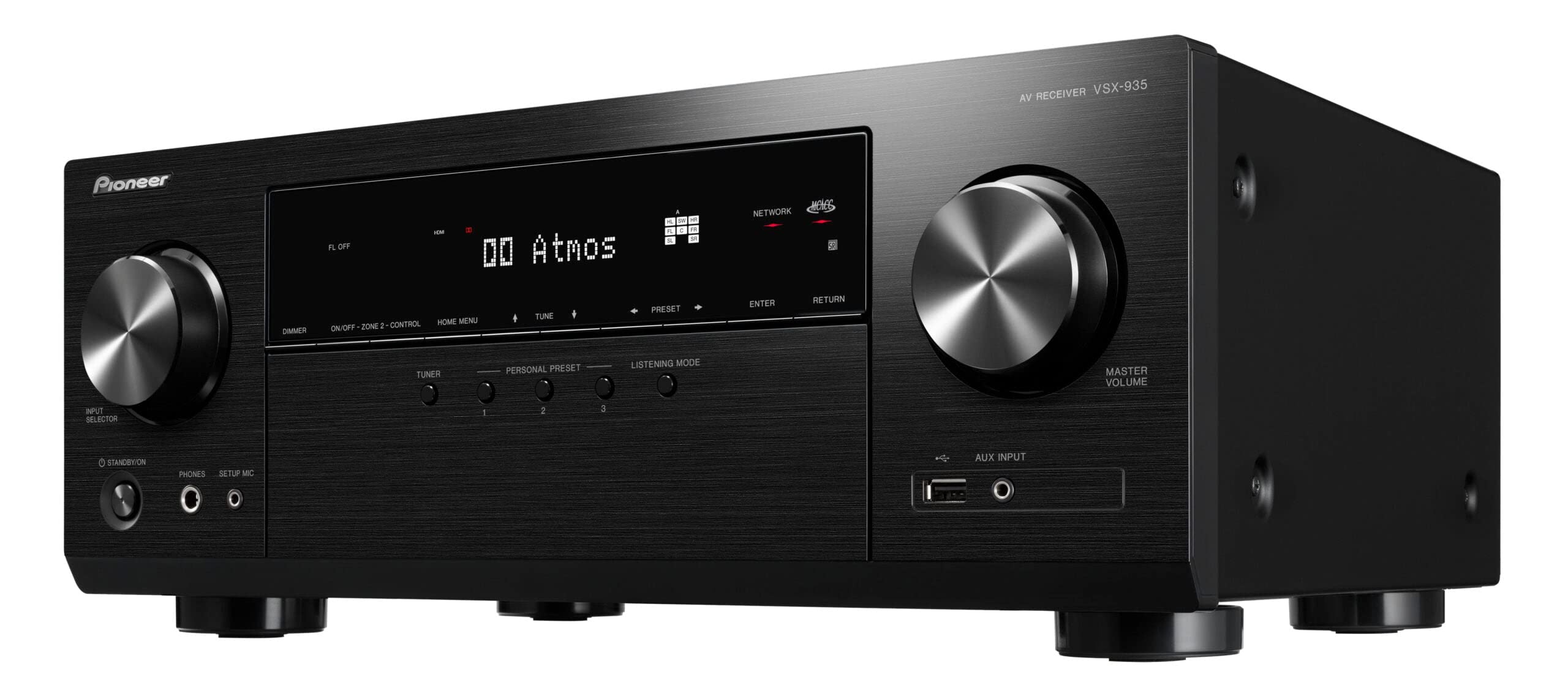
The Pioneer VSX-935 brings HDMI 2.1 with 8K pass-through, Dolby Atmos Height Virtualization, and a 7.2-channel layout to a competitive price point. The virtualization technology creates a sense of overhead sound without requiring physical height speakers, which is a genuine advantage for renters or those who cannot ceiling-mount. It also supports enhanced gaming features like VRR and ALLM for reduced input lag.
Audio performance is crisp and loud, with gradual volume ramping that avoids sudden jumps. The RF remote works through cabinets, and the dual-zone output lets you send different audio to a second room. The on-screen setup is straightforward, and the included mic calibration improves timing and frequency response noticeably. Owners feeding it high-res audio via Audirvana report clean DSD128 playback.
Bluetooth implementation is two-way and unreliable, requiring deep menu navigation for pairing. First-unit defect rates appear higher than average — dead displays and no-sound issues show up in reports. The interface feels dated, and the lack of a dedicated Bluetooth button adds daily friction. Buy new with a good return policy.
Why it’s great
- Dolby Atmos Height Virtualization for phantom height channels
- HDMI 2.1 with 8K and low-latency gaming features
- Dual-zone audio output for multi-room
Good to know
- Bluetooth pairing is cumbersome and glitchy
- Higher than average DOA reports
- Interface and menus feel outdated
6. Denon AVR-X1700H 7.2ch 8K Home Theater Receiver (Renewed)

The Denon AVR-X1700H is a 7.2-channel receiver that punches above its weight with Audyssey MultEQ room correction, three dedicated 8K HDMI inputs, and Dolby Atmos Height Virtualization. It supports Dolby Atmos, DTS:X, and DTS Virtual:X for immersive sound without requiring height speakers. HEOS built-in enables multi-room streaming via Wi-Fi, AirPlay 2, and Bluetooth, and voice control works with Alexa, Google Assistant, and Siri.
Audyssey MultEQ is the standout feature — it measures multiple positions in the room and applies precise filters to tame bass peaks and smooth the frequency response. The result is a noticeably cleaner soundstage, especially for dialogue and rear channel effects. The amplifier section delivers 80 watts per channel into eight ohms with low distortion, and the 8K upscaling works on all six HDMI inputs. The quick-start on-screen guide walks you through connection and calibration step by step.
As a renewed unit, cosmetic condition is generally good, but some buyers report needing certified 48Gbps HDMI cables for stable 4K120 signal. Power line interference can cause momentary picture dropouts in certain homes. For the price, the X1700H offers the best room correction and codec support in this guide.
Why it’s great
- Industry-leading Audyssey MultEQ room calibration
- Three dedicated 8K HDMI inputs
- Dolby Atmos Height Virtualization included
Good to know
- Requires certified 48Gbps HDMI cables for 4K120
- Renewed condition may have minor blemishes
- Power line interference can cause dropouts
7. Yamaha RX-V6A 7.2-Channel AV Receiver with MusicCast

The Yamaha RX-V6A upgrades to 7.2 channels with YPAO-R.S.C. multipoint calibration, Dolby Atmos, DTS:X, and a full suite of MusicCast streaming. It features seven HDMI inputs — three of which support 8K60 and 4K120 — with HDCP 2.3 and eARC. The 100 watts per channel into eight ohms provides headroom for medium to large rooms, and the advanced DSP modes from Yamaha’s Cinema DSP 3D library create expansive sound fields.
Audio quality is characterized by a high slew rate that preserves transients and clarity during action sequences. Dialogue remains intelligible even at low volumes, and the YPAO-R.S.C. calibration smooths frequency response across multiple seating positions. The RX-V6A handles 4-ohm speaker loads comfortably, a differentiator from many competitors. Dual subwoofer pre-outs allow for more even bass distribution in larger rooms.
The learning curve is steeper than the RX-V4A, and the remote layout is similarly cramped. HDMI-CEC behavior with certain TV and soundbar combinations can require manual configuration to avoid power-on conflicts. The unit does not auto-power on with all brands of TV via eARC. For a 7.2 system with room to grow into Atmos and multi-room audio, the RX-V6A is a long-term investment.
Why it’s great
- Powerful 100W per channel into 8 ohms
- YPAO-R.S.C. multipoint calibration
- Three 8K HDMI inputs for future-proofing
Good to know
- Steep learning curve for full feature set
- Remote has small, stiff buttons
- HDMI-CEC may need manual HDMI tweaking
8. Denon AVR-S670H 5.2 Ch Home Theater Receiver

The Denon AVR-S670H is a 5.2-channel receiver that brings 8K60 and 4K120 pass-through, HEOS multi-room streaming, and Audyssey MultEQ calibration to an entry-level price. The amplifier delivers 75 watts per channel into eight ohms, sufficient for most bookshelf and center channel speakers. It includes Dolby TrueHD, Dolby Pro Logic II, and DTS Neo:6 upmixing for non-native surround content. A phono input is built in for turntable users.
Setup is impressively straightforward — the on-screen assistant guides you through speaker connection and calibration without needing internet access. The Audyssey calibration measures your room and applies filters that clean up muddiness, particularly in the mid-bass region. HDMI ARC/eARC works reliably with modern TVs, and the single remote can control both the TV and receiver after initial programming. Sound quality is clean and neutral, making it a great foundation.
HEOS streaming via Wi-Fi can be laggy or drop connections during Spotify playback, though wired network performance is flawless. The 5.2 channel limit means you cannot add height speakers for Atmos without upgrading. For a simple, reliable 5.2 system with 8K video support and a phono input, the S670H delivers immense value.
Why it’s great
- Audyssey MultEQ calibration included
- 8K60 and 4K120 pass-through with HDCP 2.3
- Built-in phono input for turntables
Good to know
- HEOS wireless streaming can be unreliable
- 5.2 channel limit prevents Atmos expansion
- Power output is modest for large rooms
9. Marantz NR1510 UHD AV Receiver – Slim 5.2 Channel

The Marantz NR1510 is a 5.2-channel receiver that stands just over four inches tall, making it the most space-efficient option in this guide. Despite the slim chassis, it packs six HDMI inputs (one output) with full HDCP 2.3, eARC, and 4K60 support with Dolby Vision and HLG. The discrete amplifier outputs 50 watts per channel into eight ohms with Marantz’s signature Hyper-Dynamic Amplifier Modules for low-distortion performance. A built-in MM phono preamp simplifies turntable integration.
Sound quality is refined and musical, with a noticeably quieter noise floor than many competitors. The Audyssey MultEQ calibration adjusts for room acoustics and performs well with 5.1 satellite and bookshelf systems. The HEOS app enables multi-room streaming via Wi-Fi and AirPlay 2, and the setup assistant is clear enough that first-time users can be running in under an hour. The half-decibel volume increments give precise level control that audiophiles appreciate.
The receiver runs warm and needs good ventilation. It lacks 4K120 support, so it is not ideal for Xbox Series X or PS5 owners who want high-refresh gaming. The HEOS skill with Alexa has known reliability issues. For a space-saving 5.2 system with a phono input and excellent audio character, the NR1510 is a refined choice in the upper tier.
Why it’s great
- Slim 4-inch profile fits tight AV racks
- Built-in phono preamp for vinyl playback
- Low noise floor and musical sound signature
Good to know
- No 4K120 support for next-gen gaming
- Runs warm and needs ample ventilation
- HEOS Alexa integration can be unreliable
FAQ
Can I run a 5.1.2 Atmos setup with a 7.2-channel receiver under $500?
Do I need HDMI 2.1 if I only stream movies and do not game?
Why does my receiver sound different after auto-calibration?
What is the difference between Dolby Atmos and DTS:X?
Final Thoughts: The Verdict
For most users, the av receiver under $500 winner is the Yamaha RX-V4A because it combines reliable YPAO calibration, 8K-ready HDMI, and seamless MusicCast streaming in a 5.2 package that fits real-world budgets. If you want Audyssey MultEQ room correction and 8K support, grab the Denon AVR-X1700H. And for a slim chassis with a phono input and refined sound, nothing beats the Marantz NR1510.

Mo Maruf
I created WellFizz to bridge the gap between vague wellness advice and actionable solutions. My mission is simple: to decode the research and give you practical tools you can actually use.
Beyond the data, I am a passionate traveler. I believe that stepping away from the screen to explore new environments is essential for mental clarity and physical vitality.