Our readers keep the lights on and my smoothie glass nicely filled. As an Amazon Associate, I earn from qualifying purchases.
Choosing an AV receiver for music means prioritizing clean stereo performance, precise digital-to-analog conversion, and seamless streaming integration over the sheer number of surround channels or the latest video standards. The market is flooded with home-theater-first designs that treat music as an afterthought, so identifying the models with dedicated DAC stages, low-noise amplification paths, and phono inputs that respect your vinyl collection is essential.
I’m Mohammad Maruf — the founder and writer behind WellFizz. I’ve spent hundreds of hours analyzing DAC implementations, power-supply topologies, and streaming platform compatibility to separate the music-first receivers from the surround-sound pretenders.
Whether you listen to lossless streams, analog vinyl, or high-res digital files, the best av receiver for music must deliver transparent amplification, a low-noise floor, and a feature set that puts listening pleasure above all else.
How To Choose The Best AV Receiver For Music
Most AV receivers are designed with home theater as the primary purpose — they prioritize HDMI switching, surround decoding, and multi-channel power. Music listening demands a different set of priorities: a high-quality DAC, robust stereo amplification, low total harmonic distortion, and a clean signal path. Below are the key factors that separate a genuine music receiver from a jack-of-all-trades.
DAC Performance and Digital Inputs
The digital-to-analog converter is the heart of any music system. Look for receivers with ESS Sabre or AKM DACs that support PCM up to 24-bit/192kHz and native DSD playback. Optical, coaxial, and USB inputs must be present for connecting CD transports, media streamers, and computers. A receiver that skimps on the DAC stage will sound flat and lifeless, especially with high-resolution files.
Stereo Power Output and Amplifier Topology
Rated power per channel (8 ohms, 20Hz–20kHz, two channels driven) is the spec that matters for stereo music. Many receivers inflate ratings by measuring with one channel or at higher distortion. A genuine 70–100 watts per channel of clean Class A/B or well-implemented Class D amplification will drive most bookshelf and floor-standing speakers to satisfying volumes without strain.
Streaming and Network Capabilities
Native support for Spotify Connect, TIDAL Connect, Apple AirPlay 2, and Chromecast built-in is far more convenient than Bluetooth alone. Wi-Fi with 5GHz support ensures stable high-resolution streaming. Look for receivers that also support Roon Ready or DTS Play-Fi for advanced multi-room setups. A well-designed smartphone app can make or break the daily listening experience.
Phono Stage and Analog Purity
If you own a turntable, a built-in phono preamp saves you the cost and clutter of an external box. Most integrated phono stages are designed for moving magnet (MM) cartridges only — if you use a moving coil (MC), you will need an external step-up transformer or phono preamp. A Pure Direct or Source Direct mode that bypasses digital processing and tone controls reveals the true character of your amplifier and speakers.
Build Quality and Connectivity
A well-damped chassis, high-quality binding posts, and isolated power supplies reduce mechanical and electrical noise. For music-first setups, you do not need seven HDMI inputs, but you do need robust RCA line-level inputs, a front-panel USB port, and pre-outs if you plan to add an external power amplifier later. The weight and ventilation of the unit often hint at transformer quality and thermal stability.
Quick Comparison
On smaller screens, swipe sideways to see the full table.
| Model | Category | Best For | Key Spec | Amazon |
|---|---|---|---|---|
| Yamaha R-N800A | 2‑Channel | Critical Listening | ESS ES9080Q DAC | Amazon |
| Marantz STEREO 70s | 2‑Channel | Compact Hi‑Fi | Class A/B amp | Amazon |
| Yamaha R-N600A | 2‑Channel | Best Value | ESS ES9010K2M DAC | Amazon |
| Sony STR-AZ1000ES | 7.2 Channel | Hybrid Use | 100W/Ch (8 ohms) | Amazon |
| Denon AVR-S970H | 7.2 Channel | Entry Surround | 90W/Ch (8 ohms) | Amazon |
| Onkyo TX-RZ50 | 9.2 Channel | Atmos + Music | Dirac Live | Amazon |
| Onkyo TX-NR7100 | 9.2 Channel | Best Bang for Buck | Dirac Live | Amazon |
| JBL MA9100HP | 9.2 Channel | Unique Style | 140W/Ch (Class D) | Amazon |
| Yamaha RX-A4A | 7.2 Channel | AVENTAGE Build | Surround:AI | Amazon |
| Marantz Cinema 50 | 9.4 Channel | Ultimate System | Audyssey XT32 | Amazon |
| Sony STR-AZ5000ES | 11.2 Channel | Flagship Power | 360 Spatial Sound | Amazon |
In‑Depth Reviews
1. Yamaha R-N800A Network Receiver

The Yamaha R-N800A is the definitive music-first stereo receiver in this roundup, pairing the flagship ESS SABRE ES9080Q Ultra DAC with 100 watts per channel of clean, Class A/B power. Its ToP-ART mechanical structure and low-impedance concept keep the signal path pure, while YPAO-R.S.C. room correction fine-tunes the listening environment without coloring the sound. Reviewers consistently praise the vast soundstage and excellent channel separation, noting that CD and streaming inputs deliver a neutral, involving presentation that outshines competitive integrated amplifiers from NAD and Marantz.
The built-in Wi-Fi, Bluetooth, and Ethernet support cover every modern streaming protocol — Spotify Connect, Apple AirPlay 2, and high-resolution DSD 11.2 MHz playback are all handled natively. A phono input (MM) is included for vinyl enthusiasts, though some users report it is a bit low on gain and recommend an external pre-amp for moving-coil cartridges. The included remote feels less premium than the receiver itself, but the MusicCast app provides a stable and intuitive control experience.
This is a strictly stereo receiver — there are no HDMI inputs, no surround processing, and no multi-channel expansion. For the listener who wants a dedicated 2.1-channel hub for critical music listening, the R-N800A delivers a level of DAC performance and amplifier refinement that rival separates costing significantly more. The build quality, with a substantial transformer and heat sinks, inspires long-term confidence.
Why it’s great
- Top-tier ESS ES9080Q DAC delivers superb S/N ratio
- 100W/channel stereo power from Class A/B topology
- YPAO room correction tailors sound to your space
- Roon Tested for advanced streaming integration
Good to know
- Phono stage is MM-only and a bit low on gain
- No HDMI inputs or surround processing
- Remote control feels cheap for this price tier
2. Marantz STEREO 70s

The Marantz STEREO 70s brings legendary Marantz warmth in a chassis that is nearly half the depth of a traditional receiver, making it an ideal fit for media consoles with limited space. It delivers 75 watts per channel via discrete Class A/B amplifiers and features the signature HDAM (Hyper Dynamic Amplifier Module) current feedback circuitry that Marantz is famous for. Owners upgrading from the NR1200 reported a immediately noticeable improvement in soundstage depth and instrument separation, with several noting that their speakers sounded like an entirely new pair.
Connectivity is surprisingly generous for a compact unit: six HDMI inputs (including eARC), a phono input for MM turntables, dual subwoofer outputs, and Wi-Fi with HEOS multi-room streaming. The receiver supports Dolby Atmos height virtualization, so it can create a convincing surround effect from a 2.1 or 5.1 speaker layout — a nice bonus if you watch movies. A few users noted that the built-in phono preamp has lower gain than expected, and there was a firmware-related HEOS controversy that affected some early production units.
For anyone who prioritizes 2-channel music but occasionally wants to connect a TV or gaming console, the STEREO 70s strikes a rare balance: genuine audiophile-grade amplifier design in a package that does not dominate your furniture. The slim, elegant look with the iconic Marantz porthole display is a visual treat that matches its sonic refinement.
Why it’s great
- Compact chassis fits shallow media consoles
- Signature Marantz warmth with HDAM circuitry
- Six HDMI inputs with eARC for TV integration
- Dual subwoofer outputs for flexible bass
Good to know
- Phono stage gain is on the low side
- HEOS streaming had firmware issues on early units
- Only 75W per channel — may struggle with power-hungry speakers
3. Yamaha R-N600A Network Receiver

The Yamaha R-N600A is the budget-friendly gateway to high-quality stereo streaming without sacrificing DAC performance. It uses the ESS SABRE ES9010K2M Ultra DAC, the same chip family found in much more expensive equipment, and supports native DSD 11.2 MHz playback as well as 384 kHz PCM via its front-panel USB port. The 80 watts per channel of Class A/B amplification is ample for most bookshelf speakers, and Pure Direct mode bypasses unnecessary circuitry for a cleaner signal path.
Reviewers consistently praised this receiver for its vintage-modern aesthetic — the brushed metal front panel, large volume knob, and sturdy build evoke classic Yamaha designs from the 1970s. It has no HDMI ports, which keeps the focus on pure audio: coaxial, optical, RCA, and phono (MM) inputs cover all traditional sources. MusicCast streaming works reliably over Wi-Fi or Ethernet, and the app handles queue management from NAS drives and DLNA servers without hiccups.
The main compromises are the plastic knobs, the lack of room correction, and a phono stage that is best suited for high-output MM cartridges. Some users also noted that volume levels vary between sources. But at this price point, the R-N600A offers a DAC and amplifier combination that easily outperforms all-in-one streaming receivers costing several hundred more.
Why it’s great
- ESS SABRE DAC for high-resolution audio
- Pure Direct mode bypasses digital processing
- Classic retro-modern design with metal face
- MusicCast multi-room streaming is stable
Good to know
- No HDMI inputs or room correction
- Plastic knobs feel less premium
- Phono stage needs a high-output cartridge
4. Sony STR-AZ1000ES

The Sony STR-AZ1000ES proves that a home theater receiver can excel at music when the amplifier section is given proper attention. Delivering 100 watts per channel (8 ohms, 1kHz, 2ch driven) with 0.9% THD, this 7.2-channel ES-series receiver uses Sony’s Digital Cinema Auto Calibration IX and 360 Spatial Sound Mapping to create an immersive stage that extends well beyond the physical speaker boundaries. Music listeners who use it in Pure Direct mode report excellent dialogue clarity and a warm, detailed presentation that makes both analog and digital sources sound full-bodied.
Connectivity is future-proof: six HDMI 2.1 inputs (two outputs), eARC, Wi-Fi, Bluetooth, Chromecast built-in, Spotify Connect, and Apple AirPlay 2. The unit also integrates with Sonos systems via Works with Sonos certification. A few owners mentioned that the receiver runs hot during extended listening sessions and requires good ventilation — some added a small USB fan. The auto-calibration mic setup is straightforward, though experienced users recommend manually measuring speaker distances with a tape measure for the best imaging results.
This model is ideal for the listener who wants one receiver that handles both serious stereo music and immersive surround content. The 360 Spatial Sound Mapping is genuinely unique in this price range, creating phantom height and surround channels even with a 5.1.2 speaker layout. If you want a single box that does not compromise on either side of the audio coin, the AZ1000ES is a strong contender.
Why it’s great
- Pure Direct mode for clean stereo playback
- 360 Spatial Sound Mapping for immersive stereo
- Full HDMI 2.1 suite for gaming and video
- Sonos integration and multi-protocol streaming
Good to know
- Runs hot — ensure good ventilation
- No HDR10+ support
- Auto-calibration can be finicky with surround assignments
5. Denon AVR-S970H

The Denon AVR-S970H offers a well-rounded package for anyone who wants solid stereo performance without ignoring home theater. Its 90 watts per channel (8 ohms, two channels driven) are enough to drive most speakers to satisfying levels, and the built-in phono input lets you connect a turntable directly. User reviews highlight clean, rich sound in 2-channel Pure Direct mode, with several buyers noting that vinyl playback produced near-CD clarity with impressively low noise from the phono stage.
This 7.2-channel receiver supports Dolby Atmos, DTS:X, and 8K/60Hz pass-through on three of its eight HDMI inputs. HEOS multi-room streaming gives access to Spotify, TIDAL, and other services, and the setup process is one of the easiest in this class — guided on-screen menus and a smartphone app get you running quickly. Some users reported that the HEOS app can be less intuitive than competitors and that using Bluetooth does not pass HEOS sources.
The S970H runs cooler than many comparably powered receivers, a testament to its efficient amplifier design. It lacks pre-outs for external amplification and the remote does not have a dedicated TV power button, but for the price it is a flexible hub that handles music and movies without force you to choose one over the other.
Why it’s great
- Great stereo sound in Direct mode
- Phono input with low noise floor
- Easy setup with on-screen and app guidance
- 8K/60Hz pass-through on three HDMI inputs
Good to know
- HEOS app can be clunky
- Zone 2 reduces main channels to 5.2
- No pre-outs for external amp
6. Onkyo TX-RZ50

The Onkyo TX-RZ50 is a 9.2-channel THX-certified receiver that brings professional-grade room calibration to the music listener via Dirac Live. With 120 watts per channel and 11.2 channels of processing capability (7.2.4 with an external amp), it delivers powerful, clean amplification that owners describe as warm, detailed, and highly immersive. Dirac Live transforms the listening experience by measuring and correcting for room acoustics — several reviewers reported that it made their speaker systems sound substantially more balanced and precise than competing room correction systems.
Beyond its calibration prowess, the TX-RZ50 includes HDMI 2.1 with 8K/60Hz and 4K/120Hz pass-through, making it a future-proof choice for gaming and video. It integrates with Sonos systems and supports aptX HD Bluetooth for high-quality wireless transmission. The phono input (MM) handles turntables, and dual subwoofer outputs allow for flexible bass management. A small number of users reported early units with WiFi card failures, but the majority experience excellent reliability after replacement.
For the music enthusiast who also wants a premium home theater experience, the TX-RZ50 is arguably the best value in this range. The combination of Dirac Live, THX certification, and high current output make it a powerhouse that reveals everything your speakers can do — whether you are listening to a 2-channel vinyl recording or an immersive Dolby Atmos mix.
Why it’s great
- Dirac Live room correction is class-leading
- 120W/ch THX-certified amplification
- HDMI 2.1 with 8K/60Hz and 4K/120Hz
- Sonos and aptX HD support
Good to know
- Runs warm during extended use
- Dual subwoofer outputs are not independently adjustable
- WiFi card issues reported on some early units
7. Onkyo TX-NR7100
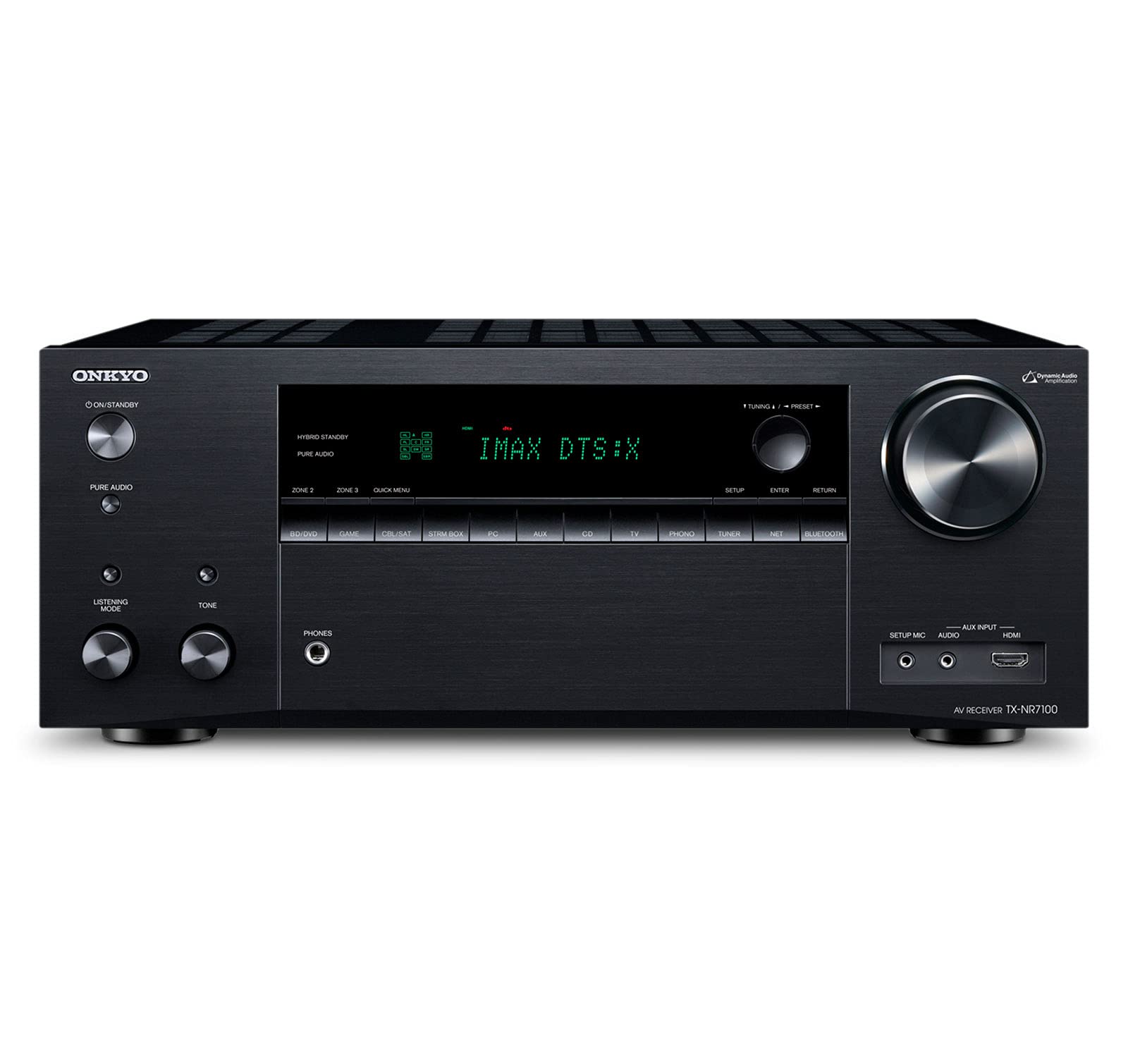
The Onkyo TX-NR7100 is the entry point to Dirac Live calibration for those who do not need the full 11.2-channel processing of its bigger sibling. It offers 9.2 channels with 100 watts per channel and THX certification, making it one of the most affordable ways to get professional room correction into a music-focused system. Owners upgrading from older receivers consistently noted that Dirac Live cleaned up bass nodes, tightened imaging, and made the system sound more cohesive across all genres of music.
This receiver supports Dolby Atmos, DTS:X, and 8K/60Hz pass-through with VRR and ALLM for gaming. It is Works with Sonos Certified, integrates with DTS Play-Fi, and includes bidirectional Bluetooth with aptX HD transmission. Setup is detailed — some users described the manual as intimidating — but the on-screen calibration process guides you through speaker detection and distance measurement. A few negative reviews pointed to reliability concerns, with isolated reports of crackling audio and limited remote control range.
If you are building a system that prioritizes music but also needs full home theater functionality, the TX-NR7100 delivers the most impactful calibration technology at its price point. The sound character is neutral with a slight warmth that pairs well with both bright and laid-back speakers, and the HDMI 2.1 implementation ensures it will stay relevant for years.
Why it’s great
- Full Dirac Live built-in at an affordable price
- 100W/channel THX certified
- HDMI 2.1 with 8K/60Hz for gaming
- Sonos and DTS Play-Fi integration
Good to know
- Complex setup — requires careful manual reading
- Bluetooth connectivity issues reported with PCs
- Limited remote control range in some units
8. JBL MA9100HP
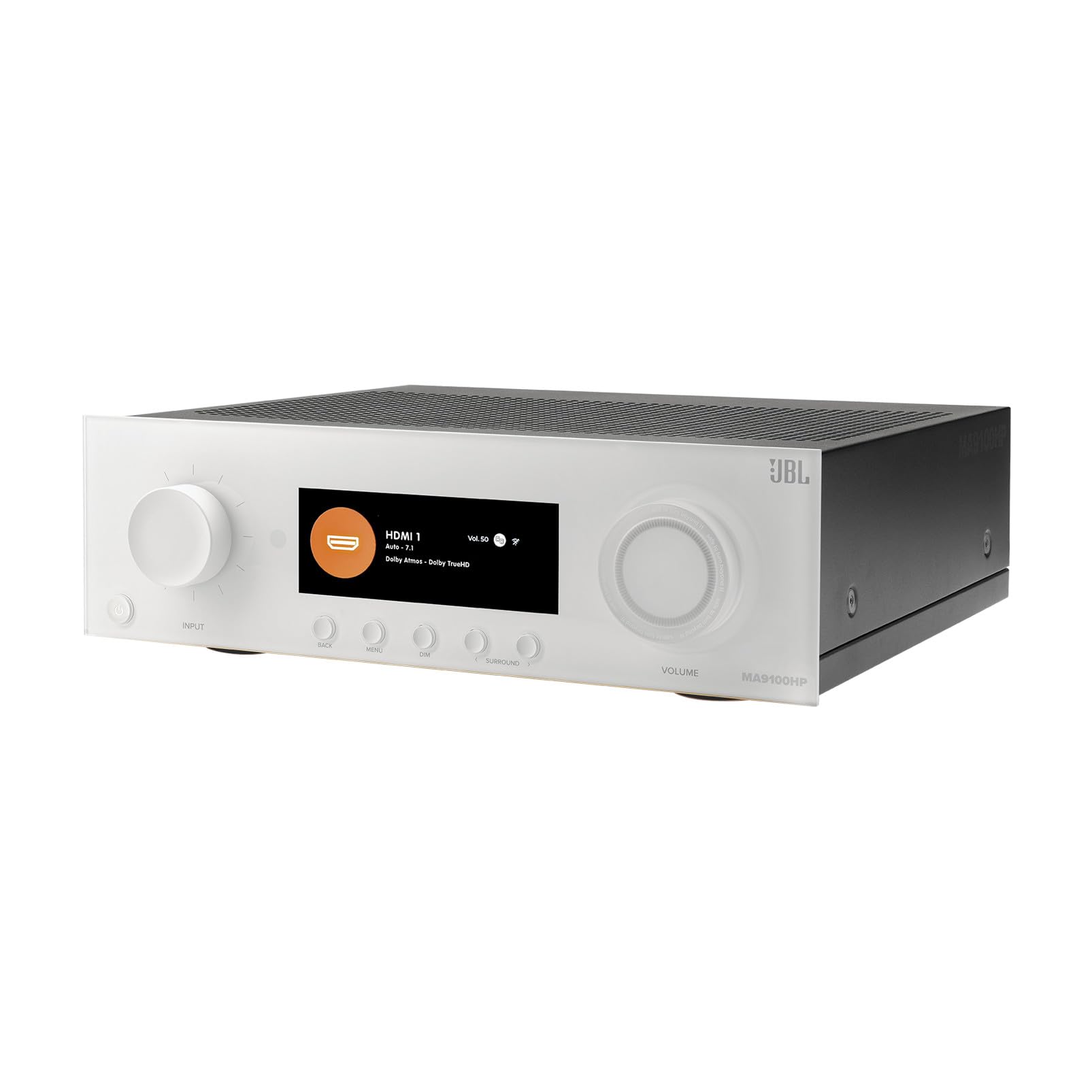
The JBL MA9100HP stands out visually with a clean white finish that breaks the all-black convention, but its real story is the 140 watts per channel from efficient Class D amplification. This 9.2-channel receiver supports up to 5.1.4 or 7.1.2 configurations and includes Dolby Atmos and DTS:X decoding. Music listeners appreciate the high power output that drives even power-hungry tower speakers with authority, and the Class D design means it runs cooler and fits into shallower cabinets than most competitors.
Connectivity includes six HDMI inputs (two outputs) with eARC, Apple AirPlay 2, Google Chromecast, and Bluetooth. The MA9100HP is a relatively new model, and users have noted that the initial firmware update is mandatory and the setup process can be confusing until you use the on-screen TV menu. Some owners expressed frustration with the non-backlit remote and the bright front-panel glow that cannot be dimmed without digging into menus.
A notable limitation for music purists: the MA9100HP does not downmix DTS-HD Master Audio to 2.1, which is problematic if you watch concert Blu-rays in a stereo-only configuration. JBL confirmed that older models support this feature, but the MA9100HP does not. For streaming and general music use, however, the Class D amplifier offers excellent clarity and control.
Why it’s great
- 140W/channel Class D runs cool and powerful
- Unique white design fits modern interiors
- Shallow chassis fits tight media consoles
- Full Apple AirPlay 2 and Chromecast support
Good to know
- No DTS-HD MA downmix to 2.1
- Remote is not backlit
- Setup requires mandatory firmware update
9. Yamaha RX-A4A AVENTAGE

The Yamaha RX-A4A is part of the AVENTAGE line, Yamaha’s top-tier series known for premium build quality — anti-resonance feet with an extra bottom panel, high-grade DACs, and separate power supply sections for analog and digital stages. This 7.2-channel receiver delivers 100 watts per channel and features Surround:AI technology that analyzes scene content in real time and optimizes the sound envelope for maximum immersion. In Pure Direct mode, owners report a spacious, accurate stereo presentation with excellent transparency.
YPAO R.S.C. with 3D multipoint measurement provides sophisticated room correction that refines the frequency response without dulling the character of your speakers. The rear panel includes seven HDMI 2.1 inputs (three outputs), all supporting 8K60 and 4K120 with ALLM and VRR. MusicCast handles multi-room streaming, and the unit is Roon Tested. A few users found the initial firmware update process tedious — it requires a USB flash drive, and the setup menu has many nested options that demand patience.
For the buyer who values mechanical integrity as much as sonic performance, the RX-A4A’s build quality is evident the moment you lift it. It is a heavy, solid unit with a refined sound that works well for both music and movies. The Surround:AI feature is genuinely interesting for film content, but it can push vocal information to the center channel on older stereo tracks — best left off for critical listening.
Why it’s great
- AVENTAGE build quality with anti-resonance design
- YPAO R.S.C. with 3D multipoint room correction
- Seven HDMI 2.1 inputs with 8K/60Hz
- Roon Tested for high-end streaming
Good to know
- Firmware update requires USB drive
- Setup menus are complex and deep
- Surround:AI can push voice to center on stereo tracks
10. Marantz Cinema 50

The Marantz Cinema 50 is a serious step into high-end home audio, offering 110 watts per channel across nine channels with the legendary HDAM current feedback circuitry that gives Marantz its characteristic warmth and organic tonality. It supports 9.4 channels with four independent subwoofer outputs, Dolby Atmos, DTS:X Pro, IMAX Enhanced, and Auro-3D. Music listeners will appreciate the Audyssey MultEQ XT32 room correction, which provides deep bass management and filter resolution that fine-tunes the system without robbing the music of its emotional impact.
Connectivity is comprehensive: nine 8K HDMI inputs (three outputs) with eARC, analog inputs including a phono stage, and HEOS multi-room streaming. The Cinema 50 is among the few receivers that can build a true 7.1.4 system with an external amplifier for the extra channels. Owners praise its clean, controlled power delivery, excellent channel separation, and the ability to drive demanding speakers like Klipsch Reference Premiere series with zero distortion at high volumes.
The unit runs hot — plan for at least four inches of clearance above it. Setup ideally requires the Audyssey app for fine-tuning, which some users feel should not be necessary. But for the buyer who wants a receiver that excels equally at two-channel music and immersive surround, the Cinema 50 delivers a level of refinement that justifies its premium position.
Why it’s great
- HDAM circuitry delivers warm, detailed sound
- Four independent subwoofer outputs
- Audyssey MultEQ XT32 room correction
- Supports Auro-3D and IMAX Enhanced
Good to know
- Runs very hot — needs ample ventilation
- Audyssey app required for advanced calibration
- Phono stage is MM-only with modest gain
11. Sony STR-AZ5000ES

The Sony STR-AZ5000ES is the flagship of Sony’s ES line, delivering 130 watts per channel across 11.2 channels with an arsenal of proprietary technologies including 360 Spatial Sound Mapping and Digital Cinema Auto Calibration IX. This receiver is built for the listener who wants the most immersive audio possible — its 360SSM technology can create phantom height and surround channels that make a 5.1.2 setup sound almost like a full 7.1.4 array. Music in stereo mode benefits from Pure Direct, which bypasses all digital processing for a clean analog signal path.
The amplifier stage is genuinely powerful, with owners noting significant headroom for dynamic peaks and the ability to drive difficult speaker loads without strain. Connectivity includes seven HDMI 2.1 inputs (two outputs) with 8K/60Hz support, eARC, and a full suite of streaming protocols: Chromecast, Spotify Connect, Apple AirPlay 2, and Bluetooth. It is Works with Sonos Certified and integrates with Google Assistant. The backlit remote is a welcome premium touch that is missing from many competing receivers.
Heat management is a consideration — the unit runs hot enough that many owners install a USB-powered cooling fan. It also lacks HDR10+ support, which may matter if you have a TV that uses that format. But for sheer sonic scale, channel count, and the unique spatial processing that makes music feel three-dimensional, the AZ5000ES is a formidable choice for those building a no-compromise system.
Why it’s great
- 130W/channel across 11.2 channels
- 360 Spatial Sound Mapping creates immersive phantom channels
- Backlit remote with premium feel
- Pure Direct mode for unprocessed stereo
Good to know
- Runs very hot — cooling fan recommended
- No HDR10+ support
- Auto-calibration needs careful manual distance checks
FAQ
Why would I choose a stereo receiver over an AV receiver for music?
What does Pure Direct mode do and should I use it?
Do I need an external phono preamp or does the built-in one work fine?
Is Bluetooth good enough for high-quality music streaming?
What is the real benefit of Dirac Live over basic room correction?
Final Thoughts: The Verdict
For most users, the best av receiver for music winner is the Yamaha R-N800A because it pairs a flagship ESS Sabre DAC with 100W of pure Class A/B amplification and YPAO room correction in a dedicated stereo package that leaves nothing to compromise. If you want a compact chassis with genuine Marantz warmth and just enough HDMI connectivity for a TV, grab the Marantz STEREO 70s. And for the buyer who needs a full home theater receiver that still delivers excellent stereo performance, the Onkyo TX-RZ50 with Dirac Live and THX certification is the smartest investment you can make.

Mo Maruf
I created WellFizz to bridge the gap between vague wellness advice and actionable solutions. My mission is simple: to decode the research and give you practical tools you can actually use.
Beyond the data, I am a passionate traveler. I believe that stepping away from the screen to explore new environments is essential for mental clarity and physical vitality.