Our readers keep the lights on and my smoothie glass nicely filled. As an Amazon Associate, I earn from qualifying purchases.
The difference between a home theater that thunders and one that merely chirps often comes down to a single component: the AV receiver. With 4K and 8K displays becoming the norm, your receiver must handle high-bandwidth HDMI 2.1 signals, decode object-based audio like Dolby Atmos, and manage speaker loads across multiple channels — all without introducing lag or dropping frames. A unit that can’t keep up will bottleneck your entire system, turning a flagship TV into a frustrating source of handshake errors and audio dropouts.
I’m Mohammad Maruf — the founder and writer behind WellFizz. I specialize in dissecting home theater hardware specifications, from HDMI bandwidth and channel configuration to room correction algorithms and amplifier topologies, to identify the receivers that actually deliver on their lab-sheet promises.
This guide cuts through the jargon to help you find the best av receiver 4k for your specific setup, whether you’re building a budget-friendly 5.1 system or a premium 7.2.4 Atmos rig.
How To Choose The Best AV Receiver 4K
Buying an AV receiver is a long-term investment — most units sit in your rack for five to ten years. Making the right choice requires understanding a few critical specifications that define performance, compatibility, and future-proofing. Here’s what to focus on.
Channel Count and Atmos Configuration
The first number in a receiver’s spec (5.2, 7.2, 9.2) tells you how many speakers it can power and how many subwoofers it supports. A 5.2-channel receiver drives five main speakers and two subs — enough for a basic surround setup. For Dolby Atmos with overhead or up-firing height speakers, you need at least 7 channels (5.1.2) or 9 channels (5.1.4 or 7.1.2). The 9.2-channel units like the Onkyo TX-RZ50 allow a full 5.1.4 Atmos configuration, which places four height channels above you for truly immersive object-based audio.
HDMI Version and Bandwidth
HDMI 2.1 is the current standard, supporting up to 40 Gbps bandwidth for 4K/120Hz, 8K/60Hz, and advanced gaming features like VRR (Variable Refresh Rate), ALLM (Auto Low Latency Mode), and QFT (Quick Frame Transport). Ensure the receiver has at least three HDMI 2.1 inputs if you plan to connect a PS5, Xbox Series X, and a streaming device simultaneously. Units with only HDMI 2.0 (18 Gbps) will still handle standard 4K/60Hz content but won’t support higher frame rate gaming.
Room Correction and Calibration
A receiver is only as good as its ability to adapt to your room’s acoustics. Basic systems like YPAO (Yamaha) offer quick speaker distance and level calibration. Mid-range solutions like Audyssey MultEQ XT32 (Denon/Marantz) provide more precise frequency-domain correction. Premium units like the Onkyo TX-RZ50 and TX-NR7100 ship with Dirac Live — widely regarded as the most sophisticated room correction software, capable of dramatically reducing bass nulls and smoothing the frequency response across all listening positions.
Amplifier Power and Speaker Matching
Look beyond the total wattage number — focus on watts per channel with two channels driven (usually listed as 2-ch driven at 8 ohms). A receiver with 100 watts per channel will comfortably drive most bookshelf and tower speakers. If you own power-hungry 4-ohm speakers, check for a unit rated stable at 4 ohms (like the Yamaha RX-V6A). For larger rooms or less efficient speakers, stepping up to 120W or more prevents distortion at high volumes.
Quick Comparison
On smaller screens, swipe sideways to see the full table.
| Model | Category | Best For | Key Spec | Amazon |
|---|---|---|---|---|
| Denon AVR-S970H | Mid-Range | Best Overall Value | 90W x 7, 8K/60Hz, Audyssey MultEQ | Amazon |
| Onkyo TX-RZ50 | Premium | Best for Atmos (5.1.4) | 120W x 9, Dirac Live, THX | Amazon |
| Sony STR-AN1000 | Mid-Range | Best for Sony TV Owners | 165W (6 ohms), 360 SSM | Amazon |
| Yamaha RX-A4A | Premium | Best Build Quality | 100W x 7, YPAO R.S.C., Auro-3D | Amazon |
| Marantz Cinema 60 | Premium | Best for Audiophile Stereo | 100W x 7, HDAM, Audyssey XT32 | Amazon |
| Sony STRAZ1000ES | Premium | Best for Custom Integration | 100W x 7, 360 SSM, IP Control | Amazon |
| Onkyo TX-NR7100 | Mid-Range | Best for Dirac Enthusiasts | 100W x 9, Dirac Live, THX | Amazon |
| Denon AVR-S670H | Entry-Level | Best Budget Surround | 75W x 5, 8K/60Hz, Audyssey | Amazon |
| Pioneer VSX-935 | Mid-Range | Best for Gamers | 80W x 7, HDMI 2.1, 8K | Amazon |
| JBL MA310 | Entry-Level | Best for Simple Setup | 60W x 5, Bluetooth 5.1 | Amazon |
| Yamaha RX-V6A | Mid-Range | Best for MusicCast Multi-Room | 100W x 7, 4K/120Hz, YPAO | Amazon |
In‑Depth Reviews
1. Denon AVR-S970H

The Denon AVR-S970H strikes the ideal balance between performance, connectivity, and price for the vast majority of home theater builders. Its 90 watts per channel across seven channels provide ample headroom for a 5.1.2 Dolby Atmos setup, and the Audyssey MultEQ room correction does a commendable job taming room modes and balancing speaker levels. The three 8K HDMI 2.1 inputs support 4K/120Hz passthrough, VRR, and ALLM, making it a natural partner for both a PS5 and Xbox Series X simultaneously.
Setup is genuinely beginner-friendly — the on-screen assistant guides you through speaker detection, distance calibration, and input assignment without requiring a degree in audio engineering. The HEOS multi-room platform lets you stream Spotify, TIDAL, and TuneIn to other HEOS-enabled speakers around the house, and the phono input means turntable owners don’t need an external preamp. Bluetooth and Wi-Fi are both onboard, though the HEOS app can occasionally lag with wireless streaming.
Where the S970H really shines is its reliability. Owner reports consistently note stable HDMI handshakes with modern TVs, cool operating temperatures compared to competitors, and clean, distortion-free sound even at reference volumes. It’s not the absolute last word in refinement — that goes to the Marantz or Yamaha AVENTAGE lines — but for a single-box solution that nails the core requirements of a modern 4K/8K home theater, this is the receiver to beat.
Why it’s great
- Three 8K HDMI 2.1 inputs with full gaming feature support.
- Audyssey MultEQ provides effective, easy-to-run room correction.
- Phono input and HEOS multi-room streaming expand versatility.
Good to know
- Powered Zone 2 reduces main zone to 5 channels.
- Remote lacks a dedicated TV power button.
2. Onkyo TX-RZ50

The Onkyo TX-RZ50 is a serious step up for anyone building a dedicated Atmos theater. Its 9.2-channel amplifier delivers 120 watts per channel — enough to drive a full 5.1.4 layout without breaking a sweat. The headline feature here is Dirac Live, included out of the box, which offers professional-grade room correction that far surpasses the simpler EQ systems found on budget receivers. Dirac measures your room at multiple listening positions and applies precise filters to flatten frequency response and tighten bass.
THX certification means the TX-RZ50 has passed a battery of tests ensuring it can reproduce reference-level sound in a treated room without adding noise or distortion. Klipsch Optimize Mode automatically sets crossover points for compatible Klipsch speakers, simplifying integration. With three HDMI 2.1 inputs supporting 8K/60Hz and 4K/120Hz, plus eARC, VRR, and ALLM, this receiver is ready for the latest consoles and PC gaming at high frame rates.
The unit runs warm under load — good airflow is essential. Some owners report a slight HDMI switching delay (12–15 seconds), and the remote lacks a backlight, which can be annoying in a dark theater. But the combination of Dirac Live calibration, 11.2-channel processing pre-outs (allowing expansion to 7.2.4 with an external amp), and robust build quality makes this the best value proposition for serious Atmos enthusiasts who want room correction that actually transforms their listening experience.
Why it’s great
- Dirac Live room correction included — best in class at this price.
- THX Certified for reference-level performance and low distortion.
- 9.2 channels with pre-outs for future expansion to 7.2.4.
Good to know
- Runs warm; requires good ventilation in the rack.
- Remote is not backlit, which is unusual at this tier.
3. Yamaha RX-A4A AVENTAGE

The Yamaha RX-A4A represents the AVENTAGE line, Yamaha’s top-tier series defined by premium internal construction, anti-vibration engineering, and meticulously selected components. Its 7.2-channel amplifier with 100 watts per channel delivers clean, open sound with a wide soundstage. The unique Surround:AI technology analyzes audio in real-time and automatically adjusts surround parameters to enhance dialogue clarity, height effects, and rear-channel ambience, making it particularly effective for movies with complex soundtracks.
All seven HDMI inputs are HDCP 2.3 and support 8K60 and 4K120 at 40 Gbps, ensuring full compatibility with the latest displays and sources. The RX-A4A also supports Auro-3D, a three-dimensional audio format that adds a height layer to the soundstage, alongside Dolby Atmos and DTS:X. YPAO R.S.C. with 3D and precision EQ provides effective room correction, though it’s not as sophisticated as Dirac Live found on the Onkyo units. MusicCast allows seamless multi-room audio streaming to other Yamaha devices.
Build quality is exceptional — the unit has a rigid chassis, gold-plated terminals, and a high-quality DAC section that brings out detail in music as effectively as it handles movie soundtracks. The phono input is a welcome addition for vinyl listeners. Setup requires a firmware update via USB flash drive, which is somewhat tedious, and the front panel lacks an HDMI input. Once configured, however, the RX-A4A is a set-and-forget solution that sounds fantastic with both stereo music and multichannel cinema.
Why it’s great
- Surround:AI optimizes audio in real-time for movies and games.
- Auro-3D support adds an extra dimension beyond Atmos/DTS:X.
- Exceptional build quality with anti-vibration design and quality DACs.
Good to know
- Firmware update requires a USB flash drive and some computer skills.
- No front HDMI input for quick device connection.
4. Marantz Cinema 60

The Marantz Cinema 60 is the receiver for buyers who prioritize musicality and build quality above raw channel count. Its proprietary HDAM (Hyper Dynamic Amplifier Module) current feedback circuitry delivers a warm, detailed, and dynamic sound signature that audiophiles will appreciate for both stereo listening and movie playback. Rated at 100 watts per channel across seven channels, it provides clean power for a 5.1.2 Atmos setup, and Dolby Height Virtualization can simulate overhead effects without physical height speakers.
Audyssey MultEQ XT32 is one of the more sophisticated room correction systems available at this level, offering high-resolution filtering for both subs and mains. The Cinema 60 features three 8K HDMI 2.1 inputs with support for 4K/120Hz, VRR, ALLM, QMS, and QFT — fully covering the gaming feature set. HEOS multi-room streaming, AirPlay 2, and built-in Wi-Fi/Bluetooth cover wireless needs, while the phono input accommodates turntable enthusiasts.
The user experience is polished — the on-screen graphical interface is clean and responsive, and the remote control feels premium with a modern, non-bulky design. Owners consistently remark on the remarkable clarity of dialogue and the receiver’s ability to handle complex soundtracks without harshness. Initial setup may require sequential firmware updates to unlock all features, and the price point is higher than many 7.2-channel competitors. For those building a system where two-channel music performance matters as much as home theater, the Cinema 60 is the clear winner.
Why it’s great
- HDAM circuitry delivers warm, detailed, audiophile-grade sound.
- Audyssey MultEQ XT32 provides high-resolution room correction.
- Premium build, polished interface, and excellent remote design.
Good to know
- Requires multiple firmware updates to unlock all features.
- Premium price compared to similarly-specced competitors.
5. Sony STR-AN1000

The Sony STR-AN1000 is a smart choice for those deeply invested in the Sony ecosystem, particularly owners of Sony Bravia TVs and PlayStation consoles. Its Digital Cinema Auto Calibration IX (D.C.A.C. IX) and 360 Spatial Sound Mapping create a remarkably wide and enveloping soundfield, even in rooms with challenging layouts. The unique S-Center Out feature allows you to use a compatible Sony Bravia TV’s built-in speaker as the center channel, anchoring dialogue precisely to the screen.
With six HDMI inputs (two of which support 8K/60Hz and 4K/120Hz), the STR-AN1000 offers solid connectivity, though the maximum 40 Gbps bandwidth means it’s limited compared to full 48 Gbps implementations on some competitors. It supports Dolby Atmos, DTS:X, and IMAX Enhanced, and 360 Spatial Sound Mapping can upmix stereo content to a convincing 3D soundscape. The receiver has a compact footprint for its power rating (165W at 6 ohms), making it easier to fit into furniture.
The automatic calibration via the included microphone is quick and effective, though some users note that subwoofer distances may require manual adjustment. The front display is small and difficult to read from a distance, and the unit lacks a phono input. Sony’s “Works with Sonos” certification allows integration with Sonos systems, and Chromecast built-in plus AirPlay 2 cover mobile streaming. For Sony enthusiasts who want seamless integration and immersive virtual surround without ceiling speakers, the STR-AN1000 is a compelling option.
Why it’s great
- 360 Spatial Sound Mapping creates immersive virtual height effects.
- S-Center Out integrates select Sony TV speakers as the center channel.
- Compact design with high power output (165W at 6 ohms).
Good to know
- Lacks a built-in phono input for turntables.
- Front display is small and difficult to read from across the room.
6. Sony STRAZ1000ES

The Sony STRAZ1000ES is a member of Sony’s Elite Series, designed for custom integrators and dedicated theater rooms. It offers 100 watts per channel across seven channels and features the same 360 Spatial Sound Mapping and D.C.A.C. IX calibration found in the STR-AN1000, but with significant upgrades in build quality, connectivity, and integration capabilities. Seamless IP control compatibility with leading home automation systems makes it ideal for whole-house setups.
The unit also includes a front cover plate for a clean, flush look in equipment racks, and a welcome improvement over the AN1000: a backlit remote control. The calibration process is thorough — the on-screen interface, web UI, and mobile app all provide setup options. It supports Dolby Atmos, DTS:X, and IMAX Enhanced, with a wide compatibility for HDR formats including Dolby Vision, HDR10, HLG, and IMAX Enhanced. The receiver runs very hot under load, so ventilation in a closed rack is a must.
Sound quality is excellent, with a wide, detailed soundstage and powerful, controlled bass. The 360 Spatial Sound Mapping upmixing is particularly effective, making 5.1.2 sound like a larger 7.1.4 system. It lacks HDR10+ support, which may matter to owners of Samsung or Panasonic displays. For users building a fully integrated, custom home theater who value Sony’s sound signature and professional-grade support, the STRAZ1000ES is the logical upgrade.
Why it’s great
- IP control integration for custom home automation systems.
- Backlit remote control and front cover plate for rack installations.
- Excellent 360 Spatial Sound Mapping upmixing performance.
Good to know
- Runs very hot; needs significant ventilation in enclosed racks.
- Does not support HDR10+.
7. Onkyo TX-NR7100
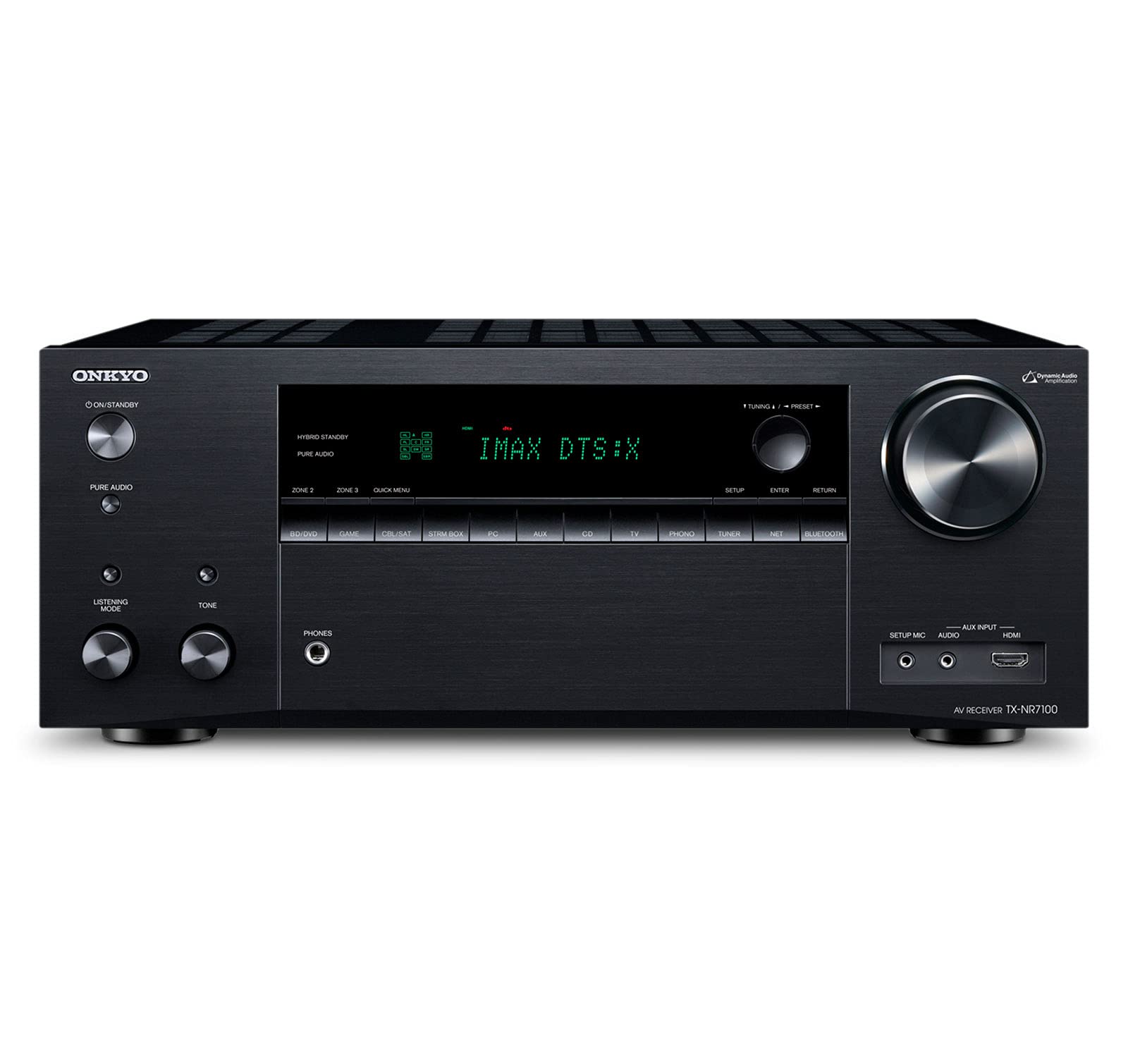
The Onkyo TX-NR7100 brings Dirac Live room correction to a more accessible price point than the flagship TX-RZ50. With 100 watts per channel across nine channels, it can handle a 5.1.4 or 7.1.2 Atmos configuration, and THX certification guarantees reference-level, low-distortion performance. The inclusion of Dirac Live at this price is remarkable — it allows you to dramatically improve the sound of your system by precisely measuring and correcting for room acoustics.
HDMI 2.1 with 8K/60Hz and 4K/120Hz passthrough, VRR, ALLM, and QFT are all supported, making it perfect for high-end gaming. The receiver also features bi-directional Bluetooth, allowing you to stream audio to the receiver or transmit the receiver’s audio to Bluetooth headphones — a rare and useful feature. Works with Sonos certification, Chromecast built-in, AirPlay 2, and DTS Play-Fi provide extensive streaming options.
Setup can be initially challenging — the 200-page manual is a clue. Some early units shipped with HDMI glitches (crackling/static) and Wi-Fi issues, though these seem to be isolated cases. The remote is not backlit. When fully dialed in, the TX-NR7100 delivers warm, dynamic, and precise sound. For buyers who prioritize room correction fidelity over maximum channel count, this is arguably the best value in the Onkyo lineup and a strong competitor to the Denon AVR-X series.
Why it’s great
- Includes Dirac Live room correction at a mid-range price point.
- THX Certified with 9 channels of amplification and HDMI 2.1.
- Bi-directional Bluetooth for private listening via headphones.
Good to know
- Some units may have required warranty service for HDMI/Wi-Fi issues.
- Setup is complex and the remote lacks a backlight.
8. Yamaha RX-V6A

The Yamaha RX-V6A is a well-rounded 7.2-channel receiver that delivers excellent value for those wanting to step into the MusicCast ecosystem. It offers 100 watts per channel and supports Dolby Atmos and DTS:X, with Dolby Atmos Height Virtualization providing immersive sound without physical height speakers. YPAO R.S.C. with multipoint measurement provides competent room correction that works well for most living rooms.
Connectivity is generous — seven HDMI inputs (three supporting 8K/60Hz and 4K/120Hz) with HDCP 2.3 and eARC, along with Wi-Fi, Bluetooth, AirPlay 2, and Spotify Connect. The RX-V6A supports voice control via Alexa and Google Assistant, and MusicCast allows multi-room audio streaming to other Yamaha devices. Video support covers Dolby Vision, HDR10+, HLG, and BT.2020, ensuring compatibility with all modern HDR formats.
Setup is relatively straightforward, though the unit may require a firmware update out of the box. Some users note that eARC does not always auto-wake with Sony TVs, requiring a manual power-on. The unit runs cooler than many competitors, and the sound signature is clean with good dialogue clarity. The RX-V6A is a solid all-arounder for Yamaha loyalists or those building a MusicCast multi-room system who need a reliable, mid-range receiver for 4K/8K video passthrough.
Why it’s great
- MusicCast for seamless whole-home audio streaming.
- Three 8K HDMI 2.1 inputs with Dolby Vision and HDR10+ support.
- Runs cooler than many comparable receivers.
Good to know
- eARC auto-switching can be temperamental with some TV brands.
- Setup complexity is moderate; not fully beginner-friendly.
9. Pioneer VSX-935
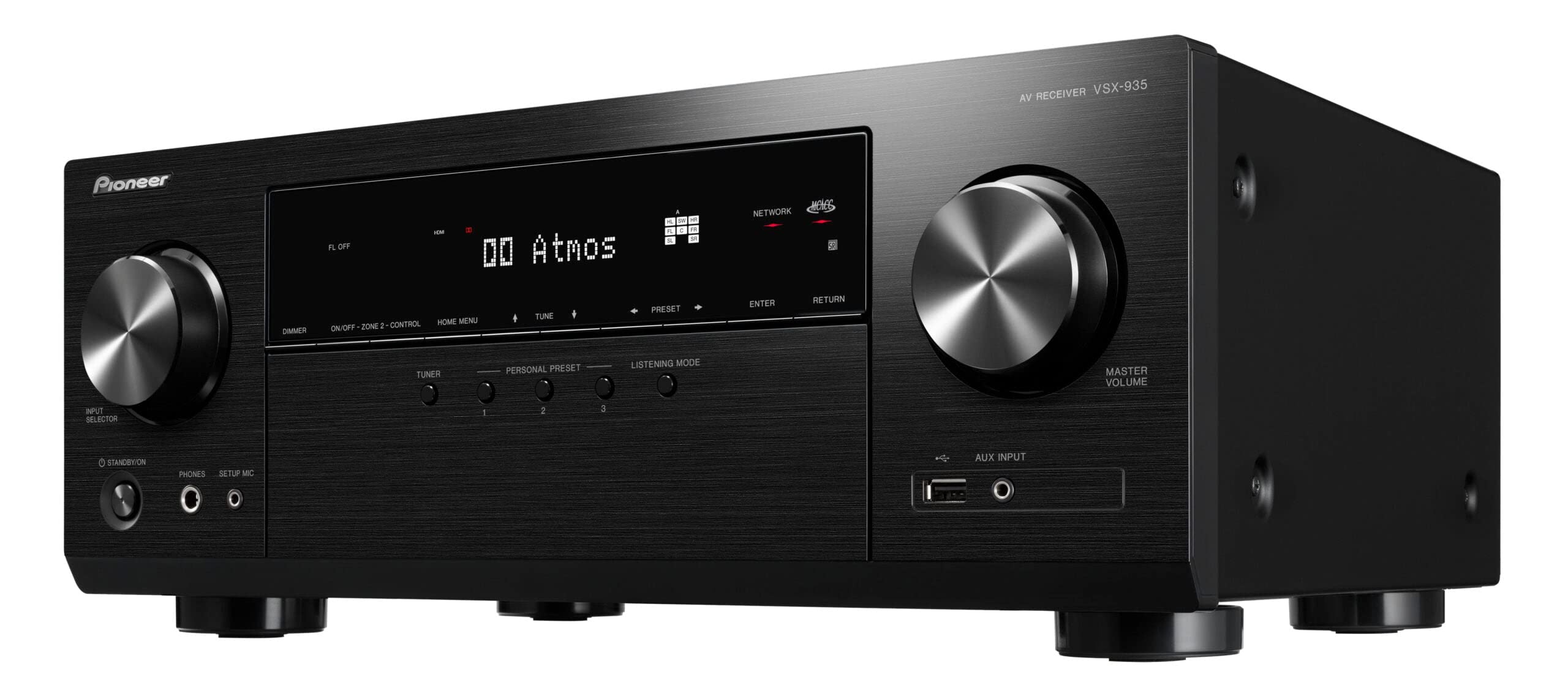
The Pioneer VSX-935 is a 7.2-channel receiver that packs HDMI 2.1 with 8K support and enhanced gaming features (VRR, ALLM, QFT) at a competitive price point. It delivers 80 watts per channel and supports Dolby Atmos and DTS:X, with Dolby Atmos Height Virtualization for simulating overhead effects. The RF remote is a nice touch for users who want control without line-of-sight.
Dual zone output allows you to power speakers in a second room, and the network connectivity covers AirPlay 2, Chromecast built-in, Spotify Connect, and TIDAL. The on-screen setup assistant is functional, though the auto-calibration is basic; manual setup yields significantly better results. Once dialed in, the sound is crisp, clear, and loud, with a gradual volume curve that ramps up to 50 then accelerates.
Reliability can be a concern — some users report DOA units or HDMI video issues with computers. The firmware update process uses USB only, which can be finicky. For buyers who prioritize gaming features (HDMI 2.1 with VRR) and want a decent 7.2-channel foundation, the VSX-935 offers good value. Those seeking higher reliability and polished room correction may want to look at the Denon S970H instead.
Why it’s great
- HDMI 2.1 with 8K support and full gaming feature set (VRR, ALLM).
- RF remote provides control without line-of-sight.
- Dual zone audio output for a second room.
Good to know
- Some units suffer from DOA and HDMI reliability issues.
- Firmware updates require USB only; basic room correction.
10. Denon AVR-S670H

The Denon AVR-S670H is the most affordable entry point into modern 4K/8K home theater, offering 75 watts per channel across five channels and 8K/60Hz passthrough on one of its HDMI inputs. Despite its budget positioning, it includes a phono input for turntables, Audyssey MultEQ room correction, and support for Dolby TrueHD, DTS HD Master Audio, and Dolby Pro Logic II. It’s a great foundation for a basic 5.1 surround system.
HDMI ARC/eARC works seamlessly with modern TVs, and the receiver can be controlled via voice assistants (Alexa, Google Assistant, Siri). The HEOS platform allows multi-room audio streaming when paired with other HEOS devices. Setup is impressively easy — the on-screen guide walks you through speaker detection, distance calibration, and input assignment without needing to refer to the manual. Owners consistently praise the clear, reliable sound and straightforward operation.
Channel count is limited to 5.2 — there is no way to add height speakers for Dolby Atmos without upgrading to a 7-channel model. The plastic chassis feels less substantial than higher-tier Denons. If your goal is a simple, no-fuss 5.1 system for a dedicated media room or a second living space, the AVR-S670H delivers excellent value. For Atmos or larger rooms, budget for the AVR-S970H or higher.
Why it’s great
- Phono input and Audyssey MultEQ at an entry-level price.
- Seamless HDMI ARC/eARC integration with modern TVs.
- Very easy setup with on-screen guidance.
Good to know
- 5.2-channel only — no support for Dolby Atmos height speakers.
- Plastic chassis feels less premium than higher-tier models.
11. JBL MA310

The JBL MA310 is a budget-friendly 5.2-channel receiver designed for simplicity and compactness. Its shallow chassis fits into media consoles that can’t accommodate deeper receivers, and the 60 watts per channel is sufficient for moderately efficient speakers in a small room. It supports Dolby and DTS 5.1 decoding over its four HDMI inputs (with ARC), and Bluetooth 5.1 + LE allows wireless music streaming from any device.
The sound is surprisingly good for the price — reviews note it drives in-wall and bookshelf speakers cleanly, producing impressive quality for a system under a modest total budget. Setup is straightforward via the TV interface, though the initial firmware update can be unresponsive until completed. The receiver defaults to a 20-minute auto shut-off, which must be changed in settings if you want it to stay on.
The remote is not backlit, and some owners find the faceplate’s LED glow distracting in the dark. The MA310 does not downmix DTS-HD Master Audio to 2.1, so owners of 2.1-channel systems playing Blu-ray discs will only get the core DTS track. For users building a simple 5.1 system around a TV setup, gaming console, and streaming stick — and who don’t plan to expand to Atmos — the JBL MA310 delivers the most affordable path to surround sound with a solid, well-known brand name.
Why it’s great
- Shallow depth design fits tight media consoles and racks.
- Bluetooth 5.1 + LE for reliable wireless audio streaming.
- Affordable entry into 5.1 surround sound from a trusted brand.
Good to know
- Does not downmix DTS-HD Master Audio to 2.1 systems.
- Remote is not backlit; auto shut-off needs manual disabling.
FAQ
What is the minimum HDMI version I need for 4K/120Hz gaming?
Can I add height speakers for Dolby Atmos to a 5.2 or 7.2 receiver?
Does room correction like Dirac Live or Audyssey really matter for sound quality?
How many amplified channels do I need for a 5.1.4 setup?
What is eARC and why is it important?
Final Thoughts: The Verdict
For most users, the av receiver 4k winner is the Denon AVR-S970H because it delivers the right balance of power (90W x 7), modern HDMI 2.1 connectivity with three 8K inputs, effective Audyssey room correction, and a phono input — all at a mid-range price that doesn’t compromise on future-proofing. If you want professional-grade room correction and the ability to build a full 5.1.4 Atmos system, the Onkyo TX-RZ50 is the clear choice. And for a simple 5.1 system where budget is the primary concern, nothing beats the Denon AVR-S670H for reliable, clean surround sound with an easy setup.

Mo Maruf
I created WellFizz to bridge the gap between vague wellness advice and actionable solutions. My mission is simple: to decode the research and give you practical tools you can actually use.
Beyond the data, I am a passionate traveler. I believe that stepping away from the screen to explore new environments is essential for mental clarity and physical vitality.