Our readers keep the lights on and my smoothie glass nicely filled. As an Amazon Associate, I earn from qualifying purchases.
Managing medications for a loved one with Alzheimer’s is a profound responsibility, where a simple mistake can have serious consequences. The right dispenser isn’t just about convenience; it’s a critical tool for safety, independence, and profound peace of mind.
I’m Mohammad Maruf — the founder and writer behind WellFizz. My research focuses on analyzing product specifications, user feedback, and safety features to identify which solutions genuinely address the complex needs of cognitive decline, separating true innovations from marketing claims.
This guide is built on a detailed examination of over a dozen devices, their mechanisms, and real-world caregiver reports to help you make a confident, informed choice for a safer daily routine. The right automatic pill dispenser for alzheimer’s patients creates a crucial safety barrier against missed or double doses.
How To Choose The Best Automatic Pill Dispenser For Alzheimer’S Patients
Selecting a device for someone with memory impairment requires moving beyond basic convenience. The core goal is to create a fail-safe system that compensates for cognitive loss. A basic weekly organizer may suffice for very early stages, but as confusion progresses, a system with enforced timing and access becomes essential to prevent dangerous errors.
Safety and Access Control is Paramount
For Alzheimer’s patients, the ability to access pills outside of scheduled times poses the greatest risk. Look for dispensers with a physical locking mechanism, often with a key, that only a caregiver can open. This prevents double-dosing or taking another person’s medication. Some premium models add biometric locks or smart app controls for an added layer of security and remote oversight.
Alarm and Reminder Effectiveness
The reminder must cut through distraction and sensory decline. A combination of loud, persistent audible alarms, bright flashing lights, and clear voice prompts is most effective. Consider if the alarm resets only when the medication is physically removed, ensuring the action is completed. For those hard of hearing, strong visual cues are critical.
Capacity and Refill Complexity
More capacity means fewer refills, reducing caregiver burden. A 28-day or monthly system is ideal, but ensure the refill process is logical and not overly fiddly. Devices with removable carousels or trays are easier to fill at a table than those you must load in-place. Also, verify compartment size can accommodate larger pills or multiple medications per dose.
Ease of Use for the Patient
The final step—the patient retrieving their dose—must be simple. Look for one-touch or one-button dispensing that doesn’t require fine motor skills, pinching, or pulling small latches. A design that deposits pills into a catch cup is safer and easier than trying to pour them directly into a hand.
Quick Comparison
On smaller screens, swipe sideways to see the full table.
| Model | Type | Best For | Key Feature | Amazon |
|---|---|---|---|---|
| Live Fine 28-Day (Upgraded) | Automatic | Long-term safety & multiple daily doses | 9 dosage templates, loud alert, locking lid | Amazon |
| Medcenter Monthly System | Organizer + Alarm | Caregiver-managed monthly system | Talking clock, 31 daily 4-compartment boxes | Amazon |
| Daviky Pill Dispenser Daily | Manual Dispenser | Arthritis-friendly, easy dispensing | 14-day push-button “Ferris wheel” design | Amazon |
| Live Fine Automatic Dispenser | Automatic | Basic automatic dispensing with lock | 28-day, 6 dosage rings, sound & light alerts | Amazon |
| Colorwing Smart Dispenser | Smart Automatic | High-tech oversight & access control | Fingerprint & key lock, Bluetooth app, voice | Amazon |
| MEDCENTER Talking Alarm Clock | Reminder Clock | Audible verbal reminders | Friendly voice announces time/date for 4 doses | Amazon |
| Pill Dispenser with Alarm (Blue) | Alarm Organizer | Visual dose display with alarms | Shows pill data on LCD when lid opens | Amazon |
| TabTime Pill Reminder | Portable Alarm | Simple multi-alarm timer | 8 independent alarms, compact, multiple backs | Amazon |
| EZY DOSE (Removable Trays) | Manual Organizer | Easy-open, portable weekly organizer | Push-button lids, removable AM/PM trays | Amazon |
| EZY DOSE Push Button (Rainbow) | Manual Organizer | Entry-level weekly pill sorting | Arthritis-friendly push buttons, color-coded | Amazon |
| Colorwing 31-Slot (Alternate) | Smart Automatic | Tech-enabled monthly management | Similar to model 10, with app and dual lock | Amazon |
In‑Depth Reviews
1. Live Fine 28-Day Automatic Pill Dispenser (Upgraded)

This upgraded Live Fine model represents the sweet spot for families managing Alzheimer’s or dementia medication. It combines robust safety features—a key-locked lid to prevent unauthorized access—with exceptional flexibility, offering nine different interchangeable dosage rings. This means you can program it for complex schedules from once daily up to nine times a day, making it adaptable as care needs evolve.
The alert system is designed for effectiveness, with three volume settings and three beep patterns, plus a bright LCD that illuminates. Crucially, the alarm continues for 30 minutes until the user inverts the unit to dispense the pills, creating a direct link between the reminder and the required action. The large, clear compartments can hold multiple pills, and the transparent lid allows for a quick visual check without unlocking.
While setup requires a caregiver’s attention, the process is logical. The upgraded display is significantly easier to read than older models. User reports highlight its reliability in ensuring doses are taken correctly, providing immense relief to caregivers who cannot be present 24/7. Its balance of security, capacity, and customizable alerts makes it our top recommendation for most situations.
Why it’s great
- Superior safety with a key-locked lid to prevent double-dosing.
- Highly flexible with nine pre-set dosage templates for complex schedules.
- Persistent 30-minute alarm ensures the task is completed.
- Large, bright LCD screen is easy for caregivers to read and configure.
Good to know
- Loading the carousel requires careful setup by a caregiver.
- Some very large or oddly shaped pills may occasionally get stuck.
- Relies on AA batteries, which need periodic replacement.
2. Medcenter Monthly Pill Organizer System

The Medcenter Monthly System is a comprehensive, non-electronic solution centered around a talking alarm clock and a 31-day supply of individual pill boxes. It’s engineered for clarity: each small box holds four doses (morning, noon, evening, night) and is labeled with a date, not a day of the week, reducing confusion for those unsure of what day it is. The standalone talking clock provides friendly voice reminders up to four times daily, announcing the date and which dose to take.
This system excels in scenarios where a caregiver fills all medications once a month. The patient simply takes the day’s box out of the tower and places it next to the clock. When the alarm sounds, they open the appropriate compartment. The visual cue of the red/green ends on the boxes (green for upcoming, red for taken) adds another layer of clarity. It shifts the cognitive load from the patient to the system and the caregiver during the monthly refill.
It’s important to note this is not a locked dispenser; it’s a highly organized reminder system. It’s ideal for patients who can follow the verbal prompt and open the correct compartment but should not be used if there’s a risk of the patient opening multiple compartments at once. The separate components also make it portable for travel or moving around the house.
Why it’s great
- Eliminates weekly refills with a full month of pre-sorted medications.
- Talking clock provides clear, verbal instructions that reduce anxiety.
- Date-based system (vs. day-of-week) is less confusing for cognitive impairment.
- Visual red/green system offers an immediate status check.
Good to know
- Does not have a locking mechanism to prevent access to future doses.
- The individual box lids can be snug and challenging for severe arthritis.
- Monthly refill process is time-consuming and requires a dedicated space.
3. Daviky Pill Dispenser Daily
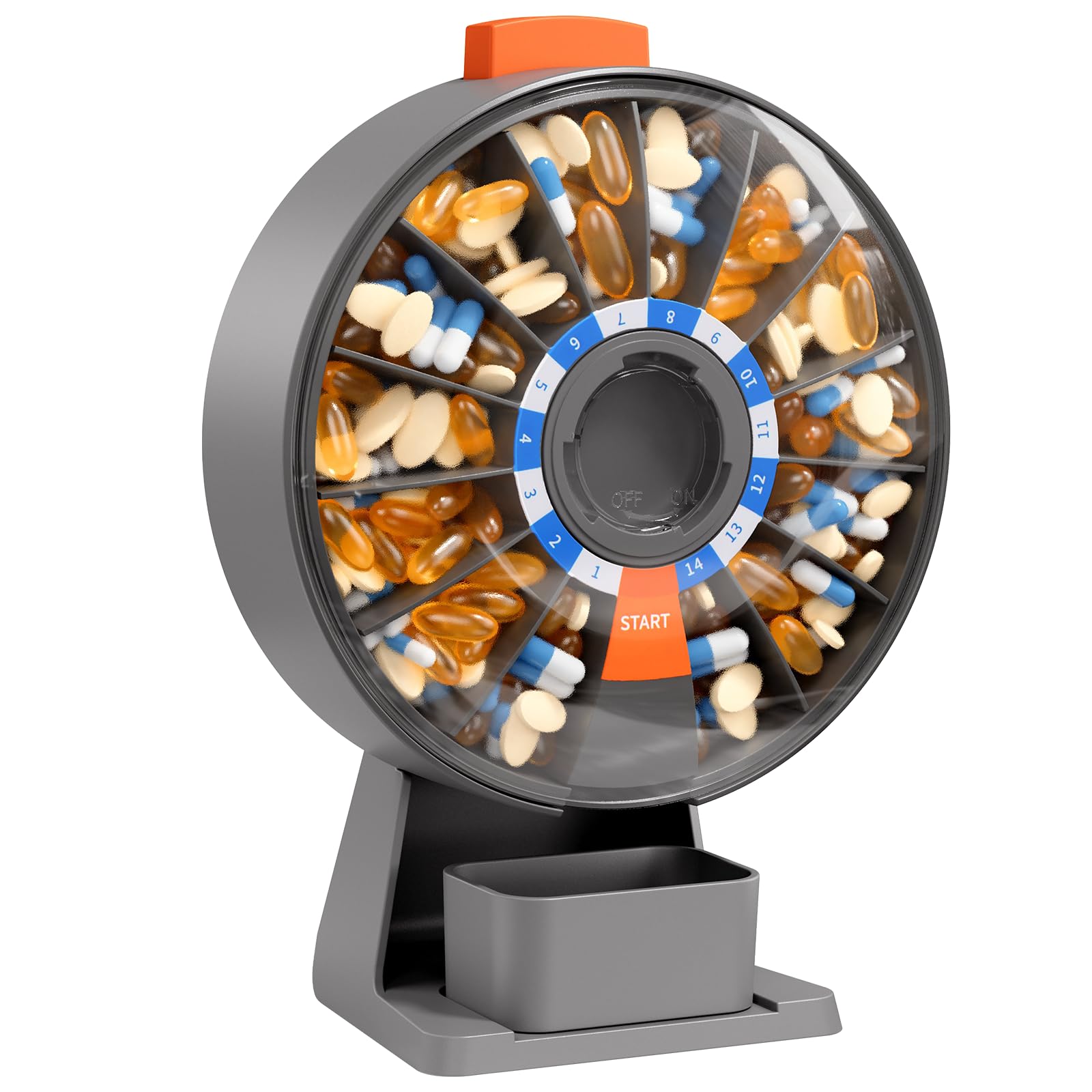
The Daviky dispenser uses a clever and satisfying “Ferris wheel” design that makes accessing pills remarkably easy. With a simple press of a large, orange button, the rotating carousel advances and deposits the day’s pills into a built-in catch cup. This one-action process is ideal for users with arthritis, limited dexterity, or who are easily frustrated by small latches or lids.
It holds a two-week supply, striking a good balance between reducing refill frequency and keeping the device a manageable size. The wheel is easy to remove from the base for filling, and it comes with multiple sticker kits so you can label it for AM/PM dosing, days of the week, or simple numbers. The clear cover lets you see the pills inside, and the whole unit feels stable and well-constructed.
It’s crucial to understand this is a manual dispenser—it does not have alarms or locks. Its strength is in simplifying the physical act of getting the correct dose. It’s an excellent choice for early-stage memory loss where the main challenge is physical dexterity or mild forgetfulness, but a caregiver is still managing the weekly refill. It brings joy and independence to the daily routine without electronic complexity.
Why it’s great
- Extremely simple, one-button operation perfect for stiff or weak hands.
- Two-week capacity reduces refill chores compared to weekly organizers.
- Stable base and catch cup prevent spills and mess.
- Multiple labeling options provide customization for different schedules.
Good to know
- No alarms, reminders, or locking mechanism for safety.
- Not suitable if there is a risk of pressing the button multiple times.
- Wall-mount option is for the wheel only, not the entire unit with cup.
4. Live Fine Automatic Pill Dispenser

This is the earlier version of our top pick and serves as a superb entry point into locked, automatic dispensers. It offers the core safety features needed for Alzheimer’s care: a key-locked lid, a 28-day rotating carousel with six different dosage templates, and audible/visual alerts that won’t stop until the unit is turned upside down to dispense the pills. This action-based alarm shutoff is a critical safety design.
The setup is straightforward with a three-button interface, and the removable carousel makes loading relatively simple. The compartments are generous, and the transparent lid allows for a visual inventory. For caregivers seeking a reliable, no-frills automatic system that prevents access to future doses and ensures reminders are acted upon, this model delivers exceptional foundational value.
Differences from the upgraded model include a smaller, less bright display and fewer alert customization options (volume and beep patterns are fixed). Some users have noted the locking mechanism can feel a bit flimsy over time. However, its performance in creating a timed, locked barrier between the patient and their medication is proven and effective, offering significant peace of mind at a more accessible point.
Why it’s great
- Provides essential safety with a locking lid and timed, persistent alarms.
- Excellent one-month capacity minimizes caregiver refill tasks.
- Alarm only stops when medication is dispensed, enforcing compliance.
- Removable carousel simplifies the loading process.
Good to know
- Display is smaller and less customizable than the upgraded model.
- The physical lock and key mechanism may feel less durable over years of use.
- Alert sound and pattern are not adjustable, which may be less ideal for some environments.
5. Colorwing Smart Pill Dispenser
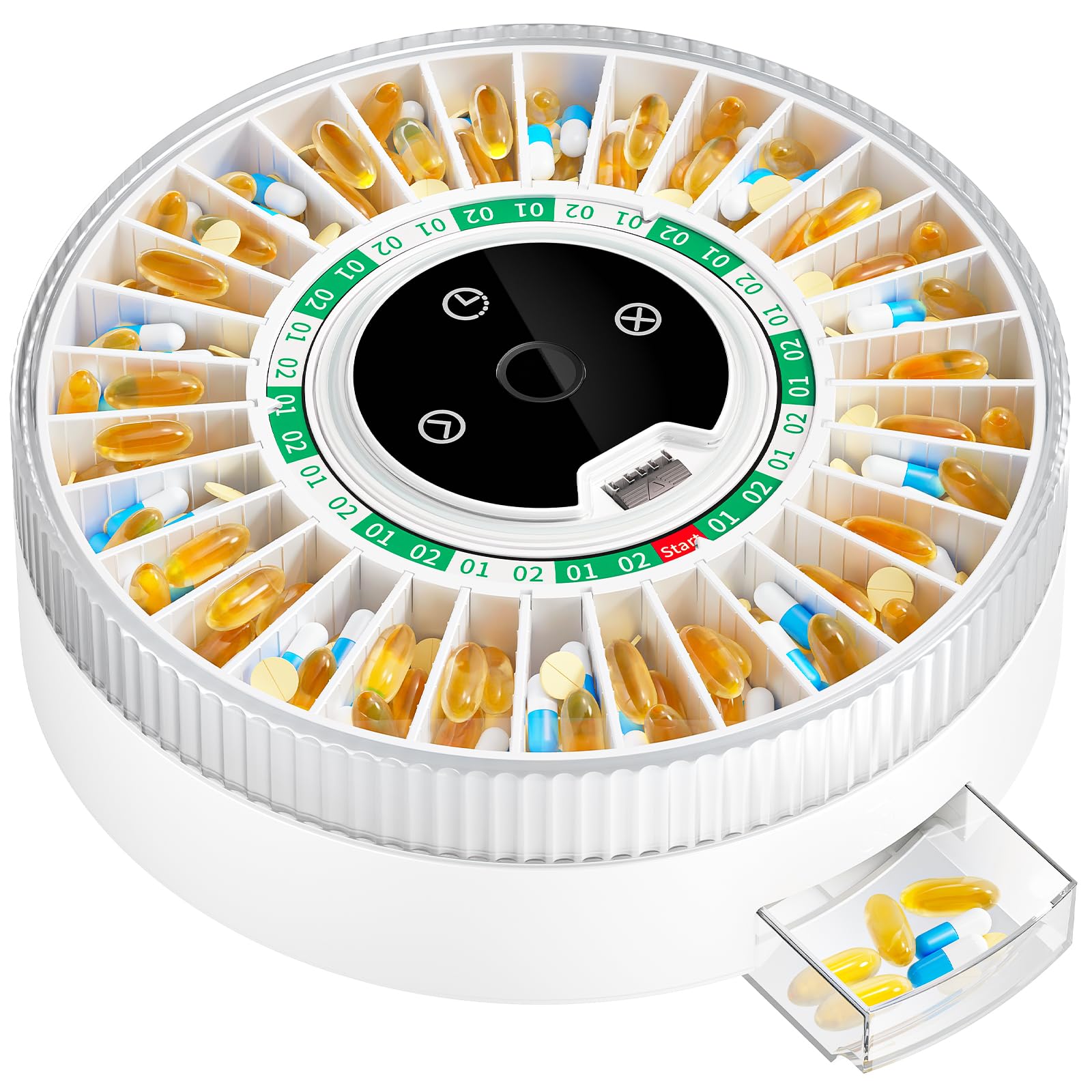
The Colorwing represents the cutting edge of medication management technology, designed for caregivers who want maximum oversight and control. Its standout feature is a dual-lock system: a fingerprint scanner to block impulsive access, backed by a physical key. This is paired with a Bluetooth-connected app that allows remote setup, dose tracking, and notifications sent to a caregiver’s phone when a dose is taken or missed.
Additional high-tech touches include the ability to record a custom voice reminder (e.g., “Mom, it’s time for your heart pill”) and a rechargeable battery that lasts about a month. The 31-slot carousel can be configured for complex schedules, and the device dispenses pills into a drawer with a one-touch release. It’s built for the scenario where a family caregiver lives separately but needs to monitor adherence closely.
This level of technology comes with complexity. Setup is app-dependent and can be challenging. The mechanism for dispensing pills has been reported by some users to be finicky, with pills occasionally sticking or the drawer not aligning perfectly. It’s a powerful tool for tech-savvy families managing a patient who may be prone to attempting to access medication but requires a committed caregiver to manage the digital interface.
Why it’s great
- Unparalleled access control with fingerprint and key lock.
- Remote monitoring via smartphone app provides real-time peace of mind.
- Custom voice reminders can be more recognizable and calming.
- Rechargeable battery eliminates the hunt for AAs.
Good to know
- Setup and troubleshooting are reliant on a smartphone app and can be complex.
- Some users report mechanical reliability issues with the dispensing mechanism.
- Premium tech features come at a higher cost point.
6. MEDCENTER Talking Alarm Clock

This dedicated talking clock solves one problem exceptionally well: delivering clear, verbal prompts. Unlike a beep or buzz that can be ignored or misunderstood, it uses a friendly female voice to say, “Good morning! Please take your MORNING pills for the 20th.” It announces the time and date, reinforcing temporal orientation, which is often lost in dementia. It can be set for up to four reminders per day.
The voice alert is loud and has an “extra loud” setting, making it suitable for those with hearing challenges. A large red “Alarm Acknowledged” button is easy to see and press. When pressed, it verbally confirms and tells you when the next alarm is due. It’s a simple, standalone device that doesn’t require pairing with a specific pillbox; it can remind someone to take medication from any organizer.
It’s important to pair this with a secure pillbox, as the clock itself does not store or dispense medication. It’s an ideal companion to the Medcenter Monthly System or a locked drawer where a caregiver has placed the day’s pills. For patients who respond better to a human voice than a generic beep, this can significantly improve adherence and reduce caregiver nagging, which can often cause friction.
Why it’s great
- Clear, verbal instructions reduce confusion and are harder to ignore than a beep.
- Reinforces date and time awareness, which supports cognitive function.
- Extremely loud settings are effective for the hearing impaired.
- Simple, battery-powered operation with no complex apps or wires.
Good to know
- Is only a reminder clock; does not include any medication storage or locking.
- Setting the clock and alarms can be confusing without the paper instructions.
- The voice cannot be customized or changed to a family member’s voice.
7. Pill Dispenser with Alarm (Blue)

This compact electronic pillbox bridges the gap between a basic organizer and a full automatic dispenser. Its unique feature is an LCD screen that can display custom “pill data” you program for each alarm. For example, when the 9 AM alarm beeps and vibrates, you open the lid, and the screen might flash “B2, C1” indicating you should take pills from compartments B and C. This is helpful for complex regimens with multiple pills at different times.
It holds up to a week’s worth of pills across six compartments (dividers are removable to create fewer, larger compartments). The alarm is persistent, beeping every five minutes for 30 minutes if not addressed. It’s a good option for someone with mild cognitive impairment who can still follow a simple screen prompt and open the correct lid, and for caregivers who want to leave precise visual instructions.
The limitations are notable: it does not have a locking mechanism, so a determined individual could open all compartments. The programming interface, while powerful, is not intuitive and can be frustrating to set up. It’s best suited for a cooperative patient who needs structured reminders and visual guidance but does not pose a safety risk to themselves by accessing extra medication.
Why it’s great
- LCD screen provides specific visual instructions for which compartments to use.
- Flexible interior can be configured from 3 to 6 compartments.
- Persistent alarm repeats for 30 minutes to ensure it’s noticed.
- Compact size is relatively portable for daily carry.
Good to know
- No locking mechanism to prevent access to all pills.
- Programming the alarms and pill data is complex and poorly documented.
- The lid must be opened to stop the alarm, which could be forgotten after silencing.
8. TabTime Pill Reminder
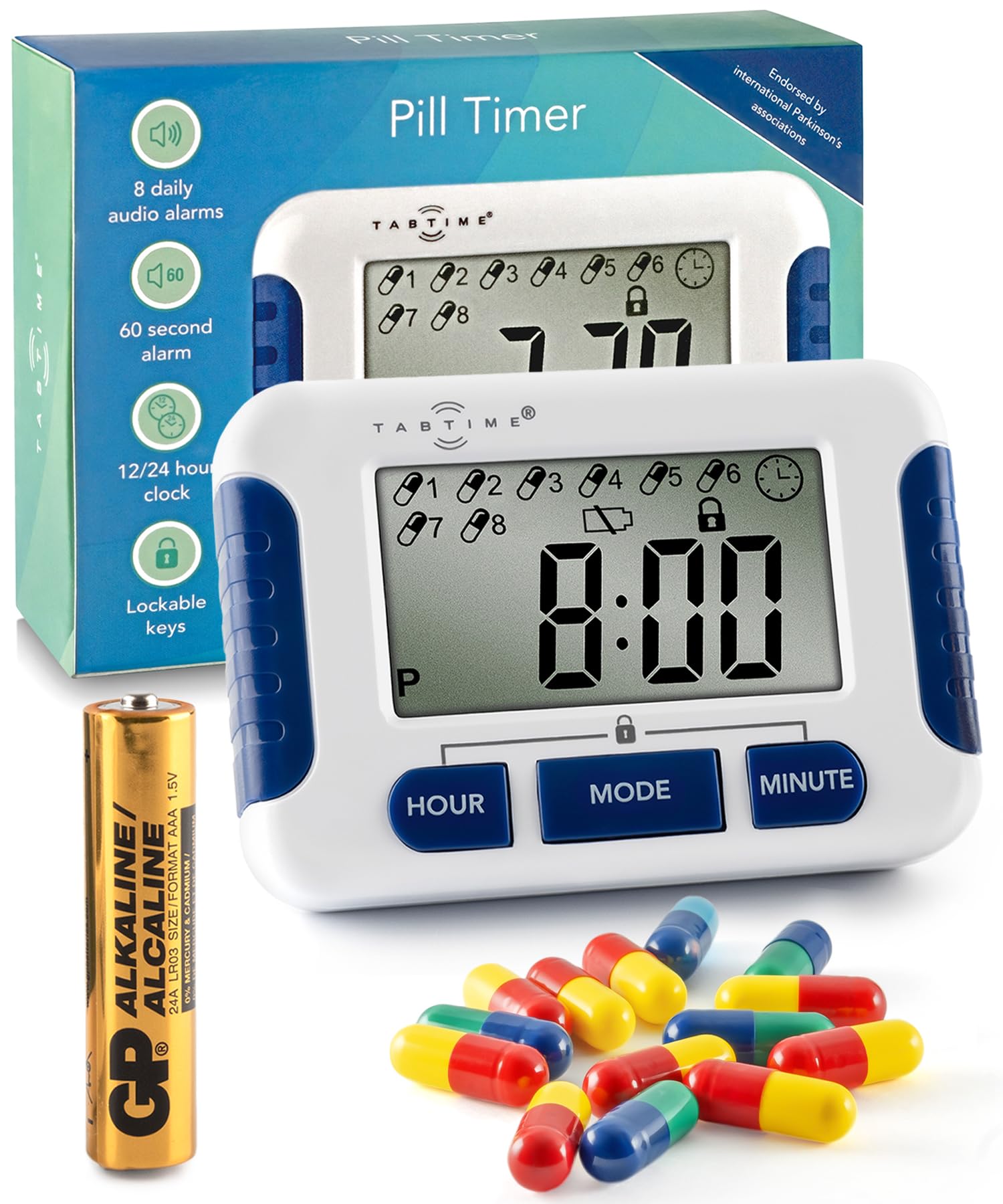
The TabTime is a straightforward, dedicated electronic timer. Its sole job is to beep at up to eight pre-set times throughout the day. It’s pocket-sized and includes a fold-out stand, a magnetic back, and a loop for hanging, making it easy to keep close by. For individuals in the early stages of memory loss who simply forget the time or get distracted, this discrete, persistent beep can be enough to trigger the memory to take pills from a separate container.
It’s incredibly simple in concept: set it and forget it. The alarms will repeat daily until the battery dies. The large display shows the current time when not alarming. It’s an excellent, low-cost tool to support medication independence for those who are otherwise organized and have their pills in a simple weekly box but need a nudge for timing.
Its critical limitation is that it has no connection to the medication itself. It doesn’t know if the pills were taken, only that it beeped. It should never be relied upon for patients who may double-dose or who have progressed beyond simple forgetfulness. However, as a first-line, non-intrusive reminder aid, it has helped many maintain their routine with minimal fuss.
Why it’s great
- Extremely portable with multiple ways to carry or place it (magnet, stand, loop).
- Up to 8 daily alarms cover even the most complex medication schedules.
- Set-it-and-forget-it operation; alarms repeat daily automatically.
- Discreet and less stigmatizing than a large, medical-looking device.
Good to know
- Merely a timer; provides no medication storage, dispensing, or safety locks.
- Buttons can be tricky to program, and the interface is not intuitive.
- Alarm sound is a generic beep, which may be ignored or not heard.
9. EZY DOSE Push Button (Removable Trays)

This EZY DOSE model improves upon the classic weekly organizer with two key features: easy push-button opening and fully removable daily trays. The push-button mechanism requires minimal force, making it accessible for those with arthritis. The black (PM) and white (AM) lids provide clear visualcues, and each AM/PM tray snaps out completely, allowing your loved one to take just that day’s doses to the table or on a short trip.
The large compartments can hold numerous pills, and the snap-out feature adds a layer of flexibility not found in fixed organizers. It’s a thoughtful upgrade for someone who manages their own weekly refill but struggles with traditional flip-top lids or needs to separate their doses throughout the day. The stability and clear labeling support independence.
As with all manual organizers, this offers no reminders or security against double-dosing. It’s best suited for the earliest stages of memory loss, where the primary challenges are physical dexterity and organization rather than cognitive confusion about whether a dose was taken. It’s a high-quality, user-friendly tool for that specific need.
Why it’s great
- Removable trays offer unmatched flexibility for daily portability.
- Push-button opening requires minimal strength and dexterity.
- High-contrast black/white lids make AM/PM differentiation instant.
- Large compartments accommodate big vitamins and multiple medications.
Good to know
- No alarms, locks, or reminders are included.
- The hinge mechanism for the lids may have a finite lifespan with heavy use.
- Not suitable if there is any risk of taking pills from the wrong day.
10. EZY DOSE Push Button (Rainbow)
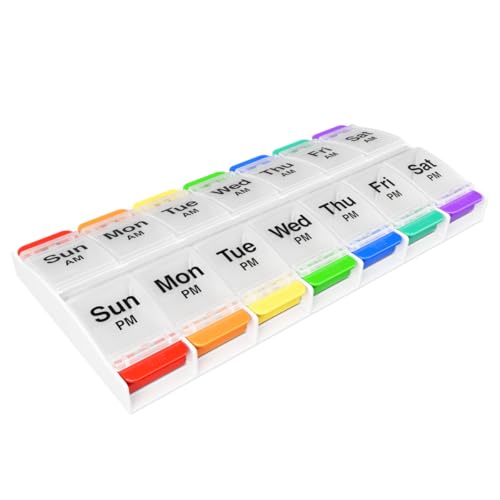
This is the most entry-level option in our guide, a simple 7-day AM/PM organizer with a helpful push-button opening mechanism. It’s an excellent, low-cost tool for individuals or caregivers in the very initial phase of needing medication organization, where the main goal is sorting pills for the week ahead. The rainbow color-coding by day and large, easy-to-read labels aid in visual identification.
The push-button design is its standout feature, earning an Arthritis Foundation commendation. It requires a simple press to pop the lid open, which is significantly easier than prying up a traditional flip-top. The contoured bottom of each compartment also helps in scooping out the last pill. For someone with mild forgetfulness or arthritis who is still reliably managing their own medication, this can bring welcome ease.
It is crucial to understand its severe limitations for Alzheimer’s care: it has no alarms, no locks, and all pills for the week are immediately accessible. It should only be considered for situations where there is absolutely no risk of the patient confusing days, taking extra doses, or where a caregiver is directly supervising each dose. Its value is purely in physical organization and ease of access.
Why it’s great
- Extremely affordable entry point for basic pill sorting.
- Arthritis-friendly push-button lids are genuinely easy to use.
- Bright, color-coded days and large text support visual clarity.
- Extra-large compartments fit many pills or large supplements.
Good to know
- Offers zero protection against missed or double doses.
- All medication for the week is accessible at once, posing a safety risk.
- The orientation of the days can be confusing when using the box.
11. Colorwing 31-Slot Smart Dispenser (Alternate)

This model is functionally identical to the Colorwing Smart Dispenser reviewed earlier, offered as an alternate purchase option. It features the same advanced tech suite: a fingerprint and mechanical key dual-lock system, Bluetooth connectivity for remote caregiver monitoring via a smartphone app, custom voice reminders, and a 31-slot carousel for monthly management.
All the same powerful benefits and caveats apply. It represents the high-tech frontier of medication management, designed for families who need remote oversight and the highest level of access control. The ability to receive notifications when a dose is taken or missed provides unparalleled peace of mind for long-distance caregivers.
As with its counterpart, this sophistication demands a tech-comfortable caregiver for setup and troubleshooting. The mechanical complexity also means it may be less forgiving than simpler automatic dispensers if not operated precisely. It remains a compelling choice for those who need its specific set of connected, high-security features and are prepared to manage the learning curve.
Why it’s great
- Provides remote oversight and alerts via smartphone app.
- Strong dual-layer security with fingerprint and key lock.
- Customizable voice prompts can be more engaging.
- Full month capacity in a relatively compact unit.
Good to know
- Setup is entirely app-dependent and can be challenging.
- Potential for mechanical hiccups with the dispensing mechanism.
- Premium features come with a corresponding cost.
Understanding the Specs
Lock Type
This is the most critical spec for safety. A key lock is the standard, requiring physical access by a caregiver. A dual lock (e.g., fingerprint + key) adds a high-tech barrier against impulsive access. Devices without any lock are not suitable for unsupervised Alzheimer’s patients past the earliest stages.
Alert System
Look for a persistent, action-triggered alarm that only stops when the pill is dispensed (e.g., by inverting the unit). Voice alerts are clearer than beeps for some. Bright flashing lights are essential for the hearing impaired. The best systems use multiple modes (sound, light, voice) simultaneously.
Capacity & Compartments
28-day or 31-day capacity drastically reduces refill work. The number of compartments per day (1 to 4+) must match dosing frequency. Interchangeable dosage rings allow you to change the schedule (e.g., from 2x/day to 4x/day) without buying a new device.
Power Source
Battery-powered (AA/AAA) units are portable but need monitoring. Rechargeable batteries are more eco-friendly and convenient. A few models offer a DC power adapter option for stationary use. Consider battery life claims and how easy it is to replace them.
FAQ
What is the most important feature for an Alzheimer’s patient?
Can these dispensers handle large pills or many pills per dose?
Who should refill the dispenser?
Are these devices covered by HSA or FSA funds?
Final Thoughts: The Verdict
For most people, the automatic pill dispenser for alzheimer’s patients winner is the Live Fine 28-Day (Upgraded) because it delivers the perfect balance of enforced safety, flexible scheduling, and reliable alerts at a mid-range point. If you want a comprehensive, caregiver-managed monthly system with clear verbal prompts, grab the Medcenter Monthly System. And for cutting-edge remote oversight and biometric security, nothing beats the Colorwing Smart Dispenser.

Mo Maruf
I created WellFizz to bridge the gap between vague wellness advice and actionable solutions. My mission is simple: to decode the research and give you practical tools you can actually use.
Beyond the data, I am a passionate traveler. I believe that stepping away from the screen to explore new environments is essential for mental clarity and physical vitality.