Our readers keep the lights on and my smoothie glass nicely filled. As an Amazon Associate, I earn from qualifying purchases.
The bottleneck in your office isn’t the printer—it’s the single-sided flatbed that turns a five-minute stack into an hour-long chore. An automatic document feeder scanner eliminates that friction, turning piles of contracts, receipts, and double-sided reports into searchable digital files without you flipping a single page.
I’m Mohammad Maruf — the founder and writer behind WellFizz. I’ve spent years analyzing production scanning hardware, focusing on feed mechanism reliability, duplex speed consistency, and software integration depth so you don’t have to guess which model can handle a mixed batch of paper stock.
This guide breaks down nine of the market’s most serious automatic document feeder scanner options, comparing their sheet capacities, scanning speeds, and connectivity to help you match a machine to your actual workload.
How To Choose The Best Automatic Document Feeder Scanner
A scanner’s value is defined by how many pages it can pull through without jamming, how fast it captures both sides, and how well its software handles the output. Focus on these three areas first.
Sheet Capacity and Duplex Speed
The ADF tray capacity determines batch size. A 30-sheet tray requires loading for any stack larger than a short report, while 100-sheet trays let you walk away. Pair this with duplex speed—measured in images per minute (ipm)—which is double the page-per-minute (ppm) rate for two-sided documents. A 30 ppm scanner that scans duplex captures 60 images per minute, making it roughly twice as productive as a simplex-only unit.
Paper Handling and Build Quality
Not all scanners handle mixed media well. If you regularly scan receipts, business cards, plastic ID cards, or long documents, look for models with a dedicated manual feed slot or adjustable paper guides. Entry-level units often rely on user separation by paper type, while mid-range and premium scanners can process a mixed stack without jamming or double-feeding.
Connectivity and Software Ecosystem
USB-only scanners are reliable and simple but require a computer nearby. Wireless models (Wi-Fi) let you scan directly to cloud storage, email, or a mobile device without a PC. A good software bundle includes OCR for searchable PDFs, document management for organization, and direct integration with services like Dropbox, Google Drive, or QuickBooks. Some premium units also offer a touchscreen for scan-to-USB operation without a computer.
Quick Comparison
On smaller screens, swipe sideways to see the full table.
| Model | Category | Best For | Key Spec | Amazon |
|---|---|---|---|---|
| Epson Workforce ES-580W | Premium | High-volume wireless office | 35 ppm duplex, 100-sheet ADF | Amazon |
| ScanSnap iX2400 | Premium | One-touch speed for heavy stacks | 45 ppm duplex, 100-sheet ADF | Amazon |
| Epson RapidReceipt RR-620W | Premium | Receipt digitizing and AI data extraction | 45 ppm duplex, 100-sheet ADF, Wi-Fi | Amazon |
| Brother ADS-3100 | Mid-Range | Work-from-home with USB simplicity | 40 ppm duplex, 60-sheet ADF | Amazon |
| ScanSnap iX1300 | Mid-Range | Compact desktop with versatile media handling | 30 ppm duplex, Wi-Fi, manual feeder | Amazon |
| Canon imageFORMULA R30 | Mid-Range | Plug-and-scan with no driver install | 25 ppm duplex, 60-sheet ADF | Amazon |
| Canon imageFORMULA DR-C225 II | Mid-Range | Reliable long-term workhorse for mixed media | 25 ppm duplex, 30-sheet ADF | Amazon |
| Doxie Pro | Budget-Friendly | Entry-level duplex with smart software | Duplex scanning, 20-sheet ADF | Amazon |
| HP Small USB HPPS100 | Budget-Friendly | Ultra-portable simplex scanning on the go | 15 ppm simplex, 10-sheet ADF | Amazon |
In‑Depth Reviews
1. Epson Workforce ES-580W
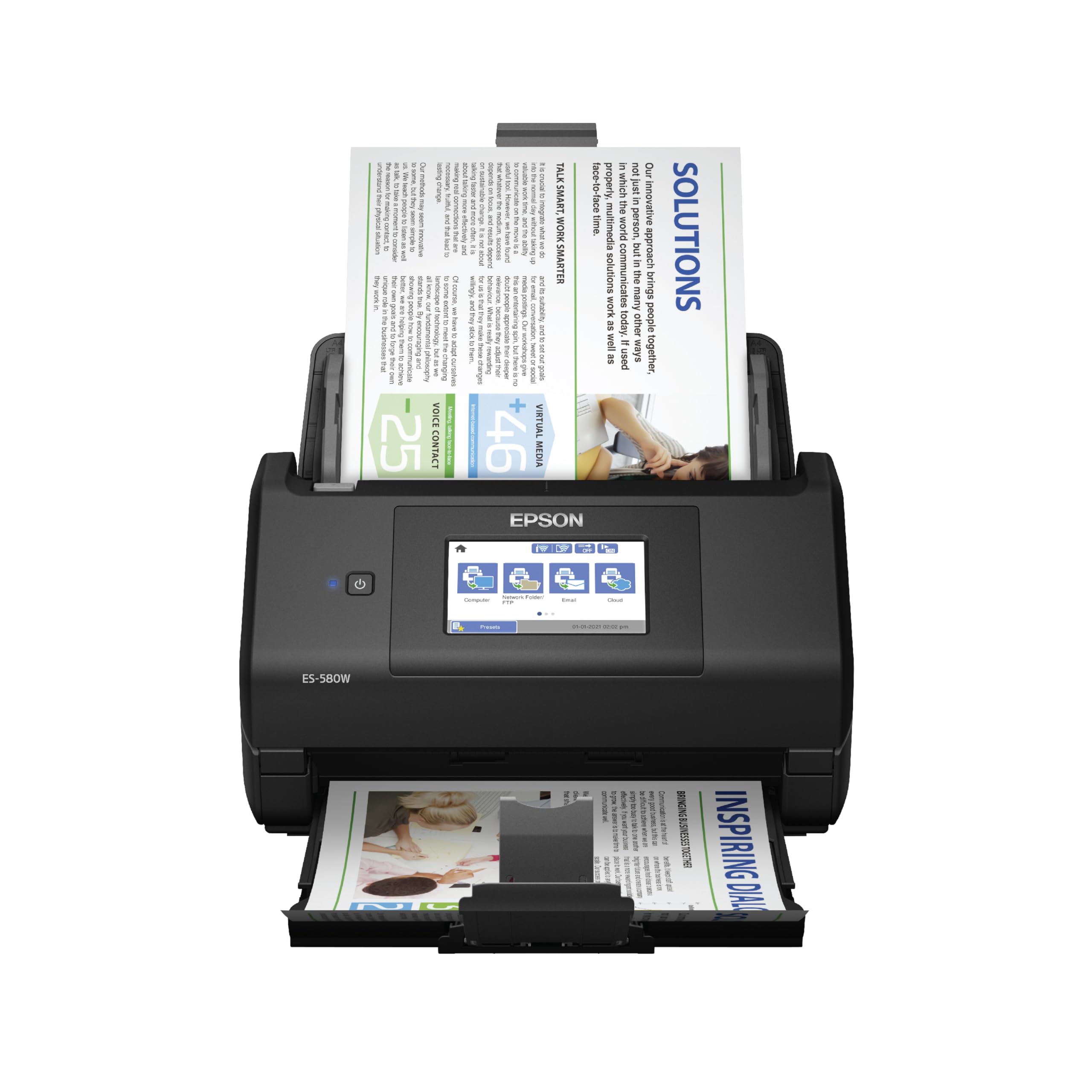
The ES-580W strikes an ideal balance between high-volume capacity and wireless convenience. Its 100-sheet ADF feeds stacks of mixed media, and the 4.3-inch color touchscreen lets you navigate scan-to-cloud, scan-to-USB, and email destinations without touching a computer. At 35 ppm duplex, it’s fast enough for a busy office workflow.
Epson’s single-step technology captures both sides in one pass, and the CCD optical sensor delivers sharper depth and color accuracy than CIS units, especially on thin or textured paper. The bundled software includes OCR for searchable PDFs and direct export to editable Word or Excel files, making document cleanup more automated.
Wireless setup is straightforward for both Windows and macOS, and the scanner supports TWAIN for legacy applications. Some users note it lacks an Ethernet port for wired networks, but the Wi-Fi performance and touchscreen control compensate well for most small-to-mid-size office layouts.
Why it’s great
- 100-sheet ADF allows long, unattended scanning sessions
- Color touchscreen for computer-free scanning to cloud or USB
- CCD sensor provides excellent image quality on varied media
Good to know
- No Ethernet LAN port for wired network integration
- A bit heavier at 8.2 lbs, less suited for frequent travel
2. ScanSnap iX2400
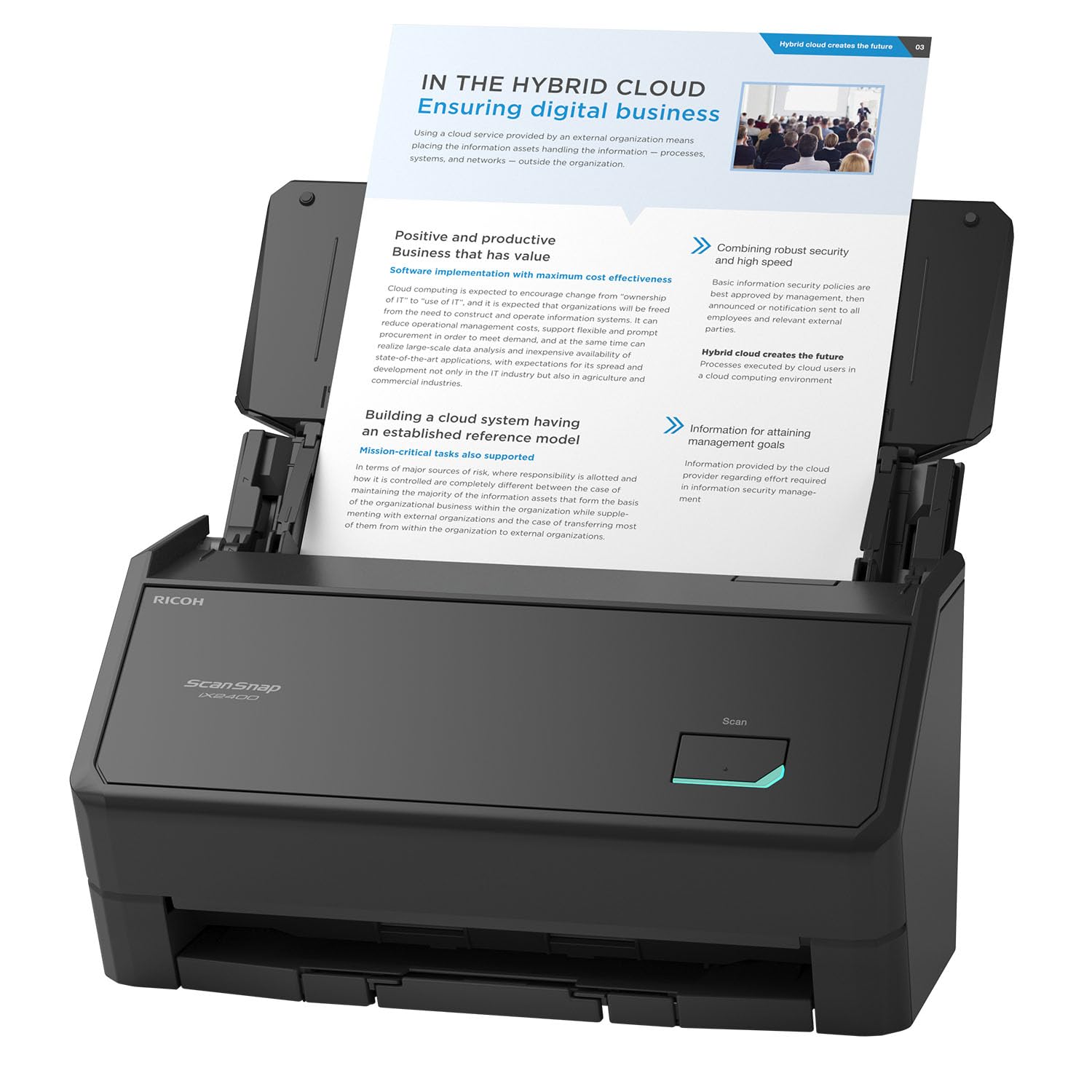
The iX2400 is the fastest unit in this lineup, churning through 45 pages per minute duplex with a 100-sheet feeder. One-touch scanning via the included button or Quick Menu software means you can drop a stack, press a single button, and walk away. The ScanSnap Home software handles auto-color detection, de-skew, and blank page removal without manual tweaking.
This model is a direct upgrade from the popular iX1400, adding a collapsible output tray and refined feed rollers that reduce jams on mixed paper stocks. It handles business cards, receipts, and even envelopes reliably. The USB-only connection ensures consistent performance without Wi-Fi dropouts, which is ideal for fixed desk setups.
Users consistently praise its reliability over years of use, with many reporting seven-plus years of service from previous ScanSnap units. The only compromise is the lack of TWAIN/WIA drivers, which restricts compatibility with some third-party document management software. It’s a closed, but incredibly polished, ecosystem.
Why it’s great
- Blazing 45 ppm duplex speed with a 100-sheet ADF
- One-touch operation with excellent auto-correction
- Proven long-term reliability and build quality
Good to know
- No TWAIN or WIA driver for third-party software integration
- USB-only connection; no Wi-Fi option
3. Epson RapidReceipt RR-620W
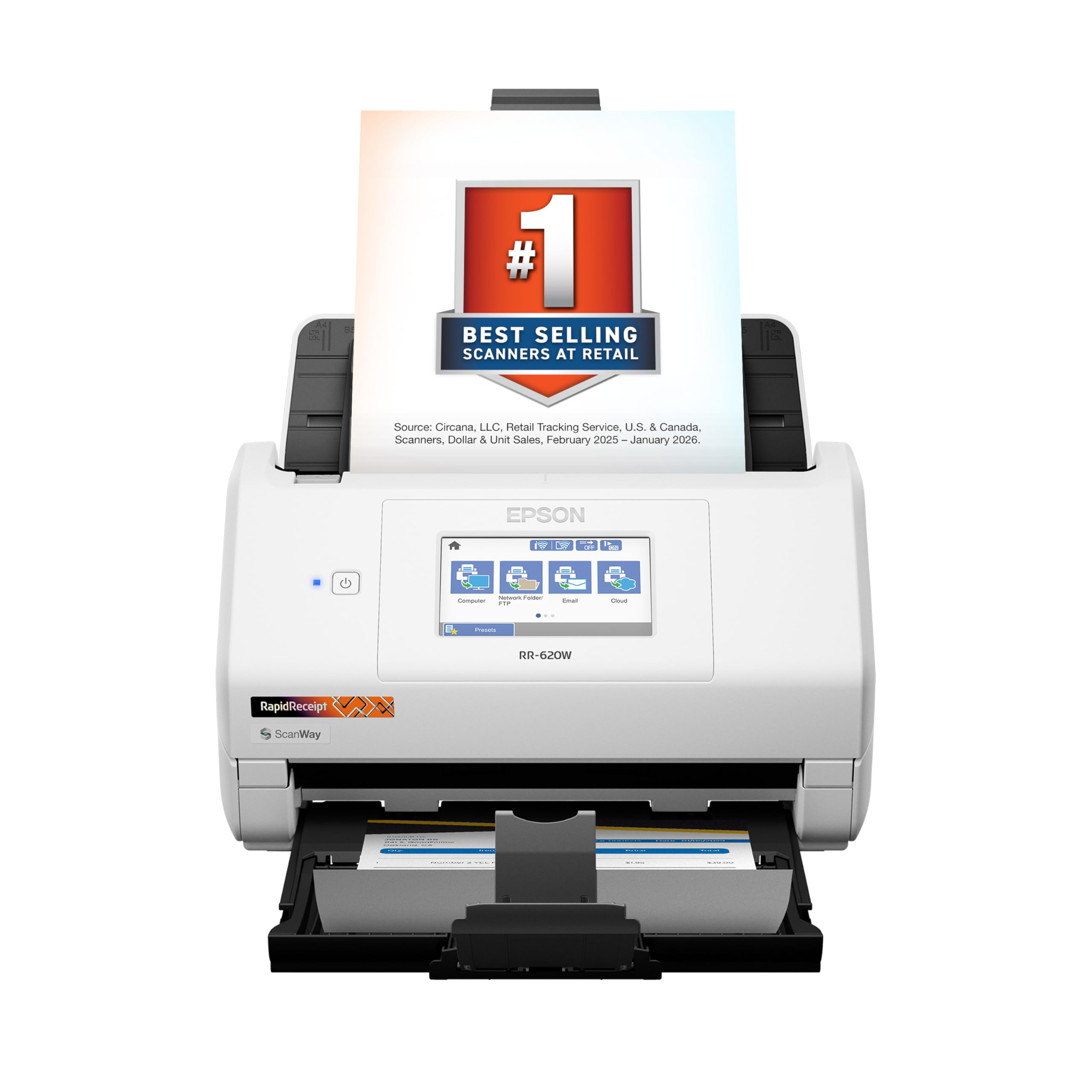
The RR-620W targets users who process high volumes of receipts and invoices and need automated data extraction. Its AI-ready ScanSmart Pro technology captures text and converts it into categorized data that integrates directly with QuickBooks, TurboTax, and Excel. The 4.3-inch color touchscreen supports standalone scanning to email, USB drives, or cloud services without a computer.
At 45 ppm duplex with a 100-sheet ADF, it matches the fastest speed tier in this roundup. The built-in Wi-Fi is reliable, and the scanner’s small footprint fits neatly on a desktop corner. The included software suite handles receipt edge detection and cropping automatically, reducing manual cleanup significantly.
The primary caution involves the bundled third-party PDF software license key, which some users found required careful manual setup. Epson’s own ScanSmart software is more than sufficient for most workflows anyway. For any business owner who needs to reconcile expenses quickly, the automated categorization alone justifies the investment.
Why it’s great
- AI-powered data extraction for receipts and invoices
- 45 ppm duplex speed with a 100-sheet ADF
- Standalone scan-to-USB or cloud via touchscreen
Good to know
- Bundled third-party software license setup can be confusing
- Heavier build at 8.2 lbs; less portable
4. Brother ADS-3100

The Brother ADS-3100 packs near-premium speed—40 ppm duplex—into a compact chassis that fits under a monitor riser. The 60-sheet ADF is adequate for moderate-volume jobs, and Hi-Speed USB 3.0 connectivity ensures fast data transfer without network complexity. It’s ideal for a home office that needs quick batch scanning without occupying a large footprint.
The bundled software suite includes seven applications for optimizing, enhancing, and customizing documents, which is a strong value-add. The triple-layer security features—secure scan-to-USB, secure network connection, and user authentication—make it a solid choice for handling sensitive documents like contracts or client files.
A small subset of users reported occasional multiple-page feeding issues, though these occurred most frequently with very thin or crinkled paper. Routine cleaning of the separation pad usually resolves this. For its speed and size, the ADS-3100 offers a compelling middle ground for professionals who need fast output without a premium price tag.
Why it’s great
- Fast 40 ppm duplex in a very compact design
- Hi-Speed USB 3.0 for rapid data transfer
- Triple-layer security features for sensitive documents
Good to know
- Some users experience feeding issues on very thin paper
- No touchscreen or wireless connectivity
5. ScanSnap iX1300

The iX1300’s standout feature is its dual feeder design: an ADF for standard documents and a separate manual feeder slot for thick items like plastic ID cards, photos, or folded pages. This adds versatility that most ADF-only scanners lack. It scans at 30 ppm duplex via USB or Wi-Fi, and its folding space-saving design means it can slide into a drawer when not in use.
The ScanSnap Home software provides a unified interface for managing scans from documents, receipts, business cards, and photos. The Quick Menu feature lets you scan directly to apps like Evernote, Dropbox, or OneNote with drag-and-drop simplicity. The auto-crop, de-skew, and color optimization work well right out of the box.
Performance is strong for moderate-volume use, but some users reported occasional paper jams when feeding card stock or oddly sized documents through the ADF. The manual feeder is a great workaround for these cases. For a compact scanner that handles the widest variety of media types, the iX1300 is a top contender.
Why it’s great
- Dual feeder handles standard and thick media separately
- Space-saving folding design
- Wi-Fi connectivity plus USB option
Good to know
- ADF can jam on non-standard media without manual feed
- Lower 30 ppm speed compared to premium models
6. Canon imageFORMULA R30

The R30 is unique in this list because its software is built directly into the scanner’s memory. Connect the USB cable and it appears as a storage drive—no driver installation, no CD, and no internet download required. This plug-and-scan approach is invaluable for IT-constrained environments or users who just want to start scanning immediately.
Duplex scanning at 25 ppm with a 60-sheet ADF is solid for moderate workloads. Users have reported scanning thousands of pages in a single session without issues. The scanner automatically detects document size, color depth, and blank pages, outputting clean, searchable PDFs. It handles mixed batches of receipts, contracts, and business cards reliably.
While the hardware is robust, some users found the Canon driver software finicky—requiring reinstallation after a system restart in a few cases. The plug-and-play USB drive approach bypasses that issue entirely, so sticking with that method is recommended. For a midsize office that needs a no-fuss solution, the R30 delivers.
Why it’s great
- Plug-and-play USB drive; zero driver installation needed
- 60-sheet ADF handles large batches reliably
- Auto-crop, de-skew, and blank page removal
Good to know
- Software can require reinstallation after restart if not using USB mode
- Cannot scan bound books or pages
7. Canon imageFORMULA DR-C225 II

The DR-C225 II is built for endurance. Its upright design with top feed and top eject saves desk space, and a three-year warranty backs its reliability. Users report units lasting over nine years with zero jams, thanks to a separation pad that handles taped documents and Post-It notes better than many competitors. The 30-sheet ADF is smaller, but the long-term dependability compensates.
It scans at 25 ppm duplex with a color depth of 24 bits. The bundled software includes Cardiris for business card management and eCopy PDF Pro for PDF editing and collaboration. It also supports TWAIN drivers, ensuring compatibility with legacy document management systems that many enterprise environments require.
The only notable downside is the lack of an override setting for scanning Post-It notes, which the earlier DR-C125 handled more gracefully. Some users also encountered a double-feed error when pages weren’t properly fanned before loading. For anyone prioritizing a machine that simply works for years, this Canon is a proven choice.
Why it’s great
- Exceptional long-term durability; many units last 9+ years
- Handles taped documents and Post-Its without double-feed errors
- Includes TWAIN driver for legacy software compatibility
Good to know
- 30-sheet ADF requires frequent reloading for large batches
- Cannot scan envelopes or Post-Its without paper separator override
8. Doxie Pro

Doxie Pro targets users who want duplex scanning and smart software without a premium price. The scanner features a collapsible document feeder that holds up to 20 pages, plus a direct feed slot for thick or delicate paper. The bundled software offers automatic cropping, rotation, contrast boost, and OCR text recognition, and it integrates directly with Dropbox, Evernote, OneNote, and iCloud.
Setup is genuinely simple—plug in the USB cable, and the software auto-launches. The scanner handles typical office documents, receipts, and business cards competently at up to 600 dpi. Its compact footprint (12 by 4 by 3 inches) fits easily on a crowded desk. The build quality is sturdy plastic, and users praise its reliability on long scanning sessions.
The main trade-off is speed; it’s not designed for massive batch jobs. The 20-sheet ADF and slower duplex speed mean it’s best suited for personal use or micro-office environments scanning tens of pages, not hundreds. For a budget-conscious buyer who needs duplex functionality, the Doxie Pro provides excellent value.
Why it’s great
- Duplex scanning at an entry-level price point
- Excellent software integration with cloud services
- Compact and sturdy build for small desks
Good to know
- 20-page ADF is small; not for high-volume work
- No SD card slot or external battery option
9. HP Small USB Document & Photo Scanner (HPPS100)

The HPPS100 is purpose-built for extreme portability. Weighing just 3 ounces and drawing power entirely through USB, it’s designed for travelers, commuters, or home users who need to digitize a handful of documents while on the move. The 10-sheet ADF handles one-sided scanning only (simplex), which suits intermittent use like scanning receipts, business cards, or contracts.
Resolution tops out at 1200 dpi for detailed scans of business cards or photos. The free HP WorkScan software provides basic editing and batch scanning functions but lacks advanced OCR or duplex support. Setup is genuinely instant—plug it into a Windows or macOS computer and it’s recognized immediately.
This is not a production scanner. The 15 ppm simplex speed and 10-sheet ADF make it unsuitable for heavy office workloads. However, for someone who needs an occasional-scan tool that fits in a briefcase pocket, the HPPS100 is the lightest, simplest option available. It’s ideal for digitizing the occasional stack of receipts or contracts while traveling.
Why it’s great
- Extremely lightweight at 3 oz; fits in a briefcase pocket
- USB-powered; no external power adapter needed
- Instant plug-and-play setup on Windows and Mac
Good to know
- Simplex only—cannot scan both sides automatically
- 10-sheet ADF and 15 ppm speed limits batch work
FAQ
What is the difference between ppm and ipm on a document scanner?
Can an ADF scanner handle photos and plastic cards safely?
Why does my scanner double-feed or jam so often?
Do I need TWAIN or WIA driver support?
Final Thoughts: The Verdict
For most users, the automatic document feeder scanner winner is the Epson Workforce ES-580W because it combines a 100-sheet ADF, 35 ppm duplex speed, Wi-Fi, and a color touchscreen for standalone use in one balanced package. If you want unmatched raw speed for large batch jobs, grab the ScanSnap iX2400. And for a budget-friendly entry point into duplex scanning with excellent software, nothing beats the Doxie Pro.

Mo Maruf
I created WellFizz to bridge the gap between vague wellness advice and actionable solutions. My mission is simple: to decode the research and give you practical tools you can actually use.
Beyond the data, I am a passionate traveler. I believe that stepping away from the screen to explore new environments is essential for mental clarity and physical vitality.