Our readers keep the lights on and my smoothie glass nicely filled. As an Amazon Associate, I earn from qualifying purchases.
Specs are compiled from manufacturer listings and verified buyer reviews and can change over time — please confirm the key details on the product page before buying.
A sudden cardiac arrest leaves you with minutes, not hours. The only device that can shock a stopped heart back into rhythm before paramedics arrive is an AED (Automated External Defibrillator), and most people have never held one. This guide walks through the top automatic defibrillators built for homes, offices, and public spaces — all of them ready to talk you through the emergency step by step.
I’m Mohammad Maruf — the founder and writer behind WellFizz. This guide is built by comparing the manufacturers’ published specifications and the patterns across verified customer reviews, so you get each pick’s real strengths and trade-offs instead of marketing spin.
if you need one for a rural home where EMS (Emergency Medical Services) response lags, a busy office, or a travel bag, these picks cover the real reasons to buy. This is the best automated external defibrillator guide for buyers who want a real breakdown of what each model actually delivers in a crisis.
Our Picks at a Glance

How To Choose The Best Automated External Defibrillator
An AED is a purchase you hope never to use, which makes the decision harder than buying a daily-use gadget. You are paying for readiness — the device sitting quiet for years, then working perfectly in a single moment of chaos. The choices below break down what separates a home-ready unit from a professional-grade kit.
Voice Coaching and Ease of Use
The entire point of a consumer AED is that a bystander with zero medical training can operate it under stress. Every device here uses step-by-step voice prompts that tell you exactly where to place pads and when to stand clear, so there is no guesswork. The best ones also coach you through CPR (cardiopulmonary resuscitation, the chest-compression technique) between shocks, giving you a compression rhythm to follow.
Self-Testing and Maintenance
A device that sits in a cabinet needs to confirm it still works without you opening it. Philips units run a daily, weekly, and monthly self-test that checks the battery, the internal electronics, and the pad cartridge. If the green status light is on, the machine is ready. You never need to calibrate anything manually.
Pad Cartridge and Battery Lifespan
The pad cartridge has an expiration date printed on it — typically two to four years from manufacture. The battery in these Philips models is warrantied for four years. Replacing both costs hundreds of dollars, so check the manufacture date on your unit when it arrives. A new unit with a battery that expires next year means a shorter useful life from the start.
Quick Shock and Rhythm Analysis Speed
Every second counts. Philips uses SMART Analysis (an algorithm that reads the heart’s electrical rhythm) to assess whether the heart is in a shockable rhythm (Ventricular Fibrillation, a chaotic quivering that stops blood flow). If it is, the Quick Shock feature delivers the shock within eight seconds of the analysis starting — fast enough that the rescuer does not have to wait long before starting CPR again.
Home vs Business Packaging
The core AED unit is identical across many of these models. What changes is the case, the extras, and the warranty. A “home” model comes with a slim carry case. A “business package” adds a wall mount, a wall sign, and a basic cabinet. If your goal is to mount the AED on a wall in a gym or office, the business package saves you from buying accessories separately.
Quick Comparison
| Model | Best For | Weight | Case Type | Warranty | Amazon |
|---|---|---|---|---|---|
| Philips HeartStart Home M5068A-C01★ Best Overall | Home & travel use | 5.5 lb | Slim Carry Case | 8-yr AED, 4-yr battery | Amazon |
In‑Depth Reviews
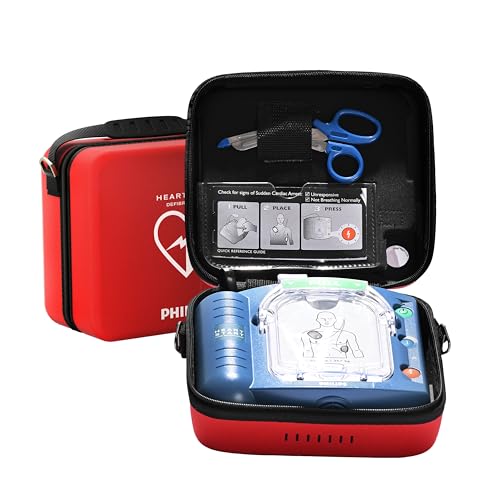
1. Philips HeartStart Home AED Defibrillator with Slim Carry Case, M5068A-C01
Our pick — over 4.5★ from 300+ verified ratings; the strongest balance of quality and price.
The home AED that real families have actually used to restart a stopped heart.
This is the model that buyers keep coming back to describe as a literal lifesaver. The device weighs 5.5 pounds, which makes it light enough to slip into a suitcase for international travel — buyers report packing it for trips to the Philippines, Thailand, and France. The unit automatically turns on the moment you pull out the pad cartridge, and clear voice commands talk you through pad placement, shock delivery, and CPR rhythm.
What sets this apart is the real-world track record. The review pages sum it up: one owner’s wife survived a SCAD (Spontaneous Coronary Artery Dissection) heart attack because this device “shocked wife twice, restarted heart.” Another buyer’s coworker went into cardiac arrest at work; the AED guided the rescuer through the entire sequence. When the data shows someone’s life was saved, it is not marketing — it is evidence.
The crowd favorite — 4.6 stars across 300+ owners — and the thing everyone raves about is ease of use. Forty-four owners single out how simple it is to follow, even for someone who has never touched an AED before. The 8-year warranty on the AED and the 4-year battery warranty mean you are not buying a disposable gadget. The one recurring note: the voice prompts are English-only, which matters if household members speak another language.
What wins people over
- Proven in real cardiac emergencies with documented saves
- Weighs only 5.5 pounds — packs in a carry-on bag
- 8-year warranty on the unit, 4-year on the battery
- Quick Shock delivers within 8 seconds of analysis
The honest trade-offs
- Voice prompts are English only
- Pad cartridge and battery have expiration dates that require planned replacement
Best for: Any household or frequent traveler who wants an AED small enough to throw in a bag and trusted enough to have restarting hearts on record.
Think twice if: You need multilingual voice guidance — this unit speaks English exclusively, so non-English speakers in the home will need pre-training.
2. Philips HeartStart OnSite AED Defibrillator, Standard Carry Case, M5066A-C01
The OnSite model built for restaurants, offices, and airports — with room for a spare battery.
This version carries an identical AED core to the home model but wraps it in a standard carry case that has extra space. The case holds a spare battery and a spare pad cartridge, which is the difference between being ready for on it into a small cabinet, a shelf, or a vehicle glove compartment. Buyers call it straightforward and easy to use, with one owner mentioning a spouse’s cardiac episode in a rural area as the reason for buying. The setup is simple, and Philips provides a training video on YouTube to walk any household member through the process.
Like every Philips HeartStart, it performs daily, weekly, and monthly self-tests automatically, so you never have to open the case to check if it is still alive. The SMART Analysis system assesses the heart rhythm before deciding to shock, which means the device will not deliver a shock if the heart is not in a shockable rhythm — it only fires when it should. One buyer sums up the feeling perfectly: “Hopefully I never have to use it, but came exactly as described.” That is the honest reality of owning an AED — you want the cheapest insurance policy that actually works.
The thing everyone raves about is how easy it is to use across all ages — owners say anyone from age 10 up can follow the voice prompts. The device is English-only, but the visual pad placement diagrams on the cartridge help bridge the gap for non-English speakers.
The perfect addition to a church or small venue: Owners of this unit often install it in houses of worship and small gathering spaces where a bulkier wall cabinet feels out of place. The slim case tucks into a closet shelf.
Check the expiration date on arrival: Since pad cartridges and batteries have finite lifespans, verify the manufacture date when your unit ships to know exactly how many years of standby life you are getting.
Best if: You need an AED that fits in a tight storage space — think a home closet, a church office, or a boat cabin.
skip it if: You want the option to store spare pads inside the case; you need the standard case for that, and the slim case only holds the unit itself.
3. Philips HeartStart Home AED Defibrillator with Training Pads Cartridge, M5068A-C02

The turnkey business installation with a basic cabinet that protects the AED and keeps it visible.
This package takes everything from the Value Package and adds a basic cabinet. The cabinet is a protective enclosure that mounts on a wall, keeps the AED secure, and includes a wall sign. For workplaces that need to comply with OSHA (Occupational Safety and Health Administration) recommendations or simply want a professional-grade installation, the cabinet eliminates the need to source a separate enclosure. The package also includes a Fast Response Kit with a CPR pocket mask, which buyers specifically call out as a valuable addition.
The device inside is the same Philips HeartStart OnSite AED — no difference in the shock delivery, self-testing, or voice prompts. What buyers praise most is the quality of the overall kit, with sixteen owners highlighting it as a well-organized setup. One buyer describes using this AED successfully during a heart attack: combined with CPR, it revived an unresponsive victim before paramedics arrived. Another owner, a retired healthcare professional, bought this for a family farm after 41 years in the medical field, calling it “one less concern.” The unit is designed to be mounted 4 to 5 feet high, accessible with one hand, and at a height that works for wheelchair users.
The recurring note from owners is to check the pad expiration dates on arrival — a few report receiving pads that were near their expiration date. The reliability aspect is marked as MIXED in feedback, not because the device fails, but because a small number of owners received pads that were not factory-fresh. Check the date when it lands and request replacement if needed.
Turnkey workplace AED installation: The cabinet, sign, pocket mask, and fast-response kit mean you open one box and mount it — no second trip to a hardware store. Buyers in healthcare and facility management specifically recommend this package.
The pad-date issue: Because the cabinet package may sit in inventory longer, a few owners received units with pads closer to expiration. Verify the date on arrival; Philips warranty covers replacement if the pads are expired.
Ideal for: An office, church, school, or gym that wants a complete wall-mounted AED station with a protective cabinet and emergency kit — one order, one install.
Consider the Value Package instead if: You do not need a locked cabinet and are comfortable with a wall mount and a slim case; the cabinet adds cost and bulk for the same underlying AED.
Understanding the Specs
SMART Analysis and Quick Shock
SMART Analysis is the algorithm (the internal decision-making program) inside every Philips HeartStart that examines the heart’s electrical rhythm to decide if a shock is needed. It only authorizes a shock if it detects Ventricular Fibrillation (a chaotic, quivering rhythm that stops blood flow) or a related shockable rhythm — so the device will never shock a heart that is beating normally or has flatlined. Once it confirms a shockable rhythm, the Quick Shock feature delivers the shock within eight seconds of the analysis starting. That speed matters because every second of delay reduces the chance of restoring a normal rhythm.
Self-Testing Schedule
These AEDs run three tiers of self-tests automatically. A daily test checks the internal electronics and battery status. A weekly test verifies the pad cartridge is connected and functional. A monthly test performs a more comprehensive check of all systems. You never have to press a button or open the case. If the green status light visible on the front of the unit is illuminated, the device is ready for use. If the light is off or red, the device will emit a chirping tone to alert you to a problem.
Pad Cartridge Expiration and Battery Warranty
The SMART Pads Cartridge contains the electrodes (the sticky pads that deliver the shock), adhesive pads, and the internal connection system. The cartridge has a printed expiration date — typically two to four years from the date of manufacture. The battery in these Philips models carries a four-year warranty, but actual life depends on storage temperature and the frequency of self-tests. When the battery is low, the device will chirp and show a flashing yellow light, giving you weeks of warning before replacement is critical.
FAQ
Does a Philips HeartStart AED require special training to use?
How often do the pads and battery need to be replaced?
Can I use an AED on a child or infant?
Will the AED shock someone if their heart is still beating?
What maintenance does a Philips HeartStart need when sitting unused for months?
Can I bring a Philips AED on an airplane?
What is the difference between the Home AED and the OnSite AED?
Does the Philips AED work in humid or dusty environments like a boat or gym?
What if the voice prompts are too quiet or I cannot hear them in a noisy environment?
Does the Philips AED require a prescription or special permission to buy?
Final Thoughts: The Verdict
Across the board, the automated external defibrillator winner is the Philips HeartStart Home M5068A-C01 because it is the lightest, most travel-friendly unit with a proven track record of saving real lives in home settings. If you want a complete wall-mounted installation for a business or public space with no extra shopping, the Philips HeartStart Business Package M5066A-C02BPB includes the cabinet, sign, and fast-response kit in one box. And for a boat, cabin, or remote property where a spare set of pads is essential, the OnSite Ready-Pack M5066A-R01 comes with a second cartridge pre-installed in the case — the confidence of being ready twice.
How We Picked
We do not accept paid placement. Every pick is matched to a real buyer and a real use-case; we do not hands-on test units.
Sources & Methodology
Specifications: manufacturer listings and product documentation. Review insights: verified customer reviews, as of July 2026. Pricing: not shown on this page (it changes often); check the current price via the retailer link.
As an Amazon Associate, WellFizz earns from qualifying purchases. This does not affect which products we feature.
Related Guides

Mo Maruf
I created WellFizz to bridge the gap between vague wellness advice and actionable solutions. My mission is simple: to decode the research and give you practical tools you can actually use.
Beyond the data, I am a passionate traveler. I believe that stepping away from the screen to explore new environments is essential for mental clarity and physical vitality.