Our readers keep the lights on and my smoothie glass nicely filled. As an Amazon Associate, I earn from qualifying purchases.
When you invest in high-fidelity vinyl playback, the smallest resonance from a motor bearing or a fraction of a gram of tracking force separates a merely warm sound from a performance that places the vocalist in your room. The difference lives in platter mass, tonearm geometry, and cartridge compliance, not gimmicks. This guide isolates the turntables that deliver measurable acoustic truth — from speed stability figures to effective tonearm mass — across a spectrum that begins near entry-level precision and extends into reference-grade territory.
I’m Mohammad Maruf — the founder and writer behind WellFizz. My research process for this category involves weeks of analyzing published frequency-response curves, comparing spec-sheet claims for wow-and-flutter ratios, signal-to-noise floors, and effective tonearm mass across each model, and cross-referencing verified owner feedback to weight real-world durability against laboratory performance.
Below, thirteen systems are dissected by their engineering DNA, not their price tags, so you can match a turntable’s strengths — balanced tonearm tracking, vibration control, or upgrade path — to the sound signature you are chasing. This deep dive into the best audiophile turntable landscape shows how each contender justifies its place on a serious listener’s shelf, regardless of whether the cartridge is fixed or swappable.
How To Choose The Best Audiophile Turntable
Selecting a high-fidelity turntable is a series of deliberate trade-offs between motor type, tonearm architecture, and cartridge pairing. The three variables below define the ceiling of what a system can retrieve from the groove.
Drive Mechanism: Belt vs. Direct Drive
Belt-drive physically isolates the motor from the platter via a rubber or silicone belt, which mechanically filters motor noise. This yields a lower noise floor and is historically favored for critical listening. Direct drive, once dismissed as a DJ compromise, has been reinvented with coreless brushless DC motors that eliminate cogging torque. Modern high-end direct drive systems like the Technics SL-100C achieve speed accuracy (wow and flutter below 0.05%) that belt-drive struggles to match without elaborate speed-control circuitry. Choose belt-drive for airy midrange and low mechanical noise; choose direct drive for rock-solid pitch stability and instant start-up.
Tonearm and Cartridge Matching
The tonearm’s effective mass must be matched to the cartridge’s dynamic compliance. A high-compliance cartridge (like many moving magnet designs from Ortofon) needs a low-mass tonearm to avoid forcing the stylus suspension into resonance. Moving coil cartridges typically have low compliance and pair with medium- or high-mass tonearms. Ignoring this match produces either woolly bass or a thin, brittle top end. The best tables in this guide state their tonearm mass explicitly or make it easy to swap headshells and counterweights to achieve the right balance.
Platter Mass and Material
Heavier platters store more rotational energy and resist speed fluctuations caused by stylus drag during loud passages. Acrylic platters absorb resonance in the midband, yielding a three-dimensional soundstage and tighter bass. Die-cast aluminum platters with rubber mats offer decent damping at a lower cost. High-density MDF platters damp wideband vibrations but add mass that taxes the motor. A table that ships with an interchangeable platter or lets you add an acrylic upgrade later represents a better long-term investment.
Quick Comparison
On smaller screens, swipe sideways to see the full table.
| Model | Category | Best For | Key Spec | Amazon |
|---|---|---|---|---|
| Technics SL-100C | Direct Drive | Rock-stable speed, easy cartridge swaps | Coreless DC motor, S-shaped tonearm | Amazon |
| Marantz TT-15S1 | Belt Drive | Ultra-low noise floor, floating motor | ClearAudio Virtuoso MM cartridge | Amazon |
| Denon DP-3000NE | Direct Drive | Full auto operation, 78 RPM support | 40 lb plinth, S-shaped tonearm | Amazon |
| Pro-Ject Debut EVO 2 | Belt Drive | True balanced output, next-gen refinement | 1.7-kg TPE-damped aluminum platter | Amazon |
| Technics SL-40CBT | Direct Drive | Bluetooth convenience, classic Technics DNA | Coreless motor, built-in phono EQ | Amazon |
| Pioneer DJ PLX-1000 | Direct Drive | High torque for DJ duty or home use | High-torque motor, VTA adjustable | Amazon |
| Pro-Ject Debut Carbon EVO | Belt Drive | Classic Pro-Ject sound, Sumiko Rainier | Carbon fiber tonearm, 68dB S/N | Amazon |
| YAMAHA TT-S303 | Belt Drive | Built-in phono preamp, straight tonearm | High-inertia platter, 67dB S/N | Amazon |
| Denon DP-450USB | Belt Drive | USB recording, semi-auto, 78 RPM | Built-in phono EQ, auto-lift | Amazon |
| Fluance RT85N | Belt Drive | Nagaoka MP-110 warmth, acrylic platter | 0.07% wow/flutter, Nagaoka cartridge | Amazon |
| Fluance RT85 | Belt Drive | Ortofon 2M Blue detail, acrylic platter | 0.07% wow/flutter, Ortofon cartridge | Amazon |
| Audio-Technica AT-LPW50BT-RW | Belt Drive | Bluetooth streaming, rosewood finish | Die-cast aluminum platter, speed sensor | Amazon |
| U-Turn Audio Orbit Plus (Gen 2) | Belt Drive | Lowest entry point for serious tracking | OA3 gimbal tonearm, acrylic platter | Amazon |
In‑Depth Reviews
1. Technics SL-100C

The SL-100C inherits the coreless direct-drive motor from the SL-1200GR lineage, eliminating cogging torque that plagued earlier direct-drive designs. The S-shaped aluminum tonearm allows VTA adjustment across 6 mm and uses a standard SME headshell, making cartridge swapping trivial. Speed accuracy is essentially perfect without any belt stretch or speed-box intervention.
Out of the box, it ships with an Audio-Technica AT-VM95C conical stylus. That cartridge is competent but undersells the table; upgrading to an AT-VM95ML microline stylus reveals inner-groove detail and transient snap that the stock conical smears. The auto-lift mechanism at the end of a record’s run-out groove uses a purely mechanical spring — no motor engagement, no induced noise.
The 21.8-lb chassis and double-layered base plate absorb footfall and speaker feedback better than anything in its class. The only compromise is the auto-lift’s 60-second delay, which can be defeated. For a listener who wants a future-proof platform, this is the anchor of the list.
Why it’s great
- Coreless motor delivers near-zero wow/flutter in real use
- Adjustable VTA and removable headshell for cartridge rolling
- Heavy plinth and dual-layer base reject vibration
Good to know
- Auto-lift delay of up to 60 seconds before it engages
- Stock VM95C cartridge should be budgeted for upgrade
2. Marantz TT-15S1
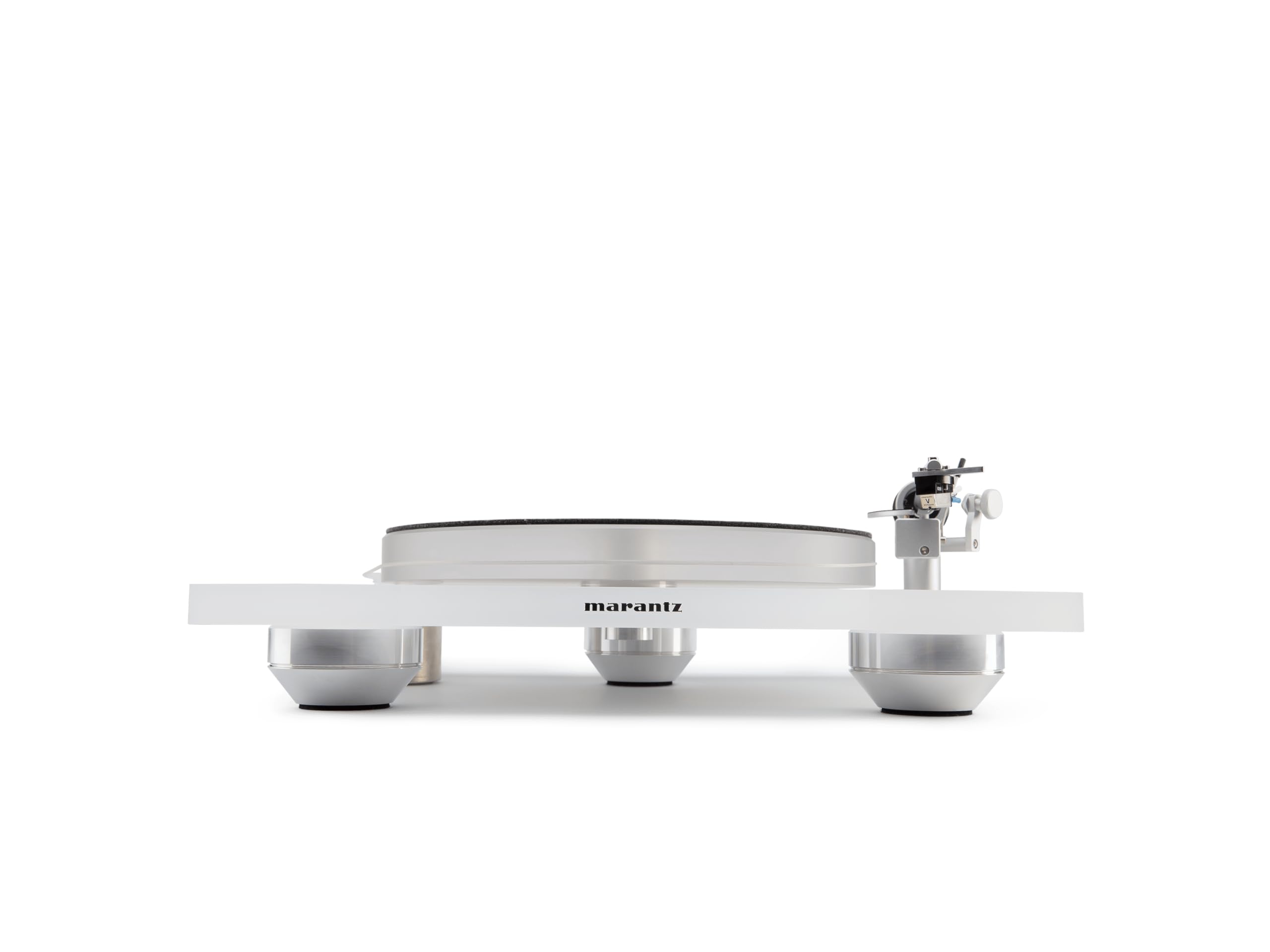
The TT-15S1 is a collaboration between Marantz and Clearaudio, and it shows in the floating motor mount. The AC asynchronous motor is physically decoupled from the chassis via a separate sub-plate, so no mechanical vibration reaches the platter or tonearm. This yields a noise floor so low that the included ClearAudio Virtuoso MM cartridge (with an ebony wood body) produces a black background against which transients explode.
The tonearm is a ClearAudio Satisfy — an 8.0-gram effective mass design that pairs naturally with medium-compliance moving magnet cartridges. The acrylic platter is heavy and ring-damped, rejecting halo resonances that thinner platters introduce. Setup is more involved than a plug-and-play table: the belt needs careful centering on the motor pulley, and the anti-skate must be dialed in with a test record.
No dust cover is included. This is a deliberate statement: Marantz expects the table to live on a dedicated isolated shelf. Owners report that adding a simple acrylic cover for about works fine. If you value retrieval of low-level detail and are willing to invest in isolation, this table out-resolves tables costing twice as much.
Why it’s great
- Floating motor effectively eliminates mechanical noise
- Clearaudio tonearm and cartridge are reference-grade
- Acrylic platter delivers expansive soundstage depth
Good to know
- No dust cover in the box
- Setup demands patience and a tracking-force gauge
3. Denon DP-3000NE

The DP-3000NE is Denon’s flagship analog deck, built on a massive 40.8-lb chassis with real ebony wood veneer. The fully automatic operation — push a button and the tonearm lifts, moves to the lead-in groove, and lowers — is a rare luxury in serious turntables.
The S-shaped tonearm includes on-the-fly VTA adjustment and an anti-skate dial that works across a wide range of tracking forces. No cartridge is included, which is a deliberate choice: Denon expects the buyer to pair it with a high-quality moving magnet or moving coil of their choice. The built-in phono equalizer is competent but an external stage will improve channel separation.
Three speeds (33 1/3, 45, 78 RPM) and a swappable headshell make it the most versatile high-end chassis available. The only functional limitation is that it is not fully automatic for 78 RPM records — auto-stop works, but the arm must be placed manually. For the collector who values convenience without sacrificing sonic integrity, this is the automatic reference.
Why it’s great
- Full auto-start/stop with 40-pound vibration-killing plinth
- On-the-fly VTA and three-speed operation
- Real ebony wood veneer finish
Good to know
- No cartridge included; budget for a premium pick
- Manual tonearm placement required for 78 RPM
4. Pro-Ject Debut EVO 2
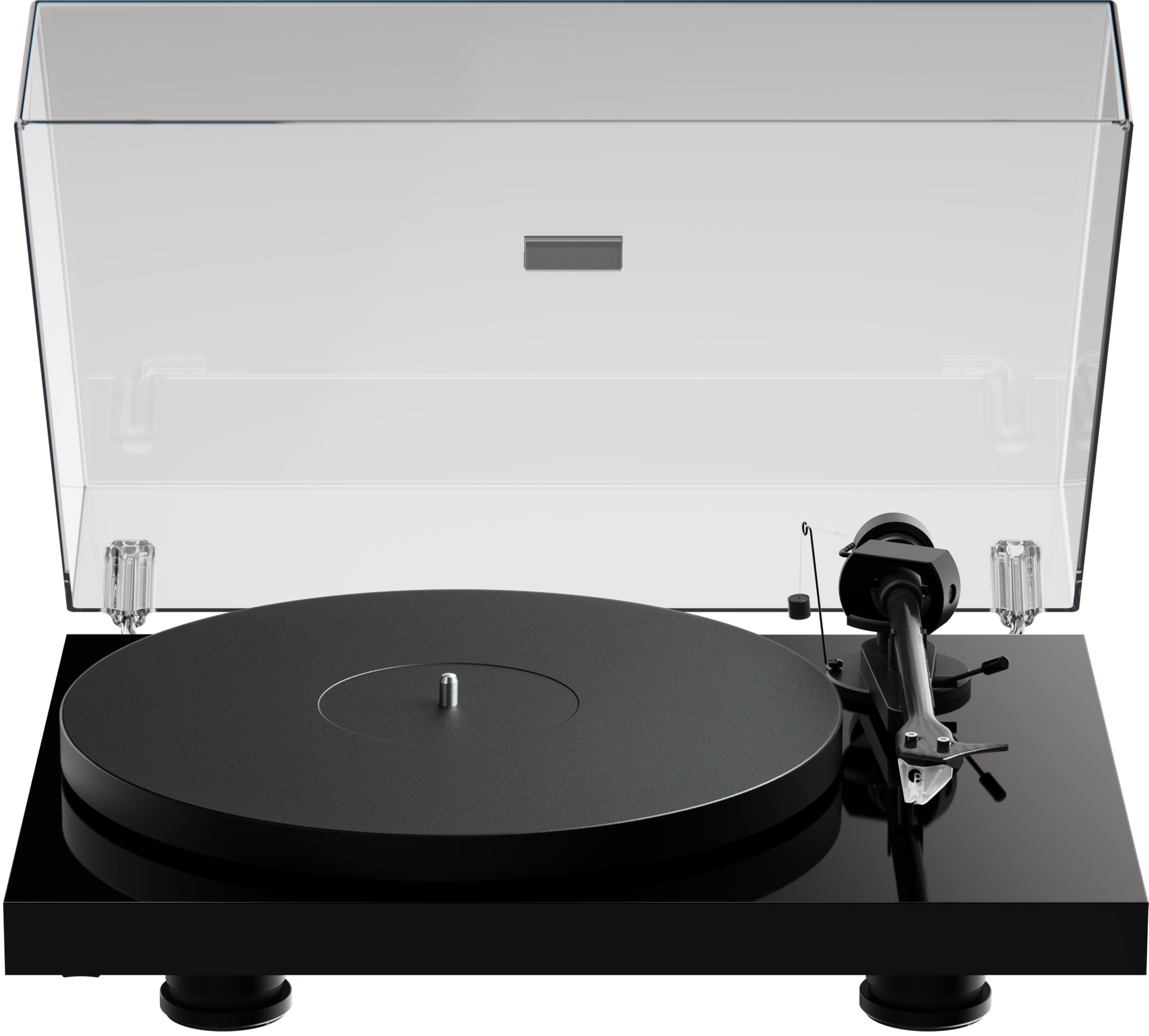
The Debut EVO 2 evolves the Debut Carbon platform with a 1.7-kg anti-magnetic die-cast aluminum platter that is TPE-damped to kill ringing. The tonearm is a one-piece carbon fiber structure with a low 6.0-gram effective mass, making it a natural partner for the included Pick it MM EVO cartridge (a high-compliance moving magnet with a bonded elliptical stylus).
What separates the EVO 2 from its predecessor is true balanced output: a mini-XLR on the back of the plinth feeds a balanced signal to a compatible phono stage, cancelling common-mode noise and lowering the noise floor by several dB. The DC motor is isolated in a separate housing beneath the chassis, and the belt-drive mechanism is an upgrade from the previous model’s silicone belt to a seamless design that reduces start-up vibration.
Setup is straightforward, but the anti-skate weight on the tonearm thread can detach if bumped. Once dialed in, the EVO 2 offers clarity that rivals tables costing twice as much, especially in the upper midrange where cymbals and female vocals gain extra air.
Why it’s great
- True balanced output via mini-XLR for lower noise
- 1.7-kg TPE-damped aluminum platter kills resonance
- Excellent instrument separation for the price
Good to know
- Anti-skate weight can detach from the thread easily
- Requires external phono preamp with balanced input
5. Technics SL-40CBT
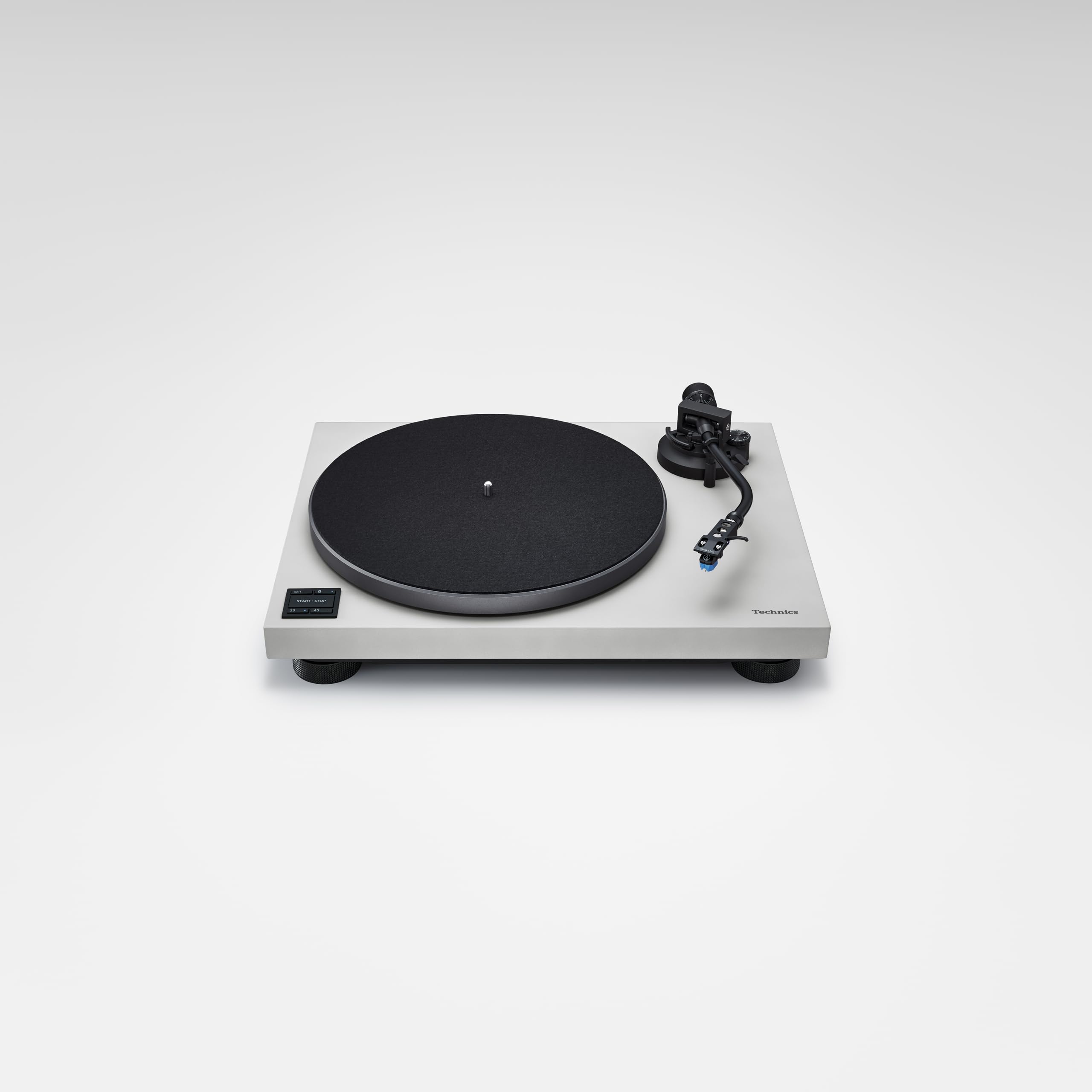
The SL-40CBT bridges classic Technics direct-drive engineering with modern wireless convenience. The coreless motor is identical to the one used in the SL-1500C, meaning zero cogging and near-instantaneous speed lock. The aluminum S-shaped tonearm sits on a micron-precision gimbal.
Built-in Bluetooth (aptX) streams to speakers or headphones with minimal latency, though wired listening via the internal phono stage reveals the table’s true resolution. The cartridge is an Audio-Technica AT-VM95C conical; swapping the stylus to a microline profile (VMN95ML) transforms detail retrieval without changing the body. The 40CBT also includes a built-in phono equalizer switchable to line output, so it works with any amplifier input.
The Terracotta Brown finish is polarizing but distinctive. The dust cover hinges are spring-damped and close smoothly. The only notable omission is a 78 RPM speed; this is strictly a 33/45 deck. For a listener who wants one box that works with modern powered speakers or a vintage receiver, this is the most flexible high-performance option.
Why it’s great
- Coreless motor with zero cogging and silent operation
- Built-in Bluetooth and switchable phono EQ
- Stylish design with damped dust cover hinges
Good to know
- No 78 RPM speed support
- Stock conical cartridge benefits from stylus upgrade
6. Pioneer DJ PLX-1000

The PLX-1000 is a high-torque direct-drive turntable designed for professional DJ use but adopted by audiophiles for its rock-solid speed stability. The motor delivers enough torque to reach speed instantly and hold it under heavy stylus drag. The S-shaped tonearm includes VTA adjustment and a removable headshell, making it friendly for cartridge rolling.
Unlike consumer tables, the PLX-1000 ships without a cartridge or preamp. This is actually an advantage for the serious listener who already has a preferred cartridge. The plinth is zinc die-cast and weighs 38 lbs — enough to reject feedback even on a hollow stage. The blue strobe light provides visual speed confirmation.
The motor is AC, not brushless DC, so there is a faint transformer hum that can be heard through sensitive moving coil systems. The table also lacks a built-in phono stage and does not support 78 RPM. For a home listener who values pitch stability above all else and runs a dedicated external phono stage, this is a rock-solid foundation.
Why it’s great
- High-torque direct drive with instant speed lock
- 38-lb chassis rejects feedback completely
- Adjustable VTA and standard headshell for cartridge swaps
Good to know
- No cartridge or preamp included
- AC motor emits faint transformer hum with MC cartridges
7. Pro-Ject Debut Carbon EVO

The Debut Carbon EVO is the model that established Pro-Ject as a serious contender in the sub- category. The one-piece carbon fiber tonearm has an effective mass of 6.0 grams and eliminates the colorations of metal or resin arms. The Sumiko Rainier cartridge (bonded elliptical stylus, carbon fiber cantilever) is a warm, forgiving partner that works especially well with older records.
The EVO includes height-adjustable aluminum feet with three different damping settings — soft, medium, hard — for matching different support surfaces. The motor is a precision AC synchronous type housed in a separate sub-chassis to reduce vibration coupling. The platter is a heavy polyoxymethylene (POM) acrylic design that damps resonance effectively.
Some units ship with tight dust cover hinges that can crack the plinth if overtightened; a small spacer is recommended. The anti-skate calibration requires the user to download a guide from Pro-Ject’s website, which is an extra step. Once properly set up, the EVO delivers a spacious, musical presentation that prioritizes rhythm over hyper-detail.
Why it’s great
- Carbon fiber tonearm with low effective mass
- Adjustable damped feet for isolation tuning
- Sumiko Rainier cartridge is warm and musical
Good to know
- Dust cover hinges can crack plinth if over-tightened
- Anti-skate setup requires a separate downloaded guide
8. YAMAHA TT-S303
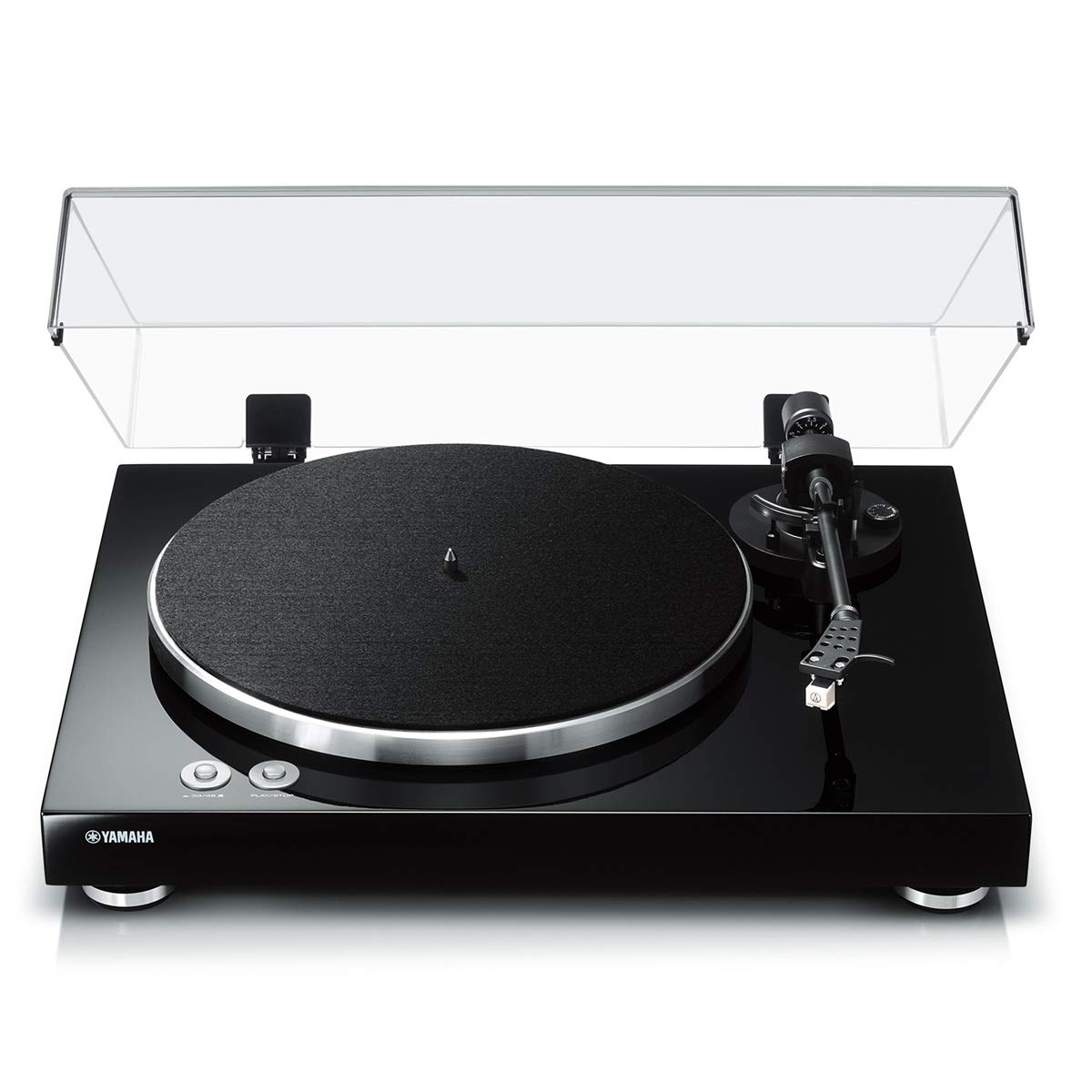
The Yamaha TT-S303 is a straight-tonearm, belt-drive table that includes a built-in phono preamp. The straight aluminum arm reduces tracking error across the record surface. The high-inertia platter is belt-driven by a DC motor with an optical speed sensor for consistency.
The stock cartridge is a basic moving magnet that many owners replace immediately with an Ortofon 2M Red. Doing so lifts the table into a different performance class — the built-in phono stage is quieter than expected for a unit in this range, and it connects directly to line-level inputs without an external box. The Piano Black finish is glossy but attracts fingerprints. The 67 dB signal-to-noise ratio is respectable but not class-leading.
The biggest functional complaint is the lack of auto-stop. The platter continues spinning after the record ends, and the tonearm remains in the run-out groove. For a listener who wants a clean, integrated solution for a secondary system or an office setup, the TT-S303 delivers reliable sound without the complexity of external components.
Why it’s great
- Built-in phono preamp for direct line-level connection
- Optical speed sensor maintains accurate rotation
- Straight tonearm reduces horizontal tracking error
Good to know
- No auto-stop; platter continues after record ends
- Stock cartridge benefits from upgrade to Ortofon Red
9. Denon DP-450USB
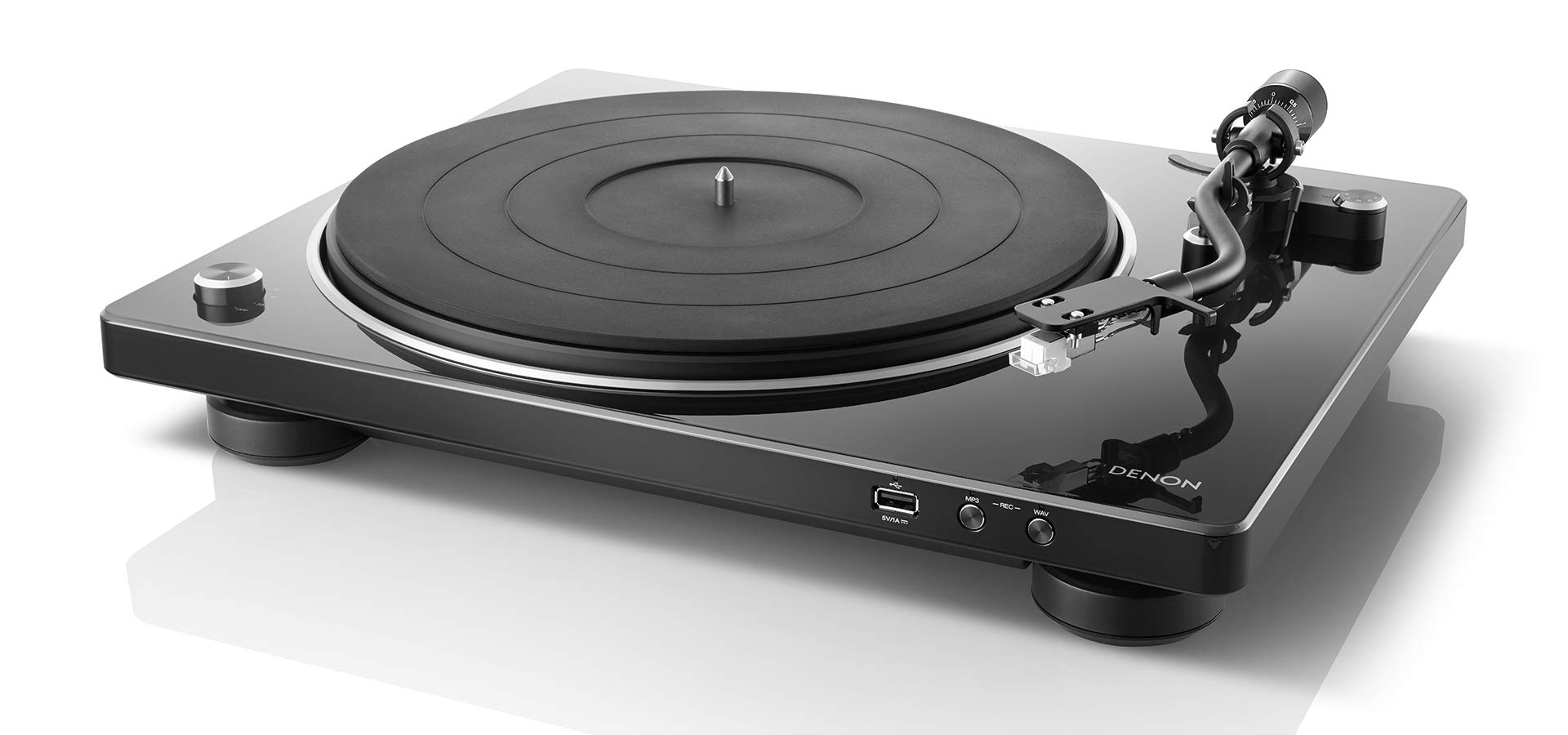
The DP-450USB is a semi-automatic belt-drive table that supports 33 1/3, 45, and 78 RPM. The curved tonearm is designed to reduce harmonic distortion, and the built-in phono equalizer allows connection to any amplifier input. The auto-lift feature raises the tonearm at the end of the record and stops the platter, protecting the stylus from prolonged groove wear.
The USB output allows direct recording to a PC using the included MusiCut software. Recording quality is 16-bit / 44.1 kHz CD-standard. The speed auto-sensor ensures correct rotational speed even if the belt stretches slightly over time. The weighted belt-driven platter adds mass for speed stability.
USB recording can be buggy — some users report truncated tracks or file overwrite issues. The dust cover rests on the platter and must be removed before playing records, which is inconvenient. The stock cartridge is adequate but not exceptional. For a collector who needs to digitize a 78 RPM library without buying a second table, the DP-450USB fills a unique niche.
Why it’s great
- Three-speed operation including 78 RPM
- Built-in phono EQ and USB recording
- Semi-automatic auto-lift protects stylus
Good to know
- Dust cover must be removed to play records
- USB recording software can be unreliable
10. Fluance RT85N

The RT85N is the version of Fluance’s flagship table that ships with the Nagaoka MP-110 cartridge — a bonded elliptical moving magnet that many listeners prefer over the Ortofon 2M Blue for its fuller midrange and less fatiguing top end. The acrylic platter is the same high-density, high-mass design as the RT85, dampening vibrations for a three-dimensional soundstage.
The belt-drive motor is speed-controlled to 0.07% wow/flutter, which is competitive with tables costing twice as much. The high-mass MDF plinth is finished in real wood veneer (Bamboo in this variant) and sits on adjustable isolation feet. The S-shaped tonearm uses a gimbal bearing and includes a damped cue lever.
Some users report static pops and crackles that are resolved by adding Fluance’s silicone platter mat (PFHTRP). The lack of VTA adjustment makes swapping cartridges more involved. For a listener who values a warm, liquid presentation and does not plan to regularly change cartridges, the RT85N is the most musically engaging option in the mid-range.
Why it’s great
- Nagaoka MP-110 cartridge delivers warm, non-fatiguing sound
- Acrylic platter provides excellent vibration damping
- Real wood veneer plinth and adjustable feet
Good to know
- No VTA adjustment; cartridge swaps require more care
- Static issues resolved with silicone platter mat
11. Fluance RT85

The RT85 bundles the Ortofon 2M Blue, a nude elliptical cartridge known for its detailed, analytical top end and precise channel separation. The stylus profile is finer than a bonded elliptical, allowing it to trace high-frequency groove modulations with exceptional accuracy. The same acrylic platter and speed-controlled motor as the RT85N provide a stable mechanical foundation.
The 2M Blue sounds bright and forward compared to the Nagaoka MP-110. It reveals sibilance and recording flaws that warmer cartridges gloss over. Pairing it with a tube phono stage or a warm integrated amplifier balances its clinical tendencies. The table ships with a bubble level to help with setup, and the 16.76-lb weight gives it a planted feel.
As with the RT85N, there is no VTA adjustment, and the cue lever feels somewhat cheap compared to the rest of the build. The included felt mat can be swapped for the silicone or cork mat to adjust the sound. For a listener who wants to hear every detail in the grooves and has an amplifier that leans warm, the RT85 is a powerful analytical tool.
Why it’s great
- Ortofon 2M Blue cartridge reveals exceptional detail
- Acrylic platter improves soundstage depth
- Excellent value for a 2M Blue bundled package
Good to know
- Bright presentation can be fatiguing with bright amps
- No VTA adjustment for cartridge optimization
12. Audio-Technica AT-LPW50BT-RW

The AT-LPW50BT-RW is a belt-drive table with integrated Bluetooth wireless technology, allowing direct streaming to Bluetooth speakers or headphones. The motor uses a speed-sensor system to maintain accurate platter rotation. The die-cast aluminum platter is anti-resonance and paired with a rubber mat for additional damping.
The rosewood veneer finish is visually striking, and the stainless steel plinth adds mass. The fully manual operation keeps the design simple. The included cartridge is Audio-Technica’s AT-VM95E, a bonded elliptical moving magnet that is a competent starter but not in the same league as the Nagaoka or Ortofon cartridges on the Fluance models. The adjustable dynamic anti-skate control helps track demanding passages.
Bluetooth quality is stable and low-latency, but wired playback sounds significantly better — the built-in phono stage is decent, but the wireless codec introduces compression. The lack of a dust cover with hinges (only a slipcover is included) is a notable omission. For a listener who wants convenience and a striking look without deep budget investment, this is the easiest table to live with daily.
Why it’s great
- Integrated Bluetooth for wireless speaker streaming
- Speed-sensor motor maintains accurate rotation
- Striking rosewood veneer finish
Good to know
- Wired playback significantly outperforms Bluetooth
- Only a slipcover dust cover included, not a hinged one
13. U-Turn Audio Orbit Plus (Gen 2)
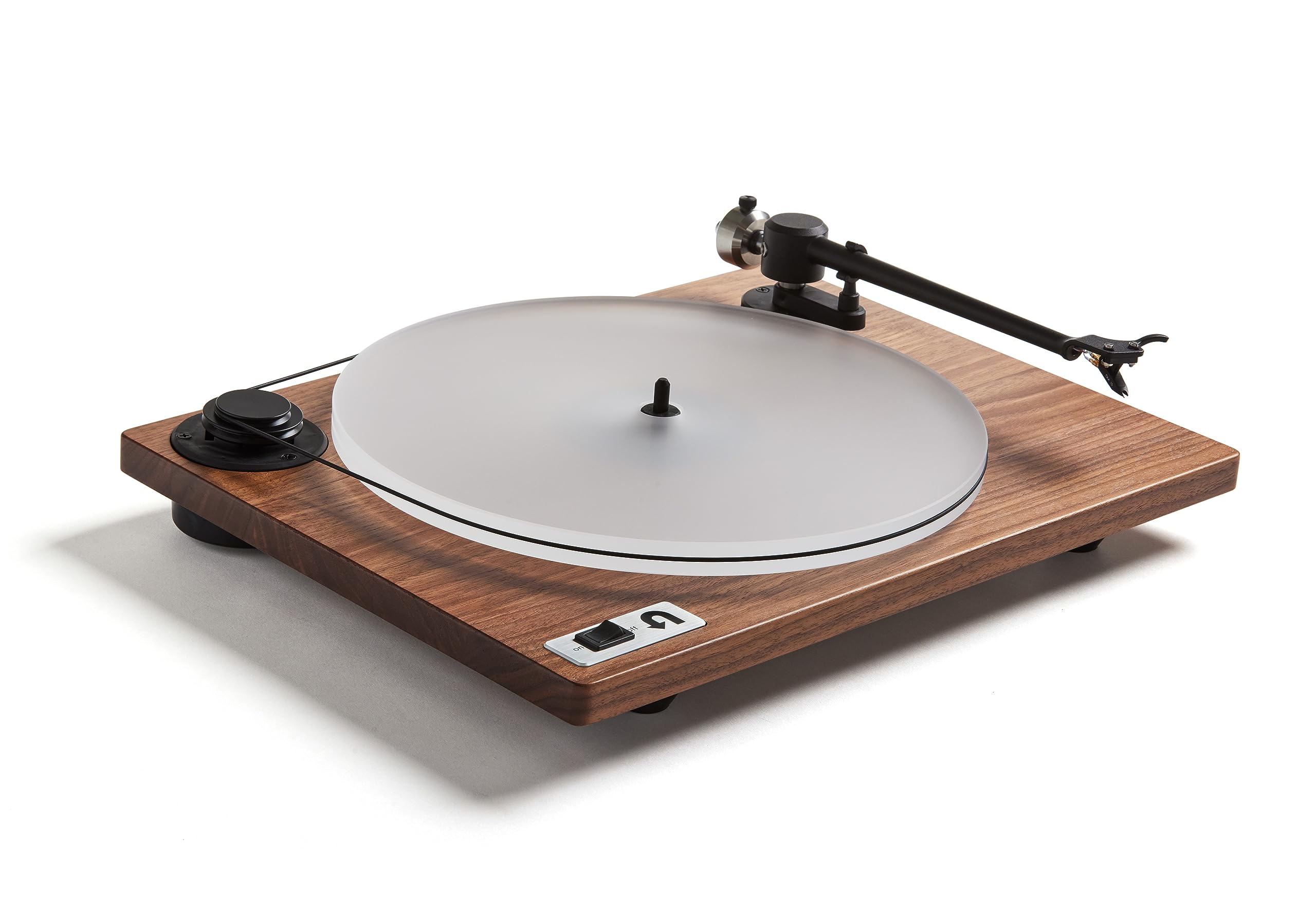
The Orbit Plus Gen 2 is the entry-level model that earns its place on this list through its tonearm — the OA3 precision gimbal with a one-piece magnesium armtube. This is a genuinely low-mass, low-friction bearing assembly that tracks warped records better than many tables costing double. The Ortofon OM5E cartridge with an elliptical diamond stylus delivers a balanced frequency response without harshness.
The grooved acrylic platter adds mass and improves speed consistency over the standard Orbit’s MDF platter. The external belt drive uses a seamless silicone belt that isolates motor noise. Speed changes between 33 and 45 RPM require manually moving the belt on the pulley — there is no electronic speed switch. Anti-skate is internal, and the adjustable counterweight is robust for the price.
No cue lever or auto-return is included; both are available as upgrades from U-Turn. No built-in preamp is included either, so an external phono stage is mandatory. For a new audiophile who wants a future-proof tonearm and a documented upgrade path, the Orbit Plus is the correct starting point.
Why it’s great
- OA3 gimbal tonearm with magnesium armtube tracks superbly
- Acrylic platter improves speed stability and detail
- Seamless silicone belt eliminates motor noise
Good to know
- No cue lever, auto-return, or built-in preamp
- Manual belt speed change between 33 and 45 RPM
FAQ
Is a built-in phono preamp acceptable for an audiophile turntable?
Should I choose a moving magnet or moving coil cartridge?
Does a belt-drive turntable always sound better than a direct-drive?
How critical is VTA adjustment for sound quality?
What does “anti-skate” actually do?
Can I use a turntable without a dedicated phono input on my amplifier?
Final Thoughts: The Verdict
For most users, the best audiophile turntable winner is the Technics SL-100C because it combines coreless direct-drive speed accuracy with a fully adjustable tonearm and a path to easily upgrade the cartridge. If you want a warm, non-fatiguing sound that engages you emotionally, grab the Fluance RT85N with the Nagaoka MP-110. And for the collector who needs full automatic convenience and 78 RPM support, nothing beats the Denon DP-3000NE.

Mo Maruf
I created WellFizz to bridge the gap between vague wellness advice and actionable solutions. My mission is simple: to decode the research and give you practical tools you can actually use.
Beyond the data, I am a passionate traveler. I believe that stepping away from the screen to explore new environments is essential for mental clarity and physical vitality.