Our readers keep the lights on and my smoothie glass nicely filled. As an Amazon Associate, I earn from qualifying purchases.
The difference between a subwoofer that adds weight to a kick drum and one that turns every bass note into a shapeless rumble is not about how loud it gets. It is about control — how cleanly the amplifier arrests the cone after the signal stops. For music listeners who actually care about tonal accuracy, a sub that lingers is a sub that ruins the mix.
I’m Mohammad Maruf — the founder and writer behind WellFizz. I have spent years analyzing amplifier topologies, driver motor assemblies, and cabinet resonance data across hundreds of home audio products to identify the subwoofers that actually deliver flat, articulate low-end without the bloat.
This guide cuts through the marketing to evaluate sealed and ported designs by their distortion profiles, extension depth, and system integration — helping you identify the best audiophile subwoofer for your specific listening space and music preferences.
How To Choose The Best Audiophile Subwoofer
An audiophile subwoofer is not about shaking furniture. It is about filling the lowest octave (20–80 Hz) with pitch-definition and speed that matches your main speakers. The wrong choice introduces phase smear, port chuffing, or a one-note hump that ruins imaging. The right choice disappears into the room and simply makes everything sound bigger.
Sealed vs. Ported – The Real Trade-Off
Sealed (acoustic suspension) enclosures provide a 12 dB/octave roll-off below the tuning point, which translates to tighter, more transient-accurate bass. They excel in small rooms where boundary gain naturally extends low-end. Ported enclosures extend deep bass with higher efficiency at the tuning frequency, but they introduce group delay and potential port noise. For music-first systems, sealed designs generally integrate with greater speed and fewer artifacts.
Amplifier Topology and Power Margins
Class D amplifiers dominate modern subwoofers for their efficiency and heat management, but the execution matters: a high-quality Class D module with a linear preamp stage (like the SVS STA-325D) retains signal integrity far better than a cheap switching design. RMS power should comfortably exceed what you need at your listening position, leaving headroom for dynamic peaks without clipping. A 300–500 watt RMS amplifier is sufficient for most medium rooms; high-output 12-inch designs benefit from 500+ watts.
DSP, Crossover Flexibility, and Room Integration
Parametric EQ (PEQ) and adjustable crossover slopes allow a subwoofer to blend with speakers that have different natural roll-off points. App-controlled DSP lets you fine-tune from the listening position without walking back and forth. Look for variable crossover (40–150 Hz), phase adjustment (0–180 degrees or continuous), and at least three bands of PEQ. Room correction features like SVS’s smartphone app or WiiM’s AI RoomFit automate this process, but manual PEQ always gives the most precise result.
Quick Comparison
On smaller screens, swipe sideways to see the full table.
| Model | Category | Best For | Key Spec | Amazon |
|---|---|---|---|---|
| Audioengine S8 | Mid-Range | Desktop / small room | 250W RMS, down-firing | Amazon |
| JBL LSR310S | Mid-Range | Studio monitor pairing | 10-inch, 113 dB peak | Amazon |
| WiiM Sub Pro | Mid-Range | Wireless multi-room | 8-inch, 25 Hz extension | Amazon |
| Definitive Technology DN8 | Mid-Range | Compact high SPL | 500W peak, passive radiators | Amazon |
| SVS SB-1000 Pro | Premium | Sealed music precision | 12-inch, 325W RMS | Amazon |
| Klipsch RP-1000SW | Premium | Home theater / music blend | 10-inch, Cerametallic driver | Amazon |
| REL T/5x | Premium | 2-channel stereo | 8-inch sealed, Class AB | Amazon |
| SVS PB-1000 Pro | Premium | Deep ported extension | 12-inch ported, 20 Hz | Amazon |
| REL HT/1205 MKII | High-End | HT & music hybrid | 12-inch, 500W Class D | Amazon |
| Klipsch RP-1200SW | High-End | Large room / high SPL | 12-inch ported, 400W+ | Amazon |
| KEF KC62 | High-End | Compact high-end music | Dual 6.5-inch, 1000W | Amazon |
In‑Depth Reviews
1. SVS SB-1000 Pro
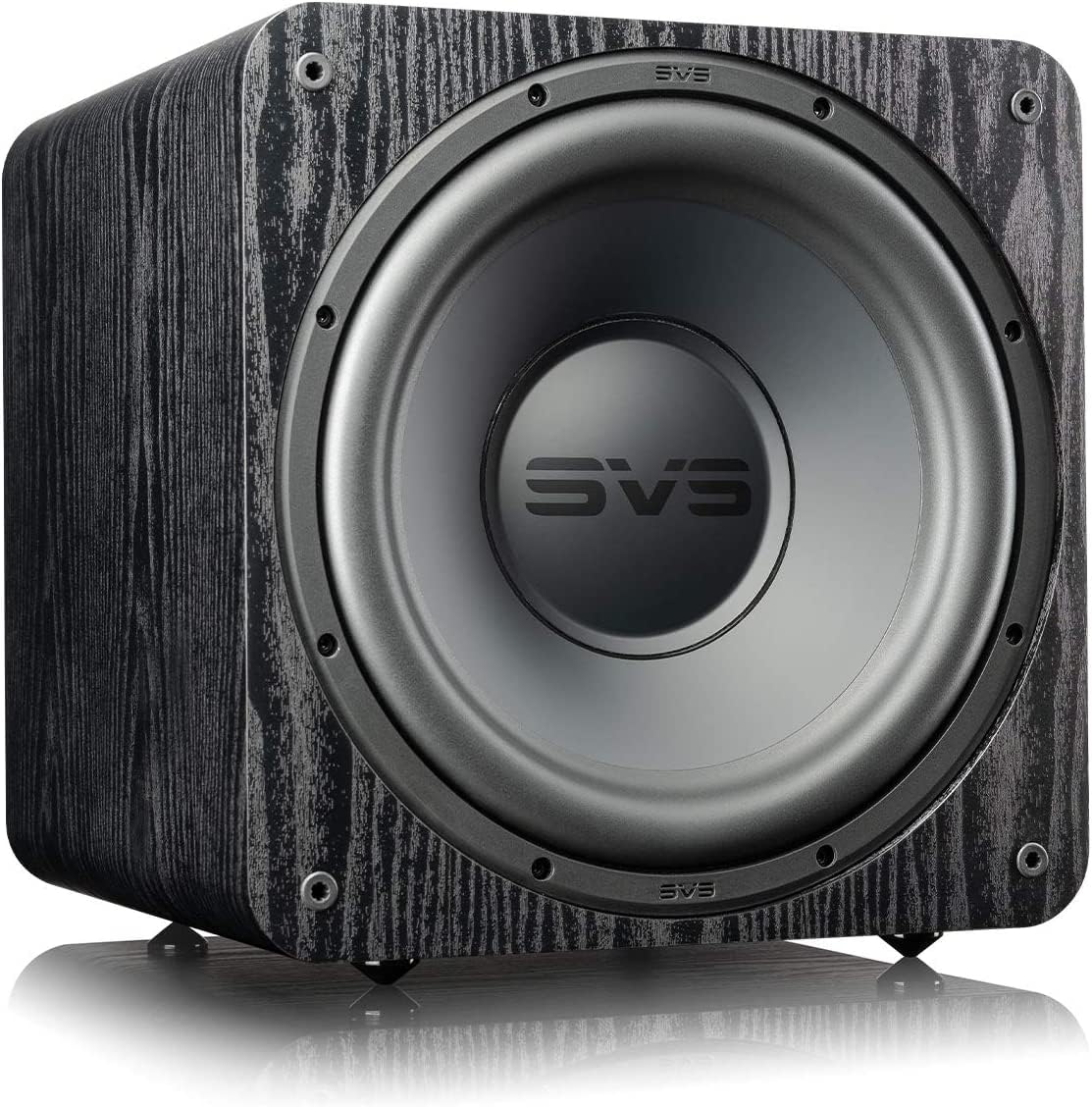
The SVS SB-1000 Pro sets the benchmark for music-first subwoofers in its price tier. The 12-inch high-excursion driver with a dual ferrite motor assembly and long-throw surround delivers massive output while maintaining finesse at low levels. The 325-watt RMS Sledge STA-325D amplifier uses discrete MOSFETs with Class D efficiency, keeping distortion exceptionally low even during sustained bass passages. The Analog Devices 50MHz DSP provides 3-band PEQ and room gain compensation you can control from your listening position via the SVS app, solving integration problems that would otherwise require measurement gear.
Customers report flat in-room response down to 20 Hz, a figure that competes with subs costing twice as much. The sealed cabinet eliminates port noise and minimizes group delay, so kick drums hit with precise attack and sustained bass notes remain articulate rather than bloated. The compact 13-inch cube fits under desks or beside furniture without dominating the room, and the auto-on/off circuit works reliably across multiple input sources.
For a 2-channel music system with bookshelf speakers like KEF LS50 or similar, the SB-1000 Pro adds the lowest octave without smearing mid-bass detail. The app also allows two separate presets — one for critical listening, one for casual playback — with different volume and EQ settings. This is the sub that disappears into the music and only announces itself when the track calls for it.
Why it’s great
- Flat response to 20 Hz in-room with usable output
- Full DSP with phone app for precise room tuning
- Sealed design delivers fast, articulate transient response
Good to know
- App does not include auto-EQ; PEQ must be set manually
- Logarithmic volume scale limits fine adjustments at low gain
2. SVS PB-1000 Pro

The ported sibling of the SB-1000 Pro, the PB-1000 Pro trades a bit of transient speed for deeper low-end extension and higher output at the tuning frequency. The dual-port cabinet is acoustically tuned for maximum airflow without chuffing, and the 12-inch driver and 325-watt amplifier are identical in core design to the sealed version. The result is flat response to 20 Hz with 3-4 dB more output in the 25-35 Hz range, making it better suited for movies and pipe organ music.
Reviewers consistently note that the PB-1000 Pro fills a 15×20 foot living room with tactile bass without strain. The Bluetooth app provides three bands of PEQ and room gain compensation, which users have used to tame a 25-50 Hz room mode that made their old sub sound boomy. The front-firing ports allow corner placement without obstruction, and the cabinet’s braced construction stays inert even at high SPL.
This sub excels in hybrid systems used for both music and movies. For stereo music, port plugs are available to convert the cabinet to a quasi-sealed alignment, tightening the response further. The crossover integrates cleanly with speakers like the KEF LS50 and Klipsch RP series, with no audible transition at the 80 Hz crossover point. For users who want one sub for everything, this is the smarter pick.
Why it’s great
- Extended low-end output to 20 Hz with high efficiency
- App-controlled DSP with 3-band PEQ
- Front-firing ports enable corner placement
Good to know
- Ported design introduces more group delay than sealed
- Mid-bass may feel less immediate with some music
3. REL HT/1205 MKII
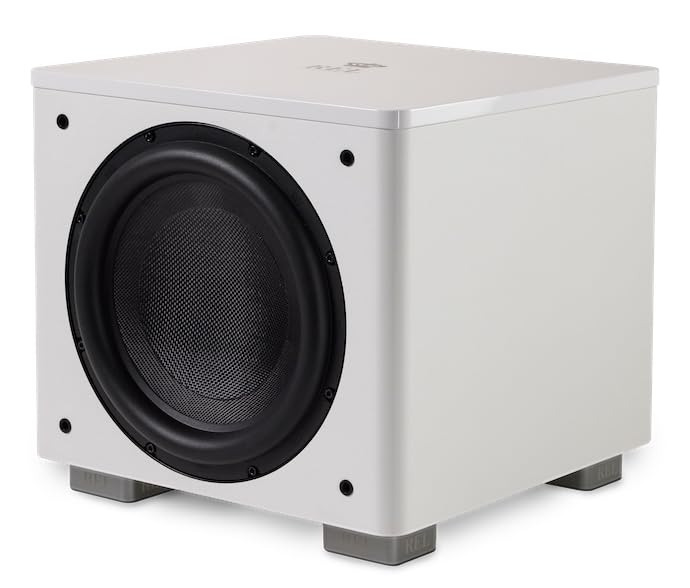
REL’s HT/1205 MKII is a sealed 12-inch subwoofer designed to satisfy both home theater LFE demands and 2-channel music purists. The 500-watt Class D amplifier is paired with a long-throw driver in a heavily braced wooden cabinet. The sealed alignment produces a 12 dB/octave roll-off, which means the sub integrates naturally with speakers that have their own low-end extension without causing a mid-bass hump.
The HT/1205 MKII offers simultaneous high-level (speaker wire) and low-level (RCA/LFE) inputs, letting you run it in a stereo music system via the Neutrik Speakon connector while keeping it connected to your AVR for movies. This dual-input flexibility is rare in subwoofers and is a hallmark of REL’s design philosophy. The 22 Hz extension at -6 dB provides usable sub-bass without overhang, and reviewers describe the bass as fast, tight, and integrated rather than prominent.
Finish options include black and white, both in a line-grained textured surface. The sub is heavy — around 50 pounds — so placement is a set-it-and-forget-it affair. For users with modest floor-standing or large bookshelf speakers in a room up to 400 square feet, the HT/1205 MKII offers the speed of a sealed design with the output capability to pressurize a room for film soundtracks.
Why it’s great
- Dual high-level and low-level inputs for seamless integration
- Sealed design delivers fast, musical bass response
- Wood cabinet construction reduces resonance
Good to know
- Some users report output lower than expected at max volume
- Not the deepest extension compared to ported alternatives
4. KEF KC62

The KEF KC62 is a radical engineering achievement: dual 6.5-inch drivers in a force-canceling configuration that eliminates cabinet vibration entirely, housed in a chassis just 10 inches cubed. The 1000-watt RMS amplifier drives the woofers in opposing directions, canceling reactive forces so the cabinet does not move — only the air does. This allows placement in locations normally off-limits to subwoofers, including shelving and cabinets.
Frequency response extends to 11 Hz at -6 dB, which is extraordinary for a subwoofer of any size, let alone one this small. The KC62 includes five DSP presets: Free Space, Wall, Corner, Cabinet, and Apartment Mode, each adjusting the EQ curve to compensate for boundary gain and room modes. For users with KEF’s LS50 or LSX speakers, the integration is seamless — the KC62’s crossover and slope are designed to match KEF’s Uni-Q driver roll-off.
Reviewers consistently praise the musicality and speed of the KC62, noting that it sounds faster and more articulate than many larger ported subs. It is expensive relative to its driver size, but the extension, DSP tuning, and near-zero vibration make it a unique proposition for listeners who prioritize placement flexibility and aesthetic discretion over raw SPL. For small rooms and critical music listening, it is a class leader.
Why it’s great
- Force-canceling design eliminates cabinet vibration
- Response extends to 11 Hz for sub-bass extension
- Five DSP presets for flexible room placement
Good to know
- Output limited below 95 dB; not for large-room home theater
- Premium price reflects engineering, not driver size
5. REL T/5x

The REL T/5x is a compact 8-inch sealed subwoofer designed specifically for 2-channel stereo systems. The 125-watt Class AB amplifier is a departure from the Class D topology most manufacturers use — Class AB runs hotter and less efficiently, but it can offer superior linearity and lower crossover distortion at moderate volumes. For listeners who value tonal purity over raw output, this trade-off makes sense.
The T/5x uses REL’s high-level input connection via a Neutrik Speakon cable, which sums the left and right speaker signals after the main amplifier. This allows the subwoofer to inherit the sonic signature of your amplifier rather than filtering through a separate preamp stage. The result is bass that feels like an extension of the main speakers rather than a separate source. Extension is rated to 33 Hz at -6 dB, which is adequate for most acoustic music, jazz, and vocal tracks.
Reviewers with vintage speakers and low-powered tube amplifiers particularly praise the T/5x for its ability to add weight without smearing timing. The cabinet is finished in high-gloss lacquer, and the down-firing driver keeps the visual profile clean. Room-size recommendation is up to 400 square feet; larger spaces may benefit from a stereo pair. For listeners who prioritize coherence with their main speakers over seismic output, the T/5x is a reference implementation.
Why it’s great
- Class AB amplifier offers superior linearity for music
- High-level input preserves amplifier character
- Compact sealed enclosure with premium finish
Good to know
- Limited low-end extension compared to larger subs
- Insufficient output for serious home theater LFE
6. Klipsch RP-1200SW

The Klipsch Reference Premiere RP-1200SW is a 12-inch ported subwoofer built around a redesigned Cerametallic driver. The spun-copper cone is both lightweight and exceptionally stiff, reducing cone breakup and improving transient response. The proprietary Aerofoil front slot port uses internal flaring to minimize turbulence and port noise, which is a common issue with high-output ported designs.
The Class D amplifier features an analog preamp design that maintains a clean signal path before the switching output stage. This yields lower noise and better detail than many competitors in the same price bracket. The RP-1200SW is rated for 400+ watts RMS with substantial peak headroom, and customer reports confirm it pressurizes rooms up to 300 square feet with ease. The cabinet is finished in scratch-resistant ebony vinyl with rounded corners and shock-absorbing rubber feet.
Reviewers note that this sub delivers clean, non-boomy bass that blends well with floor-standing speakers for music, while providing chest-thumping impact for movie LFE. The front-firing driver and slot port allow placement against a wall or in a corner without degrading performance. The dual RCA/LFE inputs and wireless port kit compatibility add flexibility for system integration. For users with Klipsch RP towers, the tonal match is near-perfect.
Why it’s great
- Cerametallic driver minimizes distortion at high SPL
- Aerofoil port reduces chuffing for cleaner bass
- Analog preamp design preserves signal integrity
Good to know
- Large cabinet requires significant floor space
- May overpower small rooms with excessive SPL
7. Klipsch RP-1000SW

The smaller sibling in the RP-SW line, the RP-1000SW uses a 10-inch Cerametallic driver in a ported enclosure that strikes a balance between cabinet footprint and output capability. The same high-efficiency Class D amplifier and analog preamp design as the 12-inch model are present here, delivering clean power with low distortion. The Aerofoil slot port is scaled down for the 10-inch cabinet but retains the proprietary internal flare geometry that minimizes turbulence.
For rooms around 14 x 18 feet, the RP-1000SW provides more than enough output for both music and movies without overwhelming the space. The front-firing driver allows placement flexibility, and the scratch-resistant ebony vinyl finish matches Klipsch’s Reference Premiere tower speakers visually. The amplifier includes a dedicated LFE input and dual RCA line-level inputs for stereo integration.
Customers who pair this sub with RP-8000F II towers report seamless crossover integration at 80 Hz, with clean, powerful bass that never sounds muddy. The woven cloth grille and steel grille posts give the cabinet a premium feel. The 10-inch driver size also means slightly faster transient response than the 12-inch version, making it a strong choice for music listeners who want Klipsch’s signature dynamics without the cabinet mass of the larger model.
Why it’s great
- 10-inch driver balances output with transient speed
- Aerofoil port eliminates chuffing at high levels
- Premium fit and finish with durable cloth grille
Good to know
- Oversized cabinet for a 10-inch subwoofer
- Not as deep extension as 12-inch variants
8. WiiM Sub Pro

The WiiM Sub Pro redefines wireless subwoofer integration for the streaming age. It uses Wi-Fi 6 and Bluetooth 5.3 for low-latency wireless connection, eliminating the need for a long RCA cable run. The 8-inch high-excursion woofer with a 250-watt Class D amplifier reaches 25 Hz in-room, which is impressive for the driver size. The killer feature is AI RoomFit auto-calibration — one tap tunes the subwoofer to your room without any external microphone kit.
The WiiM Home app offers a 10-band parametric EQ, crossover slope adjustment, phase control, and latency tweaks. This is an unprecedented level of DSP control for a subwoofer in this price range. The Sub Pro integrates seamlessly with WiiM streamers and amps for multi-room groups, and the RCA input ensures compatibility with any standard subwoofer output.
Reviewers report that RoomFit achieves a flat in-room response to 30 Hz, with tight, controlled bass that integrates well with bookshelf speakers like the KEF LS50. The piano black finish and heavy, non-vibrating cabinet add to the premium feel. For users building a WiiM-based streaming system, the Sub Pro is an obvious choice; for anyone who hates the hassle of subwoofer calibration, it is equally compelling.
Why it’s great
- AI RoomFit auto-calibration eliminates manual tuning
- Wi-Fi 6 wireless connection for clean setup
- 10-band PEQ app for advanced DSP control
Good to know
- Insufficient output for large speakers or big rooms
- Alexa Multi-Room and Google Cast have temporary limitations
9. Definitive Technology DN8

Definitive Technology’s DN8 uses a 3XR architecture that replaces a conventional port with two pressure-coupled 8-inch passive radiators. This triples the bass-producing surface area relative to a port of equivalent size, enabling the DN8 to perform like a 10-inch subwoofer from an 8-inch cabinet. The 500-watt peak Class D amplifier is digitally tuned for optimal power delivery and reduced digital noise.
The passive radiator design eliminates port noise completely while providing higher output than a sealed cabinet of the same volume. The non-resonant cabinet construction and acoustic transparency keep the subwoofer neutral in tonal character. Connection is via standard RCA LFE or stereo line-level inputs, making it compatible with any AVR or integrated amplifier with a subwoofer output.
Customers who compared the DN8 to the SVS SB-12 and SVS 3000 Micro found it delivered more SPL and better integration in small to medium rooms. Some listeners seeking absolute musical transparency still found it slightly boomy relative to REL’s offerings, but for home theater impact with music capability, the DN8 provides tremendous value. The cloth grille wraps entirely around the cabinet, which may be inconvenient for some placement scenarios.
Why it’s great
- Passive radiators eliminate port noise
- 3XR architecture performs like a larger sub
- Compact form factor for an 8-inch sub
Good to know
- Volume may still be audible at minimum setting
- Cloth grille design complicates some placements
10. Audioengine S8

The Audioengine S8 is an 8-inch down-firing subwoofer designed primarily as an upgrade for powered desktop speaker systems. Its 250-watt RMS amplifier and sealed enclosure produce tight, controlled bass that integrates well with Audioengine’s A2+ and A5+ speakers. The down-firing design makes placement easier and reduces floor reflections compared to front-firing configurations.
Sleep mode auto-powers the subwoofer down when no signal is detected, which saves energy without introducing a physical switch. The RCA input accepts both LFE and line-level signals. Crossover and volume controls are located on the rear panel, with a continuously variable crossover from 40-180 Hz. The compact form factor fits under most desks without interfering with legroom.
Customer feedback is consistently excellent for desktop use, with many users reporting that the S8 completes a near-field system that rivals much larger setups. The bass is characterized as clean and punchy rather than deep, with good extension to around 35 Hz. For a small to medium room, it adds the missing weight without overwhelming. The build quality is solid with a black vinyl finish, and Audioengine’s support is well-regarded.
Why it’s great
- Excellent integration with Audioengine desktop speakers
- Down-firing design simplifies placement
- Auto sleep mode saves power
Good to know
- Limited extension compared to larger subs
- Sharp feet can scratch hardwood floors
11. JBL LSR310S

The JBL LSR310S is a 10-inch ported studio subwoofer optimized for near-field monitoring. It features balanced XLR and 1/4-inch TRS inputs and outputs, allowing seamless integration with professional audio interfaces and studio monitors. The custom-designed driver achieves deep response to 27 Hz with 113 dB peak output, suitable for critical mixing and mastering environments.
The patented double-flared port design works with the driver to extend low-frequency response without port noise. The XLF setting engages a specialized tuning curve that emulates the bass boost typical of modern dance clubs — useful for producers working on genres where low-end impact is critical. The sensitivity switch (-10 dBV / +4 dBu) ensures compatibility with both consumer and professional signal levels.
Reviewers using the LSR310S with JBL’s 3-series monitors (LSR305, 306, 308) report a seamless crossover at 80 Hz with excellent phase coherence. The subwoofer can also serve as a system preamplifier, providing cleaner signal routing. The large cabinet fits under a desk but requires some vertical clearance. For studio use, the LSR310S is a reference standard; for audiophile listening, it offers flat, uncolored bass that reveals recording quality without adding character.
Why it’s great
- Balanced XLR/TRS inputs for professional integration
- Flat response to 27 Hz with high SPL headroom
- XLF tuning for dance music production
Good to know
- Designed for near-field; less suitable for home theater
- No remote control or smartphone app
FAQ
Why do audiophiles prefer sealed subwoofers for music?
How do I determine the right subwoofer size for my room?
What is the correct crossover setting for an audiophile system?
Does high-level (speaker wire) input sound better than low-level (RCA) input?
Final Thoughts: The Verdict
For most users, the best audiophile subwoofer winner is the SVS SB-1000 Pro because it delivers flat response to 20 Hz in a sealed cabinet with DSP app control, all at a price that undercuts competitors with similar performance. If you want deeper low-end output for movie LFE without sacrificing music quality, grab the SVS PB-1000 Pro. And for an ultra-compact system where placement flexibility and vibration-free operation are critical, nothing beats the KEF KC62.

Mo Maruf
I created WellFizz to bridge the gap between vague wellness advice and actionable solutions. My mission is simple: to decode the research and give you practical tools you can actually use.
Beyond the data, I am a passionate traveler. I believe that stepping away from the screen to explore new environments is essential for mental clarity and physical vitality.