Our readers keep the lights on and my smoothie glass nicely filled. As an Amazon Associate, I earn from qualifying purchases.
A faint hum, a washed-out image, a compressed dynamic range—these are the fingerprints of dirty AC power. Every amp, preamp, and source component in your system is a transducer of the wall socket’s chaos, translating voltage fluctuations and radio-frequency interference directly into your listening experience. A dedicated power conditioner is the single most effective tool to cut that noise floor, deliver a stable voltage rail, and reveal the performance your gear was designed to deliver.
I’m Mohammad Maruf — the founder and writer behind WellFizz. I’ve spent years analyzing the electrical specifications, filtering architectures, and surge-protection topologies of dozens of AC power products to understand which designs actually deliver measurable sonic and visual improvements in a real-world audio system.
After comparing isolation topologies, linear filtering bandwidths, and voltage-regulation accuracy across seven models, the best audiophile power conditioner depends on whether you need a noise filter, a voltage regulator, or a complete isolation station for your critical components.
How To Choose The Best Audiophile Power Conditioner
An audiophile power conditioner is not a simple power strip with a surge protector sticker. The quality of your AC source directly determines the signal-to-noise ratio your system can achieve. Choosing incorrectly can leave a persistent 60-cycle hum that masks low-level detail or, worse, fail to protect your gear during a voltage spike. Here are the three specifications that separate a genuine conditioner from a glorified extension cord.
Filtering Topology: Linear vs. Basic EMI/RFI
Basic surge protectors use a single metal-oxide varistor (MOV) that clamps voltage spikes but does nothing to scrub continuous line noise. A real conditioners employ an isolation transformer or a multi-stage linear filter network. The best units, like those from Furman and Panamax, provide over 40 dB of transverse-mode noise attenuation starting as low as 10 kHz. This directly removes the hiss and hash that digital processors and switching power supplies inject back into your mains line.
Isolated Outlet Banks
When a streaming box and a power amplifier share the same un-isolated outlet strip, the digital switching noise from the streamer can bleed into the amplifier’s ground reference, causing a compressed soundstage. Conditioners with physically separated outlet banks—ideally 2 to 5 isolated zones—prevent this cross-contamination. High-current outlets for amplifiers must have direct, low-impedance paths to the AC input, while digital outlets benefit from additional ultrasonic filtering.
Voltage Regulation vs. Simple Conditioning
A basic conditioner can filter noise but cannot correct a brownout or an overvoltage condition. If your home’s AC voltage fluctuates outside the 114–126V window, a model with Automatic Voltage Regulation (AVR) is non-negotiable. The Tripp Lite LC2400 and Furman P-1800 AR actively boost or buck incoming voltage to maintain a stable 120V output, protecting class-A amplifiers and sensitive preamps from drifting bias points that degrade linearity and increase distortion.
Quick Comparison
On smaller screens, swipe sideways to see the full table.
| Model | Category | Best For | Key Spec | Amazon |
|---|---|---|---|---|
| Furman Elite-15 PF i | Premium | Critical listening systems | >80 dB filtering at 2–100 kHz | Amazon |
| Furman P-1800 AR | Premium | Voltage regulation priority | Regulates 97–137V to 120V | Amazon |
| Panamax M5300-PM | Premium | Multi-component isolation | 5 isolated outlet banks | Amazon |
| AudioQuest PowerQuest 3 | Mid-Range | AV systems with video | Non-sacrificial surge protection | Amazon |
| Tripp Lite LC2400 | Mid-Range | Voltage correction (AVR) | 2400W / 1440 joule surge | Amazon |
| Panamax MR4300 | Mid-Range | Entry-level conditioning | Level 3 noise filtration | Amazon |
| WAudio AC Noise Conditioner | Budget | Basic noise reduction | 12 outlets / 15A overload | Amazon |
In‑Depth Reviews
1. Furman Elite-15 PF i

The Furman Elite-15 PF i is a 2RU rack-mount linear AC power source that employs a wide-bandwidth filtering network with over 80 dB of attenuation from 2 kHz to 100 kHz. This level of transverse-mode noise rejection directly attacks the switching noise from digital sources and SMPS amplifiers, dropping the noise floor to a depth that reveals micro-detail and air around instruments. The unit also incorporates Furman’s Power Factor Technology, which delivers over 45 amps of peak current for transient demands from power amplifiers.
Its 13 outlets are split into three isolated groups: four with ultrasonic filtering for digital components, four linearly filtered outlets switchable via a 12V trigger, one front-panel outlet, and four additional linearly filtered outlets. The Extreme Voltage Shutdown (EVS) circuit disconnects power when input exceeds 137V, preventing damage from severe overvoltage events. The zero-ground contamination circuitry ensures that the ground reference remains silent, a critical advantage when integrating video displays and A/V receivers.
Owners consistently report immediate, non-subtle improvements: deeper blacks on displays, tighter bass, and a vanishing of the 60-cycle hum that plagued previous conditioners. The build quality is all-metal with a substantial 15-pound chassis. The front-panel display is illuminating but can be covered for critical listening sessions. The Elite-15 PF i is the benchmark for high-resolution systems where every decibel of noise reduction counts.
Why it’s great
- Exceptional >80 dB linear filtering from 2–100 kHz.
- Power Factor Technology delivers 45A transient current.
- EVS circuitry disconnects at unsafe overvoltage levels.
Good to know
- Front-panel display is bright with no dimming option.
- Rack-mount form factor may not suit all shelf setups.
2. Furman P-1800 AR

The Furman P-1800 AR combines genuine linear AC power filtering with automatic voltage regulation, making it the go-to solution for spaces where the wall voltage sags or spikes throughout the day. Its true RMS voltage regulation engine accepts an input range of 97 to 137 volts and delivers a stable 120V output. This is crucial for class-A amplifiers whose bias stability depends on a consistent rail voltage, as even a 5-volt shift can alter the harmonic distortion profile and compression behavior.
Furman’s SMP+ surge protection is non-sacrificial, meaning it can absorb multiple transient events without degrading. The LiFT filtering network scrubs AC noise across the audio band, reducing hash from switching power supplies. The front panel includes a USB charging port and an ammeter that shows real-time current draw, which helps diagnose whether your system is nearing the 15-amp limit. The stainless steel chassis is rugged enough for touring racks and permanent installations alike.
Users in regions with unstable utility power—rural areas, old buildings, or storm-prone zones—find the P-1800 AR eliminates subwoofer popping, network printer glitches, and amplifier shutdowns caused by undervoltage. It also survived a transformer explosion event without damage to connected equipment. The unit runs cool and silent, with no mechanical hum or fan noise. For systems that need both voltage correction and noise filtration, this is the most complete package at this tier.
Why it’s great
- True RMS regulation from 97V to 137V input range.
- Non-sacrificial SMP+ surge protection.
- Front-panel ammeter and USB charging port.
Good to know
- 1800W max power limits very large systems.
- No isolated outlet banks for high-current vs. digital separation.
3. Panamax M5300-PM

The Panamax M5300-PM is built around a key architectural advantage: five isolated outlet banks that physically separate analog, digital, video, and high-current components to prevent cross-contamination. This is the most effective hardware-level solution for complex multi-component systems where a streaming box can inject noise into a preamplifier through the shared AC ground. Each bank employs Level 4 power cleaning, Panamax’s most advanced filtration stage, designed to eliminate noise from both differential and common-mode sources.
Two of the eleven outlets are high-current, intended for amplifiers, while the remaining banks are split into groups optimized for digital sources and video displays. The built-in Automatic Voltage Monitoring (AVM) constantly evaluates incoming line voltage and will disconnect power if it falls outside a safe window, protecting connected equipment from brownouts and surges. The front panel includes a voltmeter, an ammeter display, a USB charging port, and a LAN/phone surge protection pass-through, making it future-proof for networked systems.
Reviews from professional home theater installers highlight the M5300-PM as a value leader that rivals more expensive models. Owners report visibly smoother motion on OLED displays and a significant drop in background noise that makes listening sessions less fatiguing. The unit weighs nearly 20 pounds, reflecting the heavy-gauge internal transformer and copper windings. The blue front-panel display is dimmable, a thoughtful feature for darkened home theater rooms.
Why it’s great
- Five isolated outlet banks prevent component cross-talk.
- Level 4 filtration with AVM disconnection.
- Dimmable voltmeter and ammeter display.
Good to know
- Heavy chassis at 19.5 pounds requires solid shelf or rack.
- High price point for entry-level enthusiasts.
4. AudioQuest PowerQuest 3
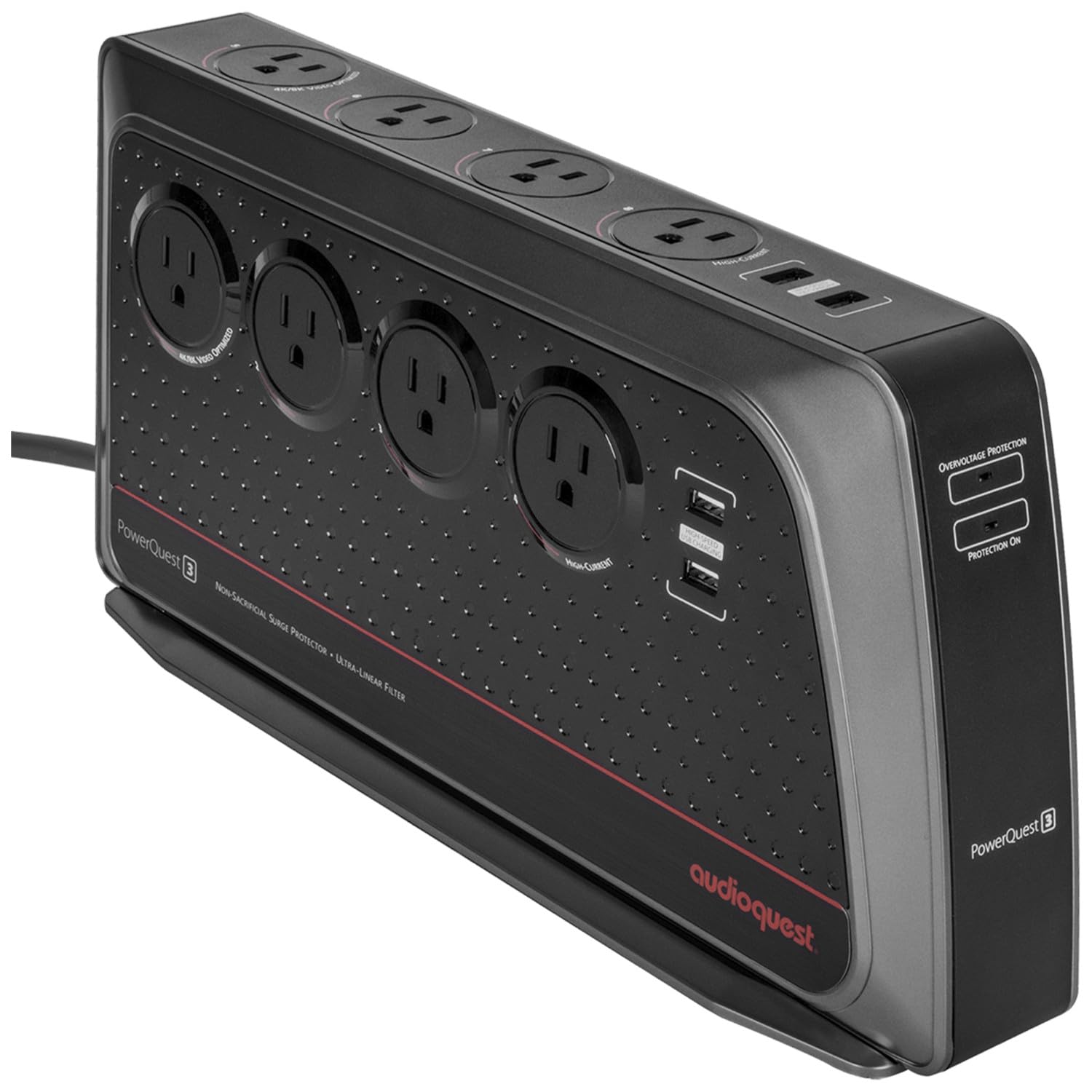
The AudioQuest PowerQuest 3 focuses on a critical niche: non-sacrificial surge protection combined with ultra-linear noise dissipation. Traditional MOV-based surge protectors degrade after each clamping event, slowly losing their protective ability. The PowerQuest 3’s design does not rely on sacrificial components, meaning it maintains the same level of protection for the life of the unit. Its catastrophic surge protection circuit safely shunts extreme events to ground without requiring replacement.
The eight outlets are divided into three zones: two outlets with 4K/8K video-optimized ultra-linear filtering, two high-current outlets for amplifiers, and four standard ultra-linear filtered outlets. The video-optimized outlets are specifically tuned to remove noise in the frequency ranges that affect HDMI signal integrity, which users report results in smoother color gradients, deeper blacks, and reduced viewing fatigue. Two high-speed USB-A charging ports provide 2.4A per port for peripherals.
Listeners describe the sonic improvement as a widened soundstage, clearer highs, and tighter bass without altering the tonal balance. The PowerQuest 3 is also lighter than full-rack units at only 2 pounds, making it easy to place on a shelf behind a credenza. The plastic chassis is less substantial than metal alternatives, but the internal filtering topology is genuinely advanced. For video-first systems or gamers pairing a PS5 with an OLED TV, this is a cost-effective upgrade.
Why it’s great
- Non-sacrificial catastrophic surge protection.
- Dedicated 4K/8K video-optimized filtered outlets.
- USB-A charging ports rated at 2.4A each.
Good to know
- Plastic enclosure feels less durable than metal racks.
- Only 8 outlets for larger component totals.
5. Tripp Lite LC2400

The Tripp Lite LC2400 is fundamentally an automatic voltage regulator with line conditioning built in, prioritizing power stability over extreme noise filtering. It accepts an input range of 87 to 140 volts and uses a multi-tap transformer to boost or buck the output, holding it between 114 and 126 volts. This is the right tool when your primary issue is brownouts, voltage sags from large appliances, or generator power, rather than subtle noise artifacts.
Its six outlets include four NEMA 5-15R and two NEMA 5-20R connectors, allowing it to serve higher-current equipment like power amplifiers or workstation computers. The EMI/RFI filter removes up to 80 dB of line noise, which is respectable for a voltage-focused unit. The 1440-joule surge suppression provides network-grade protection, and the diagnostic front-panel LEDs show incoming voltage level and line status at a glance. A 6-foot NEMA 5-15P cord is included, but the full 2400W capacity requires a 20-amp outlet and a 5-20P plug (sold separately).
Real-world testing shows the LC2400 eliminates equipment shutdowns caused by fluctuating building voltage—a common problem in older apartments or shared office spaces. Musicians on tour use it to solve glitches from venue power. It runs warm but not hot, and the internal transformer produces no audible hum. The LC2400 will not provide the blackest background for high-end phono stages, but for voltage-sensitive systems in unstable electrical environments, it is a critical protection tool.
Why it’s great
- Wide input range regulation (87–140V to 114–126V).
- Up to 80 dB EMI/RFI noise filtering.
- Two NEMA 5-20R outlets for high-current gear.
Good to know
- Full 2400W capacity needs a 20A circuit and plug.
- Not designed for the deepest noise floor reduction.
6. Panamax MR4300

The Panamax MR4300 is the entry point into genuine power conditioning from a brand with decades of AV protection expertise. It features Panamax’s Level 3 Noise Filtration, which targets the frequency ranges most audible in audio and video systems, and Automatic Voltage Monitoring (AVM) that disconnects power if the incoming line drifts into unsafe territory. This is a Protect or Disconnect design: if the conditioner cannot keep the voltage within safe limits, it shuts off rather than passing damaging power to your gear.
Nine outlets are distributed across the rear panel, all protected and filtered. The front panel includes a USB charging slot and a digital voltmeter that displays incoming voltage with adjustable brightness. The Lifetime Connected Equipment Protection Policy covers up to , backed by Panamax’s 30-year history. The chassis uses a mix of copper and plastic with a durable black finish that blends into most AV racks.
Owners report that the MR4300 improves sound clarity and reduces listening fatigue, particularly in systems previously plagued by a digital edge in the treble. Some users note that it did not eliminate all grounding issues—a hum from a power amplifier was only solved by drawing power from a separate circuit. It also survived multiple power drops and surges without failure, resetting to full function after each event. For a mid-range first conditioner, it offers the best warranty and build quality at its price point.
Why it’s great
- Level 3 filtration with AVM disconnect protection.
- Lifetime Connected Equipment Policy.
- Adjustable brightness voltmeter and USB slot.
Good to know
- Cannot resolve ground-loop hum from shared circuits.
- Not rack-mountable without additional hardware.
7. WAudio AC Noise Conditioner W-5900

The WAudio W-5900 is a value-oriented power conditioner that prioritizes essential protections over premium filtering depth. It offers twelve AC outlets, split into eight filtered and four direct (non-filtered) ports, giving users the option to keep high-current amplifiers on unfiltered paths while shielding digital sources. The metal chassis with aluminum plates provides decent shielding against external RFI, and the front-panel VU meter adds a vintage aesthetic while showing incoming voltage levels.
The unit includes overload protection that trips at 15 amps with a reset button, automatic phase detection with an indicator light, and basic surge and spike clamping. Its voltage protection circuit disconnects power during dangerous voltage irregularities. The six-foot power cord terminates in a standard NEMA 5-15P plug. The overall build quality is solid for the class, with a clean silver finish that suits shelf or desktop placement.
User experiences are mixed at this tier. Many confirm that the W-5900 provides audible improvement—tighter low-end punch and a quieter background—at a fraction of the cost of name-brand units. Others report early failures with indicator lights or a lack of dramatic noise reduction in already-clean circuits. The W-5900 is best viewed as an affordable step up from a raw power strip for small home theater setups or desktop audio rigs where budget is the primary constraint and absolute noise floor depth is secondary.
Why it’s great
- 12 outlets with 8 filtered and 4 direct paths.
- Metal chassis with aluminum plates for shielding.
- Front-panel VU meter and phase detection indicator.
Good to know
- Build quality inconsistencies reported by some users.
- Limited filtering depth compared to premium units.
FAQ
Will an audiophile power conditioner eliminate hum from my speakers?
Do I need a voltage regulator or just a power conditioner?
What is the difference between a power conditioner and a UPS?
How many outlets do I need for my audio system?
Final Thoughts: The Verdict
For most users, the best audiophile power conditioner winner is the Furman Elite-15 PF i because it provides the deepest noise filtering, robust surge protection, and a clean power factor for transient-demanding amplifiers. If you need automatic voltage regulation to combat fluctuating wall voltage, grab the Furman P-1800 AR. And for complex multi-component systems requiring maximum isolation between digital and analog stages, nothing beats the outlet-bank architecture of the Panamax M5300-PM.

Mo Maruf
I created WellFizz to bridge the gap between vague wellness advice and actionable solutions. My mission is simple: to decode the research and give you practical tools you can actually use.
Beyond the data, I am a passionate traveler. I believe that stepping away from the screen to explore new environments is essential for mental clarity and physical vitality.