Our readers keep the lights on and my smoothie glass nicely filled. As an Amazon Associate, I earn from qualifying purchases.
The difference between a decent computer speaker and an audiophile-grade set isn’t just volume—it’s the ability to separate a snare hit from a hi-hat in a dense metal track, or hear the recording engineer’s breath before the first verse. For anyone who spends hours at a desk editing, mixing, or simply obsessing over their playlist, the jump in transient response and stereo imaging transforms the experience from background noise to critical listening.
I’m Mohammad Maruf — the founder and writer behind WellFizz. I’ve spent years analyzing audio hardware specifications, from crossover slopes to power supply topologies, to separate genuine performance gains from marketing hype in the desktop audio space.
This guide cuts through the spec sheet noise to help you find the pair that matches your space and standards, covering everything from active monitors with ribbon tweeters to powered bookshelf speakers with HDMI ARC. Whether you’re hunting for best audiophile computer speakers for a home studio or a gaming rig, the right set delivers detail without fatigue.
How To Choose The Best Audiophile Computer Speakers
Jumping into the world of high-fidelity desktop audio means evaluating a few key specs that go far beyond wattage. The right decision hinges on your room size, source equipment, and whether you need a subwoofer to fill the bottom octave.
Driver Configuration and Tweeter Type
The tweeter is your window into the high-frequency sparkle. Soft dome tweeters (silk or textile) deliver a warm, non-fatiguing top end ideal for long sessions. Ribbon and AMT (Accelerated Ribbon Tweeter) designs offer faster transient response and wider dispersion but can be unforgiving with poorly recorded material. The woofer material also plays a role: paper cones offer natural warmth, aluminum provides rigidity and low distortion, and woven Kevlar excels in punch and longevity.
Amplification and Power Handling
Active speakers with bi-amplification (separate amp channels for tweeter and woofer) generally offer cleaner crossover points and more headroom than passive setups requiring an external amp. Look for RMS wattage that matches your listening distance—50W per channel is often enough for near-field desktop use, while 100W+ suits larger rooms and higher dynamic peaks without compression.
Input Flexibility and DAC Quality
For a computer-centric setup, USB-C or USB-B input bypasses your PC’s internal sound card and uses the speaker’s built-in DAC. This matters more than Bluetooth codec support for latency-free, high-resolution playback. If you plan to connect a turntable or game console, check for RCA, optical (Toslink), or HDMI ARC inputs. A subwoofer output with a built-in crossover (typically 80-100 Hz) simplifies integrating a dedicated sub.
Quick Comparison
On smaller screens, swipe sideways to see the full table.
| Model | Category | Best For | Key Spec | Amazon |
|---|---|---|---|---|
| Edifier S3000MKII | Premium Bookshelf | High-Resolution Reference Listening | Planar Magnetic Tweeter | 6.5″ Woofer | Amazon |
| Vanatoo Transparent One Encore Plus | Powered Monitor | Near-Field Critical Monitoring | 240W RMS | Multi-Input DSP | Amazon |
| KRK RP8G5 ROKIT 8 Gen 5 | Studio Monitor | Mixing & Game Audio Detail | 8″ Kevlar Woofer | 25 EQ Combos | Amazon |
| Edifier S1000W WiFi | Active Bookshelf | Multi-Room Wi-Fi Streaming | 120W RMS | AirPlay 2 | 5.5″ Woofer | Amazon |
| ELAC Debut ConneX | Powered Bookshelf | TV + Music Hybrid Desk Setup | HDMI ARC | 4.5″ Woofer | 2x50W | Amazon |
| ADAM Audio D3V | Desktop Monitor | Ultra-Compact Precision Monitoring | D-ART Ribbon Tweeter | 45Hz Bass | Amazon |
| Kanto ORA | Compact Active | Space-Saver with Subwoofer Upgrade | USB-C | 100W | 70Hz – 22kHz | Amazon |
| Audio-Technica AT-SP3X | Entry-Level Active | Simple Bluetooth Desktop Upgrade | Bluetooth Multipoint | 3″ Driver | Amazon |
| Polk Signature Elite ES10 | Passive Surround | Home Theater Surround Integration | Power Port | 4″ Woofer | Walnut | Amazon |
In‑Depth Reviews
1. Edifier S3000MKII

The Edifier S3000MKII represents a serious step up in driver engineering for the desktop audiophile. Each cabinet houses a planar magnetic tweeter paired with a 6.5-inch long-throw aluminum diaphragm mid-bass driver, a combination that delivers airy, extended highs with very low distortion and bass that can pressurize a medium room without a sub. The tweeter’s low mass and large diaphragm area produce transient attack that soft domes simply cannot match, making cymbal decays and string harmonics feel present and three-dimensional.
Connectivity covers high-res USB audio up to 24-bit/192kHz, Bluetooth 5.0 with aptX HD, optical, coaxial, and balanced XLR inputs. The wireless inter-speaker link uses a proprietary 5.8GHz connection to eliminate the need for a speaker cable between channels, though each speaker still needs wall power. The included IR remote controls volume, bass, treble, and input selection. At this tier, the separation and clarity outpace many passive bookshelf systems that cost considerably more once you add an amplifier.
Build quality is excellent—heavy MDF cabinets with wood veneer, substantial binding posts, and a polished aesthetic. The downside is the physical footprint: these are true bookshelf speakers, not compact desktop monitors, so they demand adequate desk or stand space. The mid-bass driver benefits from some break-in time, and the speakers respond well to positioning adjustments. For a primary listening system that bridges high-end home audio and pro-grade desktop fidelity, the S3000MKII is a benchmark.
Why it’s great
- Planar magnetic tweeter delivers exceptional high-frequency detail and low distortion.
- 6.5-inch aluminum woofers produce deep, controlled bass without requiring a sub for many genres.
- Comprehensive input options with a robust in-built DAC up to 24/192kHz.
Good to know
- Large physical size may overwhelm small desks.
- Both speakers need access to a power outlet, limiting placement flexibility.
2. Vanatoo Transparent One Encore Plus

Vanatoo’s Transparent One Encore Plus is a compact powered speaker system purpose-built for the desktop. It packs 240 watts RMS of amplifier power into cabinets that remain small enough to fit under a monitor without looking excessive. The sound signature leans neutral and flat, designed to reveal what the recording engineer heard rather than flattering the material. This makes it ideal for critical listening—you hear compression artifacts, room reflections, and mix imbalances with uncomfortable clarity.
The input panel is one of the most versatile in this class: USB audio, Toslink optical, coaxial, Bluetooth 5.1, and analog AUX. Vanatoo’s automatic input switching works reliably, detecting which source is active and switching without manual intervention. The remote controls volume, bass, treble, balance, and subwoofer output level. The built-in DSP manages a crossover that automatically engages when you connect a subwoofer, offloading low-end duties so the main drivers can focus on midrange and vocal clarity.
A notable caveat is a slight tweeter hiss audible at close listening distances (under three feet) in quiet passages, though it disappears once music plays. The proprietary speaker cable between the active and passive unit is a limitation if you ever need longer runs. For near-field mixing and detailed analytical listening, these speakers provide a level of precision that few all-in-one systems can touch, and they integrate seamlessly with a dedicated subwoofer for full-range performance.
Why it’s great
- Neutral, flat frequency response ideal for critical listening and mixing decisions.
- Generous amplifier headroom with no audible distortion at moderate levels.
- Automatic input switching simplifies a multi-source desktop workflow.
Good to know
- Minor tweeter hiss at very close range in silent moments.
- Proprietary cable between speakers limits custom wire routing.
3. KRK RP8G5 ROKIT 8 Gen 5

The KRK RP8G5 is a no-compromise 8-inch studio monitor built for accuracy in the near-field. Its woven Kevlar aramid fiber woofer delivers tight, articulate low-end that handles sub-bass synth lines and kick drum thwacks without bloat or port chuffing. The fifth generation improves on the previous iteration with a revised low-diffraction baffle that reduces edge reflections, tightening the stereo image and improving off-axis consistency. For a desktop setup, the full-range response from 45 Hz upward is impressive, though the 8-inch driver demands enough room to breathe.
The onboard DSP offers 25 boundary and tuning EQ combinations, a powerful tool for compensating for desk placement, wall proximity, and room nodes. The front-firing port design allows placement closer to a rear wall than rear-ported alternatives. Inputs include balanced XLR and 1/4-inch TRS combo jacks, making these a natural fit for audio interfaces and studio gear. The included acoustic foam isolation pads decouple the monitors from the desk surface to reduce low-frequency resonance.
These are not casual speakers—they reveal poor source material mercilessly, and the 8-inch woofer can overpower a small untreated room, causing modal issues below 100 Hz. For serious mixing and gaming where positional audio matters, the imaging is top-tier. The white baffle option is polarizing but helps with visibility in a dim studio. Pair with a reliable audio interface and room treatment for best results.
Why it’s great
- 8-inch Kevlar woofer delivers authoritative bass with minimal distortion.
- Flexible DSP EQ system adapts to varied room acoustics and placement.
- Excellent stereo imaging for critical mixing and spatial audio in games.
Good to know
- Large 8-inch drivers require a spacious desk and careful positioning.
- Revealing nature may sound harsh with low-bitrate or poorly mastered tracks.
4. Edifier S1000W WiFi

The Edifier S1000W brings Wi-Fi streaming and multi-room functionality into a traditionally wired active bookshelf speaker design. It supports AirPlay 2, Spotify Connect, and Tidal Connect, which means you can stream lossless audio directly without relying on Bluetooth compression. The built-in Wi-Fi module also works with Alexa for voice control, and the Edifier ConneX app allows grouping with other compatible speakers for whole-home playback. This makes the S1000W a rare hybrid: a near-field listening speaker that doubles as a smart home audio node.
The acoustic hardware includes a 1-inch silk dome tweeter and a 5.5-inch aluminum cone woofer, powered by 120W RMS of total amplification. The sound is warm and detailed, with a balanced midrange that handles vocals naturally. Bass extension is respectable for the driver size, reaching around 40 Hz in-room. The heavy MDF cabinets with real wood side panels minimize resonance and give the speakers a premium feel that matches their price point. Inputs beyond Wi-Fi include Bluetooth 5.0, optical, coaxial, and dual RCA.
One limitation is the remote—it’s small and easy to misplace, and without it, changing inputs or volume on the back panel is awkward. The tweeter exhibits a faint hiss if you put your ear within inches of the driver, but it’s inaudible at typical listening distances. For anyone who wants high-resolution audio from streaming services without a separate DAC or network streamer, the S1000W is a convenient all-in-one solution.
Why it’s great
- Wi-Fi streaming with AirPlay 2 and Spotify Connect preserves high-resolution audio.
- Heavy MDF cabinets with real wood veneer reduce cabinet resonance.
- Multi-room grouping via app for whole-home audio distribution.
Good to know
- Remote control is required for convenient input and volume changes.
- Tweeter hiss is present at very close proximity, though not audible at the desk.
5. ELAC Debut ConneX
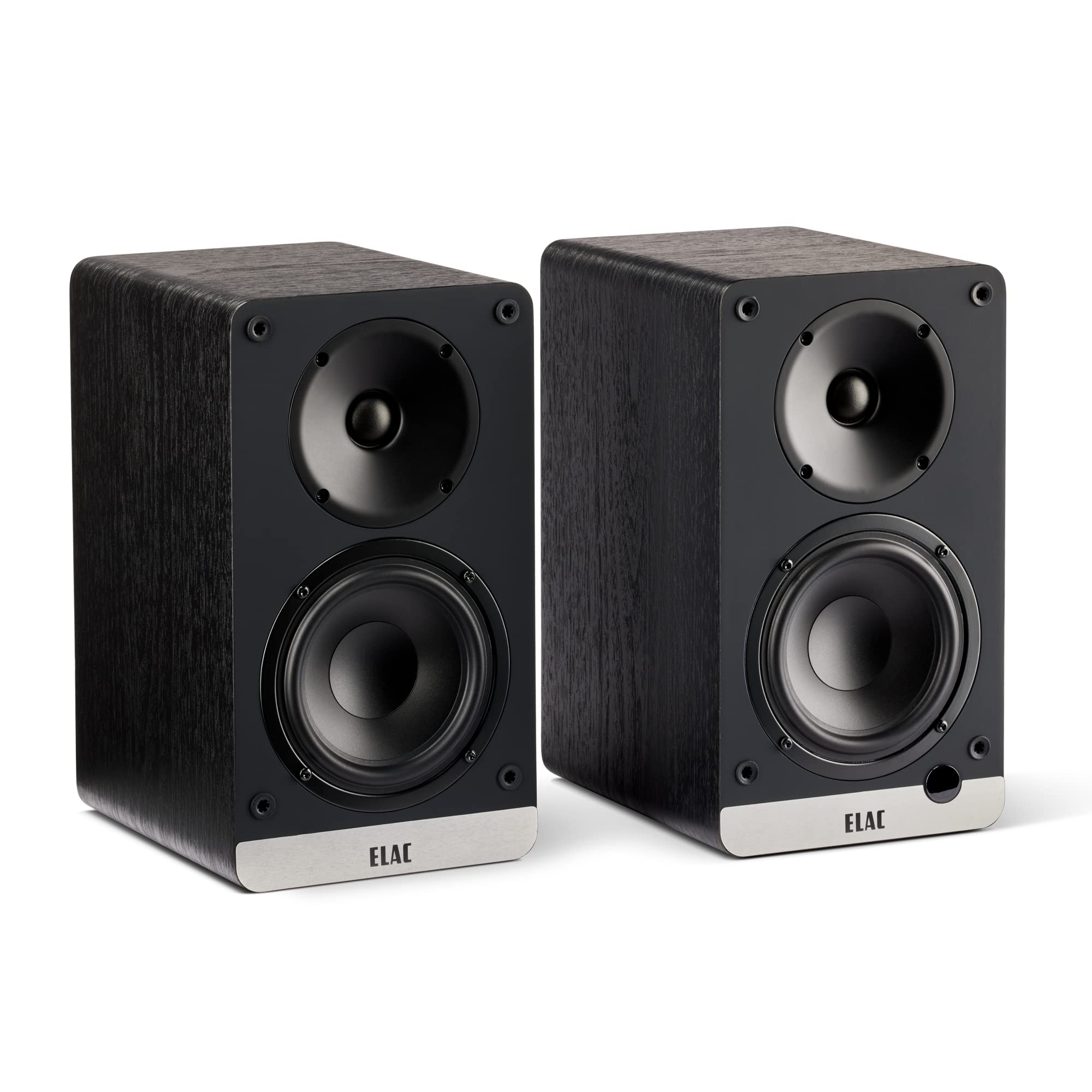
The ELAC Debut ConneX occupies a unique niche among active desktop speakers: it offers an HDMI ARC input, which simplifies connecting to a TV and letting the TV remote control volume. This is a rare feature in the audiophile speaker space and makes the ConneX an excellent choice for a dual-purpose desk setup—music production during the day, movie watching at night. The amplifier delivers 50 watts per channel to a 4.5-inch woofer and a 3/4-inch soft dome tweeter, a modest setup that trades raw loudness for composure at moderate volumes.
The sound is clear and well-composed, with the wool-like paper cone woofer providing a natural, uncolored midrange. Highs are smooth and non-fatiguing, which suits long listening sessions. The built-in phono preamp is a nice touch for turntable owners looking to simplify their signal chain. Inputs also include USB, optical, and Bluetooth, plus a subwoofer output for later expansion. The remote control is necessary for power toggling and input selection, as there is no physical on/off switch on the speakers.
Potential desktop users should be aware that the USB input introduces a notable audio delay (~0.25 seconds), which causes sync issues in games and missed Windows notification sounds. This makes the ConneX a poor choice for gaming or video editing via USB, but optical input avoids this problem entirely. The lack of bass and treble EQ knobs means you rely solely on source material and room placement. For a living room or a desk where optical or HDMI is the primary connection, these are a strong mid-range contender.
Why it’s great
- HDMI ARC input allows seamless TV integration with CEC volume control.
- Built-in phono preamp eliminates the need for an external stage with turntables.
- Natural, uncolored sound signature with smooth highs for fatigue-free listening.
Good to know
- USB input has significant latency, unsuitable for gaming or video editing.
- No physical power switch or tone controls on the speaker panel.
6. ADAM Audio D3V
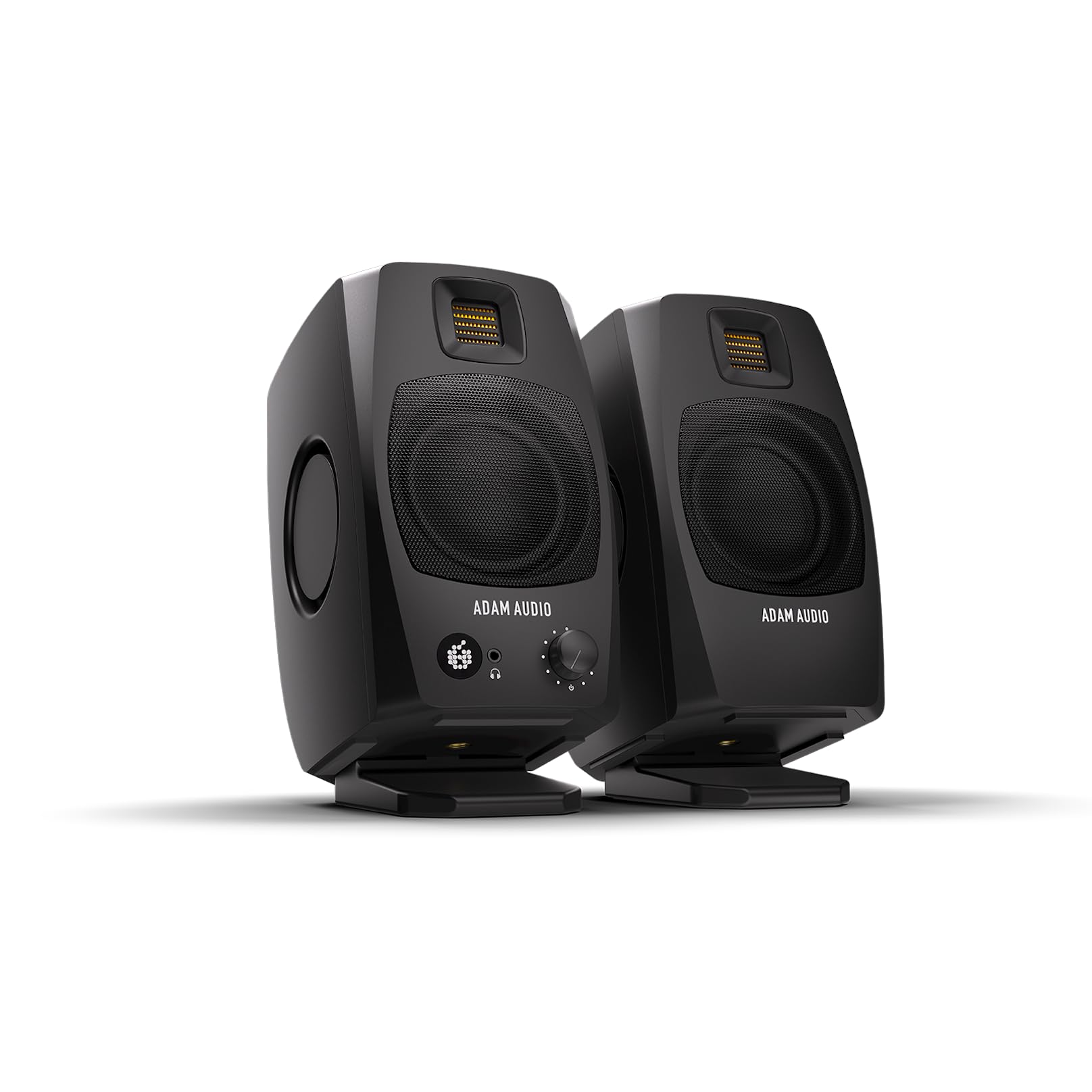
The ADAM Audio D3V is a fully active desktop monitoring system that packs a surprising amount of engineering into its small frame. It uses a 1.5-inch D-ART (Desktop Accelerated Ribbon Tweeter) derived from ADAM’s professional studio monitors, paired with a 3.5-inch aluminum woofer and dual-sided 3.5-inch passive radiators. This combination achieves a claimed low-end extension down to 45 Hz, which is genuinely impressive for a system this compact. The ribbon tweeter provides the same detailed, non-fatiguing high-frequency reproduction that makes ADAM’s larger monitors a studio favorite.
The left speaker’s backplate houses USB-C input, balanced 1/4-inch TRS inputs, and DSP-controlled switches to compensate for boundary effects and desk placement. The front panel includes a headphone jack and a volume knob. The included detachable stands angle the speakers at 15 degrees toward the listener, directly addressing a common near-field alignment issue without needing aftermarket stands. A standard 3/8-inch threaded mount on the bottom allows microphone stand or boom arm mounting for flexible placement.
Critically, the USB input operates at 16-bit, which can sound slightly dry and boxy in the midrange compared to feeding the speakers through a high-quality external DAC via the TRS inputs. The auto-sleep mode is adjustable via firmware, but there is no auto-sense for input switching—you must double-press the volume knob to toggle sources. For the size, the imaging and bass extension are best-in-class, but achieving full-fidelity results may require an external DAC.
Why it’s great
- Ribbon tweeter offers exceptional transient speed and high-frequency air.
- 45 Hz bass extension from a compact dual-radiator system is remarkable.
- Included angled stands ensure proper near-field alignment out of the box.
Good to know
- USB input is limited to 16-bit, which may sound boxy; an external DAC improves this.
- No automatic input switching—manual toggle required between sources.
7. Kanto ORA

Kanto’s ORA speakers aim to deliver near-studio-grade sound from a footprint that fits sideways under a monitor. Each cabinet houses a 3-inch paper cone woofer and a 3/4-inch silk dome tweeter, powered by 100W of bi-amplified Class-D amplification with DSP tuning. The sound is impressively linear for the size, with a laid-back treble that avoids fatigue over long sessions. Bass rolls off around 70 Hz, but the built-in crossover network automatically engages when a subwoofer is connected, offloading sub-bass duties to allow the ORA to play louder with less distortion.
Inputs include USB-C (for high-quality PC audio), Bluetooth 5.0 (for convenient phone streaming), and RCA (for analog gear). The USB-C connection allows OS-level volume control, a significant convenience for desktop users. The rear mount thread (1/4-inch-20) allows wall or ceiling mounting. The magnetically shielded drivers also make these safe to place directly next to older CRT monitors or high-end PVMs, appealing to retro computing enthusiasts. The cabinet is plastic, which limits overall mass, but the DSP tuning compensates effectively.
Some users find the out-of-box soundstage slightly flat, requiring a parametric EQ (like Equalizer APO) to pull out the detail in complex tracks. The notch at 400 Hz reduces midrange muddiness by design but can sound recessed to certain ears. The plastic enclosure has a visible assembly seam that detracts from the premium aesthetic. For a compact desktop system where space is at a premium and a subwoofer is part of the plan, the ORA delivers remarkable performance.
Why it’s great
- USB-C input with OS-level volume control simplifies desktop integration.
- Automatic subwoofer crossover improves headroom and clarity.
- Small footprint fits under a monitor or sideways on a cluttered desk.
Good to know
- Plastic cabinet with visible assembly seam feels less premium than wood alternatives.
- Out-of-box sound may benefit from software EQ to widen the soundstage.
8. Audio-Technica AT-SP3X

The Audio-Technica AT-SP3X is an entry-level active bookshelf speaker designed for simplicity and versatility. It features 3-inch full-range drivers housed in compact plastic enclosures, with Bluetooth 5.0 and dual RCA inputs for connecting a computer, turntable, or smartphone. The multipoint Bluetooth function allows you to stay connected to two devices simultaneously, making it easy to switch between a laptop and a phone without re-pairing. The front panel includes a volume dial and a power button with a built-in LED indicator.
Sonic performance is surprisingly lively for the size and price tier. The speakers lean slightly bass-forward, which gives a satisfying warmth for pop, rock, and electronic genres. They get loud enough to fill a small room without obvious distortion, though the 3-inch driver naturally lacks sub-bass extension below 100 Hz. The soundstage is adequate for casual listening but not wide enough for critical mixing—instruments can blur together in complex arrangements. The included international plug adapters make this a travel-friendly option for digital nomads.
Build quality is acceptable for the price, but the plastic enclosures feel light and can resonate at higher volumes. There is no subwoofer output, meaning you cannot easily add a sub later without a separate preamp. The lack of a DAC bypass means audio quality depends on your source device’s internal conversion. For a clean, affordable upgrade from laptop speakers or a first step into powered speakers for a turntable setup, the AT-SP3X is a functional, low-friction choice.
Why it’s great
- Bluetooth multipoint connects two devices simultaneously for easy switching.
- Surprisingly punchy and warm sound from a compact, budget-friendly package.
- International plug adapters included, making it travel-friendly.
Good to know
- Plastic enclosures can resonate at higher volumes, limiting clarity.
- No subwoofer output, blocking easy low-end expansion.
9. Polk Signature Elite ES10

The Polk Signature Elite ES10 is a passive surround speaker, meaning it requires an external amplifier or AV receiver to operate. This places it in a different category from the active speakers on this list—it is designed for those building a home theater or expanding an existing system with surround channels. The cabinet houses a 1-inch Terylene tweeter and a 4-inch woofer, with Polk’s patented Power Port technology that extends bass response by reducing port turbulence. The result is a cleaner low-end than typical budget surround speakers.
Sound quality is clear and neutral, with a balanced presentation that works well for both movie dialogue and music playback. The high sensitivity rating means they achieve good volume with modest amplifier power. They are compatible with Dolby Atmos and DTS:X AV receivers, supporting the latest object-based surround formats. Placement options are flexible: keyhole slots and screw inserts allow wall mounting, or they can sit on standard speaker stands. The contemporary walnut finish looks attractive, though it is a vinyl wrap rather than real wood veneer.
Bass extension rolls off below 80 Hz, so these are not meant to operate without a subwoofer in a full-range system. As a standalone desktop pair, they lack the deep bass needed for music listening, but as surrounds in a 5.1 or 7.1 setup, they excel. The price point is competitive for a pair of high-quality surrounds with Power Port technology. Buyers should budget for a separate amplifier or AVR and a subwoofer for a complete system.
Why it’s great
- Power Port technology delivers cleaner bass with less port noise than typical ported designs.
- High sensitivity works well with modest external amplification.
- Flexible wall-mounting options and a sleek contemporary finish.
Good to know
- Passive speakers require an external amplifier or AVR—not a plug-and-play setup.
- Bass rolls off below 80 Hz, necessitating a subwoofer for full-range performance.
FAQ
Do I need a subwoofer with audiophile computer speakers?
What is the difference between a studio monitor and an audiophile speaker for desktop use?
Should I choose active or passive speakers for a computer setup?
Final Thoughts: The Verdict
For most users, the best audiophile computer speakers winner is the Edifier S3000MKII because its planar magnetic tweeter and 6.5-inch woofers deliver a level of air, detail, and bass authority that few competitors match at this tier. If you want uncompromising near-field accuracy for mixing and critical listening, grab the Vanatoo Transparent One Encore Plus. And for a compact desk that demands studio-grade clarity from a small footprint, nothing beats the ADAM Audio D3V with its ribbon tweeter and extended bass radiators.

Mo Maruf
I created WellFizz to bridge the gap between vague wellness advice and actionable solutions. My mission is simple: to decode the research and give you practical tools you can actually use.
Beyond the data, I am a passionate traveler. I believe that stepping away from the screen to explore new environments is essential for mental clarity and physical vitality.