Our readers keep the lights on and my smoothie glass nicely filled. As an Amazon Associate, I earn from qualifying purchases.
Every streaming service, phone call, and notification noise in your pocket is a tiny intruder. A dedicated MP3 player is the only honest way to reclaim your digital silence — a closed ecosystem where signal purity matters more than screen size, app updates, or push notifications. The difference between a smartphone headphone jack and a true audio-grade DAC isn’t a mystery; it’s physics, and the upgrade is audible immediately.
I’m Mohammad Maruf — the founder and writer behind WellFizz. I have spent hundreds of hours analyzing circuit board schematics, DAC chip specifications, and real-world impedance charts to identify which portable players actually deliver on their noise-floor and dynamic range claims.
Whether you are rediscovering old FLAC files or extracting new detail from familiar master tracks, choosing the right audio quality mp3 player transforms how you hear recorded music — every micro-dynamic, every room echo, every carefully mixed layer becomes audible again.
How To Choose The Best Audio Quality MP3 Player
Choosing an audio-quality-focused MP3 player is not about picking the most expensive option — it is about matching your headphone impedance, preferred file format, and listening environment to the correct amplifier topology and DAC architecture. A mismatch here erases the benefit of a premium player.
DAC Chip Architecture: Delta-Sigma vs. R2R
Most modern players use Delta-Sigma DACs like the ESS ES9018K2M or Cirrus Logic CS43198 — they offer excellent measured performance (low THD+N, high SNR) and are ideal for analytical, detailed playback. R2R ladder DACs, like those in the FiiO M33, use a physically different resistor network that produces a warmer, more analog-sounding tonal character. Neither is “better,” but the difference is immediately audible — choose R2R if you prefer smooth, organic timbre over clinical precision.
Output Power and Balanced Outputs
Milliwatts matter. A player delivering 70mW into 32Ω is fine for sensitive IEMs, but driving 300Ω Sennheiser HD600s requires 500mW or more, ideally through a 4.4mm balanced output. Balanced reduces ground noise and doubles voltage swing. If your headphones are power-hungry, skip players below 200mW balanced and look for dedicated high-gain modes.
Bluetooth Codecs and Wired Priority
LDAC and aptX HD enable high-resolution wireless streaming, but Bluetooth compression still discards data. For maximum fidelity, wired playback through a 3.5mm or 4.4mm jack is mandatory. A player should have excellent Bluetooth as a convenience feature, not a primary listening path — if Bluetooth is your main use, you are not getting best audio quality.
Quick Comparison
On smaller screens, swipe sideways to see the full table.
| Model | Category | Best For | Key Spec | Amazon |
|---|---|---|---|---|
| FiiO M21 | Premium Mid | Desktop Mode Hybrid | 950mW Balanced Output | Amazon |
| HiBy R4 | Premium | Streaming + High-Power | Quad DAC + Class A Amp | Amazon |
| JadeAudio/FiiO JM21 | Mid-Range | Feature-Packed Entry DAP | 700mW + 700mW Balanced | Amazon |
| SHANLING M1 Plus | Mid-Range | Ultra-Compact Travel | 660mW @ 32Ω Balanced | Amazon |
| HIFI WALKER H2 | Entry | Budget Bluetooth/Audiophile | ESS ES9018K2M DAC | Amazon |
| MECHEN M30 | Value | Budget Lossless DSD | WM8965 + TI TPA6530 | Amazon |
| FiiO M33 R2R | Flagship | R2R Analog Sound | 1100mW R2R Balanced | Amazon |
In‑Depth Reviews
1. FiiO M21
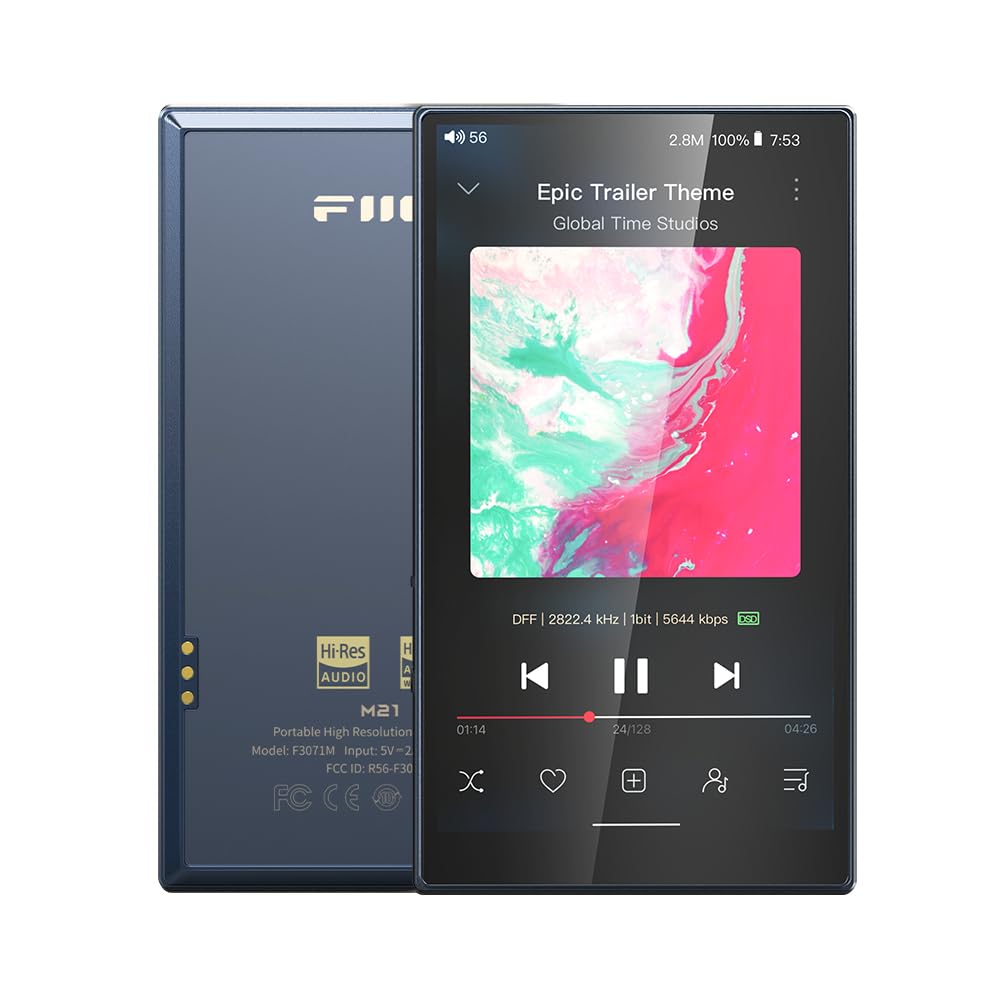
The FiiO M21 occupies a rare middle ground — it is powerful enough to drive full-size planar headphones (950mW balanced) yet compact enough for daily carry. Its quad CS43198 DAC matrix and fully balanced two-stage amplification produce exceptionally low noise floor and wide channel separation, revealing micro-details that cheaper players smear over.
What sets the M21 apart is its patented Desktop Mode: when docked, the player runs entirely on external power, bypassing battery charging and extending the cell’s lifespan. This is a genuine long-term durability feature that competing players at similar output levels simply do not offer. Android 13 with 4GB+64GB ensures smooth app support for Tidal, Qobuz, and USB Audio Player Pro.
The DSP-based PEQ (parametric equalizer) is one of the most flexible in this class, allowing precise notch adjustments without introducing distortion artifacts. Some users report occasional firmware quirks, but unit-to-unit consistency is solid.
Why it’s great
- Desktop mode preserves battery chemistry for years
- 950mW balanced drives demanding headphones with headroom
- Quad CS43198 DACs deliver extremely low noise floor
Good to know
- Android UI can feel slightly dated compared to newer flagships
- Internal WiFi antenna is a known failure point in some units
2. HiBy R4

The HiBy R4 is built around four discrete DAC chips and a Class A headphone amplifier — an unusual architecture for its price bracket. Class A amplification runs hot and draws more battery, but the payoff is linear, low-distortion output that preserves transient attack and decay better than Class AB or D designs. The internal 28 tantalum capacitors and separate DSD circuitry further clean the signal path.
Android 12 with SRC (sample rate conversion) bypass ensures that streaming apps like Tidal and Qobuz output bit-perfect audio without Android’s resampling layer corrupting the signal. The 4.7-inch LCD is responsive enough for app navigation, and physical FN keys provide tactile shortcuts for volume, play, and track control without looking at the screen.
The biggest complaint among owners is reliability inconsistency — some units brick overnight, and warranty service requires international shipping. When functioning correctly, the R4’s combination of streaming flexibility and Class A power is unmatched at this level.
Why it’s great
- Class A amp delivers ultra-low distortion bass and treble extension
- SRC bypass preserves native sample rates from streaming apps
- Expandable to 2TB for massive local libraries
Good to know
- Some units experience random bricking overnight
- Battery life drops significantly when using Class A mode
3. JadeAudio/FiiO JM21

The JM21 was the world’s first portable player powered by the Snapdragon 680 (6nm), which gives it a huge efficiency and UI fluidity advantage over older MediaTek-based competitors. Dual CS43198 DACs and dual SGM8262 op-amps produce 700mW+700mW of balanced output — enough to drive 300Ω headphones like the HD600 to satisfying levels without an external amp.
Android 13 with Pure Mode strips away all non-essential functions, creating a distraction-free listening environment that still supports Apple Music, Spotify, and Tidal. The 4.7mm thickness and 156g weight make it genuinely pocketable — notable given the power it delivers. Battery life hits about 12.5 hours in mixed use, and idle drain in Pure Mode is minimal.
The main drawback is build quality: the finish is plastic and can flake, and the balanced port has been reported to fail after months of use. Sound quality, however, is consistently excellent for the price — clean, with good imaging and dynamic swing.
Why it’s great
- 700mW balanced output rivals players costing twice as much
- Snapdragon 680 provides smooth Android 13 performance
- Pure Mode eliminates distractions during critical listening
Good to know
- Plastic shell can flake along edges within weeks
- 4.4mm balanced port durability is a known concern
4. SHANLING M1 Plus
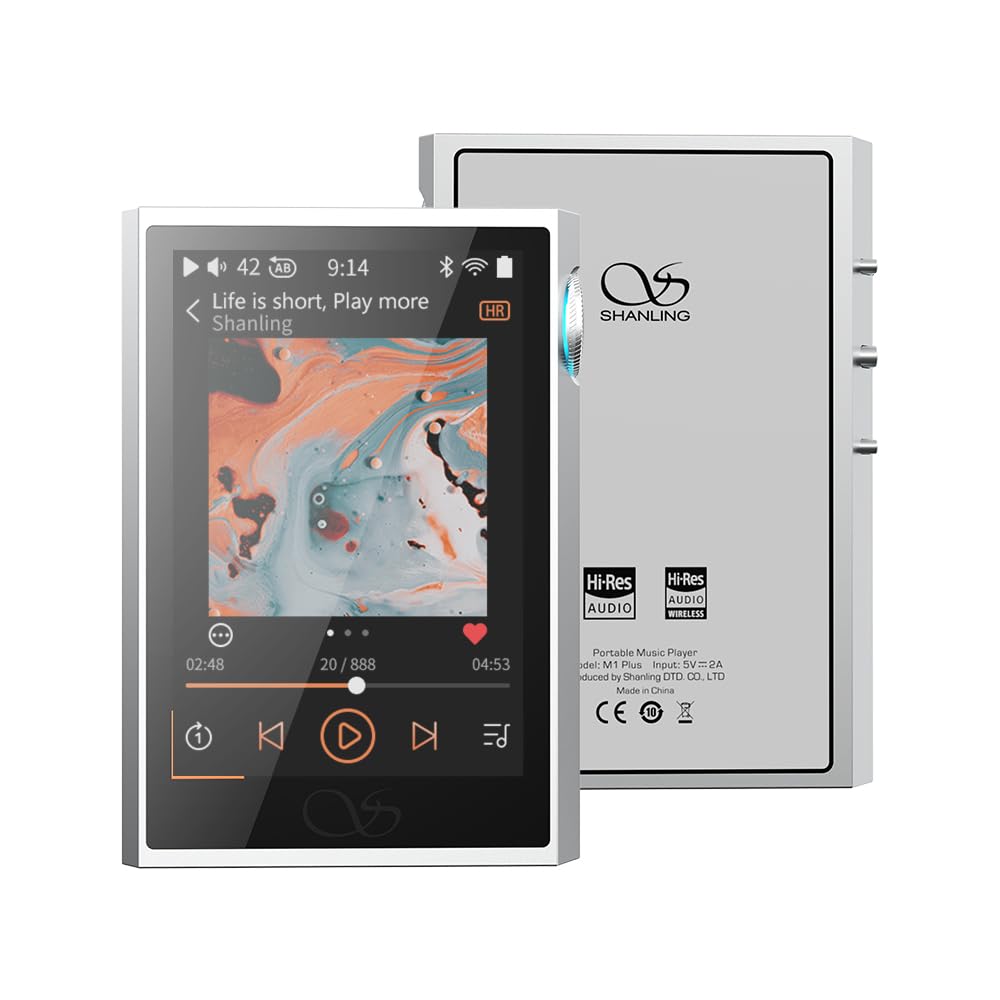
The SHANLING M1 Plus proves that small size does not require sacrificing output power. At 116g and 17mm thickness, its aluminum-and-glass body houses the ESS ES9069Q DAC chip (native PCM768 and DSD512) paired with dual SGM8262 amplifiers delivering 660mW into 32Ω balanced — enough to drive most full-size headphones competently.
The M1 Plus uses SHANLING’s MTouch UI on an Ingenic X2000 processor, which is minimalist and fast for local file playback but lacks the app flexibility of Android players. It supports Wi-Fi (DLNA and AirPlay) and bidirectional Bluetooth 5.2 with LDAC, so streaming from a phone or NAS is straightforward for a non-Android device.
Where this player shines is its analog output quality: zero background hiss, clean channel separation, and a natural frequency response that avoids harsh treble peaks. The screen is described as AMOLED but buyers report it is actually TFT — a minor deception that does not affect audio performance. Battery life is solid at around 12 hours.
Why it’s great
- 660mW balanced power in a truly pocketable form factor
- Zero noise floor; ideal for sensitive IEMs
- DLNA/AirPlay support enables seamless network streaming
Good to know
- Non-Android OS limits streaming app availability
- Cannot use Bluetooth and Wi-Fi simultaneously
5. HIFI WALKER H2
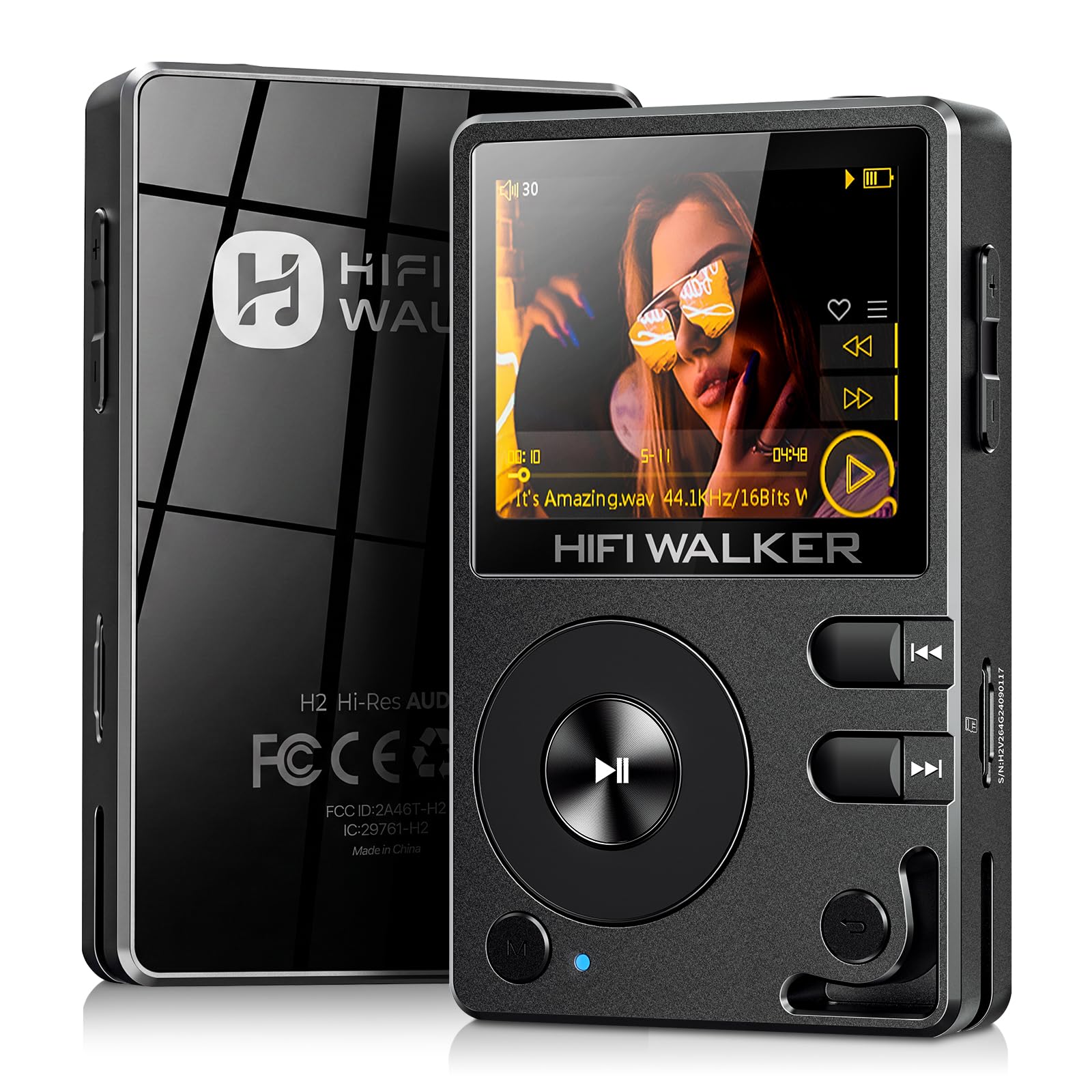
The HIFI WALKER H2 brings an ESS ES9018K2M DAC — a chip found in audiophile desktop DACs — to a portable player priced for the entry-level market. With 70mW output into 32Ω, it is not designed to drive high-impedance headphones, but it pairs beautifully with efficient IEMs and earbuds, delivering the signature clean, extended top-end that ESS chips are known for.
Bluetooth 5.2 with Qualcomm aptX enables high-quality wireless listening, and it functions as a USB DAC for PC audio — a rare feature at this price point. The zinc alloy body and ALPS scroll wheel provide a tactile, premium feel that contradicts its modest cost. The H2 supports DSD128 native decoding, which is unusual for players under .
The UI is basic and navigation can be clunky, and some units suffer from Bluetooth signal dropout. Sound quality with wired IEMs, however, is noticeably better than any phone headphone jack, with improved detail retrieval and a wider soundstage.
Why it’s great
- ESS ES9018K2M DAC delivers audiophile-grade measurement performance
- Bluetooth 5.2 with aptX for reliable wireless listening
- Zinc alloy build feels premium despite low cost
Good to know
- Limited output power; unsuitable for high-impedance headphones
- Basic UI and intermittent Bluetooth dropouts reported
6. MECHEN M30

The MECHEN M30 is the most accessible way to start listening to lossless audio files without spending heavily. Its dual-decoding architecture uses a professional DSP audio IC and the WM8965 DAC, supporting native DSD128 (5.6MHz), FLAC up to 192kHz, and APE. The 1500mAh battery delivers 25 hours of continuous playback — an excellent endurance figure for a compact player.
The aluminum alloy body and scroll wheel navigation provide a tactile, reassuringly solid feel. The M30 comes with a 64GB memory card pre-installed, which is generous at this price point. The 2.0-inch LCD screen displays album art and lyrics, and the UI is clean and intuitive for basic library navigation.
Missing features include Bluetooth, Wi-Fi, and any streaming support — the M30 is strictly a wired, offline player. It also uses micro-USB instead of USB-C, which feels dated. For someone who wants pure local file playback without any wireless distractions, this is a capable and affordable entry point.
Why it’s great
- Native DSD128 and high-res FLAC support at an entry-level price
- 25-hour battery life outlasts most options in any class
- Included 64GB card means zero additional cost for storage
Good to know
- No Bluetooth or wireless connectivity of any kind
- Uses micro-USB instead of the modern USB-C standard
7. FiiO M33 R2R
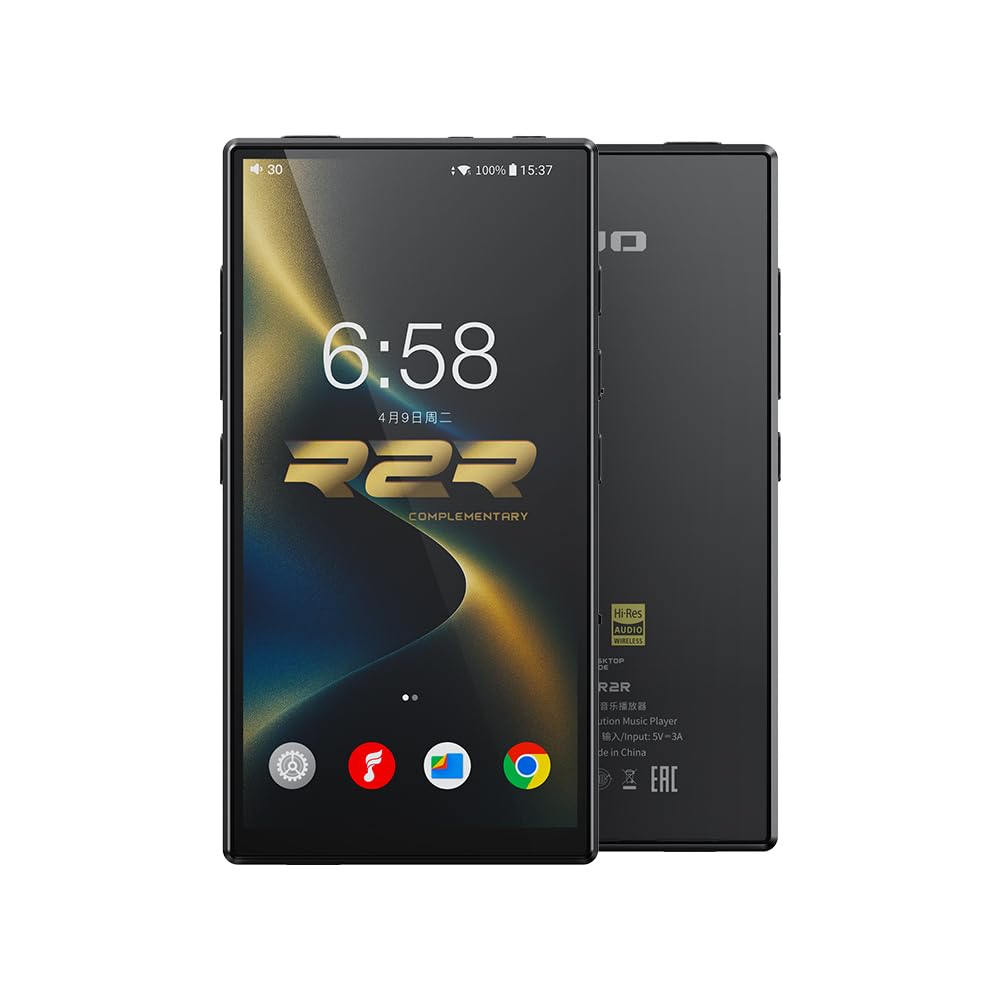
The FiiO M33 R2R represents FiiO’s first portable implementation of a true resistor-ladder DAC. Unlike Delta-Sigma chips that convert digital signals through oversampling and noise shaping, R2R uses a physical network of resistors to directly reconstruct the analog waveform. The result is a smoother, more natural presentation with less digital glare — a warm, organic sound that mimics the character of high-end vinyl or tube amplification.
Power output hits 1100mW balanced, enough to drive virtually any headphone, including power-hungry planars like the Hifiman Arya or Susvara. The dedicated XMOS XU316 processor handles USB audio duties, reducing jitter and ensuring clean output regardless of the source device. AUTO EQ automatically adjusts frequency curves based on headphone model, enabling precise correction without manual PEQ setup.
The 5.5-inch AMOLED display with 1080×2160 resolution is the sharpest in its class, and the 128GB internal storage with 8GB RAM ensures smooth multitasking. The main downside is the price — this is a true flagship player with flagship cost. Build quality is excellent, but the top-mounted power button and sharp edges irritate some users during long sessions.
Why it’s great
- True R2R DAC produces warm, analog-like sound signature
- 1100mW balanced output drives any headphone with authority
- AUTO EQ provides lossless headphone-specific tuning
Good to know
- Premium pricing limits its audience to serious audiophiles
- Sharp edges and top-mounted ports can be uncomfortable in hand
FAQ
Do I need a dedicated MP3 player if I already have a good phone with a headphone jack?
What is the difference between DSD128 and high-resolution FLAC?
Will a high-power MP3 player damage my sensitive IEMs?
Final Thoughts: The Verdict
For most users, the audio quality mp3 player winner is the FiiO M21 because it balances desktop-grade power (950mW), longevity-focused Desktop Mode, and Android streaming support at a reasonable mid-premium cost. If you want a warm, analog-focused signature with effortless headphone drive, grab the FiiO M33 R2R. And for a portable that fits in a shirt pocket while still powering demanding headphones, nothing beats the SHANLING M1 Plus.

Mo Maruf
I created WellFizz to bridge the gap between vague wellness advice and actionable solutions. My mission is simple: to decode the research and give you practical tools you can actually use.
Beyond the data, I am a passionate traveler. I believe that stepping away from the screen to explore new environments is essential for mental clarity and physical vitality.