Our readers keep the lights on and my smoothie glass nicely filled. As an Amazon Associate, I earn from qualifying purchases.
Finding the right audio interface under $500 means navigating a sea of specs: preamp gain, converter bit depth, sample rate, latency figures, and I/O count. The wrong choice can introduce noise, limit your recording potential, or require a costly upgrade within months. Whether you are a vocalist, a guitar player, a podcaster, or a producer building a home studio, the interface is the backbone of your signal chain.
I’m Mohammad Maruf — the founder and writer behind WellFizz. I have analyzed over 50 audio interfaces across all price brackets, focusing on measurable specs like Equivalent Input Noise (EIN), dynamic range, and driver stability rather than marketing fluff.
After thorough research, the following guide breaks down the top contenders for the audio interface under $500, covering everything from vintage preamp emulation to all-in-one production consoles.
How To Choose The Best Audio Interface Under $500
Your choice of interface determines the ceiling of your recording quality. Focus on preamp quality, connectivity, and feature set rather than brand alone. The right interface matches your specific workflow, whether that is tracking a single vocalist or managing a multi-mic podcast setup.
Preamp Quality and Gain
The preamp is the heart of the interface. Look for a specification called Equivalent Input Noise (EIN) — numbers around -129dBV or lower indicate a quiet, clean preamp. High gain (over 60dB) is essential for low-output dynamic mics like the Shure SM7B without needing an external cloudlifter. Some interfaces feature switchable impedance or vintage modes that alter the preamp character.
Input/Output Configuration
Count your sources. A 2-input interface (like a Scarlett Solo) is sufficient for a single mic and guitar. A 4-input interface (like the MOTU M4) allows for two mics and two line sources simultaneously. For podcasters hosting guests, 4+ inputs are a practical necessity. Outputs matter too: multiple headphone outs with independent mixes are a game-changer for tracking with musicians.
Connectivity and Driver Support
USB-C is standard for modern low-latency performance and bus power. Confirm compatibility with your operating system — Windows users should check for dedicated ASIO driver quality, while macOS users generally enjoy class-compliant plug-and-play. Loopback functionality (routing computer audio back into the interface) is critical for podcasters and streamers mixing in system sound.
Build Quality and Form Factor
A studio interface needs a chassis that survives regular cable insertion and extraction. Full metal construction is preferred over plastic. Rack-mountable units are available for permanent setups, while compact desktop units prioritize portability. Weight and dimensions matter, especially if you travel or have a cramped desk.
Software and Included Bundle
Most interfaces include a DAW (Digital Audio Workstation), effects plugins, and virtual instruments. PreSonus and Universal Audio bundles often include full-featured versions of Studio One and LUNA respectively. SSL and Focusrite offer substantial plugin bundles. Evaluate the software — a good bundle can save hundreds of dollars on production tools.
Quick Comparison
On smaller screens, swipe sideways to see the full table.
| Model | Category | Best For | Key Spec | Amazon |
|---|---|---|---|---|
| RØDE RØDECaster Duo | All-in-One | Podcasters and Streamers | 4 faders, 76dB gain | Amazon |
| SSL 2 MKII | Studio Interface | Producers Seeking Warmth | 32-bit / 192kHz converters | Amazon |
| Audient EVO 8 | Multi-Channel | Home Studios with 4 Mics | 4 EVO mic preamps | Amazon |
| MOTU M4 | USB-C Interface | Low Latency Tracking | 4-in/4-out, LCD meters | Amazon |
| Universal Audio Volt 2 | Vintage Style | Warm Analog Tone | UA 610 preamp emulation | Amazon |
| PreSonus AudioBox 96 25th | All-In-One Bundle | Complete Starter Studio | Studio One Artist included | Amazon |
| Focusrite Scarlett Solo 3rd | Entry Level | Solo Guitarists and Vocalists | 120dB dynamic range | Amazon |
| Focusrite Vocaster Two | Podcasting | Two-Host Podcasting | 70dB preamp gain | Amazon |
| Behringer U-PHORIA STUDIO | Budget Bundle | Extreme Budget Setup | 192kHz sample rate | Amazon |
In‑Depth Reviews
1. RØDE RØDECaster Duo
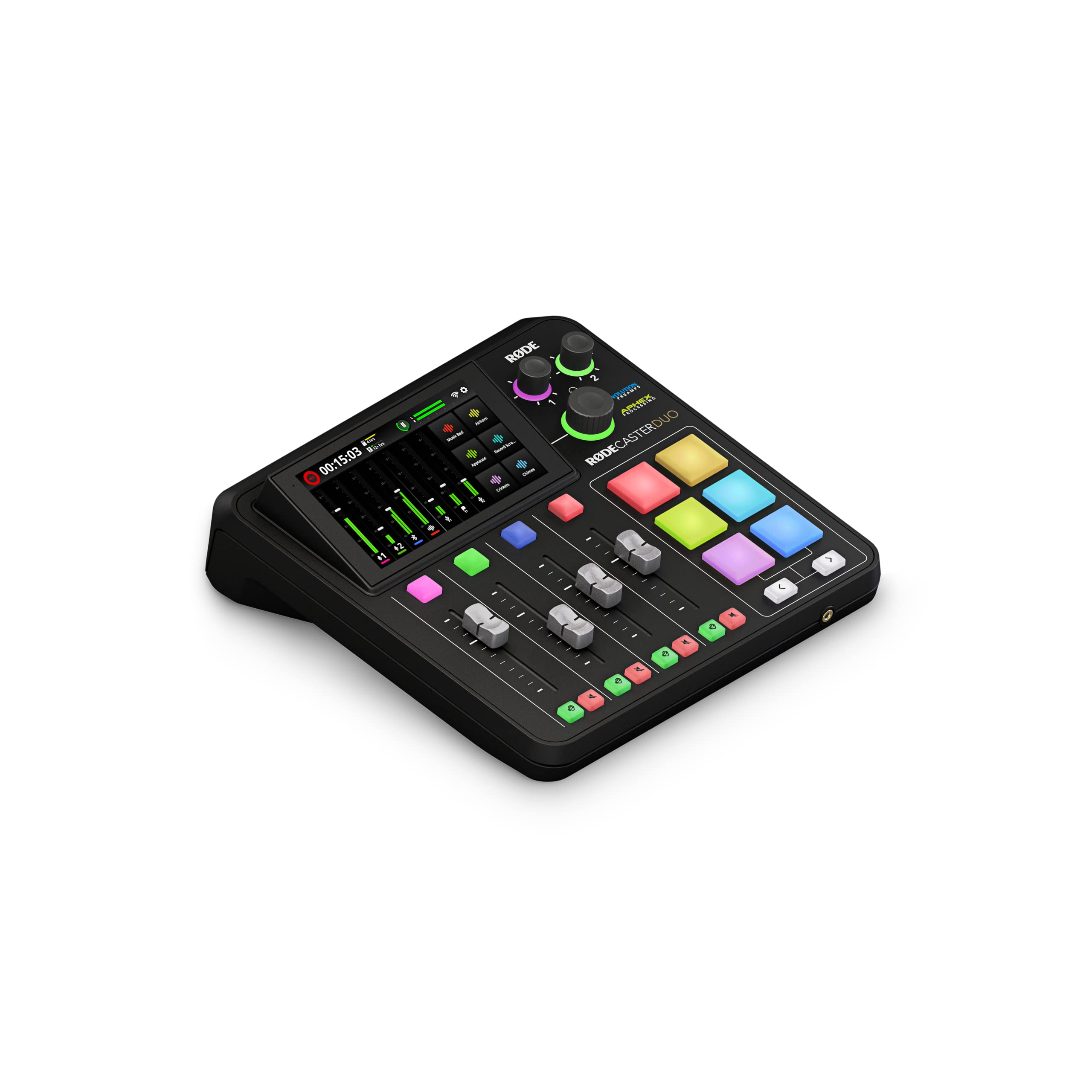
The RØDECaster Duo is a standalone production console that merges audio interface, mixer, soundboard, and recorder into a single chassis with a high-resolution touchscreen. Its dual Revolution Preamps deliver an astonishing -131.5dBV EIN and 76dB of gain, allowing any dynamic microphone to reach full performance without a separate booster. The unit features four broadcast-quality faders, six SMART pads with bank switching, and built-in APHEX processing — including the Aural Exciter and Big Bottom effects — offering a polished sound straight out of the box.
Setup is more involved than a standard interface, especially for iPhone connectivity requiring specific cables, but the workflow payoff is enormous for podcasters and streamers. The haptic touchscreen streamlines audio routing, and the dedicated headphone outputs with individual mixes allow seamless host-guest monitoring. The USB-C connection handles both Mac and PC, though Windows users should install RØDE’s driver for full functionality.
Build quality is exceptional with a metal chassis and weighted faders that feel truly broadcast-grade. The unit can serve as a standalone recorder to an SD card, bypassing the computer entirely — a lifesaver for portable recording. While the price sits at the upper boundary of this guide, the RØDECaster Duo replaces thousands of dollars in separate equipment for a streamlined, professional workflow.
Why it’s great
- Massive 76dB preamp gain handles any mic without a cloudlifter.
- Built-in APHEX processing adds polish without plugins.
- Standalone SD card recording frees you from the computer.
Good to know
- Learning curve is steep for complete beginners.
- iPhone streaming requires a separate RØDE cable adapter.
2. Solid State Logic SSL 2 MKII

The SSL 2 MKII brings the legendary sound of SSL consoles to the desktop with its 32-bit/192kHz AD/DA converters and proprietary Legacy 4K analog enhancement. The 4K button injects a subtle high-frequency presence and gentle harmonic saturation that makes vocals and acoustic guitars sit naturally in a mix without extra plugin processing. The mic preamps are exceptionally clean with a low noise floor, and the stainless steel chassis feels built for decades of use.
Beyond the famous sound, the MKII iteration adds a robust MIDI I/O via 5-pin DIN jacks — a welcome addition for hardware synth users. The headphone amplifier is notably powerful, driving high-impedance cans with clarity and headroom. Zero-latency monitoring with high-pass filters (HPF) on both inputs helps eliminate rumble and plosives before they hit the recording.
The included SSL Production Pack bundles Vocalstrip 2 and Drumstrip plugins, alongside the renowned Native Instruments Komplete Start. Setup is straightforward on both Mac and PC with dedicated ASIO drivers for Windows. The 2-in/2-out configuration is ideal for solo producers and vocalists, though the price exceeds budget-tier options by a significant margin.
Why it’s great
- Legacy 4K analog enhancement adds genuine console warmth.
- 32-bit converters deliver exceptional dynamic range and headroom.
- Full metal chassis with a premium, heavy feel.
Good to know
- Only 2 inputs — not suitable for multi-mic recording.
- USB bus power limits headphone output on some laptops.
3. Audient EVO 8

The Audient EVO 8 packs four EVO microphone preamps with Smartgain — an automatic level-setting feature that intelligently adjusts gain for each channel in seconds. This is a massive time-saver for podcasters recording multiple guests simultaneously. The preamps are transparent with low noise, and the single JFET instrument input provides a warm, amp-like DI sound for direct guitar recording without extra pedals.
The interface offers two headphone outputs with independent mixes, crucial for tracking sessions where the performer needs a different cue mix than the engineer. The EVO control knob handles volume, Smartgain activation, and monitor mix through a single intuitive interface, while the EVO app provides deeper control over routing and settings. The lightweight chassis is surprisingly compact for a 4-preamp unit.
Operation is class-compliant on macOS and Windows, though installing drivers beforehand is recommended to avoid system lockups. The lack of dedicated physical controls for each channel (relying on the single knob and app) may frustrate users who prefer tactile faders over software menus. The light weight means the USB cable can lift the front of the unit, requiring a small block to keep it stable on a desk.
Why it’s great
- Smartgain auto-levels up to 4 mics simultaneously.
- JFET instrument input adds warmth to DI guitar.
- Two independent headphone mixes for collaboration.
Good to know
- Physical controls are minimal; requires software for detailed settings.
- Light chassis can be unstable if the cable pulls on it.
4. MOTU M4

The MOTU M4 is a 4-in/4-out USB-C audio interface that has earned a reputation for bulletproof Windows drivers and extremely low round-trip latency, making it a favorite among virtual instrument players and producers. Its two mic preamps are renowned for their transparency with -129dBV EIN, and the built-in LCD level meters on each input provide precise visual feedback for gain staging — a feature rare in this price tier.
The M4 includes a dedicated loopback channel for streaming and podcasting that works without any complex routing configuration. The front-panel 48V switches and independent monitor/headphone volume controls are thoughtfully placed for quick adjustments. The headphone output is capable but can be anemic on bus power with high-impedance headphones; a powered USB hub or external power alleviates this. Direct monitoring allows zero-latency hardware mixing between input and computer playback.
One quirk involves a rare pitch-shifting bug on Windows, resolved by disabling Windows fast startup. The included Performer Lite and Ableton Live Lite provide solid starting points for production. For users needing transparent sound, pristine preamps, and expandable I/O, the MOTU M4 sets a standard that competitors struggle to match at this price point.
Why it’s great
- Class-leading low latency on Windows with dedicated ASIO drivers.
- LCD level meters on every input for precise gain control.
- Built-in loopback for seamless streaming and podcasting.
Good to know
- Headphone amp is weaker than desktop interfaces on bus power.
- Occasional Windows pitch-shift bug requires a system setting tweak.
5. Universal Audio Volt 2

The Universal Audio Volt 2 brings the warm, rich character of UA’s iconic 610 vacuum tube preamp to a compact, USB-powered interface via its Vintage mode circuit. Activating the Vintage button adds subtle harmonic saturation and a gentle high-frequency lift that makes vocals and acoustic instruments sound immediately more polished and analog. The converters deliver 24-bit/192kHz quality with crystal clarity, capturing every transient without harshness.
This interface is built around simplicity: two combo inputs (one with the Vintage circuit), a single headphone output, and monitor outputs. The included LUNA DAW offers a unique analog workflow with tape-style summing and console emulation, bridging the gap between digital convenience and analog sound. The free UAD plugins and Ableton Live Lite add substantial production value. The metal chassis is compact and durable for mobile recording.
No external power supply is required for standard use, though iOS/iPad operation requires a separate Volt power supply and a camera adapter. The lack of MIDI I/O is a drawback for synth users, and the single headphone output limits collaborative tracking. For vocalists and singer-songwriters prioritizing tone and simplicity, the Volt 2 delivers a uniquely musical sound within this guide.
Why it’s great
- Vintage mode emulates the classic UA 610 preamp for instant analog warmth.
- Includes LUNA DAW with tape-style workflow and UAD plugins.
- USB-powered and highly portable for on-the-go recording.
Good to know
- No MIDI I/O; incompatible with hardware synth users.
- iOS/iPad recording requires an external power supply and adapter.
6. PreSonus AudioBox USB 96 25th Anniversary

The PreSonus AudioBox USB 96 25th Anniversary Studio is the quintessential all-in-one starter kit, bundling the rugged AudioBox interface, an M7 large-diaphragm condenser microphone, HD7 monitoring headphones, and all necessary cables and a desktop stand. The AudioBox itself records at 24-bit/96kHz with two combo inputs featuring low-latency monitoring and preamps that rival units twice its price. The included Studio One Artist DAW alone represents substantial software value.
The M7 condenser microphone delivers warm, detailed recordings that suit vocals and acoustic instruments, though it picks up room noise due to its sensitivity. The HD7 headphones offer balanced frequency response with good isolation for tracking. The interface includes MIDI I/O and supports class-compliant operation on macOS and Windows without driver installation, though the provided power cable must be used — a longer USB cable caused communication issues for some users.
While the interface caps out at 96kHz sample rate (lower than some 192kHz competitors), the audible difference is negligible for most applications. The metal chassis is built to withstand regular studio use. For beginners needing everything to start recording music or podcasts immediately, this bundle eliminates the guesswork of matching separate components.
Why it’s great
- Complete bundle with mic, headphones, cables, and DAW — everything included.
- Studio One Artist is a full-featured DAW with mastering tools.
- Rugged all-metal construction suitable for beginners and mobile use.
Good to know
- Maximum sample rate is 96kHz, not 192kHz.
- Included headphones are adequate but not comfortable for long sessions.
7. Focusrite Scarlett Solo 3rd Gen

The Scarlett Solo 3rd Gen is the benchmark entry-level interface that has introduced millions of musicians and podcasters to home recording. Its 3rd Gen mic preamp delivers 120dB of dynamic range with switchable Air mode, which applies an analog EQ shelf to brighten vocals and acoustic instruments. The Gain Halos provide simple green-to-red visual feedback for setting optimal levels without clipping.
The all-metal chassis is compact and surprisingly heavy for its size, surviving years of studio use. High-performance converters support 24-bit/192kHz recording, preserving the full frequency spectrum of your source. The bundle includes Ableton Live Lite, Pro Tools Intro+, and the Hitmaker Expansion suite of effects and instruments, providing a complete software ecosystem for new producers. The headphone output is clean and sufficient for standard impedance headphones.
USB bus power means no wall wart needed, and the USB cable (USB-C to A) is included. The 1-instrument/1-mic configuration limits immediate expansion for dual-mic recording. Some users report that the preamp gain is moderate — around 56dB — which may require a booster for extremely low-output ribbon or dynamic microphones. For solo vocalists and guitarists entering the space, the Scarlett Solo remains a reliable, well-supported industry standard.
Why it’s great
- Air mode adds professional clarity without extra effects.
- Rugged metal body with proven durability across years of use.
- Outstanding software bundle for beginners including Pro Tools Intro+.
Good to know
- Only one mic input and one instrument input — limited expandability.
- Preamp gain (~56dB) may not be sufficient for very low-output mics without a booster.
8. Focusrite Vocaster Two

The Focusrite Vocaster Two is purpose-built for podcasters who need to record a host and a remote guest with minimal friction. Its two mic inputs deliver over 70dB of gain, sufficient for dynamic podcasting mics like the RØDE PodMic without a cloudlifter, and the Auto Gain button sets optimal levels in seconds. The Enhance button cycles through four presets (Clean, Warm, Bright, and Radio) that apply EQ and compression to polish the vocal sound instantly.
Connectivity is the standout feature: Bluetooth for hands-free phone calls into the mix, a dedicated TRRS input for mobile device connection via cable, and a camera output to send interface-quality audio directly to a DSLR or mirrorless camera. Each presenter gets their own headphone output with independent Show Mix (blending the mix with your own voice). The included hardware mute button cuts all audio with a single press, ideal for live recording.
The construction is primarily plastic but feels rugged enough for travel. The headphone jacks angle outward, which can cause cable strain if the interface is placed tight against a wall. The USB-C connection works with iPads and iPhones for truly portable recording. The bundled software includes the full Vocaster Hub for routing control. For dedicated podcasters, the Vocaster Two streamlines the workflow better than any standard audio interface.
Why it’s great
- Auto Gain and Enhance presets deliver polished vocal sound instantly.
- Bluetooth phone integration captures remote callers without cables.
- Two independent headphone outputs with individual show mixes.
Good to know
- Primarily plastic construction — less durable than metal equivalents.
- Headphone jacks angle sideways, creating potential cable strain.
9. Behringer U-PHORIA STUDIO

The Behringer U-PHORIA STUDIO package is the most budget-conscious bundle in this guide, combining a UMC22 audio interface, a B-1 condenser microphone, and HPS3000 studio headphones. The interface features a single XLR/TS combo input plus a dedicated instrument input, phantom power, and 192kHz sample rate support. The included condenser microphone performs surprisingly well for its price class, delivering clear vocal recordings that exceed the expectations for a kit this affordable.
The interface preamp is workable for spoken word and basic music recording, though it lacks the gain headroom of premium options — some users report a slight buzz on the mic input that requires noise gate processing in the DAW to clean up. The line-in performance is solid for direct instrument recording. The bundle includes all necessary cables and a desktop mic stand, making it immediately functional out of the box.
The headphones are the weakest link: they provide adequate sound for monitoring but are designed for small head sizes and become uncomfortable for adult users. The build quality of the interface is plastic, but it survives gentle home-studio use. For absolute beginners on a tight budget who want to start recording immediately, this bundle removes the financial barrier to entry. Upgrading the headphones should be the first priority allocation.
Why it’s great
- Complete recording bundle at the lowest entry cost available.
- Condenser microphone performs well above its price tier for vocals.
- 192kHz sample rate support despite the low price.
Good to know
- Included headphones are uncomfortable and flimsy; plan to replace them.
- Preamp has noticeable noise on the mic channel; a gate in your DAW helps.
FAQ
What preamp gain level do I need for a Shure SM7B?
Is 192kHz sample rate necessary for music recording?
Can I use a USB audio interface with an iPad or iPhone?
What is the difference between a dynamic and condenser microphone preamp requirement?
Does MIDI I/O matter on an audio interface?
Final Thoughts: The Verdict
For most users, the audio interface under $500 winner is the Solid State Logic SSL 2 MKII because it delivers legendary console-grade analog character with 32-bit converters, MIDI I/O, and a stainless steel chassis that rivals studio-standard gear. If you want a complete all-in-one production solution without needing extra gear, grab the RØDE RØDECaster Duo. And for the absolute best multi-mic interface with transparent preamps and expandable I/O, nothing beats the MOTU M4.

Mo Maruf
I created WellFizz to bridge the gap between vague wellness advice and actionable solutions. My mission is simple: to decode the research and give you practical tools you can actually use.
Beyond the data, I am a passionate traveler. I believe that stepping away from the screen to explore new environments is essential for mental clarity and physical vitality.