Our readers keep the lights on and my smoothie glass nicely filled. As an Amazon Associate, I earn from qualifying purchases.
During summer, an unventilated attic can hit 150°F, baking your shingles from below and forcing your AC to run twice as long. A properly specified attic ventilation system pushes that superheated air out, drops the temperature differential, and protects your roof deck and insulation from moisture damage. But choosing between CFM ratings, motor types, and mounting styles requires understanding how your attic actually breathes.
I’m Mohammad Maruf — the founder and writer behind WellFizz. I’ve spent years analyzing residential ventilation hardware, comparing EC versus AC motor efficiency curves, shutter seal integrity, and real-world airflow delivery across hundreds of homeowner installations.
This guide breaks down the specifications that separate a good system from a glorified hole in the wall. Whether you need a gable-mounted fan, a solar-powered roof vent, or a high-CFM shutter unit for a workshop, finding the right best attic ventilation system depends on matching motor technology to your square footage and climate.
How To Choose The Best Attic Ventilation System
Selecting the right system starts with matching CFM capacity to your attic floor area. A general rule is 1 CFM per square foot of attic space, though hot climates or dark roofing materials may require 1.5 CFM per square foot. Beyond raw airflow, motor type and control method determine whether the system quietly manages conditions on its own or requires manual intervention.
CFM and Square Footage Matching
Measure the attic floor’s length and width, then multiply for total square footage. For a 1,500 sq ft attic, you need at least 1,500 CFM. Oversizing by 20–30 percent is acceptable because variable-speed controllers can reduce flow when full power isn’t needed. Undersizing forces the fan to run continuously and still may not achieve adequate air exchange on the hottest days.
Motor Technology: AC, EC, and DC Brushless
Traditional AC motors are the most affordable but draw more wattage per CFM delivered. EC (electronically commutated) motors, found on mid-range and premium models, use PWM speed control to maintain high efficiency across all speeds while running significantly quieter. DC brushless motors, common in solar-powered units, offer the lowest power consumption but depend on panel wattage for sustained high-speed output.
Mounting Style and Shutter Design
Wall-mounted shutter fans with gravity-closing louvers are the most common for gable vents. The shutters must open fully under airflow without rattling at high speed. Roof-mounted solar units use a flashing kit to seal around the vent hole and rely on a flapper or internal damper to prevent backdraft when the fan is off. For exterior walls, aluminum shutters resist corrosion better than steel in coastal or humid environments.
Quick Comparison
On smaller screens, swipe sideways to see the full table.
| Model | Category | Best For | Key Spec | Amazon |
|---|---|---|---|---|
| Quietcool AFG SMT PRO-2.0 | Smart Gable | Smart home integration | 1,945 CFM | Amazon |
| AC Infinity AIRLIFT T14 | WiFi Shutter | App-controlled automation | 1,513 CFM | Amazon |
| iLiving 20-Inch | Mid-Size Shutter | Large garages and workshops | 3,368 CFM | Amazon |
| VIVOHOME 14-Inch | Smart Shutter | Humidity alarm monitoring | 1,700 CFM | Amazon |
| VEVOR 24-Inch | High-Flow Shutter | Maximum air exchange rate | 4,800 CFM | Amazon |
| AC Infinity AIRLIFT S10 | Compact Shutter | Small sheds and greenhouses | 631 CFM | Amazon |
| VEVOR 42W Solar Attic Fan | Solar Hybrid | Off-grid roof ventilation | 2,800 CFM | Amazon |
| iLiving 24-Inch | Industrial Shutter | Large metal buildings | 4,244 CFM | Amazon |
| Remington Solar 30W | Solar Roof | Zero-energy attic cooling | N/A CFM | Amazon |
In‑Depth Reviews
1. Quietcool AFG SMT PRO-2.0 Smart Attic Fan

The Quietcool AFG SMT PRO-2.0 combines a two-speed PSC motor with a dedicated smart hub, enabling temperature and humidity-based automation through a mobile app. At high speed it moves 1,945 CFM while drawing only 120 watts, making it one of the most energy-efficient gable-mount options available. The Fire Safety Sense shut-off feature adds peace of mind by automatically killing power if smoke is detected.
Installation is truly plug-and-play — the fan comes with a 20-foot power cord and a pre-attached control hub, so no hardwiring is required. The app allows you to set staged speed triggers, view real-time attic conditions, and adjust schedules remotely. Users in hot Texas climates report noticeable temperature drops after programming the fan to kick on at 100°F on low speed and ramp to high at 110°F.
The only trade-off is the slightly vague instruction manual, which can make the initial WiFi pairing less straightforward than it should be. Additionally, the keyhole mounting slots are designed for screw sizes that aren’t included, so you may need a trip to the hardware store. Overall, this is the best integration-focused attic fan for homeowners who want set-and-forget smart control.
Why it’s great
- Smart app with temp/humidity scheduling and alerts
- Very quiet operation at both low and high speeds
- Low power draw per CFM compared to AC-motor fans
Good to know
- Instructions lack clarity on anti-vibration pad placement
- Keyhole slots don’t match included screw heads
2. AC Infinity AIRLIFT T14 Shutter Exhaust Fan

The AC Infinity AIRLIFT T14 uses an EC motor paired with a WiFi-enabled controller that gives you full remote access via smartphone. It delivers 1,513 CFM at a maximum noise level of 68 dBA — noticeably quieter than comparable AC-motor shutters. The IP44-rated steel housing and aluminum blades resist moisture and dust, which is critical for attic environments where humidity and debris are constant.
The controller supports dynamic temperature and humidity programming, allowing you to set minimum fan speed, temperature ramps, and even daily schedules. Users praise the app’s ability to track historical climate data and send notifications if conditions exceed thresholds. For crawl spaces and attics where manual checking is impractical, this automation is a genuine advantage.
One drawback is that strong external winds can cause the gravity shutters to rattle or flap open when the fan is off — some users have improvised hooks or magnets to hold the louvers closed during winter. The highest speed setting also produces audible vibration through the housing. Despite these quirks, the T14 remains a top choice for remote monitoring and fine-grained airflow control.
Why it’s great
- Full WiFi app with climate data logging and alarms
- EC motor delivers high efficiency across 10 speeds
- Rust-resistant aluminum blades and steel housing
Good to know
- Wind can rattle shutters when fan is off
- Loudest speed setting may vibrate in thin walls
3. iLiving 20-Inch Wall Mounted Shutter Exhaust Fan

The iLiving 20-inch moves an impressive 3,368 CFM using a 1/5 HP AC motor spinning at 980 RPM, enough to exchange air in spaces up to 5,000 square feet. The galvanized steel frame and aluminum shutters are built for longevity in unconditioned spaces like warehouses and barns. It includes the Thermospeed controller, which combines variable speed adjustment with a thermostat that activates the fan when ambient temperature exceeds a set point between 32°F and 130°F.
Noise output stays under 69 dB at full speed — about the level of a vacuum cleaner in the next room. Users report that in a 12,500 cubic foot warehouse, the fan dropped the temperature from 94°F to 83°F within 45 minutes, drawing around 253 watts at peak. The aluminum gravity shutters open smoothly under airflow and close tightly when off, keeping pests and debris out.
The shutters can produce a light rattle at higher speeds, and the power cord is not included with this model, so plan for a dedicated outlet or extension. Some users also note that the thermostat sensor reads temperature at the controller location rather than at the fan itself, which may cause slight delays in response. For the price per CFM, this unit is exceptionally hard to beat.
Why it’s great
- Highest CFM-per-dollar in the mid-size category
- Industrial-grade galvanized frame resists corrosion
- Variable speed and thermostat in one controller
Good to know
- Power cord not included
- Shutters can rattle slightly at high RPM
4. VIVOHOME 14-Inch Shutter Exhaust Fan

The VIVOHOME 14-inch is driven by a 40-watt brushless EC motor that keeps noise below 60 dB while reaching 1,700 CFM — ideal for residential gable vents where silence matters. The 3-in-1 smart controller monitors both temperature (32°F–120°F) and humidity (30%–90%), with an alarm that triggers if either parameter exceeds the set range. This makes it particularly useful for attics prone to moisture accumulation or for hobby spaces like greenhouses and chicken coops.
The fan offers nine manual speeds and a 12-hour auto shut-off timer, giving you precise control without needing a smartphone. The remote displays current mode, speed, temperature, and humidity, and can be wall-mounted or used handheld. Build quality is solid — the rust-resistant frame is rated for over 20,000 hours of operation, and the auto-shutdown shutters include foam inserts that cut vibration and block outdoor elements.
Some users note that the remote does not display room temperature feedback while adjusting settings, making it hard to confirm whether the target condition has been reached without walking to the fan. The 14-inch size also limits suitability for larger attics over 1,600 sq ft. For smaller spaces where quiet, smart humidity management is the priority, this fan excels.
Why it’s great
- Extremely quiet EC motor under 60 dB
- Humidity and temperature alarm for moisture protection
- 12-hour timer reduces unnecessary runtime
Good to know
- Remote lacks real-time temperature display
- 14-inch size may undersize larger attics
5. VEVOR 24-Inch Variable Speed Exhaust Fan

The VEVOR 24-inch shutter fan delivers a massive 4,800 CFM from its 180-watt AC motor spinning at 1,200 RPM, making it one of the highest-flow residential-grade units on the market. The stepless variable speed controller lets you dial airflow from a gentle breeze to hurricane force, which is essential for spaces like large workshops or barns where air quality needs fluctuate dramatically. The all-metal steel construction is deformation-resistant and handles damp conditions without rusting.
At full speed the fan moves air at 6.5 m/s, enough to clear smoke, dust, or fumes from a 2,000+ sq ft space in minutes. Users mention that the shutters open fully and close tightly, blocking rain and small animals when the fan is off. The included M8x50 expansion bolts make wall mounting straightforward, though the unit weighs nearly 24 pounds, so a two-person installation is advisable.
The speed controller starts on high rather than low, which can be startling if you’re used to a gentler ramp-up. The remote cord is also relatively short, limiting where you can mount the control box. For raw air-moving capacity at a budget-friendly tier, this fan is unmatched.
Why it’s great
- 4,800 CFM moves air faster than most residential units
- Stepless speed dial offers infinite airflow adjustment
- All-metal build resists weather and physical impact
Good to know
- Speed controller defaults to high on startup
- Controller cord is short for convenient placement
6. AC Infinity AIRLIFT S10 Shutter Exhaust Fan

The AC Infinity AIRLIFT S10 is a 10-inch shutter fan powered by an EC motor with PWM speed control, offering ten precise speed levels from a whisper-quiet breeze up to 631 CFM. The IP44-rated frame and aluminum blades are designed for environments where moisture and dust are present, such as greenhouses, sheds, and small workshops. Despite its compact size, the build quality is excellent — the steel housing feels substantial and the dual-ball bearings ensure long-term reliability.
Users consistently praise the S10 for its quiet operation, with many noting that it pushes two to three times more air than comparable-sized AC fans while drawing less power. Speed 5 is often cited as the sweet spot for balancing airflow and silence. When paired with the optional AC Infinity 67 controller, the fan gains thermostat and hygrometer functionality with automatic speed ramping based on temperature or humidity thresholds.
At maximum speed the fan is noticeably loud, and some users report a slight rattle from the shutters at the highest setting. The 10-inch size limits coverage to smaller spaces — roughly 600 sq ft or less — so it’s not a solution for whole-attic ventilation. For targeted spot ventilation in a grow room, chicken coop, or tool shed, this is the most polished compact option available.
Why it’s great
- EC motor with 10-speed PWM for precise airflow control
- Quiet operation at low and mid speeds
- IP44-rated for moisture and dust resistance
Good to know
- Maximum speed is noticeably loud
- Limited CFM makes it unsuitable for large attics
7. VEVOR 42W Solar Attic Fan
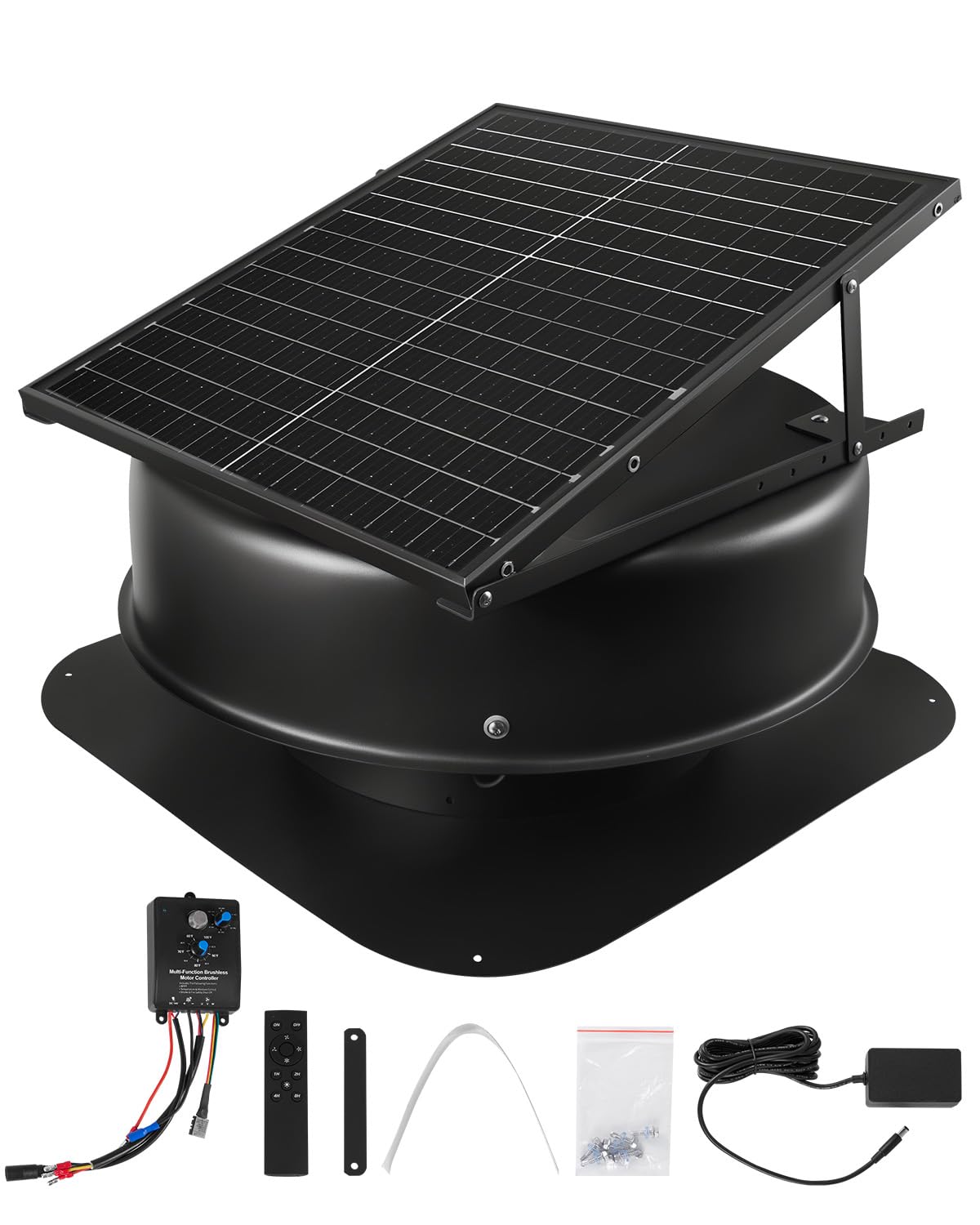
The VEVOR 42W Solar Attic Fan combines a 42-watt monocrystalline solar panel with an MPPT charge controller and a brushless DC motor capable of moving up to 2,800 CFM under full sun. The unit automatically switches to AC power (via an included adapter) after sunset, ensuring 24/7 ventilation regardless of cloud cover or nighttime conditions. This hybrid approach solves the biggest limitation of pure solar fans — performance drop during overcast weather.
The integrated temperature and humidity controller activates the fan when attic temperature exceeds 79°F and shuts it off when conditions drop below that threshold. The smoke detection safety feature automatically kills power if smoke is sensed, adding a layer of fire protection. Installation on shingle or metal roofs is straightforward, with users reporting completion times under two hours, even for DIYers in their 70s.
The remote control operates from up to 32 feet away, but some users note that the fan stops running if even partial shade falls on the solar panel during daylight hours. The panel angle is adjustable for optimal sun exposure, but you may need to fine-tune it seasonally. For homeowners committed to reducing energy consumption, this hybrid fan delivers excellent coverage without ongoing electricity costs.
Why it’s great
- Hybrid solar-AC operation guarantees 24/7 ventilation
- MPPT controller maximizes panel output in varying light
- Smoke detection shut-off enhances attic safety
Good to know
- Fan stops if panel is shaded during the day
- Panel angle may need seasonal adjustment
8. iLiving 24-Inch Wall Mounted Exhaust Fan

The iLiving 24-inch is a serious industrial-grade shutter fan rated for 4,244 CFM at 1,050 RPM, driven by a 1/4 HP thermally protected motor. It covers up to 6,200 square feet, making it suitable for large metal buildings, warehouses, and pole barns where massive air exchange is required. The galvanized steel frame and high-grade aluminum shutters are built to withstand years of exposure to heat, moisture, and dust without corroding.
The fan includes automatic louvered shutters that open under airflow and close tightly when the fan stops, but the speed controller is sold separately (iLIVING ILG8SFSC). Users who have installed it in 40×60-foot shops report that it clears dust and smoke in minutes and noticeably reduces interior temperatures when paired with adequate intake vents. After 18 months of daily use, owners report no degradation in performance, confirming the motor’s durability.
The shutters can be rattly at high speed — a common trade-off with large gravity-closing louvers. Because the controller is not included, the upfront cost is higher than the product price alone suggests. For large-scale ventilation needs where CFM output is the primary metric, this fan delivers exceptional value.
Why it’s great
- 4,244 CFM suitable for 6,200 sq ft spaces
- Galvanized steel and aluminum resist long-term corrosion
- Thermally protected motor with proven longevity
Good to know
- Speed controller sold separately
- Shutters can rattle audibly at high speed
9. Remington Solar 30 Watt Roof Mount Solar Attic Fan
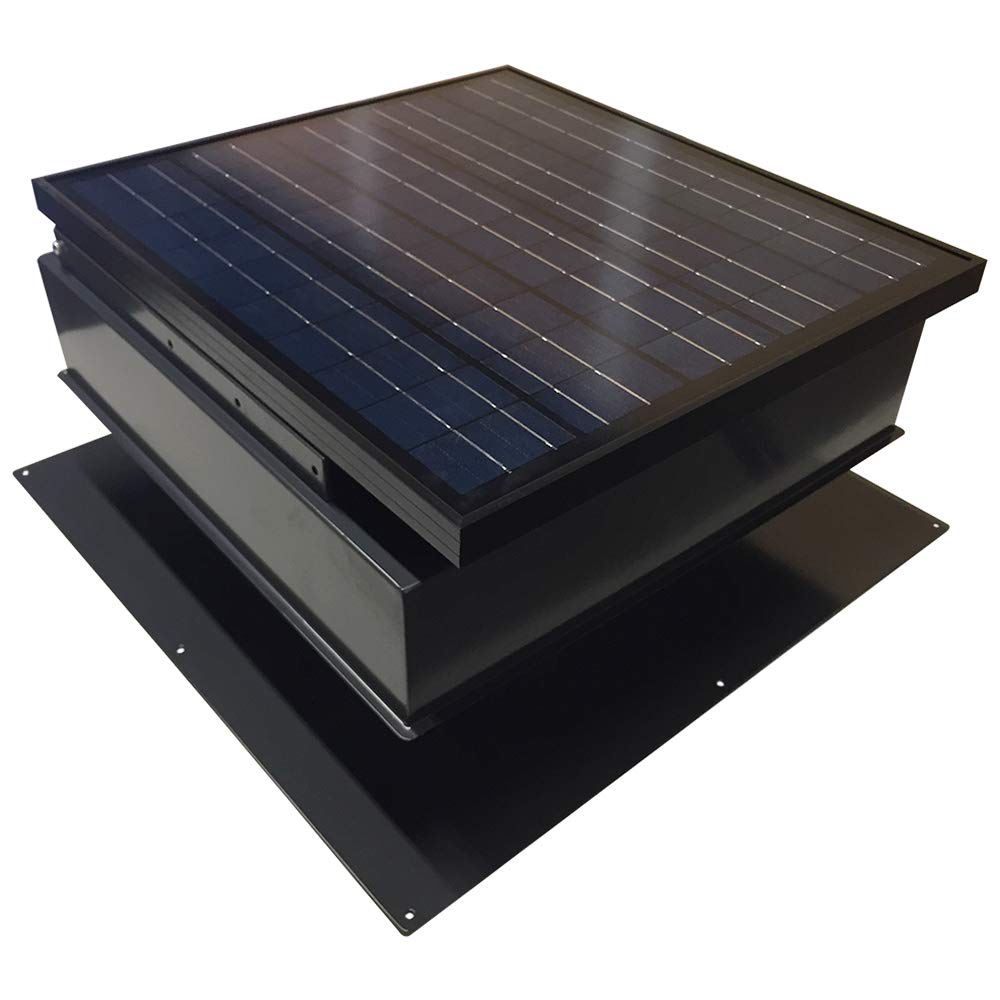
The Remington Solar 30W is a roof-mounted DC brushless fan powered entirely by solar energy, requiring no electrical wiring or ongoing electricity costs. It includes a built-in humidistat and thermostat that automatically adjust airflow based on attic conditions. The 22.5-inch steel flashing is extra large to prevent leaks, and the fan is designed to withstand hail and severe weather, backed by a limited lifetime warranty.
Users in hot climates report dropping attic temperatures by 25°F or more after installation, which directly reduces the load on HVAC systems and improves comfort in rooms below. The fan runs silently — the brushless motor generates no friction noise, making it nearly inaudible both inside and outside the house. Roofers and contractors frequently recommend this model for its build quality and straightforward installation.
The critical limitation is that the fan requires direct, unobstructed sunlight to operate at full capacity. Even partial shading from clouds or a nearby tree branch causes the fan to slow significantly or stop entirely. An optional hybrid AC adapter is sold separately for night-time operation, but this adds to the overall investment. For homeowners with a south-facing roof that receives consistent sun, this fan is a set-and-forget solution with zero operating costs.
Why it’s great
- Zero electricity cost after installation
- Near-silent brushless DC motor
- Limited lifetime warranty and weatherproof build
Good to know
- Fan stops when solar panel is shaded
- AC hybrid adapter for night use costs extra
FAQ
How do I calculate the right CFM for my attic?
Can a solar attic fan work on a north-facing roof?
Should I install the fan at the gable or through the roof?
Final Thoughts: The Verdict
For most users, the best attic ventilation system winner is the Quietcool AFG SMT PRO-2.0 because its smart app integration, low power draw, and quiet two-speed motor deliver the best balance of automation and performance for the average home. If you want WiFi-enabled climate tracking with precise EC motor control, grab the AC Infinity AIRLIFT T14. And for budget-friendly, high-CFM ventilation in a large workshop or barn, nothing beats the iLiving 20-Inch.

Mo Maruf
I created WellFizz to bridge the gap between vague wellness advice and actionable solutions. My mission is simple: to decode the research and give you practical tools you can actually use.
Beyond the data, I am a passionate traveler. I believe that stepping away from the screen to explore new environments is essential for mental clarity and physical vitality.