Our readers keep the lights on and my smoothie glass nicely filled. As an Amazon Associate, I earn from qualifying purchases.
An attic that hits 140°F in summer doesn’t just shorten your roof’s lifespan — it turns your HVAC system into a losing battle and can warp your framing from the inside out. A properly selected ventilation fan is the only cure.
I’m Mohammad Maruf — the founder and writer behind WellFizz. I’ve spent hundreds of hours analyzing CFM ratings, motor types, and controller logic to separate the fans that actually pull heat from those that just make noise.
Whether you need a quiet smart unit for a finished attic or a brute-force shutter fan for a workshop, this guide to the best attic ventilation fans breaks down real specs and real owner experiences to help you cool your space without wasting a dollar.
How To Choose The Best Attic Ventilation Fans
Choosing an attic ventilation fan isn’t about picking the most powerful motor you can find. The key is balancing CFM (cubic feet per minute) with your attic volume, the type of fan placement (gable, roof, or wall-mounted shutter), and the control features that match your climate. A fan that moves air without a smart thermostat or humidistat can be less effective than a smaller unit that runs intelligently.
CFM and Attic Size
A general rule of thumb is to aim for 1 CFM of exhaust per square foot of attic floor space. That means a 1,500-square-foot attic needs roughly 1,500 CFM. Overpowering the space with a huge fan can create negative pressure, pulling conditioned air from your living space into the attic. Undersizing it means it runs constantly without making a real dent.
Motor Type: EC vs PSC vs AC
Electronically Commutated (EC) motors are the current standard for efficiency and quiet operation, and they’re a common feature on mid-range and premium models. They offer variable speed with very low energy draw. PSC (Permanent Split Capacitor) motors are simpler and cheaper but are less efficient and typically two-speed-only. Traditional AC motors are loud and draw more current; they’re mostly found on budget units. Look for EC if noise and power bills matter to you.
Installation and Vent Type
Gable-mounted fans are the easiest to install and work well if you have an unobstructed gable vent. Roof-mounted solar fans require cutting a hole in the roof but sit flush and can run for free in sunlight. Wall-mounted shutter fans are ideal for garages and workshops because they seal tight when off. Match the fan type to the vent you already have — retrofitting a new vent type adds significant labor and material cost.
Quick Comparison
On smaller screens, swipe sideways to see the full table.
| Model | Category | Best For | Key Spec | Amazon |
|---|---|---|---|---|
| AC Infinity AIRLIFT T14 | Premium | Smart attic control | 1513 CFM / 68 dBA | Amazon |
| Quietcool PRO-2.0 | Premium | Gable mount / App control | 1945 CFM / 120W | Amazon |
| iLIVING 20″ Shutter | Mid-Range | Large shop / Garage | 3368 CFM / 20 inch | Amazon |
| VEVOR 14″ Shutter | Mid-Range | Workshop / Shed | 2000 CFM / EC Motor | Amazon |
| Air Vent 53315 | Mid-Range | Gable mount classic | 1050 CFM / 14 inch | Amazon |
| AC Infinity AIRTITAN T3 | Mid-Range | Small / Crawl space | 120 CFM / WiFi | Amazon |
| Remington Solar Builder | Mid-Range | Solar / Roof mount | 40W / Hybrid AC | Amazon |
| ecoCalm Solar Fan | Budget | Shed / Chicken coop | 220 CFM / 4400mAh | Amazon |
| iLIVING 24″ Shutter | Premium | Large warehouse | 4244 CFM / 24 inch | Amazon |
In‑Depth Reviews
1. AC Infinity AIRLIFT T14 Shutter Exhaust Fan

The AIRLIFT T14 is the gold standard for anyone who wants a single fan that handles temperature and humidity with real intelligence. Its EC motor draws minimal power at low speeds and still pushes 1,513 CFM at full throttle. The steel shutters close tightly when off, sealing against dust and weather, and the powder-coated finish holds up in unconditioned attic environments.
The WiFi app gives you full control: you can set separate temperature and humidity triggers, create fan speed profiles for different times of day, and monitor attic conditions remotely. Owners report the fan runs almost silently at low speed and only becomes audible at high speed — it’s rated at 68 dBA. The IP-44 rating means it resists dust and splashing, an important detail for any attic penetration.
Dual ball bearings support the aluminum blades, and multiple users confirmed the fan runs reliably after one year of continuous use. The only minor complaint is the control interface can feel dense at first, but once programmed it runs automatically. For a balance of smart features, quiet operation, and build quality, this is the most complete package on the list.
Why it’s great
- Exceptionally quiet EC motor at low speeds
- WiFi app with deep scheduling and trigger logic
- IP-44 weather resistance on housing and shutters
Good to know
- App setup can be complex for non-tech users
- Price reflects premium build and features
2. Quietcool AFG SMT PRO-2.0 Smart Attic Fan

Quietcool designed the PRO-2.0 specifically for gable vents, and its two-speed PSC motor delivers 1,945 CFM on high while drawing only 120 watts. The entire unit is plug-and-play — you don’t need to wire it into a junction box, which makes it a strong option for DIY installs. The smart control hub connects to WiFi and lets you adjust temperature and humidity set points from the Quietcool app.
It includes a fire safety sense shut-off feature that automatically kills power if a fire is detected in the attic, an extra layer of protection that few other fans offer. The alloy steel blades are built to last, and the 20-foot power cord means you won’t struggle to reach an outlet. Users in hot climates like Arizona have reported a clear attic temperature drop after installing two units and programming staged speed thresholds.
On the downside, the instructions can be vague, and the included anti-vibration pad has odd keyhole sizing that may require modification. The fan itself is very quiet — even at high speed, owners describe it as impressively unobtrusive. For a gable-mounted solution with remote monitoring, this is a top-tier choice.
Why it’s great
- Plug-and-play installation with 20-foot cord
- Fire safety shut-off for peace of mind
- Excellent CFM-per-watt efficiency
Good to know
- Two-speed motor lacks variable speed control
- Instructions can be unclear for first-time installers
3. iLIVING 20″ Wall Mounted Shutter Exhaust Fan

If raw airflow is your priority, the iLIVING 20″ is hard to beat at this price. Its 3,368 CFM rating and 1/5 HP motor can ventilate a 5,000-square-foot area, making it ideal for large garages, metal workshops, or oversized attics. The galvanized steel frame and aluminum shutters are corrosion-resistant, and the gravity louvers seal the fan opening tightly when the unit is off.
The variable-speed Thermospeed controller lets you set the exact temperature threshold (32-130°F) and fan speed, so you can let it run automatically on hot days without manual babysitting. Owners report it reduced garage temps from 94°F to 83°F in under 45 minutes. The noise level is around 65 dB at close range — noticeable but not unbearable, and typical for this class of shutter fan.
One thing to be aware of: the shutters can rattle at high speeds if the fan isn’t mounted perfectly level, and some owners experienced minor water intrusion in extreme wind. The fan also draws 253 watts at full load, so run-time energy costs are modest. It’s a straightforward, bulletproof design that moves a colossal amount of air without breaking the bank.
Why it’s great
- Massive 3368 CFM for large spaces
- Variable speed with precise thermostat control
- Corrosion-resistant galvanized steel build
Good to know
- Shutters can rattle at top speed
- Minor water intrusion possible in extreme weather
4. VEVOR 14″ Wall Mounted Attic Fan
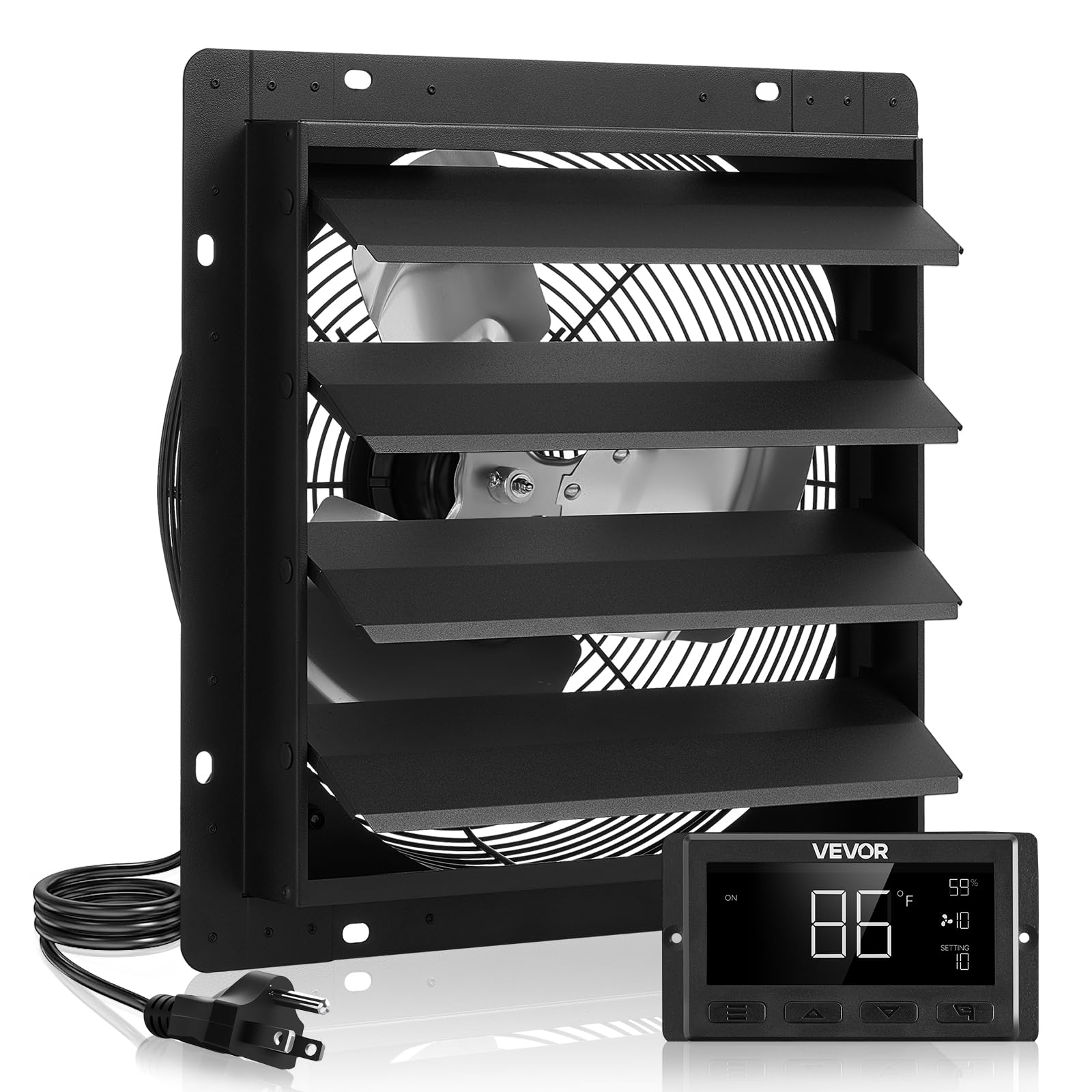
VEVOR packs an EC motor into a 14-inch shutter fan at a price that undercuts most competitors. It delivers 2,000 CFM with a variable speed controller that offers up to 10 settings, plus separate temperature and humidity triggers. The all-metal steel construction feels solid and the automatic shutters open smoothly when the fan turns on.
The intelligent controller lets you set it to auto-adjust speed based on current conditions — when attic temps hit 90°F, the fan ramps up without you touching a thing. Owners in Phoenix noted it keeps their garage at ambient outside temperature, protecting battery-powered tools from heat damage. The 1500 RPM motor runs quietly enough that it doesn’t interfere with workshop activity.
The main drawback is the control panel itself: the digital display becomes nearly invisible in direct daylight, and the manual is not particularly clear. A small number of owners reported the control module failing after a few months, which makes the warranty support a concern. Despite those caveats, the EC motor and smart features at this price make it a compelling mid-range option.
Why it’s great
- EC motor delivers variable speed and low noise
- Combined temperature and humidity automation
- All-metal build with smooth-louvre shutters
Good to know
- Display screen hard to read in sunlight
- Control module reliability has mixed reports
5. Air Vent Gable Ventilator 53315
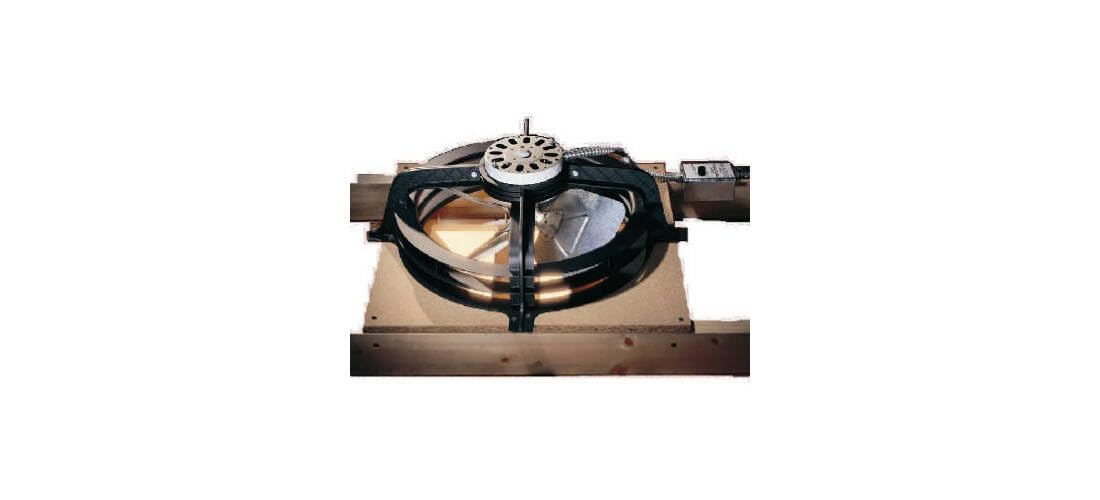
The Air Vent 53315 is the stripped-down workhorse of attic ventilation. It’s a 14-inch gable-mount fan that pushes 1,050 CFM — enough for up to 1,500 square feet — and runs on a simple thermostat switch. There’s no WiFi, no app, no variable speed; it’s a time-tested design that mounts in a standard gable vent opening and just works.
The stainless steel finish resists rust, and the plastic blade is lighter than metal, which keeps the motor load low. Owners have repurposed this fan for warehouse hot-air exhaust and garage dust ventilation by mounting it horizontally. It’s noticeably quieter than cheap shutter fans thanks to the direct-drive motor.
Quality control can be an issue: a few owners reported misaligned impellers on their first unit and had to exchange it. The plastic mounting tabs also require care to avoid cracking. For anyone who wants a simple, effective fan without smart gimmicks, it’s a reliable pick — just inspect it carefully on arrival.
Why it’s great
- Simple plug-in installation with thermostat included
- Quiet operation for a direct-drive fan
- Works on standard gable vents with no mods
Good to know
- Occasional misaligned impeller out of the box
- Plastic mounting tabs can crack if over-tightened
6. AC Infinity AIRTITAN T3

The AIRTITAN T3 is a 6-inch inline fan designed for small spaces like crawl spaces, small sheds, or even bathroom vent replacements. It moves only 120 CFM, but the precision of its control system is unmatched at this size. The WiFi app gives you dynamic temperature and humidity programming with VPD (Vapor Pressure Deficit) settings, timers, and scheduling.
The EC motor is whisper-quiet, and the 0.01-ounce weight (the fan unit itself is very light) makes it easy to mount in tight attic spaces or ducting. The IP-55 rating means it can handle humid environments without corrosion. Owners have used it to keep humidity under 60% in a 10×10 shed for six months of continuous operation, and the controller’s alarm feature alerts you if conditions go out of range.
The controller interface is notoriously tricky — new users often find the trigger logic confusing, and factory test triggers left active can cause the fan to run unexpectedly. The display backlight has also been reported to fail after extended use. For small, climate-controlled zones requiring precise thresholds, this fan is a specialized winner.
Why it’s great
- Exceptional control granularity with WiFi app
- IP-55 dust and liquid resistance rating
- Very quiet EC motor even at higher speeds
Good to know
- Controller programming is non-intuitive
- Display backlight prone to failure over time
7. Remington Solar Builder Series 40W

The Remington Solar Builder Series is a roof-mounted solar attic fan that includes a 110V AC adapter for night operation — a rare feature that solves the biggest limitation of solar fans. The 40W panel powers a brushless DC motor that runs silently, and the built-in humidistat and thermostat allow it to automate based on actual attic conditions. The 22.5-inch flashing is extra-large, which eliminates the risk of roof leaks when installed correctly.
Owner reports show it drops attic temperature from 120°F to around 90°F on 100°F days, and the hybrid AC adapter ensures it keeps ventilating even during overcast stretches. The brushless motor has no friction points, which extends its lifespan significantly. It also comes with a limited lifetime warranty on the fan unit.
Installation requires cutting a roof hole and sealing the flashing — not a beginner job. Some owners complained that the company’s warranty process is difficult, requiring the homeowner to diagnose the fan from the roof. It’s also the most expensive option on this list, though the solar savings can offset the upfront cost over time for sun-rich climates.
Why it’s great
- Hybrid AC adapter for 24/7 ventilation
- Brushless motor is nearly silent in operation
- Lifetime warranty on the fan unit
Good to know
- Requires professional roof installation
- Warranty service can be slow and complicated
8. ecoCalm Solar Fan with Battery

The ecoCalm Solar Fan is a budget-friendly entry into solar ventilation. It comes with an 8-inch fan, a 25W bifacial solar panel, and a 4400mAh rechargeable battery that can run the fan for up to 8 hours after a full charge. The bifacial panel collects energy from both sides, boosting efficiency by up to 130% compared to traditional panels. The temperature control box lets you set an activation threshold.
Owners report the battery lasts two days of continuous use in chicken coops and small greenhouses before dropping below 80%, and the fan is quiet enough not to disturb animals. The included 14.8-foot cable gives flexibility in panel placement, and the IP44-rated fan blades can handle outdoor weather. It pushes 220 CFM, which is modest but adequate for spaces up to 380 cubic feet.
The main limitation is solar dependence: on consecutive cloudy days, the battery won’t fully recharge, and the fan may run slower or stop. Some users noted the panel needs frequent repositioning to catch peak sun. For a small shed, chicken coop, or greenhouse where wiring AC power is impractical, this is a functional and affordable solution.
Why it’s great
- Bifacial solar panel boosts charging efficiency
- Battery provides overnight ventilation
- Quiet operation suitable for animal enclosures
Good to know
- Battery won’t adequately charge on cloudy days
- Fan slows significantly when running on battery alone
9. iLIVING 24″ Wall Mounted Exhaust Fan

The iLIVING 24″ is the highest-CFM unit in this roundup at 4,244 cubic feet per minute. This is a serious industrial fan designed for large workshops, metal buildings, and commercial attics. Its 1/4 HP motor spins 24-inch aluminum blades at 1050 RPM, and the automatic galvanized steel shutters seal the opening when the fan is off. The coverage area is rated at 6,200 square feet.
The fan is compatible with iLIVING’s separate speed controller (sold separately), which gives you variable speed selection. The permanently lubricated, thermally protected motor is built for long run times in hot environments.
The louvers are a known weak point: they’re a bit rattly at high speeds, and the sound is more noticeable than the fan motor itself. The fan also does not include a power cord, so you’ll need to supply your own. It’s a brute-force tool, not a refined appliance, but if you need to move a room’s worth of air in seconds, this is the fan to get.
Why it’s great
- Industry-leading 4244 CFM for large spaces
- Durable galvanized steel and aluminum construction
- Proven reliability over 1+ years of daily use
Good to know
- Louvers can rattle at full speed
- Power cord not included with purchase
FAQ
Will an attic fan help cool my whole house?
Should I choose a gable mount or a roof mount?
Can I install an attic fan myself?
What is the ideal attic temperature for running a fan?
Do I need additional intake venting for an attic fan to work?
Final Thoughts: The Verdict
For most users, the best attic ventilation fans winner is the AC Infinity AIRLIFT T14 because it delivers the perfect balance of quiet EC motor performance, WiFi app control, and all-metal shutter build for the majority of residential attics. If you want a straightforward gable mount with smart app control and fire safety, grab the Quietcool PRO-2.0. And for a large workshop that needs brute-force air movement, nothing beats the iLIVING 20″ Shutter Fan.

Mo Maruf
I created WellFizz to bridge the gap between vague wellness advice and actionable solutions. My mission is simple: to decode the research and give you practical tools you can actually use.
Beyond the data, I am a passionate traveler. I believe that stepping away from the screen to explore new environments is essential for mental clarity and physical vitality.