Our readers keep the lights on and my smoothie glass nicely filled. As an Amazon Associate, I earn from qualifying purchases.
Choosing the right athletic watch means wading through marketing fluff to find a device that accurately captures your exertion, maps your route without dropping signal, and survives the daily grind of training without needing a charge every night. The difference between a solid training partner and a frustrating gadget often comes down to a handful of core specs that many buyers overlook.
I’m Mohammad Maruf — the founder and writer behind WellFizz. My deep-dive market research analyzes the exact physical and technical specifications that separate a useful athletic watch from a disappointing one, from dual-frequency GPS chipsets to AMOLED brightness and BioTracker sensor generations.
This guide breaks down nine of the leading models on the market today to help you find the true best athletic watches for your specific training needs, budget, and lifestyle.
How To Choose The Best Athletic Watches
Before you click “add to cart,” you need to know which metrics actually matter for your chosen sport. A marathon runner has different priorities than a CrossFit athlete or a weekend hiker. The right watch balances sensor accuracy, battery endurance, display readability, and software ecosystem against your specific training volume.
GPS Accuracy and Satellite Systems
Single-band GPS is fine for open fields, but if you run city canyons, wooded trails, or near tall buildings, look for multi-band or dual-frequency GPS with SatIQ. These systems lock onto multiple satellite constellations (GPS, GLONASS, Galileo, BeiDou) simultaneously, dramatically reducing position drift. A watch that logs a 5K as 4.7 miles is worthless for pacing.
Optical Heart Rate Sensor Generation
All wrist-based optical HR sensors struggle with rapid changes during intervals or weightlifting. Newer sensor generations, like Amazfit’s BioTracker 5.0 or Garmin’s Elevate V5, use more LEDs and signal processing to reduce motion artifact. If you need beat-for-beat accuracy, consider a chest strap that pairs with the watch. The sensor generation matters most for HIIT, sprint repeats, and strength training.
Display Technology and Brightness
AMOLED screens offer vibrant colors and high contrast, but they consume more power and can wash out in direct sunlight if not bright enough. MIP (Memory In Pixel) displays are always-on, reflect ambient light for excellent outdoor readability, and sip battery. For runners who train at dawn or dusk, an AMOLED with at least 1,000 nits brightness is preferable. For all-day hiking in glare, MIP wins.
Battery Life and Charging
Manufacturer battery claims are measured under ideal lab conditions. Real-world GPS battery life is typically 30-50% lower. If you run more than an hour daily, look for at least 30 hours of GPS tracking. For triathletes and ultrarunners, 50+ hours of GPS is a baseline. Fast charging (15 minutes for 8 hours of smartwatch use) is a game-changer for daily wear.
Ecosystem and App Integration
A great watch is useless if its app doesn’t sync with your preferred platforms (Strava, TrainingPeaks, Apple Health, Google Fit). Garmin and COROS offer native training plans and deep analytics. Fitbit and Apple Watch integrate tightly with their respective health ecosystems. The Zepp app from Amazfit is free of subscription fees and offers robust data export. Check compatibility before committing.
Quick Comparison
On smaller screens, swipe sideways to see the full table.
| Model | Category | Best For | Key Spec | Amazon |
|---|---|---|---|---|
| Garmin Forerunner 970 | Premium Triathlon | Serious runners & triathletes | 26 hrs GPS, AMOLED, multi-band | Amazon |
| Garmin Instinct 3 Solar | Rugged Outdoor | Adventure & tactical users | Unlimited solar battery, MIP | Amazon |
| COROS PACE Pro | Premium Running | Distance runners & coaches | 38 hrs GPS, AMOLED, offline maps | Amazon |
| Apple Watch Series 11 | Premium Lifestyle | iPhone users wanting health data | ECG, sleep apnea, 24-hr battery | Amazon |
| COROS PACE 3 | Mid-Range Running | Budget-conscious runners | 38 hrs GPS, dual-frequency, 30g | Amazon |
| Amazfit Active Max | Mid-Range All-Rounder | All-day wear & gym users | 25-day battery, 3000-nit display | Amazon |
| Fitbit Versa 4 | Mid-Range Lifestyle | Daily readiness & sleep tracking | 6-day battery, GPS, 40+ modes | Amazon |
| Amazfit Active 2 Premium | Entry-Level Premium | Value seekers wanting style | 10-day battery, sapphire glass | Amazon |
| Fitbit Charge 6 | Budget Fitness Tracker | Heart rate & gym equipment | 7-day battery, ECG, built-in GPS | Amazon |
In‑Depth Reviews
1. Garmin Forerunner 970

The Forerunner 970 is Garmin’s statement piece for endurance athletes, packing a bright AMOLED touchscreen with a lightweight titanium bezel and sapphire lens for scratch resistance. Its multi-band GPS with SatIQ delivers rapid satellite lock even in dense urban environments, and the built-in LED flashlight is genuinely useful for pre-dawn or post-sunset runs. Battery life reaches 15 days in smartwatch mode and 26 hours in full GPS mode, which covers most marathon training blocks without mid-week charging.
Running-specific metrics go deep: running economy, step speed loss, ground contact time, and wrist-based running power are all available without an additional pod. The training readiness score combines HRV status, sleep quality, and recovery to tell you when to push and when to rest. The triathlon mode auto-detects transitions, making it a seamless race-day tool. Garmin Coach adaptive plans adjust based on your performance rather than following a rigid schedule.
The trade-off is learning curve. Navigating the menus and customizing data fields takes time, and the device is expensive. For runners who want professional-grade data and are willing to invest in the ecosystem, this is the gold standard. The ECG app and wrist-based running dynamics add medical-grade heart rhythm monitoring for those 22 and older.
Why it’s great
- Bright AMOLED with sapphire lens is extremely durable
- Deep training metrics: running economy, step speed loss, HRV status
- Built-in LED flashlight for low-light visibility
- Triathlon auto-transition mode works reliably in races
Good to know
- Steep learning curve and dense menu structure
- Premium price point limits accessibility
- Running dynamics require optional HRM-Pro chest strap for full data
2. Garmin Instinct 3 Solar

The Instinct 3 Solar is built for those who treat their watch like a tool, not a jewel. It uses a solar-charging lens over a 0.9-inch MIP display that remains crisp in direct sunlight without draining power. The fiber-reinforced polymer case and metal-reinforced bezel meet MIL-STD-810 for thermal and shock resistance, and the 10 ATM water rating means you can take it swimming, snorkeling, or whitewater rafting without concern.
Battery performance is the headline feature: with sufficient daily sun exposure (3 hours in 50,000 lux conditions), the battery can theoretically last indefinitely in smartwatch mode. The built-in LED flashlight offers variable intensities and strobe modes, a practical safety feature that many users rely on more than expected. Multi-band GPS with SatIQ ensures accurate tracking even under dense forest canopy or in urban canyons, while the 3-axis compass and barometric altimeter support confident navigation.
It intentionally omits music storage, color maps, and a touchscreen to maximize durability and battery life. The monochrome MIP display is utilitarian but incredibly readable. The Garmin Connect app handles all data syncing, and Connect IQ lets you add basic apps and watch faces. This is not a lifestyle smartwatch—it is a field instrument for athletes who spend days away from a charger.
Why it’s great
- Solar charging delivers unlimited battery in bright conditions
- MIL-STD-810 and 10 ATM water rating for extreme durability
- Multi-band GPS with SatIQ locks fast in difficult terrain
- Physical buttons work with wet hands or gloves
Good to know
- Monochrome MIP display lacks maps and color contrast
- No onboard music storage or touchscreen
- Requires Garmin Connect app running in background for phone sync
3. COROS PACE Pro

The COROS PACE Pro combines a vibrant 1.3-inch AMOLED display with 1,500 nits of brightness, making it one of the most legible screens in direct sunlight among running watches. Its processor is the fastest in COROS’s lineup, delivering 2x the performance and 3x the zoom speed of the PACE 3. The operating system is snappy, and the digital crown provides intuitive menu navigation without fumbling touchscreen taps during a run.
Battery life is benchmark-setting: 38 hours of continuous GPS tracking with a single charge, or 20 days in daily smartwatch mode. When using the always-on display, expect about six days. The new USB-C charging adapter is a welcome shift away from proprietary cables, and the keychain adapter means you can share a single cable across all your devices. Offline topographical maps with turn-by-turn navigation are free, with no paywalls for map downloads.
Accuracy is strong across the board. The GPS tracks within about 10 feet per mile, and the heart rate sensor handles steady-state runs well, though it still lags behind chest straps during intervals. The COROS app offers deep training analytics, including Training Status, load tracking, and custom workouts. Watch faces are limited compared to Garmin or Apple, and the nylon band on some models can feel stiff initially.
Why it’s great
- 1,500-nit AMOLED is excellent in all light conditions
- 38-hour GPS battery is class-leading for AMOLED watches
- Free offline maps with no subscription required
- USB-C charging is universal and convenient
Good to know
- Watch face and app customization is limited versus Garmin
- Optical HR sensor accuracy drops during high-intensity intervals
- Initial band can feel stiff before break-in
4. Apple Watch Series 11
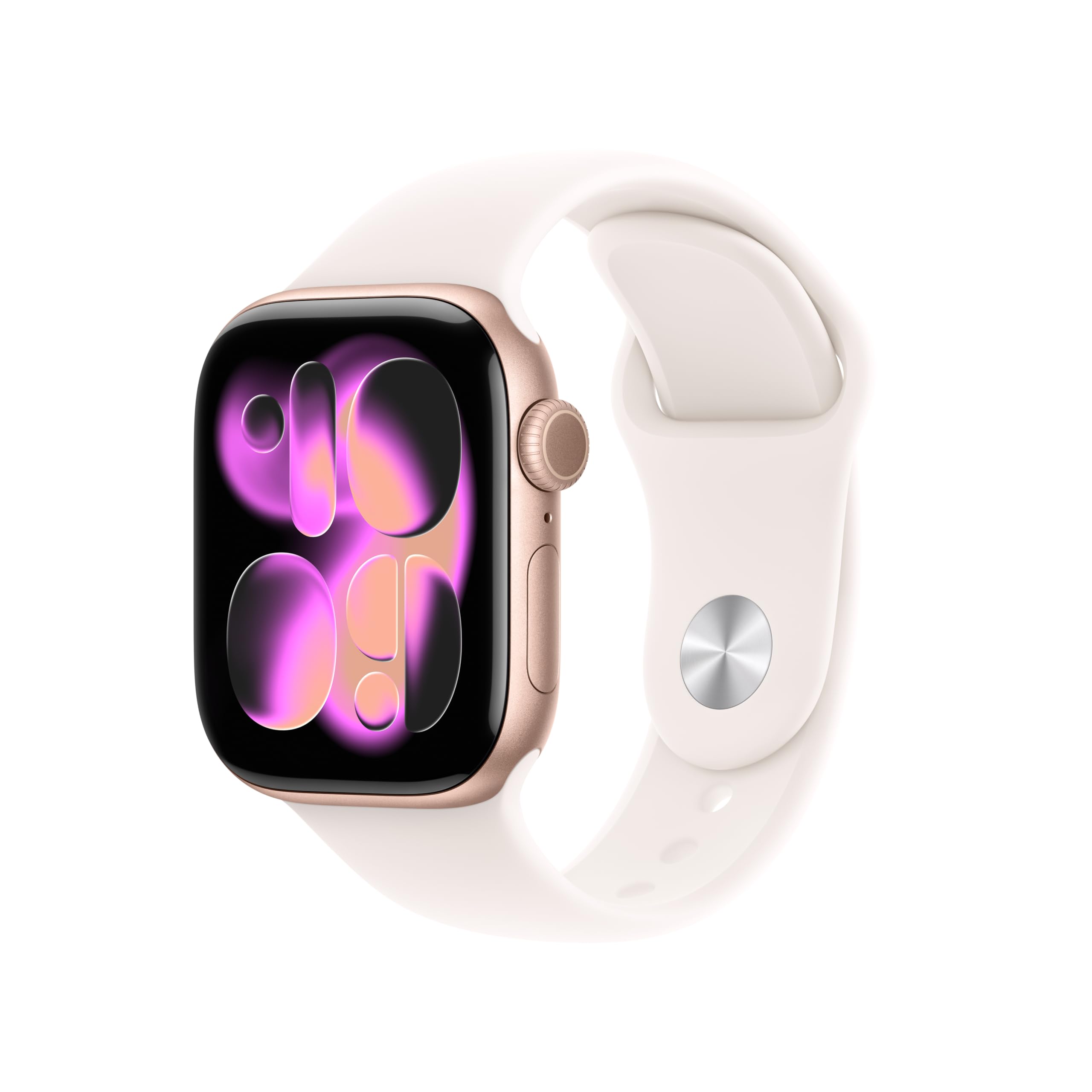
The Apple Watch Series 11 is not the most specialized athletic watch, but it is the most capable smartwatch for health monitoring. The ECG app is FDA-cleared for detecting atrial fibrillation, and the new hypertension notification feature analyzes blood vessel response to detect potential chronic high blood pressure. The Vitals app consolidates overnight health metrics, and sleep apnea notifications add a medically relevant layer of insight.
Fitness tracking has matured well. The Pacer feature, heart rate zones, and training load metrics now rival dedicated running watches for casual to semi-serious athletes. The always-on Retina display is bright enough for outdoor workouts, and the 42mm case is thin and lightweight for comfortable 24/7 wear. Fast charging delivers 8 hours of normal use from just 15 minutes on the charger, mitigating the 24-hour battery life limitation that still trails most dedicated sports watches.
The catch is ecosystem lock-in. The Watch requires an iPhone for setup and most functionality. Battery life is still a daily-charge proposition for heavy users, especially when using GPS for extended workouts. The glass display is more scratch-resistant than Series 10 but remains more fragile than the sapphire found on Garmin or Amazfit premium models. For iPhone users who prioritize health monitoring over raw athletic metrics, this is the most refined option.
Why it’s great
- ECG, hypertension, and sleep apnea notifications provide medical-grade insights
- Fast charging: 15 minutes delivers 8 hours of use
- Always-on Retina display is bright and responsive
- Seamless integration with iPhone and Apple Health ecosystem
Good to know
- Requires iPhone; not compatible with Android
- 24-hour battery life forces daily charging
- Glass display more scratch-prone than sapphire alternatives
5. COROS PACE 3

The COROS PACE 3 redefines what a budget running watch can deliver. Weighing just 30 grams with the nylon band, it is nearly unnoticeable on the wrist during a long run or overnight sleep tracking. The 1.2-inch always-on transflective touchscreen is readable in direct glare without cranking up a backlight, preserving battery for when you need it. Dual-frequency GPS with a redesigned satellite chipset provides accurate tracking even in high-rise cities where single-band watches drift.
Battery life is exceptional for its size: 38 hours of continuous GPS tracking and 17 days of daily use on a single charge. The charging cable is proprietary but compact, and the watch charges quickly. The COROS app provides detailed sleep analysis, HRV status, and training load management without any subscription fees. Route planning with breadcrumb navigation helps you stay on course during trail runs without requiring a premium data plan.
It smartwatch features are barebones. There is no music storage, no contactless payments, and no color maps. The screen is transflective, not vibrant AMOLED. For runners who want distraction-free training with accurate GPS and long battery life at a reasonable price, the PACE 3 is the clear winner. It pairs well with chest strap HRMs for interval work, but the wrist sensor is adequate for steady-state efforts.
Why it’s great
- Ultra-light 30g design is comfortable for 24/7 wear
- Dual-frequency GPS locks quickly and tracks accurately in cities
- 38-hour GPS battery outlasts many watches twice the price
- Free app with no subscription for analytics and route planning
Good to know
- No music storage, color maps, or contactless payments
- Transflective display is less vibrant than AMOLED
- Small band can be difficult to fasten; third-party straps help
6. Amazfit Active Max

The Amazfit Active Max goes beyond typical mid-range watches with a 1.5-inch AMOLED display that reaches 3,000 nits peak brightness, making it one of the most outdoor-readable screens available regardless of price. The bezels are slim, and the interface feels fluid. Onboard storage of 4GB allows you to load music and offline maps with turn-by-turn directions, a feature usually reserved for watches costing twice as much.
Battery life is the other standout: up to 25 days with typical use, or roughly 10 days with heavy GPS activity. The BioCharge energy monitoring system adjusts your readiness score based on daily workouts and stress, helping you periodize training without overthinking it. Zepp Coach provides AI-driven training plans for 3K, 5K, 10K, half, and full marathons that adapt to your performance and recovery. Five satellite positioning systems ensure fast GPS lock, and the 5 ATM water resistance handles pool swimming easily.
The Zepp app is free with no subscription, and it syncs well with Google Fit and Apple Health. However, it lacks deep integration with third-party platforms like TrainingPeaks or Strava’s full feature set. The optical heart rate sensor is accurate during steady-state cardio but can lag during rapid interval changes. Sleep tracking is decent but not as granular as COROS or Garmin offerings in this price tier.
Why it’s great
- 3,000-nit AMOLED is exceptionally bright outdoors
- 4GB storage for music and offline maps
- 25-day battery with typical use, good GPS endurance
- Free Zepp Coach AI plans for race distances
Good to know
- Optical HR sensor less accurate during HIIT intervals
- Third-party app integration is limited
- Sleep stage tracking is less detailed than premium competitors
7. Fitbit Versa 4

The Fitbit Versa 4 positions itself as a coach on your wrist rather than a raw data stream. The Daily Readiness Score combines sleep quality, HRV, and recent activity to recommend workout intensity, while the Stress Management Score uses heart rate variability and skin temperature to flag mental strain. The interface is clean and approachable, making it ideal for users who want guided training without learning a complex menu.
GPS is built-in, but accuracy is a weak point compared to Garmin and COROS. Multiple users report drift issues, especially in the first mile of a run. On-wrist Bluetooth calling, Google Wallet, and Google Maps provide smartwatch convenience, and battery life of 4 to 6 days reduces charging frequency compared to an Apple Watch. The included 3-month Google Health Premium membership unlocks deeper analytics and guided programs before you decide on a subscription.
The aluminum case is lightweight, but the silicone band is basic and some users replace it for long-term comfort. Sleep tracking is Fitbit’s strong suit, with detailed sleep stages and a Sleep Score that correlates well with subjective rest quality. For users focused on overall wellness rather than competitive training, the Versa 4 is a polished partner. For serious runners, the GPS inconsistency and shorter battery are harder to overlook.
Why it’s great
- Daily Readiness Score simplifies training decisions
- Comfortable and lightweight aluminum design
- Solid sleep stage tracking with Sleep Score
- Google Wallet and Maps add everyday utility
Good to know
- GPS accuracy can drift significantly on runs
- Battery life of 4-6 days is average for this category
- Premium membership required for advanced analytics after trial
8. Amazfit Active 2 Premium

The Amazfit Active 2 Premium punches far above its price bracket with sapphire glass, a leather strap, and a spare silicone band in the box. The 1.32-inch AMOLED display is bright and sharp, and the stainless steel case gives it a classic aesthetic that transitions from the gym to dinner without looking out of place. The BioTracker optical sensor provides heart rate and SpO2 tracking that reviewers report as more accurate than previous Amazfit generations.
Battery life hits 10 days with typical use, and GPS tracking with five satellite positioning systems delivers reliable route logging for runs, hikes, and cycling. Over 160 sport modes cover HYROX, padel, strength training, and yoga, with 50-meter water resistance for swimming. Zepp Flow voice control lets you reply to messages hands-free, and speech-to-text works on Android. Free downloadable maps with turn-by-turn guidance are included with no subscription.
The Zepp app still has room to grow in terms of training analytics depth compared to Garmin Connect or COROS. Sleep tracking, in particular, can feel less accurate than dedicated sleep trackers. The leather strap is attractive but picks up moisture during workouts, making the included silicone band the better choice for sweaty sessions. For buyers seeking an affordable smartwatch that feels premium and offers solid fitness tracking, the Active 2 Premium is a compelling option.
Why it’s great
- Sapphire glass and stainless steel case for durability and style
- 10-day battery with typical use
- Includes both leather and silicone straps
- Free downloadable maps with turn-by-turn directions
Good to know
- Zepp app analytics are less advanced than Garmin/COROS
- Sleep tracking can be inconsistent
- Leather strap unsuitable for high-sweat workouts
9. Fitbit Charge 6

The Fitbit Charge 6 is a fitness tracker first and a smartwatch second. Its slim, band-like form factor is less obtrusive than a full smartwatch, and the stainless steel case adds durability. The 1.04-inch AMOLED is small but sharp. ECG functionality on a device at this price is rare, and the ability to broadcast heart rate to compatible gym equipment (treadmills, ellipticals) is a genuine advantage for maintaining accurate zone tracking during indoor sessions.
Google integration adds YouTube Music controls, Google Maps directions, and Google Wallet payments. The included 3-month Google Health Premium trial gives access to personalized coaching and advanced analytics. Battery life of 7 days is competitive for a device with an always-on AMOLED display, though GPS usage cuts that significantly. The built-in GPS means you can leave your phone at home for runs, though accuracy is adequate for distance estimation rather than race-precise splits.
Customer feedback is mixed on sensor accuracy. Some users report that distance and calorie tracking can be off by significant margins, especially on elliptical machines. The app integration with iPhone Health is limited, and the touch-sensitive side button can be finicky during sweaty workouts. For the price, the Charge 6 offers exceptional value for basic fitness tracking, but serious athletes may outgrow its capabilities quickly. It is best suited for daily wellness monitoring rather than structured training.
Why it’s great
- ECG and real-time HR broadcast to gym equipment
- 7-day battery life with typical use
- Built-in GPS for phone-free outdoor runs
- Compact, comfortable band design
Good to know
- GPS and calorie accuracy can be inconsistent
- Small display limits on-wrist training data visibility
- Touch button can be unresponsive during sweaty workouts
FAQ
Can I use an athletic watch for swimming?
How accurate are wrist-based heart rate monitors during weightlifting?
Do I need a subscription for advanced training features?
What is the benefit of offline maps on a running watch?
How often should I replace the band on my athletic watch?
Final Thoughts: The Verdict
For most users, the best athletic watches winner is the Garmin Forerunner 970 because it combines professional-grade running dynamics, durable sapphire construction, and long battery life without sacrificing smartwatch features. If you want an AMOLED display with offline maps and a better price-to-performance ratio, grab the COROS PACE Pro. And for rugged outdoor durability with effectively unlimited battery, nothing beats the Garmin Instinct 3 Solar.

Mo Maruf
I created WellFizz to bridge the gap between vague wellness advice and actionable solutions. My mission is simple: to decode the research and give you practical tools you can actually use.
Beyond the data, I am a passionate traveler. I believe that stepping away from the screen to explore new environments is essential for mental clarity and physical vitality.