Our readers keep the lights on and my smoothie glass nicely filled. As an Amazon Associate, I earn from qualifying purchases.
That sharp, shooting pain in your heel after a long run or the nagging ache in your arch halfway through a basketball game isn’t something you just have to live with. The wrong insole—or no insole at all—forces your feet to absorb every impact from the ground up, transferring shock to your knees, hips, and lower back. Athletic insoles are the single most effective piece of gear you can swap to change that equation entirely.
I’m Mohammad Maruf — the founder and writer behind WellFizz. For years I’ve analyzed the materials science, biomechanics, and real-world durability data behind shoe inserts to separate the marketing fluff from what actually stabilizes your foot during high-impact movement.
After evaluating arch rigidity, heel cup depth, gel placement, and pressure distribution across five distinct models, I’ve locked in the one list that covers every scenario. This is the definitive guide to finding your best athletic insoles for whatever sport or lifestyle you throw at them.
How To Choose The Best Athletic Insoles
Selecting the right athletic insole is a matter of matching foot mechanics to activity demands. Here are the three critical factors that determine whether an insert will help or hinder your performance.
Arch Type & Support Level
The single biggest variable in insole performance is your arch profile. Flat feet need a rigid medial post to prevent overpronation, while high arches require deeper heel-cup encapsulation and forefoot cushioning to absorb shock. Neutral arches can use a medium-contour insole that supports without pushing. Check your wet footprint or ask a running-shoe specialist before buying anything — an insole that overcorrects your arch will cause joint pain faster than no insole at all.
Material Stack & Shock Absorption
Athletic insoles are built on a material sandwich. The bottom layer is typically a rigid base (TPU, nylon, or carbon fiber) that locks the arch shape. The mid-layer uses EVA, PU, or PORON foam to soak up vertical impact. The top layer — often a gel pad in the heel or forefoot — disperses shear forces during lateral cuts. For high-impact sports like basketball or trail running, look for a dual-density stack with a visible gel insert. For gym lifting or walking, a single-density foam works fine.
Heel Cup Depth & Stability
A deep U-shaped heel cup cradles your calcaneus and prevents the insole from sliding inside the shoe during lateral movement. Shallow cups are fine for low-impact walking. For sports that involve cutting, jumping, or sprinting, the heel cup should be at least 10–12 mm deep with a rigid counter. This feature alone determines whether you feel stable planting and pivoting or loose and unsteady.
Quick Comparison
On smaller screens, swipe sideways to see the full table.
| Model | Category | Best For | Key Spec | Amazon |
|---|---|---|---|---|
| Move Game Day | Premium | High-Impact Sports | Composite Heel + Reactive Stability | Amazon |
| CRUVHEAL Sport | Mid-Range | Running & Gym Training | Gel Heel Pad + Deep Cup | Amazon |
| Sof Sole Athlete Performance | Mid-Range | Daily Training & Walking | Full-Length Gel Forefoot | Amazon |
| Cloudflo Plantar Fasciitis | Entry-Level | Standing All Day | Rigid TPU Arch + Ortholite | Amazon |
| Professional Heavy Duty Support | Entry-Level | Work Boots & Heavy Loads | Dual PORON Cushioning | Amazon |
In‑Depth Reviews
1. Move Game Day Performance Insoles

Move Game Day is the only insole on this list co-founded by an NBA All-Pro, and the engineering reflects that pedigree. The composite heel unit is stiff enough to eliminate heel-slip during lateral cuts yet compliant enough to absorb the repetitive pounding of a 5K run. Multiple customers reported that chronic shin splints and knee pain disappeared within days after swapping to these. That’s the direct result of the reactive stability layer, which uses a carbon-fiber-like frame to prevent the arch from collapsing under load.
The arch support replicates the profile of custom orthotics without the price tag. Testers with flat feet and plantar fasciitis both found relief because the medial post is aggressive enough to control overpronation but contoured to avoid hot spots. The forefoot is molded rather than flat, which locks the insole in place inside tight basketball or running shoes.
One trade-off: the rigid construction adds noticeable weight to your footwear. Some users recommend going up half a shoe size if you plan to use these in snug performance sneakers. But for court sports, field sports, or pavement pounding, the protection from impact-related injuries makes the small weight penalty irrelevant.
Why it’s great
- Eliminates shin splints and knee pain for most users
- Carbon-fiber-grade arch replicates custom orthotics
- Molded forefoot prevents slipping during aggressive cuts
Good to know
- Heavier than standard foam insoles
- May require sizing up half a size in tight shoes
2. CRUVHEAL Sport Shock Absorbing Insoles

CRUVHEAL placed its gel pads exactly where high-impact athletes need them most: the heel and the metatarsal head. This strategic placement reduces the peak ground-reaction force that leads to shin splints and tendonitis. A deep, non-slip heel cup keeps the insert stable inside your shoe even during 90-degree cuts on a basketball court or quick direction changes on a soccer field.
The foam base strikes a middle ground that reviewers consistently call “just right” — not marshmallow-soft (which robs energy return) and not concrete-firm (which transmits shock). The insoles come with a specific adaptation guideline: start with 2–5 hours per day for the first week to let your feet adjust to the orthotic profile. Users who followed this reported zero break-in discomfort.
The only real concern is bulk. The stack height is higher than standard insoles, which can feel cramped inside low-volume shoes like Hokas or minimal trainers. But in standard sneakers, basketball shoes, or running trainers, this becomes a durable, springy foundation that outlasts the shoes themselves.
Why it’s great
- Gel pads target high-impact zones for heel and forefoot
- Deep heel cup eliminates slipping during lateral movement
- Comfortable out of box with minimal break-in
Good to know
- May feel bulky in low-profile shoes
- Heavier than stock foam insoles
3. Sof Sole Insoles Women’s Athlete Performance

Sof Sole has been making this exact Athlete Performance insole for more than two decades, and the design hasn’t needed radical changes because it got the fundamentals right early. A full-length gel layer runs from the heel through the forefoot, providing uniform shock absorption during long-distance runs or daily training. Runners who replaced both their Hoka and Brooks stock insoles with these reported immediate relief from ankle and joint fatigue.
The trim-to-fit system is straightforward: follow the printed size guides on the insole for your shoe size and cut with scissors. Unlike some rigid orthotics that crack or splinter during trimming, the gel-foam composite cuts cleanly. The fit is forgiving enough that one reviewer, who cut hers too narrow for cowboy boots, still found them comfortable on the uncut factory line.
The downside is that the arch support is moderate rather than aggressive. If you have severe flat feet or diagnosed plantar fasciitis, you may need a more structured orthotic like the Move Game Day. But for general-purpose athletic wear — gym sessions, walking, casual running — this is the most reliable drop-in upgrade to any sneaker.
Why it’s great
- Full-length gel layer reduces foot and ankle joint fatigue
- Easy trim-to-fit system cuts cleanly without cracking
- Proven 20-year track record across multiple shoe brands
Good to know
- Arch support is medium — not ideal for severe flat feet
- Gel layer may compress over time with heavy use
4. Cloudflo Plantar Fasciitis Insoles
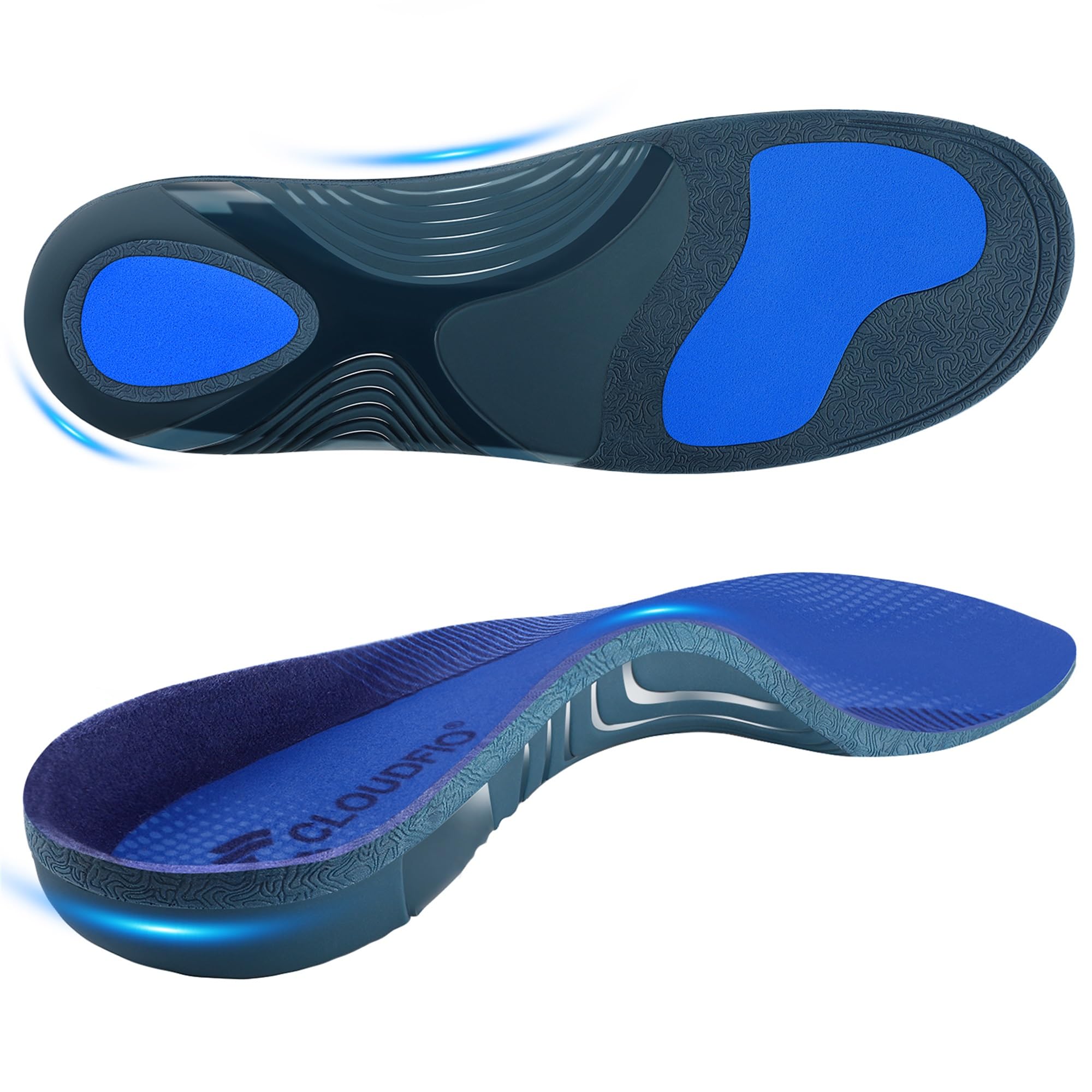
Cloudflo uses a hard, rigid TPU arch that resists deformation even under loads exceeding 220 pounds. This is the critical spec for anyone whose job keeps them on concrete floors for 10+ hour shifts—nurses, teachers, retail associates, and warehouse workers. The TPU frame locks the foot into a neutral alignment, preventing the arch from collapsing as fatigue sets in. The Ortholite top layer adds moisture-wicking breathability that keeps feet dry even during sweaty shifts.
Reviewers with plantar fasciitis reported that the pain relief was immediate — no lengthy break-in period. The insole fits sneakers and work boots without slipping, and the velour surface doesn’t trap odor the way cheaper foam insoles do. The deep PU heel pad absorbs the repetitive heel-strike of walking on hard flooring all day.
The rigid construction is the trade-off. If you need a highly flexible insole for running or plyometric training, this one will feel too stiff. It is purpose-built for standing and walking, not for sprinting or jumping. But for its target use case — all-day stationary support — it outperforms many insoles costing twice as much.
Why it’s great
- Rigid TPU arch handles 220+ pounds without deformation
- Immediate plantar fasciitis relief with zero break-in
- Odor-resistant velour and Ortholite moisture management
Good to know
- Too stiff for running or high-impact sports
- Not ideal for shoes with limited vertical volume
5. Professional Heavy Duty Support Pain Relief Orthotics

This insole uses dual layers of PORON — a high-rebound polyurethane foam that retains 95% of its thickness after millions of compressions. Unlike standard EVA, PORON doesn’t bottom out over months of use. The “Golden Triangle” design distributes support across three points: the forefoot, the arch, and the heel. That three-point contact reduces the walking stress that accumulates during long shifts on hard floors.
The deep U-shaped heel cup provides enough stability for 9-10 hour work shifts, and testers confirmed that the medium arch support worked effectively for flat feet and plantar fasciitis without feeling overly aggressive. The full PU layer on the footbed is sweat-proof and breathable, which matters when wearing these in non-breathable work boots. Customers reported noticeable pain relief within a single day of use — something that usually requires a premium insole to achieve.
The thickness is the main drawback. In low-backed shoes like dress sneakers or loafers, the added height may require loosening the laces or sizing up. This is clearly a work-boot or gym-shoe insole, not a casual-insert option. But for anyone carrying extra load — literally or figuratively — the durability and immediate support justify the trade-off.
Why it’s great
- Dual PORON foam retains shape far longer than EVA
- Golden Triangle design reduces walking stress on three pressure points
- Noticeable pain relief within one day for many users
Good to know
- Thick profile may not fit low-volume casual shoes
- Medium arch may not be enough for severe overpronators
FAQ
How do I know if I need low, medium, or high arch support?
Can I use the same insoles for running and basketball?
How long does it take to break in new athletic insoles?
Final Thoughts: The Verdict
For most users, the best athletic insoles winner is the Move Game Day Performance Insoles because it combines pro-level arch support with reactive stability that eliminates shin splints and knee pain in high-impact sports. If you want targeted gel cushioning for running or training without breaking the bank, grab the CRUVHEAL Sport. And for heavy-duty all-day standing on concrete floors, nothing beats the durability of the Professional Heavy Duty Support Orthotics.

Mo Maruf
I created WellFizz to bridge the gap between vague wellness advice and actionable solutions. My mission is simple: to decode the research and give you practical tools you can actually use.
Beyond the data, I am a passionate traveler. I believe that stepping away from the screen to explore new environments is essential for mental clarity and physical vitality.